

The DOI matches its Crossref record; 55 of the 55 references it cites were found in a registry or an index.
Effects of prenatal exposure to diesel exhaust particles on postnatal development, behavior, genotoxicity and inflammation in mice
Open accessAbstract
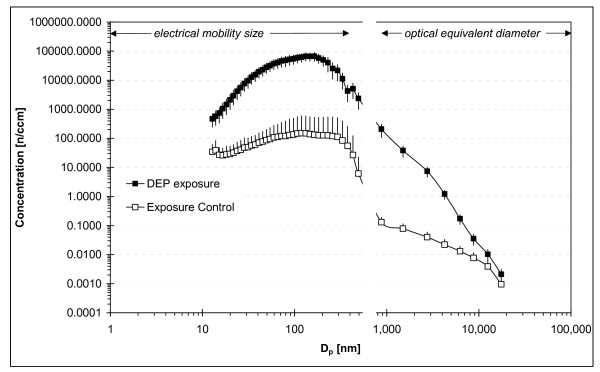
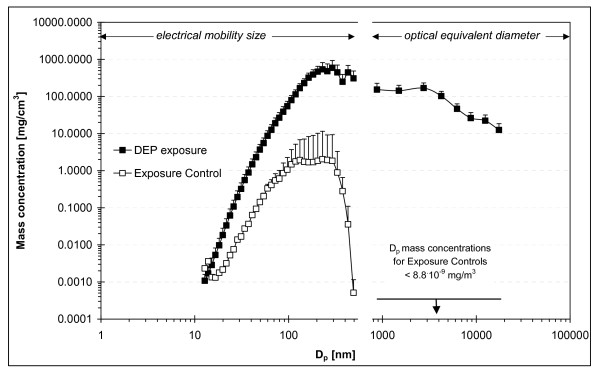
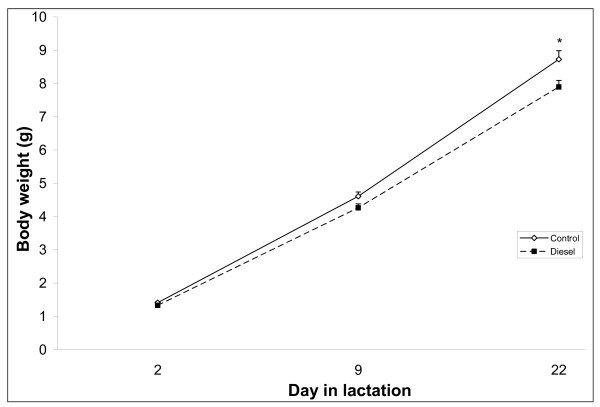
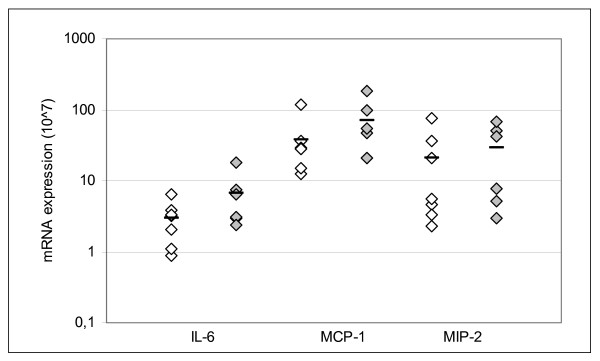
BACKGROUND: Results from epidemiological studies indicate that particulate air pollution constitutes a hazard for human health. Recent studies suggest that diesel exhaust possesses endocrine activity and therefore may affect reproductive outcome. This study in mice aimed to investigate whether exposure to diesel exhaust particles (DEP; NIST 2975) would affect gestation, postnatal development, activity, learning and memory, and biomarkers of transplacental toxicity. Pregnant mice (C57BL/6; BomTac) were exposed to 19 mg/m3 DEP (~1.106 particles/cm3; mass median diameter congruent with 240 nm) on gestational days 9-19, for 1 h/day. RESULTS: Gestational parameters were similar in control and diesel groups. Shortly after birth, body weights of DEP offspring were slightly lower than in controls. This difference increased during lactation, so by weaning the DEP exposed offspring weighed significantly less than the control progeny. Only slight effects of exposure were observed on cognitive function in female DEP offspring and on biomarkers of exposure to particles or genotoxic substances. CONCLUSION: In utero exposure to DEP decreased weight gain during lactation. Cognitive function and levels of biomarkers of exposure to particles or to genotoxic substances were generally similar in exposed and control offspring. The particle size and chemical composition of the DEP and differences in exposure methods (fresh, whole exhaust versus aged, resuspended DEP) may play a significant role on the biological effects observed in this compared to other studies.
Overview
The claims and statistics of this paper haven’t been checked yet.
Run the check — free, no account needed. It reads the open-access text and checks the sources it cites.
Integrity signals
Registry
Cites
Statistics
Figures
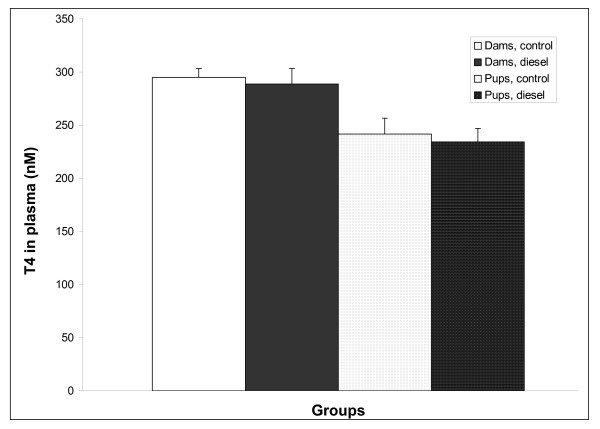
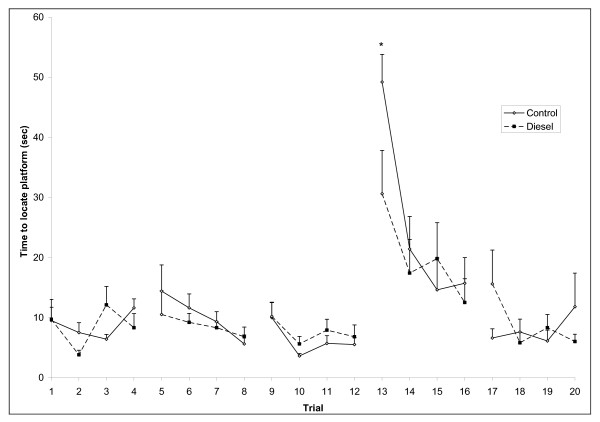
Verification
Claims the paper makes
The claims and statistics of this paper haven’t been checked yet.
Run the check — free, no account needed. It reads the open-access text and checks the sources it cites.
Claims other papers make about this one
Each is checked against this paper’s own text: does it say what the citing paper says it does?
The source backs part of the claim, not all of it — or backs it for a different population, condition or comparison.
In the citing paper
“Other studies have confirmed early reductions in offspring birth weight following prenatal diesel exhaust particle exposure, which were sustained throughout lactation [81].”
From Air pollution and children’s health—a review of adverse effects associated with prenatal exposure from fine to ultrafine particulate matter (2021) · cites this paper as [81]
Experimental — accuracy not yet measured
Self-check
Percentages, sums and reported differences re-computed from the paper’s own numbers.
The self-check needs the paper’s full text.
Citations
Cites
Lung cancer, cardiopulmonary mortality, and long-term exposure to fine particulate air pollution
Pope III, C. A. (2002) · JAMA · doi:10.1001/jama.287.9.1132 · Cited by 8,447
Nanotoxicology: An Emerging Discipline Evolving from Studies of Ultrafine Particles
Oberdörster, G., Oberdörster, E., & Oberdörster, J. (2005) · Environmental Health Perspectives · doi:10.1289/ehp.7339 · Cited by 7,891
Kittelson, D. B. (1998) · Journal of Aerosol Science · doi:10.1016/s0021-8502(97)10037-4 · Cited by 2,289
In utero programming of chronic disease
BARKER, D. J. P. (1998) · Clinical Science · doi:10.1042/cs0950115 · Cited by 1,765
Ambient Air Pollution and Pregnancy Outcomes: A Review of the Literature
Šrám, R. J., Binková, B., Dejmek, J., & Bobák, M. (2005) · Environmental Health Perspectives · doi:10.1289/ehp.6362 · Cited by 685
The comet assay: what can it really tell us?
Collins, A. R., Dobson, V. L., Dušinská, M., Kennedy, G., & Štětina, R. (1997) · Mutation research. Fundamental and molecular mechanisms of mutagenesis · doi:10.1016/s0027-5107(97)00013-4 · Cited by 667
Inhaled particles and lung cancer. Part A: Mechanisms
Knaapen, A. M., Borm, P. J. A., Albrecht, C., & Schins, R. P. F. (2004) · International Journal of Cancer · doi:10.1002/ijc.11708 · Cited by 606
Lessons learned from perinatal exposure to diethylstilbestrol
Newbold, R. R. (2004) · Toxicology and Applied Pharmacology · doi:10.1016/j.taap.2003.11.033 · Cited by 301
Goldey, E. S., Kehn, L. S., Lau, C. S., Rehnberg, G. L., & Crofton, K. M. (1995) · Toxicology and Applied Pharmacology · doi:10.1006/taap.1995.1210 · Cited by 289
Raabe, O. G., AL-BAYATI, M. A., Teague, S. V., & RASOLT, A. (1988) · Elsevier eBooks · doi:10.1016/b978-0-08-034185-9.50011-5 · Cited by 277
Cited by
Sorted by citations
Traffic-Related Air Pollution, Particulate Matter, and Autism
Volk, H. E., Lurmann, F., Penfold, B., Hertz-Picciotto, I., & McConnell, R. (2013) · JAMA Psychiatry · doi:10.1001/jamapsychiatry.2013.266 · Cited by 638
Costa, L. G., Cole, T. B., Dao, K., Chang, Y. C., Coburn, J. L., & Garrick, J. M. (2020) · Pharmacology & Therapeutics · doi:10.1016/j.pharmthera.2020.107523 · Cited by 511
Neurotoxicity of traffic-related air pollution
Costa, L. G., Cole, T. B., Coburn, J. L., Chang, Y., Dao, K., & Roqué, P. J. (2015) · NeuroToxicology · doi:10.1016/j.neuro.2015.11.008 · Cited by 416
Residential Proximity to Freeways and Autism in the CHARGE Study
Volk, H. E., Hertz-Picciotto, I., Delwiche, L., Lurmann, F., & McConnell, R. (2011) · Environmental Health Perspectives · doi:10.1289/ehp.1002835 · Cited by 347
Johnson, N. M., Hoffmann, A. R., Behlen, J. C., Lau, C., Pendleton, D., Harvey, N., Shore, R., Li, Y., Chen, J., Tian, Y., et al. (2021) · Environmental Health and Preventive Medicine · doi:10.1186/s12199-021-00995-5 · Cited by 339
Metadata
- Authors
- Hougaard, K. S., Jensen, K. A., Nordly, P., Taxvig, C., Vogel, U., Saber, A. T., & Wallin, H.
- Affiliations
- National Research Centre for the Working Environment (DK)
- University of Copenhagen (DK)
- Technical University of Denmark (DK)
- Venue
- Particle and Fibre Toxicology
- Published
- 2008
- Volume
- 5
- Issue
- 1
- Pages
- 3
- ISSN
- 1743-8977 (ISSN-L)
- PMC
- PMC2323399
- OpenAlex
- W2102523805
- Cited by
- 132
- References
- 54
- Citations by year
- 2026: 1 · 2025: 4 · 2024: 5 · 2023: 4 · 2022: 8 · 2021: 5 · 2020: 7 · 2019: 13 · 2018: 10 · 2017: 11 · 2016: 5 · 2015: 11 · 2014: 6 · 2013: 10 · 2012: 7
- FWCI
- 5.76
- Type
- journal article
- Language
- en
- Open access
- gold
- doi.org
- Licence
- cc-by
- Locations
- Particle and Fibre Toxicology (publishedVersion, cc-by)
- PubMed Central (publishedVersion, cc-by)
- PubMed (publishedVersion)
- DOAJ (DOAJ: Directory of Open Access Journals) (submittedVersion, cc-by-sa)
- Research at the University of Copenhagen (University of Copenhagen) (submittedVersion)
- Technical University of Denmark, DTU Orbit (Technical University of Denmark, DTU) (submittedVersion, other-oa)
- Topics
- Physical Sciences › Environmental Science › Health, Toxicology and Mutagenesis › Air Quality and Health Impacts
- Physical Sciences › Environmental Science › Health, Toxicology and Mutagenesis › Toxic Organic Pollutants Impact
- Life Sciences › Biochemistry, Genetics and Molecular Biology › Cancer Research › Carcinogens and Genotoxicity Assessment
- Keywords
- diesel exhaust particles, prenatal exposure, postnatal development, weight gain, lactation, cognitive function, learning and memory, genotoxicity, inflammation, particulate matter pollution, endocrine activity, gestation, mice
About these checks
Registry, retraction, Cites and statistics results are computed, not judged, with one exception: a printed reference that no index lists is read once by a model before it counts as a citation error. Claims are extracted by a model and kept only when their quote appears verbatim in the text; each cited source is then checked, with a model’s help, for whether it says what the claim relies on. Those verdicts can be wrong — read the claim’s quote and the cited source before relying on one.
Statistics and arithmetic are recomputed, not judged.
Confidence bands are shown only for fields calibrated on our annotated test set. None is calibrated yet, so no band is shown.
What counts as a claim ›How we measure confidence ›How we check this ›
Are you an author, or do you see a problem with this page? Request a review
