

Asbestos, carbon nanotubes and the pleural mesothelium: a review and the hypothesis regarding the role of long fibre retention in the parietal pleura, inflammation and mesothelioma
Open accessThe DOI matches its Crossref record; 63 of the 65 references it cites were found in a registry or an index.
Abstract
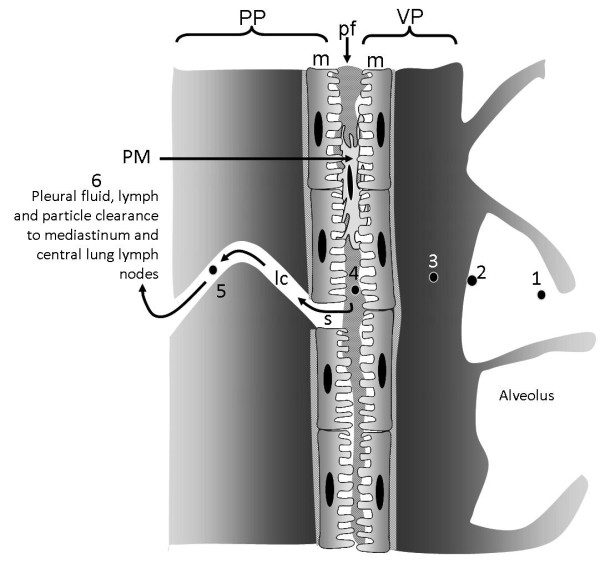
The unique hazard posed to the pleural mesothelium by asbestos has engendered concern in potential for a similar risk from high aspect ratio nanoparticles (HARN) such as carbon nanotubes. In the course of studying the potential impact of HARN on the pleura we have utilised the existing hypothesis regarding the role of the parietal pleura in the response to long fibres. This review seeks to synthesise our new data with multi-walled carbon nanotubes (CNT) with that hypothesis for the behaviour of long fibres in the lung and their retention in the parietal pleura leading to the initiation of inflammation and pleural pathology such as mesothelioma. We describe evidence that a fraction of all deposited particles reach the pleura and that a mechanism of particle clearance from the pleura exits, through stomata in the parietal pleura. We suggest that these stomata are the site of retention of long fibres which cannot negotiate them leading to inflammation and pleural pathology including mesothelioma. We cite thoracoscopic data to support the contention, as would be anticipated from the preceding, that the parietal pleura is the site of origin of pleural mesothelioma. This mechanism, if it finds support, has important implications for future research into the mesothelioma hazard from HARN and also for our current view of the origins of asbestos-initiated pleural mesothelioma and the common use of lung parenchymal asbestos fibre burden as a correlate of this tumour, which actually arises in the parietal pleura.
Overview
The claims and statistics of this paper haven’t been checked yet.
Free: it reads the open-access text and checks the first 5 claims that cite a source we can check. Create a free account to check every claim.
Integrity signals
Registry
Cites
Statistics
Figures
Verification
Claims the paper makes
The claims and statistics of this paper haven’t been checked yet.
Free: it reads the open-access text and checks the first 5 claims that cite a source we can check. Create a free account to check every claim.
Claims other papers make about this one
Each is checked against this paper’s own text: does it say what the citing paper says it does?
The source backs part of the claim, not all of it — or backs it for a different population, condition or comparison.
In the citing paper
“In MPM pathogenesis, the retention of long asbestos fibers in the respiratory tract, coupled with the defeated phagocytosis of pleural macrophages that try to ingest them, increases oxidative stress with ROS generation and forces continuous inflammation, which may promote mesothelial cell transformation [78,79].”
From Chronic Inflammation, Oxidative Stress and Metabolic Plasticity: Three Players Driving the Pro-Tumorigenic Microenvironment in Malignant Mesothelioma (2023) · cites this paper as [79]
Experimental — accuracy not yet measuredThe source backs part of the claim, not all of it — or backs it for a different population, condition or comparison.
In the citing paper
“There are several distinct mechanisms in asbestos‐induced carcinogenesis, including oxidative stress (free radical generation), molecular adsorption (hemoglobin and histones), chromosome tangling, and chronic inflammation, which work in combination.7, 8, 9, 10”
From Phlebotomy as a preventive measure for crocidolite-induced mesothelioma in male rats (2018) · cites this paper as [7]
Experimental — accuracy not yet measuredThe cited source says what the claim attributes to it.
In the citing paper
“Following decades of fibre toxicology studies, asbestos toxicity is considered a consequence of some characteristic physico-chemical properties of the material8910.”
From The interaction of asbestos and iron in lung tissue revealed by synchrotron-based scanning X-ray microscopy (2013) · cites this paper as [8]
The cited source says what the claim attributes to it.
In the citing paper
“These results suggest that ROS originates not only from frustrated phagocytosis [11] but from LDCD of macrophages.”
From Asbestos conceives Fe(II)-dependent mutagenic stromal milieu through ceaseless macrophage ferroptosis and β-catenin induction in mesothelium (2020) · cites this paper as [11]
The cited source says what the claim attributes to it.
In the citing paper
“For fibres in general, the pathogenicity is described within a toxicology structure-activity paradigm, the main determinants being fibre length, diameter and bio-persistence8.”
From The interaction of asbestos and iron in lung tissue revealed by synchrotron-based scanning X-ray microscopy (2013) · cites this paper as [8]
4 more claims about this paper
Create a free account to see every claim other papers make about this one.
Self-check
Percentages, sums and reported differences re-computed from the paper’s own numbers.
The self-check needs the paper’s full text.
Citations
Cites
Poland, C. A., Duffin, R., Kinloch, I., Maynard, A., Wallace, W. A. H., Seaton, A., Stone, V., Brown, S., MacNee, W., & Donaldson, K. (2008) · Nature Nanotechnology · doi:10.1038/nnano.2008.111 · Cited by 2,645 · cited 8×
“Therefore, we would postulate that there are two important parts to the mechanism of the pro-inflammatory effects of long fibres in the peritoneal cavity, shared by both asbestos and long MWCNT i) failure of long fibres to negotiate the diaphragmatic stomata with subsequent retention of the long fibre dose at the diap…”
BackgroundResultInfluentialSelf-citationEnvironmental Health Perspectives at 50
Kaufman, J. D. (2022) · Environmental Health Perspectives · doi:10.1289/ehp11367 · Cited by 2,284
Donaldson, K., Aitken, R., Tran, L., Stone, V., Duffin, R., Forrest, G., & Alexander, A. (2006) · Toxicological Sciences · doi:10.1093/toxsci/kfj130 · Cited by 1,167 · cited 2×
“Graphene, the basic structural component of CNT is an exceedingly strong material [31] and so is likely to be biopersistent when the graphene is pristine, with few defects and underivatised, and that is suggested by our own data (in preparation).”
BackgroundSelf-citationProceedings of the American Association for Cancer Research.
Konings, E. J. M., van den Brandt, P. A., Saris, W. H. M., Brants, H. A. M., & Goldbohm, R. A. (2001) · Cited by 764
British journal of industrial medicine
(1989) · Journal of Sound and Vibration · doi:10.1016/0022-460x(89)90628-7 · Cited by 751
Physiology and pathophysiology of pleural fluid turnover
Miserocchi, G. (1997) · European Respiratory Journal · doi:10.1183/09031936.97.10010219 · Cited by 315
Mesothelioma Epidemiology, Carcinogenesis, and Pathogenesis
Yang, H., Testa, J. R., & Carbone, M. (2008) · Current Treatment Options in Oncology · doi:10.1007/s11864-008-0067-z · Cited by 274
Inhaled Multiwalled Carbon Nanotubes Potentiate Airway Fibrosis in Murine Allergic Asthma
Ryman-Rasmussen, J. P., Tewksbury, E. W., Moss, O. R., Cesta, M. F., Wong, B. A., & Bonner, J. C. (2009) · American Journal of Respiratory Cell and Molecular Biology · doi:10.1165/rcmb.2008-0276oc · Cited by 261
Occupational & environmental medicine
LaDou, J. (1997) · Prentice-Hall International eBooks · Cited by 233
The role of the diaphragm in lymphatic absorption from the peritoneal cavity.
Abu-Hijleh, M. F., Habbal, O. A., & Moqattash, S. T. (1995) · Europe PMC (PubMed Central) · Cited by 225
Research works printed but not linked: 3
- [3]Kane AB Macdonald JL Moalli PA Acute injury and regeneration of mesothelial cells produced by crocidolite asbestos fibers American Review Of Respiratory Disease 1986 133 A198
- [14]Schlesinger RB Ben-Jebria A Dahl AR Snipes MB Ultman J Massaro EJ Disposition of inhaled toxicicants Handbook of Human Toxicology 1997 CRC Press Boca Raton 493 550
- [15]Walton WH Liddell D, Miller K Chapter 5. Airborne dusts Mineral Fibers and Health 1991 Boca Raton, FL:CRC Press 55 77
Cited by
Implant infections: adhesion, biofilm formation and immune evasion
Arciola, C. R., Campoccia, D., & Montanaro, L. (2018) · Nature Reviews Microbiology · doi:10.1038/s41579-018-0019-y · Cited by 2,241
Mechanisms of Nanoparticle-Induced Oxidative Stress and Toxicity
Manke, A., Wang, L., & Rojanasakul, Y. (2013) · BioMed Research International · doi:10.1155/2013/942916 · Cited by 1,727
Sharifi, S., Behzadi, S., Laurent, S., Laird Forrest, M., Stroeve, P., & Mahmoudi, M. (2012) · Chem. Soc. Rev. · doi:10.1039/c1cs15188f · Cited by 1,460
Current characterization methods for cellulose nanomaterials
Foster, E. J., Moon, R. J., Agarwal, U. P., Bortner, M. J., Bras, J., Camarero-Espinosa, S., Chan, K. J., Clift, M. J. D., Cranston, E. D., Eichhorn, S. J., et al. (2018) · Chemical Society Reviews · doi:10.1039/c6cs00895j · Cited by 1,021
Elsaesser, A., & Howard, C. V. (2012) · Advanced Drug Delivery Reviews · doi:10.1016/j.addr.2011.09.001 · Cited by 895
Metadata
- Authors
- Donaldson, K., Murphy, F. A., Duffin, R., & Poland, C. A.
- Affiliations
- Centre for Inflammation Research (GB)
- Corresponding author
- Donaldson, Ken
- Venue
- Particle and Fibre Toxicology
- Published
- 2010
- Volume
- 7
- Issue
- 1
- Pages
- 5
- ISSN
- 1743-8977 (ISSN-L)
- PMC
- PMC2857820
- OpenAlex
- W2160275284
- Cited by
- 916
- References
- 65
- Citations by year
- 2026: 24 · 2025: 47 · 2024: 36 · 2023: 48 · 2022: 53 · 2021: 55 · 2020: 51 · 2019: 47 · 2018: 62 · 2017: 64 · 2016: 50 · 2015: 76 · 2014: 80 · 2013: 80 · 2012: 81
- FWCI
- 12.22
- Type
- journal article
- Language
- en
- Open access
- gold
- doi.org
- Licence
- cc-by
- Locations
- Particle and Fibre Toxicology (publishedVersion, cc-by)
- PubMed Central (publishedVersion, cc-by)
- PubMed (publishedVersion)
- Strathprints: The University of Strathclyde institutional repository (University of Strathclyde) (acceptedVersion)
- DOAJ (DOAJ: Directory of Open Access Journals) (submittedVersion, cc-by-sa)
- Edinburgh Research Explorer (University of Edinburgh) (submittedVersion, cc-by)
- Funders
- National Institute for Health and Care Research
- Colt Foundation
- Topics
- Health Sciences › Medicine › Pulmonary and Respiratory Medicine › Occupational and environmental lung diseases
- Physical Sciences › Engineering › Biomedical Engineering › Graphene and Nanomaterials Applications
- Health Sciences › Medicine › Pulmonary and Respiratory Medicine › Interstitial Lung Diseases and Idiopathic Pulmonary Fibrosis
- Keywords
- asbestos, carbon nanotubes, pleural mesothelium, parietal pleura, pleural mesothelioma, high aspect ratio nanoparticles, pleural inflammation, pleural disease, tumor origin
- MeSH terms
- Air Pollutants, Animals, Asbestos, Disease Models, Animal, Epithelium, Humans, Mesothelioma, Metabolic Clearance Rate, Particle Size, Pleura, Mineral Fibers, Nanotubes, Carbon, Mice
About these checks
Registry, retraction, Cites and statistics results are computed, not judged, with one exception: a printed reference that no index lists is read once by a model before it counts as a citation error. Claims are extracted by a model and kept only when their quote appears verbatim in the text; each cited source is then checked, with a model’s help, for whether it says what the claim relies on. Those verdicts can be wrong — read the claim’s quote and the cited source before relying on one.
Statistics and arithmetic are recomputed, not judged.
Confidence bands are shown only for fields calibrated on our annotated test set. None is calibrated yet, so no band is shown.
What counts as a claim ›How we measure confidence ›How we check this ›
Are you an author, or do you see a problem with this page? Request a review
Data sources
Bibliographic data: Semantic Scholar, OpenAlex, Crossref.
Contains information from the Semantic Scholar Academic Graph Datasets, made available under the ODC Attribution License (ODC-BY 1.0).
Semantic Scholar’s data is described in: Kinney, R., et al. (2023). The Semantic Scholar Open Data Platform. arXiv:2301.10140.
