

Mobile health for non-communicable diseases in Sub-Saharan Africa: a systematic review of the literature and strategic framework for research
Open accessThe DOI matches its Crossref record; 36 of the 37 references it cites were found in a registry or an index.
Abstract
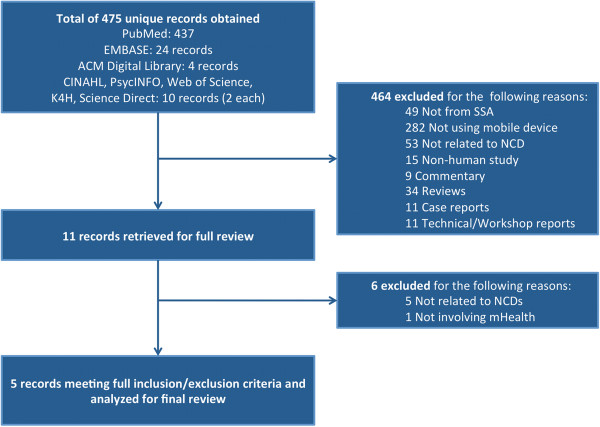
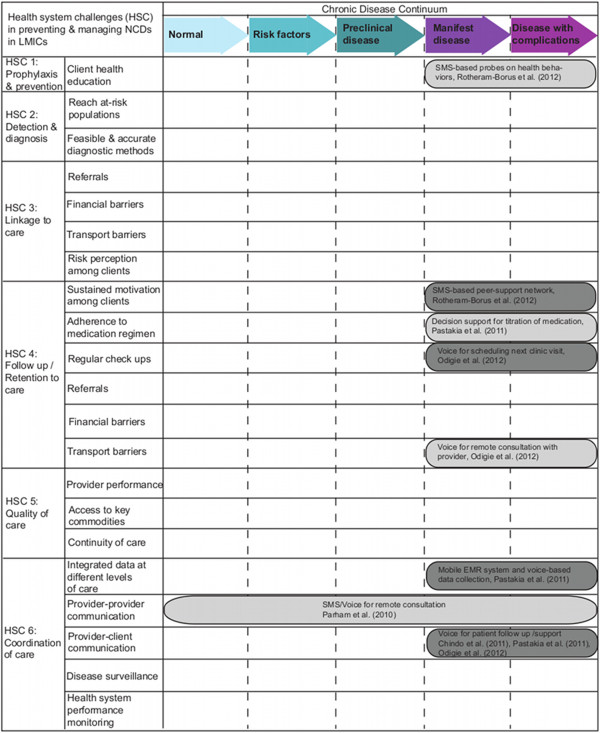
BACKGROUND: Mobile health (mHealth) approaches for non-communicable disease (NCD) care seem particularly applicable to sub-Saharan Africa given the penetration of mobile phones in the region. The evidence to support its implementation has not been critically reviewed. METHODS: We systematically searched PubMed, Embase, Web of Science, Cochrane Central Register of Clinical Trials, a number of other databases, and grey literature for studies reported between 1992 and 2012 published in English or with an English abstract available. We extracted data using a standard form in accordance with Preferred Reporting Items for Systematic Reviews and Meta-Analyses guidelines. RESULTS: Our search yielded 475 citations of which eleven were reviewed in full after applying exclusion criteria. Five of those studies met the inclusion criteria of using a mobile phone for non-communicable disease care in sub-Saharan Africa. Most studies lacked comparator arms, clinical endpoints, or were of short duration. mHealth for NCDs in sub-Saharan Africa appears feasible for follow-up and retention of patients, can support peer support networks, and uses a variety of mHealth modalities. Whether mHealth is associated with any adverse effect has not been systematically studied. Only a small number of mHealth strategies for NCDs have been studied in sub-Saharan Africa. CONCLUSIONS: There is insufficient evidence to support the effectiveness of mHealth for NCD care in sub-Saharan Africa. We present a framework for cataloging evidence on mHealth strategies that incorporates health system challenges and stages of NCD care. This framework can guide approaches to fill evidence gaps in this area. Systematic review registration: PROSPERO CRD42014007527.
Overview
The claims and statistics of this paper haven’t been checked yet.
Free: it reads the open-access text and checks the first 5 claims that cite a source we can check. Create a free account to check every claim.
Integrity signals
Registry
Cites
Statistics
Figures
Verification
Claims the paper makes
The claims and statistics of this paper haven’t been checked yet.
Free: it reads the open-access text and checks the first 5 claims that cite a source we can check. Create a free account to check every claim.
Claims other papers make about this one
Each is checked against this paper’s own text: does it say what the citing paper says it does?
The source backs part of the claim, not all of it — or backs it for a different population, condition or comparison.
In the citing paper
“Potential advantages include streamlined data collection to inform policy makers, standardisation of advice and access to telemedicine for remote communities, but current evidence in SSA remains limited. 15”
From Effectiveness of App-Based Cognitive Screening for Dementia by Lay Health Workers in Low Resource Settings. A Validation and Feasibility Study in Rural Tanzania (2021) · cites this paper as [15]
Experimental — accuracy not yet measuredThe cited source says what the claim attributes to it.
In the citing paper
“Three recent systematic reviews, two specifically focusing on the use of mHealth interventions for the care and management of NCDs in SSA [6] and in developing countries [9], and the other looking more broadly at the use of mHealth interventions against chronic diseases in developing countries [10], found that the included studies generally reported positive outcomes.”
From A realist review of mobile phone-based health interventions for non-communicable disease management in sub-Saharan Africa (2017) · cites this paper as [6]
The cited source says what the claim attributes to it.
In the citing paper
“Bloomfield et al. [16] performed a review of mHealth interventions against NCDs focusing only on Sub-Saharan African countries.”
From A systematic review of randomized controlled trials of mHealth interventions against non-communicable diseases in developing countries (2016) · cites this paper as [16]
The cited source says what the claim attributes to it.
In the citing paper
“Use of technological solutions may improve access to diagnosis, particularly in the context of a task-shifting approach. Mobile health (m-health) and similar initiatives have been investigated in chronic disease management in similar low-resource settings 15 and form part of current WHO recommendations for non-communicable diseases in low-resource settings. 16”
The check wasn’t confident either way, so it gives no verdict — never disputed.
In the citing paper
“Most reviews of use of digital communication with patients in sub-Saharan Africa, comment on the problems of implementation of the communication system, particularly technical and maintenance issues.26–28 54–58”
From mHealth text and voice communication for monitoring people with chronic diseases in low-resource settings: a realist review (2018) · cites this paper as [26]
Experimental — accuracy not yet measured
5 more claims about this paper
Create a free account to see every claim other papers make about this one.
Self-check
Percentages, sums and reported differences re-computed from the paper’s own numbers.
The self-check needs the paper’s full text.
Citations
Cites
Lozano, R., Naghavi, M., Foreman, K., Lim, S., Shibuya, K., Aboyans, V., Abraham, J., Adair, T., Aggarwal, R., Ahn, S. Y., et al. (2012) · The Lancet · doi:10.1016/s0140-6736(12)61728-0 · Cited by 14,070
Lim, S. S., Vos, T., Flaxman, A. D., Danaei, G., Shibuya, K., Adair-Rohani, H., AlMazroa, M. A., Amann, M., Anderson, H. R., Andrews, K. G., et al. (2012) · The Lancet · doi:10.1016/s0140-6736(12)61766-8 · Cited by 11,805
Murray, C. J. L., Vos, T., Lozano, R., Naghavi, M., Flaxman, A. D., Michaud, C., Ezzati, M., Shibuya, K., Salomon, J. A., Abdalla, S., et al. (2012) · The Lancet · doi:10.1016/s0140-6736(12)61689-4 · Cited by 8,888
The Epidemiologic Transition: A Theory of the Epidemiology of Population Change
OMRAN, A. R. (2005) · The Milbank Quarterly · doi:10.1111/j.1468-0009.2005.00398.x · Cited by 3,823
The Epidemiologic Transition: A Theory of the Epidemiology of Population Change
Omran, A. R. (1971) · The Milbank Memorial Fund Quarterly · doi:10.2307/3349375 · Cited by 2,887
Preventing chronic diseases: a vital investment
Vita-Finzi, L., & Who, G. E. (2005) · Cited by 1,679
Human resources for health: overcoming the crisis
Chen, L., Evans, T., Anand, S., Boufford, J. I., Brown, H., Chowdhury, M., Cueto, M., Dare, L., Dussault, G., Elzinga, G., et al. (2004) · The Lancet · doi:10.1016/s0140-6736(04)17482-5 · Cited by 1,552 · cited 1×
“even basic healthcare needs [1,2].”
Text messaging as a tool for behavior change in disease prevention and management
Cole-Lewis, H., & Kershaw, T. (2010) · Epidemiologic Reviews · doi:10.1093/epirev/mxq004 · Cited by 1,190 · cited 1×
“Mobile phones have been leveraged for client health education using text messaging to address risk factors for NCDs in developed countries [35].”
BackgroundFree, C., Phillips, G., Watson, L., Galli, L., Felix, L., Edwards, P., Patel, V., & Haines, A. (2013) · PLoS Medicine · doi:10.1371/journal.pmed.1001363 · Cited by 1,187 · cited 2×
“There have been a number of systematic reviews of the effectiveness of mHealth for improving adherence to clinic attendance [26], improving health care service delivery [27], and healthcare in general [28].”
BackgroundHealthcare via Cell Phones: A Systematic Review
Krishna, S., Boren, S. A., & Balas, E. A. (2009) · Telemedicine and e-Health · doi:10.1089/tmj.2008.0099 · Cited by 882
Cited by
Items 101–154 of 154
Paolino, M., Antelo, V. S., Kohler, R. E., Viswanath, K., & Arrossi, S. (2023) · BMC Women s Health · doi:10.1186/s12905-023-02475-0 · Cited by 10
Carrillo-Larco, R. M., Jiwani, S. S., Diez‐Canseco, F., Kanter, R., Beratarrechea, A. G., Irazola, V. E., Ramírez‐Zea, M., Rubinstein, A. L., Martínez, H., Miranda, J. J., et al. (2018) · JMIR mhealth and uhealth · doi:10.2196/10226 · Cited by 8
“Mobile health (mHealth) strategies have been increasingly used in public health research studies, some of them showing effective results in improving the profiles of traditional risk factors for noncommunicable diseases [1,2], including in developing countries [3-6].”
BackgroundMobile Gesundheitskommunikation und mobiles Gesundheitsmanagement mittels Smart Devices
Brew‐Sam, N. (2019) · Springer eBooks · doi:10.1007/978-3-658-10727-7_17 · Cited by 7
Tweheyo, R., Selig, H., Gibson, D. G., Pariyo, G. W., & Rutebemberwa, E. (2020) · JMIR Formative Research · doi:10.2196/21671 · Cited by 8
mHealth Applications: Potentials, Limitations, Current Quality and Future Directions
Meßner, E.-M., Probst, T., O’Rourke, T., Stoyanov, S. R., & Baumeister, H. (2022) · Studies in neuroscience, psychology and behavioral economics · doi:10.1007/978-3-030-98546-2_18 · Cited by 6
Prata, N., Weidert, K., & Soro, D. R. (2021) · mHealth · doi:10.21037/mhealth-20-125 · Cited by 7
Vasudevan, L., Zeller, K., & Labrique, A. B. (2018) · Health informatics · doi:10.1007/978-3-319-61446-5_2 · Cited by 6
Self-citationDetermining the potential of mobilephone-based health interventions in Kumasi, Ghana
Stephani, V., Opoku, D., & Otupiri, E. (2020) · Ghana Medical Journal · doi:10.4314/gmj.v54i2.6 · Cited by 4
Olds, P., Nuwagaba, G., Obwoya, P. S., Nuwagira, E., Haberer, J. E., & Okello, S. (2023) · PLoS ONE · doi:10.1371/journal.pone.0295596 · Cited by 4
“…in this study highlighted how novel technology—especially mHealth—can significantly improve access to care when patient movement is limited. mHealth has shown significant promise in improving access to longitudinal NCD care in SSA, with numerous successes during the COVID-19 pandemic [36, 37].”
BackgroundE-health solutions in primary health care
Çöme, O., & Mevsim, V. (2023) · The Journal of Turkish Family Physician · doi:10.15511/tjtfp.23.00130 · Cited by 3
Leveraging Mobile Technology to Reduce Resource-Related Health Care Disparities
Mirabel, M., & Badano, L. P. (2017) · JACC. Cardiovascular imaging · doi:10.1016/j.jcmg.2017.08.015 · Cited by 4
“Systematic reviews focusing on the use of mHealth interventions for the care and management of NCDs in LMICs reported overall positive outcomes (8,9).”
BackgroundEvaluation of eHealth Implementations in Uganda: Investigating Practices, Challenges and InsightsPreprint
Nabukenya, J., & Ashaba, J. (2019) · Research Square · doi:10.21203/rs.2.12339/v1 · Cited by 5
“Some aspects that threaten ICT systems implementation in the health sector involve economic resources, income disparities, exorbitant costs of usage fees, excessive costs for even rudimentary health information systems, lack of human trained resources, lack of governmental policies that address a well-defined health s…”
BackgroundTeng, C., Yu, P., & Liu, L. (2024) · Humanities and Social Sciences Communications · doi:10.1057/s41599-024-02782-3 · Cited by 3
“…scenario, the utilization of emergency mobile facilities, including mobile medical vehicles, medical rooms, and nucleic acid sampling facilities, etc., is regarded as a versatile and expedient remedy (Bloom fi eld et al., 2014; Nair and Miller-Hooks, 2009; Yang et al., 2021; Çak ı r et al., 2022).”
Ndayizigamiye, P., Soni, T. C., & Jere, N. (2018) · IST-Africa Week Conference · Cited by 12
Mobile Apps to Improve Health Parameters in Healthy Adults: Systematic Review
Leuzzi, G., Job, M., Cosentino, C., Testa, R., Scafoglieri, A., & Testa, M. (2026) · JMIR mhealth and uhealth · doi:10.2196/66881 · Cited by 4
“Other systematic reviews were carried out on mHealth in the last years [85-89] and were also characterized by a very limited number of selected studies with high heterogeneity, and therefore they could not assess mHealth effectiveness.”
Ekongefeyin, S. N. N., Dedino, G. A., & Wild, C. E. K. (2025) · Heart · doi:10.1136/heartjnl-2025-325992 · Cited by 5
“48 49 Literature shows the existence of simpler mHealth approaches such as SMS/text and phone calls, along with an increasing number of smartphone applications and the emergence of AI and social media apps like WhatsApp for pilot testing.”
Mobile Gesundheitskommunikation und mobiles Gesundheitsmanagement mittels Smart Devices
Krömer, N. (2016) · Springer eBooks · doi:10.1007/978-3-658-10948-6_17-1 · Cited by 3
El-Halabi, S., Atkins, S. A., Khader, Y. S., Taweel, A., Alrawabdeh, A., & El‐Khatib, Z. (2021) · Springer eBooks · doi:10.1007/978-3-030-36811-1_74 · Cited by 2
Citizen science for malaria control in Rwanda : Engagement, motivation, and behaviour change
Asingizwe, D. (2020) · doi:10.18174/526218 · Cited by 3
“However, in the extant literature, only a few projects focus on African countries with much emphasis on HIV/AIDS and noncommunicable diseases (Bloomfield et al., 2014; Forrest et al., 2015).”
BackgroundPrimary prevention of diabetes mellitus type 2
Niazi, A. K., Shafique, K., & Schwartz, P. E. H. (2024) · Elsevier eBooks · doi:10.1016/b978-0-443-22106-4.00001-2 · Cited by 2
mHealth: only as good as the company it keeps
Bloomfield, G. S. (2015) · The Lancet Diabetes & Endocrinology · doi:10.1016/s2213-8587(15)00455-6 · Cited by 1
Self-citationFiogbé, E., Aho, S., & Kiki, G. M. (2017) · International Journal of Medical Reviews · doi:10.29252/ijmr-040306 · Cited by 1
Halake, D. G., & Ogoncho, I. M. (2017) · Cited by 4
Zakane, S. A. (2017) · Figshare · Cited by 1
Diabetic Living: Senegalese Women's Experiences with Metabolic Illness
Bunkley, E. N. (2021) · UA Campus Repository (The University of Arizona) · Cited by 3
The contribution of community-based programmes to health
Pardoel, Z. (2024) · University of Groningen research database (University of Groningen / Centre for Information Technology) · doi:10.33612/diss.925136990 · Cited by 1
López-Hernández, D., Navarro-Meneses, R. M., Blanco-Cornejo, M., Sam, I. L. R. Y. C., Mosso-Zempoalteca, V., & Cerritos, A. (2018) · Salud Pública de México · doi:10.21149/8874 · Cited by 1
El-Halabi, S., Atkins, S. A., Khader, Y. S., Taweel, A., Alrawabdeh, A., & El‐Khatib, Z. (2020) · Springer eBooks · doi:10.1007/978-3-319-74365-3_74-1
Ochieng, B., Magadi, M. A., Smith, L., Orton, B. R., Hayter, M., Kaseje, M., Wafula, C. O., Ocholla, P., Ogutu-Owii, S., Onukwugha, F. I., et al. (2021) · Research Square · doi:10.21203/rs.3.rs-663929/v1
Nabukenya, J., & Ashaba, J. (2020) · Research Square · doi:10.21203/rs.2.12339/v2 · Cited by 4
Mobile Health Applications to Tackle Obesity and Assist Weight-Management Goals among Adults
Zhou, Y. (2022) · Highlights in Science Engineering and Technology · doi:10.54097/hset.v2i.556 · Cited by 2
“Additionally, they may complement traditional treatment by enabling access to less stigmatised restorative materials or medical therapy [21,22].”
BackgroundYeke, S., & Selçuk, A. G. (2022) · Nevşehir Hacı Bektaş Veli Üniversitesi SBE Dergisi · doi:10.30783/nevsosbilen.932088
Mandari, H. E., & Yahaya, M. (2022) · Journal of international technology and information management · doi:10.58729/1941-6679.1518
Matewere, F., & Kaasbøll, J. (2023) · IFIP advances in information and communication technology · doi:10.1007/978-3-031-50154-8_21
Matewere, F., Kaasbøll, J., & Kanjo, C. (2024) · IFIP advances in information and communication technology · doi:10.1007/978-3-031-66986-6_12
Sargsyan, K., & Muradyan, A. A. (2024) · Sustainable development goals series · doi:10.1007/978-3-031-62332-5_16
Using Digital Learning Tools During the Ongoing MPOX Response in Africa: Proposing a Strategy
Nana, R., & Gara, L. (2024) · American Journal of Education and Information Technology · doi:10.11648/j.ajeit.20240802.17
Improving NCD screening in Indonesia: Implementation of Aplikasi Sehat IndonesiaKu (ASIK) (Preprint)Preprint
Aisyah, D. N., Setiawan, A. H., Faradiba, N., Lokopessy, A. F., Hamid, N. A., Jonathan, W., Ratih, T. S. D., Kozlakidis, Z., & Manikam, L. (2025) · doi:10.2196/preprints.73026
Morris, R. J. T. (2025) · Elsevier eBooks · doi:10.1016/b978-0-443-28969-9.00001-7
Ndinawe, J. B., Kabakyenga, J. K., Namukwaya, E., Mulogo, E. M., & Katushabe, E. (2026) · JBI Evidence Synthesis · doi:10.11124/jbies-24-00560 · Cited by 1
Pardoel, Z., Reijneveld, S. A., Lensink, R., Widyaningsih, V., Probandari, A., Stein, C., Hoang, G. N., Koot, J. A. R., Fenenga, C., Postma, M., et al. (2021) · Figshare · doi:10.6084/m9.figshare.16862743
Pardoel, Z., Reijneveld, S. A., Lensink, R., Widyaningsih, V., Probandari, A., Stein, C., Hoang, G. N., Koot, J. A. R., Fenenga, C., Postma, M., et al. (2021) · Figshare · doi:10.6084/m9.figshare.16862746
Yebei, V. N., Njuguna, B., Koros, H., Andesia, J., Kamano, J., Mercer, T., Bloomfield, G. S., Pastakia, S. D., Vedanthan, R., & Akwanalo, C. O. (2023) · Figshare · doi:10.6084/m9.figshare.23935851
Self-citationFarmer, A., Bobrow, K., Leon, N., Williams, N., Phiri, E., Namadingo, H., Cooper, S., Prince, J., Crampin, A., Besada, D., et al. (2021) · Figshare · doi:10.6084/m9.figshare.16851085
Farmer, A., Bobrow, K., Leon, N., Williams, N., Phiri, E., Namadingo, H., Cooper, S., Prince, J., Crampin, A., Besada, D., et al. (2021) · Figshare · doi:10.6084/m9.figshare.16851091
Pardoel, Z., Reijneveld, S. A., Lensink, R., Widyaningsih, V., Probandari, A., Stein, C., Hoang, G. N., Koot, J. A. R., Fenenga, C., Postma, M., et al. (2021) · Figshare · doi:10.6084/m9.figshare.16862749
Ndinawe, J. B., Kabakyenga, J. K., Namukwaya, E., Mulogo, E. M., & Nagujja, F. (2026) · BMC Palliative Care · doi:10.1186/s12904-026-02034-y
Leung, C. L., Bosworth, H. B., Webel, A. R., Aifah, A. A., Akwanalo, C. O., Bloomfield, G. S., Choi, E. W., Gripshover, B., Hileman, C. O., Kamano, J. H., et al. (2026) · BMC Global and Public Health · doi:10.1186/s44263-026-00257-y
Self-citationDeweirdt, J. (2018) · theses.fr (ABES) · doi:10.70675/965ae416zb6eaz4dd2z9f06zbdc887f2a0f1 · Cited by 1
Mapingure, M. P., Dzinamarira, T., Chingombe, I., Moyo, E., Mpofu, A., Mugurungi, O. M., Herrera, H., Madziva, R., & Musuka, G. (2026) · BMC Public Health · doi:10.1186/s12889-026-28362-5
“Individuals in higher wealth quintiles may genuinely experience higher NCD burden due to lifestyle-related factors such as increased consumption of processed foods, sedentary lifestyles, and reduced physical activity [17, 18].”
Metadata
- Authors
- Bloomfield, G. S., Vedanthan, R., Vasudevan, L., Kithei, A., Were, M., & Velazquez, E. J.
- Affiliations
- Duke University (US)
- Icahn School of Medicine at Mount Sinai (US)
- Johns Hopkins University (US)
- Moi University (KE)
- Regenstrief Institute (US)
- Corresponding author
- Bloomfield, Gerald S
- Venue
- Globalization and Health
- Published
- 2014
- Volume
- 10
- Issue
- 1
- Pages
- 49
- ISSN
- 1744-8603 (ISSN-L)
- PMC
- PMC4064106
- OpenAlex
- W2138414452
- Cited by
- 154
- References
- 37
- Citations by year
- 2026: 4 · 2025: 6 · 2024: 6 · 2023: 14 · 2022: 13 · 2021: 23 · 2020: 18 · 2019: 15 · 2018: 17 · 2017: 14 · 2016: 14 · 2015: 10
- FWCI
- 2.16
- Type
- journal article
- Language
- en
- Open access
- gold
- doi.org
- Licence
- cc-by
- Locations
- Globalization and Health (publishedVersion, cc-by)
- Europe PMC (PubMed Central) (publishedVersion, cc-by)
- PubMed Central (publishedVersion, cc-by)
- PubMed (publishedVersion)
- DukeSpace (Duke University) (submittedVersion, cc-by-nc-nd)
- IUScholarWorks (Indiana University) (submittedVersion, cc-by)
- Funders
- National Institutes of Health
- Fogarty International Center (K01TW009218, K01TW008407)
- Topics
- Health Sciences › Health Professions › General Health Professions › Mobile Health and mHealth Applications
- Physical Sciences › Computer Science › Information Systems › Mobile Learning in Education
- Physical Sciences › Computer Science › Information Systems › ICT in Developing Communities
- Keywords
- mobile health, non-communicable diseases, sub-Saharan Africa, evidence gaps, research framework, patient retention, peer support networks, health system challenges
- MeSH terms
- Chronic Disease, Health Services Research, Humans, Global Health, Telemedicine, Africa South of the Sahara
About these checks
Registry, retraction, Cites and statistics results are computed, not judged, with one exception: a printed reference that no index lists is read once by a model before it counts as a citation error. Claims are extracted by a model and kept only when their quote appears verbatim in the text; each cited source is then checked, with a model’s help, for whether it says what the claim relies on. Those verdicts can be wrong — read the claim’s quote and the cited source before relying on one.
Statistics and arithmetic are recomputed, not judged.
Confidence bands are shown only for fields calibrated on our annotated test set. None is calibrated yet, so no band is shown.
What counts as a claim ›How we measure confidence ›How we check this ›
Are you an author, or do you see a problem with this page? Request a review
Data sources
Bibliographic data: Semantic Scholar, OpenAlex, Crossref.
Contains information from the Semantic Scholar Academic Graph Datasets, made available under the ODC Attribution License (ODC-BY 1.0).
Semantic Scholar’s data is described in: Kinney, R., et al. (2023). The Semantic Scholar Open Data Platform. arXiv:2301.10140.
