

Mobile health for non-communicable diseases in Sub-Saharan Africa: a systematic review of the literature and strategic framework for research
Open accessThe DOI matches its Crossref record; 36 of the 37 references it cites were found in a registry or an index.
Abstract
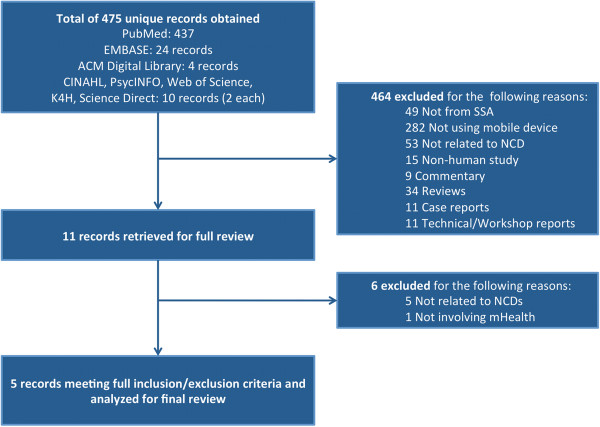
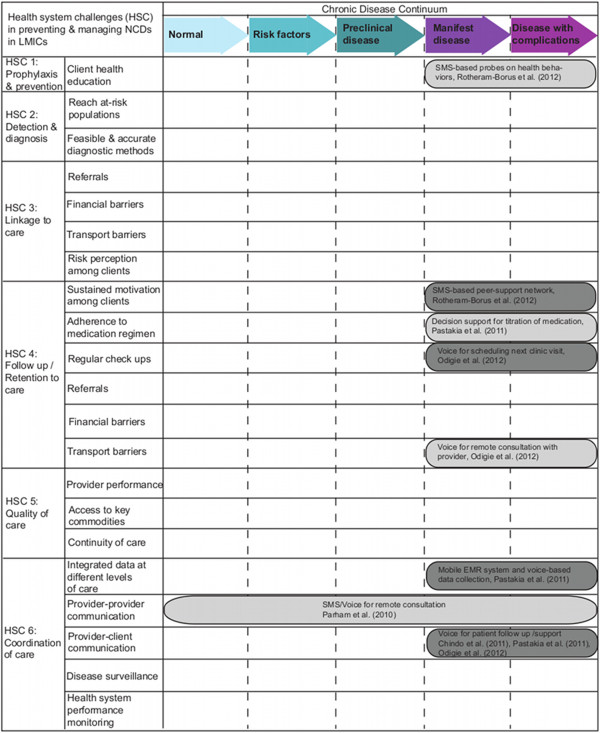
BACKGROUND: Mobile health (mHealth) approaches for non-communicable disease (NCD) care seem particularly applicable to sub-Saharan Africa given the penetration of mobile phones in the region. The evidence to support its implementation has not been critically reviewed. METHODS: We systematically searched PubMed, Embase, Web of Science, Cochrane Central Register of Clinical Trials, a number of other databases, and grey literature for studies reported between 1992 and 2012 published in English or with an English abstract available. We extracted data using a standard form in accordance with Preferred Reporting Items for Systematic Reviews and Meta-Analyses guidelines. RESULTS: Our search yielded 475 citations of which eleven were reviewed in full after applying exclusion criteria. Five of those studies met the inclusion criteria of using a mobile phone for non-communicable disease care in sub-Saharan Africa. Most studies lacked comparator arms, clinical endpoints, or were of short duration. mHealth for NCDs in sub-Saharan Africa appears feasible for follow-up and retention of patients, can support peer support networks, and uses a variety of mHealth modalities. Whether mHealth is associated with any adverse effect has not been systematically studied. Only a small number of mHealth strategies for NCDs have been studied in sub-Saharan Africa. CONCLUSIONS: There is insufficient evidence to support the effectiveness of mHealth for NCD care in sub-Saharan Africa. We present a framework for cataloging evidence on mHealth strategies that incorporates health system challenges and stages of NCD care. This framework can guide approaches to fill evidence gaps in this area. Systematic review registration: PROSPERO CRD42014007527.
Overview
The claims and statistics of this paper haven’t been checked yet.
Free: it reads the open-access text and checks the first 5 claims that cite a source we can check. Create a free account to check every claim.
Integrity signals
Registry
Cites
Statistics
Figures
Verification
Claims the paper makes
The claims and statistics of this paper haven’t been checked yet.
Free: it reads the open-access text and checks the first 5 claims that cite a source we can check. Create a free account to check every claim.
Claims other papers make about this one
Each is checked against this paper’s own text: does it say what the citing paper says it does?
The source backs part of the claim, not all of it — or backs it for a different population, condition or comparison.
In the citing paper
“Potential advantages include streamlined data collection to inform policy makers, standardisation of advice and access to telemedicine for remote communities, but current evidence in SSA remains limited. 15”
From Effectiveness of App-Based Cognitive Screening for Dementia by Lay Health Workers in Low Resource Settings. A Validation and Feasibility Study in Rural Tanzania (2021) · cites this paper as [15]
Experimental — accuracy not yet measuredThe cited source says what the claim attributes to it.
In the citing paper
“Three recent systematic reviews, two specifically focusing on the use of mHealth interventions for the care and management of NCDs in SSA [6] and in developing countries [9], and the other looking more broadly at the use of mHealth interventions against chronic diseases in developing countries [10], found that the included studies generally reported positive outcomes.”
From A realist review of mobile phone-based health interventions for non-communicable disease management in sub-Saharan Africa (2017) · cites this paper as [6]
The cited source says what the claim attributes to it.
In the citing paper
“Bloomfield et al. [16] performed a review of mHealth interventions against NCDs focusing only on Sub-Saharan African countries.”
From A systematic review of randomized controlled trials of mHealth interventions against non-communicable diseases in developing countries (2016) · cites this paper as [16]
The cited source says what the claim attributes to it.
In the citing paper
“Use of technological solutions may improve access to diagnosis, particularly in the context of a task-shifting approach. Mobile health (m-health) and similar initiatives have been investigated in chronic disease management in similar low-resource settings 15 and form part of current WHO recommendations for non-communicable diseases in low-resource settings. 16”
The check wasn’t confident either way, so it gives no verdict — never disputed.
In the citing paper
“Most reviews of use of digital communication with patients in sub-Saharan Africa, comment on the problems of implementation of the communication system, particularly technical and maintenance issues.26–28 54–58”
From mHealth text and voice communication for monitoring people with chronic diseases in low-resource settings: a realist review (2018) · cites this paper as [26]
Experimental — accuracy not yet measured
5 more claims about this paper
Create a free account to see every claim other papers make about this one.
Self-check
Percentages, sums and reported differences re-computed from the paper’s own numbers.
The self-check needs the paper’s full text.
Citations
Cites
Lozano, R., Naghavi, M., Foreman, K., Lim, S., Shibuya, K., Aboyans, V., Abraham, J., Adair, T., Aggarwal, R., Ahn, S. Y., et al. (2012) · The Lancet · doi:10.1016/s0140-6736(12)61728-0 · Cited by 14,070
Lim, S. S., Vos, T., Flaxman, A. D., Danaei, G., Shibuya, K., Adair-Rohani, H., AlMazroa, M. A., Amann, M., Anderson, H. R., Andrews, K. G., et al. (2012) · The Lancet · doi:10.1016/s0140-6736(12)61766-8 · Cited by 11,805
Murray, C. J. L., Vos, T., Lozano, R., Naghavi, M., Flaxman, A. D., Michaud, C., Ezzati, M., Shibuya, K., Salomon, J. A., Abdalla, S., et al. (2012) · The Lancet · doi:10.1016/s0140-6736(12)61689-4 · Cited by 8,888
The Epidemiologic Transition: A Theory of the Epidemiology of Population Change
OMRAN, A. R. (2005) · The Milbank Quarterly · doi:10.1111/j.1468-0009.2005.00398.x · Cited by 3,823
The Epidemiologic Transition: A Theory of the Epidemiology of Population Change
Omran, A. R. (1971) · The Milbank Memorial Fund Quarterly · doi:10.2307/3349375 · Cited by 2,887
Preventing chronic diseases: a vital investment
Vita-Finzi, L., & Who, G. E. (2005) · Cited by 1,679
Human resources for health: overcoming the crisis
Chen, L., Evans, T., Anand, S., Boufford, J. I., Brown, H., Chowdhury, M., Cueto, M., Dare, L., Dussault, G., Elzinga, G., et al. (2004) · The Lancet · doi:10.1016/s0140-6736(04)17482-5 · Cited by 1,552 · cited 1×
“even basic healthcare needs [1,2].”
Text messaging as a tool for behavior change in disease prevention and management
Cole-Lewis, H., & Kershaw, T. (2010) · Epidemiologic Reviews · doi:10.1093/epirev/mxq004 · Cited by 1,190 · cited 1×
“Mobile phones have been leveraged for client health education using text messaging to address risk factors for NCDs in developed countries [35].”
BackgroundFree, C., Phillips, G., Watson, L., Galli, L., Felix, L., Edwards, P., Patel, V., & Haines, A. (2013) · PLoS Medicine · doi:10.1371/journal.pmed.1001363 · Cited by 1,187 · cited 2×
“There have been a number of systematic reviews of the effectiveness of mHealth for improving adherence to clinic attendance [26], improving health care service delivery [27], and healthcare in general [28].”
BackgroundHealthcare via Cell Phones: A Systematic Review
Krishna, S., Boren, S. A., & Balas, E. A. (2009) · Telemedicine and e-Health · doi:10.1089/tmj.2008.0099 · Cited by 882
Diabetes in sub-Saharan Africa
Mbanya, J. C. N., Motala, A. A., Sobngwi, E., Assah, F. K., & Enoru, S. T. (2010) · The Lancet · doi:10.1016/s0140-6736(10)60550-8 · Cited by 775
Scaling Up mHealth: Where Is the Evidence?
Tomlinson, M., Rotheram-Borus, M. J., Swartz, L., & Tsai, A. C. (2013) · PLoS Medicine · doi:10.1371/journal.pmed.1001382 · Cited by 673 · cited 2×
“, that despite the calls to scale up mHealth interventions in SSA, there are few current mHealth interventions that meet standards for scale up [15], especially for NCDs.”
BackgroundThe double burden of communicable and non-communicable diseases in developing countries
Boutayeb, A. (2006) · Transactions of the Royal Society of Tropical Medicine and Hygiene · doi:10.1016/j.trstmh.2005.07.021 · Cited by 672 · cited 1×
“Although the model of the epidemiologic transition postulates that NCDs tend to become dominant causes of death as societies and populations evolve [11], several factors—such as adverse diet trends, mechanization of transport, and increasingly sedentary jobs in LMICs— have led to an acceleration and overlap between th…”
BackgroundQuinn, C. C., Shardell, M. D., Terrin, M. L., Barr, E. A., Ballew, S. H., & Gruber-Baldini, A. L. (2011) · Diabetes Care · doi:10.2337/dc11-0366 · Cited by 650
Non-communicable diseases in sub-Saharan Africa: what we know now
Dalal, S., Beunza, J. J., Volmink, J., Adebamowo, C., Bajunirwe, F., Njelekela, M., Mozaffarian, D., Fawzi, W., Willett, W., Adami, H.-O., et al. (2011) · International Journal of Epidemiology · doi:10.1093/ije/dyr050 · Cited by 631 · cited 1×
“Poor knowledge of preventive measures is a key contributor to the rising incidence of NCDs in SSA [34].”
BackgroundLabrique, A. B., Vasudevan, L., Kochi, E., Fabricant, R., & Mehl, G. (2013) · Global Health: Science and Practice · doi:10.9745/ghsp-d-13-00031 · Cited by 601 · cited 3×
“World Health Organization: Preventing Chronic Diseases: A Vital Investment.”
BackgroundSelf-citationMartínez-Pérez, B., de la Torre-Díez, I., & López-Coronado, M. (2013) · Journal of Medical Internet Research · doi:10.2196/jmir.2600 · Cited by 550
Vervloet, M., Linn, A. J., van Weert, J. C. M., de Bakker, D. H., Bouvy, M. L., & van Dijk, L. (2012) · Journal of the American Medical Informatics Association · doi:10.1136/amiajnl-2011-000748 · Cited by 455 · cited 1×
“The mHealth strategies with an evidence base to improve retention often deal with SMS reminders about medication and appointment adherence [26,46].”
BackgroundBeratarrechea, A., Lee, A. G., Willner, J. M., Jahangir, E., Ciapponi, A., & Rubinstein, A. (2014) · Telemedicine and e-Health · doi:10.1089/tmj.2012.0328 · Cited by 403 · cited 1×
“None of these reviews included studies from SSA, even when focused on developing countries, and few of them relate to NCDs [29].”
BackgroundCaring for People with Chronic Conditions: A Health System Perspective
Nolte, E., & McKee, M. (2008) · Cited by 377
Gurman, T. A., Rubin, S. E., & Roess, A. A. (2012) · Journal of Health Communication · doi:10.1080/10810730.2011.649160 · Cited by 331 · cited 2×
“The evidence supporting the implementation of mHealth in SSA has been focused on HIV/AIDS, malaria, and maternal and child health despite the fact that the burden of NCDs is growing at a faster rate [8-10].”
BackgroundGuy, R., Hocking, J., Wand, H., Stott, S., Ali, H., & Kaldor, J. (2012) · Health Services Research · doi:10.1111/j.1475-6773.2011.01342.x · Cited by 329 · cited 2×
“The mHealth strategies with an evidence base to improve retention often deal with SMS reminders about medication and appointment adherence [26,46].”
BackgroundConvergence of non-communicable and infectious diseases in low- and middle-income countries
Remais, J. V., Zeng, G., Li, G., Tian, L., & Engelgau, M. M. (2013) · International Journal of Epidemiology · doi:10.1093/ije/dys135 · Cited by 250
E-imci: improving pediatric health care in low-income countries
DeRenzi, B., Lesh, N., Parikh, T., Sims, C., Maokla, W., Chemba, M., Hamisi, Y., S hellenberg, D., Mitchell, M., & Borriello, G. (2008) · Proceedings of the SIGCHI Conference on Human Factors in Computing Systems · doi:10.1145/1357054.1357174 · Cited by 166
Evaluation of an Android-based mHealth system for population surveillance in developing countries
Rajput, Z. A., Mbugua, S., Amadi, D., Chepngeno, V., Saleem, J. J., Anokwa, Y., Hartung, C., Borriello, G., Mamlin, B. W., Ndege, S. K., et al. (2012) · Journal of the American Medical Informatics Association · doi:10.1136/amiajnl-2011-000476 · Cited by 139
Self-citationH_pe for mHealth: More “y” or “o” on the horizon?
Labrique, A., Vasudevan, L., Chang, L. W., & Mehl, G. (2013) · International Journal of Medical Informatics · doi:10.1016/j.ijmedinf.2012.11.016 · Cited by 111
Self-citationDiabetes Buddies: Peer Support Through a Mobile Phone Buddy System
Rotheram-Borus, M. J., Tomlinson, M., Gwegwe, M., Comulada, W. S., Kaufman, N., & Keim, M. (2012) · The Diabetes Educator · doi:10.1177/0145721712444617 · Cited by 108 · cited 10×
“Despite this, there was some benefit seen in sleeping and coping [25].”
InfluentialeC3-A Modern Telecommunications Matrix for Cervical Cancer Prevention in Zambia
Parham, G. P., Mwanahamuntu, M. H., Pfaendler, K. S., Sahasrabuddhe, V. V., Myung, D., Mkumba, G., Kapambwe, S., Mwanza, B., Chibwesha, C., Hicks, M. L., et al. (2010) · Journal of Lower Genital Tract Disease · doi:10.1097/lgt.0b013e3181cd6d5e · Cited by 79
The mobile phone as a tool in improving cancer care in Nigeria
Odigie, V. I., Yusufu, L. M. D., Dawotola, D. A., Ejagwulu, F., Abur, P., Mai, A., Ukwenya, Y., Garba, E. S., Rotibi, B. B., & Odigie, E. C. (2012) · Psycho-Oncology · doi:10.1002/pon.1894 · Cited by 74 · cited 2×
“A study from a Nigerian teaching hospital investigated mHealth as a tool for improving support during cancer care [24].”
BackgroundQuinn, C., Shardell, M., Terrin, M., Barr, E., Ballew, S., & Gruber-Baldini, A. (2013) · Diabetes Care · doi:10.2337/dc13-er11 · Cited by 62
Colven, R., Shim, M.-H. M., Brock, D., & Todd, G. (2011) · Telemedicine and e-Health · doi:10.1089/tmj.2010.0163 · Cited by 52 · cited 4×
“This approach has a longer track record in dermatopathology and communicable diseases though adoption for NCDs has been demonstrated in Zambia [23,42].”
BackgroundInfluentialEmbedding Cardiovascular Research Into Practice
Califf, R. M., & Platt, R. G. (2013) · JAMA · doi:10.1001/jama.2013.282771 · Cited by 40 · cited 1×
“For NCDs, the need for high-quality evidence to inform many important decisions regarding diagnosis, prevention and treatment is too great for research and implementation to operate independently [33].”
BackgroundVedanthan, R., Kamano, J. H., Yebei, V. N., DeLong, A. K., Were, M. C., Finkelstein, E. A., Menya, D., Akwanalo, C. O., Bloomfield, G. S., Binanay, C. A., et al. (2014) · Trials · doi:10.1186/1745-6215-15-143 · Cited by 39 · cited 1×
“We found no published studies that used mHealth for linkage to care for NCDs in SSA, but more insights may be soon forthcoming [45].”
BackgroundSelf-citationThe Evolution of Diabetes Care in the Rural, Resource-Constrained Setting of Western Kenya
Pastakia, S. D., Karwa, R., Kahn, C. B., & Nyabundi, J. S. (2011) · Annals of Pharmacotherapy · doi:10.1345/aph.1p779 · Cited by 38
Karanja, S., Mbuagbaw, L. C. E., Ritvo, P., Law, J., Kyobutungi, C. K., Reid, G., Ram, R., Estambale, B., & Lester, R. T. (2011) · PubMed · doi:10.11604/pamj.2011.10.37.1198 · Cited by 19
Blank, E., Tuikong, N., Misoi, L., Kamano, J. H., Hutchinson, C. L., Kimaiyo, S. N., Fustera, V., Were, M. C., & Vedanthan, R. (2013) · PubMed · Cited by 8
Self-citation
Cited by
The impact of mHealth interventions: systematic review of systematic reviews
Marcolino, M. S., Oliveira, J. A. Q., D'Agostino, M., Ribeiro, A. L., Alkmim, M. B. M., & Novillo-Ortiz, D. (2018) · JMIR mHealth and uHealth · doi:10.2196/mhealth.8873 · Cited by 1,163
“However, one study showed reduced benefit: educational group sessions for diabetic women via SMS showed higher diastolic blood pressure (+7 mmHg) and less spiritual hope at 6 months, and frequent texters had higher BMI and more sedentary time [35]”
Prevention of stroke: a global perspective
Pandian, J. D., Gall, S. L., Kate, M. P., Silva, G. S., Akinyemi, R. O., Ovbiagele, B. I., Lavados, P. M., Gandhi, D. B. C., & Thrift, A. G. (2018) · The Lancet · doi:10.1016/s0140-6736(18)31269-8 · Cited by 450
Mobile Health (mHealth) in Low- and Middle-Income Countries
McCool, J., Dobson, R., Whittaker, R., & Paton, C. (2022) · Annual Review of Public Health · doi:10.1146/annurev-publhealth-052620-093850 · Cited by 269
Müller, A. M., Alley, S., Schoeppe, S., & Vandelanotte, C. (2016) · International Journal of Behavioral Nutrition and Physical Activity · doi:10.1186/s12966-016-0434-2 · Cited by 213
Anstey Watkins, J. O. T., Goudge, J., Gómez-Olivé, F. X., & Griffiths, F. (2018) · Social Science & Medicine · doi:10.1016/j.socscimed.2018.01.011 · Cited by 196
“In South Africa, 84.2 percent of households own a mobile phone (Gillwald et al., 2012, 49).”
BackgroundInfluential
Metadata
- Authors
- Bloomfield, G. S., Vedanthan, R., Vasudevan, L., Kithei, A., Were, M., & Velazquez, E. J.
- Affiliations
- Duke University (US)
- Icahn School of Medicine at Mount Sinai (US)
- Johns Hopkins University (US)
- Moi University (KE)
- Regenstrief Institute (US)
- Corresponding author
- Bloomfield, Gerald S
- Venue
- Globalization and Health
- Published
- 2014
- Volume
- 10
- Issue
- 1
- Pages
- 49
- ISSN
- 1744-8603 (ISSN-L)
- PMC
- PMC4064106
- OpenAlex
- W2138414452
- Cited by
- 154
- References
- 37
- Citations by year
- 2026: 4 · 2025: 6 · 2024: 6 · 2023: 14 · 2022: 13 · 2021: 23 · 2020: 18 · 2019: 15 · 2018: 17 · 2017: 14 · 2016: 14 · 2015: 10
- FWCI
- 2.16
- Type
- journal article
- Language
- en
- Open access
- gold
- doi.org
- Licence
- cc-by
- Locations
- Globalization and Health (publishedVersion, cc-by)
- Europe PMC (PubMed Central) (publishedVersion, cc-by)
- PubMed Central (publishedVersion, cc-by)
- PubMed (publishedVersion)
- DukeSpace (Duke University) (submittedVersion, cc-by-nc-nd)
- IUScholarWorks (Indiana University) (submittedVersion, cc-by)
- Funders
- National Institutes of Health
- Fogarty International Center (K01TW009218, K01TW008407)
- Topics
- Health Sciences › Health Professions › General Health Professions › Mobile Health and mHealth Applications
- Physical Sciences › Computer Science › Information Systems › Mobile Learning in Education
- Physical Sciences › Computer Science › Information Systems › ICT in Developing Communities
- Keywords
- mobile health, non-communicable diseases, sub-Saharan Africa, evidence gaps, research framework, patient retention, peer support networks, health system challenges
- MeSH terms
- Chronic Disease, Health Services Research, Humans, Global Health, Telemedicine, Africa South of the Sahara
About these checks
Registry, retraction, Cites and statistics results are computed, not judged, with one exception: a printed reference that no index lists is read once by a model before it counts as a citation error. Claims are extracted by a model and kept only when their quote appears verbatim in the text; each cited source is then checked, with a model’s help, for whether it says what the claim relies on. Those verdicts can be wrong — read the claim’s quote and the cited source before relying on one.
Statistics and arithmetic are recomputed, not judged.
Confidence bands are shown only for fields calibrated on our annotated test set. None is calibrated yet, so no band is shown.
What counts as a claim ›How we measure confidence ›How we check this ›
Are you an author, or do you see a problem with this page? Request a review
Data sources
Bibliographic data: Semantic Scholar, OpenAlex, Crossref.
Contains information from the Semantic Scholar Academic Graph Datasets, made available under the ODC Attribution License (ODC-BY 1.0).
Semantic Scholar’s data is described in: Kinney, R., et al. (2023). The Semantic Scholar Open Data Platform. arXiv:2301.10140.
