

Executive and motivational processes in adolescents with Attention-Deficit-Hyperactivity Disorder (ADHD)
Open accessThe DOI matches its Crossref record; 65 of the 66 references it cites were found in a registry or an index, and 1 are not checked yet.
Abstract
Background: The objective of the current study was to examine performance and correlates of performance on a decision-making card task involving risky choices (Iowa Gambling Task) in adolescents with ADHD and comparison controls. Forty-four participants with ADHD and 34 controls were administered measures of estimated intellectual ability, working memory, and the card task. Also, behavioural ratings were obtained from parents and teachers. Results: Adolescents with ADHD scored lower on the measures of intellectual ability, working memory, and made less advantageous selections on the card task compared to controls. Performance on measures of intellectual ability and working memory were unrelated to card task performance in both the ADHD and control samples. Parent ratings of hyperactivity/impulsivity were significantly associated with card task performance in the adolescents with ADHD, but not in controls. Conclusion: These findings demonstrate impaired decision-making in adolescents with ADHD, and the separability of motivational and executive function processes, supporting current dual pathway models of ADHD.
Overview
The claims and statistics of this paper haven’t been checked yet.
Free: it reads the open-access text and checks the first 5 claims that cite a source we can check. Create a free account to check every claim.
Integrity signals
Registry
Cites
Statistics
Figures
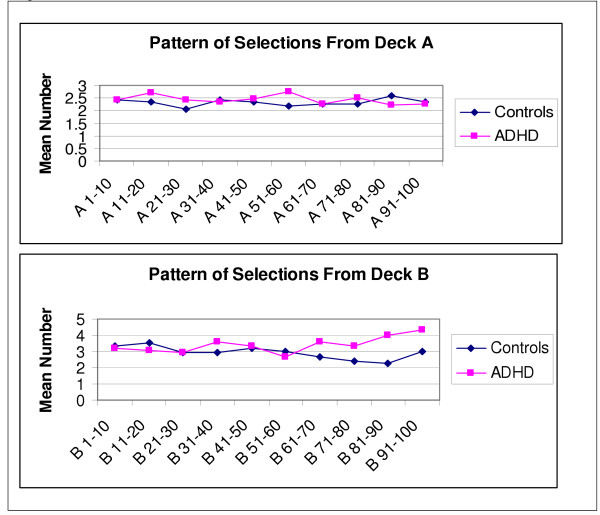
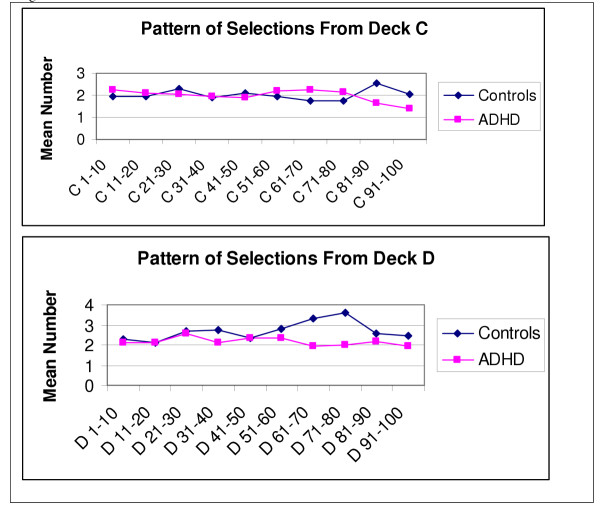
Verification
Claims the paper makes
The claims and statistics of this paper haven’t been checked yet.
Free: it reads the open-access text and checks the first 5 claims that cite a source we can check. Create a free account to check every claim.
Claims other papers make about this one
Each is checked against this paper’s own text: does it say what the citing paper says it does?
The cited source doesn’t support the claim as written.
In the citing paper
“participants with ADHD-C and ADHD-H [52], [54] (2/15 = 13% of studies with null findings)”
From Risky behavior in gambling tasks in individuals with ADHD–a systematic literature review (2013) · cites this paper as [52]
Checked by a reasoning model — may be wrong.
Experimental — accuracy not yet measuredThe source backs part of the claim, not all of it — or backs it for a different population, condition or comparison.
In the citing paper
“Astle and Fletcher-Watson (2020) suggested that this was because studies often used strict exclusion criteria that excluded children with co-occurring difficulties (Willcutt et al., 2001; Toplak et al., 2005).”
From Executive Functions in Neurodevelopmental Disorders: Comorbidity Overlaps Between Attention Deficit and Hyperactivity Disorder and Specific Learning Disorders (2021) · cites this paper as Toplak et al., 2005
Experimental — accuracy not yet measuredThe source backs part of the claim, not all of it — or backs it for a different population, condition or comparison.
In the citing paper
“No group differences were found in the net score and financial outcome of the ADHD group compared to the NCs.”
From Risky behavior in gambling tasks in individuals with ADHD–a systematic literature review (2013) · cites this paper as [52]
Experimental — accuracy not yet measuredThe source backs part of the claim, not all of it — or backs it for a different population, condition or comparison.
In the citing paper
“No difference was found in net score between these two subtypes of ADHD.”
From Risky behavior in gambling tasks in individuals with ADHD–a systematic literature review (2013) · cites this paper as [52]
Experimental — accuracy not yet measuredThe source backs part of the claim, not all of it — or backs it for a different population, condition or comparison.
In the citing paper
“This supports the idea that individuals with ADHD are more sensitive for the frequency than the magnitude of penalties.”
From Risky behavior in gambling tasks in individuals with ADHD–a systematic literature review (2013) · cites this paper as [52]
Experimental — accuracy not yet measured
11 more claims about this paper
Create a free account to see every claim other papers make about this one.
Self-check
Percentages, sums and reported differences re-computed from the paper’s own numbers.
The self-check needs the paper’s full text.
Citations
Cites
Tabachnick, B. G., & Fidell, L. S. (1983) · Cited by 80,058
Diagnostic and Statistical Manual of Mental Disorders, Fourth Edition, Text Revision (DSM-IV-TR)
American Psychiatric Association (2000) · doi:10.1176/appi.books.9780890423349 · Cited by 11,069
(1994) · DigitalGeorgetown (Georgetown University Library) · Cited by 10,542
KAUFMAN, J., BIRMAHER, B., BRENT, D., RAO, U., FLYNN, C., MORECI, P., WILLIAMSON, D., & RYAN, N. (1997) · Journal of the American Academy of Child & Adolescent Psychiatry · doi:10.1097/00004583-199707000-00021 · Cited by 10,148
Cohen, J. (1992) · Psychological Bulletin · doi:10.1037//0033-2909.112.1.155 · Cited by 8,771
DESCARTES' ERROR: Emotion, Reason, and the Human Brain
Marg, E. (1995) · Optometry and Vision Science · doi:10.1002/j.1538-9235.1995.tb03988.x · Cited by 8,118
Insensitivity to future consequences following damage to human prefrontal cortex
Bechara, A., Damasio, A. R., Damasio, H., & Anderson, S. W. (1994) · Cognition · doi:10.1016/0010-0277(94)90018-3 · Cited by 6,128
The feeling of what happens: body and emotion in the making of consciousness
(2000) · Choice Reviews Online · doi:10.5860/choice.37-6553 · Cited by 5,998
Wechsler Intelligence Scale for Children
(2018) · The SAGE Encyclopedia of Intellectual and Developmental Disorders · doi:10.4135/9781483392271.n537 · Cited by 4,109
PINKER, S. (1999) · Annals of the New York Academy of Sciences · doi:10.1111/j.1749-6632.1999.tb08538.x · Cited by 3,738
Research works printed but not linked: 3
- Wechsler D Wechsler Abbreviated Scale of Intelligence (WASI) 1999 USA: The Psychological Corporation
- Kaplan E Fein D Kramer J Delis D Morris R WISC-III-PI Manual 1999 U.S.A: The Psychological Corporation
- Douglas VI Bloomingdale L The response of ADD children to reinforcement: Theoretical and clinical implications Attention deficit disorder: Identification, course and treatment rationale 1985 New York: Spectrum Press 49 66
Cited by
Items 101–200 of 302
Sørensen, L., Sonuga-Barke, E. J. S., Eichele, H., van Wageningen, H., Wollschlaeger, D., & Plessen, K. J. (2017) · Neuropsychology · doi:10.1037/neu0000297 · Cited by 45
Buelow, M. T., Okdie, B. M., & Blaine, A. L. (2013) · Frontiers in Psychology · doi:10.3389/fpsyg.2013.00773 · Cited by 42
Cognitive impulsivity in Parkinson's disease patients: Assessment and pathophysiology
Robert, G. H., Drapier, D., Vérin, M., Millet, B., Azulay, J., & Blin, O. (2009) · Movement Disorders · doi:10.1002/mds.22836 · Cited by 40
Lao, Y., Wang, Y., Shi, J., Ceschin, R. C., Nelson, M. D., Panigrahy, A., & Leporé, N. (2014) · Brain Structure and Function · doi:10.1007/s00429-014-0921-7 · Cited by 37
Williams, T. S., Roberts, S. D., Coppens, A. M., Crosbie, J., Dlamini, N., & Westmacott, R. (2017) · Child Neuropsychology · doi:10.1080/09297049.2017.1333091 · Cited by 41
Aram, S., Levy, L. B., Patel, J. B., Anderson, A. A., Zaragoza, R., Dashtestani, H., Chowdhry, F. A., Gandjbakhche, A., & Tracy, J. K. (2019) · SAGE Open · doi:10.1177/2158244019856911 · Cited by 44
A novel task for examining strategic planning: Evidence for impairment in children with ADHD
Kofman, O., Larson, J. G., & Mostofsky, S. H. (2008) · Journal of Clinical and Experimental Neuropsychology · doi:10.1080/13803390701380583 · Cited by 38
Krieger, V., Amador, J. A., & Gallardo‐Pujol, D. (2019) · Journal of Clinical and Experimental Neuropsychology · doi:10.1080/13803395.2019.1599824 · Cited by 39
Temporal processing impairment in children with attention-deficit-hyperactivity disorder
Huang, J., Yang, B., Zou, X., Jin, J., Pen, G., McAlonan, G. M., & Chan, R. C. K. (2011) · Research in Developmental Disabilities · doi:10.1016/j.ridd.2011.10.021 · Cited by 41
Risky bicycling behavior among youth with and without attention‐deficit hyperactivity disorder
Nikolas, M. A., Elmore, A. L., Franzen, L., O’Neal, E. E., Kearney, J. K., & Plumert, J. M. (2015) · Journal of Child Psychology and Psychiatry · doi:10.1111/jcpp.12491 · Cited by 37
Lu, W.-H., Chou, W., Hsiao, R. C.-J., Hu, H., & Yen, C. (2019) · Frontiers in Psychiatry · doi:10.3389/fpsyt.2019.00268 · Cited by 36
Effects of the History of Conduct Disorder on the Iowa Gambling Tasks
Kim, Y., Lee, S. J., & Kim, S. (2006) · Alcoholism Clinical and Experimental Research · doi:10.1111/j.1530-0277.2006.00051.x · Cited by 39
Miguel, C. S., Martins, P. A., Moleda, N., Klein, M., Chaim-Avancini, T. M., Gobbo, M. A., Alves, T. M., da Silva, M. A., & Louzã, M. R. (2016) · Drug and Alcohol Dependence · doi:10.1016/j.drugalcdep.2015.12.040 · Cited by 37
Using Dual Process Models to Examine Impulsivity Throughout Neural Maturation
Leshem, R. (2016) · Developmental Neuropsychology · doi:10.1080/87565641.2016.1178266 · Cited by 37
Wilson, T. W., Heinrichs‐Graham, E., White, M. L., Knott, N. L., & Wetzel, M. W. (2013) · Neuropsychology · doi:10.1037/a0034032 · Cited by 39
Amphetamine Modestly Improves Conners’ Continuous Performance Test Performance in Healthy Adults
MacQueen, D. A., Minassian, A., Henry, B. L., Geyer, M. A., Young, J. W., & Perry, W. (2017) · Journal of the International Neuropsychological Society · doi:10.1017/s135561771700090x · Cited by 29
Effects of developmental nicotine exposure in rats on decision-making in adulthood
Mitchell, M. R., Mendez, I. A., Vokes, C. M., Damborsky, J. C., Winzer‐Serhan, U. H., & Setlow, B. (2011) · Behavioural Pharmacology · doi:10.1097/fbp.0b013e32834eb04a · Cited by 31
Negative Affectivity Predicts Individual Differences in Decision Making for Preschoolers
Garon, N., & Moore, C. L. (2007) · The Journal of Genetic Psychology · doi:10.3200/gntp.167.4.443-462 · Cited by 34
Miura, H. (2009) · Psychiatry and Clinical Neurosciences · doi:10.1111/j.1440-1819.2009.01935.x · Cited by 30
The uncertainty appraisal enhances the prominent deck B effect in the Iowa gambling task
İyilikci, E. A., & Amado, S. (2017) · Motivation and Emotion · doi:10.1007/s11031-017-9643-5 · Cited by 32
Rahimi‐Golkhandan, S., Steenbergen, B., Piek, J. P., & Wilson, P. H. (2014) · Human Movement Science · doi:10.1016/j.humov.2014.09.008 · Cited by 32
Zhou, B., Zhang, W., Li, Y., Xue, J., & Zhang‐James, Y. (2020) · Psychiatry Research · doi:10.1016/j.psychres.2020.112814 · Cited by 31
Leshem, R., Fano, A. D., & Ben‐Soussan, T. D. (2020) · Frontiers in Psychology · doi:10.3389/fpsyg.2020.00940 · Cited by 34
Rahimi‐Golkhandan, S., Piek, J. P., Steenbergen, B., & Wilson, P. H. (2014) · Cognitive Development · doi:10.1016/j.cogdev.2014.06.002 · Cited by 37
Kibby, M. Y., Newsham, G., Imre, Z., & Schlak, J. E. (2021) · Child Neuropsychology · doi:10.1080/09297049.2021.1908532 · Cited by 31
Mata, F., Neves, F. S., Lage, G. M., de Moraes, P. H. P., Mattos, P., Fuentes, D., Corrêa, H., & Malloy‐Diniz, L. F. (2011) · Archives of Clinical Psychiatry (São Paulo) · doi:10.1590/s0101-60832011000300005 · Cited by 53
Soliva, J. C., Carmona, S., Fauquet, J., Hoekzema, E., Bulbena, A., Hilferty, J., & Vilarroya, O. (2009) · Annals of the New York Academy of Sciences · doi:10.1111/j.1749-6632.2009.04604.x · Cited by 25
Taylor, C. L., Zaghi, A. E., Kaufman, J. C., Reis, S. M., & Renzulli, J. S. (2018) · The Journal of Creative Behavior · doi:10.1002/jocb.370 · Cited by 37
Hu, X., Beard, K., Sherbel, M. C., Nascimento, T. D., Petty, S., Pantzlaff, E., Schwitzer, D., Kaciroti, N., Maslowski, E., Ashman, L. M., et al. (2021) · Journal of Medical Internet Research · doi:10.2196/27298 · Cited by 30
Hovik, K. T., Plessen, K. J., Cavanna, A. E., Skogli, E. W., Andersen, P. N., & Øie, M. G. (2015) · PLoS ONE · doi:10.1371/journal.pone.0144874 · Cited by 31
A Peer-Delivered Intervention for High School Students With Impairing ADHD Symptoms
Sibley, M. H., Morley, C., Rodriguez, L. M., Coxe, S. J., Evans, S. W., Morsink, S., & Torres, F. (2020) · School Psychology Review · doi:10.1080/2372966x.2020.1720803 · Cited by 26
Miller, M. R., Sheridan, M. A., Cardoos, S. L., & Hinshaw, S. P. (2012) · Journal of the International Neuropsychological Society · doi:10.1017/s1355617712000975 · Cited by 27
Miura, H., & Fuchigami, Y. (2016) · Criminal Behaviour and Mental Health · doi:10.1002/cbm.1993 · Cited by 27
Lincă, F. I., Budișteanu, M., Popovici, D. V., & Cucu, N. (2022) · Children · doi:10.3390/children9111637 · Cited by 28
Brown, A. J., & Casey, B. (2016) · Journal of Educational and Developmental Psychology · doi:10.5539/jedp.v6n1p204 · Cited by 35
Bexkens, A., Jansen, B. R. J., van der Molen, M. W., & Huizenga, H. M. (2015) · Research on Child and Adolescent Psychopathology · doi:10.1007/s10802-015-9996-8 · Cited by 28
Kroyzer, N., Gross‐Tsur, V., & Pollak, Y. (2014) · The Journal of Nervous and Mental Disease · doi:10.1097/nmd.0000000000000100 · Cited by 24
Sibley, M. H., & Yegüez, C. E. (2018) · School Mental Health · doi:10.1007/s12310-018-9273-4 · Cited by 26
Exploring decision-making strategies in the Iowa gambling task and rat gambling task
Hultman, C., Tjernström, N., Vadlin, S., Rehn, M., Nilsson, K. W., Roman, E., & Åslund, C. (2022) · Frontiers in Behavioral Neuroscience · doi:10.3389/fnbeh.2022.964348 · Cited by 25
Buelow, M. T., & Suhr, J. A. (2012) · Applied Neuropsychology Child · doi:10.1080/21622965.2012.691065 · Cited by 23
Abouzari, M., Oberg, S., Gruber, A. J., & Tata, M. S. (2015) · Behavioural Brain Research · doi:10.1016/j.bbr.2015.05.041 · Cited by 27
Mice Gamble for Food: Individual Differences in Risky Choices and Prefrontal Cortex Serotonin
Pittaras, E., Cressant, A., Serreau, P., Bruijel, J., Dellu-Hagedorn, F., Callebert, J., Rabat, A., & Granon, S. (2013) · Journal of Addiction Research & Therapy · doi:10.4172/2155-6105.s4-011 · Cited by 25
Right Superior Frontal Gyrus Cortical Thickness in Pediatric ADHD
Hai, T., Swansburg, R. M., Kahl, C. K., Frank, H., Stone, K. D., Lemay, J.-F., & MacMaster, F. P. (2022) · Journal of Attention Disorders · doi:10.1177/10870547221110918 · Cited by 23
Dinu, L. M., Singh, S. N., Baker, N. S., Georgescu, A. L., Singer, B. F., Overton, P. G., & Dommett, E. J. (2023) · Behavioral Sciences · doi:10.3390/bs13020129 · Cited by 24
Quantitative EEG in Childhood Attention Deficit Hyperactivity Disorder and Learning Disabilities
Chiarenza, G. A. (2020) · Clinical EEG and Neuroscience · doi:10.1177/1550059420962343 · Cited by 24
Silveira, M. M., Murch, W. S., Clark, L., & Winstanley, C. A. (2015) · Behavioural Pharmacology · doi:10.1097/fbp.0000000000000203 · Cited by 23
Heterogeneity in choices on Iowa Gambling Task: preference for infrequent–high magnitude punishment
Singh, V., & Khan, A. (2009) · Mind & Society · doi:10.1007/s11299-008-0050-1 · Cited by 12
Oram, R., Rogers, M., & DuPaul, G. J. (2019) · Canadian Journal of School Psychology · doi:10.1177/0829573519880063 · Cited by 23
Rahimi‐Golkhandan, S., Steenbergen, B., Piek, J. P., & Wilson, P. H. (2015) · Radboud Repository (Radboud University) · doi:10.1016/j.humov.2015.06.004 · Cited by 9
Underlying decision making processes on Iowa Gambling Task
Kumar, R., Kumar, K. J., & Benegal, V. (2018) · Asian Journal of Psychiatry · doi:10.1016/j.ajp.2018.12.006 · Cited by 21
Jacobson, L. T., & Reid, R. R. (2012) · Exceptionality · doi:10.1080/09362835.2012.724624 · Cited by 25
Feedback May Harm: Role of Feedback in Probabilistic Decision Making of Adolescents with ADHD
Pollak, Y., & Shoham, R. (2015) · Research on Child and Adolescent Psychopathology · doi:10.1007/s10802-015-0016-9 · Cited by 19
Ledochowski, J., Andrade, B. F., & Toplak, M. E. (2019) · Journal of Clinical and Experimental Neuropsychology · doi:10.1080/13803395.2019.1567694 · Cited by 16
Self-citationThomson, D. M., Openshaw, R. L., Mitchell, E. J., Kouskou, M., Millan, M. J., la Cour, C. M., Morris, B., & Pratt, J. A. (2020) · Genes Brain & Behavior · doi:10.1111/gbb.12710 · Cited by 14
Leshem, R., & Glicksohn, J. (2012) · Developmental Neuropsychology · doi:10.1080/87565641.2012.718815 · Cited by 19
Barnhart, W. R., & Buelow, M. T. (2021) · Assessment · doi:10.1177/10731911211004741 · Cited by 18
Yoo, J. Y., & Kim, M. S. (2016) · Neuropsychiatry · doi:10.4172/neuropsychiatry.1000156 · Cited by 18
Lin, C.-H., Wang, C.-C., Sun, J.-H., Ko, C., & Chiu, Y.-C. (2019) · Frontiers in Psychiatry · doi:10.3389/fpsyt.2019.00232 · Cited by 20
Sallum, I., Mata, F., de Miranda, D. M., & Malloy‐Diniz, L. F. (2013) · Frontiers in Psychology · doi:10.3389/fpsyg.2013.00899 · Cited by 16
Weller, J. A., Parker, A. M., Reynolds, M., & Kirisci, L. (2020) · Addictive Behaviors · doi:10.1016/j.addbeh.2020.106650 · Cited by 15
Disadvantageous Deck Selection in the Iowa Gambling Task: The Effect of Cognitive Load
Hawthorne, M. J., & Pierce, B. H. (2015) · Europe’s Journal of Psychology · doi:10.5964/ejop.v11i2.931 · Cited by 17
Bigorra, A., Garolera, M., Guijarro, S., & Hervas, A. (2016) · Neuropsychiatry · doi:10.4172/neuropsychiatry.1000147 · Cited by 18
Wagner, F., Rohde, L. A., & Trentini, C. M. (2016) · Psico-USF · doi:10.1590/1413-82712016210311 · Cited by 42
Shafiee‐Kandjani, A. R., Mohammadzadeh, Z., Amiri, S., Arfaie, A., Sarbakhsh, P., & Safikhanlou, S. (2020) · international journal high risk behaviors & addiction · doi:10.5812/ijhrba.98997 · Cited by 15
Schulze, M., Coghill, D., Lux, S., & Philipsen, A. (2021) · Frontiers in Psychiatry · doi:10.3389/fpsyt.2021.519840 · Cited by 14
It's All in How You Think About It: Construal Level and the Iowa Gambling Task
Okdie, B. M., Buelow, M. T., & Bevelhymer-Rangel, K. (2016) · Frontiers in Neuroscience · doi:10.3389/fnins.2016.00002 · Cited by 19
Chiarenza, G. A., Villa, S., Galán, L., Valdes-Sosa, P. A., & Bosch‐Bayard, J. (2018) · International Journal of Psychophysiology · doi:10.1016/j.ijpsycho.2018.05.007 · Cited by 14
Dual conception of risk in the Iowa Gambling Task: effects of sleep deprivation and test-retest gap
Singh, V. (2013) · Frontiers in Psychology · doi:10.3389/fpsyg.2013.00628 · Cited by 13
Evidence of Altered Habenular Intrinsic Functional Connectivity in Pediatric ADHD
Arfuso, M., Salas, R., Castellanos, F. X., & Roy, A. K. (2019) · Journal of Attention Disorders · doi:10.1177/1087054719843177 · Cited by 11
Fogleman, N. D., Naaz, F., Knight, L. K., Stoica, T., Patton, S. C., Olson-Madden, J. H., Barnhart, M. C., Hostetter, T. A., Forster, J. E., Brenner, L. A., et al. (2017) · Psychiatry Research Neuroimaging · doi:10.1016/j.pscychresns.2017.06.014 · Cited by 15
Attention, Motivation, and Reading Coherence Failure: A Neuropsychological Perspective
Wasserman, T. H. (2012) · Applied Neuropsychology Adult · doi:10.1080/09084282.2011.643940 · Cited by 13
Becker, L., Keck, A., Rohleder, N., & Müller, N. (2022) · Frontiers in Behavioral Neuroscience · doi:10.3389/fnbeh.2022.883926 · Cited by 14
Decision making and somatic markers in conversation after traumatic brain injury
Body, R. (2007) · Aphasiology · doi:10.1080/02687030600911450 · Cited by 14
Randolph, J. J., & Chaytor, N. S. (2013) · Springer eBooks · doi:10.1007/978-1-4614-6605-5_5 · Cited by 16
Lin, C.-H., Song, T.-J., Lin, Y.-K., & Chiu, Y.-C. (2012) · PLoS ONE · doi:10.1371/journal.pone.0047202 · Cited by 12
van der Meer, D., Hartman, C. A., van Rooij, D., Franke, B., Heslenfeld, D. J., Oosterlaan, J., Faraone, S. V., Buitelaar, J. K., & Hoekstra, P. J. (2017) · Journal of Psychiatry and Neuroscience · doi:10.1503/jpn.150350 · Cited by 16
Haas, S. M., Derefinko, K. J., & Waschbusch, D. A. (2017) · Personality and Individual Differences · doi:10.1016/j.paid.2017.04.028 · Cited by 10
Orm, S., Pollak, Y., Fossum, I. N., Andersen, P. N., Øie, M. G., & Skogli, E. W. (2022) · Developmental Neuropsychology · doi:10.1080/87565641.2022.2082430 · Cited by 10
O Iowa Gambling Task: uma revisão crítica
Areias, G., Paixão, R. A. P., & Figueira, A. P. C. (2013) · Psicologia Teoria e Pesquisa · doi:10.1590/s0102-37722013000200009 · Cited by 23
Heterogeneity of decision-making strategies for preschoolers on a variant of the IGT
Garon, N., & English, S. D. (2021) · Applied Neuropsychology Child · doi:10.1080/21622965.2021.1973470 · Cited by 9
Kim, M., & Seo, J. (2021) · Journal of Psychiatric Research · doi:10.1016/j.jpsychires.2021.07.044 · Cited by 11
León, J. J., Fernández‐Martín, P., González-Rodríguez, A., Rodríguez‐Herrera, R., García-Pinteño, J., Pérez-Fernández, C., Sánchez-Kuhn, A., Amaya‐Pascasio, L., Ontoso, M. S., Martínez‐Sánchez, P., et al. (2023) · Addictive Behaviors · doi:10.1016/j.addbeh.2023.107683 · Cited by 10
Buelow, M. T., Wirth, J. H., & Kowalsky, J. M. (2023) · Journal of American College Health · doi:10.1080/07448481.2023.2186129 · Cited by 9
Graziano, P. A., Sibley, M. H., Coxe, S. J., Bickman, L., Martin, P., Scheres, A., & Hernandez, M. L. (2023) · Behavior Therapy · doi:10.1016/j.beth.2023.08.001 · Cited by 7
Gerlach, M., Deckert, J., Rothenberger, A., & Warnke, A. (2008) · Journal of Neural Transmission · doi:10.1007/s00702-007-0870-x · Cited by 8
The Role of the Circadian System in Attention Deficit Hyperactivity Disorder
Bondopadhyay, U., Díaz-Orueta, U., & Coogan, A. N. (2021) · Advances in experimental medicine and biology · doi:10.1007/978-3-030-81147-1_7 · Cited by 8
Bob, P., & Privara, M. (2025) · Frontiers in Psychiatry · doi:10.3389/fpsyt.2025.1536207 · Cited by 13
Şandor, S. (2018) · Journal of Clinical Psychiatry · doi:10.5505/kpd.2018.28291 · Cited by 8
Magnetoencephalography Coherence Source Imaging in Dyslexia: Activation of Working Memory Pathways
Mansour, A., Bowyer, S. M., Richard, A. E., Moran, J. E., Erdődi, L. A., Olszewski, A. K., Pawluk, L., Jacobson, D., Vogt, K., Moore, A. M., et al. (2014) · Psychology · doi:10.4236/psych.2014.516193 · Cited by 6
Recollecting Cross-Cultural Evidences: Are Decision Makers Really Foresighted in Iowa Gambling Task?
Lee, W.-K., Lin, C.-J., Liu, L., Lin, C.-H., & Chiu, Y.-C. (2020) · Frontiers in Psychology · doi:10.3389/fpsyg.2020.537219 · Cited by 7
A Simplified Model of Choice Behavior under Uncertainty
Lin, C.-H., Lin, Y.-K., Song, T.-J., Huang, J.-T., & Chiu, Y.-C. (2016) · Frontiers in Psychology · doi:10.3389/fpsyg.2016.01201 · Cited by 7
Chronaki, G., Benikos, N., Soltész, F., & Sonuga-Barke, E. J. S. (2019) · NeuroImage Clinical · doi:10.1016/j.nicl.2019.101917 · Cited by 7
The perils of acting rashly: Risk-taking propensity impeding emotion-based learning in entrepreneurs
Seloni, G., Kusrohmaniah, S., & Lufityanto, G. (2023) · Journal of International Entrepreneurship · doi:10.1007/s10843-022-00325-y · Cited by 9
Rosi, A., Cavallini, E., Gamboz, N., & Russo, R. (2016) · Judgment and Decision Making · doi:10.1017/s1930297500007294 · Cited by 9
Anning, K. L., Langley, K., Hobson, C. W., de Sonneville, L. M. J., & van Goozen, S. H. M. (2023) · Child Neuropsychology · doi:10.1080/09297049.2023.2190964 · Cited by 7
Anning, K. L., Langley, K., Hobson, C. W., & van Goozen, S. H. M. (2024) · European Child & Adolescent Psychiatry · doi:10.1007/s00787-023-02344-z · Cited by 10
Dinu, L. M., Singh, S. N., Baker, N. S., Georgescu, A. L., Overton, P. G., & Dommett, E. J. (2023) · PLoS ONE · doi:10.1371/journal.pone.0294911 · Cited by 8
Learning Process During Risk Detection in Adolescents With ADHD
Medrano, E., Flóres-Lázaro, J. C., & Nicolini, H. (2015) · Journal of Attention Disorders · doi:10.1177/1087054715573995 · Cited by 7
Saadani‐Makki, F., Aarabi, A., Fouladivanda, M., Kazemi, K., & Makki, M. (2021) · Diagnostics · doi:10.3390/diagnostics11030560 · Cited by 3
Sanwald, S., Montag, C., & Kiefer, M. (2022) · Journal of Molecular Neuroscience · doi:10.1007/s12031-022-02019-5 · Cited by 4
Metadata
- Authors
- Toplak, M. E., Jain, U., & Tannock, R.
- Affiliations
- Hospital for Sick Children (CA)
- Centre for Addiction and Mental Health (CA)
- Norwegian Academy of Science and Letters (NO)
- Corresponding author
- Toplak, Maggie E
- ORCID
- Toplak, Maggie E
- Venue
- Behavioral and Brain Functions
- Published
- 2005-06-27
- Volume
- 1
- Issue
- 1
- Pages
- 8-8
- ISSN
- 1744-9081 (ISSN-L)
- PMC
- PMC1183187
- OpenAlex
- W1923665259
- Cited by
- 303
- References
- 66
- Citations by year
- 2026: 7 · 2025: 4 · 2024: 28 · 2023: 11 · 2022: 7 · 2021: 18 · 2020: 11 · 2019: 16 · 2018: 10 · 2017: 14 · 2016: 23 · 2015: 21 · 2014: 12 · 2013: 22 · 2012: 16
- FWCI
- 7.05
- Type
- journal article
- Language
- en
- Open access
- gold
- doi.org
- Licence
- cc-by
- Locations
- Behavioral and Brain Functions (publishedVersion, cc-by)
- PubMed Central (publishedVersion, cc-by)
- PubMed (publishedVersion)
- DOAJ (DOAJ: Directory of Open Access Journals) (submittedVersion, cc-by-sa)
- Funders
- National Institutes of Health (5r21mh066393-03)
- Canadian Institutes of Health Research
- National Institute of Mental Health (R21-MH066393)
- Topics
- Health Sciences › Medicine › Psychiatry and Mental health › Attention Deficit Hyperactivity Disorder
- Life Sciences › Neuroscience › Cognitive Neuroscience › Neural and Behavioral Psychology Studies
- Social Sciences › Psychology › Neuropsychology and Physiological Psychology › Developmental and Educational Neuropsychology
- Keywords
- attention deficit hyperactivity disorder, adolescents, decision-making, decision making under risk, Iowa Gambling Task, executive function, motivation, working memory, hyperactivity/impulsivity, dual-pathway model, intellectual ability
About these checks
Registry, retraction, Cites and statistics results are computed, not judged, with one exception: a printed reference that no index lists is read once by a model before it counts as a citation error. Claims are extracted by a model and kept only when their quote appears verbatim in the text; each cited source is then checked, with a model’s help, for whether it says what the claim relies on. Those verdicts can be wrong — read the claim’s quote and the cited source before relying on one.
Statistics and arithmetic are recomputed, not judged.
Confidence bands are shown only for fields calibrated on our annotated test set. None is calibrated yet, so no band is shown.
What counts as a claim ›How we measure confidence ›How we check this ›
Are you an author, or do you see a problem with this page? Request a review
Data sources
Bibliographic data: Semantic Scholar, OpenAlex, Crossref.
Contains information from the Semantic Scholar Academic Graph Datasets, made available under the ODC Attribution License (ODC-BY 1.0).
Semantic Scholar’s data is described in: Kinney, R., et al. (2023). The Semantic Scholar Open Data Platform. arXiv:2301.10140.
