

The DOI matches its Crossref record; 7 of the 7 references it cites were found in a registry or an index.
Is deck C an advantageous deck in the Iowa Gambling Task?
Overview
The claims and statistics of this paper haven’t been checked yet.
Run the check — free, no account needed. It reads the open-access text and checks the sources it cites.
Integrity signals
Registry
Cites
Statistics
Figures
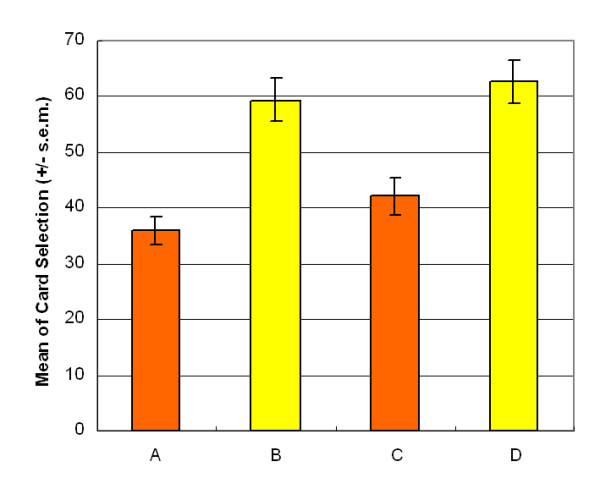
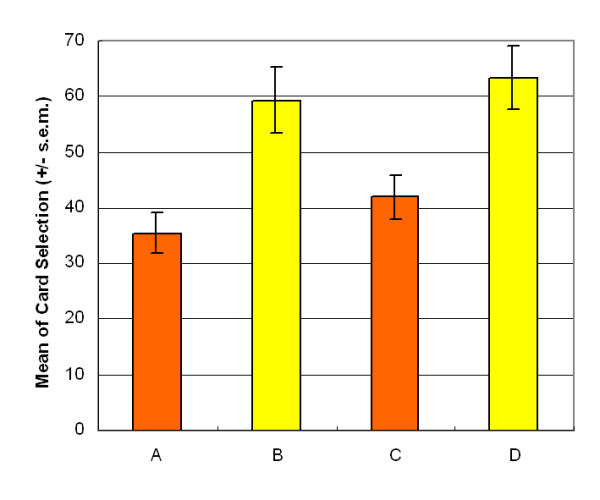
Verification
Claims the paper makes
The claims and statistics of this paper haven’t been checked yet.
Run the check — free, no account needed. It reads the open-access text and checks the sources it cites.
Claims other papers make about this one
Each is checked against this paper’s own text: does it say what the citing paper says it does?
In the citing paper
“whereas deck C′ that was considered “safe” is avoided by healthy participants (Chiu and Lin, 2007).”
From Dual conception of risk in the Iowa Gambling Task: effects of sleep deprivation and test-retest gap (2013) · cites this paper as Chiu and Lin, 2007
In the citing paper
“whereas deck C′ that was considered “safe” is avoided by healthy participants (Chiu and Lin, 2007).”
From Dual conception of risk in the Iowa Gambling Task: effects of sleep deprivation and test-retest gap (2013) · cites this paper as Chiu and Lin, 2007
Self-check
Percentages, sums and reported differences re-computed from the paper’s own numbers.
The self-check needs the paper’s full text.
Citations
Cites
Prospect Theory: An Analysis of Decision under Risk
Kahneman, D., & Tversky, A. (1979) · Econometrica · doi:10.2307/1914185 · Cited by 48,524
The Framing of Decisions and the Psychology of Choice
Tversky, A., & Kahneman, D. (1981) · Science · doi:10.1126/science.7455683 · Cited by 18,497
Maps of Bounded Rationality: Psychology for Behavioral Economics
Kahneman, D. (2003) · American Economic Review · doi:10.1257/000282803322655392 · Cited by 5,377
The somatic marker hypothesis and the possible functions of the prefrontal cortex
Damasio, A. R. (1996) · Philosophical Transactions of the Royal Society of London. Series B: Biological Sciences · doi:10.1098/rstb.1996.0125 · Cited by 2,847
Different contributions of the human amygdala and ventromedial prefrontal cortex to decision-making
Bechara, A., Damasio, H., Damasio, A. R., & Lee, G. P. (1999) · The Journal of Neuroscience · doi:10.1523/jneurosci.19-13-05473.1999 · Cited by 2,001
DAMASIO, A. (1990) · Behavioural Brain Research · doi:10.1016/0166-4328(90)90144-4 · Cited by 1,275
Toplak, M. E., Jain, U., & Tannock, R. (2005) · Behavioral and Brain Functions · doi:10.1186/1744-9081-1-8 · Cited by 303
Research works printed but not linked: 40
- Damasio H Graboeski T Frank R Galaburda A Damasio AR The return of Phineas Gage: Clues about the brain from the skull of a famous patient Science 1994 264 1102 1105 8178168 10.1126/science.8178168 · DOI
- Bechara A Damasio AR Damasio H Anderson SW Insensitivity to future consequences following damage to human prefrontal cortex Cognition 1994 50 7 15 8039375 10.1016/0010-0277(94)90018-3 · DOI · Paper page
- Bechara A Damasio H Tranel D Damasio AR Deciding advantageously before knowing the advantageous strategy Science 1997 275 1293 1295 9036851 10.1126/science.275.5304.1293 · DOI · Paper page
- Bechara A Damasio H Tranel D Anderson SW Dissociation Of working memory from decision making within the human prefrontal cortex J Neurosci 1998 18 428 437 9412519 PMC6793407
- Bowman CH Evans CEY Turnbull OH Artificial time constraints on the Iowa Gambling Task: The effects on behavioral performance and subjective experience Brain Cogn 2005 57 21 25 15629209 10.1016/j.bandc.2004.08.015 · DOI · Paper page
- Glimcher P Neuroeconomics: the consilience of brain and decision Science 2004 306 447 452 15486291 10.1126/science.1102566 · DOI
- Shiv B Loewenstein G Bechara A Damasio H Damasio AR Investment behavior and the negative side of emotion Psychol Sci 2004 16 435 439 15943668
- Dunn BD Dalgleish T Lawrence AD The somatic marker hypothesis: A critical evaluation Neurosci Biobehav Rev 2006 30 239 271 16197997 10.1016/j.neubiorev.2005.07.001 · DOI · Paper page
- Lin CH Chiu YC Lee PL Hsieh JC Is deck B a disadvantageous deck in the Iowa Gambling Task? Behav Brain Funct 2007 3 16 17362508 10.1186/1744-9081-3-16 PMC1839101 · DOI · Paper page
- Lin CH Chiu YC Lee PL Hsieh JC The preferences of decision-making in IOWA Gambling Task: The testing of frequency effect and long-term outcomes in Somatic Marker Hypothesis Proceedings of 2nd Conference of NeuroEconomics: 2004; Münster, Germany 2004
- Chiu YC Lin CH Huang JT Lin S Lee PL Hsieh JC Immediate gain is long-term loss: Are there foresighted decision makers in Iowa gambling task? Proceedings of Society for Neuroeconomics 3rd Annual Meeting: September 15–18 2005; Kiawah Island, South Carolina, USA 2005
- Bechara A Tranel D Damasio H Damasio AR Characterization of the decision-making deficit of patients with ventromedial prefrontal cortex lesions Brain 2000 123 2189 2202 11050020 10.1093/brain/123.11.2189 · DOI
- Wilder KE Weinberger DR Goldberg TE Operant conditioning and the orbitofrontal cortex in schizophrenic patients: unexpected evidence for intact functioning Schizophr Res 1998 30 169 174 9549781 10.1016/S0920-9964(97)00135-7 · DOI · Paper page
- Ritter LM Meador-Woodruff JH Dalack GW Neurocognitive measures of prefrontal cortical dysfunction in schizophrenia Schizophr Res 2004 68 65 73 15037340 10.1016/S0920-9964(03)00086-0 · DOI
- O'Carroll RE Papps BP Decision making in humans: the effect of manipulating the central noradrenergic system J Neurol Neurosurg Psychiatry 2003 74 376 378 12588933 10.1136/jnnp.74.3.376 PMC1738336 · DOI
- Overman WH Frassrand K Ansel S Trawalter S Bies B Redmond A Performance on the IOWA card task by adolescents and adults Neuropsychologia 2004 42 1838 1851 15351632 10.1016/j.neuropsychologia.2004.03.014 · DOI
- Bark R Dieckmann S Bogerts B Northoff G Deficit in decision making in catatonic schizophrenia: an exploratory study Psychiatry Res 2005 134 131 141 15840414 10.1016/j.psychres.2004.04.013 · DOI · Paper page
- Rodriguez-Sanchez JM Crespo-Facorro B Perez-Iglesias R Gonzalez-Blanch C Alvarez-Jimenez M Llorca J Vazquez-Barquero JL Prefrontal cognitive functions in stabilized first-episode patients with schizophrenia spectrum disorders: a dissociation between dorsolateral and orbitofrontal functioning Schizophr Res 2005 77 279 288 15950437 10.1016/j.schres.2005.04.023 · DOI
- Fernie G Tunney RJ Some decks are better than others: the effect of reinforcer type and task instructions on learning in the Iowa Gambling Task Brain Cogn 2006 60 94 102 16271818 10.1016/j.bandc.2005.09.011 · DOI
- Caroselli JS Hiscock M Scheibel RS Ingram F The simulated gambling paradigm applied to young adults: an examination of university students' performance Appl Neuropsychol 2006 13 203 212 17362140 10.1207/s15324826an1304_1 · DOI
- Crone EA Somsen RJM van Beek B van Der Molen MW Heart rate and skin conductance analysis of antecendents and consequences of decision making Psychophysiology 2004 41 531 540 15189476 10.1111/j.1469-8986.2004.00197.x · DOI
- Martino DJ Bucay D Butman JT Allegri RF Neuropsychological frontal impairments and negative symptoms in schizophrenia Psychiatry Res 2007 17507100
- Overman W Graham L Redmond A Eubank R Boettcher L Samplawski O Walsh K Contemplation of moral dilemmas eliminates sex differences on the Iowa gambling task Behav Neurosci 2006 120 817 825 16893287 10.1037/0735-7044.120.4.817 · DOI
- Maia TV McClelland JL A reexamination of the evidence for the somatic marker hypothesis: what participants really know in the Iowa gambling task Proc Natl Acad Sci U S A 2004 101 16075 16080 15501919 10.1073/pnas.0406666101 PMC528759 · DOI · Paper page
- Lichtenstein S Slovic P Zink DJ Effect of instruction in expected value on optimality of gambling decisions J Exp Psychol Gen 1969 79 236 240 10.1037/h0026888 · DOI
- Hastie R Dawes RM Rational Decision in an uncertainty world: The psychology of judgment and decision making 2001 London: Sage Publications
- Berridge K Brocas I, Carrillo J Irrational Pursuits: Hyper-Incentives from a Visceral Brain The psychology of economics decisions: Rationality and Well-Being 2003 1 New York: Oxford University Press 17 40
- Baumeister R Brocas I, Carrillo J The psychology of irrationality: Why people make foolish, self-defeating choices The psychology of economics decisions: Rationality and Well-Being 2003 I New York: Oxford University Press
- Rolls ET Emotion Explained 2005 New York: Oxford University Press
- Herrnstein RJ Formal properties of the matching law J Exp Anal Behav 1974 21 159 164 16811728 10.1901/jeab.1974.21-159 PMC1333179 · DOI
- Heims HC Critchley HD Dolan R Mathias CJ Cipolotti L Social and motivational functioning is not critically dependent on feedback of autonomic responses: neuropsychological evidence from patients with pure autonomic failure Neuropsychologia 2004 42 1979 1988 15381028 10.1016/j.neuropsychologia.2004.06.001 · DOI
- Leland J Grafman J Experimental tests of Somatic Marker hypothesis Games Econ Behav 2005 52 386 409 10.1016/j.geb.2004.09.001 · DOI
- Suzuki A Hirota A Takasawa N Shigemasu K Application of the somatic marker hypothesis to individual differences in decision making Biol Psychol 2003 65 81 88 14638290 10.1016/S0301-0511(03)00093-0 · DOI
- Tomb I Hauser M Deldin P Caramazza A Do somatic markers mediate decisions on the gambling task? Nature Neuroscience 2002 5 1103 1104 12403997 10.1038/nn1102-1103 · DOI
- North NT O'Carroll RE Decision making in patients with spinal cord damage: afferent feedback and the somatic marker hypothesis Neuropsychologia 2001 39 521 524 11254934 10.1016/S0028-3932(00)00107-X · DOI
- Lin CH Chiu YC Cheng CM Hsieh JC What is the real function of medial frontal cortex under a complete uncertainty? An fMRI study of the Iowa Gambling Task Proceedings of Society for Neuroeconomics 4rd Annual Meeting: September 7–10 2006; Park City, Utah, USA 2006
- Lin CH Chiu YC Lin YK Hsieh JC Event-related skin conductance in response to immediate monetary gain-loss in the Soochow Gambling Task Proceedings of Society for Neuroeconomics 4rd Annual Meeting: September 7–10 2006; Park City, Utah, USA 2006
- Lin CH Chiu YC Wu CH Lee PL Hsieh JC Medial prefrontal activities represent immediate monetary outcomes in the Soochow Gambling Task: A Near-infrared Ray combined EEG study Proceedings of Society for Neuroeconomics 4rd Annual Meeting: September 7–10 2006; Park City, Utah, USA 2006
- Rodriguez-Sanchez JM Crespo-Facorro B Perez-Iglesias R Gonzalez-Blanch C Alvarez-Jimenez M Llorca J Vazquez-Barquero JL Prefrontal cognitive functions in stabilized first-episode patients with schizophrenia spectrum disorders: a dissociation between dorsolateral and orbitofrontal functioning Schizophr Res 2005 77 279 288 15950437 15950437 10.1016/j.schres.2005.04.023 · DOI
- MacPherson SE Phillips LH Della Sala S Age, executive function, and social decision making: a dorsolateral prefrontal theory of cognitive aging Psychol Aging 2002 17 598 609 12507357 10.1037/0882-7974.17.4.598 · DOI
Cited by
Sorted by citations
Toplak, M. E., Sorge, G. B., Benoit, A., West, R. F., & Stanovich, K. E. (2010) · Clinical Psychology Review · doi:10.1016/j.cpr.2010.04.002 · Cited by 326
Dual conception of risk in the Iowa Gambling Task: effects of sleep deprivation and test-retest gap
Singh, V. (2013) · Frontiers in Psychology · doi:10.3389/fpsyg.2013.00628 · Cited by 13
Metadata
- Authors
- Chiu, Y.-C., & Lin, C.-H.
- Venue
- Behavioral and Brain Functions
- Published
- 2007
- Volume
- 3
- Issue
- 1
- Pages
- 37
- ISSN
- 1744-9081
- PMC
- PMC1995208
- Cited by
- 41
- References
- 7
About these checks
Registry, retraction, Cites and statistics results are computed, not judged, with one exception: a printed reference that no index lists is read once by a model before it counts as a citation error. Claims are extracted by a model and kept only when their quote appears verbatim in the text; each cited source is then checked, with a model’s help, for whether it says what the claim relies on. Those verdicts can be wrong — read the claim’s quote and the cited source before relying on one.
Statistics and arithmetic are recomputed, not judged.
Confidence bands are shown only for fields calibrated on our annotated test set. None is calibrated yet, so no band is shown.
What counts as a claim ›How we measure confidence ›How we check this ›
Are you an author, or do you see a problem with this page? Request a review
