

Hyperresponsiveness to social rewards in children and adolescents with attention-deficit/hyperactivity disorder (ADHD)
Open accessThe DOI matches its Crossref record; 47 of the 48 references it cites were found in a registry or an index.
Abstract
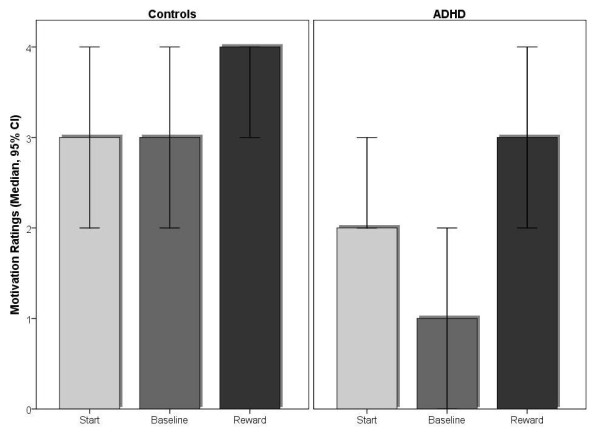
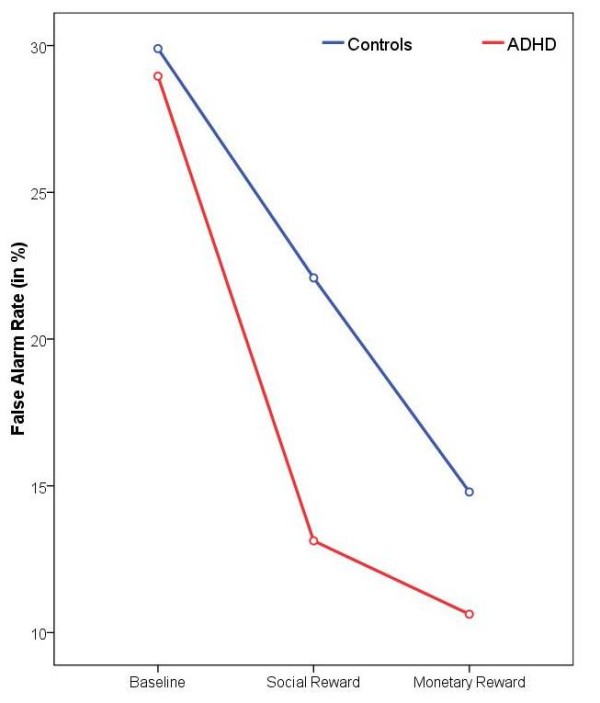
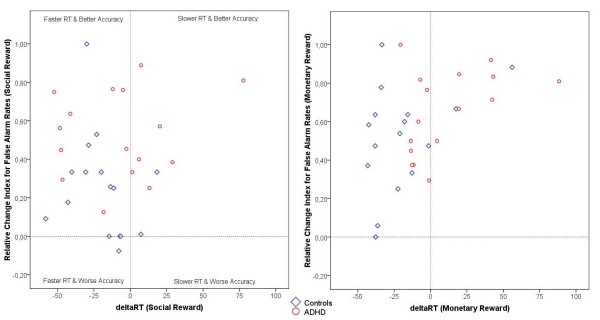
BACKGROUND: Current research suggests that attention-deficit/hyperactivity disorder (ADHD) is associated with larger behavioral sensitivity to reinforcement contingencies. However, most studies have focused thus far on the enhancing effects of tangible rewards such as money, neglecting that social-emotional stimuli may also impact task performance in ADHD patients. METHODS: To determine whether non-social (monetary) and social (positive facial expressions) rewards differentially improve response inhibition accuracy in children and adolescents with ADHD, we applied an incentive go/no-go task with reward contingencies for successful inhibition and compared ADHD subjects with typically developing individuals. RESULTS: Both social and monetary contingencies improved inhibition accuracy in all participants. However, individuals with ADHD displayed a particularly higher profit from social reward than healthy controls, suggesting that cognitive control in ADHD patients can be specifically improved by social reinforcement. By contrast, self-rated motivation associated with task performance was significantly lower in ADHD patients. CONCLUSION: Our findings provide evidence for hyperresponsiveness to social rewards in ADHD patients, which is accompanied by limited self-awareness. These data suggest that social reward procedures may be particularly useful in behavioral interventions in children with ADHD.
Overview
The claims and statistics of this paper haven’t been checked yet.
Free: it reads the open-access text and checks the first 5 claims that cite a source we can check. Create a free account to check every claim.
Integrity signals
Registry
Cites
Statistics
Figures
Verification
Claims the paper makes
The claims and statistics of this paper haven’t been checked yet.
Free: it reads the open-access text and checks the first 5 claims that cite a source we can check. Create a free account to check every claim.
Claims other papers make about this one
Each is checked against this paper’s own text: does it say what the citing paper says it does?
The cited source says what the claim attributes to it.
In the citing paper
“They found that children with ADHD showed an abnormal response to reinforcement on executive performance during a social reward condition, but not during a monetary reward condition.”
From Can Motivation Normalize Working Memory and Task Persistence in Children with Attention-Deficit/Hyperactivity Disorder? The Effects of Money and Computer-Gaming (2012) · cites this paper as Kohls et al. 2009
The cited source says what the claim attributes to it.
In the citing paper
“Furthermore, apart from the studies that have compared feedback-only with an incentive condition, only Kohls et al. (2009) compared the impact of different forms of reinforcement on executive performance between children with- and without ADHD.”
From Can Motivation Normalize Working Memory and Task Persistence in Children with Attention-Deficit/Hyperactivity Disorder? The Effects of Money and Computer-Gaming (2012) · cites this paper as Kohls et al. 2009
Self-check
Percentages, sums and reported differences re-computed from the paper’s own numbers.
The self-check needs the paper’s full text.
Citations
Cites
Diagnostic and Statistical Manual of Mental Disorders
Williams, J. B. W., & First, M. (2013) · Encyclopedia of Social Work · doi:10.1093/acrefore/9780199975839.013.104 · Cited by 109,519
(1991) · Medical Entomology and Zoology · Cited by 8,071
Homans, G. C. (1958) · American Journal of Sociology · doi:10.1086/222355 · Cited by 5,350
Attention Deficit Hyperactivity Disorder: A Handbook for Diagnosis and Treatment
Barkley, R. A., & Poillion, M. J. (1994) · Behavioral Disorders · doi:10.1177/019874299401900205 · Cited by 4,639
Willcutt, E. G., Doyle, A. E., Nigg, J. T., Faraone, S. V., & Pennington, B. F. (2005) · Biological Psychiatry · doi:10.1016/j.biopsych.2005.02.006 · Cited by 3,568
Characterizing cognition in ADHD: beyond executive dysfunction
Castellanos, F. X., Sonuga-Barke, E. J. S., Milham, M. P., & Tannock, R. (2006) · Trends in Cognitive Sciences · doi:10.1016/j.tics.2006.01.011 · Cited by 1,170
sagvolden, T., johansen, E. B., aase, H., & russell, V. A. (2005) · Behavioral and Brain Sciences · doi:10.1017/s0140525x05000075 · Cited by 1,035
Psychological heterogeneity in AD/HD—a dual pathway model of behaviour and cognition
Sonuga-Barke, E. J. S. (2002) · Behavioural Brain Research · doi:10.1016/s0166-4328(01)00432-6 · Cited by 901
Is ADHD a disinhibitory disorder?
Nigg, J. T. (2001) · Psychological Bulletin · doi:10.1037/0033-2909.127.5.571 · Cited by 878
Marsh, A. A., Finger, E. C., Mitchell, D. G. V., Reid, M. E., Sims, C., Kosson, D. S., Towbin, K. E., Leibenluft, E., Pine, D. S., & Blair, R. J. R. (2008) · American Journal of Psychiatry · doi:10.1176/appi.ajp.2007.07071145 · Cited by 852
Research works printed but not linked: 2
- [12]Unnewehr S Schneider S Margraf J Diagnostisches Interview bei psychischen Störungen im Kindes- und Jugendalter 1995 Berlin, Springer
- [15]Bortz J Lienert GA Kurzgefasste Statistik für die klinische Forschung 2003 Heidelberg, Springer
Cited by
Tripp, G., & Wickens, J. R. (2009) · Neuropharmacology · doi:10.1016/j.neuropharm.2009.07.026 · Cited by 492
Luman, M., Tripp, G., & Scheres, A. (2010) · Neuroscience & Biobehavioral Reviews · doi:10.1016/j.neubiorev.2009.11.021 · Cited by 335
ADHD and autism: differential diagnosis or overlapping traits? A selective review
Taurines, R., Schwenck, C., Westerwald, E., Sachse, M., Siniatchkin, M., & Freitag, C. (2012) · ADHD Attention Deficit and Hyperactivity Disorders · doi:10.1007/s12402-012-0086-2 · Cited by 301
Reward system dysfunction in autism spectrum disorders
Kohls, G., Schulte-Rüther, M., Nehrkorn, B., Müller, K., Fink, G. R., Kamp-Becker, I., Herpertz-Dahlmann, B., Schultz, R. T., & Konrad, K. (2013) · Social Cognitive and Affective Neuroscience · doi:10.1093/scan/nss033 · Cited by 259
Self-citationThe research domain criteria framework: The case for anterior cingulate cortex
Holroyd, C. B., & Umemoto, A. (2016) · Neuroscience & Biobehavioral Reviews · doi:10.1016/j.neubiorev.2016.09.021 · Cited by 187
Scheres, A., Tontsch, C., Thoeny, A. L., & Kaczkurkin, A. (2010) · Biological Psychiatry · doi:10.1016/j.biopsych.2009.10.033 · Cited by 167
Dovis, S., Van der Oord, S., Wiers, R. W., & Prins, P. J. M. (2012) · Journal of Abnormal Child Psychology · doi:10.1007/s10802-011-9601-8 · Cited by 165
Demurie, E., Roeyers, H., Baeyens, D., & Sonuga‐Barke, E. (2011) · Journal of Child Psychology and Psychiatry · doi:10.1111/j.1469-7610.2010.02374.x · Cited by 127
Sonuga-Barke, E. J. S., & Fairchild, G. (2012) · Biological Psychiatry · doi:10.1016/j.biopsych.2012.04.004 · Cited by 124
Aldridge‐Waddon, L., Vanova, M., Munneke, J., Puzzo, I., & Kumari, V. (2020) · Clinical Psychology Review · doi:10.1016/j.cpr.2020.101942 · Cited by 105
Neural responses to social and monetary reward in early adolescence and emerging adulthood
Ethridge, P., Kujawa, A., Dirks, M. A., Arfer, K. B., Kessel, E. M., Klein, D. N., & Weinberg, A. (2017) · Psychophysiology · doi:10.1111/psyp.12957 · Cited by 96
Creativity in ADHD: Goal-Directed Motivation and Domain Specificity
Boot, N., Nevicka, B., & Baas, M. (2020) · Journal of Attention Disorders · doi:10.1177/1087054717727352 · Cited by 63
Early Maladaptive Schemas and Schema Modes in clinical disorders: A systematic review
Bär, A., Bär, H. E., Rijkeboer, M. M., & Lobbestael, J. (2023) · Psychology and Psychotherapy: Theory, Research and Practice · doi:10.1111/papt.12465 · Cited by 79
Ma, I., van Duijvenvoorde, A. C. K., & Scheres, A. (2016) · Clinical Psychology Review · doi:10.1016/j.cpr.2016.01.001 · Cited by 84
Turel, O., & Bechara, A. (2016) · Frontiers in Psychology · doi:10.3389/fpsyg.2016.00455 · Cited by 67
Kruppa, J. A., Gossen, A., Oberwelland Weiß, E., Kohls, G., Großheinrich, N., Cholemkery, H., Freitag, C. M., Karges, W., Wölfle, E., Sinzig, J., et al. (2019) · Neuropsychopharmacology · doi:10.1038/s41386-018-0258-7 · Cited by 69
Self-citationTarver, J., Daley, D., & Sayal, K. (2015) · Child: Care, Health and Development · doi:10.1111/cch.12159 · Cited by 54
Parent–child interaction of mothers with depression and their children with ADHD
Lee, P.-C., Lin, K., Robson, D., Yang, H., Chen, V. C., & Niew, W.-I. (2012) · Research in Developmental Disabilities · doi:10.1016/j.ridd.2012.09.009 · Cited by 61
Modulation of Social Influence by Methylphenidate
Campbell-Meiklejohn, D. K., Simonsen, A., Jensen, M., Wohlert, V., Gjerløff, T., Scheel‐Krüger, J., Møller, A., Frith, C., & Roepstorff, A. (2012) · Neuropsychopharmacology · doi:10.1038/npp.2011.337 · Cited by 54
Breeman, L. D., van Lier, P. A. C., Wubbels, T., Verhulst, F. C., van der Ende, J., Maras, A., Struiksma, A. J. C., Hopman, J. A. B., & Tick, N. T. (2015) · Journal of Positive Behavior Interventions · doi:10.1177/1098300715593466 · Cited by 52
Differentiating neural reward responsiveness in autism versus ADHD
Kohls, G., Thönessen, H., Bartley, G. K., Grossheinrich, N., Fink, G. R., Herpertz-Dahlmann, B., & Konrad, K. (2014) · Developmental Cognitive Neuroscience · doi:10.1016/j.dcn.2014.08.003 · Cited by 50
Self-citationDemurie, E., Roeyers, H., Wiersema, J. R., & Sonuga-Barke, E. J. S. (2013) · Journal of Attention Disorders · doi:10.1177/1087054712473179 · Cited by 57
Delisle, J., & Braun, C. M. J. (2011) · Archives of Clinical Neuropsychology · doi:10.1093/arclin/acr043 · Cited by 49
Teicher, M. H., Polcari, A., Fourligas, N., Vitaliano, G., & Navalta, C. P. (2012) · BMC Psychiatry · doi:10.1186/1471-244x-12-190 · Cited by 40
Reward sensitivity to faces versus objects in children: an ERP study
Stavropoulos, K. K. M., & Carver, L. J. (2013) · Social Cognitive and Affective Neuroscience · doi:10.1093/scan/nst149 · Cited by 44
Umemoto, A., Lukie, C. N., Kerns, K. A., Müller, U., & Holroyd, C. B. (2014) · Cognitive Affective & Behavioral Neuroscience · doi:10.3758/s13415-014-0298-3 · Cited by 43
Task-related motivation and academic achievement in children and adolescents with ADHD
Morsink, S., Sonuga-Barke, E. J. S., der Oord, S. V., Dessel, J. V., Lemiere, J., & Danckaerts, M. (2020) · European Child & Adolescent Psychiatry · doi:10.1007/s00787-020-01494-8 · Cited by 53
Demurie, E., Roeyers, H., Baeyens, D., & Sonuga‐Barke, E. (2012) · International Journal of Methods in Psychiatric Research · doi:10.1002/mpr.1370 · Cited by 35
Gerencsér, L., Bunford, N., Moesta, A., & Miklósi, Á. (2018) · Scientific Reports · doi:10.1038/s41598-018-22605-1 · Cited by 36
Responsivity to familiar versus unfamiliar social reward in children with autism
Pankert, A., Pankert, K., Herpertz‐Dahlmann, B., Konrad, K., & Kohls, G. (2014) · Journal of Neural Transmission · doi:10.1007/s00702-014-1210-6 · Cited by 34
Self-citationConzelmann, A., Woidich, E., Mucha, R. F., Weyers, P., Jacob, C. P., Lesch, K.-P., & Pauli, P. (2011) · Brain Research · doi:10.1016/j.brainres.2010.12.085 · Cited by 27
Yu, X., & Sonuga-Barke, E. J. S. (2016) · Journal of Attention Disorders · doi:10.1177/1087054716661231 · Cited by 26
Tarver, J., Daley, D., & Sayal, K. S. (2021) · Child and Adolescent Mental Health · doi:10.1111/camh.12476 · Cited by 22
Defining social reward: A systematic review of human and animal studies.
Stijovic, A., Siegel, M., Koçan, A. U., Bojkovska, I., Korb, S., & Silani, G. (2024) · Psychological Bulletin · doi:10.1037/bul0000455 · Cited by 21
Attachment and Autonomy Problems in Adults With ADHD
Koemans, R. G., van Vroenhoven, S., Karreman, A., & Bekker, M. H. J. (2012) · Journal of Attention Disorders · doi:10.1177/1087054712453170 · Cited by 22
Belendiuk, K. A., Pedersen, S. L., King, K. M., Pelham, W. E., & Molina, B. S. G. (2016) · Psychology of Addictive Behaviors · doi:10.1037/adb0000117 · Cited by 21
Bunford, N., Csibra, B., & Gácsi, M. (2019) · Scientific Reports · doi:10.1038/s41598-019-47510-z · Cited by 18
Palma, S. M. M., Fernandes, D. R. M., Muszkat, M., & Calil, H. M. (2012) · Psychiatry Research · doi:10.1016/j.psychres.2011.10.016 · Cited by 16
Smith, J. N., Jusko, M. L., Fosco, W. D., Musser, E. D., & Raiker, J. S. (2023) · Development and Psychopathology · doi:10.1017/s0954579422001432 · Cited by 11
Vloet, T. D., Konrad, K., Herpertz‐Dahlmann, B., & Kohls, G. (2011) · Zeitschrift für Kinder- und Jugendpsychiatrie und Psychotherapie · doi:10.1024/1422-4917/a000127 · Cited by 11
Self-citationThe relationship between responsiveness to social and monetary rewards and ADHD symptoms
Sütçübaşı, B., Metin, B., Taş, C., Krzan, F., Sarı, B. A., Özçimen, B., & Tarhan, N. (2018) · Cognitive Affective & Behavioral Neuroscience · doi:10.3758/s13415-018-0609-1 · Cited by 9
Lauth-Lebens, M., & Lauth, G. W. (2020) · Lernen und Lernstörungen · doi:10.1024/2235-0977/a000284 · Cited by 9
Cognitive Training in Children with Neurodevelopmental Conditions
de Vries, M., Kenworthy, L. E., Dovis, S., & Geurts, H. M. (2020) · Springer eBooks · doi:10.1007/978-3-030-39292-5_24 · Cited by 9
Flannery, J. S., Parr, A. C., Lindquist, K. A., & Telzer, E. H. (2025) · Developmental Cognitive Neuroscience · doi:10.1016/j.dcn.2025.101594 · Cited by 9
Asymmetric developmental change regarding the effect of reward and punishment on response inhibition
Miyasaka, M., & Nomura, M. (2019) · Scientific Reports · doi:10.1038/s41598-019-49037-9 · Cited by 6
Cai, W., & Mizuno, Y. (2026) · Translational Psychiatry · doi:10.1038/s41398-026-03972-0 · Cited by 5
McDermott, J. M., & Egwuatu, A. C. (2018) · Biological Psychology · doi:10.1016/j.biopsycho.2018.08.012 · Cited by 6
Marino, C., Cardillo, R., Canale, N., Lenzi, M., Bergamin, M., Bonichini, S., & Santinello, M. (2021) · Frontiers in Education · doi:10.3389/feduc.2021.702539 · Cited by 4
Rewards Can Foster Response Execution and Response Inhibition in Young Children Diagnosed with ADHD
Sader, A., Walg, M., & Ferdinand, N. K. (2022) · Journal of Cognition and Development · doi:10.1080/15248372.2022.2110875 · Cited by 5
Treier, A., Hautmann, C., Dose, C., Nordmann, L., Katzmann, J., Pinior, J., Scholz, K., & Döpfner, M. (2022) · Child Psychiatry & Human Development · doi:10.1007/s10578-022-01400-0 · Cited by 4
Gerber, A. S., Griffin, J. W., Keifer, C. M., Lerner, M. D., & McPartland, J. C. (2024) · Journal of Autism and Developmental Disorders · doi:10.1007/s10803-024-06266-w · Cited by 4
Anticipation to Social and Nonsocial Dynamic Cues in Preschool-Age Children
Engle, J., Baker‐Harvey, H., Nguyen, H., Carney, H., Stavropoulos, K. K. M., & Carver, L. J. (2021) · Child Development · doi:10.1111/cdev.13551 · Cited by 3
Miyasaka, M., & Nomura, M. (2023) · Research in Developmental Disabilities · doi:10.1016/j.ridd.2023.104438 · Cited by 4
Sleep and Sleep Hygiene of Adolescents With and Without ADHD During COVID-19
Marten, F., Keuppens, L., Baeyens, D., Boyer, B. E., Danckaerts, M., & der Oord, S. V. (2023) · Journal of Attention Disorders · doi:10.1177/10870547231191492 · Cited by 3
Wise, M. L., Wise, B. L., & Jones, S. R. (2019) · The ADHD Report · doi:10.1521/adhd.2019.27.7.1 · Cited by 3
Electrophysiological indices of reward anticipation as ADHD risk and prognostic biomarkers
Bunford, N., Ágrez, K., Hámori, G., Koller, J., Pulay, A. J., Nemoda, Z., & Réthelyi, J. (2024) · European Child & Adolescent Psychiatry · doi:10.1007/s00787-024-02606-4 · Cited by 2
Zhu, C., Bore, M. C., Wang, X., Xu, T., & Feng, T. (2026) · Molecular Psychiatry · doi:10.1038/s41380-026-03495-6 · Cited by 2
Individual differences in the effects of salience and reward on impulse control and action selection
Schutte, I., Schutter, D. J. L. G., & Kenemans, J. L. (2023) · International Journal of Psychophysiology · doi:10.1016/j.ijpsycho.2023.08.012 · Cited by 2
Lynch, J. D., Fisher, A. P., Rodriguez, G. M., Zoromski, A. K., Ciesielski, H. A., & Epstein, J. N. (2024) · Evidence-Based Practice in Child and Adolescent Mental Health · doi:10.1080/23794925.2024.2405908 · Cited by 2
Gerber, A. S., Naples, A. J., Chawarska, K., Dawson, G., Kleinhans, N. M., Jeste, S., Faja, S., Dziura, J. D., Webb, S. J., Sugar, C. A., et al. (2025) · Psychological Medicine · doi:10.1017/s0033291725000650 · Cited by 2
Rivero, T. S., Pereira, D. A., Schultz, R. C., Marengo, L., & Bueno, O. F. A. (2021) · Cuadernos de neuropsicología · Cited by 1
Neurowissenschaftliche Erklärungsansätze und –modelle
Kilian, B., & Sidiropoulos, K. (2023) · Springer eBooks · doi:10.1007/978-3-662-65726-3_3 · Cited by 1
Breeman, L. D. (2015) · RePub (Erasmus University Rotterdam) · Cited by 1
Stavropoulos, K. K. M. (2014) · eScholarship (California Digital Library)
Commentary: Are ADHD symptoms habit‐like? – a commentary on Goodman et al (2014)
Tannock, R. (2014) · Journal of Child Psychology and Psychiatry · doi:10.1111/jcpp.12258
Putnam, K. H. (2011) · UA Campus Repository (The University of Arizona)
FOUR WOMEN’S PERCEPTIONS OF LIVING A LIFETIME WITH ADHD
Popovic, A. L. (2011) · QSpace (Queen's University Library) · Cited by 2
The interplay between motivation and inhibition in ADHD
Ma, I. (2017) · Radboud Repository (Radboud University)
Boot, N. C. (2018) · UvA-DARE (University of Amsterdam) · Cited by 2
Calmenson, N. E. (2017) · University of North Texas Digital Library (University of North Texas) · doi:10.12794/metadc1062861
Reward sensitivity in ADHD: what do we know and how can we use it?
Gaastra, G. F. (2020) · University of Groningen research database (University of Groningen / Centre for Information Technology) · doi:10.33612/diss.109733199
Meredith, J. E. (2020) · Otago University Research Archive (University of Otago)
Burton, S. P., Puddephatt, J., Baines, L. A., Sheen, F., Warren, J. G., & Jones, A. (2021) · Alcohol and Alcoholism · doi:10.1093/alcalc/agab020
Será mejor hacernos los suecos o los suizos
Guillot, M. (2000) · Revista hispano cubana
Attention-Deficit Hyperactivity Disorder
Nissley‐Tsiopinis, J., Krehbiel, C., & Power, T. J. (2014) · Springer eBooks · doi:10.1007/978-1-4899-7497-6_9 · Cited by 1
The case for a primary social drive: Revisiting definitions for primary drives
Christoffersen, M. (2025) · Acta Psychologica · doi:10.1016/j.actpsy.2025.104696
The dog as a model of human ADHD
Csibra, B. (2024) · Eötvös Loránd Tudományegyetem · doi:10.15476/elte.2023.066
How do adults with neurodevelopmental disorders prefer information being presented?
Otermans, P. C. J., Seon, J., Cooper, E. L., Roomi, A., Baines, S., & Aditya, D. (2025) · Educational Media International · doi:10.1080/09523987.2025.2544118
Treier, A.-K. (2023) · Kölner Universitäts PublikationsServer (Universität zu Köln)
Interaction of Attention and Emotion Across Development and Disorder
Ruiz, E. D. R. (2012) · DigitalGeorgetown (Georgetown University Library)
Marten, F. (2024) · Lirias (KU Leuven)
Who Sets the Norm?: Designing Communication Scaffolds for ADHD Romantic Relationships
Hong, J.-O., Choi, D., Lee, E., & Hong, H. (2026) · Designing Interactive Systems Conference · doi:10.1145/3800645.3812917
利他的動機づけは衝動的な人の意思決定を変えるか? : モデルベース/モデルフリー学習の観点から
須田, 陸., & 月元, 敬. (2025) · Institutional Repositories DataBase (IRDB)
Avni, T., Harush, O. M. B., Arad, G., Azriel, O., Lazarov, A., & Bar‐Haim, Y. (2026) · Behaviour Research and Therapy · doi:10.1016/j.brat.2026.105154
Graziano, P. A., Goldhagen, E. L., Hernandez, M. L., & Dick, A. S. (2026) · Journal of Clinical Child & Adolescent Psychology · doi:10.1080/15374416.2026.2745073
Metadata
- Authors
- Kohls, G., Herpertz-Dahlmann, B., & Konrad, K.
- Affiliations
- Children's Hospital of Philadelphia (US)
- RWTH Aachen University (DE)
- Corresponding author
- Kohls, Gregor
- Venue
- Behavioral and Brain Functions
- Published
- 2009
- Volume
- 5
- Issue
- 1
- Pages
- 20
- ISSN
- 1744-9081 (ISSN-L)
- PMC
- PMC2685404
- OpenAlex
- W2062841682
- Cited by
- 73
- References
- 48
- Citations by year
- 2026: 5 · 2025: 4 · 2024: 3 · 2023: 6 · 2022: 2 · 2021: 4 · 2020: 4 · 2019: 3 · 2018: 4 · 2017: 3 · 2016: 4 · 2015: 3 · 2014: 6 · 2013: 2 · 2012: 9
- FWCI
- 3.92
- Type
- journal article
- Language
- en
- Open access
- gold
- doi.org
- Licence
- cc-by
- Locations
- Behavioral and Brain Functions (publishedVersion, cc-by)
- PubMed Central (publishedVersion, cc-by)
- PubMed (publishedVersion)
- DOAJ (DOAJ: Directory of Open Access Journals) (submittedVersion)
- RWTH Publications (RWTH Aachen) (submittedVersion, other-oa)
- Topics
- Health Sciences › Medicine › Psychiatry and Mental health › Attention Deficit Hyperactivity Disorder
- Life Sciences › Neuroscience › Cognitive Neuroscience › Neural and Behavioral Psychology Studies
- Life Sciences › Neuroscience › Cellular and Molecular Neuroscience › Neurotransmitter Receptor Influence on Behavior
- Keywords
- attention deficit hyperactivity disorder, social reward, monetary rewards, incentive sensitivity, response inhibition, cognitive control, go/no-go task, motivation, self-awareness, children and adolescents, behavioral interventions
About these checks
Registry, retraction, Cites and statistics results are computed, not judged, with one exception: a printed reference that no index lists is read once by a model before it counts as a citation error. Claims are extracted by a model and kept only when their quote appears verbatim in the text; each cited source is then checked, with a model’s help, for whether it says what the claim relies on. Those verdicts can be wrong — read the claim’s quote and the cited source before relying on one.
Statistics and arithmetic are recomputed, not judged.
Confidence bands are shown only for fields calibrated on our annotated test set. None is calibrated yet, so no band is shown.
What counts as a claim ›How we measure confidence ›How we check this ›
Are you an author, or do you see a problem with this page? Request a review
Data sources
Bibliographic data: Semantic Scholar, OpenAlex, Crossref.
Contains information from the Semantic Scholar Academic Graph Datasets, made available under the ODC Attribution License (ODC-BY 1.0).
Semantic Scholar’s data is described in: Kinney, R., et al. (2023). The Semantic Scholar Open Data Platform. arXiv:2301.10140.
