

The DOI matches its Crossref record; 38 of the 38 references it cites were found in a registry or an index.
Meditation acutely improves psychomotor vigilance, and may decrease sleep need
Open accessAbstract
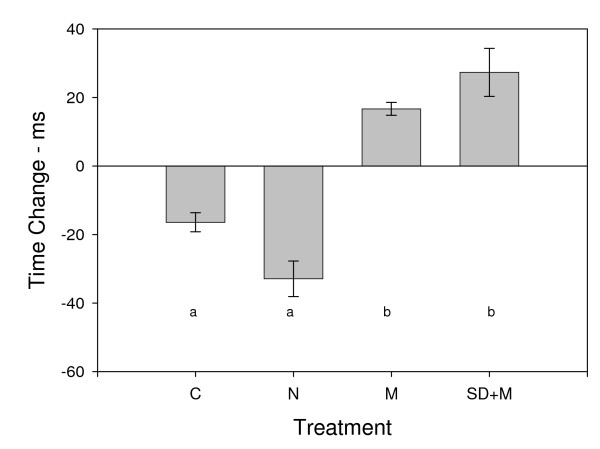
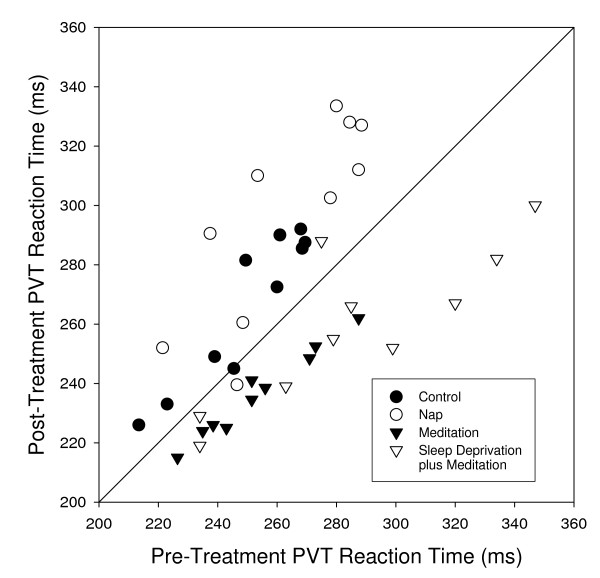
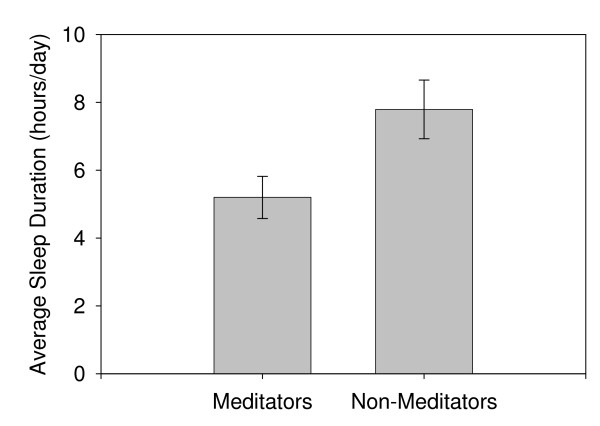
Background: A number of benefits from meditation have been claimed by those who practice various traditions, but few have been well tested in scientifically controlled studies. Among these claims are improved performance and decreased sleep need. Therefore, in these studies we assess whether meditation leads to an immediate performance improvement on a well validated psychomotor vigilance task (PVT), and second, whether longer bouts of meditation may alter sleep need. Methods: The primary study assessed PVT reaction times before and after 40 minute periods of mediation, nap, or a control activity using a within subject cross-over design. This study utilized novice meditators who were current university students (n = 10). Novice meditators completed 40 minutes of meditation, nap, or control activities on six different days (two separate days for each condition), plus one night of total sleep deprivation on a different night, followed by 40 minutes of meditation. A second study examined sleep times in long term experienced meditators (n = 7) vs. non-meditators (n = 23). Experienced meditators and controls were age and sex matched and living in the Delhi region of India at the time of the study. Both groups continued their normal activities while monitoring their sleep and meditation times. Results: Novice meditators were tested on the PVT before each activity, 10 minutes after each activity and one hour later. All ten novice meditators improved their PVT reaction times immediately following periods of meditation, and all but one got worse immediately following naps. Sleep deprivation produced a slower baseline reaction time (RT) on the PVT that still improved significantly following a period of meditation. In experiments with long-term experienced meditators, sleep duration was measured using both sleep journals and actigraphy. Sleep duration in these subjects was lower than control non-meditators and general population norms, with no apparent decrements in PVT scores. Conclusions: These results suggest that meditation provides at least a short-term performance improvement even in novice meditators. In long term meditators, multiple hours spent in meditation are associated with a significant decrease in total sleep time when compared with age and sex matched controls who did not meditate. Whether meditation can actually replace a portion of sleep or pay-off sleep debt is under further investigation.
Overview
The claims and statistics of this paper haven’t been checked yet.
Run the check — free, no account needed. It reads the open-access text and checks the sources it cites.
Integrity signals
Registry
Cites
Statistics
Figures
Verification
Claims the paper makes
The claims and statistics of this paper haven’t been checked yet.
Run the check — free, no account needed. It reads the open-access text and checks the sources it cites.
Claims other papers make about this one
Each is checked against this paper’s own text: does it say what the citing paper says it does?
The cited source says what the claim attributes to it.
In the citing paper
“Kaul et al.55 found that meditation naive university students who performed a 40-min FA mediation improved their performance on the psychomotor vigilance task (PVT) in comparison to a nap or a control activity.”
From Awakening is not a metaphor: the effects of Buddhist meditation practices on basic wakefulness (2014) · cites this paper as [55]
The cited source says what the claim attributes to it.
In the citing paper
“Sleep diaries indicated a significantly shorter average nocturnal sleep duration in meditators than controls (5.2 h vs. 7.8 h, P< 0.00001).”
From Awakening is not a metaphor: the effects of Buddhist meditation practices on basic wakefulness (2014) · cites this paper as [55]
In the citing paper
“This study also found that meditation improved decrements in PVT vigilance following a night of sleep deprivation, so that meditation practice increased wakefulness.”
From Awakening is not a metaphor: the effects of Buddhist meditation practices on basic wakefulness (2014) · cites this paper as [55]
Self-check
Percentages, sums and reported differences re-computed from the paper’s own numbers.
The self-check needs the paper’s full text.
Citations
Cites
Principles and Practice of Sleep Medicine
(2011) · Elsevier eBooks · doi:10.1016/c2009-0-59875-3 · Cited by 5,088
Sleep Homeostasis and Models of Sleep Regulation
Borb, A. A., & Achermann, P. (1999) · Journal of Biological Rhythms · doi:10.1177/074873099129000894 · Cited by 1,472
Long-term meditators self-induce high-amplitude gamma synchrony during mental practice
Lutz, A., Greischar, L. L., Rawlings, N. B., Ricard, M., & Davidson, R. J. (2004) · Proceedings of the National Academy of Sciences · doi:10.1073/pnas.0407401101 · Cited by 1,328 · cited 3×
“Among these claims are improvement in many types of performance and alterations in sleep and EEG patterns that have received considerable, but sometimes mixed, scientific support over the past few decades [3,9,22-25].”
BackgroundNormal Human Sleep: An Overview
Carskadon, M. A., & Dement, W. C. (2005) · Principles and Practice of Sleep Medicine · doi:10.1016/b0-72-160797-7/50009-4 · Cited by 995
Mental Training Affects Distribution of Limited Brain Resources
Slagter, H. A., Lutz, A., Greischar, L. L., Francis, A. D., Nieuwenhuis, S., Davis, J. M., & Davidson, R. J. (2007) · PLoS Biology · doi:10.1371/journal.pbio.0050138 · Cited by 757
The role of actigraphy in sleep medicine
Sadeh, A., & Acebo, C. (2002) · Sleep Medicine Reviews · doi:10.1053/smrv.2001.0182 · Cited by 720
Physiological effects of transcendental meditation
Wallace, R. K. (1970) · Science · doi:10.1126/science.167.3926.1751 · Cited by 653 · cited 1×
“Previous studies on meditation have documented clear changes in the EEG that are distinct from sleep and typical wake, as well as a variety of other physiological changes [1-5].”
BackgroundTassi, P., & Muzet, A. (2000) · Sleep Medicine Reviews · doi:10.1053/smrv.2000.0098 · Cited by 458
Spectral analysis of the EEG in meditation
Banquet, J. P. (1973) · Electroencephalography and Clinical Neurophysiology · doi:10.1016/0013-4694(73)90170-3 · Cited by 378
Cited by
Awakening is not a metaphor: the effects of Buddhist meditation practices on basic wakefulness
Britton, W. B., Lindahl, J. R., Cahn, B. R., Davis, J. H., & Goldman, R. E. (2014) · Annals of the New York Academy of Sciences · doi:10.1111/nyas.12279 · Cited by 134
Ferrarelli, F., Smith, R., Dentico, D., Riedner, B. A., Zennig, C., Benca, R. M., Lutz, A., Davidson, R. J., & Tononi, G. (2013) · PLoS ONE · doi:10.1371/journal.pone.0073417 · Cited by 122
Britton, W. B., Haynes, P. L., Fridel, K. W., & Bootzin, R. R. (2012) · Psychotherapy and Psychosomatics · doi:10.1159/000332755 · Cited by 81
Non-verbal communication of compassion: measuring psychophysiologic effects
Kemper, K. J., & Shaltout, H. A. (2011) · BMC Complementary and Alternative Medicine · doi:10.1186/1472-6882-11-132 · Cited by 32
Metadata
- Authors
- Kaul, P., Passafiume, J., Sargent, R. C., & O'Hara, B. F.
- Affiliations
- University of Kentucky (US)
- Venue
- Behavioral and Brain Functions
- Published
- 2010-07-29
- Volume
- 6
- Issue
- 1
- Pages
- 47-47
- ISSN
- 1744-9081 (ISSN-L)
- PMC
- PMC2919439
- OpenAlex
- W2124637688
- Cited by
- 65
- References
- 38
- Citations by year
- 2026: 3 · 2025: 3 · 2023: 4 · 2022: 3 · 2021: 7 · 2020: 4 · 2019: 4 · 2018: 3 · 2017: 9 · 2016: 4 · 2015: 5 · 2014: 5 · 2013: 3 · 2012: 3
- FWCI
- 3.17
- Type
- journal article
- Language
- en
- Open access
- gold
- doi.org
- Licence
- cc-by
- creativecommons.org/licenses/by/2.0 (tdm)
- Locations
- Behavioral and Brain Functions (publishedVersion, cc-by)
- PubMed Central (publishedVersion, cc-by)
- PubMed (publishedVersion)
- UKnowledge (University of Kentucky) (submittedVersion, cc-by)
- DOAJ (DOAJ: Directory of Open Access Journals) (submittedVersion, cc-by-sa)
- Funders
- University of Kentucky
- Topics
- Social Sciences › Psychology › Clinical Psychology › Mindfulness and Compassion Interventions
- Social Sciences › Psychology › Experimental and Cognitive Psychology › Sleep and Work-Related Fatigue
- Life Sciences › Neuroscience › Cognitive Neuroscience › Mind wandering and attention
- Keywords
- meditation, psychomotor vigilance, reaction time, sleep need, sleep duration, sleep deprivation, NAP, experienced meditators, novice meditators, sleep debt, performance improvement
- MeSH terms
- Adult, Female, Humans, India, Male, Medical Records, Middle Aged, Neuropsychological Tests, Psychomotor Performance, Reaction Time, Sleep, Sleep Deprivation, Time Factors, Cross-Over Studies, Meditation, Young Adult, Actigraphy
About these checks
Registry, retraction, Cites and statistics results are computed, not judged, with one exception: a printed reference that no index lists is read once by a model before it counts as a citation error. Claims are extracted by a model and kept only when their quote appears verbatim in the text; each cited source is then checked, with a model’s help, for whether it says what the claim relies on. Those verdicts can be wrong — read the claim’s quote and the cited source before relying on one.
Statistics and arithmetic are recomputed, not judged.
Confidence bands are shown only for fields calibrated on our annotated test set. None is calibrated yet, so no band is shown.
What counts as a claim ›How we measure confidence ›How we check this ›
Are you an author, or do you see a problem with this page? Request a review
How to cite
Cite CoChat for the checks on this page, and the paper for its own findings.
- This page
- CoChat. (2026). Citation check: Meditation acutely improves psychomotor vigilance, and may decrease sleep need. https://app.cochat.ai/papers/10.1186/1744-9081-6-47
- The paper
- Kaul, P., Passafiume, J., Sargent, R. C., & O'Hara, B. F. (2010). Meditation acutely improves psychomotor vigilance, and may decrease sleep need. Behavioral and Brain Functions. https://doi.org/10.1186/1744-9081-6-47
Data sources
Bibliographic data: Semantic Scholar, OpenAlex, Crossref.
Contains information from the Semantic Scholar Academic Graph Datasets, made available under the ODC Attribution License (ODC-BY 1.0).
Semantic Scholar’s data is described in: Kinney, R., et al. (2023). The Semantic Scholar Open Data Platform. arXiv:2301.10140.
