

Exceptional error minimization in putative primordial genetic codes
Open accessThe DOI matches its Crossref record; 75 of the 75 references it cites were found in a registry or an index.
Abstract
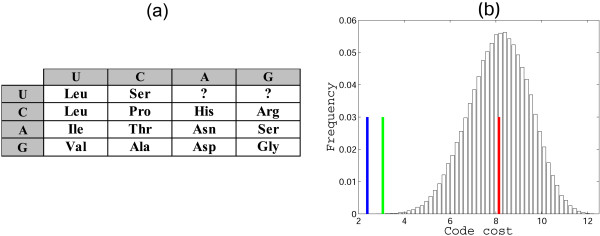
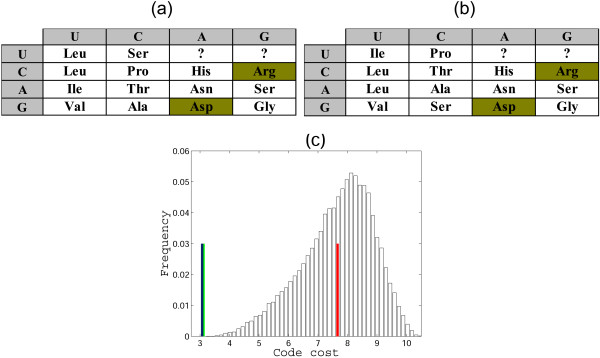
BACKGROUND: The standard genetic code is redundant and has a highly non-random structure. Codons for the same amino acids typically differ only by the nucleotide in the third position, whereas similar amino acids are encoded, mostly, by codon series that differ by a single base substitution in the third or the first position. As a result, the code is highly albeit not optimally robust to errors of translation, a property that has been interpreted either as a product of selection directed at the minimization of errors or as a non-adaptive by-product of evolution of the code driven by other forces. RESULTS: We investigated the error-minimization properties of putative primordial codes that consisted of 16 supercodons, with the third base being completely redundant, using a previously derived cost function and the error minimization percentage as the measure of a code's robustness to mistranslation. It is shown that, when the 16-supercodon table is populated with 10 putative primordial amino acids, inferred from the results of abiotic synthesis experiments and other evidence independent of the code's evolution, and with minimal assumptions used to assign the remaining supercodons, the resulting 2-letter codes are nearly optimal in terms of the error minimization level. CONCLUSION: The results of the computational experiments with putative primordial genetic codes that contained only two meaningful letters in all codons and encoded 10 to 16 amino acids indicate that such codes are likely to have been nearly optimal with respect to the minimization of translation errors. This near-optimality could be the outcome of extensive early selection during the co-evolution of the code with the primordial, error-prone translation system, or a result of a unique, accidental event. Under this hypothesis, the subsequent expansion of the code resulted in a decrease of the error minimization level that became sustainable owing to the evolution of a high-fidelity translation system. REVIEWERS: This article was reviewed by Paul Higgs (nominated by Arcady Mushegian), Rob Knight, and Sandor Pongor. For the complete reports, go to the Reviewers' Reports section.
Overview
The claims and statistics of this paper haven’t been checked yet.
Free: it reads the open-access text and checks the first 5 claims that cite a source we can check. Create a free account to check every claim.
Integrity signals
Registry
Cites
Statistics
Figures


Verification
Claims the paper makes
The claims and statistics of this paper haven’t been checked yet.
Free: it reads the open-access text and checks the first 5 claims that cite a source we can check. Create a free account to check every claim.
Claims other papers make about this one
Each is checked against this paper’s own text: does it say what the citing paper says it does?
The cited source says what the claim attributes to it.
In the citing paper
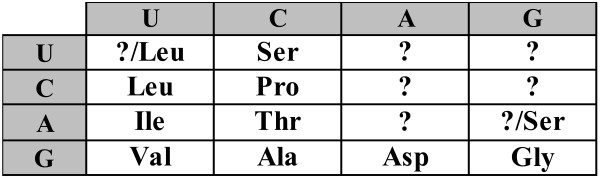
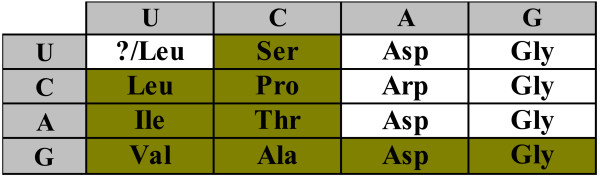
“Postulating that the third letter of the codons was uninformative in the primordial code and reducing the code table to the codons for the 10 early amino acids resulted in the reconstruction of the ancient doublet code, albeit with several codon series remaining ambiguous ( Figure 2 ) (59).”
From Origin and Evolution of the Universal Genetic Code (2017) · cites this paper as [59]
The cited source says what the claim attributes to it.
In the citing paper
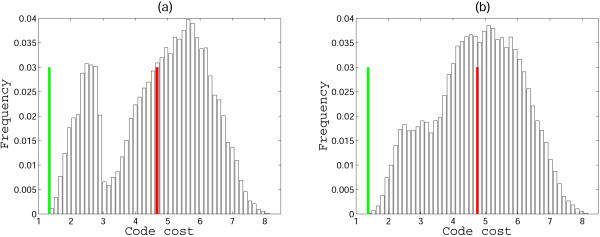
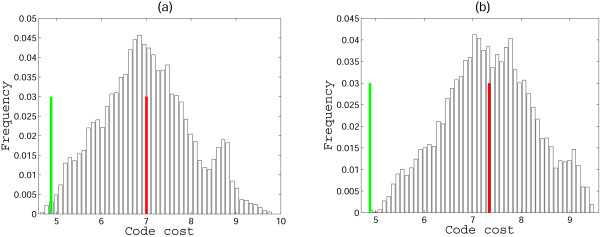
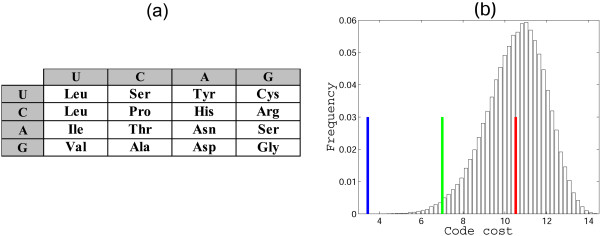
“Notably, this reconstructed primordial code shows an exceptional level of error minimization and is much closer to the global optimum than the SGC.”
From Origin and Evolution of the Universal Genetic Code (2017) · cites this paper as [59]
In the citing paper
“Extensive quantitative analyses that employed cost functions differently derived from physico-chemical properties of amino acids have shown that the code is indeed highly resilient, with the probability to pick an equally robust random code being on the order of 10−7–10−8 [14,15,61,62,63,64,65,66,67,68].”
From Frozen Accident Pushing 50: Stereochemistry, Expansion, and Chance in the Evolution of the Genetic Code (2017) · cites this paper as [65]
Self-check
Percentages, sums and reported differences re-computed from the paper’s own numbers.
The self-check needs the paper’s full text.
Citations
Cites
The Proceedings of the National Academy of Sciences
Richards, J. W. (1915) · Science · doi:10.1126/science.42.1074.161 · Cited by 13,983
Darwin, C., Burndy Library, Darwin, C., Edmonds & Remnants, & Henry Sotheran Ltd. (1859) · J. Murray eBooks · doi:10.5962/bhl.title.59991 · Cited by 6,984
A Production of Amino Acids Under Possible Primitive Earth Conditions
Miller, S. L. (1953) · Science · doi:10.1126/science.117.3046.528 · Cited by 3,522 · cited 12×
“The early ones are taken to be the 10 that are found in Miller and Urey experiments, which have previously been assumed by authors such as Wong [10] and Di Giulio [59].”
InfluentialThe origin of the genetic code
Crick, F. H. C. (1968) · Journal of Molecular Biology · doi:10.1016/0022-2836(68)90392-6 · Cited by 2,320
Miller, S. L., & Urey, H. C. (1959) · Science · doi:10.1126/science.130.3370.245 · Cited by 1,405
Xia, T., SantaLucia, J., Burkard, M. E., Kierzek, R., Schroeder, S. J., Jiao, X., Cox, C., & Turner, D. H. (1998) · Biochemistry · doi:10.1021/bi9809425 · Cited by 1,140 · cited 2×
“1st/2nd base Amino acid DNA melting [30,67] RNA stacking [68] S/W theory [69]”
BackgroundMethodMistranslation-Induced Protein Misfolding as a Dominant Constraint on Coding-Sequence Evolution
Drummond, D. A., & Wilke, C. O. (2008) · Cell · doi:10.1016/j.cell.2008.05.042 · Cited by 1,053 · cited 1×
“This course of evolution was made possible by the evolution of the modern, high-fidelity translation system as well as proteins that are partially optimized for robustness to misfolding [62], and was driven by the selective advantage of the increased diversity of the amino acid repertoire.”
Dueck, G. (1993) · Journal of Computational Physics · doi:10.1006/jcph.1993.1010 · Cited by 765 · cited 1×
“In most cases, a heuristic combinatorial algorithm was used (the Great Deluge Algorithm [ 65 ]), 3 to 5 solutions were identified, and the solution with the lowest cost was taken as the optimal.”
MethodA co-evolution theory of the genetic code
Wong, J. T.-F. (1975) · Proceedings of the National Academy of Sciences · doi:10.1073/pnas.72.5.1909 · Cited by 649
The genetic code is one in a million
Freeland, S. J., & Hurst, L. D. (1998) · Journal of Molecular Evolution · doi:10.1007/pl00006381 · Cited by 563 · cited 3×
“The errorminimization theory holds that the structure of the code is the result of selection for robustness to mistranslation [11,34,39,53,54].”
BackgroundMethod
Cited by
Origin and Evolution of the Universal Genetic Code
Koonin, E. V., & Novozhilov, A. S. (2017) · Annual Review of Genetics · doi:10.1146/annurev-genet-120116-024713 · Cited by 200
Self-citationKoonin, E. (2017) · Life · doi:10.3390/life7020022 · Cited by 85
“Extensive quantitative analyses that employed cost functions differently derived from physico-chemical properties of amino acids have shown that the code is indeed highly resilient, with the probability to pick an equally robust random code being on the order of 10-7-10-8 [14, 15, 61-68].”
MethodSelf-citationKoonin, E. (2017) · doi:10.20944/preprints201705.0121.v1 · Cited by 85
Self-citationExtraordinarily Adaptive Properties of the Genetically Encoded Amino Acids
Ilardo, M., Meringer, M., Freeland, S., Rasulev, B., & Cleaves II, H. J. (2015) · Scientific Reports · doi:10.1038/srep09414 · Cited by 68
Resource conservation manifests in the genetic code
Shenhav, L., & Zeevi, D. (2020) · Science · doi:10.1126/science.aaz9642 · Cited by 75
Pathways of Genetic Code Evolution in Ancient and Modern Organisms
Sengupta, S., & Higgs, P. G. (2015) · Journal of Molecular Evolution · doi:10.1007/s00239-015-9686-8 · Cited by 68
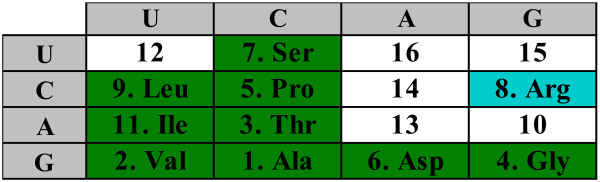
“Novozhilov and Koonin (2009) also used the code cost function with certain constraints to show that a code which distributes the ten earliest amino acids among the 16 codon blocks in a manner that is consistent with the standard genetic code is also the most optimal.”
BackgroundThe evolution of the genetic code: Impasses and challenges
Kun, Á., & Radványi, Á. (2017) · Biosystems · doi:10.1016/j.biosystems.2017.10.006 · Cited by 59
“The error minimization theory gained quite some credit when it was shown that the standard genetic code is quite robust against mutations (Ardell, 1998; Freeland et al., 2003; Gilis et al., 2001; Haig and Hurst, 1991; Kumar and Saini, 2016; Novozhilov and Koonin, 2009).”
BackgroundStop codons in bacteria are not selectively equivalent
Povolotskaya, I., Kondrashov, F. A., Ledda, A., & Vlasov, P. K. (2012) · Biology Direct · doi:10.1186/1745-6150-7-30 · Cited by 48
“The sub-optimal organization of the genetic table revealed here provides a striking counterexample to the remarkable optimization of the genetic code with respect to error minimization [28-30].”
BackgroundSeligmann, H., & Warthi, G. (2017) · Computational and Structural Biotechnology Journal · doi:10.1016/j.csbj.2017.08.001 · Cited by 40
Rooted tRNAomes and evolution of the genetic code
Pak, D., Du, N., Kim, Y., Sun, Y., & Burton, Z. F. (2018) · Transcription · doi:10.1080/21541264.2018.1429837 · Cited by 35
“It appears that errors in tRNA charging drove code evolution [2,14,25].”
BackgroundRogers, S. O. (2019) · Journal of Theoretical Biology · doi:10.1016/j.jtbi.2019.01.022 · Cited by 30
Babbitt, G. A., Alawad, M. A., Schulze, K., & Hudson, A. O. (2014) · Nucleic Acids Research · doi:10.1093/nar/gku811 · Cited by 26
“Interestingly, the observation by Novozhilov and Koonin (67) that arginine appears to bring the most non-optimality to the code, is highly congruent with the observations of Rohs et al. (32) for arginine’s critical role in genomic architecture and gene regulation via charge neutralization of DNA through interactions o…”
BackgroundResultInfluentialVishnoi, A., Sethupathy, P., Simola, D. F., Plotkin, J. B., & Hannenhalli, S. S. (2011) · Molecular Biology and Evolution · doi:10.1093/molbev/msr085 · Cited by 23
KLUMP, H. H., Völker, J., & Breslauer, K. J. (2020) · Quarterly Reviews of Biophysics · doi:10.1017/s0033583520000098 · Cited by 22
“evolution of the code, including error minimization (Freeland et al., 2003; Novozhilov and Koonin, 2009), stereochemical (Yarus et al.”
BackgroundThe Self-Referential Genetic Code is Biologic and Includes the Error Minimization Property
Guimarães, R. C. (2015) · Origins of Life and Evolution of Biospheres · doi:10.1007/s11084-015-9417-6 · Cited by 18
“This rationale has been called an evolutionary process of optimization in the distribution of the correspondences in favor of minimization of the consequences of errors (Higgs 2009; Jestin and Kempf 2009; Novozhilov and Koonin 2009; Bandhu et al. 2013).”
BackgroundAggarwal, N., Bandhu, A. V., & Sengupta, S. (2016) · Physical Biology · doi:10.1088/1478-3975/13/3/036007 · Cited by 15
EF-P and its paralog EfpL (YeiP) differentially control translation of proline-containing sequences
Sieber, A., Parr, M., von Ehr, J., Dhamotharan, K., Kielkowski, P., Brewer, T. E., Schäpers, A., Krafczyk, R., Qi, F., Schlundt, A., et al. (2024) · Nature Communications · doi:10.1038/s41467-024-54556-9 · Cited by 16
“Remarkably, all six amino acids encoded by GNN (Gly, Ala, Asp, Glu, Val, Leu) are included among the standard amino acids that can be produced under emulated primordial conditions 72 .”
Sulfur Amino Acids: From Prebiotic Chemistry to Biology and Vice Versa
Vallée, Y., & Youssef‐Saliba, S. (2021) · Synthesis · doi:10.1055/a-1472-7914 · Cited by 15
Bandhu, A. V., Aggarwal, N., & Sengupta, S. (2013) · Origins of Life and Evolution of Biospheres · doi:10.1007/s11084-014-9353-x · Cited by 14
Stability of the genetic code and optimal parameters of amino acids
Chechetkin, V. R., & Lobzin, V. V. (2010) · Journal of Theoretical Biology · doi:10.1016/j.jtbi.2010.10.015 · Cited by 12
“If, for example, the primordial genetic code has been developed by a half of existing amino acids (Higgs and Pudritz, 2009; Novozhilov and Koonin, 2009), then subsequent recruiting of amino acids would depend on the developed code structure.”
BackgroundResultInfluentialFundamental role of start/stop regulators in whole DNA and new trinucleotide classification
Rosandić, M., Paar, V., & Glunčić, M. (2013) · Gene · doi:10.1016/j.gene.2013.09.021 · Cited by 10
“…numerous hypotheses have been formulated (Crick, 1968; Wong, 1975; Gilbert, 1986; Knight and Landweber, 2000; Di Giulio, 2005; Jordan et al., 2005; Di Giulio, 2008; Higgs, 2009; Koonin and Novozhilov, 2009; Novozhilov and Koonin, 2009; Frenkel and Trifonov, 2012; Kawahara-Kobayashi et al., 2012).”
Fidelity in Archaeal Information Processing
de Koning, B., Blombach, F., Brouns, S. J. J., & John van der, O. O. S. T. (2010) · Archaea · doi:10.1155/2010/960298 · Cited by 9
“The presumable primordial genetic code that codes for an original set of 10 amino acids [65], as well as the 20 amino acid genetic code, operating in extant cellular life forms, are relatively robust, as most misincorporations will result in substitutions by physicochemically related amino acids that only in rare occa…”
BackgroundA search for the physical basis of the genetic code
Moghadam, S. A., Kłobukowski, M., & Tuszyński, J. A. (2020) · Biosystems · doi:10.1016/j.biosystems.2020.104148 · Cited by 8
Alphabet cardinality and adaptive evolution
Srivastava, M., Rozhoňová, H., & Payne, J. L. (2023) · Journal of Physics A Mathematical and Theoretical · doi:10.1088/1751-8121/ad0200 · Cited by 7
Babbitt, G. A., Coppola, E. E., Mortensen, J. S., Ekeren, P. X., Viola, C., Goldblatt, D., & Hudson, A. O. (2018) · Journal of Molecular Evolution · doi:10.1007/s00239-018-9828-x · Cited by 7
“2003; Novozhilov and Koonin 2009), or, as originally hypothesized, (D) strong functional conservation of a nonrandom pattern that has no functional significance at all (Crick 1968).”
BackgroundInfluentialProbable relationship between partitions of the set of codons and the origin of the genetic code
Salinas, D. G., Gallardo, M. O., & Osorio, M. I. (2014) · Biosystems · doi:10.1016/j.biosystems.2014.01.007 · Cited by 3
Factors in Protobiomonomer Selection for the Origin of the Standard Genetic Code
Saralov, A. I. (2021) · Acta Biotheoretica · doi:10.1007/s10441-021-09420-4 · Cited by 3
Mutuality in Discrete and Compositional Information: Perspectives for Synthetic Genetic Codes
Guimarães, R. C. (2011) · Cognitive Computation · doi:10.1007/s12559-011-9116-1 · Cited by 3
“that minimization of the consequences of errors would be obtained [43, 65].”
BackgroundClayworth, P., & Kornilov, S. A. (2026) · Biosystems · doi:10.1016/j.biosystems.2026.105919 · Cited by 2
An Unsupervised Classifier for Whole-Genome Phylogenies, the Maxwell© Tool
Gardes, J., Maldivi, C., Boisset, D., Aubourg, T., & Demongeot, J. (2023) · International Journal of Molecular Sciences · doi:10.3390/ijms242216278 · Cited by 2
Mapping the inter- and intra-genic codon-usage landscape in Homo sapiens
Arshad, M., Uchmanowicz, M., Rana, V., Trost, B., Scherer, S. W., & Rafiq, M. A. (2026) · NAR Genomics and Bioinformatics · doi:10.1093/nargab/lqag024 · Cited by 2
“Rather than proceeding at a constant rate, translation follows a “rhythm” of acceleration and deceleration dictated by tRNA availability [ 5 ].”
KLUMP, H. H., Völker, J., & Breslauer, K. J. (2020) · Quarterly Reviews of Biophysics · doi:10.1017/s0033583520000116 · Cited by 2
Broecker, F. (2026) · Springer eBooks · doi:10.1007/978-3-032-24295-2_10 · Cited by 1
Mierke, C. T. (2020) · Biological and medical physics, biomedical engineering · doi:10.1007/978-3-030-58532-7_11 · Cited by 1
Numeric Structure of Genetic Code in Natural Evolution: Energy GroundsPreprint
Moldavanov, A. (2022) · doi:10.32388/pmot1f · Cited by 1
Prebiological Organization of Molecules in Models and in the Matter of the Origin of Life
Zhogol, R. A., & . (2018) · International Journal of Engineering & Technology · doi:10.14419/ijet.v7i3.14.17044
“In addition, it is known that if the genetic year is "doublet" and the third position does not matter, then such code is more resistant to errors, it can be even more reliable than modern (Novozhilov and Koonin, 2009).”
BackgroundAssessing the robustness of genetic codes and genomes
Castellanos, M. S. (2020) · doi:10.71781/10470
A Survey of the Battlefield for the Origin of Life
Gordon, R. (2024) · Wiley eBooks · doi:10.1002/9781119901228.ch11
Radványi, Á. (2024) · Eötvös Loránd Tudományegyetem · doi:10.15476/elte.2023.124
Avoiding Catastrophic Mutations Accurately Predicts Amino Acid to Codon Pairing
Nonacs, P., & Nonacs, T. (2025) · Journal of Molecular Evolution · doi:10.1007/s00239-025-10294-0
“…for reducing mutation costs in the network of codon assignments (Zhu et al. 2003; Copley et al. 2005 ; Butler and Goldenfeld 2007; Stoltzfus and Yampolsky 2007; Novozhilov and Koonin 2009 ; Tlusty 2010 ; Kun and Radványi 2018 ; Fimmel et al. 2021 ; Rad-ványi and Kun 2021 ; Freeland et al. 2023).”
Triplet architecture enables deep error-minimization of the genetic codePreprint
Ribbeck, H. E., Paudyal, J., & Kiran, B. (2026) · Research Square · doi:10.21203/rs.3.rs-10491657/v1
Metadata
- Authors
- Novozhilov, A. S., & Koonin, E. V.
- Affiliations
- National Institutes of Health (US)
- Corresponding author
- Koonin, Eugene V
- Venue
- Biology Direct
- Published
- 2009
- Volume
- 4
- Issue
- 1
- Pages
- 44
- ISSN
- 1745-6150 (ISSN-L)
- PMC
- PMC2785773
- OpenAlex
- W2172088040
- Cited by
- 37
- References
- 75
- Citations by year
- 2026: 4 · 2025: 1 · 2024: 2 · 2023: 2 · 2022: 1 · 2021: 2 · 2020: 4 · 2019: 1 · 2018: 3 · 2017: 4 · 2016: 1 · 2015: 3 · 2014: 2 · 2013: 2 · 2012: 1
- FWCI
- 0.67
- Type
- journal article
- Language
- en
- Open access
- gold
- doi.org
- Licence
- cc-by
- Locations
- Biology Direct (publishedVersion, cc-by)
- PubMed Central (publishedVersion, cc-by)
- PubMed (publishedVersion)
- arXiv (Cornell University) (submittedVersion)
- DOAJ (DOAJ: Directory of Open Access Journals) (submittedVersion, cc-by-sa)
- arXiv (Cornell University)
- Funders
- U.S. Department of Health and Human Services
- National Institutes of Health
- U.S. National Library of Medicine
- Topics
- Life Sciences › Biochemistry, Genetics and Molecular Biology › Molecular Biology › RNA and protein synthesis mechanisms
- Physical Sciences › Physics and Astronomy › Astronomy and Astrophysics › Origins and Evolution of Life
- Life Sciences › Biochemistry, Genetics and Molecular Biology › Genetics › Evolution and Genetic Dynamics
- Keywords
- error reduction, translation errors, translation robustness, code evolution, abiotic synthesis, early selection, cost function
- MeSH terms
- Amino Acid Sequence, Amino Acids, Codon, Genetic Code, Models, Genetic, Molecular Sequence Data
About these checks
Registry, retraction, Cites and statistics results are computed, not judged, with one exception: a printed reference that no index lists is read once by a model before it counts as a citation error. Claims are extracted by a model and kept only when their quote appears verbatim in the text; each cited source is then checked, with a model’s help, for whether it says what the claim relies on. Those verdicts can be wrong — read the claim’s quote and the cited source before relying on one.
Statistics and arithmetic are recomputed, not judged.
Confidence bands are shown only for fields calibrated on our annotated test set. None is calibrated yet, so no band is shown.
What counts as a claim ›How we measure confidence ›How we check this ›
Are you an author, or do you see a problem with this page? Request a review
Data sources
Bibliographic data: Semantic Scholar, OpenAlex, Crossref.
Contains information from the Semantic Scholar Academic Graph Datasets, made available under the ODC Attribution License (ODC-BY 1.0).
Semantic Scholar’s data is described in: Kinney, R., et al. (2023). The Semantic Scholar Open Data Platform. arXiv:2301.10140.
