

The DOI matches its Crossref record; 40 of the 40 references it cites were found in a registry or an index.
A Meta-analysis of the effects of Exercise Training on Left Ventricular Remodeling Following Myocardial Infarction: Start early and go longer for greatest exercise benefits on remodeling
Open accessAbstract
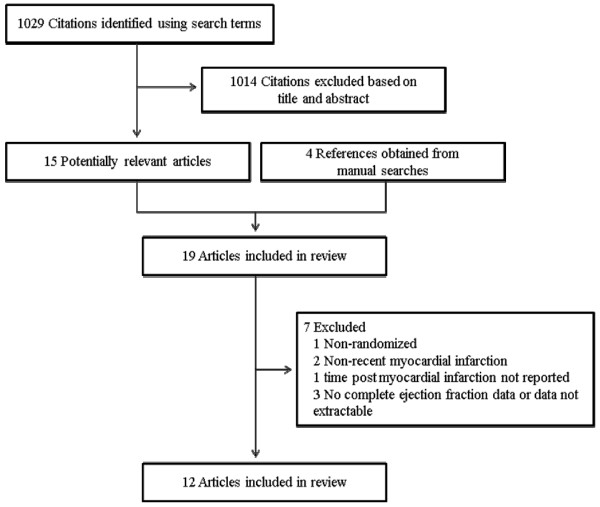
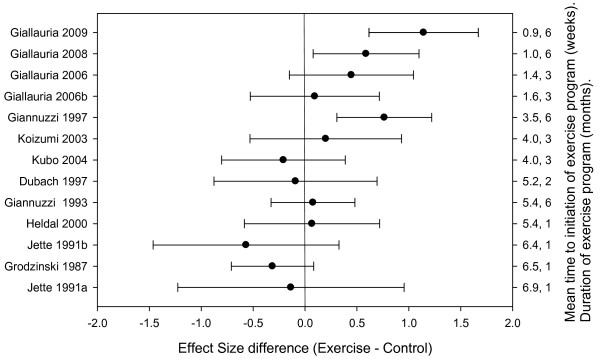
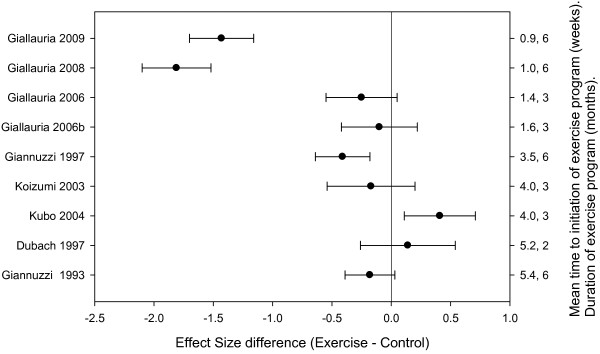
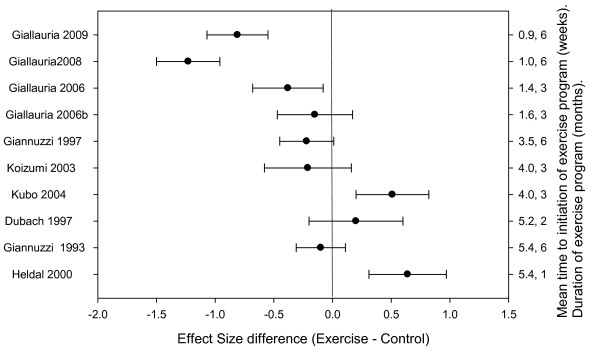
BACKGROUND: The effects of variations in exercise training on left ventricular (LV) remodeling in patients shortly after myocardial infarction (MI) are important but poorly understood. METHODS: Systematic review incorporating meta-analysis using meta-regression. Studies were identified via systematic searches of: OVID MEDLINE (1950 to 2009), Cochrane Central Register of Controlled Trials (1991 to 2009), AMED (1985 to 2009), EMBASE (1988 to 2009), PUBMED (1966 to 2009), SPORT DISCUS (1975 to 2009), SCOPUS (1950 to 2009) and WEB OF SCIENCE (1950 to 2009) using the medical subject headings: myocardial infarction, post myocardial infarction, post infarction, heart attack, ventricular remodeling, ventricular volumes, ejection fraction, left ventricular function, exercise, exercise therapy, kinesiotherapy, exercise training. Reference lists of all identified studies were also manually searched for further relevant studies. Studies selected were randomized controlled trials of exercise training interventions reporting ejection fraction (EF) and/or ventricular volumes in patients following recent MI (≤ 3 months) post-MI patients involving control groups. Studies were excluded if they were not randomized, did not have a 'usual-care' control (involving no exercise), evaluated a non-exercise intervention, or did not involve human subjects. Non-English studies were also excluded. RESULTS: After screening of 1029 trials, trials were identified that reported EF (12 trials, n = 647), End Systolic Volumes (ESV) (9 trials, n = 475) and End Diastolic Volumes (EDV) (10 trials, n = 512). Meta-regression identified that changes in EF effect size difference decreased as the time between MI and initiation of the exercise program lengthened, and increased as the duration of the program increased (Q = 25.48, df = 2, p < 0.01, R2 = 0.76). Greater reductions in ESV and EDV (as indicated by effect size decreases) occurred with earlier initiation of exercise training and with longer training durations (ESV: Q = 23.89, df = 2, p < 0.05, R2 = 0.79; EDV: Q = 27.42, df = 2, p < 0.01, R2 = 0.83). Differences remained following sensitivity analysis. Each week that exercise was delayed required an additional month of training to achieve the same level of benefit on LV remodeling. CONCLUSIONS: Exercise training has beneficial effects on LV remodeling in clinically stable post-MI patients with greatest benefits occurring when training starts earlier following MI (from one week) and lasts longer than 3 months.
Overview
The claims and statistics of this paper haven’t been checked yet.
Run the check — free, no account needed. It reads the open-access text and checks the sources it cites.
Integrity signals
Registry
Cites
Statistics
Figures
Verification
Claims the paper makes
The claims and statistics of this paper haven’t been checked yet.
Run the check — free, no account needed. It reads the open-access text and checks the sources it cites.
Claims other papers make about this one
Each is checked against this paper’s own text: does it say what the citing paper says it does?
In the citing paper
“A 2011 meta-analysis concludes that exercise training has greatest beneficial effects on left ventricular remodeling in clinically stable post-MI patients when training starts one week following the MI (227).”
From Lack of Exercise Is a Major Cause of Chronic Diseases (2012) · cites this paper as [227]
In the citing paper
“A previous meta-analysis 162 found that exercise training following MI can improve LV remodelling, notably by reducing LV end-systolic volume (LVESV)-a strong predictor of mortality after MI-with these benefits maximized if exercise implementation starts early (∼1 week) after the event.”
From Exercise benefits in cardiovascular diseases: From mechanisms to clinical implementation (2023) · cites this paper as [162]
Self-check
Percentages, sums and reported differences re-computed from the paper’s own numbers.
The self-check needs the paper’s full text.
Citations
Cites
Assessing the quality of reports of randomized clinical trials: Is blinding necessary?
Jadad, A. R., Moore, R. A., Carroll, D., Jenkinson, C., Reynolds, D. J. M., Gavaghan, D. J., & McQuay, H. J. (1996) · Controlled Clinical Trials · doi:10.1016/0197-2456(95)00134-4 · Cited by 17,582
(2000) · Cited by 9,198
White, H. D., Norris, R. M., Brown, M. A., Brandt, P. W., Whitlock, R. M. L., & Wild, C. J. (1987) · Circulation · doi:10.1161/01.cir.76.1.44 · Cited by 2,348
Taylor, R. S., Brown, A., Ebrahim, S., Jolliffe, J., Noorani, H., Rees, K., Skidmore, B., Stone, J. A., Thompson, D. R., & Oldridge, N. (2004) · The American Journal of Medicine · doi:10.1016/j.amjmed.2004.01.009 · Cited by 2,239
An overview of randomized trials of rehabilitation with exercise after myocardial infarction.
O'Connor, G. T., Buring, J. E., Yusuf, S., Goldhaber, S. Z., Olmstead, E. M., Paffenbarger, R. S., & Hennekens, C. H. (1989) · Circulation · doi:10.1161/01.cir.80.2.234 · Cited by 1,414
Uncertainty in heterogeneity estimates in meta-analyses
Ioannidis, J. P. A., Patsopoulos, N. A., & Evangelou, E. (2007) · BMJ · doi:10.1136/bmj.39343.408449.80 · Cited by 1,254
Meta-analysis: secondary prevention programs for patients with coronary artery disease
Clark, A. M., Hartling, L., Vandermeer, B., & McAlister, F. A. (2005) · Annals of Internal Medicine · doi:10.7326/0003-4819-143-9-200511010-00010 · Cited by 979
Kotseva, K., Wood, D., De Backer, G., De Bacquer, D., Pyörälä, K., & Keil, U. (2009) · The Lancet · doi:10.1016/s0140-6736(09)60330-5 · Cited by 833
Oldridge, N. B. (1988) · JAMA · doi:10.1001/jama.1988.03410070073031 · Cited by 800
Chow, C. K., Jolly, S., Rao-Melacini, P., Fox, K. A. A., Anand, S. S., & Yusuf, S. (2010) · Circulation · doi:10.1161/circulationaha.109.891523 · Cited by 719
Cardiac Rehabilitation and Survival in Older Coronary Patients
Suaya, J. A., Stason, W. B., Ades, P. A., Normand, S.-L. T., & Shepard, D. S. (2009) · Journal of the American College of Cardiology · doi:10.1016/j.jacc.2009.01.078 · Cited by 557
Cardiac rehabilitation in Europe: results from the European Cardiac Rehabilitation Inventory Survey
Bjarnason‐Wehrens, B., McGee, H. M., Zwisler, A., Piepoli, M. F., Benzer, W., Schmid, J., Dendale, P., Вачиковна, П. Н., Zdrenghea, D., Niebauer, J., et al. (2010) · European Journal of Cardiovascular Prevention & Rehabilitation · doi:10.1097/hjr.0b013e328334f42d · Cited by 510
Home based versus centre based cardiac rehabilitation: Cochrane systematic review and meta-analysis
Dalal, H. M., Zawada, A., Jolly, K., Moxham, T., & Taylor, R. S. (2010) · BMJ · doi:10.1136/bmj.b5631 · Cited by 487
Corrà, U., Piepoli, M. F., Carré, F., Heuschmann, P. U., Hoffmann, U., Verschuren, W. M. M., Halcox, J., Reviewers, D., Giannuzzi, P., Saner, H. E., et al. (2010) · European Heart Journal · doi:10.1093/eurheartj/ehq236 · Cited by 423
Haykowsky, M. J., Liang, Y., Pechter, D., Jones, L. W., McAlister, F. A., & Clark, A. M. (2007) · Journal of the American College of Cardiology · doi:10.1016/j.jacc.2007.02.055 · Cited by 396
Taking healthcare interventions from trial to practice
Glasziou, P., Chalmers, I., Altman, D. G., Bastian, H., Boutron, I., Brice, A., Jamtvedt, G., Farmer, A., Ghersi, D., Groves, T., et al. (2010) · BMJ · doi:10.1136/bmj.c3852 · Cited by 209
Dubach, P., MYERS, J. N., Dziekan, G., Goebbels, U., Reinhart, W. H., Muller, P., Buser, P., Stulz, P. M., Vogt, P. R., & Ratti, R. (1997) · Journal of the American College of Cardiology · doi:10.1016/s0735-1097(97)82540-5 · Cited by 205
Jugdutt, B. I., Michorowski, B. L., & Kappagoda, C. T. (1988) · Journal of the American College of Cardiology · doi:10.1016/0735-1097(88)90407-x · Cited by 201
Giannuzzi, P., Temporelli, P. L., Corrà, U., Gattone, M., Giordano, A., Tavazzi, L., & for the ELVD Study Group (1997) · Circulation · doi:10.1161/01.cir.96.6.1790 · Cited by 196
Belardinelli, R., Georgiou, D., Ginzton, L. E., Cianci, G., & Purcaro, A. (1998) · Circulation · doi:10.1161/01.cir.97.6.553 · Cited by 173
Dubach, P., MYERS, J. N., Dziekan, G., Goebbels, U., Reinhart, W. H., Vogt, P. R., Ratti, R., Muller, P., Miettunen, R., & Buser, P. T. (1997) · Circulation · doi:10.1161/01.cir.95.8.2060 · Cited by 172
Giannuzzi, P., Tavazzi, L., Temporelli, P. L., Corrà, U., Imparato, A., Gattone, M., Giordano, A., Sala, L., Schweiger, C., & Malinverni, C. (1993) · Journal of the American College of Cardiology · doi:10.1016/0735-1097(93)90764-r · Cited by 171
Randomized 4-week exercise program in patients with impaired left ventricular function.
Jetté, M., Heller, R., Landry, F., & Blümchen, G. (1991) · Circulation · doi:10.1161/01.cir.84.4.1561 · Cited by 162
Ehsani, A. A., Biello, D. R., Schultz, J., Be, S., & Holloszy, J. O. (1986) · Circulation · doi:10.1161/01.cir.74.2.350 · Cited by 152
Stamm, R. B., Gibson, R. S., Bishop, H. L., Carabello, B. A., Beller, G. A., & Martin, R. P. (1983) · Circulation · doi:10.1161/01.cir.67.1.233 · Cited by 145
Malfatto, G., Facchini, M., Bragato, R., Branzi, G., Sala, L., & Leonetti, G. (1996) · European Heart Journal · doi:10.1093/oxfordjournals.eurheartj.a014905 · Cited by 139
Vona, M., Rossi, A., Capodaglio, P., Rizzo, S., Servi, P., Marchi, M. D., & Cobelli, F. (2004) · American Heart Journal · doi:10.1016/j.ahj.2003.12.023 · Cited by 114
Giallauria, F., Cirillo, P., Lucci, R., Pacileo, M., De Lorenzo, A., D'Agostino, M., Moschella, S., Psaroudaki, M., Del Forno, D., Orio, F., et al. (2008) · European Journal of Cardiovascular Prevention & Rehabilitation · doi:10.1097/hjr.0b013e3282f00990 · Cited by 99
Prevention of ventricular remodelling post myocardial infarction: timing and duration of therapy.
Jugdutt, B. I. (1993) · PubMed · Cited by 97
Dafoe, W. A., Arthur, H. M., Stokes, H. C., Morrin, L. I., & Beaton, L. J. (2006) · Canadian Journal of Cardiology · doi:10.1016/s0828-282x(06)70309-9 · Cited by 91
Giallauria, F., Lorenzo, A. D., Pilerci, F., Manakos, A., Lucci, R., Psaroudaki, M., D'Agostino, M., Forno, D. D., & Vigorito, C. (2006) · European Journal of Cardiovascular Prevention & Rehabilitation · doi:10.1097/01.hjr.0000209810.59831.f4 · Cited by 60
Giallauria, F., Lucci, R., Lorenzo, A. D., D’Agostino, M., Forno, D. D., & Vigorito, C. (2006) · Age and Ageing · doi:10.1093/ageing/afl098 · Cited by 59
Giallauria, F., Galizia, G., Lucci, R., D’Agostino, M., Vitelli, A., Maresca, L., Orio, F., & Vigorito, C. (2008) · International Journal of Cardiology · doi:10.1016/j.ijcard.2008.05.026 · Cited by 57
Return to Full Normal Activities Including Work at Two Weeks After Acute Myocardial Infarction
Kovoor, P., Lee, A. K. Y., Carrozzi, F. M., Wiseman, V. L., Byth, K., Zecchin, R. P., Dickson, C., King, M., Hall, J. P., Ross, D. L., et al. (2006) · The American Journal of Cardiology · doi:10.1016/j.amjcard.2005.10.040 · Cited by 46
Kubo, N., Ohmura, N., Nakada, I., Yasu, T., Katsuki, T., Fujii, M., & Saito, M. (2003) · American Heart Journal · doi:10.1016/s0002-8703(03)00521-0 · Cited by 40
Koizumi, T., Miyazaki, A., Komiyama, N., Sun, K., Nakasato, T., Masuda, Y., & Komuro, I. (2003) · Circulation Journal · doi:10.1253/circj.67.233 · Cited by 34
SENARATNE, M. P. J., Smith, G., & Gulamhusein, S. S. (2000) · Journal of the American College of Cardiology · doi:10.1016/s0735-1097(00)00545-3 · Cited by 30
Grodzinski, E., Jetté, M., Blümchen, G., & BORER, J. S. (1987) · Journal of Cardiopulmonary Rehabilitation · doi:10.1097/00008483-198707110-00001 · Cited by 8
Heldal, M., Rootwelt, K., Sire, S., & Dale, J. (2000) · Scandinavian Cardiovascular Journal · doi:10.1080/713783109 · Cited by 7
Grodzinski, E., Jetté, M., Blümchen, G., et al. (1987) · Journal of Cardiopulmonary Rehabilitation · doi:10.1097/00008483-198711200-00001 · Cited by 5
Research works printed but not linked: 2
- Parker k, Hauer T, Arena R, Lundberg D, Aggarwal S, Goodhart D, D. T: Attendance in an early discharge clinic with symptom limited maximal exercise testing is safe and improves cardiac rehabilitation participation among low-risk stemi patients. Eur J Cardiovasc Prev Rehabil. 2009, 16:
- Clark AM, Hartling L, Vandermeer B, McAlister FA: Secondary prevention program for patients with coronary artery disease: A meta-analysis of randomized control trials. Ann Int Med. 2005, 143: 659-672. · DOI · Paper page
Cited by
Sorted by citations
Lack of Exercise Is a Major Cause of Chronic Diseases
Booth, F. W., Roberts, C. K., & Laye, M. J. (2012) · Comprehensive Physiology · doi:10.1002/cphy.c110025 · Cited by 2,575
2020 ESC guidelines on sports cardiology and exercise in patients with cardiovascular disease
Pelliccia, A., Sharma, S., Gati, S., Bäck, M., Börjesson, M., Caselli, S., Collet, J.-P., Corrado, D., Drezner, J. A., Halle, M., et al. (2021) · European Heart Journal · doi:10.1093/eurheartj/ehaa605 · Cited by 1,958
Ambrosetti, M., Abreu, A., Corrà, U., Davos, C. H., Hansen, D., Frederix, I., Iliou, M. C., Pedretti, R. F. E., Schmid, J.-P., Vigorito, C., et al. (2021) · European Journal of Preventive Cardiology · doi:10.1177/2047487320913379 · Cited by 965
Exercise benefits in cardiovascular disease: beyond attenuation of traditional risk factors
Fiuza-Luces, C., Santos-Lozano, A., Joyner, M., Carrera-Bastos, P., Picazo, O., Zugaza, J. L., Izquierdo, M., Ruilope, L. M., & Lucia, A. (2018) · Nature Reviews Cardiology · doi:10.1038/s41569-018-0065-1 · Cited by 803
Liu, X., Xiao, J., Zhu, H., Wei, X., Platt, C., Damilano, F., Xiao, C., Bezzerides, V. J., Boström, P., Che, L., et al. (2015) · Cell Metabolism · doi:10.1016/j.cmet.2015.02.014 · Cited by 397
Metadata
- Authors
- Haykowsky, M., Scott, J., Esch, B., Schopflocher, D., Myers, J., Paterson, I., Warburton, D., Jones, L., & Clark, A. M.
- Affiliations
- University of Alberta (CA)
- University of British Columbia (CA)
- VA Palo Alto Health Care System (US)
- Duke Medical Center (US)
- Corresponding author
- Haykowsky, Mark
- Venue
- Trials
- Published
- 2011-04-04
- Volume
- 12
- Issue
- 1
- Pages
- 92-92
- ISSN
- 1745-6215 (ISSN-L)
- PMC
- PMC3083361
- OpenAlex
- W2132363115
- Cited by
- 228
- References
- 40
- Citations by year
- 2026: 7 · 2025: 10 · 2024: 23 · 2023: 17 · 2022: 18 · 2021: 22 · 2020: 17 · 2019: 18 · 2018: 15 · 2017: 13 · 2016: 19 · 2015: 12 · 2014: 13 · 2013: 8 · 2012: 14
- FWCI
- 1.93
- Type
- journal article
- Language
- en
- Open access
- gold
- doi.org
- Licence
- Locations
- Trials (publishedVersion, cc-by)
- Europe PMC (PubMed Central) (publishedVersion, cc-by)
- PubMed Central (publishedVersion, cc-by)
- PubMed (publishedVersion)
- Research Bank (Australian Catholic University) (submittedVersion)
- cIRcle (University of British Columbia) (submittedVersion, cc-by)
- DOAJ (DOAJ: Directory of Open Access Journals) (submittedVersion)
- Funders
- U.S. Department of Veterans Affairs (IK6 RX002477)
- Canadian Institutes of Health Research
- Topics
- Health Sciences › Medicine › Cardiology and Cardiovascular Medicine › Cardiac Health and Mental Health
- Health Sciences › Medicine › Physiology (medical) › Cardiovascular and exercise physiology
- Health Sciences › Medicine › Cardiology and Cardiovascular Medicine › Cardiac Fibrosis and Remodeling
- Keywords
- exercise training, left ventricular remodeling, myocardial infarction, ejection fraction, end-systolic volume, end-diastolic volume, training duration, cardiac rehabilitation, left ventricular function, ventricular volume
- MeSH terms
- Exercise Therapy, Humans, Myocardial Infarction, Stroke Volume, Time Factors, Ventricular Function, Left, Treatment Outcome, Evidence-Based Medicine, Ventricular Remodeling
About these checks
Registry, retraction, Cites and statistics results are computed, not judged, with one exception: a printed reference that no index lists is read once by a model before it counts as a citation error. Claims are extracted by a model and kept only when their quote appears verbatim in the text; each cited source is then checked, with a model’s help, for whether it says what the claim relies on. Those verdicts can be wrong — read the claim’s quote and the cited source before relying on one.
Statistics and arithmetic are recomputed, not judged.
Confidence bands are shown only for fields calibrated on our annotated test set. None is calibrated yet, so no band is shown.
What counts as a claim ›How we measure confidence ›How we check this ›
Are you an author, or do you see a problem with this page? Request a review
