

Involving service users in trials: developing a standard operating procedure
Open accessThe DOI matches its Crossref record; 40 of the 42 references it cites were found in a registry or an index.
Abstract
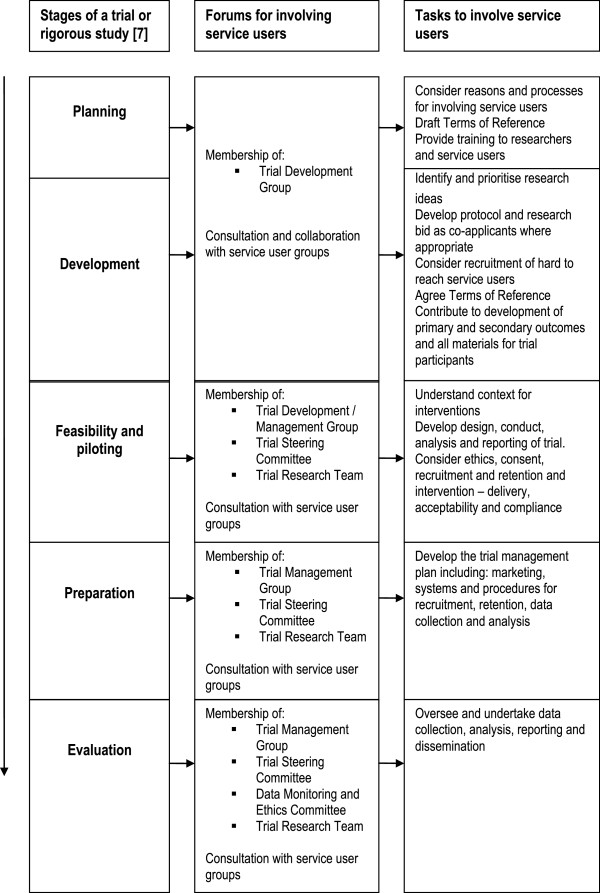
BACKGROUND: Many funding bodies require researchers to actively involve service users in research to improve relevance, accountability and quality. Current guidance to researchers mainly discusses general principles. Formal guidance about how to involve service users operationally in the conduct of trials is lacking. We aimed to develop a standard operating procedure (SOP) to support researchers to involve service users in trials and rigorous studies. METHODS: Researchers with experience of involving service users and service users who were contributing to trials collaborated with the West Wales Organisation for Rigorous Trials in Health, a registered clinical trials unit, to develop the SOP. Drafts were prepared in a Task and Finish Group, reviewed by all co-authors and amendments made. RESULTS: We articulated core principles, which defined equality of service users with all other research team members and collaborative processes underpinning the SOP, plus guidance on how to achieve these. We developed a framework for involving service users in research that defined minimum levels of collaboration plus additional consultation and decision-making opportunities. We recommended service users be involved throughout the life of a trial, including planning and development, data collection, analysis and dissemination, and listed tasks for collaboration. We listed people responsible for involving service users in studies and promoting an inclusive culture. We advocate actively involving service users as early as possible in the research process, with a minimum of two on all formal trial groups and committees. We propose that researchers protect at least 1% of their total research budget as a minimum resource to involve service users and allow enough time to facilitate active involvement. CONCLUSIONS: This SOP provides guidance to researchers to involve service users successfully in developing and conducting clinical trials and creating a culture of actively involving service users in research at all stages. The UK Clinical Research Collaboration should encourage clinical trials units actively to involve service users and research funders should provide sufficient funds and time for this in research grants.
Overview
The claims and statistics of this paper haven’t been checked yet.
Free: it reads the open-access text and checks the first 5 claims that cite a source we can check. Create a free account to check every claim.
Integrity signals
Registry
Cites
Statistics
Figures
Verification
Claims the paper makes
The claims and statistics of this paper haven’t been checked yet.
Free: it reads the open-access text and checks the first 5 claims that cite a source we can check. Create a free account to check every claim.
Claims other papers make about this one
Each is checked against this paper’s own text: does it say what the citing paper says it does?
The source backs part of the claim, not all of it — or backs it for a different population, condition or comparison.
In the citing paper
“Several sources recommended a range of stakeholders (e.g. intervention providers, intervention recipients, public representatives as well as practitioners who might use the evidence produced by the full trial) be involved in the planning and running of the exploratory study to ensure exploratory studies reflect the realities of intervention setting [15, 28, 31, 32, 39, 40].”
From Exploratory studies to decide whether and how to proceed with full-scale evaluations of public health interventions: a systematic review of guidance (2018) · cites this paper as [28]
Experimental — accuracy not yet measuredThe source backs part of the claim, not all of it — or backs it for a different population, condition or comparison.
In the citing paper
“Indeed, there is guidance available on patient and public involvement in trials, showing how service users can be involved at the feasibility/pilot stage of a trial by being members of the management group, steering committee and research team and by contributing to the design, analysis and reporting of the feasibility study [44].”
From Maximising the impact of qualitative research in feasibility studies for randomised controlled trials: guidance for researchers (2015) · cites this paper as [44]
Experimental — accuracy not yet measuredThe cited source says what the claim attributes to it.
In the citing paper
“These were often discussed within the context of the MRC’s intervention development-evaluation cycle [6, 9, 10, 13, 25–28].”
From Exploratory studies to decide whether and how to proceed with full-scale evaluations of public health interventions: a systematic review of guidance (2018) · cites this paper as [28]
The cited source says what the claim attributes to it.
In the citing paper
“While many highlighted the value of stakeholders on Trial Steering Committees and other similar study groups [15, 28, 40]”
From Exploratory studies to decide whether and how to proceed with full-scale evaluations of public health interventions: a systematic review of guidance (2018) · cites this paper as [28]
In the citing paper
“‘Pilot’ and ‘feasibility’ studies were sometimes used interchangeably [10, 20, 25–28, 31] while others made distinctions between the two according to design features or particular aims [7, 8, 19, 29, 32–34].”
From Exploratory studies to decide whether and how to proceed with full-scale evaluations of public health interventions: a systematic review of guidance (2018) · cites this paper as [28]
Self-check
Percentages, sums and reported differences re-computed from the paper’s own numbers.
The self-check needs the paper’s full text.
Citations
Cites
Developing and evaluating complex interventions: the new Medical Research Council guidance
Craig, P., Dieppe, P., Macintyre, S., Michie, S., Nazareth, I., & Petticrew, M. (2008) · BMJ · doi:10.1136/bmj.a1655 · Cited by 10,995 · cited 2×
“Service users bring understanding and experience of conditions and interventions to the process of designing and conducting trials [5,7].”
BackgroundMethodBrett, J., Staniszewska, S., Mockford, C., Herron‐Marx, S., Hughes, J., Tysall, C., & Suleman, R. (2014) · Health Expectations · doi:10.1111/j.1369-7625.2012.00795.x · Cited by 1,598 · cited 3×
“Recent evidence reports the importance of context and process on involvement, highlighting the need for researchers to understand their role in facilitating service user involvement and follow best practice [13,31].”
BackgroundMethodCommunity-based participatory research: assessing the evidence.
Viswanathan, M., Ammerman, A., Eng, E. M., Garlehner, G., Lohr, K. N., Griffith, D. M., Rhodes, S. D., Samuel‐Hodge, C. D., Maty, S. C., Lux, L. J., et al. (2004) · PubMed Central · Cited by 1,063
Consumer involvement in health research: a review and research agenda
Boote, J., Telford, R., & Cooper, C. (2002) · Health Policy · doi:10.1016/s0168-8510(01)00214-7 · Cited by 513 · cited 4×
“We also described opportunities for involvement by consultation to inform a process of collaborative or shared decision-making since involvement in a project can vary between approaches [32,36,37].”
BackgroundInfluentialLay perspectives: advantages for health research
Entwistle, V. A., Renfrew, M. J., Yearley, S., Forrester, J., & Lamont, T. (1998) · BMJ · doi:10.1136/bmj.316.7129.463 · Cited by 376 · cited 1×
“There is also a need to tackle misunderstood anxieties around who to involve, to explain the contribution of service users’ perspectives, so that researchers are not misled by anxieties about gaining representation, the so-called ‘red herring’ [33], in place of experience [32,34,35].”
BackgroundStaniszewska, S., Brett, J., Mockford, C., & Barber, R. (2011) · International Journal of Technology Assessment in Health Care · doi:10.1017/s0266462311000481 · Cited by 369 · cited 1×
“We adhered to elements of the GRIPP checklist where relevant to reporting guidance [38].”
Method(2012) · SpringerReference · doi:10.1007/springerreference_75865 · Cited by 285
From passive subjects to equal partners: Qualitative review of user involvement in research
Trivedi, P., & Wykes, T. (2002) · British Journal of Psychiatry · doi:10.1192/bjp.181.6.468 · Cited by 279 · cited 2×
“It also makes specific recommendations for providing the financial and time resources necessary to achieve effective involvement and foster an environment to support researchers in understanding its potential and current limitations [10,19,43-45,51].”
BackgroundCancer expert doubts claims about prostate cancer trial
Cole, A. (2008) · BMJ · doi:10.1136/bmj.a979 · Cited by 255
Gillard, S., Simons, L., Turner, K., Lucock, M., & Edwards, C. (2012) · Qualitative Health Research · doi:10.1177/1049732312448541 · Cited by 245
Research works printed but not linked: 4
- Wales Office of Research and Development for Health and Social Care Research Governance Framework for Health and Social Care in Wales: Second Edition 2005 Cardiff: Welsh Assembly Government
- Nolan M Hanson E Grant G Keady J Magnusson L Nolan M, Hansen E, Grant G, Keady J Introduction: what counts as knowledge, whose knowledge counts? Towards authentic participatory enquiry User Participation in Health and Social Care Research 2007 Maidenhead: OUP McGraw Hill 1 13
- Nolan M Hanson E Grant G Keady J Nolan M, Hansen E, Grant G, Keady J Conclusions: realising authentic participatory enquiry User Participation in Health and Social Care Research 2007 Maidenhead: OUP McGraw Hill 183 202
- INVOLVE Patient and public involvement in research and research ethics committee review 2009 Eastleigh: INVOLVE
Cited by
Greenhalgh, T., Hinton, L., Finlay, T., Macfarlane, A., Fahy, N., Clyde, B., & Chant, A. (2019) · Health Expectations · doi:10.1111/hex.12888 · Cited by 1,059
O’Cathain, A., Hoddinott, P., Lewin, S., Thomas, K. J., Young, B., Adamson, J., Jansen, Y. J., Mills, N., Moore, G., & Donovan, J. L. (2015) · Pilot and Feasibility Studies · doi:10.1186/s40814-015-0026-y · Cited by 458
“…on patient and public involvement in trials, showing how service users can be involved at the feasibility/pilot stage of a trial by being members of the management group, steering committee and research team and by contributing to the design, analysis and reporting of the feasibility study [44].”
Hallingberg, B., Turley, R., Segrott, J., Wight, D., Craig, P., Moore, L., Murphy, S., Robling, M., Simpson, S. A., & Moore, G. (2018) · Pilot and Feasibility Studies · doi:10.1186/s40814-018-0290-8 · Cited by 248
“intervention recipients, public representatives as well as practitioners who might use the evidence produced by the full trial) be involved in the planning and running of the exploratory study to ensure exploratory studies reflect the realities of intervention setting [12, 27, 31, 32, 39, 40].”
BackgroundMethodInfluentialBagley, H. J., Short, H., Harman, N. L., Hickey, H. R., Gamble, C. L., Woolfall, K., Young, B., & Williamson, P. R. (2016) · Research Involvement and Engagement · doi:10.1186/s40900-016-0029-8 · Cited by 200
Healy, P., Galvin, S., Williamson, P. R., Treweek, S., Whiting, C., Maeso, B., Bray, C., Brocklehurst, P., Moloney, M. C., Douiri, A., et al. (2018) · Trials · doi:10.1186/s13063-018-2544-4 · Cited by 159
Patient and public involvement in dementia research in the European Union: a scoping review
Miah, J., Dawes, P., Edwards, S., Leroi, I., Starling, B., & Parsons, S. (2019) · BMC Geriatrics · doi:10.1186/s12877-019-1217-9 · Cited by 149
Raftery, J. P., Hanney, S. R., Greenhalgh, T., Glover, M. J., & Blatch-Jones, A. (2016) · Health Technology Assessment · doi:10.3310/hta20760 · Cited by 132
Buck, D., Gamble, C., Dudley, L., Preston, J., Hanley, B., Williamson, P. R., Young, B., & The EPIC Patient Advisory Group (2014) · BMJ Open · doi:10.1136/bmjopen-2014-006400 · Cited by 103
Brunsdon, D., Biesty, L., Brocklehurst, P., Brueton, V. C., Devane, D., Elliott, J., Galvin, S., Gamble, C. L., Gardner, H., Healy, P., et al. (2019) · Trials · doi:10.1186/s13063-019-3687-7 · Cited by 93
Gamble, C. L., Dudley, L., Allam, A., Bell, P., Goodare, H., Hanley, B., Preston, J., Walker, A., Williamson, P. R., & Young, B. (2014) · BMJ Open · doi:10.1136/bmjopen-2014-005234 · Cited by 88
Self-citationMann, C., Chilcott, S., PLUMB, K. H. M., Brooks, E., & Man, M. (2018) · Research Involvement and Engagement · doi:10.1186/s40900-018-0098-y · Cited by 84
“[20] in timeframe, planning, resourcing, PPI coordinator role, support from the Chief Investigator and involvement of the PPI group at all stages of the trial.”
BackgroundMethodInfluentialWilliams, J. G., Alam, M. F., Alrubaiy, L., Clement, C., Cohen, D. R., Grey, M., Hilton, M., Hutchings, H. A., Longo, M., Morgan, J. M., et al. (2016) · Health Technology Assessment · doi:10.3310/hta20440 · Cited by 77
Self-citationSnooks, H. A., Anthony, R., Chatters, R., Dale, J. R., Fothergill, R. T., Gaze, S., Halter, M., Humphreys, I., Koniotou, M., Logan, P., et al. (2017) · Health Technology Assessment · doi:10.3310/hta21130 · Cited by 83
Self-citationInvolving Patients in Research: Considering Good Practice
Gooberman‐Hill, R., Burston, A., Clark, E., Johnson, E. C., Nolan, S., Wells, V., Betts, L., & PEP‐R (2013) · Musculoskeletal Care · doi:10.1002/msc.1060 · Cited by 78
“Relating to clinical trials, a team in Wales have developed a standard operating procedure for involvement, providing some guidance that focuses attention on resources and possible forms of involvement at each stage in the research lifecycle (Evans et al., 2013).”
Methodde Wit, M. P. T., Beurskens, A. J. H. M., Piškur, B., Stoffers, E., & Moser, A. (2018) · Health Expectations · doi:10.1111/hex.12671 · Cited by 76
Seagrove, A. C., Alam, M. F., Alrubaiy, L., Cheung, W., Clement, C., Cohen, D. R., Grey, M., Hilton, M., Hutchings, H. A., Morgan, J. M., et al. (2014) · BMJ Open · doi:10.1136/bmjopen-2014-005091 · Cited by 54
Self-citationGamble, C. L., Dudley, L., Allam, A., Bell, P., Buck, D., Goodare, H., Hanley, B., Preston, J., Walker, A., Williamson, P. R., et al. (2015) · Health Services and Delivery Research · doi:10.3310/hsdr03390 · Cited by 60
Self-citationPrice, D., Edwards, M., Carson‐Stevens, A., Cooper, A., Davies, F., Evans, B. A., Hibbert, P. D., Hughes, T. C., Rainer, T. H., Siriwardena, A. N., et al. (2020) · BMC Medical Research Methodology · doi:10.1186/s12874-020-01039-2 · Cited by 47
Self-citationSnooks, H. A., Khanom, A., Cole, R., Edwards, A., Edwards, B. M., Evans, B. A., Foster, T., Fothergill, R. T., Gripper, C. P., Hampton, C., et al. (2019) · BMC Emergency Medicine · doi:10.1186/s12873-019-0297-3 · Cited by 46
Self-citationWhat can we learn from trial decliners about improving recruitment? Qualitative study
Hughes-Morley, A., Young, B., Hempel, R., Russell, I. T., Waheed, W., & Bower, P. (2016) · Trials · doi:10.1186/s13063-016-1626-4 · Cited by 42
“Thus a priority for future research is the presentation and provision of accurate and effective trial information in which patients and the public play a seminal role [78].”
BackgroundSelf-citationHøeg, B. L., Tjørnhøj‐Thomsen, T., Skaarup, J. A., Langstrup, H., Zoffmann, V., Saltbæk, L., Karlsen, R. V., Dalton, S. O., Johansen, C., & Bidstrup, P. E. (2019) · Acta Oncologica · doi:10.1080/0284186x.2019.1566776 · Cited by 36
“Using the PPI guidelines mentioned above [13,17,18], trial researchers identified which patients to involve, the areas requiring patient input, recruitment procedures and decided on the use of the focus group interview as the preferred method of gathering a range of patient perspectives through facilitated discussion…”
BackgroundMethodAndrews, L. M., Allen, H., Sheppard, Z. A., Baylis, G., & Wainwright, T. W. (2015) · Research Involvement and Engagement · doi:10.1186/s40900-015-0013-8 · Cited by 44
“[15] have produced guidance for researchers in the form of a standard operating procedure for involving service users in research, and examples of good practice have been published [16] but further work is required.”
BackgroundMethodFrost, J., Gibson, A., Harris‐Golesworthy, F., Harris, J., & Britten, N. (2018) · Health Expectations · doi:10.1111/hex.12814 · Cited by 37
Brocklehurst, P. R., Baker, S. R., & Langley, J. (2020) · Community Dentistry And Oral Epidemiology · doi:10.1111/cdoe.12570 · Cited by 38
Hutchings, H. A., Evans, B. A., Fitzsimmons, D. F., Harrison, J., Heaven, M. L., Huxley, P. J., Kingston, M. R., Lewis, L., Phillips, C. J., Porter, A. M., et al. (2013) · Trials · doi:10.1186/1745-6215-14-301 · Cited by 32
“In accordance with the WWORTH Standard Operating Procedure for Service User Inclusion [39], we have recruited two service users who will actively participate throughout the study as members of the Research Management Group.”
MethodSelf-citationEvans, B. A., Brown, A., Bulger, J. K., Fegan, G., Ford, S. J., Guy, K., Jones, S., Keen, L. J., Khanom, A., Longo, M., et al. (2019) · BMJ Open · doi:10.1136/bmjopen-2018-026073 · Cited by 28
Self-citationEvans, B. A., Khanom, A., Edwards, A., Edwards, B. M., Farr, A., Foster, T., Fothergill, R. T., Gripper, P., Gunson, I. M., Porter, A. M., et al. (2023) · Health Expectations · doi:10.1111/hex.13856 · Cited by 26
“In addition, we recruited two public contributors to the independent Study Steering Committee.”
MethodSelf-citationPredictive risk stratification model: a randomised stepped-wedge trial in primary care (PRISMATIC)
Snooks, H. A., Bailey, K., Burge-Jones, D., Dale, J. R., Davies, J., Evans, B. A., Farr, A., Fitzsimmons, D. F., Harrison, J., Heaven, M. L., et al. (2018) · Health Services and Delivery Research · doi:10.3310/hsdr06010 · Cited by 33
Self-citationAas, S. N., Distefano, M. B., Pettersen, I., Gravrok, B., Nordvoll, L. Y., Bjaastad, J. F., & Grimsgaard, S. (2023) · Research Involvement and Engagement · doi:10.1186/s40900-023-00458-x · Cited by 19
Aslam, R. W., Snooks, H. A., Porter, A. M., Khanom, A., Cole, R., Edwards, A., Edwards, B. M., Evans, B. A., Foster, T., Fothergill, R. T., et al. (2022) · BMJ Open · doi:10.1136/bmjopen-2021-053123 · Cited by 15
Self-citationBulger, J. K., Brown, A., Evans, B. A., Fegan, G., Ford, S., Guy, K., Jones, S., Keen, L. J., Khanom, A., Pallister, I., et al. (2017) · Pilot and Feasibility Studies · doi:10.1186/s40814-016-0115-6 · Cited by 17
“We follow best practise in supporting their contribution so they collaborate as equal members of the study team throughout [46, 47].”
BackgroundSelf-citationEvans, B. A., Brown, A., Fegan, G., Ford, S., Guy, K., Jones, J., Jones, S., Keen, L. J., Khanom, A., Longo, M., et al. (2019) · BMJ Open · doi:10.1136/bmjopen-2019-033398 · Cited by 19
Self-citationKoniotou, M., Evans, B. A., Chatters, R., Fothergill, R. T., Garnsworthy, C., Gaze, S., Halter, M., Mason, S. M., Peconi, J., Porter, A. M., et al. (2015) · Trials · doi:10.1186/s13063-015-0821-z · Cited by 15
“Methods We took the Swansea CTU SOP for service user involvement in trials [20] as our starting point.”
BackgroundMethodInfluentialSelf-citationProtocol for Take-home naloxone In Multicentre Emergency (TIME) settings: feasibility study
Jones, M., Bell, F., Benger, J. R., Black, S., Buykx, P., Dixon, S., Driscoll, T., Evans, B. A., Edwards, A., Fuller, G. W., et al. (2020) · Pilot and Feasibility Studies · doi:10.1186/s40814-020-00626-w · Cited by 11
Self-citationImplementation and trial evidence: a plea for fore-thought
Brocklehurst, P. R., Williams, L., Burton, C. R., Goodwin, T. L., & Rycroft‐Malone, J. (2017) · BDJ · doi:10.1038/sj.bdj.2017.213 · Cited by 15
Evans, B. A., Carson‐Stevens, A., Cooper, A., Davies, F., Edwards, M., Harrington, B., Hepburn, J., Hughes, T., Price, D., Siriwardena, A. N., et al. (2022) · Health Expectations · doi:10.1111/hex.13566 · Cited by 10
“Funders need to acknowledge the cost of genuine public involvement and accept that these may result in bigger research budgets.(15,36) Otherwise, research teams risk cutting other costs that are necessary to delivery of high‐quality and timely research, to appear competitive in the contested research application proce…”
BackgroundSelf-citationLi, P. W. C., & Yu, D. S. F. (2018) · European Journal of Cardiovascular Nursing · doi:10.1177/1474515118810126 · Cited by 9
Implementing emergency admission risk prediction in general practice: a qualitative study.
Evans, B. A., Dale, J. R., Davies, J., Hutchings, H. A., Kingston, M. R., Porter, A. M., Russell, I. T., Williams, V. R., & Snooks, H. A. (2022) · PubMed Central · doi:10.3399/bjgp.2021.0146 · Cited by 7
“42–44 As members of the research management group, they were responsible for strategic and operational decisions, and contributed as equal team members to ensure patients’ perspectives were considered at all stages of the study.”
Self-citationComparative Effectiveness and Practice Variation in Neonatal Care
Lagatta, J. M., Uhing, M. R., & Panepinto, J. A. (2014) · Clinics in Perinatology · doi:10.1016/j.clp.2014.08.007 · Cited by 5
LaFave, S. E., Wallace, D. J., Grover, R., Clark, R., Marks, S., Lacanienta, C., Evans, C., Kalil, G. Z., Ouyang, P., Himmelfarb, C. D., et al. (2021) · Journal of Clinical and Translational Science · doi:10.1017/cts.2021.818 · Cited by 5
Treem, J. W., Schneider, M. L., Zender, R., & Sorkin, D. H. (2018) · Journal of Clinical and Translational Science · doi:10.1017/cts.2018.311 · Cited by 5
Transient Ischaemic attack Emergency Referral (TIER): randomised feasibility trial results
Watkins, A. J., Jones, J., Ali, K., Dewar, R., Edwards, A., Evans, B. A., Evans, L., Ford, G. A., Hampton, C., John, R., et al. (2024) · Emergency Medicine Journal · doi:10.1136/emermed-2021-212230 · Cited by 5
Self-citationJohnson, E. E., Gill, S., Still, M., Trenchard, D., Smith, D. M., Harmston, R. R., McDermott, J., & Pearson, F. (2025) · Health Expectations · doi:10.1111/hex.70425 · Cited by 4
Baghdadi, F., Evans, B. A., Goodacre, S. W., John, P. A., Hettiarachchi, T., John, A. M., Lyons, R. A., Porter, A. M., Safari, S., Siriwardena, A. N., et al. (2023) · BMJ Open · doi:10.1136/bmjopen-2022-069596 · Cited by 2
Self-citationNelson, K., Carter, K., Hepburn, J., Hill, I. D., Hurlow, C., O’Neill, C., Tang, A., & Harris, D. A. (2023) · Health Expectations · doi:10.1111/hex.13796 · Cited by 2
Research procedure acceptability through women during pregnancy and postpartum: A pilot study
Simon, J., Thisse, J., Chabert, C., Barasinski, C., & Ambroise-Grandjean, G. (2023) · International Journal of Gynecology & Obstetrics · doi:10.1002/ijgo.15104 · Cited by 2
“4 Steering Group meetings including users, supportive research environment and users access to research activities can produce better designed and reported studies.”
BackgroundMoenkemann, H., Pilger, R., Reinecker, S., Houben, P., & Paulus, U. (2014) · Clinical Investigation · doi:10.4155/cli.13.125 · Cited by 2
Patient participation – What is it?
Moser, A., van der Weijden, T., & Steckelberg, A. (2016) · Zeitschrift für Evidenz Fortbildung und Qualität im Gesundheitswesen · doi:10.1016/j.zefq.2015.12.010 · Cited by 2
Exploring the meaning and impact of public involvement in health research
Barber, R. (2014) · White Rose eTheses Online (University of Leeds, The University of Sheffield, University of York) · Cited by 6
Watkins, A. J., Aslam, R. W., Dearden, A., Driscoll, T., Edwards, A., Edwards, B. M., Evans, B. A., Farr, A., Foster, T., Fothergill, R. T., et al. (2025) · Health and Social Care Delivery Research · doi:10.3310/pwgf6008 · Cited by 2
Self-citationAas, S. N., Distefano, M. B., Pettersen, I., Gravrok, B., Nordvoll, L. Y., Bjaastad, J. F., & Grimsgaard, S. (2023) · Figshare · doi:10.6084/m9.figshare.23650148
Metadata
- Authors
- Evans, B., Bedson, E., Bell, P., Hutchings, H., Lowes, L., Rea, D., Seagrove, A., Siebert, S., Smith, G., Snooks, H., Thomas, M., Thorne, K., Russell, I., & on behalf of the West Wales Organisation for Rigorous Trials in Health (WWORTH)
- Affiliations
- Swansea University (GB)
- University of Liverpool (GB)
- Cardiff University (GB)
- University of Glasgow (GB)
- The University of Wales, Newport (GB)
- Corresponding author
- Evans, Bridie
- ORCID
- Venue
- Trials
- Published
- 2013
- Volume
- 14
- Issue
- 1
- Pages
- 219
- ISSN
- 1745-6215 (ISSN-L)
- PMC
- PMC3725161
- OpenAlex
- W2113173442
- Cited by
- 52
- References
- 41
- Citations by year
- 2025: 2 · 2024: 1 · 2023: 6 · 2022: 3 · 2021: 2 · 2020: 3 · 2019: 7 · 2018: 8 · 2017: 3 · 2016: 5 · 2015: 4 · 2014: 6 · 2013: 2
- FWCI
- 10.26
- Type
- journal article
- Language
- en
- Open access
- gold
- doi.org
- Licence
- cc-by
- Locations
- Trials (publishedVersion, cc-by)
- Europe PMC (PubMed Central) (publishedVersion, cc-by)
- PubMed Central (publishedVersion, cc-by)
- PubMed (publishedVersion)
- ENLIGHTEN (Jurnal Bimbingan dan Konseling Islam) (acceptedVersion)
- Research Space (acceptedVersion)
- ORCA Online Research @Cardiff (Cardiff University) (submittedVersion)
- Topics
- Health Sciences › Health Professions › General Health Professions › Mental Health and Patient Involvement
- Health Sciences › Medicine › Public Health, Environmental and Occupational Health › Ethics in Clinical Research
- Health Sciences › Medicine › Public Health, Environmental and Occupational Health › Community Health and Development
- Keywords
- service user involvement, clinical trials, standard operating procedures, co-production, research funding, clinical trial units, research culture
- MeSH terms
- Clinical Trials as Topic, Community Participation, Cooperative Behavior, Decision Support Techniques, Humans, Research Design, Research Personnel, Wales, Program Development, Guidelines as Topic, Interdisciplinary Communication, Research Subjects
About these checks
Registry, retraction, Cites and statistics results are computed, not judged, with one exception: a printed reference that no index lists is read once by a model before it counts as a citation error. Claims are extracted by a model and kept only when their quote appears verbatim in the text; each cited source is then checked, with a model’s help, for whether it says what the claim relies on. Those verdicts can be wrong — read the claim’s quote and the cited source before relying on one.
Statistics and arithmetic are recomputed, not judged.
Confidence bands are shown only for fields calibrated on our annotated test set. None is calibrated yet, so no band is shown.
What counts as a claim ›How we measure confidence ›How we check this ›
Are you an author, or do you see a problem with this page? Request a review
Data sources
Bibliographic data: Semantic Scholar, OpenAlex, Crossref.
Contains information from the Semantic Scholar Academic Graph Datasets, made available under the ODC Attribution License (ODC-BY 1.0).
Semantic Scholar’s data is described in: Kinney, R., et al. (2023). The Semantic Scholar Open Data Platform. arXiv:2301.10140.
