

Involving service users in trials: developing a standard operating procedure
Open accessThe DOI matches its Crossref record; 40 of the 42 references it cites were found in a registry or an index.
Abstract
BACKGROUND: Many funding bodies require researchers to actively involve service users in research to improve relevance, accountability and quality. Current guidance to researchers mainly discusses general principles. Formal guidance about how to involve service users operationally in the conduct of trials is lacking. We aimed to develop a standard operating procedure (SOP) to support researchers to involve service users in trials and rigorous studies. METHODS: Researchers with experience of involving service users and service users who were contributing to trials collaborated with the West Wales Organisation for Rigorous Trials in Health, a registered clinical trials unit, to develop the SOP. Drafts were prepared in a Task and Finish Group, reviewed by all co-authors and amendments made. RESULTS: We articulated core principles, which defined equality of service users with all other research team members and collaborative processes underpinning the SOP, plus guidance on how to achieve these. We developed a framework for involving service users in research that defined minimum levels of collaboration plus additional consultation and decision-making opportunities. We recommended service users be involved throughout the life of a trial, including planning and development, data collection, analysis and dissemination, and listed tasks for collaboration. We listed people responsible for involving service users in studies and promoting an inclusive culture. We advocate actively involving service users as early as possible in the research process, with a minimum of two on all formal trial groups and committees. We propose that researchers protect at least 1% of their total research budget as a minimum resource to involve service users and allow enough time to facilitate active involvement. CONCLUSIONS: This SOP provides guidance to researchers to involve service users successfully in developing and conducting clinical trials and creating a culture of actively involving service users in research at all stages. The UK Clinical Research Collaboration should encourage clinical trials units actively to involve service users and research funders should provide sufficient funds and time for this in research grants.
Overview
The claims and statistics of this paper haven’t been checked yet.
Free: it reads the open-access text and checks the first 5 claims that cite a source we can check. Create a free account to check every claim.
Integrity signals
Registry
Cites
Statistics
Figures
Verification
Claims the paper makes
The claims and statistics of this paper haven’t been checked yet.
Free: it reads the open-access text and checks the first 5 claims that cite a source we can check. Create a free account to check every claim.
Claims other papers make about this one
Each is checked against this paper’s own text: does it say what the citing paper says it does?
The source backs part of the claim, not all of it — or backs it for a different population, condition or comparison.
In the citing paper
“Several sources recommended a range of stakeholders (e.g. intervention providers, intervention recipients, public representatives as well as practitioners who might use the evidence produced by the full trial) be involved in the planning and running of the exploratory study to ensure exploratory studies reflect the realities of intervention setting [15, 28, 31, 32, 39, 40].”
From Exploratory studies to decide whether and how to proceed with full-scale evaluations of public health interventions: a systematic review of guidance (2018) · cites this paper as [28]
Experimental — accuracy not yet measuredThe source backs part of the claim, not all of it — or backs it for a different population, condition or comparison.
In the citing paper
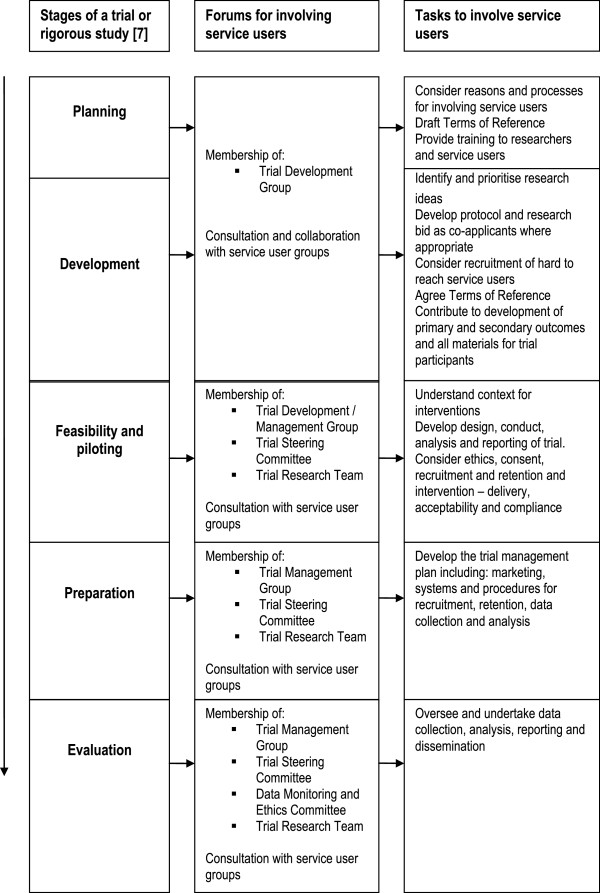
“Indeed, there is guidance available on patient and public involvement in trials, showing how service users can be involved at the feasibility/pilot stage of a trial by being members of the management group, steering committee and research team and by contributing to the design, analysis and reporting of the feasibility study [44].”
From Maximising the impact of qualitative research in feasibility studies for randomised controlled trials: guidance for researchers (2015) · cites this paper as [44]
Experimental — accuracy not yet measuredThe cited source says what the claim attributes to it.
In the citing paper
“These were often discussed within the context of the MRC’s intervention development-evaluation cycle [6, 9, 10, 13, 25–28].”
From Exploratory studies to decide whether and how to proceed with full-scale evaluations of public health interventions: a systematic review of guidance (2018) · cites this paper as [28]
The cited source says what the claim attributes to it.
In the citing paper
“While many highlighted the value of stakeholders on Trial Steering Committees and other similar study groups [15, 28, 40]”
From Exploratory studies to decide whether and how to proceed with full-scale evaluations of public health interventions: a systematic review of guidance (2018) · cites this paper as [28]
In the citing paper
“‘Pilot’ and ‘feasibility’ studies were sometimes used interchangeably [10, 20, 25–28, 31] while others made distinctions between the two according to design features or particular aims [7, 8, 19, 29, 32–34].”
From Exploratory studies to decide whether and how to proceed with full-scale evaluations of public health interventions: a systematic review of guidance (2018) · cites this paper as [28]
Self-check
Percentages, sums and reported differences re-computed from the paper’s own numbers.
The self-check needs the paper’s full text.
Citations
Cites
Developing and evaluating complex interventions: the new Medical Research Council guidance
Craig, P., Dieppe, P., Macintyre, S., Michie, S., Nazareth, I., & Petticrew, M. (2008) · BMJ · doi:10.1136/bmj.a1655 · Cited by 10,995 · cited 2×
“Service users bring understanding and experience of conditions and interventions to the process of designing and conducting trials [5,7].”
BackgroundMethodBrett, J., Staniszewska, S., Mockford, C., Herron‐Marx, S., Hughes, J., Tysall, C., & Suleman, R. (2014) · Health Expectations · doi:10.1111/j.1369-7625.2012.00795.x · Cited by 1,598 · cited 3×
“Recent evidence reports the importance of context and process on involvement, highlighting the need for researchers to understand their role in facilitating service user involvement and follow best practice [13,31].”
BackgroundMethodCommunity-based participatory research: assessing the evidence.
Viswanathan, M., Ammerman, A., Eng, E. M., Garlehner, G., Lohr, K. N., Griffith, D. M., Rhodes, S. D., Samuel‐Hodge, C. D., Maty, S. C., Lux, L. J., et al. (2004) · PubMed Central · Cited by 1,063
Consumer involvement in health research: a review and research agenda
Boote, J., Telford, R., & Cooper, C. (2002) · Health Policy · doi:10.1016/s0168-8510(01)00214-7 · Cited by 513 · cited 4×
“We also described opportunities for involvement by consultation to inform a process of collaborative or shared decision-making since involvement in a project can vary between approaches [32,36,37].”
BackgroundInfluentialLay perspectives: advantages for health research
Entwistle, V. A., Renfrew, M. J., Yearley, S., Forrester, J., & Lamont, T. (1998) · BMJ · doi:10.1136/bmj.316.7129.463 · Cited by 376 · cited 1×
“There is also a need to tackle misunderstood anxieties around who to involve, to explain the contribution of service users’ perspectives, so that researchers are not misled by anxieties about gaining representation, the so-called ‘red herring’ [33], in place of experience [32,34,35].”
BackgroundStaniszewska, S., Brett, J., Mockford, C., & Barber, R. (2011) · International Journal of Technology Assessment in Health Care · doi:10.1017/s0266462311000481 · Cited by 369 · cited 1×
“We adhered to elements of the GRIPP checklist where relevant to reporting guidance [38].”
Method(2012) · SpringerReference · doi:10.1007/springerreference_75865 · Cited by 285
From passive subjects to equal partners: Qualitative review of user involvement in research
Trivedi, P., & Wykes, T. (2002) · British Journal of Psychiatry · doi:10.1192/bjp.181.6.468 · Cited by 279 · cited 2×
“It also makes specific recommendations for providing the financial and time resources necessary to achieve effective involvement and foster an environment to support researchers in understanding its potential and current limitations [10,19,43-45,51].”
BackgroundCancer expert doubts claims about prostate cancer trial
Cole, A. (2008) · BMJ · doi:10.1136/bmj.a979 · Cited by 255
Gillard, S., Simons, L., Turner, K., Lucock, M., & Edwards, C. (2012) · Qualitative Health Research · doi:10.1177/1049732312448541 · Cited by 245
Hanley, B., Truesdale, A., King, A., Elbourne, D., & Chalmers, I. (2001) · BMJ · doi:10.1136/bmj.322.7285.519 · Cited by 184 · cited 2×
“We based this SOP on research evidence, good practice and experience of actively involving service users in research, including randomised trials [9,20,39-42].”
MethodWhat does it mean to involve consumers successfully in NHS research? A consensus study
Telford, R., Boote, J. D., & Cooper, C. L. (2004) · Health Expectations · doi:10.1111/j.1369-7625.2004.00278.x · Cited by 181 · cited 2×
“It also makes specific recommendations for providing the financial and time resources necessary to achieve effective involvement and foster an environment to support researchers in understanding its potential and current limitations [10,19,43-45,51].”
BackgroundCultivating Knowledge Sharing and Trust in Online Communities for Educators
Booth, S. E. (2012) · Journal of Educational Computing Research · doi:10.2190/ec.47.1.a · Cited by 174
Callard, F., Rose, D., & Wykes, T. (2012) · Health Expectations · doi:10.1111/j.1369-7625.2011.00681.x · Cited by 132 · cited 1×
“by identifying nonacademic routes and the best format for communicating findings) [3,9-17].”
BackgroundEvans, J., Rose, D., Flach, C., Csipke, E., Glossop, H., Mccrone, P., Craig, T., & Wykes, T. (2012) · Journal of Mental Health · doi:10.3109/09638237.2011.629240 · Cited by 128 · cited 1×
“by identifying nonacademic routes and the best format for communicating findings) [3,9-17].”
BackgroundUser involvement in the development of a research bid: barriers, enablers and impacts1
Staniszewska, S., Jones, N., Newburn, M., & Marshall, S. (2007) · Health Expectations · doi:10.1111/j.1369-7625.2007.00436.x · Cited by 112 · cited 1×
“In practice, however, seeking to involve service users encounters practical issues and unreceptive attitudes [22,32,46].”
BackgroundThompson, J., Bissell, P., Cooper, C., Armitage, C. J., & Barber, R. (2012) · Health: An Interdisciplinary Journal for the Social Study of Health, Illness and Medicine · doi:10.1177/1363459312441008 · Cited by 111 · cited 1×
“by identifying nonacademic routes and the best format for communicating findings) [3,9-17].”
BackgroundEvaluating the impact of service user involvement on research: a prospective case study
Barber, R., Beresford, P., Boote, J., Cooper, C., & Faulkner, A. (2011) · International Journal of Consumer Studies · doi:10.1111/j.1470-6431.2011.01017.x · Cited by 107
Boote, J., Barber, R., & Cooper, C. (2006) · Health Policy · doi:10.1016/j.healthpol.2005.03.012 · Cited by 105 · cited 2×
“We also described opportunities for involvement by consultation to inform a process of collaborative or shared decision-making since involvement in a project can vary between approaches [32,36,37].”
BackgroundMethodStaley, K., Buckland, S. A., Hayes, H., & Tarpey, M. (2014) · Health Expectations · doi:10.1111/hex.12017 · Cited by 94 · cited 1×
“Recent evidence reports the importance of context and process on involvement, highlighting the need for researchers to understand their role in facilitating service user involvement and follow best practice [13,31].”
BackgroundConsumer involvement in systematic reviews of comparative effectiveness research
Kreis, J., Puhan, M. A., Schünemann, H. J., & Dickersin, K. (2013) · Health Expectations · doi:10.1111/j.1369-7625.2011.00722.x · Cited by 88 · cited 1×
“Despite the emerging evidence base and strong policy support [48], the legitimacy of involving service users in research is still questioned and it still happens in a minority of research studies [49,50].”
BackgroundWright, D., Corner, J., Hopkinson, J., & Foster, C. (2006) · Health Expectations · doi:10.1111/j.1369-7625.2006.00353.x · Cited by 86 · cited 1×
“There is also a need to tackle misunderstood anxieties around who to involve, to explain the contribution of service users’ perspectives, so that researchers are not misled by anxieties about gaining representation, the so-called ‘red herring’ [33], in place of experience [32,34,35].”
BackgroundUser involvement in research: Exploring the challenges
Beresford, P. (2003) · NT Research · doi:10.1177/136140960300800106 · Cited by 73 · cited 1×
“Actively involving service users in health and social care research is encouraged as a way to improve research quality, relevance and accountability [1-3].”
BackgroundVale, C. L., Thompson, L. C., Murphy, C., Forcat, S., & Hanley, B. (2012) · Trials · doi:10.1186/1745-6215-13-9 · Cited by 72
Edwards, V., Wyatt, K., Logan, S., & Britten, N. (2011) · Health Expectations · doi:10.1111/j.1369-7625.2010.00652.x · Cited by 68 · cited 1×
“We based this SOP on research evidence, good practice and experience of actively involving service users in research, including randomised trials [9,20,39-42].”
MethodService-User Research in Health and Social Care
McLaughlin, H. (2009) · SAGE Publications Ltd eBooks · doi:10.4135/9780857028068 · Cited by 58
Consumer involvement in decisions about what health-related research is funded
O’Donnell, M., & Entwistle, V. (2004) · Health Policy · doi:10.1016/j.healthpol.2004.04.004 · Cited by 54
Consumer involvement in research projects: the activities of research funders
O'Donnell, M. T., & Entwistle, V. A. (2004) · Health Policy · doi:10.1016/j.healthpol.2003.12.011 · Cited by 54
Lowes, L., Robling, M. R., Bennert, K., Crawley, C., Hambly, H., Hawthorne, K., Gregory, J. W., & and the DEPICTED Study Team (2010) · Health Expectations · doi:10.1111/j.1369-7625.2010.00625.x · Cited by 52 · cited 1×
“by identifying nonacademic routes and the best format for communicating findings) [3,9-17].”
BackgroundSelf-citationPublic Involvement in the Design and Conduct of Clinical Trials: A Review
Boote, J., Baird, W., & Sutton, A. (2011) · The International Journal of Interdisciplinary Social Sciences: Annual Review · doi:10.18848/1833-1882/cgp/v05i11/59313 · Cited by 48 · cited 2×
“Although researchers are increasingly involving service users in planning and undertaking research, there is limited engagement with clinical trials [3,28].”
BackgroundBoote, J., Baird, W., & Sutton, A. (2012) · Journal of Comparative Effectiveness Research · doi:10.2217/cer.12.46 · Cited by 43
Getting ready for user involvement in a systematic review
Smith, E., Donovan, S., Beresford, P., Manthorpe, J., Brearley, S., Sitzia, J., & Ross, F. (2009) · Health Expectations · doi:10.1111/j.1369-7625.2009.00535.x · Cited by 40 · cited 1×
“Service users contribute to both the content and methods of research, including developing, reviewing and commissioning research proposals and undertaking research using a wide range of methods [13,18-26].”
MethodKatz, M. L., Archer, L. E., Peppercorn, J. M., Kereakoglow, S., Collyar, D. E., Burstein, H. J., Schilsky, R. L., & Partridge, A. H. (2012) · Cancer · doi:10.1002/cncr.27485 · Cited by 36
Snooks, H. A., Cheung, W., Close, J., Dale, J. R., Gaze, S., Humphreys, I., Lyons, R. A., Mason, S. M., Merali, Y., Peconi, J., et al. (2010) · BMC Emergency Medicine · doi:10.1186/1471-227x-10-2 · Cited by 32
Self-citationSnooks, H. A., Anthony, R., Chatters, R., Cheung, W., Dale, J. R., Fothergill, R. T., Gaze, S., Halter, M., Koniotou, M., Logan, P., et al. (2012) · BMJ Open · doi:10.1136/bmjopen-2012-002169 · Cited by 28 · cited 1×
“We based this SOP on research evidence, good practice and experience of actively involving service users in research, including randomised trials [9,20,39-42].”
MethodSelf-citationPublic involvement in clinical trials: supplement to the briefing notes for researchers
Vale, C. L., Fitzgibbon, J., Hanley, B., Muir, D., Murphy, C., Nelson, A., Stephens, R., & Yoing, B. (2012) · ORCA Online Research @Cardiff (Cardiff University) · Cited by 22
Involving patients in research ‐ Setting up a service users’ advisory group
Rhodes, P., Nocon, A., Wright, J., & Harrison, S. (2001) · Journal of Management in Medicine · doi:10.1108/02689230110394679 · Cited by 19 · cited 2×
“Service users contribute to both the content and methods of research, including developing, reviewing and commissioning research proposals and undertaking research using a wide range of methods [13,18-26].”
BackgroundMethodApplied public health research - falling through the cracks?
Simmons, R. K., Ogilvie, D., Griffin, S. J., & Sargeant, L. A. (2009) · BMC Public Health · doi:10.1186/1471-2458-9-362 · Cited by 18
A guide to patient-led good controlled trials
Chalmers, I. (2000) · The Lancet · doi:10.1016/s0140-6736(05)73681-3 · Cited by 15
Schneider, C. K., Salmikangas, P., Jilma, B., Flamion, B., Todorova, L., Paphitou, A., Haunerova, I., Thirstrup, S., Maimets, T., Trouvin, J., et al. (2010) · The Lancet · Cited by 12
Beteiligung Betroffener an der Forschung
Kirschning, S., Pimmer, V., Matzat, J., Brüggemann, S., & Buschmann-Steinhage, R. (2012) · Die Rehabilitation · doi:10.1055/s-0032-1327728 · Cited by 11
Patients' information sheets and multicentre studies
Service Users Research Endeavour (SURE) Group (2010) · The Lancet · doi:10.1016/s0140-6736(10)61250-0
Research works printed but not linked: 4
- Wales Office of Research and Development for Health and Social Care Research Governance Framework for Health and Social Care in Wales: Second Edition 2005 Cardiff: Welsh Assembly Government
- Nolan M Hanson E Grant G Keady J Magnusson L Nolan M, Hansen E, Grant G, Keady J Introduction: what counts as knowledge, whose knowledge counts? Towards authentic participatory enquiry User Participation in Health and Social Care Research 2007 Maidenhead: OUP McGraw Hill 1 13
- Nolan M Hanson E Grant G Keady J Nolan M, Hansen E, Grant G, Keady J Conclusions: realising authentic participatory enquiry User Participation in Health and Social Care Research 2007 Maidenhead: OUP McGraw Hill 183 202
- INVOLVE Patient and public involvement in research and research ethics committee review 2009 Eastleigh: INVOLVE
Cited by
Greenhalgh, T., Hinton, L., Finlay, T., Macfarlane, A., Fahy, N., Clyde, B., & Chant, A. (2019) · Health Expectations · doi:10.1111/hex.12888 · Cited by 1,059
O’Cathain, A., Hoddinott, P., Lewin, S., Thomas, K. J., Young, B., Adamson, J., Jansen, Y. J., Mills, N., Moore, G., & Donovan, J. L. (2015) · Pilot and Feasibility Studies · doi:10.1186/s40814-015-0026-y · Cited by 458
“…on patient and public involvement in trials, showing how service users can be involved at the feasibility/pilot stage of a trial by being members of the management group, steering committee and research team and by contributing to the design, analysis and reporting of the feasibility study [44].”
Hallingberg, B., Turley, R., Segrott, J., Wight, D., Craig, P., Moore, L., Murphy, S., Robling, M., Simpson, S. A., & Moore, G. (2018) · Pilot and Feasibility Studies · doi:10.1186/s40814-018-0290-8 · Cited by 248
“intervention recipients, public representatives as well as practitioners who might use the evidence produced by the full trial) be involved in the planning and running of the exploratory study to ensure exploratory studies reflect the realities of intervention setting [12, 27, 31, 32, 39, 40].”
BackgroundMethodInfluentialBagley, H. J., Short, H., Harman, N. L., Hickey, H. R., Gamble, C. L., Woolfall, K., Young, B., & Williamson, P. R. (2016) · Research Involvement and Engagement · doi:10.1186/s40900-016-0029-8 · Cited by 200
Healy, P., Galvin, S., Williamson, P. R., Treweek, S., Whiting, C., Maeso, B., Bray, C., Brocklehurst, P., Moloney, M. C., Douiri, A., et al. (2018) · Trials · doi:10.1186/s13063-018-2544-4 · Cited by 159
Metadata
- Authors
- Evans, B., Bedson, E., Bell, P., Hutchings, H., Lowes, L., Rea, D., Seagrove, A., Siebert, S., Smith, G., Snooks, H., Thomas, M., Thorne, K., Russell, I., & on behalf of the West Wales Organisation for Rigorous Trials in Health (WWORTH)
- Affiliations
- Swansea University (GB)
- University of Liverpool (GB)
- Cardiff University (GB)
- University of Glasgow (GB)
- The University of Wales, Newport (GB)
- Corresponding author
- Evans, Bridie
- ORCID
- Venue
- Trials
- Published
- 2013
- Volume
- 14
- Issue
- 1
- Pages
- 219
- ISSN
- 1745-6215 (ISSN-L)
- PMC
- PMC3725161
- OpenAlex
- W2113173442
- Cited by
- 52
- References
- 41
- Citations by year
- 2025: 2 · 2024: 1 · 2023: 6 · 2022: 3 · 2021: 2 · 2020: 3 · 2019: 7 · 2018: 8 · 2017: 3 · 2016: 5 · 2015: 4 · 2014: 6 · 2013: 2
- FWCI
- 10.26
- Type
- journal article
- Language
- en
- Open access
- gold
- doi.org
- Licence
- cc-by
- Locations
- Trials (publishedVersion, cc-by)
- Europe PMC (PubMed Central) (publishedVersion, cc-by)
- PubMed Central (publishedVersion, cc-by)
- PubMed (publishedVersion)
- ENLIGHTEN (Jurnal Bimbingan dan Konseling Islam) (acceptedVersion)
- Research Space (acceptedVersion)
- ORCA Online Research @Cardiff (Cardiff University) (submittedVersion)
- Topics
- Health Sciences › Health Professions › General Health Professions › Mental Health and Patient Involvement
- Health Sciences › Medicine › Public Health, Environmental and Occupational Health › Ethics in Clinical Research
- Health Sciences › Medicine › Public Health, Environmental and Occupational Health › Community Health and Development
- Keywords
- service user involvement, clinical trials, standard operating procedures, co-production, research funding, clinical trial units, research culture
- MeSH terms
- Clinical Trials as Topic, Community Participation, Cooperative Behavior, Decision Support Techniques, Humans, Research Design, Research Personnel, Wales, Program Development, Guidelines as Topic, Interdisciplinary Communication, Research Subjects
About these checks
Registry, retraction, Cites and statistics results are computed, not judged, with one exception: a printed reference that no index lists is read once by a model before it counts as a citation error. Claims are extracted by a model and kept only when their quote appears verbatim in the text; each cited source is then checked, with a model’s help, for whether it says what the claim relies on. Those verdicts can be wrong — read the claim’s quote and the cited source before relying on one.
Statistics and arithmetic are recomputed, not judged.
Confidence bands are shown only for fields calibrated on our annotated test set. None is calibrated yet, so no band is shown.
What counts as a claim ›How we measure confidence ›How we check this ›
Are you an author, or do you see a problem with this page? Request a review
Data sources
Bibliographic data: Semantic Scholar, OpenAlex, Crossref.
Contains information from the Semantic Scholar Academic Graph Datasets, made available under the ODC Attribution License (ODC-BY 1.0).
Semantic Scholar’s data is described in: Kinney, R., et al. (2023). The Semantic Scholar Open Data Platform. arXiv:2301.10140.
