

The effectiveness and cost-effectiveness of lay counsellor-delivered psychological treatments for harmful and dependent drinking and moderate to severe depression in primary care in India: PREMIUM study protocol for randomized controlled trials
Open accessThe DOI matches its Crossref record; 69 of the 70 references it cites were found in a registry or an index.
Abstract
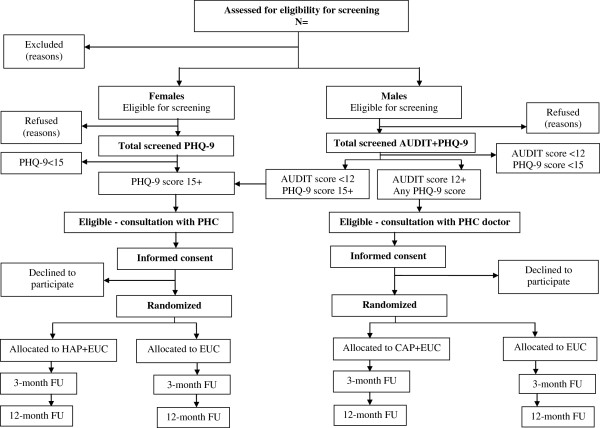
BACKGROUND: The leading mental health causes of the global burden of disease are depression in women and alcohol use disorders in men. A major hurdle to the implementation of evidence-based psychological treatments in primary care in developing countries is the non-availability of skilled human resources. The aim of these trials is to evaluate the effectiveness and cost-effectiveness of two psychological treatments developed for the treatment of depression and alcohol use disorders in primary care in India. METHODS/DESIGN: This study protocol is for parallel group, randomized controlled trials (Healthy Activity Program for moderate to severe depression, Counselling for Alcohol Problems for harmful and dependent drinking) in eight primary health centres in Goa, India. Adult primary care attendees will be screened with the Patient Health Questionnaire for depression and, in men only, the Alcohol Use Disorders Identification Test for drinking problems. Screen-positive attendees will be invited to participate; men who screen positive for both disorders will be invited to participate in the Counselling for Alcohol Problems trial. Those who consent will be allocated in a 1:1 ratio to receive either the respective psychological treatment plus enhanced usual care or enhanced usual care only using a computer generated allocation sequence, stratified by primary health centre and, for depression, by sex. The enhanced usual care comprises providing primary health centre doctors with contextualized World Health Organization guidelines and screening results. Psychological treatments will be delivered by lay counsellors, over a maximum period of three months. Primary outcomes are severity of disorder and remission rates at three months post-enrolment and, for the Counselling for Alcohol Problems trial, drinking and the impact of drinking on daily lives. Secondary outcomes include severity of disorder and remission rates at 12 months, disability scores, suicidal behaviour and economic impact, and cost-effectiveness at three and 12 months. 500 participants with depression and 400 participants with harmful drinking will be recruited. Primary analyses will be intention-to-treat. DISCUSSION: These trials may offer a new approach for the treatment of moderate-severe depression and drinking problems in primary care that is potentially scalable as it relies on delivery by a single pool of lay counsellors. TRIAL REGISTRATION: Both trials are registered with the International Society for the Registration of Clinical Trials (Healthy Activity Programme registration number ISRCTN95149997; Counselling for Alcohol Problems registration number ISRCTN76465238).
Overview
The claims and statistics of this paper haven’t been checked yet.
Free: it reads the open-access text and checks the first 5 claims that cite a source we can check. Create a free account to check every claim.
Integrity signals
Registry
Cites
Statistics
Figures
Verification
Claims the paper makes
The claims and statistics of this paper haven’t been checked yet.
Free: it reads the open-access text and checks the first 5 claims that cite a source we can check. Create a free account to check every claim.
Self-check
Percentages, sums and reported differences re-computed from the paper’s own numbers.
The self-check needs the paper’s full text.
Citations
Cites
The PHQ-9: Validity of a brief depression severity measure
Kroenke, K., Spitzer, R. L., & Williams, J. B. W. (2001) · Journal of General Internal Medicine · doi:10.1046/j.1525-1497.2001.016009606.x · Cited by 44,910
SAUNDERS, J. B., AASLAND, O. G., BABOR, T. F., DE LA FUENTE, J. R., & GRANT, M. (1993) · Addiction · doi:10.1111/j.1360-0443.1993.tb02093.x · Cited by 13,597 · cited 8×
“To detect HD or AD, they will use the AUDIT, a 10-item screening questionnaire for AUD, developed by the WHO [28].”
MethodInfluentialThe PHQ-9: A New Depression Diagnostic and Severity Measure
Kroenke, K., & Spitzer, R. L. (2002) · Psychiatric Annals · doi:10.3928/0048-5713-20020901-06 · Cited by 5,898 · cited 1×
“To detect depression they will use the PHQ-9, a nine-item questionnaire that has previously been validated for use in the study setting [25]; the cutpoint of 14 selected is the most accurate for detection of moderate to severe depression [26] and has a high positive predictive value for depressive disorder defined by…”
MethodMoher, D., Schulz, K. F., & Altman, D. G. (2001) · The Lancet · doi:10.1016/s0140-6736(00)04337-3 · Cited by 5,373
Sobell, L. C., & Sobell, M. B. (1992) · Measuring Alcohol Consumption · doi:10.1007/978-1-4612-0357-5_3 · Cited by 4,110 · cited 1×
“Alcohol consumed in past two weeks (g) Validated instrument [59] used in India [60].”
MethodMoher, D., Schulz, K. F., & Altman, D. G. (2001) · BMC Medical Research Methodology · doi:10.1186/1471-2288-1-2 · Cited by 2,755 · cited 1×
“Findings will be reported as per the CONSORT guidelines [71], including a trial flow chart.”
MethodGlobal Burden of Disease and Risk Factors
(2006) · World Bank, Washington, DC eBooks · doi:10.1596/978-0-8213-6262-4 · Cited by 2,605
Antidepressant Drug Effects and Depression Severity: A Patient-Level Meta-analysis
Fournier, J. C., DeRubeis, R. J., Hollon, S. D., Dimidjian, S., Amsterdam, J. D., Shelton, R. C., & Fawcett, J. (2010) · JAMA · doi:10.1001/jama.2009.1943 · Cited by 2,009 · cited 1×
“After consent has been obtained, the health assistant will collect the following data on potential moderators of treatment effect: age group, gender, marital status, employment status [33], duration of the illness [33] (for HAP), readiness to change drinking behaviour [34] (for CAP), severity of depression or drinking…”
MethodSelf-citationDeveloping the World Health Organization Disability Assessment Schedule 2.0
Üstün, T. B., Chatterji, S., Kostanjsek, N., Rehm, J., Kennedy, C., Epping-Jordan, J., Saxena, S., von Korff, M., & Pull, C. (2010) · Bulletin of the World Health Organization · doi:10.2471/blt.09.067231 · Cited by 1,851
Effectiveness of brief alcohol interventions in primary care populations
Kaner, E. F., Beyer, F. R., Muirhead, C., Campbell, F., Pienaar, E. D., Bertholet, N., Daeppen, J. B., Saunders, J. B., & Burnand, B. (2018) · Cochrane Database of Systematic Reviews · doi:10.1002/14651858.cd004148.pub4 · Cited by 1,665
Research works printed but not linked: 7
- WHO mhGAP Intervention Guide for Mental, Neurological and Substance Use Disorders in non-Specialized Health Settings 2010 Geneva, Switzerland: WHO 23741783
- NICE Alcohol Dependence and Harmful Alcohol Use: Full Guideline CG115 2011 London: NICE Press Office
- Martell CR Dimidjian S Herman-Dunn R Behavioural Activation for Depression: a Clinician’s Guide 2010 New York: The Guilford Press
- Miller WR Zweben A DiClimente C Rychtarik R Motivational Enhancement Therapy Manual: A Clinical Research Guide for Therapists Treating Individuals with Alcohol Abuse and Dependence 1994 Bethesda MD: National Institute on Alcohol Abuse and Alcoholism
- Allison J Bes R GR Motivational Interviewing Target Scheme (MITS 2.1) 2012 Edinburgh: Jeff Alisson Training Limited
- WHO mhGA: Mental Health Gap Action Programme: Scaling up Care for Mental, Neurological and Substance Use Disorders 2008 Geneva: World Health Organization 26290926
- OPSPL STAR: Sangath digital tool for advanced research 2013
Cited by
Patel, V., Weobong, B., Weiss, H. A., Anand, A., Bhat, B., Katti, B., Dimidjian, S., Araya, R., Hollon, S. D., King, M., et al. (2017) · The Lancet · doi:10.1016/s0140-6736(16)31589-6 · Cited by 448
Self-citationKohrt, B. A., Jordans, M. J. D., Rai, S., Shrestha, P., Luitel, N. P., Ramaiya, M. K., Singla, D. R., & Patel, V. (2015) · Behaviour Research and Therapy · doi:10.1016/j.brat.2015.03.009 · Cited by 370
Self-citationRaviola, G., Naslund, J. A., Smith, S. L., & Patel, V. (2019) · Current Psychiatry Reports · doi:10.1007/s11920-019-1028-x · Cited by 258
Self-citationShinde, S., Weiss, H. A., Varghese, B., Khandeparkar, P., Pereira, B., Sharma, A., Gupta, R., Ross, D. A., Patton, G., & Patel, V. (2018) · The Lancet · doi:10.1016/s0140-6736(18)31615-5 · Cited by 219
Self-citationvan Ginneken, N., Chin, W. Y., Lim, Y. C., Ussif, A., Singh, R., Shahmalak, U., Purgato, M., Rojas-García, A., Uphoff, E., McMullen, S., et al. (2021) · Cochrane Database of Systematic Reviews · doi:10.1002/14651858.cd009149.pub3 · Cited by 188
Nadkarni, A., Weobong, B., Weiss, H. A., McCambridge, J., Bhat, B., Katti, B., Murthy, P., King, M., McDaid, D., Park, A.-L., et al. (2017) · The Lancet · doi:10.1016/s0140-6736(16)31590-2 · Cited by 187
Self-citationChowdhary, N., Anand, A., Dimidjian, S., Shinde, S., Weobong, B., Balaji, M., Hollon, S. D., Rahman, A., Wilson, G. T., Verdeli, H., et al. (2016) · British Journal of Psychiatry · doi:10.1192/bjp.bp.114.161075 · Cited by 167
“13 The overall aim of the PREMIUM programme is to investigate a systematic, reproducible method for developing psychological treatments that incorporate global evidence, are contextually appropriate and can be delivered by non-specialist health workers.”
Self-citationKohrt, B. A., Jordans, M. J. D., Turner, E. L., Sikkema, K. J., Luitel, N. P., Rai, S., Singla, D. R., Lamichhane, J., Lund, C., & Patel, V. (2018) · Pilot and Feasibility Studies · doi:10.1186/s40814-018-0234-3 · Cited by 141
Self-citationWeobong, B., Weiss, H. A., McDaid, D., Singla, D. R., Hollon, S. D., Nadkarni, A., Park, A.-L., Bhat, B., Katti, B., Anand, A., et al. (2017) · PLOS Medicine · doi:10.1371/journal.pmed.1002385 · Cited by 135
Self-citationSingla, D. R., Weobong, B., Nadkarni, A., Chowdhary, N., Shinde, S., Anand, A., Fairburn, C. G., Dimijdan, S., Velleman, R., Weiss, H., et al. (2014) · Behaviour Research and Therapy · doi:10.1016/j.brat.2014.06.006 · Cited by 122
“…to develop and evaluate the effectiveness of two brief, contextually-appropriate psychological treatments for harmful and dependent drinking (Counselling for Alcohol Programme (CAP)) and depressive disorders (Healthy Activity Programme (HAP)) delivered by lay therapists (see Patel et al., 2014).”
BackgroundMethodSelf-citationKohrt, B. A., Ramaiya, M. K., Rai, S., Bhardwaj, A., & Jordans, M. J. D. (2015) · Global Mental Health · doi:10.1017/gmh.2015.21 · Cited by 91
“…health Gap Action Programme (mhGAP) Intervention Guide (mhGAP-IG) (WHO, 2010), psychosocial skills modules, and brief modified versions of behavioral activation (the Healthy Activity Program) and motivational interviewing (Counseling for Alcohol Program) (Patel et al. 2014; Singla et al. 2014).”
BackgroundNadkarni, A., Garber, A., Costa, S., Wood, S., Kumar, S., MacKinnon, N., Ibrahim, M., Velleman, R. D. B., Bhatia, U., Fernandes, G., et al. (2019) · Drug and Alcohol Dependence · doi:10.1016/j.drugalcdep.2019.04.031 · Cited by 98
“…(2014) India 4711 Villagers in rural area; M 2191 (46.5%); F 2520; A 49.5 (30–95) years Community Cross- sectional Nadkarni (2017a, 2017b); Patel (2014) India 377 Adult males (18-65 years), A 42 years Primary care RCT Nayak (2009) India 1043 Urban and rural males Community…”
BackgroundInfluentialSelf-citationNadkarni, A., Weiss, H. A., Weobong, B., McDaid, D., Singla, D. R., Park, A.-L., Bhat, B., Katti, B., McCambridge, J., Murthy, P., et al. (2017) · PLOS Medicine · doi:10.1371/journal.pmed.1002386 · Cited by 80
Self-citationMental health interventions by lay counsellors: a systematic review and meta-analysis
Connolly, S. M., Vanchu-Orosco, M., Warner, J., Seidi, P. A.-M., Edwards, J., Boath, E., & Irgens, A. C. (2021) · Bulletin of the World Health Organization · doi:10.2471/blt.20.269050 · Cited by 120
Pedersen, G. A., Lakshmin, P., Schafer, A., Watts, S., Carswell, K., Willhoite, A., Ottman, K. E., Hof, E. V., & Kohrt, B. A. (2020) · Journal of Behavioral and Cognitive Therapy · doi:10.1016/j.jbct.2020.06.001 · Cited by 67
“To reduce the burden of untreated mental illness, there has been a push for increased availability of psychological and psychosocial treatments around the world (Fairburn & Patel, 2014 .”
BackgroundNadkarni, A., Velleman, R., Dabholkar, H., Shinde, S., Bhat, B., McCambridge, J., Murthy, P., Wilson, T., Weobong, B., & Patel, V. (2015) · Alcoholism: Clinical and Experimental Research · doi:10.1111/acer.12653 · Cited by 59
Self-citationScreening for depression: the global mental health context
Reynolds, C. F., & Patel, V. (2017) · World Psychiatry · doi:10.1002/wps.20459 · Cited by 58
Self-citationLange, K. W. (2021) · Global Health Journal · doi:10.1016/j.glohj.2021.07.001 · Cited by 68
Joseph, J., & Basu, D. (2017) · Alcohol and Alcoholism · doi:10.1093/alcalc/agw054 · Cited by 52
Satinsky, E. N., Doran, K., Felton, J. W., Kleinman, M. B., Dean, D., & Magidson, J. F. (2020) · PLoS ONE · doi:10.1371/journal.pone.0228084 · Cited by 55
Magidson, J. F., Andersen, L. S., Satinsky, E. N., MYERS, B. J., Kagee, A., Anvari, M. S., & Joska, J. A. (2020) · Psychotherapy · doi:10.1037/pst0000257 · Cited by 59
“Despite the evidence to support the feasibility and acceptability of implementing BA to treat depression in low- and middle-income countries (LMICs) (Magidson et al., 2015; Patel et al., 2014; Patel et al., 2017) and the accumulating empirical support for BA as a therapy for substance use in high-income settings (Daug…”
BackgroundMethodInfluentialNaslund, J. A., Tugnawat, D. K., Anand, A., Cooper, Z., Dimidjian, S., Fairburn, C. G., Hollon, S. D., Joshi, U., Khan, A., Lu, C., et al. (2021) · Contemporary Clinical Trials · doi:10.1016/j.cct.2021.106267 · Cited by 49
Self-citationSoni, A., Fahey, N., Byatt, N., Prabhakaran, A., Simas, T. A. M., Vankar, J., Phatak, A. G., O’Keefe, E., Allison, J. J., & Nimbalkar, S. M. (2016) · BMJ Open · doi:10.1136/bmjopen-2015-010834 · Cited by 40
Recent Developments in the Treatment of Depression
Hollon, S. D., Cohen, Z. D., Singla, D. R., & Andrews, P. W. (2019) · Behavior Therapy · doi:10.1016/j.beth.2019.01.002 · Cited by 41
Self-citationPatel, A., Weobong, B., Patel, V., & Singla, D. R. (2019) · Archives of Women s Mental Health · doi:10.1007/s00737-019-00992-2 · Cited by 40
Self-citationDesigning Psychological Treatments for Scalability: The PREMIUM Approach
Vellakkal, S., & Patel, V. (2015) · PLOS ONE · doi:10.1371/journal.pone.0134189 · Cited by 29
Self-citationChorpita, B. F., Daleiden, E. L., Malik, K., Gellatly, R., Boustani, M. M., Michelson, D., Knudsen, K., Mathur, S., & Patel, V. H. (2020) · Behaviour Research and Therapy · doi:10.1016/j.brat.2020.103698 · Cited by 28
Self-citationPotluri, S., & Patel, A. (2021) · Journal of Traumatic Stress · doi:10.1002/jts.22699 · Cited by 28
A Review of Indian Research on Co-occurring Psychiatric Disorders and Alcohol use Disorders
Singh, S., & Balhara, Y. P. S. (2016) · Indian Journal of Psychological Medicine · doi:10.4103/0253-7176.175089 · Cited by 26
Dias, A., Azariah, F., Sequeira, M., Krishna, R. N., Morse, J. Q., Cohen, A., Cuijpers, P. J., Anderson, S., Patel, V., & Reynolds, C. F. (2019) · Global Health Action · doi:10.1080/16549716.2017.1420300 · Cited by 24
“We examined peer-reviewed literature on the prevention of depression and associated anxiety disorders, building upon the MANAS study [10], and formative research for the Premium Study [19] on depression, which included an intensive literature review as one of its components.”
MethodSelf-citationNadkarni, A., Weiss, H. A., Velleman, R., McCambridge, J., McDaid, D., Park, A., Murthy, P., Weobong, B., Bhat, B., & Patel, V. (2019) · Addiction · doi:10.1111/add.14630 · Cited by 22
“The methods for PREMIUM are fully described in the trial protocol (ISRCTN76465238) and publications regarding the trial of CAP in harmful drinkers [17,18,22].”
MethodSelf-citationRestivo, J. L., Mitchell, L. M., Joshi, U., Anand, A., Gugiu, P. C., Singla, D. R., Hollon, S. D., Patel, V., Naslund, J. A., & Cooper, Z. (2020) · Journal of Behavioral and Cognitive Therapy · doi:10.1016/j.jbct.2020.10.001 · Cited by 23
Self-citationSeward, N., Vansteelandt, S., Moreno‐Agostino, D., Patel, V., & Araya, R. (2022) · The British Journal of Psychiatry · doi:10.1192/bjp.2022.116 · Cited by 18
Self-citationSingla, D. R., Hollon, S. D., Velleman, R. D. B., Weobong, B., Nadkarni, A., Fairburn, C. G., Bhat, B., Gurav, M., Anand, A., McCambridge, J., et al. (2019) · Psychological Medicine · doi:10.1017/s0033291718003963 · Cited by 17
“The study took place in the context of two parallel randomized controlled trials in Goa, India.”
BackgroundInfluentialSelf-citationMagidson, J. F., Belus, J. M., Seitz‐Brown, C. J., Tralka, H. M., Safren, S. A., & Daughters, S. B. (2021) · AIDS and Behavior · doi:10.1007/s10461-021-03354-1 · Cited by 20
Dias, A., Azariah, F., Cohen, A., Anderson, S., Morse, J., Cuijpers, P. J., Sequeira, M., Gaude, V., Soares, S., Patel, V., et al. (2017) · Contemporary Clinical Trials Communications · doi:10.1016/j.conctc.2017.04.006 · Cited by 18
Self-citationKleinman, M. B., Anvari, M. S., Bradley, V. D., Felton, J. W., Belcher, A. M., Seitz‐Brown, C. J., Greenblatt, A. D., Dean, D., Bennett, M. E., & Magidson, J. F. (2023) · Substance Abuse Treatment Prevention and Policy · doi:10.1186/s13011-023-00524-3 · Cited by 16
Hartmann, M. A., Datta, S., Banay, R. F., Caetano, V., Floreak, R., Appaiah, P., Sreevasthsa, A., Thomas, S., Selvam, S., Barnette, Q., et al. (2018) · Frontiers in Public Health · doi:10.3389/fpubh.2018.00218 · Cited by 17
Greene, M. C., Kane, J., Alto, M., Giusto, A., Lovero, K., Stockton, M., McClendon, J., Nicholson, T., Wainberg, M. L., Johnson, R. M., et al. (2023) · Cochrane Database of Systematic Reviews · doi:10.1002/14651858.cd013350.pub2 · Cited by 11
Dai, J., Huang, Y., Liu, J., Sun, Y., Fan, X., Tu, Y., Huang, Y., Lin, Y., Zhang, M., Bai, J., et al. (2025) · Journal of Affective Disorders · doi:10.1016/j.jad.2025.01.037 · Cited by 13
van Heerden, A. C., Poudyal, A., Hagaman, A. K., Maharjan, S. M., Byanjankar, P., Bemme, D., Thapa, A., & Kohrt, B. A. (2024) · Scientific Reports · doi:10.1038/s41598-024-63232-3 · Cited by 13
“The platform gives providers easy access to review the passive data collected by the EBM app and thereby provides personalized HAP sessions to mothers.”
BackgroundMethodInfluentialAnvari, M. S., Kleinman, M. B., Dean, D., Bradley, V. D., Abidogun, T. M., Hines, A. C., Seitz‐Brown, C. J., Felton, J. W., & Magidson, J. F. (2023) · Cognitive and Behavioral Practice · doi:10.1016/j.cbpra.2023.01.003 · Cited by 13
Synowski, J., Weiss, H. A., Velleman, R. D. B., Patel, V., & Nadkarni, A. (2021) · Drug and Alcohol Dependence · doi:10.1016/j.drugalcdep.2021.108961 · Cited by 11
“A detailed description of the PREMIUM trial can be found in the study protocol (ISRCTN76465238) and in previous publications (Nadkarni et al., 2017; Patel et al., 2017, 2014).”
BackgroundMethodSelf-citationEkeke, N., Ossai, E. N., Kreibich, S., Onyima-Esmai, A. S., Chukwu, J., Nwafor, C. C., Meka, A., Murphy-Okpala, N. N., Henry, P., & Eze, C. C. (2022) · International Journal of Mycobacteriology · doi:10.4103/ijmy.ijmy_247_21 · Cited by 9
Kohrt, B. A., & Bhardwaj, A. (2019) · Elsevier eBooks · doi:10.1016/b978-0-12-814932-4.00003-3 · Cited by 7
Rossouw, J., Yadin, E., Alexander, D., & Seedat, S. (2018) · BMC Psychiatry · doi:10.1186/s12888-018-1873-x · Cited by 9
Gellatly, R., Knudsen, K. S., Boustani, M. M., Michelson, D., Malik, K., Mathur, S., Nair, P., Patel, V., & Chorpita, B. F. (2022) · Frontiers in Psychiatry · doi:10.3389/fpsyt.2022.1038259 · Cited by 7
Self-citationJoshi, U., Haney, J. R., Sequeira, M., Singla, D. R., Patel, V., Bhan, A., Cooper, Z., & Naslund, J. A. (2022) · Psychiatric Quarterly · doi:10.1007/s11126-022-10007-6 · Cited by 8
“John A. Naslund john_naslund@hms.harvard.edu 1 Sangath, Bhopal, Madhya Pradesh, India 2 Department of Global Health and Social Medicine, Harvard Medical School, 641 Huntington Ave, 02115 Boston, MA, USA 3 Sangath, Porvorim, Goa, India 4 Campbell Family Mental Health Research Institute, Center of Addiction and Mental H…”
MethodSelf-citationPozuelo, J. R., Lahiri, A., Singh, R. S. P., Kushwah, A., Khanduri, M., Shukla, A., Khan, A., Sruthi, G., Shende, V., Parashar, Y., et al. (2025) · BMC Psychiatry · doi:10.1186/s12888-025-07030-9 · Cited by 4
“Several strategies will be employed to enhance treat-ment completion rates, drawing on our experience with previous studies in the setting [41, 61, 65].”
Self-citationNon-specialist health workers to treat excessive alcohol consumption and depression
Agabio, R. (2016) · The Lancet · doi:10.1016/s0140-6736(16)32566-1 · Cited by 5
Goldschmidt, L., Mncina, B., Langa, M., Rebello, S., Budaza, T., Tshabalala, J., & Achoki, T. (2023) · BMC Health Services Research · doi:10.1186/s12913-023-10230-2 · Cited by 2
“This aligns with the findings of previous studies that had also demonstrated lay counsellors’ efficiency in administering alcohol screening instruments [5–7].”
BackgroundResultBalancing Access to Medications and Psychosocial Treatments
Areán, P. A., & Ratzliff, A. (2019) · Springer eBooks · doi:10.1007/978-3-030-11908-9_5 · Cited by 2
Metz, K. L., Figge, C. J., Alto, M. E., Kane, J. C., & Murray, L. K. (2021) · Springer eBooks · doi:10.1007/978-3-030-57296-9_145 · Cited by 2
Naslund, J. A., Tugnawat, D. K., Anand, A., Cooper, Z., Dimidjian, S., Fairburn, C. G., Hedt‐Gauthier, B., Hollon, S. D., Joshi, U., Khan, A., et al. (2026) · Nature Mental Health · doi:10.1038/s44220-026-00693-7 · Cited by 1
Self-citationChithrangathan, C. (2022) · Journal of Science Policy & Governance · doi:10.38126/jspg210204 · Cited by 1
Randomized Clinical Trials to Evaluate Mental Health Interventions in Resource-Poor Societies
Neugebauer, R. (2016) · JAMA · doi:10.1001/jama.2016.17780 · Cited by 1
Innovative Psychological Treatments for Depression
Hollon, S. D., & Williams, C. J. (2016) · FOCUS The Journal of Lifelong Learning in Psychiatry · doi:10.1176/appi.focus.20150044 · Cited by 1
Self-citationBest of Times, Worst of Times: Occupational Mental Health Research in India
Chithrangathan, C. (2017) · IOSR Journal of Humanities and Social Science · doi:10.9790/0837-2204070812
Therapist Training on TIMBER and Policy Implications
Pradhan, B., Pinninti, N. R., & Rathod, S. (2019) · Springer eBooks · doi:10.1007/978-3-030-20648-2_7
Metz, K. L., Figge, C. J., Alto, M. E., Kane, J. C., & Murray, L. K. (2021) · Springer eBooks · doi:10.1007/978-3-319-70134-9_145-1
Seward, N., Vansteelandt, S., Moreno‐Agostino, D., Patel, V., & Araya, R. (2021) · Research Square · doi:10.21203/rs.3.rs-977875/v1
Self-citationPatel, V. (2016) · The British Journal of Psychiatry · doi:10.1192/bjp.209.3.264
Self-citationPharmacoeconomics of antidepressants in a tertiary care teaching hospital of rural India
Khan, T., Ahmed, T. S. M., & Kaikade, S. B. (2022) · Indian Journal of Pharmacy and Pharmacology · doi:10.18231/j.ijpp.2022.033
Kleinman, M. B., Anvari, M. S., Bradley, V. D., Felton, J. W., Belcher, A. M., Seitz‐Brown, C. J., Greenblatt, A. D., Dean, D., Bennett, M., & Magidson, J. F. (2023) · Figshare · doi:10.6084/m9.figshare.22620715
Goldschmidt, L., Mncina, B., Langa, M., Rebello, S., Budaza, T., Tshabalala, J., & Achoki, T. (2024) · Figshare · doi:10.6084/m9.figshare.26637906
Kleinman, M. B., Anvari, M. S., Bradley, V. D., Felton, J. W., Belcher, A. M., Seitz‐Brown, C. J., Greenblatt, A. D., Dean, D., Bennett, M., & Magidson, J. F. (2023) · Figshare · doi:10.6084/m9.figshare.22620712
Metadata
- Authors
- Patel, V., Weobong, B., Nadkarni, A., Weiss, H. A., Anand, A., Naik, S., Bhat, B., Pereira, J., Araya, R., Dimidjian, S., Hollon, S. D., King, M., McCambridge, J., McDaid, D., Murthy, P., Velleman, R., Fairburn, C. G., & Kirkwood, B.
- Affiliations
- Sangath (IN)
- London School of Hygiene & Tropical Medicine (GB)
- University of Colorado Boulder (US)
- Vanderbilt University (US)
- University College London (GB)
- London School of Economics and Political Science (GB)
- National Institute of Mental Health and Neurosciences (IN)
- University of Bath (GB)
- University of Oxford (GB)
- Corresponding author
- Patel, Vikram
- ORCID
- Venue
- Trials
- Published
- 2014-04-02
- Volume
- 15
- Issue
- 1
- Pages
- 101-101
- ISSN
- 1745-6215 (ISSN-L)
- PMC
- PMC4230277
- OpenAlex
- W2125388060
- Semantic Scholar
- 8bd47a75f61f7f8c2c29f08960cc8bc41c6dc603
- Cited by
- 66
- References
- 70
- Citations by year
- 2026: 1 · 2025: 2 · 2024: 2 · 2023: 6 · 2022: 6 · 2021: 10 · 2020: 4 · 2019: 11 · 2018: 4 · 2017: 5 · 2016: 9 · 2015: 5 · 2014: 1
- FWCI
- 9.86
- Type
- journal article
- Language
- en
- Open access
- gold
- doi.org
- Licence
- cc-by
- Locations
- Trials (publishedVersion, cc-by)
- Europe PMC (PubMed Central) (publishedVersion, cc-by)
- PubMed Central (publishedVersion, cc-by)
- PubMed (publishedVersion)
- London School of Economics and Political Science Research Online (London School of Economics and Political Science) (acceptedVersion)
- Pure (University of Bath) (acceptedVersion, cc-by)
- London School of Economics and Political Science Theses Online (London School of Economics and Political Science) (acceptedVersion)
- LSHTM Research Online (London School of Hygiene and Tropical Medicine) (acceptedVersion)
- The University of Bath Online Publications Store (The University of Bath) (submittedVersion, cc-by)
- UCL Discovery (University College London) (submittedVersion)
- Research Portal (King's College London) (submittedVersion, cc-by)
- Greater South Information System
- Funders
- Wellcome Trust (084674, 079113, 100714, 079113/Z/06/Z, 091834, 094585)
- Medical Research Council (MR/K012126/1)
- Topics
- Health Sciences › Medicine › Psychiatry and Mental health › Mental Health Treatment and Access
- Health Sciences › Medicine › Epidemiology › Substance Abuse Treatment and Outcomes
- Social Sciences › Economics, Econometrics and Finance › Economics and Econometrics › Health Systems, Economic Evaluations, Quality of Life
- Keywords
- depression, hazardous drinking, alcoholism, primary care, cost-effectiveness, screening and brief intervention, WHO guidelines, disability
- MeSH terms
- Adolescent, Adult, Aged, Alcohol Drinking, Alcoholism, Clinical Protocols, Cost-Benefit Analysis, Counseling, Depression, Female, Humans, India, Male, Middle Aged, Primary Health Care, Psychiatric Status Rating Scales, Remission Induction, Research Design, Severity of Illness Index, Time Factors, Treatment Outcome, Health Care Costs, Young Adult, Intention to Treat Analysis
About these checks
Registry, retraction, Cites and statistics results are computed, not judged, with one exception: a printed reference that no index lists is read once by a model before it counts as a citation error. Claims are extracted by a model and kept only when their quote appears verbatim in the text; each cited source is then checked, with a model’s help, for whether it says what the claim relies on. Those verdicts can be wrong — read the claim’s quote and the cited source before relying on one.
Statistics and arithmetic are recomputed, not judged.
Confidence bands are shown only for fields calibrated on our annotated test set. None is calibrated yet, so no band is shown.
What counts as a claim ›How we measure confidence ›How we check this ›
Are you an author, or do you see a problem with this page? Request a review
Data sources
Bibliographic data: Semantic Scholar, OpenAlex, Crossref.
Contains information from the Semantic Scholar Academic Graph Datasets, made available under the ODC Attribution License (ODC-BY 1.0).
Semantic Scholar’s data is described in: Kinney, R., et al. (2023). The Semantic Scholar Open Data Platform. arXiv:2301.10140.
