

The DOI matches its Crossref record; 51 of the 52 references it cites were found in a registry or an index.
The risks and rewards of covariate adjustment in randomized trials: an assessment of 12 outcomes from 8 studies
Open accessAbstract
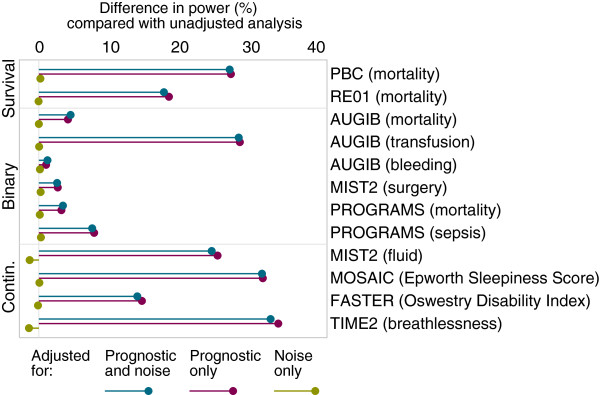
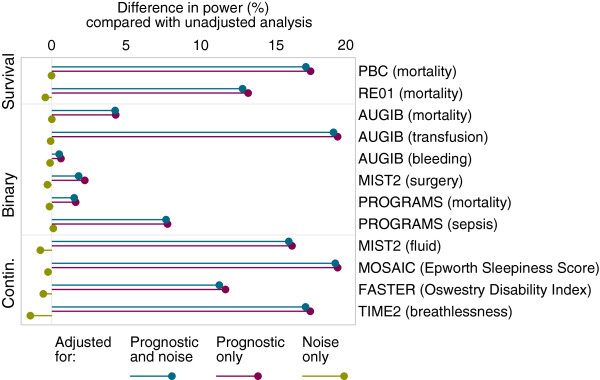
BACKGROUND: Adjustment for prognostic covariates can lead to increased power in the analysis of randomized trials. However, adjusted analyses are not often performed in practice. METHODS: We used simulation to examine the impact of covariate adjustment on 12 outcomes from 8 studies across a range of therapeutic areas. We assessed (1) how large an increase in power can be expected in practice; and (2) the impact of adjustment for covariates that are not prognostic. RESULTS: Adjustment for known prognostic covariates led to large increases in power for most outcomes. When power was set to 80% based on an unadjusted analysis, covariate adjustment led to a median increase in power to 92.6% across the 12 outcomes (range 80.6 to 99.4%). Power was increased to over 85% for 8 of 12 outcomes, and to over 95% for 5 of 12 outcomes. Conversely, the largest decrease in power from adjustment for covariates that were not prognostic was from 80% to 78.5%. CONCLUSIONS: Adjustment for known prognostic covariates can lead to substantial increases in power, and should be routinely incorporated into the analysis of randomized trials. The potential benefits of adjusting for a small number of possibly prognostic covariates in trials with moderate or large sample sizes far outweigh the risks of doing so, and so should also be considered.
Overview
The claims and statistics of this paper haven’t been checked yet.
Run the check — free, no account needed. It reads the open-access text and checks the sources it cites.
Integrity signals
Registry
Cites
Statistics
Figures
Verification
Claims the paper makes
The claims and statistics of this paper haven’t been checked yet.
Run the check — free, no account needed. It reads the open-access text and checks the sources it cites.
Claims other papers make about this one
Each is checked against this paper’s own text: does it say what the citing paper says it does?
The cited source says what the claim attributes to it.
In the citing paper
“In addition to adjusting for baseline to end-of-treatment (EOT) by group interactions, we adjusted for baseline depression, a well-established prognostic covariate of chronic pain [28], to reduce baseline differences in the outcome variables [29].”
From Yoga is effective for treating chronic pain in veterans with Gulf War Illness at long-term follow-up (2023) · cites this paper as [29]
In the citing paper
“Adjusting for baseline covariates, including those used in any stratified randomisation, is often advised in the analysis, particularly when a baseline covariate is prognostic of the outcome, as it can lead to improved power to detect an intervention effect.408 409 410”
From SPIRIT 2025 explanation and elaboration: updated guideline for protocols of randomised trials (2025) · cites this paper as [408]
In the citing paper
“However, under the assumptions of an unconfounded experimental design with batches containing both controls and cases, batch effects can be removed by adding a batch covariate to the regression model71. This increases the power compared to non-batch corrected analyses72–74.”
From scPower accelerates and optimizes the design of multi-sample single cell transcriptomic studies (2021) · cites this paper as [74]
Self-check
Percentages, sums and reported differences re-computed from the paper’s own numbers.
The self-check needs the paper’s full text.
Citations
Cites
SPIRIT 2013 explanation and elaboration: guidance for protocols of clinical trials
Chan, A.-W., Tetzlaff, J. M., Gotzsche, P. C., Altman, D. G., Mann, H., Berlin, J. A., Dickersin, K., Hrobjartsson, A., Schulz, K. F., Parulekar, W. R., et al. (2013) · BMJ · doi:10.1136/bmj.e7586 · Cited by 6,251
Pocock, S. J., & Simon, R. (1975) · Biometrics · doi:10.2307/2529712 · Cited by 2,350
Subgroup analysis and other (mis)uses of baseline data in clinical trials
Assmann, S. F., Pocock, S. J., Enos, L. E., & Kasten, L. E. (2000) · The Lancet · doi:10.1016/s0140-6736(00)02039-0 · Cited by 1,167
Pocock, S. J., Assmann, S. E., Enos, L. E., & Kasten, L. E. (2002) · Statistics in Medicine · doi:10.1002/sim.1296 · Cited by 1,077
Minimization: A new method of assigning patients to treatment and control groups
Taves, D. R. (1974) · Clinical Pharmacology & Therapeutics · doi:10.1002/cpt1974155443 · Cited by 891
Intrapleural Use of Tissue Plasminogen Activator and DNase in Pleural Infection
Rahman, N. M., Maskell, N. A., West, A., Teoh, R., Arnold, A., Mackinlay, C., Peckham, D. G., Davies, C., Ali, N. J., Kinnear, W. J. M., et al. (2011) · New England Journal of Medicine · doi:10.1056/nejmoa1012740 · Cited by 860
Self-citationSteyerberg, E. W., Eijkemans, M. J. C., Harrell, F. E., & Habbema, J. D. F. (2000) · Statistics in Medicine · doi:10.1002/(sici)1097-0258(20000430)19:8 · Cited by 789
Van Breukelen, G. J. P. (2006) · Journal of Clinical Epidemiology · doi:10.1016/j.jclinepi.2006.02.007 · Cited by 765
Davies, H. E., Mishra, E. K., Kahan, B. C., Wrightson, J., Stanton, A. E., Guhan, A., Davies, C. W. H., Grayez, J., Harrison, R. N., Prasad, A., et al. (2012) · JAMA · doi:10.1001/jama.2012.5535 · Cited by 654
Self-citationThe method of minimization for allocation to clinical trials
Scott, N. W., McPherson, G. C., Ramsay, C. R., & Campbell, M. K. (2002) · Controlled Clinical Trials · doi:10.1016/s0197-2456(02)00242-8 · Cited by 651 · cited 1×
“Patients were randomized using minimization [22-25]; stratification factors were: the size of the pleural effusion at baseline; whether the infection was hospital-acquired, and the presence of purulent pleural fluid.”
Method
Cited by
Sorted by citations
Items 301–400 of 498
Li, M., Mustillo, S., Liu, B., & Wang, W. (2024) · Chinese Sociological Review · doi:10.1080/21620555.2024.2305787 · Cited by 3
Zainal, N. H., Tan, H. H., Hong, R. Y. S., & Newman, M. G. (2025) · JMIR Mental Health · doi:10.2196/67210 · Cited by 9
A Practical Guide to Identifying Robust Clusters in Neuroimaging Data
Nakuci, J., & Rahnev, D. (2025) · Human Brain Mapping · doi:10.1002/hbm.70330 · Cited by 3
Su, X., Wong, V., Cheung, Y. T. D., Chan, H. C.-H., Wong, G. N.-T., Lee, J. K. H., Ho, S. Y., Wang, M. P., & Luk, T. T. (2024) · Digital Health · doi:10.1177/20552076241291709 · Cited by 2
How reproducible are data-driven subtypes of Alzheimer's disease atrophy?
Prevot, E., Shand, C., Initiative, A. D. N., & Oxtoby, N. P. (2026) · Journal of Alzheimer s Disease · doi:10.1177/13872877251415019 · Cited by 4
Post-COVID Rehabilitation Outcomes: A Comparative Cohort Study
Prüfer, F., Kautzky, A., Unger, A., Matko, Š., Fischer, M. J., Zwick, R. H., & Grote, V. (2025) · Archives of Rehabilitation Research and Clinical Translation · doi:10.1016/j.arrct.2025.100516 · Cited by 2
Kirsch, D. E., Grodin, E. N., Leggio, L., McKee, S. A., Meredith, L. R., Mereish, E. H., Miranda, R., Nieto, S. J., O’Malley, S. S., Schacht, J. P., et al. (2025) · Alcoholism Clinical and Experimental Research · doi:10.1111/acer.70170 · Cited by 5
Ong, S. W. X., Pinto, R. L., Mahar, R. K., Petersiel, N., Fowler, R., Davis, J. S., Daneman, N., Tong, S. Y. C., Lye, D. C., Yahav, D., et al. (2025) · Clinical Microbiology and Infection · doi:10.1016/j.cmi.2025.11.027 · Cited by 2
Lamontagne, E., Leroy, V., Howell, S., Boyer, S., & Ventelou, B. (2025) · Nature Human Behaviour · doi:10.1038/s41562-025-02361-9 · Cited by 3
Tucher, E. L., Steele, A. L., Uratsu, C. S., Hamilton, L., Brown, M. C., Nugent, J. R., Jones, D. H., Gottlieb, L. M., & GRANT, R. W. (2025) · Contemporary Clinical Trials · doi:10.1016/j.cct.2025.108210 · Cited by 3
D'Alessandro, A., Kim, J., Adhikari, S., GOFF, D. C., Stoffi, F. J. B., & Santacatterina, M. (2026) · Statistics in Medicine · doi:10.1002/sim.70436 · Cited by 2
A three-dimensional multi-modal foundation model for optical coherence tomography
Liu, Z., Xu, H., Woicik, A., Shapiro, L. G., Blazes, M. S., Wu, Y., Steffen, V., Cukras, C. A., Lee, C. S., Zhang, M., et al. (2026) · Nature Biomedical Engineering · doi:10.1038/s41551-026-01662-2 · Cited by 3
Berchialla, P., Sciannameo, V., Urru, S., Lanera, C., Azzolina, D., Gregori, D., & Baldi, I. (2021) · International Journal of Environmental Research and Public Health · doi:10.3390/ijerph18157758 · Cited by 2
Schultz, A., Chang, A. B., Gill, F. J., Walker, R., Barwick, M. A., Munns, S., Cooper, M. N., Norman, R., & Laird, P. J. (2022) · BMC Pulmonary Medicine · doi:10.1186/s12890-022-01878-3 · Cited by 2
Ondersma, S. J., Todd, L., Jablonski, S., Ahuja, C., Gilstad‐Hayden, K., Goyert, G. L., Loree, A. M., Heffner, J. L., & Yonkers, K. A. (2022) · BMJ Open · doi:10.1136/bmjopen-2022-062735 · Cited by 2
Stanley, S. M., Barton, A. W., Ritchie, L. L., Allen, M. O. T., & RHOADES, G. K. (2023) · Family Relations · doi:10.1111/fare.12845 · Cited by 3
Digital driving data can track driving exposure and quality of life in Parkinson’s disease
Chang, J. H., Bhatti, D., Uc, E. Y., Rizzo, M., & Merickel, J. (2023) · Traffic Injury Prevention · doi:10.1080/15389588.2023.2247110 · Cited by 2
Bourke, M., Bruijns, B. A., Saravanamuttoo, K., Vanderloo, L. M., & Tucker, P. (2024) · Pediatric Exercise Science · doi:10.1123/pes.2023-0180 · Cited by 2
Thombs, B. D., Adams, C., Nassar, E., Carrier, M., Golberg, M., Bharthi, K., Wurz, A. J., South, A., Kwakkenbos, L., Hoa, S. A.-T., et al. (2025) · Trials · doi:10.1186/s13063-025-08846-2 · Cited by 2
Shi, J., Wu, Z., & Dempsey, W. (2025) · Journal of the American Statistical Association · doi:10.1080/01621459.2025.2516197 · Cited by 4
Kaplan, F., & Aslan, H. (2025) · Nurse Education in Practice · doi:10.1016/j.nepr.2025.104519 · Cited by 2
Mahmood, A., Roberts, I., & Shakur‐Still, H. (2019) · Wellcome Open Research · doi:10.12688/wellcomeopenres.14731.3 · Cited by 2
Al‐Jaishi, A. A., Dixon, S. N., McArthur, E., Devereaux, P. J., Thabane, L., & Garg, A. X. (2021) · Trials · doi:10.1186/s13063-021-05590-1 · Cited by 2
Mahmood, A., Roberts, I., & Shakur‐Still, H. (2018) · Wellcome Open Research · doi:10.12688/wellcomeopenres.14731.1 · Cited by 2
Davies, P., Davies, N. M., & Qiu, T. (2017) · British Educational Research Journal · doi:10.1002/berj.3289 · Cited by 4
Roadblocks to driving cognitive gains through transcranial electrical stimulation
Mehta, U. M. (2018) · Schizophrenia Research · doi:10.1016/j.schres.2018.04.014 · Cited by 2
Best, J. G., & Werring, D. J. (2021) · Springer eBooks · doi:10.1007/978-3-030-70761-3_7 · Cited by 3
Durand, C., Magloire, L., Cousson‐Gélie, F., Bord, A., Saboni, L., Zeghnoun, A., Lepage, B., Richard, J., Catelinois, O., Mouly, D., et al. (2023) · British Journal of Health Psychology · doi:10.1111/bjhp.12650 · Cited by 2
Baggio, S., Billieux, J., Dirkzwager, A., Iglesias, K., Moschetti, K., Perroud, N. A., Schneider, M. P., Vernaz, N., Wolff, H. J., & Heller, P. (2024) · Trials · doi:10.1186/s13063-023-07827-7 · Cited by 2
Stimulation Therapy to Induce Mothers: Protocol for a Multicenter Randomized Controlled Trial
Tortal, D., Shabanova, V., Taylor, S., Xu, X., McAdow, M., Stetson, B., McCollum, S., Sanchez, E., Adjakple, A., Leventhal, J., et al. (2024) · JMIR Research Protocols · doi:10.2196/63463 · Cited by 2
Designing Better, Not Just Bigger, Multicenter Critical Care Trials
Harhay, M. O., & Russell, J. A. (2015) · Critical Care Medicine · doi:10.1097/ccm.0000000000001316 · Cited by 2
Dell‐Kuster, S., Steiner, L. A., & Young, J. (2020) · The Lancet · doi:10.1016/s0140-6736(20)30909-0 · Cited by 2
Statistical Design and Reporting of Randomised Controlled Trials for Raynaud’s Phenomenon
Wilkinson, J., & Seibold, J. R. (2024) · Springer eBooks · doi:10.1007/978-3-031-52581-0_16 · Cited by 1
The Impact of Pudendal Nerve Injection in Vaginal Surgery: A Secondary Analysis
Neveu, M. L., Sears, S. B., Rhodes, S., Slopnick, E. A., Petrikovets, A., Mangel, J. M., & Sheyn, D. D. (2024) · Urogynecology · doi:10.1097/spv.0000000000001565 · Cited by 1
Covariate Adjustment in Analyzing Randomized Clinical Trials: Approaches, Software, and Application
Liu, J., Wang, X., & Pang, H. (2024) · Springer eBooks · doi:10.1007/978-3-031-65937-9_14 · Cited by 1
Chen, S., Wei, J., Zhan, Z., Xu, X.-H., Yan, Z.-L., & Ou, C. (2025) · BMC Medical Research Methodology · doi:10.1186/s12874-025-02596-0 · Cited by 1
Ooghe, A., Pereira, Á. R., Jr., Colloca, L., Stannard, E., Ambrose, C., Lissin, D., & Branders, S. (2025) · Journal of Pain · doi:10.1016/j.jpain.2025.105489 · Cited by 1
Statistical Validation of Multivariate Treatment Effects in Longitudinal Study Designs
Madssen, T. S., Smilde, A. K., Camacho, J., Jarmund, A. H., Westerhuis, J. A., & Giskeødegård, G. F. (2025) · Journal of Chemometrics · doi:10.1002/cem.70044 · Cited by 1
Koehler, R. C., Bedirian, K., Chen, M., Shi, Y., Cao, S., Avery, B. D., Karuppagounder, S. S., Akhter, K., Bibic, A., Dawson, V. L., et al. (2025) · Journal of the American Heart Association · doi:10.1161/jaha.124.040914 · Cited by 1
Amniotic fluid metabolic biomarkers of fetal physiology and pregnancy success
Absalón-Medina, V. A., Sala, R. V., Pereira, D. C., Fricke, V. C., Devkota, I., Bonomo, Z. L., Fuego, D., McDonald, M., Sánchez, J. M., Rabaglino, M. B., et al. (2025) · Biology of Reproduction · doi:10.1093/biolre/ioaf236 · Cited by 1
Nassar, E., Wurz, A. J., Carrier, M., Golberg, M., Adams, C., Kwakkenbos, L., Hoa, S. A.-T., Benedetti, A., Thombs, B. D., Baril, G., et al. (2025) · Trials · doi:10.1186/s13063-025-09256-0 · Cited by 1
Dølven, S., Moroń, M., Eriksen, I., Toft, J. E. G., & Semkovska, M. (2025) · Neuropsychology Review · doi:10.1007/s11065-025-09686-2 · Cited by 1
Damluji, A. A., Bruce, S. A., Reeves, G. R., Pastva, A. M., Bertoni, A. G., Mentz, R. J., Whellan, D. J., Kitzman, D. W., & deFilippi, C. R. (2026) · Circulation Heart Failure · doi:10.1161/circheartfailure.125.013251 · Cited by 2
Blake, A. F., Moeyaert, M., Thoemmes, F. J., MacKinnon, D. P., & Chassin, L. (2026) · Child Abuse & Neglect · doi:10.1016/j.chiabu.2026.107882 · Cited by 1
McDonald, M. A., Berryhill, M. E., Lansing, A. H., & Lancaster, C. L. (2026) · Mindfulness · doi:10.1007/s12671-026-02774-1 · Cited by 1
Cognitive-behavioral therapy for post COVID-19 condition: A pilot randomized controlled trial
Sauer, K. S., Bräscher, A., Germer, S., Huth, D., Kolb, J., Mütze, K., & Witthöft, M. (2026) · Journal of Psychosomatic Research · doi:10.1016/j.jpsychores.2026.112920 · Cited by 1
Delgado, J. R., & Segura, E. R. (2016) · Journal of Lower Genital Tract Disease · doi:10.1097/lgt.0000000000000236 · Cited by 1
Research Questions in Data Science
Rose, S., & van der Laan, M. J. (2018) · Springer series in statistics · doi:10.1007/978-3-319-65304-4_1 · Cited by 2
Data-Adaptive Estimation in Cluster Randomized Trials
Balzer, L. B., van der Laan, M. J., & Petersen, M. L. (2018) · Springer series in statistics · doi:10.1007/978-3-319-65304-4_13 · Cited by 1
Li, L. (2022) · Springer eBooks · doi:10.1007/978-3-319-52636-2_121 · Cited by 1
Zhang, D., Li, T., Wang, A., Feng, L., Lai, X., Cao, K., Zhou, L., Yang, B., Cui, F., Li, Q., et al. (2022) · Frontiers in Pharmacology · doi:10.3389/fphar.2022.916421 · Cited by 1
Deichsel, E. L., Tickell, K. D., & McQuade, E. T. R. (2023) · Maternal and Child Nutrition · doi:10.1111/mcn.13547 · Cited by 1
Bouras, M., Clément, A., Schirr-Bonnans, S., Mauduit, N., Péré, M., Roquilly, A., Riche, V.-P., & Asehnoune, K. (2023) · Journal of Clinical Anesthesia · doi:10.1016/j.jclinane.2023.111218 · Cited by 1
Liu, J. Y. W., Man, D. W. K., Lai, F. H., Cheung, T. C. C., Cheung, A. K.-P., Cheung, D. S. K., Choi, T. K. S., Fong, G. C.-H., Kwan, R. Y. C., Lam, S. C., et al. (2023) · Digital Health · doi:10.1177/20552076231210725 · Cited by 1
Reijman, S., Vieira, C. C., Haase, T. W., Helmerhorst, K. O. W., Pontoppidan, M., Grosen, S. A., Egmose, I., Røhder, K., & Væver, M. S. (2024) · BMC Psychology · doi:10.1186/s40359-024-01568-1 · Cited by 1
Modeling Negatively Skewed Survival Data in Accelerated Failure Time and Correlated Frailty Models
Waymyers, S. D., & Chakraborty, H. (2024) · Journal of the Indian Society for Probability and Statistics · doi:10.1007/s41096-024-00184-x · Cited by 1
Bullen, J., Nickel, B., McCaffery, K. J., Wilt, T. J., Smith, J., Boroumand, F., Parker, L. M., Millar, J. L., Brodersen, J., Dahm, P., et al. (2024) · BMJ Open · doi:10.1136/bmjopen-2024-085947 · Cited by 1
Rivera, A. S., Al-Heeti, O., Feinstein, M. J., Williams, J. L., Taiwo, B., Achenbach, C. J., & Petito, L. C. (2024) · BMJ Open · doi:10.1136/bmjopen-2024-085547 · Cited by 1
Bouras, M., Tessier, P., Poulain, C., Schirr-Bonnans, S., & Roquilly, A. (2024) · Journal of Intensive Care · doi:10.1186/s40560-024-00753-z · Cited by 1
Wojcicki, J. M., Epel, E. S., Lin, J., Tai, V., Schwarz, J., Noworolski, S. M., Erkin‐Cakmak, A., Mulligan, K. M., Gugliucci, A., & Lustig, R. H. (2025) · Diabetology & Metabolic Syndrome · doi:10.1186/s13098-025-01611-0 · Cited by 1
Joshi, M., Kim, K., Pickard, A. S., Sharp, L. K., Gerber, B. S., & Touchette, D. R. (2025) · American Journal of Health-System Pharmacy · doi:10.1093/ajhp/zxaf153 · Cited by 1
Harding, J. F., Walzer, J., Piatt, R., & Goesling, B. (2025) · Contraception · doi:10.1016/j.contraception.2025.111200 · Cited by 3
Smart, K. M., Abbott-Fleming, V., Birklein, F., Bruehl, S. P., Corcoran, E., Day, S. J., Ferraro, M. C., Grieve, S., Hilgers, R.-D., Ingram, C., et al. (2025) · PAIN Reports · doi:10.1097/pr9.0000000000001320 · Cited by 1
Statistical Issues in Randomized Controlled Trials: an editorial
Wadgave, U., Khairnar, M., & Wadgave, Y. (2018) · Electronic physician · doi:10.19082/7293 · Cited by 1
Li, L. (2019) · Springer eBooks · doi:10.1007/978-3-319-52677-5_121-1 · Cited by 1
Should we adjust for background variables in a randomised controlled trial?
Lydersen, S. (2020) · Tidsskrift for Den norske legeforening · doi:10.4045/tidsskr.19.0685 · Cited by 1
A Bivariate Regression-Based Cost-Effectiveness Analysis
Arsham, A., Bebu, I., & Mathew, T. (2022) · Journal of Statistical Theory and Practice · doi:10.1007/s42519-022-00255-x · Cited by 1
Twisk, J. W. R. (2021) · Springer eBooks · doi:10.1007/978-3-030-81865-4_11 · Cited by 1
Covariate adjustment in subgroup analyses of randomized clinical trials: A propensity score approachPreprint
Yang, S., Li, F., Thomas, L. E., & Li, F. (2021) · arXiv (Cornell University) · doi:10.48550/arxiv.2102.02285 · Cited by 1
Using MetaboAnalyst 5.0 Part I: Optimizing parameters for LC-HRMS spectra processingPreprint
Pang, Z., Zhou, G., Ewald, J., Chang, L., Haçarız, O., Basu, N., & Xia, J. (2022) · Research Square · doi:10.21203/rs.3.pex-1917/v1 · Cited by 1
Using MetaboAnalyst 5.0 Part IV: Analyzing metabolomics data with complex metadataPreprint
Pang, Z., Zhou, G., Ewald, J., Chang, L., Haçarız, O., Basu, N., & Xia, J. (2022) · Research Square · doi:10.21203/rs.3.pex-1921/v1 · Cited by 1
Beyer, F., Kleine, L., Zülke, A. E., Luppa, M., Mildner, T., Frese, T., Gensichen, J. S., Czock, D., Wiese, B., König, H., et al. (2024) · Research Square · doi:10.21203/rs.3.rs-5303457/v1 · Cited by 1
Design and Analysis of Cluster Randomized Trials with Application to HIV Prevention and Treatment
Balzer, L. B. (2015) · eScholarship (California Digital Library)
Weeks, A. V. (2015) · White Rose eTheses Online (University of Leeds, The University of Sheffield, University of York)
Coping and stress management training with special focus on women with breast cancer
Kvillemo, P. (2016) · Figshare
Panchamia, J. K., Amundson, A. W., Poeran, J., Nguyen, N. T. V., Kopp, S. L., & Johnson, R. L. (2019) · Anesthesia & Analgesia · doi:10.1213/ane.0000000000004090
Samsa, G. P. (2020) · Learning Health Systems · doi:10.1002/lrh2.10219
Multiple Imputation for Handling Missing Outcome Data
Sullivan, T. (2017) · Adelaide Research & Scholarship (AR&S) (University of Adelaide)
The need for traumatic brain injury markers
Than, M. P., Fatovich, D. M., Fitzgerald, M., Gozt, A., McKinlay, A., & Snell, D. L. (2020) · Elsevier eBooks · doi:10.1016/b978-0-12-816346-7.00002-6
Statistical Methods for the Design and Analysis of Infectious Disease Studies
Kennedy‐Shaffer, L. (2020) · Digital Access to Scholarship at Harvard (DASH) (Harvard University)
Specific Aspects and Significance of Subgroup Assessment in Confirmatory Clinical Trials
Basova, O. I., Lysikova, I. V., & Ivanova, O. Y. (2021) · The Bulletin of the Scientific Centre for Expert Evaluation of Medicinal Products Regulatory Research and Medicine Evaluation · doi:10.30895/1991-2919-2021-11-2-81-93
Loh, W. W., & Ren, D. (2021) · doi:10.31234/osf.io/zkdqa
Cooper, M. N., Whitehouse, A., & Billingham, W. (2022) · Archives of Pediatrics and Adolescent Medicine · doi:10.1001/jamapediatrics.2021.5541
Evaluation of surgical methods for treatment of cubital tunnel syndrome - statistical perspectives
Morsy, A. (2017) · Clinical Trials in Orthopedic Disorders · doi:10.4103/2542-4157.213690
Ball, E., Newton, S., Kahan, B. C., Forbes, G., Wright, N., Calvete, C. C., Gibson, H. A. L., Rogozińska, E., Rivas, C. A., Taylor, S. J., et al. (2017) · doi:10.2196/preprints.7720
Self-citationMore efficient and inclusive time-to-event trials with covariate adjustment: a simulation studyPreprint
Momal, R., Trichelair, P., Blum, M. G. B., & Balazard, F. (2022) · medRxiv · doi:10.1101/2022.04.15.22273871
Al‐Jaishi, A. A., Dixon, S. N., McArthur, E., Devereaux, P. J., Thabane, L., & Garg, A. X. (2021) · Research Square · doi:10.21203/rs.3.rs-278523/v1
Ficek, J., Chen, H., Lu, Y., Huang, Y., & Mayer, J. M. (2022) · Statistics in Biopharmaceutical Research · doi:10.1080/19466315.2022.2071981
Zhang, I. Y., Flum, D. R., Agrawal, N., & Liao, J. M. (2022) · Healthcare · doi:10.1016/j.hjdsi.2022.100629
Using MetaboAnalyst 5.0 Part III: Multi-omics integrationPreprint
Pang, Z., Zhou, G., Ewald, J., Chang, L., Haçarız, O., Basu, N., & Xia, J. (2022) · Research Square · doi:10.21203/rs.3.pex-1920/v1
Using MetaboAnalyst 5.0 Part II: Obtaining functional insights from peak list dataPreprint
Pang, Z., Zhou, G., Ewald, J., Chang, L., Haçarız, O., Basu, N., & Xia, J. (2022) · Research Square · doi:10.21203/rs.3.pex-1919/v1
Loh, W. W., & Ren, D. (2021) · doi:10.31219/osf.io/yve6u
Decentralized_eSBI_factorial_trial_alcohol_pregnancy_7_12_2022Preprint
Ondersma, S. J., Todd, L., Jablonski, S., Ahuja, C., Gilstad‐Hayden, K., Goyert, G. L., Loree, A. M., Heffner, J. L., & Yonkers, K. A. (2022) · doi:10.31234/osf.io/paqx9
Applying Behavioral Nudges in a Dietary Comparator for Surgical Trials: Developing the MediDiet
Zhang, I. Y., Norwitz, D., Drewnowski, A., Agrawal, N., Flum, D. R., & Liao, J. M. (2022) · Journal of Surgical Research · doi:10.1016/j.jss.2022.06.054
Amyotrophic Lateral Sclerosis: Innovative Therapies for ALS under the Pipeline
Kumar, R. (2022) · Neurology & Neurotherapy Open Access Journal · doi:10.23880/nnoaj-16000166
Cook, J. A. (2023) · doi:10.1093/med/9780198885238.003.0009
Zhu, H., Zhang, L., Ning, J., & Wang, L. (2023) · Statistica Sinica · doi:10.5705/ss.202022.0011
Metadata
- Authors
- Kahan, B. C., Jairath, V., Doré, C. J., & Morris, T. P.
- Affiliations
- Queen Mary University of London (GB)
- University of Oxford (GB)
- University College London (GB)
- MRC Clinical Trials Unit at UCL (GB)
- Corresponding author
- Kahan, Brennan C
- Venue
- Trials
- Published
- 2014-04-23
- Volume
- 15
- Issue
- 1
- Pages
- 139-139
- ISSN
- 1745-6215 (ISSN-L)
- PMC
- PMC4022337
- OpenAlex
- W2166091513
- Cited by
- 497
- References
- 52
- Citations by year
- 2026: 31 · 2025: 69 · 2024: 61 · 2023: 67 · 2022: 73 · 2021: 57 · 2020: 37 · 2019: 22 · 2018: 26 · 2017: 16 · 2016: 20 · 2015: 11 · 2014: 6
- FWCI
- 18.68
- Type
- journal article
- Language
- en
- Open access
- gold
- doi.org
- Licence
- cc-by
- Locations
- Trials (publishedVersion, cc-by)
- Europe PMC (PubMed Central) (publishedVersion, cc-by)
- PubMed Central (publishedVersion, cc-by)
- PubMed (publishedVersion)
- UCL Discovery (University College London) (submittedVersion)
- Queen Mary Research Online (Queen Mary University of London) (submittedVersion, cc-by)
- Funders
- National Institute for Health and Care Research (CL-2013-13-008)
- Medical Research Council (MC_EX_G0800814)
- Topics
- Physical Sciences › Mathematics › Statistics and Probability › Statistical Methods in Clinical Trials
- Physical Sciences › Mathematics › Statistics and Probability › Advanced Causal Inference Techniques
- Social Sciences › Decision Sciences › Statistics, Probability and Uncertainty › Meta-analysis and systematic reviews
- Keywords
- covariate adjustment, prognostic factors, statistical power, simulation study, trial analysis
- MeSH terms
- Analysis of Variance, Computer Simulation, Data Interpretation, Statistical, Humans, Research Design, Reproducibility of Results, Models, Statistical, Linear Models, Logistic Models, Proportional Hazards Models, Randomized Controlled Trials as Topic
About these checks
Registry, retraction, Cites and statistics results are computed, not judged, with one exception: a printed reference that no index lists is read once by a model before it counts as a citation error. Claims are extracted by a model and kept only when their quote appears verbatim in the text; each cited source is then checked, with a model’s help, for whether it says what the claim relies on. Those verdicts can be wrong — read the claim’s quote and the cited source before relying on one.
Statistics and arithmetic are recomputed, not judged.
Confidence bands are shown only for fields calibrated on our annotated test set. None is calibrated yet, so no band is shown.
What counts as a claim ›How we measure confidence ›How we check this ›
Are you an author, or do you see a problem with this page? Request a review
