

SMS reminders to improve the tuberculosis cure rate in developing countries (TB-SMS Cameroon): a protocol of a randomised control study
Open accessThe DOI matches its Crossref record; 39 of the 39 references it cites were found in a registry or an index.
Abstract
BACKGROUND: Tuberculosis is a public health problem in Cameroon, just like in many other countries in the world. The National Tuberculosis Control Programme (PNLT) put in place by the state, aims to fight tuberculosis through the implementation of international directives (Directly Observed Treatment Short, DOTS). Despite the deployment of this strategy across the world, its implementation is difficult in the context of low-resource countries. Some expected results are not achieved. In Cameroon, the cure rate for patients with sputum positive pulmonary tuberculosis (TPM+) after 6 months is only about 65%, 20% below the target. This is mainly due to poor patient adherence to treatment. By relying on the potential of mobile Health, the objective of this study is to evaluate the effect of SMS reminders on the cure rate of TPM + patients, measured using 6-month bacilloscopy. METHODS/DESIGN: This is a blinded, randomised controlled multicentre study carried out in Cameroon. The research hypothesis is that sending daily SMS messages to remind patients to take their prescribed tuberculosis medication, together with the standard DOTS strategy, will increase the cure rate from 65% (control group: DOTS, no SMS intervention) to 85% (intervention group: DOTS, with SMS intervention) in a group of new TPM + patients. In accordance with each treatment centre, the participants will be randomly allocated into the two groups using a computer program: the intervention group and the control group. A member of the research team will send daily SMS messages. Study data will be collected by health professionals involved in the care of patients. Data analysis will be done by the intention-to-treat method. DISCUSSION: The achieving of expected outcomes by the PNLT through implementation of DOTS requires several challenges. Although it has been demonstrated that the DOTS strategy is effective in the fight against tuberculosis, its application remains difficult in developing countries. This study explores the potential of mHealth to support DOTS strategy. It will gather new evidence on the effectiveness of mHealth-based interventions and SMS reminders in the improvement of treatment adherence and the cure rate of tuberculosis patients, especially in a low-resource country such as Cameroon. TRIAL REGISTRATION: The trial is registered on the Pan-African Clinical Trials Registry (http://www.pactr.org) under unique identification number: PACTR201307000583416.
Overview
The claims and statistics of this paper haven’t been checked yet.
Free: it reads the open-access text and checks the first 5 claims that cite a source we can check. Create a free account to check every claim.
Integrity signals
Registry
Cites
Statistics
Figures
Verification
Claims the paper makes
The claims and statistics of this paper haven’t been checked yet.
Free: it reads the open-access text and checks the first 5 claims that cite a source we can check. Create a free account to check every claim.
Claims other papers make about this one
Each is checked against this paper’s own text: does it say what the citing paper says it does?
The cited source says what the claim attributes to it.
In the citing paper
“The use of SMS only was mentioned in 16 of 26 interventions (62%) [28-31,35,37,38,40-43,45-47,50,52].”
From Barriers to the Use of Mobile Health in Improving Health Outcomes in Developing Countries: Systematic Review (2019) · cites this paper as [38]
Self-check
Percentages, sums and reported differences re-computed from the paper’s own numbers.
The self-check needs the paper’s full text.
Citations
Cites
Cook, R. J., Dickens, B. M., & Fathalla, M. F. (2003) · Reproductive Health and Human Rights · doi:10.1093/acprof:oso/9780199241323.003.0025 · Cited by 10,769
(2001) · Journal of Obstetrics and Gynaecology Research · doi:10.1111/j.1447-0756.2001.tb01222.x · Cited by 3,461
Interventions for enhancing medication adherence
Nieuwlaat, R., Wilczynski, N., Navarro, T., Hobson, N., Jeffery, R., Keepanasseril, A., Agoritsas, T., Mistry, N., Iorio, A., Jack, S., et al. (2014) · Cochrane Database of Systematic Reviews · doi:10.1002/14651858.cd000011.pub4 · Cited by 2,945 · cited 16×
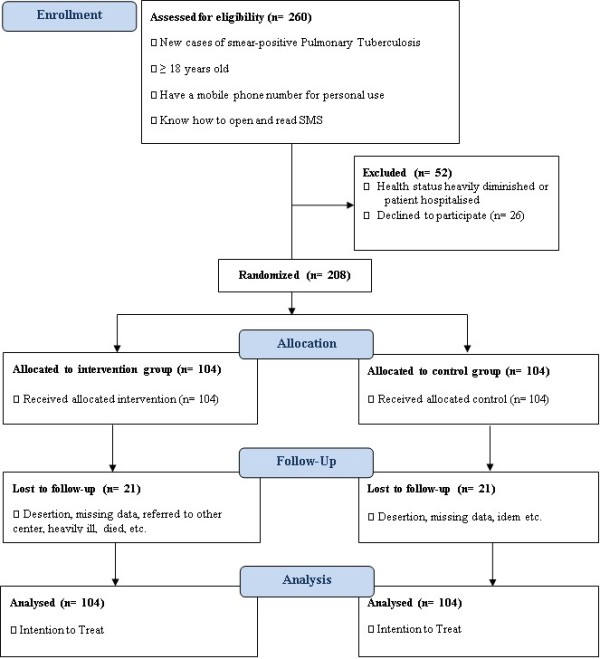
“Patients meeting the inclusion criteria will be recruited and randomised by centre into two groups (ratio 1:1): an intervention group in which participants receive SMS reminders in addition to the usual DOTS programme versus a control group where participants follow only the usual DOTS programme (Figure 1).”
BackgroundMethodInfluentialEthical principles for medical research involving human subjects
(2003) · Manual for Research Ethics Committees · doi:10.1017/cbo9780511550089.027 · Cited by 2,585
Lester, R. T., Ritvo, P., Mills, E. J., Kariri, A., Karanja, S., Chung, M. H., Jack, W., Habyarimana, J., Sadatsafavi, M., Najafzadeh, M., et al. (2010) · The Lancet · doi:10.1016/s0140-6736(10)61997-6 · Cited by 1,278 · cited 16×
“Many studies have explored the potential of mHealth (such as SMS reminders) for health objectives in the antiretroviral treatment of HIV [20-24].”
BackgroundResultInfluentialInterventions for enhancing medication adherence
Haynes, R. B., Ackloo, E., Sahota, N., McDonald, H. P., & Yao, X. (2008) · Cochrane Database of Systematic Reviews · doi:10.1002/14651858.cd000011.pub3 · Cited by 1,244
CONSORT 2010 statement: Updated guidelines for reporting parallel group randomised trials
Schulz, K. F., Altman, D. G., & Moher, D. (2011) · International Journal of Surgery · doi:10.1016/j.ijsu.2011.09.004 · Cited by 1,044
Pop-Eleches, C., Thirumurthy, H., Habyarimana, J. P., Zivin, J. G., Goldstein, M. P., de Walque, D., MacKeen, L., Haberer, J., Kimaiyo, S., Sidle, J., et al. (2011) · AIDS · doi:10.1097/qad.0b013e32834380c1 · Cited by 982 · cited 16×
“Many studies have explored the potential of mHealth (such as SMS reminders) for health objectives in the antiretroviral treatment of HIV [20-24].”
BackgroundResultInfluentialHealthcare via Cell Phones: A Systematic Review
Krishna, S., Boren, S. A., & Balas, E. A. (2009) · Telemedicine and e-Health · doi:10.1089/tmj.2008.0099 · Cited by 882 · cited 1×
“SMS-based interventions involving health staff and patients can contribute to the improvement of health process and clinical outcomes [17,18].”
BackgroundTreatment of 171 Patients with Pulmonary Tuberculosis Resistant to Isoniazid and Rifampin
Goble, M., Iseman, M. D., Madsen, L. A., Waite, D., Ackerson, L., & Horsburgh, C. R. (1993) · New England Journal of Medicine · doi:10.1056/nejm199302253280802 · Cited by 698 · cited 1×
“Irregular adherence to tuberculosis treatment causes therapeutic failure, leads to prolonged periods of infectiousness [9], provokes relapses [10], favours the emergence of drug resistance [11,12], requires prolonged and expensive treatment schemes, which do not guarantee effectiveness [13], and finally, increases mor…”
BackgroundDirectly observed therapy for treating tuberculosis
Karumbi, J., & Garner, P. (2015) · Cochrane Database of Systematic Reviews · doi:10.1002/14651858.cd003343.pub4 · Cited by 644 · cited 1×
“However, the DOTS strategy is often not well applied because its implementation, especially in developing countries, is complex [6], has numerous barriers [7] and needs enormous resources [8].”
BackgroundArnsten, J. H., Demas, P. A., Farzadegan, H., Grant, R. W., Gourevitch, M. N., Chang, C., Buono, D., Eckholdt, H., Howard, A. A., & Schoenbaum, E. E. (2001) · Clinical Infectious Diseases · doi:10.1086/323201 · Cited by 637 · cited 1×
“Used in several studies [20,34-37], VAS measures the adherence of patients to treatment and correlates with results obtained from more objective methods such as electronic follow-ups [38].”
BackgroundThe Effect of Directly Observed Therapy on the Rates of Drug Resistance and Relapse in Tuberculosis
Weis, S. E., Slocum, P. C., Blais, F. X., King, B., Nunn, M., Matney, G. B., Gomez, E., & Foresman, B. H. (1994) · New England Journal of Medicine · doi:10.1056/nejm199404283301702 · Cited by 589 · cited 1×
“Irregular adherence to tuberculosis treatment causes therapeutic failure, leads to prolonged periods of infectiousness [9], provokes relapses [10], favours the emergence of drug resistance [11,12], requires prolonged and expensive treatment schemes, which do not guarantee effectiveness [13], and finally, increases mor…”
BackgroundZurovac, D., Sudoi, R. K., Akhwale, W. S., Ndiritu, M., Hamer, D. H., Rowe, A. K., & Snow, R. W. (2011) · The Lancet · doi:10.1016/s0140-6736(11)60783-6 · Cited by 403
(2002) · Nursing Ethics · doi:10.1191/0969733002ne486xx · Cited by 389
Measuring Adherence to Antiretroviral Therapy in a Diverse Population Using a Visual Analogue Scale
Giordano, T. P., Guzman, D., Clark, R., Charlebois, E. D., & Bangsberg, D. R. (2004) · HIV Clinical Trials · doi:10.1310/jfxh-g3x2-eym6-d6ug · Cited by 337 · cited 1×
“Used in several studies [20,34-37], VAS measures the adherence of patients to treatment and correlates with results obtained from more objective methods such as electronic follow-ups [38].”
BackgroundMitchison, D. A. (1998) · PubMed · Cited by 288
Tuberculosis: Current situation, challenges and overview of its control programs in India
Sandhu, G. (2011) · Journal of Global Infectious Diseases · doi:10.4103/0974-777x.81691 · Cited by 245 · cited 2×
“These objectives raise numerous challenges in the fight against tuberculosis, in terms of infrastructure, organisation, socio-political context and funding [43,44].”
BackgroundAntiretroviral treatment adherence among HIV patients in KwaZulu-Natal, South Africa
Peltzer, K., Friend-du Preez, N., Ramlagan, S., & Anderson, J. (2010) · BMC Public Health · doi:10.1186/1471-2458-10-111 · Cited by 220 · cited 1×
“Used in several studies [20,34-37], VAS measures the adherence of patients to treatment and correlates with results obtained from more objective methods such as electronic follow-ups [38].”
BackgroundInterventions to reduce tuberculosis mortality and transmission in low- and middle-income countries.
Borgdorff, M. W., Floyd, K., & Broekmans, J. F. (2002) · Europe PMC (PubMed Central) · Cited by 212
Mahmud, N., Rodriguez, J., & Nesbit, J. (2010) · Technology and Health Care · doi:10.3233/thc-2010-0576 · Cited by 185 · cited 1×
“The interventions are cost-effective both in urban and rural settings [19].”
BackgroundVisual Analog Scale of ART Adherence: Association With 3-Day Self-Report and Adherence Barriers
Amico, K. R., Fisher, W. A., Cornman, D. H., Shuper, P. A., Redding, C. G., Konkle-Parker, D. J., Barta, W., & Fisher, J. D. (2006) · JAIDS Journal of Acquired Immune Deficiency Syndromes · doi:10.1097/01.qai.0000225020.73760.c2 · Cited by 175 · cited 1×
“Used in several studies [20,34-37], VAS measures the adherence of patients to treatment and correlates with results obtained from more objective methods such as electronic follow-ups [38].”
BackgroundBarrington, J., Wereko-Brobby, O., Ward, P., Mwafongo, W., & Kungulwe, S. (2010) · Malaria Journal · doi:10.1186/1475-2875-9-298 · Cited by 163 · cited 1×
“Effects have been observed in the prevention of HIV transmission from mother to child [25] on the adherence of health staff to guidelines for the management of malaria [26,27] and its control [28], and for the management of drug stocks [29].”
BackgroundMobile Phone Text Messaging: Tool for Malaria Control in Africa
Zurovac, D., Talisuna, A. O., & Snow, R. W. (2012) · PLoS Medicine · doi:10.1371/journal.pmed.1001176 · Cited by 135 · cited 1×
“Effects have been observed in the prevention of HIV transmission from mother to child [25] on the adherence of health staff to guidelines for the management of malaria [26,27] and its control [28], and for the management of drug stocks [29].”
BackgroundPatient education and counselling for promoting adherence to treatment for tuberculosis
M'Imunya, J. M., Kredo, T., & Volmink, J. (2012) · Cochrane Database of Systematic Reviews · doi:10.1002/14651858.cd006591.pub2 · Cited by 131
Cell phone short messaging service (SMS) for HIV/AIDS in South Africa: a literature review.
Khatry-Chhetry, M. B., & Murray, P. J. (2010) · PubMed · Cited by 101
The HAART cell phone adherence trial (WelTel Kenya1): a randomized controlled trial protocol
Lester, R. T., Mills, E. J., Kariri, A., Ritvo, P., Chung, M., Jack, W., Habyarimana, J., Karanja, S., Barasa, S., Nguti, R., et al. (2009) · Trials · doi:10.1186/1745-6215-10-87 · Cited by 91
the HIVIND study team, De Costa, A., Shet, A., Kumarasamy, N., Ashorn, P., Eriksson, B., Bogg, L., & Diwan, V. K. (2010) · BMC Medical Research Methodology · doi:10.1186/1471-2288-10-25 · Cited by 86 · cited 15×
“Many studies have explored the potential of mHealth (such as SMS reminders) for health objectives in the antiretroviral treatment of HIV [20-24].”
BackgroundInfluentialCan the power of mobile phones be used to improve tuberculosis diagnosis in developing countries?
Zimic, M., Coronel, J., Gilman, R. H., Luna, C. G., Curioso, W. H., & Moore, D. A. J. (2009) · Transactions of the Royal Society of Tropical Medicine and Hygiene · doi:10.1016/j.trstmh.2008.10.015 · Cited by 68 · cited 1×
“They can be used in the care of distant patients, as well as in the training of health staff [31].”
BackgroundMbuagbaw, L., Thabane, L., Ongolo-Zogo, P., Lester, R. T., Mills, E., Volmink, J., Yondo, D., Essi, M. J., Bonono-Momnougui, R.-C., Mba, R., et al. (2011) · Trials · doi:10.1186/1745-6215-12-5 · Cited by 66 · cited 16×
“Many studies have explored the potential of mHealth (such as SMS reminders) for health objectives in the antiretroviral treatment of HIV [20-24].”
BackgroundInfluentialPerson, A. K., Blain, M. L. M., Jiang, H., Rasmussen, P. W., & Stout, J. E. (2011) · Telemedicine and e-Health · doi:10.1089/tmj.2010.0164 · Cited by 63 · cited 2×
“The increased use of mobile technology, such as the Short Message Service (SMS), has significant potential for health systems, and is termed mobile health (mHealth) [15,16].”
BackgroundReminder systems and late patient tracers in the diagnosis and management of tuberculosis
Liu, Q., Abba, K., Alejandria, M. M., Balanag, V. M., Berba, R. P., & Lansang, M. A. D. (2008) · Cochrane Database of Systematic Reviews · doi:10.1002/14651858.cd006594.pub2 · Cited by 50
Adherence to Antiretroviral Medication Among HIV-Positive Patients in Thailand
Maneesriwongul, W., Tulathong, S., Fennie, K., & Williams, A. B. (2006) · JAIDS Journal of Acquired Immune Deficiency Syndromes · doi:10.1097/01.qai.0000248346.79888.78 · Cited by 50 · cited 1×
“Used in several studies [20,34-37], VAS measures the adherence of patients to treatment and correlates with results obtained from more objective methods such as electronic follow-ups [38].”
BackgroundInter-relations between relapses, drug regimens and compliance with treatment in tuberculosis
Ormerod, L. P., & Prescott, R. J. (1991) · Respiratory Medicine · doi:10.1016/s0954-6111(06)80087-9 · Cited by 46 · cited 1×
“Irregular adherence to tuberculosis treatment causes therapeutic failure, leads to prolonged periods of infectiousness [9], provokes relapses [10], favours the emergence of drug resistance [11,12], requires prolonged and expensive treatment schemes, which do not guarantee effectiveness [13], and finally, increases mor…”
BackgroundDean, A. L., Makin, J. D., Kydd, A. S., Biriotti, M., & Forsyth, B. W. (2012) · Journal of Telemedicine and Telecare · doi:10.1258/jtt.2012.120118 · Cited by 42 · cited 1×
“Effects have been observed in the prevention of HIV transmission from mother to child [25] on the adherence of health staff to guidelines for the management of malaria [26,27] and its control [28], and for the management of drug stocks [29].”
BackgroundImplementing Tuberculosis Control in Papua New Guinea: A Clash of Culture and Science?
Ongugo, K., Hall, J. J., & Attia, J. (2010) · Journal of Community Health · doi:10.1007/s10900-010-9324-8 · Cited by 18 · cited 1×
“However, the DOTS strategy is often not well applied because its implementation, especially in developing countries, is complex [6], has numerous barriers [7] and needs enormous resources [8].”
BackgroundChen, T., Lin, W., Lu, P., Lin, C., Lin, S., Lin, C.-J., Feng, M., Chiang, H.-C., Chen, Y., & Huang, M. (2011) · American Journal of Infection Control · doi:10.1016/j.ajic.2010.08.019 · Cited by 15 · cited 1×
“For example, they can be used to transmit laboratory images and results to improve notification and to reduce delays in the management of tuberculosis [30].”
BackgroundText messaging to improve adherence to malaria guidelines
Moonen, B., & Cohen, J. M. (2011) · The Lancet · doi:10.1016/s0140-6736(11)61089-1 · Cited by 12 · cited 1×
“Effects have been observed in the prevention of HIV transmission from mother to child [25] on the adherence of health staff to guidelines for the management of malaria [26,27] and its control [28], and for the management of drug stocks [29].”
BackgroundTuberculosis control: current status, challenges and barriers ahead in 22 high endemic countries.
Ibrahim, K. M., Khan, S., & Laaser, U. (2003) · PubMed · Cited by 9
Research works printed but not linked: 3
- Programme National de Lutte contre la Tuberculose au Cameroun Guide technique pour les personnels de santé 2011 Ministry of Public Health of Cameroon
- WHO Global Observatory for e-Health mHealth: new horizons for health through mobile technologies Second Global Survey on Health 2011 3 1 103 Global Observatory for eHealth
- Hüsler J Evaluation of the On Cue Compliance Service Pilot Testing the Use of SMS Reminders in the Treatment of Tuberculosis in Cape Town 2005 South Africa: Technology Associate, bridges.org, City of Cape Town Health Directorate and the International Development Research Council (IDRC)
Cited by
Kruse, C., Betancourt, J., Ortiz, S., Valdes Luna, S. M., Bamrah, I. K., & Segovia, N. (2019) · Journal of Medical Internet Research · doi:10.2196/13263 · Cited by 299
“Africa Infectious disease SMS only Blinded RCT (intervention n=104, control n=104) Bediang, 2014 [38] • Infrastructure • Cost • Policy”
Background(2018) · doi:10.2196/preprints.13263 · Cited by 299
Subbaraman, R., de Mondesert, L., Musiimenta, A., Pai, M., Mayer, K. H., Thomas, B. E., & Haberer, J. (2018) · BMJ Global Health · doi:10.1136/bmjgh-2018-001018 · Cited by 255
“Randomised trials of SMS strategies have not shown improvements in adherence or treatment success, 39 52 68 78 with the exception of a Kenyan study that included prompt engagement by HCPs for patients who did not report pill-taking via SMS. 79 One South African study of digital pillboxes found…”
Liu, X., Lewis, J. J., Zhang, H., Lu, W., Zhang, S., Zheng, G., Bai, L., Li, J., Li, X., Chen, H., et al. (2015) · PLOS Medicine · doi:10.1371/journal.pmed.1001876 · Cited by 234
The impact of digital health technologies on tuberculosis treatment: a systematic review
Ngwatu, B. K., Nsengiyumva, N. P., Oxlade, O., Mappin-Kasirer, B., Nguyen, N. L., Jaramillo, E., Falzon, D., & Schwartzman, K. (2018) · European Respiratory Journal · doi:10.1183/13993003.01596-2017 · Cited by 174
Metadata
- Authors
- Bediang, G., Stoll, B., Elia, N., Abena, J.-L., Nolna, D., Chastonay, P., & Geissbuhler, A.
- Affiliations
- Université de Yaoundé I (CM)
- University of Geneva (CH)
- Ministry of Public Health (CM)
- Corresponding author
- Bediang, Georges
- Venue
- Trials
- Published
- 2014-01-24
- Volume
- 15
- Issue
- 1
- Pages
- 35-35
- ISSN
- 1745-6215 (ISSN-L)
- PMC
- PMC3902069
- OpenAlex
- W2164416625
- Cited by
- 41
- References
- 39
- Citations by year
- 2024: 1 · 2023: 2 · 2022: 1 · 2021: 2 · 2020: 3 · 2019: 5 · 2018: 11 · 2017: 2 · 2016: 8 · 2015: 3 · 2014: 3
- FWCI
- 9.66
- Type
- journal article
- Language
- en
- Open access
- gold
- doi.org
- Licence
- cc-by
- creativecommons.org/licenses/by/2.0 (tdm)
- Locations
- Trials (publishedVersion, cc-by)
- Europe PMC (PubMed Central) (publishedVersion, cc-by)
- PubMed Central (publishedVersion, cc-by)
- PubMed (publishedVersion)
- Archive ouverte UNIGE (University of Geneva) (publishedVersion, other-oa)
- Archive ouverte UNIGE (University of Geneva) (submittedVersion, cc-by)
- Funders
- Hôpitaux Universitaires de Genève
- Topics
- Health Sciences › Health Professions › General Health Professions › Mobile Health and mHealth Applications
- Health Sciences › Medicine › Infectious Diseases › Tuberculosis Research and Epidemiology
- Health Sciences › Medicine › Family Practice › Medication Adherence and Compliance
- Keywords
- tuberculosis, SMS reminders, mobile health, DOTS, medication adherence, cure rate, resource-limited settings, Cameroon, National Tuberculosis Control Programme
- MeSH terms
- Antitubercular Agents, Cameroon, Clinical Protocols, Developing Countries, Female, Humans, Health Knowledge, Attitudes, Practice, Male, Motivation, Research Design, Time Factors, Tuberculosis, Pulmonary, Treatment Outcome, Reminder Systems, Directly Observed Therapy, Medication Adherence, Text Messaging
About these checks
Registry, retraction, Cites and statistics results are computed, not judged, with one exception: a printed reference that no index lists is read once by a model before it counts as a citation error. Claims are extracted by a model and kept only when their quote appears verbatim in the text; each cited source is then checked, with a model’s help, for whether it says what the claim relies on. Those verdicts can be wrong — read the claim’s quote and the cited source before relying on one.
Statistics and arithmetic are recomputed, not judged.
Confidence bands are shown only for fields calibrated on our annotated test set. None is calibrated yet, so no band is shown.
What counts as a claim ›How we measure confidence ›How we check this ›
Are you an author, or do you see a problem with this page? Request a review
Data sources
Bibliographic data: Semantic Scholar, OpenAlex, Crossref.
Contains information from the Semantic Scholar Academic Graph Datasets, made available under the ODC Attribution License (ODC-BY 1.0).
Semantic Scholar’s data is described in: Kinney, R., et al. (2023). The Semantic Scholar Open Data Platform. arXiv:2301.10140.
