

A compendium of causative agents of occupational asthma
Open accessThe DOI matches its Crossref record; 31 of the 31 references it cites were found in a registry or an index.
Abstract
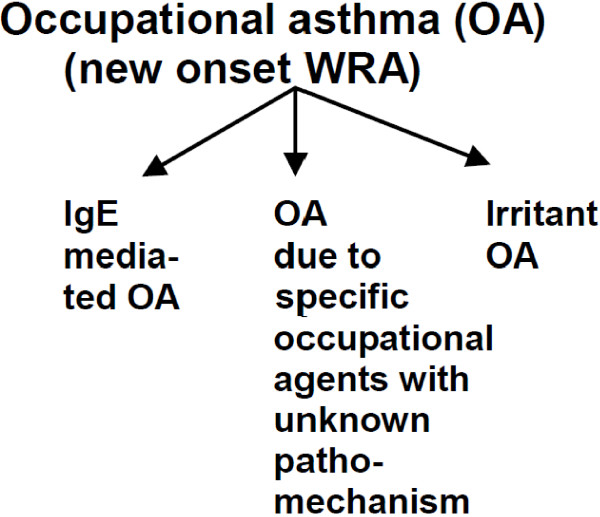
OBJECTIVE: The objective is to provide an evidence-based compendium of allergenic and irritant agents that are known to cause occupational asthma in order to improve diagnostics and disease management. METHODS: Two previously published reviews from our group utilized database searches to identify studies which were then rated according to the Scottish Intercollegiate Guideline Network (SIGN) grading system. The evidence level for each causative agent or worksite was graded using the Royal College of General Practitioners (RCGP) three-star system. RESULTS: Approximately 3,000 relevant papers were identified, which covered 372 different causes of allergic and 184 different causes of irritant occupational asthma. The highest level achieved using the SIGN grading system was 2++, indicating a high quality study with a very low risk of confounding or bias and a high probability of a causal relationship. Using the modified RCGP three-star grading system, the strongest evidence of association with an individual agent or worksite ('***') was found for exposure to laboratory animals. Associations with moderate evidence level ('**') were obtained for a) the allergenic agents or worksites: alpha-amylase from Aspergillus oryzae, various enzymes from Bacillus subtilis, papain, bakeries, western red cedar, latex, psyllium, storage mites, rat, carmine, egg proteins, Atlantic salmon, fishmeal, Norway lobster, prawn, snow crab, seafood, trout and turbot, reactive dyes, b) the irritant agents or worksites: benzene-1,2,4-tricarboxylic acid, 1,2- anhydride [trimellitic anhydride], chlorine, cobalt, cement, environmental tobacco smoke, grain, welding fumes, construction work, swine confinement, World Trade Center disaster 2001, and c) agents or worksites causing allergic as well as irritant occupational asthma, included farming, poultry confinement, various isocyanates and platinum salts. A low evidence level (RCGP) was obtained for 84 agents or worksites (42 from each group), providing a total of 141 conditions with a low, moderate or strong evidence level. CONCLUSION: This work comprises the largest compendium and evaluation of agents and worksites causing allergic or irritant occupational asthma from the literature assessed in an evidence-based manner.
Overview
The claims and statistics of this paper haven’t been checked yet.
Free: it reads the open-access text and checks the first 5 claims that cite a source we can check. Create a free account to check every claim.
Integrity signals
Registry
Cites
Statistics
Figures
Verification
Claims the paper makes
The claims and statistics of this paper haven’t been checked yet.
Free: it reads the open-access text and checks the first 5 claims that cite a source we can check. Create a free account to check every claim.
Claims other papers make about this one
Each is checked against this paper’s own text: does it say what the citing paper says it does?
The source backs part of the claim, not all of it — or backs it for a different population, condition or comparison.
In the citing paper
“Chemicals known to cause sensitization of the respiratory tract include diisocyanates, acid anhydrides, some platinum salts, reactive dyes, glutaraldehyde, plicatic acid, and chroamine.118-120”
From International Consensus Statement on Allergy and Rhinology: Allergic Rhinitis (2018) · cites this paper as [120]
Experimental — accuracy not yet measured
Self-check
Percentages, sums and reported differences re-computed from the paper’s own numbers.
The self-check needs the paper’s full text.
Citations
Cites
A new system for grading recommendations in evidence based guidelines
Harbour, R., & Miller, J. (2001) · BMJ · doi:10.1136/bmj.323.7308.334 · Cited by 1,637 · cited 1×
“The methodological quality of each selected publication was assessed by an experienced reviewer and discussed with the senior physician of the occupational unit who independently assessed the publications, before rating each according to the modified Scottish Intercollegiate Guidelines Network (SIGN) classification [1…”
MethodKay, A. B. (2001) · New England Journal of Medicine · doi:10.1056/nejm200101043440106 · Cited by 1,368
O’Hollaren, M. T., Bardana, E. J., & Montanaro, A. J. (1991) · Cited by 1,355
American thoracic society statement: occupational contribution to the burden of airway disease
(2003) · American Journal of Respiratory and Critical Care Medicine · doi:10.1164/rccm.167.5.787 · Cited by 874
Diagnosis and Management of Work-Related Asthma
Tarlo, S. M., Balmes, J., Balkissoon, R., Beach, J., Beckett, W., Bernstein, D., Blanc, P. D., Brooks, S. M., Cowl, C. T., Daroowalla, F., et al. (2008) · Chest · doi:10.1378/chest.08-0201 · Cited by 547
Globally Harmonized System of Classification and Labelling of Chemicals (GHS)
(2016) · Globally harmonized system of classification and labelling of chemicals · doi:10.18356/a6a925c3-en · Cited by 511
Occupational asthma in Europe and other industrialised areas: a population-based study
Kogevinas, M., Antó, J. M., Sunyer, J., Tobias, A., Kromhout, H., & Burney, P. (1999) · The Lancet · doi:10.1016/s0140-6736(98)07397-8 · Cited by 447
Torén, K., & Blanc, P. D. (2009) · BMC Pulmonary Medicine · doi:10.1186/1471-2466-9-7 · Cited by 285
Mapp, C. E., Boschetto, P., Maestrelli, P., & Fabbri, L. M. (2005) · American Journal of Respiratory and Critical Care Medicine · doi:10.1164/rccm.200311-1575so · Cited by 282
Respiratory tract lesions induced by sensory irritants at the RD50 concentration
Buckley, L. A., Jiang, X. Z., James, R. A., Morgan, K. T., & Barrow, C. S. (1984) · Toxicology and Applied Pharmacology · doi:10.1016/0041-008x(84)90295-3 · Cited by 214
Guidelines for the management of work-related asthma
Baur, X., Sigsgaard, T., Aasen, T. B., Burge, P. S., Heederik, D., Henneberger, P., Maestrelli, P., Rooyackers, J., Schlünssen, V., Vandenplas, O., et al. (2012) · European Respiratory Journal · doi:10.1183/09031936.00096111 · Cited by 213
Self-citationSWORD '99: surveillance of work-related and occupational respiratory disease in the UK
Meyer, J. D. (2001) · Occupational Medicine · doi:10.1093/occmed/51.3.204 · Cited by 146
Agents causing occupational asthma
Malo, J.-L., & Chan-Yeung, M. (2009) · Journal of Allergy and Clinical Immunology · doi:10.1016/j.jaci.2008.09.010 · Cited by 145 · cited 1×
“Previous reports and reviews have accumulated narrative and experimental evidence for about 300 causative agents, which are often divided into high or low molecular weight groups ([21-28]).”
BackgroundBronchial asthma and COPD due to irritants in the workplace - an evidence-based approach
Baur, X., Bakehe, P., & Vellguth, H. (2012) · Journal of Occupational Medicine and Toxicology · doi:10.1186/1745-6673-7-19 · Cited by 123
Self-citationOccupational airway sensitizers: an overview on the respective literature
van Kampen, V., Merget, R., & Baur, X. (2000) · American Journal of Industrial Medicine · doi:10.1002/1097-0274(200008)38:2<164::aid-ajim7>3.0.co;2-2 · Cited by 123
Self-citationBerger‐Preiß, E., & Gerling, S. (2012) · Wiley eBooks · doi:10.1002/3527600418.bi292188e0011 · Cited by 94
Allergens causing occupational asthma: an evidence-based evaluation of the literature
Baur, X., & Bakehe, P. (2014) · International Archives of Occupational and Environmental Health · doi:10.1007/s00420-013-0866-9 · Cited by 90
Self-citation(2006) · CRC Press eBooks · doi:10.3109/9780849374531 · Cited by 89
The management of work-related asthma guidelines: a broader perspective
Baur, X., Aasen, T., Burge, P. S., Heederik, D. J. J., Henneberger, P. K., Maestrelli, P., Schlünssen, V., Vandenplas, O., & Wilken, D. (2012) · European Respiratory Review · doi:10.1183/09059180.00004711 · Cited by 88
Self-citationGannon, P. F., & Burge, P. S. (1993) · Occupational and Environmental Medicine · doi:10.1136/oem.50.9.791 · Cited by 82
Occupational asthma: a review.
Lombardo, L. J., & Balmes, J. R. (2000) · Environmental Health Perspectives · doi:10.1289/ehp.00108s4697 · Cited by 73
Anees, W., Gannon, P. F., Huggins, V., Pantin, C. F. A., & Burge, P. S. (2004) · European Respiratory Journal · doi:10.1183/09031936.04.00027304 · Cited by 68
Sensitization and irritant-induced occupational asthma with latency are clinically indistinguishable
Burge, P. S., Moore, V. C., & Robertson, A. S. (2011) · Occupational Medicine · doi:10.1093/occmed/kqr211 · Cited by 61
Esterhuizen, T. M., Hnizdo, E., & Rees, D. (2001) · PubMed · Cited by 61
SWORD '98: surveillance of work-related and occupational respiratory disease in the UK
Meyer, J. D., Holt, D., Cherry, N., & McDonald, J. C. (1999) · Occupational Medicine · doi:10.1093/occmed/49.8.485 · Cited by 57
SWORD '96: surveillance of work-related and occupational respiratory disease in the UK
Ross, D. J., Keynes, H. L., & McDonald, J. C. (1997) · Occupational Medicine · doi:10.1093/occmed/47.6.377 · Cited by 49
Asthma in the workplace : and related conditions
Bernstein, J. A. (2006) · Taylor & Francis eBooks · Cited by 47
Occupational asthma : prevention, identification & management : systematic review & recommendations
Pj, N., Cullinan, P., Burge, P. S., & Boyle, C. (2010) · Europe PMC (PubMed Central) · Cited by 44
Zarzar, M. C. (2010) · Holmes Museum Of Anthropology (Wichita State University) · Cited by 25
New causes of occupational asthma
Quirce, S., & Sastre, J. (2011) · Current Opinion in Allergy and Clinical Immunology · doi:10.1097/aci.0b013e328344586a · Cited by 22
Airborne Allergens and Irritants in the Workplace
Baur, X. (2008) · Wiley eBooks · doi:10.1002/9781444300918.ch49 · Cited by 13
Self-citation
Research works printed but not linked: 2
- ACGIH. American Conference of Governmental Industrial Hygienists A 2009 TLVs® and BEIs® Cincinnati 2009:
- Hartwig A The MAK-Collection for Occupational Health and Safety. Part I: MAK Value Documentations 2013 Weinheim, Berlin: Wiley-VCH
Cited by
International Consensus Statement on Allergy and Rhinology: Allergic Rhinitis
Wise, S. K., Lin, S. Y., Toskala, E., Orlandi, R. R., Akdis, C. A., Alt, J. A., Azar, A., Baroody, F. M., Bachert, C., Canonica, G. W., et al. (2018) · International Forum of Allergy & Rhinology · doi:10.1002/alr.22073 · Cited by 557
EAACI position paper: irritant‐induced asthma
Vandenplas, O., Wiszniewska, M., Raulf, M., de Blay, F., Gerth van Wijk, R., Moscato, G., Nemery, B., Pala, G., Quirce, S., Sastre, J., et al. (2014) · Allergy · doi:10.1111/all.12448 · Cited by 157
The Impact of Ambient Environmental and Occupational Pollution on Respiratory Diseases
Nishida, C., & Yatera, K. (2022) · International Journal of Environmental Research and Public Health · doi:10.3390/ijerph19052788 · Cited by 159
S2k-Leitlinie zur Diagnostik und Therapie von Patienten mit Asthma
Deutsche Gesellschaft für Arbeitsmedizin und Umweltmedizin e., V., Buhl, R., Bals, R., Baur, X., Berdel, D., Criée, C.-P., Gappa, M., Gillissen, A., Greulich, T., Haidl, P., et al. (2017) · Pneumologie · doi:10.1055/s-0043-119504 · Cited by 151
Self-citationInternational consensus (ICON) on: clinical consequences of mite hypersensitivity, a global problem
Sánchez-Borges, M., Fernandez-Caldas, E., Thomas, W. R., Chapman, M. D., Lee, B. W., Caraballo, L., Acevedo, N., Chew, F. T., Ansotegui, I. J., Behrooz, L., et al. (2017) · World Allergy Organization Journal · doi:10.1186/s40413-017-0145-4 · Cited by 134
Metadata
- Authors
- Baur, X.
- Affiliations
- Charité – Universitätsmedizin Berlin (DE)
- Corresponding author
- Baur, Xaver
- ORCID
- Baur, Xaver
- Venue
- Journal of Occupational Medicine and Toxicology
- Published
- 2013
- Volume
- 8
- Issue
- 1
- Pages
- 15
- ISSN
- 1745-6673 (ISSN-L)
- PMC
- PMC3665602
- OpenAlex
- W2104315067
- Cited by
- 79
- References
- 31
- Citations by year
- 2026: 1 · 2025: 2 · 2024: 4 · 2023: 3 · 2022: 7 · 2021: 8 · 2020: 6 · 2019: 6 · 2018: 6 · 2017: 8 · 2016: 11 · 2015: 6 · 2014: 8 · 2013: 3
- FWCI
- 9.54
- Type
- journal article
- Language
- en
- Open access
- gold
- doi.org
- Licence
- cc-by
- Locations
- Journal of Occupational Medicine and Toxicology (publishedVersion, cc-by)
- Europe PMC (PubMed Central) (publishedVersion, cc-by)
- PubMed Central (publishedVersion, cc-by)
- PubMed (publishedVersion)
- Topics
- Health Sciences › Medicine › Public Health, Environmental and Occupational Health › Occupational exposure and asthma
- Health Sciences › Medicine › Pulmonary and Respiratory Medicine › Asthma and respiratory diseases
- Health Sciences › Medicine › Public Health, Environmental and Occupational Health › Occupational Health and Safety in Workplaces
- Keywords
- occupational asthma, allergic asthma, etiological agents, allergens, irritants, laboratory animals, alpha-amylase, Aspergillus oryzae, Bacillus subtilis, LaTeX, Thuja plicata, storage mites, seafood, reactive dyes, trimellitic anhydride, cobalt, cement, welding fumes, isocyanates, platinum salts, World Trade Center disaster, level of evidence, occupational exposure
About these checks
Registry, retraction, Cites and statistics results are computed, not judged, with one exception: a printed reference that no index lists is read once by a model before it counts as a citation error. Claims are extracted by a model and kept only when their quote appears verbatim in the text; each cited source is then checked, with a model’s help, for whether it says what the claim relies on. Those verdicts can be wrong — read the claim’s quote and the cited source before relying on one.
Statistics and arithmetic are recomputed, not judged.
Confidence bands are shown only for fields calibrated on our annotated test set. None is calibrated yet, so no band is shown.
What counts as a claim ›How we measure confidence ›How we check this ›
Are you an author, or do you see a problem with this page? Request a review
Data sources
Bibliographic data: Semantic Scholar, OpenAlex, Crossref.
Contains information from the Semantic Scholar Academic Graph Datasets, made available under the ODC Attribution License (ODC-BY 1.0).
Semantic Scholar’s data is described in: Kinney, R., et al. (2023). The Semantic Scholar Open Data Platform. arXiv:2301.10140.
