

Association between mental demands at work and cognitive functioning in the general population – results of the health study of the Leipzig research center for civilization diseases (LIFE)
Open accessThe DOI matches its Crossref record; 45 of the 46 references it cites were found in a registry or an index.
Abstract
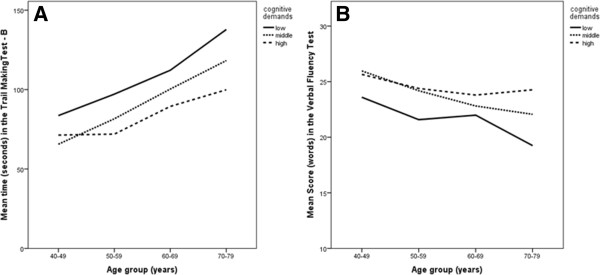
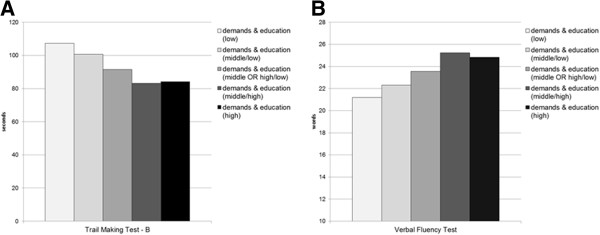
BACKGROUND: The level of mental demands in the workplace is rising. The present study investigated whether and how mental demands at work are associated with cognitive functioning in the general population. METHODS: The analysis is based on data of the Health Study of the Leipzig Research Centre for Civilization Disease (LIFE). 2,725 participants aged 40-80 years underwent cognitive testing (Trail-Making Test, Verbal Fluency Test) and provided information on their occupational situation. Participants over the age of 65 years additionally completed the Mini-Mental State Examination. Mental demands at work were rated by a standardized classification system (O*NET). The association between mental demands and cognitive functioning was analyzed using Generalized Linear Modeling (GENLIN) adjusted for age, gender, self-regulation, working hour status, education, and health-related factors. RESULTS: Univariate as well as multivariate analyses demonstrated significant and highly consistent effects of higher mental demands on better performance in cognitive testing. The results also indicated that the effects are independent of education and intelligence. Moreover, analyses of retired individuals implied a significant association between high mental demands at work of the job they once held and a better cognitive functioning in old age. CONCLUSIONS: In sum, our findings suggest a significant association between high mental demands at work and better cognitive functioning. In this sense, higher levels of mental demands - as brought about by technological changes in the working environment - may also have beneficial effects for the society as they could increase cognitive capacity levels and might even delay cognitive decline in old age.
Overview
The claims and statistics of this paper haven’t been checked yet.
Free: it reads the open-access text and checks the first 5 claims that cite a source we can check. Create a free account to check every claim.
Integrity signals
Registry
Cites
Statistics
Figures
Verification
Claims the paper makes
The claims and statistics of this paper haven’t been checked yet.
Free: it reads the open-access text and checks the first 5 claims that cite a source we can check. Create a free account to check every claim.
Claims other papers make about this one
Each is checked against this paper’s own text: does it say what the citing paper says it does?
The cited source says what the claim attributes to it.
In the citing paper
“Having a mentally stimulating job and engaging in other mentally stimulating activities may also help build cognitive reserve.[154][155][156][157]”
From 2023 Alzheimer's disease facts and figures (2023) · cites this paper as [156]
Self-check
Percentages, sums and reported differences re-computed from the paper’s own numbers.
The self-check needs the paper’s full text.
Citations
Cites
What is cognitive reserve? Theory and research application of the reserve concept
STERN, Y. (2002) · Journal of the International Neuropsychological Society · doi:10.1017/s1355617702813248 · Cited by 3,951
Improving fluid intelligence with training on working memory
Jaeggi, S. M., Buschkuehl, M., Jonides, J., & Perrig, W. J. (2008) · Proceedings of the National Academy of Sciences · doi:10.1073/pnas.0801268105 · Cited by 2,187 · cited 1×
“, [33,34]).”
Lupien, S. J., Maheu, F., Tu, M., Fiocco, A., & Schramek, T. E. (2007) · Brain and Cognition · doi:10.1016/j.bandc.2007.02.007 · Cited by 1,474 · cited 1×
“However, studies have shown that whether high mental demands really impair cognitive performance depends on task difficulty and neuroendocrinological effects [8].”
BackgroundTombaugh, T. (1999) · Archives of Clinical Neuropsychology · doi:10.1016/s0887-6177(97)00095-4 · Cited by 1,439
SÁNCHEZ-CUBILLO, I., PERIÁÑEZ, J. A., ADROVER-ROIG, D., RODRÍGUEZ-SÁNCHEZ, J. M., RÍOS-LAGO, M., TIRAPU, J., & BARCELÓ, F. (2009) · Journal of the International Neuropsychological Society · doi:10.1017/s1355617709090626 · Cited by 1,382
Arbuthnott, K., & Frank, J. (2000) · Journal of Clinical and Experimental Neuropsychology · doi:10.1076/1380-3395(200008)22:4;1-0;ft518 · Cited by 1,087 · cited 1×
“The TMT is a test measuring the cognitive abilities working memory, task-switching ability [23,24] and executive control [25,26].”
MethodBrain reserve and dementia: a systematic review
VALENZUELA, M. J., & SACHDEV, P. (2006) · Psychological Medicine · doi:10.1017/s0033291705006264 · Cited by 932 · cited 1×
“A good cognitive reserve is built up by the confrontation with mentally demanding conditions throughout the life-course, for example, obtaining a higher level of education [38].”
BackgroundVerbal fluency performance in dementia of the Alzheimer’s type: a meta-analysis
Henry, J. D., Crawford, J. R., & Phillips, L. H. (2004) · Neuropsychologia · doi:10.1016/j.neuropsychologia.2004.02.001 · Cited by 847
What cognitive abilities are involved in trail-making performance?
Salthouse, T. A. (2011) · Intelligence · doi:10.1016/j.intell.2011.03.001 · Cited by 512
What is the relationship between mental workload factors and cognitive load types?
Galy, E., Cariou, M., & Mélan, C. (2012) · International Journal of Psychophysiology · doi:10.1016/j.ijpsycho.2011.09.023 · Cited by 395
Cited by
2023 Alzheimer's disease facts and figures
(2023) · Alzheimer's & Dementia · doi:10.1002/alz.13016 · Cited by 3,212
2024 Alzheimer's disease facts and figures
(2024) · Alzheimer's & Dementia · doi:10.1002/alz.13809 · Cited by 2,536
2019 Alzheimer’s disease facts and figures.
Alzheimer's Association (2019) · Alzheimer's & Dementia · doi:10.1016/j.jalz.2019.01.010 · Cited by 2,461
2020 Alzheimer's disease facts and figures
(2020) · Alzheimer's & Dementia · doi:10.1002/alz.12068 · Cited by 2,353
2022 Alzheimer's disease facts and figures
(2022) · Alzheimer's & Dementia · doi:10.1002/alz.12638 · Cited by 2,341
2021 Alzheimer's disease facts and figures
(2021) · Alzheimer's & Dementia · doi:10.1002/alz.12328 · Cited by 2,201
2018 Alzheimer's disease facts and figures
Alzheimer's Association (2018) · Alzheimer's & Dementia · doi:10.1016/j.jalz.2018.02.001 · Cited by 1,912
2017 Alzheimer's disease facts and figures
(2017) · Alzheimer's & Dementia · doi:10.1016/j.jalz.2017.02.001 · Cited by 1,311
Cognitive reserve and cognitive function in healthy older people: a meta-analysis
Opdebeeck, C., Martyr, A., & Clare, L. (2016) · Aging, Neuropsychology, and Cognition · doi:10.1080/13825585.2015.1041450 · Cited by 465
Study of the Prevalence of Burnout in University Professors in the Period 2005–2020
Suárez, I. F., García-González, M., Torrano, F., & González, G. G. (2021) · Education Research International · doi:10.1155/2021/7810659 · Cited by 123
Woods, D. L., Wyma, J. M., Herron, T. J., & Yund, E. W. (2015) · PLoS ONE · doi:10.1371/journal.pone.0124345 · Cited by 92
Woods, D. L., Wyma, J. M., Herron, T. J., & Yund, E. W. (2016) · PLoS ONE · doi:10.1371/journal.pone.0166439 · Cited by 66
Kumral, D., Schaare, H. L., Beyer, F., Reinelt, J., Uhlig, M., Liem, F., Lampe, L., Babayan, A., Reiter, A., Erbey, M., et al. (2019) · NeuroImage · doi:10.1016/j.neuroimage.2018.10.027 · Cited by 64
Self-citationHajek, A., Brettschneider, C., Lühmann, D., Eisele, M., Mamone, S., Wiese, B., Weyerer, S. B., Werle, J., Pentzek, M., Fuchs, Â., et al. (2016) · Journal of the American Geriatrics Society · doi:10.1111/jgs.14458 · Cited by 46
Self-citationHussenoeder, F. S., Riedel-Heller, S. G., Conrad, I., & Rodriguez, F. S. (2019) · American Journal of Health Promotion · doi:10.1177/0890117119861309 · Cited by 39
Self-citationUnemployment and general cognitive ability: A review and meta-analysis
Vélez-Coto, M., Rute-Pérez, S., Pérez-García, M., & Caracuel, A. (2021) · Journal of Economic Psychology · doi:10.1016/j.joep.2021.102430 · Cited by 37
Jung, F. U. C. E., Pabst, A., Rodriguez, F. S., Luppa, M., Engel, C., Kirsten, T., Witte, A. V., Reyes, N., Loeffler, M., Villringer, A., et al. (2023) · Journal of Occupational Medicine and Toxicology · doi:10.1186/s12995-023-00388-0 · Cited by 34
Self-citationLorenzo‐López, L., Millán-Calentí, J. C., López‐López, R., Diego‐Díez, C., Laffón, B., Pásaro, E., Valdiglesias, V., & Maseda, A. (2017) · Frontiers in Psychology · doi:10.3389/fpsyg.2017.00162 · Cited by 32
Taylor, M. A., & Bisson, J. B. (2019) · Human Resource Management Review · doi:10.1016/j.hrmr.2019.02.001 · Cited by 24
Retirement and decline in episodic memory: analysis from a prospective study of adults in England
Starke, K. R., Seidler, A., Hegewald, J., Klimová, A., & Palmer, K. (2019) · International Journal of Epidemiology · doi:10.1093/ije/dyz135 · Cited by 19
Mental Work Demands and Late-Life Cognitive Impairment: Results From the Shanghai Aging Study
Liang, X., Zhao, C., Dong, X., Zhao, Q., Guo, Q., Zheng, L., Deng, W., Luo, J., & Ding, D. (2018) · Journal of Aging and Health · doi:10.1177/0898264318765034 · Cited by 18
Zuelke, A. E., Röhr, S., Schroeter, M. L., Witte, A. V., Hinz, A., Engel, C., Enzenbach, C., Thiery, J., Loeffler, M., Villringer, A., et al. (2020) · Journal of Occupational Medicine and Toxicology · doi:10.1186/s12995-020-0253-x · Cited by 15
Self-citationPrieske, O., Dalager, T., Looks, V., Golle, K., & Granacher, U. (2019) · Journal of Public Health · doi:10.1007/s10389-019-01099-9 · Cited by 13
Ahorsu, D. K., & Tsang, H. W. H. (2018) · Neuropsychiatry · doi:10.4172/neuropsychiatry.1000451 · Cited by 13
Röhr, S., & Riedel-Heller, S. G. (2021) · Psychiatrische Praxis · doi:10.1055/a-1666-8540 · Cited by 12
Self-citationBernardelli, G., Caruso, P., Travaini, G. V., Merzagora, I., Gualdi, F., Sartori, R. D. G., Mari, D., Cesari, M., & Edefonti, V. C. (2020) · BMC Geriatrics · doi:10.1186/s12877-020-01637-1 · Cited by 10
Maciel, R. R. B. T., Chiavegato, L. D., Marín, L. S., Portella, D. D. A., de Souza, M. C., Camelier, F. W. R., & Padula, R. S. (2018) · Evaluation and Program Planning · doi:10.1016/j.evalprogplan.2018.12.009 · Cited by 8
Pereira, G. Á., Maruta, C., & Nunes, M. V. S. (2022) · IntechOpen eBooks · doi:10.5772/intechopen.104646 · Cited by 7
Job Strain and Late-Life Cognition: Findings From the Puerto Rican Elderly Health Conditions Study
Vigoureux, T. F. D., Nelson, M. E., Andel, R., Small, B. J., Dávila-Roman, A., & Crowe, M. G. (2020) · Journal of Aging and Health · doi:10.1177/0898264320977329 · Cited by 6
Wang, D., Li, X., Dang, M., Zhao, S., Sang, F., & Zhang, Z. (2024) · Alzheimer s Research & Therapy · doi:10.1186/s13195-024-01613-6 · Cited by 6
Book-Oriented Environment in Childhood and Current Cognitive Performance among Old-Aged Europeans
Weinstein, G., Cohn‐Schwartz, E., & Damri, N. (2021) · Dementia and Geriatric Cognitive Disorders · doi:10.1159/000518129 · Cited by 5
Action Regulation Across the Lifespan
Hacker, W., Sachse, P., & Seubert, C. T. (2019) · Elsevier eBooks · doi:10.1016/b978-0-12-812756-8.00008-6 · Cited by 4
Exploring the role of cognitive job demands in job demands‐resources theory
Kulikowski, K. (2026) · Journal of Occupational and Organizational Psychology · doi:10.1111/joop.70095 · Cited by 4
Lekha, P. P. S., Azeez, E. P. A., Singh, A., & Irshad, C. V. (2024) · International Archives of Occupational and Environmental Health · doi:10.1007/s00420-024-02089-5 · Cited by 4
Salihu, A. T., Hill, K., Zoghi, M., & Jaberzadeh, S. (2023) · medRxiv · doi:10.1101/2023.11.28.23299165 · Cited by 4
Fernández Suárez, I. (2017) · LA Referencia (Red Federada de Repositorios Institucionales de Publicaciones Científicas) · Cited by 4
Lifetime Occupation and Late-Life Cognitive Performance Among Women
Ribeiro, P. C. C., & Lourenço, R. A. (2015) · Health Care For Women International · doi:10.1080/07399332.2015.1083027 · Cited by 3
Effects of Work Demand and Changes in Leisure Activity on Postretirement Memory
Zulka, L. E., Thorvaldsson, V., Hansson, I., & Hassing, L. B. (2021) · GeroPsych · doi:10.1024/1662-9647/a000270 · Cited by 3
Women at Greater Risk of Alzheimer’s: Way Forward
Ibeachu, C. P. (2023) · Sustainable development goals series · doi:10.1007/978-3-031-34963-8_4 · Cited by 3
Köksal, K., & KÜRÜ, S. A. (2025) · Current Psychology · doi:10.1007/s12144-025-07767-2 · Cited by 3
Digital neuropsychological test performance in a large sample of uninjured collegiate athletes
Saalfield, J., Piersol, K. L., Esopenko, C., Bates, M. E., Weismiller, S. A., Brostrand, K., Todaro, S. M., Conway, F. N., Wilde, E. A., & Buckman, J. F. (2021) · Applied Neuropsychology Adult · doi:10.1080/23279095.2021.2003365 · Cited by 3
The Relationship between Clinic Visit Accompanied by Family and Dementia Severity in Taiwan
Chang, C.-Y., Lan, S., Chu, C., & Ho, C. (2021) · International Journal of Environmental Research and Public Health · doi:10.3390/ijerph18041792 · Cited by 3
Alves, J., Lima, T. M., & Gaspar, P. D. (2026) · Technology in Society · doi:10.1016/j.techsoc.2026.103265 · Cited by 3
Castro, J. E. C., Gutierrez, M., Andrasfay, T., Aguila, E., & Downer, B. G. (2024) · SSM - Population Health · doi:10.1016/j.ssmph.2024.101738 · Cited by 3
Cheng, K., Cheng, V. C., & Ch, Z. (2018) · Frontiers in Drug Chemistry and Clinical Research · doi:10.15761/fdccr.1000107 · Cited by 1
Job sector and occupational complexity influence on late-life cognitive function among men
Aguila, E., & Mejía-Arango, S. (2025) · The Gerontologist · doi:10.1093/geront/gnaf195 · Cited by 1
The Relationships Between Yoga Practice and Cognitive Reserve: A Study on an Italian Sample
Colombo, B., Repetti, V., & Chiappetta, D. (2025) · Cognitie, Creier, Comportament · doi:10.24193/cbb.2025.29.3 · Cited by 1
Hacker, W., & Pohlandt, A. (2024) · Zeitschrift für Arbeitswissenschaft · doi:10.1007/s41449-024-00442-5 · Cited by 1
Web-based Real-time Neuropsychological Assessment in Dyslexia
Kertzman, S., Gyarmathy, É., Vainder, M., Vojtová, V., & Mikulášek, L. (2017) · Repository of the Academy's Library (Library of the Hungarian Academy of Sciences) · Cited by 1
Endocannabinoid system alterations in Alzheimer's disease: A mini-review
D’Agostino, L., Ciamarra, C., Gentile, A., & Marini, S. (2024) · World Journal of Advanced Research and Reviews · doi:10.30574/wjarr.2024.22.3.1814 · Cited by 1
Kindo, B. P., Restar, A., & Tran, A. (2025) · arXiv (Cornell University) · doi:10.48550/arxiv.2503.16560 · Cited by 1
The impact of the job demands and job resources model on the psychological well-being of employees
Alcan, G. (2022) · Çanakkale Onsekiz Mart University Institutional Repository · Cited by 1
Tárnok, A. (2014) · Cytometry Part A · doi:10.1002/cyto.a.22506 · Cited by 1
Développement de formes vectorisables innovantes dans le cadre de maladies liées à l'âge
Iskandar, S. (2019) · theses.fr (ABES) · doi:10.70675/1d771122z75d0z4ba8z8ee6zbd1a858ffc38
Keski-ikäisten sairaanhoitajien työkuormituksen yhteys vanhuuden toimintakykyyn
Kempas, M. (2015) · Jyväskylä University Digital Archive (University of Jyväskylä)
Neuropsychologische Prädiktoren für den Erfolg beruflicher Wiedereingliederung
Watzke, S., & Brieger, P. (2019) · Nervenheilkunde · doi:10.1055/a-0888-4926
Variables moduladoras de la cognición ante la ausencia de empleo
Vélez-Coto, M. (2020) · LA Referencia (Red Federada de Repositorios Institucionales de Publicaciones Científicas)
Kognitivni in psihofiziološki vidiki izgorelosti
Horvat, M. (2024) · University of Maribor digital library (University of Maribor)
Sleep and health in ageing men
Luojus, M. K. (2017) · UEF eRepo (University of Eastern Finland)
Occupational complexity and cognition in midlife and older adulthood: Population and twin analyses
Sui, J. S. Y., Koffer, R. E., Li, J., Finkel, D., & Andel, R. (2026) · Alzheimer s & Dementia · doi:10.1002/alz.72007
Metadata
- Authors
- Then, F. S., Luck, T., Luppa, M., Arélin, K., Schroeter, M. L., Engel, C., Löffler, M., Thiery, J., Villringer, A., & Riedel-Heller, S. G.
- Affiliations
- Leipzig University (DE)
- University Hospital Leipzig (DE)
- Corresponding author
- Then, Francisca S
- ORCID
- Venue
- Journal of Occupational Medicine and Toxicology
- Published
- 2014
- Volume
- 9
- Issue
- 1
- Pages
- 23
- ISSN
- 1745-6673 (ISSN-L)
- PMC
- PMC4049483
- OpenAlex
- W2162934084
- Cited by
- 48
- References
- 46
- Citations by year
- 2026: 1 · 2025: 3 · 2024: 5 · 2023: 4 · 2022: 2 · 2021: 8 · 2020: 4 · 2019: 8 · 2018: 5 · 2017: 2 · 2016: 2 · 2015: 3 · 2014: 1
- FWCI
- 4.83
- Type
- journal article
- Language
- en
- Open access
- gold
- doi.org
- Licence
- cc-by
- Locations
- Journal of Occupational Medicine and Toxicology (publishedVersion, cc-by)
- PubMed Central (publishedVersion, cc-by)
- PubMed (publishedVersion)
- MPG.PuRe (Max Planck Society) (submittedVersion, other-oa)
- Max Planck Digital Library (submittedVersion, other-oa)
- Funders
- European Commission
- Universität Leipzig
- Freistaat Sachsen
- European Regional Development Fund
- European Social Fund
- Topics
- Health Sciences › Medicine › Public Health, Environmental and Occupational Health › Workplace Health and Well-being
- Social Sciences › Psychology › Experimental and Cognitive Psychology › Cognitive Abilities and Testing
- Social Sciences › Demography › Retirement, Disability, and Employment
- Keywords
- cognitive function, cognitive aging, age-related cognitive decline, retirees, technological change in work, general population
About these checks
Registry, retraction, Cites and statistics results are computed, not judged, with one exception: a printed reference that no index lists is read once by a model before it counts as a citation error. Claims are extracted by a model and kept only when their quote appears verbatim in the text; each cited source is then checked, with a model’s help, for whether it says what the claim relies on. Those verdicts can be wrong — read the claim’s quote and the cited source before relying on one.
Statistics and arithmetic are recomputed, not judged.
Confidence bands are shown only for fields calibrated on our annotated test set. None is calibrated yet, so no band is shown.
What counts as a claim ›How we measure confidence ›How we check this ›
Are you an author, or do you see a problem with this page? Request a review
Data sources
Bibliographic data: Semantic Scholar, OpenAlex, Crossref.
Contains information from the Semantic Scholar Academic Graph Datasets, made available under the ODC Attribution License (ODC-BY 1.0).
Semantic Scholar’s data is described in: Kinney, R., et al. (2023). The Semantic Scholar Open Data Platform. arXiv:2301.10140.
