

A conceptual framework for implementation fidelity
Open accessThe DOI matches its Crossref record; 40 of the 41 references it cites were found in a registry or an index; 3 of the 55 sources its claims cite were checked for support.
Abstract
Implementation fidelity refers to the degree to which an intervention or programme is delivered as intended. Only by understanding and measuring whether an intervention has been implemented with fidelity can researchers and practitioners gain a better understanding of how and why an intervention works, and the extent to which outcomes can be improved. The authors undertook a critical review of existing conceptualisations of implementation fidelity and developed a new conceptual framework for understanding and measuring the process. The resulting theoretical framework requires testing by empirical research. Implementation fidelity is an important source of variation affecting the credibility and utility of research. The conceptual framework presented here offers a means for measuring this variable and understanding its place in the process of intervention implementation.
Overview
CoChat Summary
## TL;DR
The paper proposes a new conceptual framework for implementation fidelity, arguing that fidelity is not just adherence but is also shaped by intervention complexity, facilitation strategies, quality of delivery, and participant responsiveness. It is based on a critical review of the literature, and the authors call for empirical testing of the framework.
## Key findings
- Implementation fidelity is defined as the degree to which an intervention or programme is delivered as intended, and the paper argues it is an important source of variation affecting the credibility and utility of research.
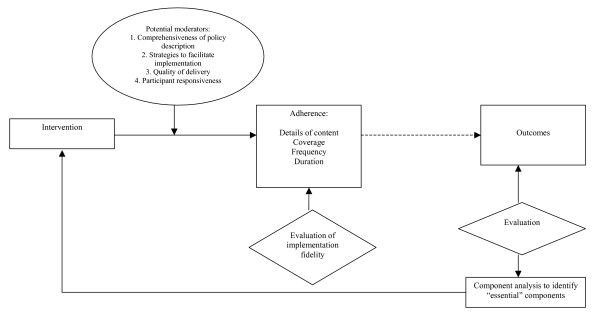
- The framework identifies adherence as the bottom-line measure of fidelity, with subcategories of content, frequency, duration, and coverage (dose).
- The authors argue that fidelity may be moderated by four factors: intervention complexity, facilitation strategies, quality of delivery, and participant responsiveness.
- The paper notes that most implementation-fidelity studies focus only on adherence, while few measure quality of delivery or participant responsiveness; it also says such research rarely reports high implementation fidelity and often falls short of the ideal.
## Methods
- The paper reports a critical review of existing conceptualisations of implementation fidelity and relevant empirical studies, reviews, and theoretical pieces.
- The literature search used the databases Applied Social Sciences Index and Abstracts, CINAHL, International Bibliography of the Social Sciences, MEDLINE, and the Social Science Citation Index, plus scanned references and conference abstracts/presentations.
- The review focused principally on research published from 2002 to 2007.
## Limitations
- The authors explicitly state that the framework is theoretical and requires testing by empirical research.
- They also state that no study has yet measured the moderating effect of facilitation strategies on implementation fidelity, and that the role of quality of delivery as a moderator has not been explored in the literature to date.
- Evident from the text: the paper is a critical review rather than a primary empirical study, so it does not provide new data testing the framework.
Model-written summary. Check it against the paper before relying on it.
Integrity signals
Registry
Cites
Statistics
Figures
Verification
Claims the paper makes
3 Valid · 2 Not valid · 19 Not checked · 32 Own results and interpretations
Every source the paper cites for this claim was checked and supports it.
In the paper
“a study of guidelines intended for General Practitioners (GPs) found that detailed and clear recommendations were almost twice as likely to be followed as vague and non-specific recommendations [23].”
§ A conceptual framework for implementation fidelity > Background > A conceptual framework: elements and relationships
What the sources say
- Supportedcites [23] Grol R Dalhuijsen J Thomas S Veld C Rutten G Mokkink H Attributes of clinical guidelines that influence use of guidelines in general practice: observational study Brit Med J 1998 317 858 861 9748183 PMC31096 source
Table 1 reports that general practitioners followed vague, non-specific recommendations in 36% of decisions, versus 67% for recommendations that were not vague or non-specific—about 1.9 times as often. It also reports 67% compliance for recommendations described concretely and precisely, supporting the claim's characterization as detailed and clear. Page numbers were not available in our copy. (LLM, conf=0.94)
plainstates an association- Asserted: passes — The authors put it forward as true.
- Checkable: passes — It can be checked against evidence.
- Load-bearing: passes — The paper’s conclusions depend on it.
- Based: passes — The paper gives a reason why it holds.
- Supported
None of the sources cited for this claim have been checked yet.
In the paper
“It has been demonstrated that the fidelity with which an intervention is implemented affects how well it succeeds [1-5].”
§ A conceptual framework for implementation fidelity > Background
What the sources say
- Not checked — no full text of the sourcecites [1] Dusenbury L Brannigan R Falco M Hansen W A review of research on fidelity of implementation: Implications for drug abuse prevention in school settings Health Educ Res 2003 18 237 256 12729182 10.1093/her/18.2.237 source
- Not checked — no full text of the sourcecites [2] Dane A Schneider B Program integrity in primary and early secondary prevention: Are implementation effects out of control Clin Psychol Rev 1998 18 23 45 9455622 10.1016/S0272-7358(97)00043-3 source
- Not checked — no full text of the sourcecites [3] Elliot D Mihalic S Issues in disseminating and replicating effective prevention programs Prev Sci 2004 5 47 53 15058912 10.1023/B:PREV.0000013981.28071.52 source
- Not matchedcites [4] Mihalic S The importance of implementation fidelity Emotional & Behavioral Disorders in Youth 2004 4 83 86 and 99–105.
Its entry has no title and year that we can search by.
- Not checked yetcites [5] Mihalic S The importance of implementation fidelity Blueprints Violence Prevention Initiative 2002 Boulder, Colorado
states a cause- Asserted: passes — The authors put it forward as true.
- Checkable: passes — It can be checked against evidence.
- Load-bearing: passes — The paper’s conclusions depend on it.
- Based: passes — The paper gives a reason why it holds.
None of the sources cited for this claim have been checked yet.
In the paper
“Implementation fidelity acts as a potential moderator of the relationship between interventions and their intended outcomes.”
§ A conceptual framework for implementation fidelity > Background
What the sources say
- Not checked — no full text of the sourcecites [1] Dusenbury L Brannigan R Falco M Hansen W A review of research on fidelity of implementation: Implications for drug abuse prevention in school settings Health Educ Res 2003 18 237 256 12729182 10.1093/her/18.2.237 source
- Not checked — no full text of the sourcecites [2] Dane A Schneider B Program integrity in primary and early secondary prevention: Are implementation effects out of control Clin Psychol Rev 1998 18 23 45 9455622 10.1016/S0272-7358(97)00043-3 source
- Not checked — no full text of the sourcecites [3] Elliot D Mihalic S Issues in disseminating and replicating effective prevention programs Prev Sci 2004 5 47 53 15058912 10.1023/B:PREV.0000013981.28071.52 source
- Not matchedcites [4] Mihalic S The importance of implementation fidelity Emotional & Behavioral Disorders in Youth 2004 4 83 86 and 99–105.
Its entry has no title and year that we can search by.
- Not checked yetcites [5] Mihalic S The importance of implementation fidelity Blueprints Violence Prevention Initiative 2002 Boulder, Colorado
hedgedstates a possible cause- Asserted: passes — The authors put it forward as true.
- Checkable: passes — It can be checked against evidence.
- Load-bearing: passes — The paper’s conclusions depend on it.
- Based: passes — The paper gives a reason why it holds.
In the paper
“Unless such an evaluation is made, it cannot be determined whether a lack of impact is due to poor implementation or inadequacies inherent in the programme itself, a so-called Type III error [11]”
§ A conceptual framework for implementation fidelity > Background
What the sources say
- Not checked — no full text of the sourcecites [11] Dobson L Cook T Avoiding Type III error in program evaluation: results from a field experiment Evaluation and Program Planning 1980 3 269 276 10.1016/0149-7189(80)90042-7 source
plainstates a cause- Asserted: passes — The authors put it forward as true.
- Checkable: passes — It can be checked against evidence.
- Load-bearing: passes — The paper’s conclusions depend on it.
- Based: passes — The paper gives a reason why it holds.
None of the sources cited for this claim have been checked yet.
In the paper
“two studies examining programmes to help people with mental health issues obtain employment found that employment outcomes among their study groups were weakest for those in poorly implemented programmes [6,7].”
§ A conceptual framework for implementation fidelity > Background
What the sources say
- Not checked — no full text of the sourcecites [6] McGrew J Griss M Concurrent and predictive validity of two scales to assess the fidelity of implementation of supported employment Psychiatr Rehab J 2005 29 41 47 10.2975/29.2005.41.47 16075696 source
- Not checked yetcites [7] Resnick B Neale M Rosenheck R Impact of public support payments, intensive psychiatric community care, and program fidelity on employment outcomes for people with severe mental illness J Nerv Ment Dis 2003 191 139 144 12637839 10.1097/00005053-200303000-00001 source
plainstates an association- Asserted: passes — The authors put it forward as true.
- Checkable: passes — It can be checked against evidence.
- Load-bearing: passes — The paper’s conclusions depend on it.
- Based: passes — The paper gives a reason why it holds.
22 more claims
Create a free account to see all 56 claims and to verify the 10 references still open.
- Probably not a substantial claim. 21
- It may state two separate claims as one. 8
Claims other papers make about this one
Each is checked against this paper’s own text: does it say what the citing paper says it does?
The source backs part of the claim, not all of it — or backs it for a different population, condition or comparison.
In the citing paper
“They are key indicators of whether a program is appropriate/acceptable for the intended audience and context, whether there are enough resources to support delivery, and whether it is being used (Carroll et al., 2007).”
From Intervention Programs Targeting the Mental Health, Professional Burnout, and/or Wellbeing of School Teachers: Systematic Review and Meta-Analyses (2023) · cites this paper as Carroll et al., 2007
Experimental — accuracy not yet measuredThe source backs part of the claim, not all of it — or backs it for a different population, condition or comparison.
In the citing paper
“They acknowledged that adaptations are likely to occur in real-world implementation, but the question on how to address this issue while measuring fidelity remained unanswered.”
From A modified theoretical framework to assess implementation fidelity of adaptive public health interventions (2015) · cites this paper as [15]
Experimental — accuracy not yet measuredThe cited source says what the claim attributes to it.
In the citing paper
“Fidelity and adherence are important in the translation of research to practice when implementing programs in the real-world.”
From Intervention Programs Targeting the Mental Health, Professional Burnout, and/or Wellbeing of School Teachers: Systematic Review and Meta-Analyses (2023) · cites this paper as Carroll et al., 2007
The cited source says what the claim attributes to it.
In the citing paper
“Evidence from a review of eHealth innovations [12] indicates that centralised diffusion systems such as those considered here were more effective in disseminating authoritative evidence and preserving the ‘fidelity’ [20] of interventions, but less successful in terms of adopter engagement, partly because of strict limits on the extent to which implementation could be modified to address the”
From Beyond pilotitis: taking digital health interventions to the national level in China and Uganda (2017) · cites this paper as [20]
The cited source says what the claim attributes to it.
In the citing paper
“The modified Carroll et al.’s framework we propose may permit a comprehensive assessment of the implementation fidelity-adaptation balance required when implementing adaptive interventions, but more empirical research is needed to validate it.”
From A modified theoretical framework to assess implementation fidelity of adaptive public health interventions (2015) · cites this paper as [15]
5 more claims about this paper
Create a free account to see every claim other papers make about this one.
Citations
Cites
Bellg, A. J., Treatment Fidelity Workgroup of the NIH Behavior Change Consortium, Borrelli, B., Resnick, B., Hecht, J., Minicucci, D. S., Ory, M., Ogedegbe, G., Orwig, D., Ernst, D., et al. (2004) · Health Psychology · doi:10.1037/0278-6133.23.5.443 · Cited by 2,620
Dusenbury, L. (2003) · Health Education Research · doi:10.1093/her/18.2.237 · Cited by 1,671
Dane, A. V., & Schneider, B. H. (1998) · Clinical Psychology Review · doi:10.1016/s0272-7358(97)00043-3 · Cited by 1,557
Reeves, M. (1993) · Cited by 903
Grol, R., Dalhuijsen, J., Thomas, S., Veld, C. I. ‘., Rutten, G., & Mokkink, H. (1998) · BMJ · doi:10.1136/bmj.317.7162.858 · Cited by 877 · cited 1×
“For example, a study of guidelines intended for General Practitioners (GPs) found that detailed and clear recommendations were almost twice as likely to be followed as vague and non-specific recommendations [23].”
Issues in Disseminating and Replicating Effective Prevention Programs
Elliott, D. S., & Mihalic, S. (2004) · Prevention Science · doi:10.1023/b:prev.0000013981.28071.52 · Cited by 794 · cited 6×
“Such strategies included the provision of manuals, guidelines, training, monitoring and feedback, capacity building, and incentives [ 3 ,6,8,17].”
InfluentialProcess evaluation on quality improvement interventions
Hulscher, M. E. J. L. (2003) · Quality and Safety in Health Care · doi:10.1136/qhc.12.1.40 · Cited by 348
Drug therapy in the elderly: what doctors believe and patients actually do
Barat, I., Andreasen, F., & Damsgaard, E. M. S. (2001) · British Journal of Clinical Pharmacology · doi:10.1046/j.0306-5251.2001.01401.x · Cited by 334 · cited 3×
“For example, it has been found that implementation fidelity of prescribed drug interventions for elderly people in the community can be low because these patients deliberately fail to comply with their prescribed regimens [ 31-33 ].”
InfluentialForgatch, M. S., Patterson, G. R., & DeGarmo, D. S. (2005) · Behavior Therapy · doi:10.1016/s0005-7894(05)80049-8 · Cited by 320
The fidelity‐adaptation debate: Implications for the implementation of public sector social programs
Blakely, C. H., Mayer, J. P., Gottschalk, R. G., Schmitt, N., Davidson, W. S., Roitman, D. B., & Emshoff, J. G. (1987) · American Journal of Community Psychology · doi:10.1007/bf00922697 · Cited by 297 · cited 2×
“Indeed, the proadaptation perspective implies that successful interventions are those that adapt to local needs [22].”
Research works printed but not linked: 3
- Medical Research Council A framework for the development and evaluation of RCTs for complex interventions to improve health 2000 London: Medical Research Council
- Rogers EM Diffusion of Innovation 2003 Fifth New York, NY: Free Press
- Herzog S Wright P Addressing the fidelity of personal and social responsibility model implementation Res Q Exerc Sport 2005 A 76
Cited by
Items 801–900 of 2,543
Cook, C. E., & Garcia, A. N. (2020) · Journal of Manual & Manipulative Therapy · doi:10.1080/10669817.2020.1739153 · Cited by 13
The inner workings of Registered ReportsPreprint
Dienes, Z. P. (2020) · doi:10.31234/osf.io/yhp2a · Cited by 14
McCullagh, M. C., Cohen, M. A., Koval, M., et al. (2019) · Translational Behavioral Medicine · doi:10.1093/tbm/ibz037 · Cited by 13
Implementation Science: A Path Toward Strengthening School Counselor Practice
Warren, J. M., & Mauk, G. W. (2019) · Professional School Counseling · doi:10.1177/2156759x19878120 · Cited by 15
Hayes, C. B., Ciblis, A. S., Darker, C. D., Dougall, N. J., Vance, J., O’Connell, N., Dobbie, F., Loudon, K., Burke, E., Devane, D., et al. (2019) · Pilot and Feasibility Studies · doi:10.1186/s40814-019-0511-9 · Cited by 15
Low, L. L., Rahim, I. A., Hamzah, N. A. R., & Ismail, M. S. (2021) · PLoS ONE · doi:10.1371/journal.pone.0245125 · Cited by 17
Szpunar, M., Johnson, A. M., Driediger, M. V., Burke, S. M., Irwin, J. D., Shelley, J., Timmons, B. W., Vanderloo, L. M., & Tucker, P. (2021) · Health Education & Behavior · doi:10.1177/1090198121996285 · Cited by 13
Can working collaboratively with police on community service promote positive youth development?
Fine, A., Padilla, K. E. L., & Tapp, J. (2021) · Police Practice and Research · doi:10.1080/15614263.2021.1959331 · Cited by 14
İlkokul ve Ortaokul Öğretmenlerinin Öğretim Programlarına Bağlılıkları
KARAKUYU, A., & Oğuz, A. (2021) · İnönü Üniversitesi Eğitim Bilimleri Enstitüsü Dergisi · doi:10.29129/inujgse.915003 · Cited by 22
Velen, K., Nguyen, V. N., Nguyen, H. B., et al. (2022) · BMJ Open · doi:10.1136/bmjopen-2021-052633 · Cited by 13
Activating Relatives to Get Involved in Care After Surgery: Protocol for a Prospective Cohort Study
Musters, S. C. W., Kreca, S., van Dieren, S., van der Wal‐Huisman, H., Romijn, J. A., Chaboyer, W. P., van Dijkum, E. J. M. N., & Eskes, A. M. (2023) · JMIR Research Protocols · doi:10.2196/38028 · Cited by 14
Akiba, C. F., Go, V. F.-L., Powell, B. J., Muessig, K. E., Golin, C. E., Dussault, J. M., Zimba, C. C., Matewere, M., Mbota, M., Thom, A., et al. (2023) · SSM - Mental Health · doi:10.1016/j.ssmmh.2023.100194 · Cited by 16
Mazza, D., Shankar, M., Botfield, J. R., Moulton, J. E., Chakraborty, S. P., Black, K. I., Tomnay, J. E., Bateson, D. J., Church, J., Laba, T., et al. (2023) · BMJ Open · doi:10.1136/bmjopen-2022-065137 · Cited by 13
Morita‐Mullaney, T., Gao, F., & Zhang, R. (2023) · TESOL Journal · doi:10.1002/tesj.718 · Cited by 13
Beames, J. R., Werner‐Seidler, A., Hodgins, M., Brown, L., Fujimoto, H., Bartholomew, A., Maston, K., Huckvale, K., Zbukvic, I., Torok, M. H., et al. (2023) · JMIR Pediatrics and Parenting · doi:10.2196/42349 · Cited by 15
Fidelity and Its Relationship to Effectiveness, Adaptation, and Implementation
Shelton, R. C., Adsul, P., Emmons, K. M., Linnan, L. A., & Allen, J. D. (2023) · Oxford University Press eBooks · doi:10.1093/oso/9780197660690.003.0007 · Cited by 16
Pingray, V., Williams, C. R., Al‐beity, F. M. A., Abalos, E. J., Arulkumaran, S., Blumenfeld, A., Carvalho, B., Carvalho, B., Deneux-Tharaux, C., Downe, S. M., et al. (2024) · BMJ Open · doi:10.1136/bmjopen-2023-079713 · Cited by 18
Good practice in school based alcohol education programmes
Thom, B. (2015) · Patient Education and Counseling · doi:10.1016/j.pec.2015.11.020 · Cited by 17
Pitpitan, E. V., Chavarin, C. V., Semple, S. J., Mendoza, D. V., Magis-Rodríguez, C. L., Staines, H., Aarons, G. A., & Patterson, T. L. (2016) · Annals of Behavioral Medicine · doi:10.1007/s12160-016-9861-1 · Cited by 12
Dubrowski, R., Barwick, M. A., & Dubrowski, A. (2018) · Springer eBooks · doi:10.1007/978-3-319-90518-1_10 · Cited by 17
Gómez-Angelats, E., & Sánchez, C. (2018) · Medical Science · doi:10.3390/medsci6030063 · Cited by 14
A scaling-up strategy supporting the expansion of integrated care: a study protocol
Grooten, L., Alexandru, C.-A., Alhambra‐Borrás, T., Anderson, S., Avolio, F., Valía-Cotanda, E., Gütter, Z., Henderson, D., Kassberg, A.-C., de Manuel, E., et al. (2018) · Journal of Integrated Care · doi:10.1108/jica-04-2018-0029 · Cited by 13
Wisenthal, A., Krupa, T. M., Kirsh, B. H., & Lysaght, R. M. (2019) · Work · doi:10.3233/wor-192893 · Cited by 21
Maintaining Intervention Fidelity When Using Technology Delivery Across Studies
Bonar, J. R. M., Wright, S. D., Yadrich, D. M., Werkowitch, M., Ridder, L., Spaulding, R. J., & Smith, C. E. (2020) · CIN Computers Informatics Nursing · doi:10.1097/cin.0000000000000625 · Cited by 14
Grant, S. J., Beauchamp, M. R., Blanchard, C. M., Carson, V., Gardner, B., Warburton, D. E. R., & Rhodes, R. E. (2020) · BMC Public Health · doi:10.1186/s12889-020-09465-z · Cited by 17
Luecking, C. T., Vaughn, A., Burney, R. V., Hennink-Kaminski, H. J., Hales, D. P., & Ward, D. S. (2021) · Translational Behavioral Medicine · doi:10.1093/tbm/ibab001 · Cited by 13
Dekker, I., Schippers, M. C., & van Schooten, E. (2021) · Journal of Research on Educational Effectiveness · doi:10.1080/19345747.2023.2231440 · Cited by 31
Developing a Tool to Measure Person-Centered Care in Service Planning
Stanhope, V., Baslock, D. M., Tondora, J., Jessell, L., Ross, A. M., & Marcus, S. C. (2021) · Frontiers in Psychiatry · doi:10.3389/fpsyt.2021.681597 · Cited by 14
Guidebook on Best Practices in Public Health
OECD (2022) · OECD eBooks · doi:10.1787/4f4913dd-en · Cited by 34
Deftereos, I., Hitch, D., Butzkueven, S., Carter, V. M., Arslan, J., Fetterplace, K., Fox, K., Ottaway, A., Pierce, K., Steer, B., et al. (2022) · Journal of Human Nutrition and Dietetics · doi:10.1111/jhn.13018 · Cited by 15
Hawkes, R. E., Miles, L. M., & French, D. (2023) · Preventive Medicine Reports · doi:10.1016/j.pmedr.2023.102112 · Cited by 13
Effective Practices for Evaluating STEM Out-of-School Time Programs.
Wilkerson, S. B., & Haden, C. (2014) · Afterschool Matters · Cited by 30
McMahon, S. A., Brenner, S., Lohmann, J., Makwero, C., Torbica, A., Mathanga, D. P., Muula, A. S., & Allegri, M. D. (2016) · BMC Health Services Research · doi:10.1186/s12913-016-1612-2 · Cited by 13
See, B. H., Gorard, S. A. C., & Siddiqui, N. (2017) · British Educational Research Journal · doi:10.1002/berj.3278 · Cited by 18
Both Promising and Problematic: Reviewing the Evidence for Implementation Science
Chiodo, D., & Kolpin, H. (2018) · Plenum series on human exceptionality · doi:10.1007/978-3-319-89842-1_2 · Cited by 22
Developing and Implementing a Standardized Ictal Examination in the Epilepsy Monitoring Unit
O’Kula, S. S., Faillace, L., Kulick‐Soper, C. V., et al. (2020) · Neurology Clinical Practice · doi:10.1212/cpj.0000000000000815 · Cited by 13
Goldthorpe, J., Epton, T., Keyworth, C., Calam, R. M., Brooks, J. M., & Armitage, C. J. (2020) · BMJ Open · doi:10.1136/bmjopen-2020-038625 · Cited by 15
Changing hygiene behaviours: a cluster-randomized trial, Ethiopia
Aragie, S., Tadesse, W., Dagnew, A., Hailu, D., Dubie, M., Wittberg, D. M., Melo, J. S., Haile, M., Zeru, T., Freeman, M. C., et al. (2021) · Bulletin of the World Health Organization · doi:10.2471/blt.21.285915 · Cited by 15
Hirko, K. A., Dorn, J. M., Dearing, J. W., Alfano, C. M., Wigton, A., & Schmitz, K. H. (2021) · International Journal of Environmental Research and Public Health · doi:10.3390/ijerph182412909 · Cited by 15
Aifah, A. A., Hade, E. M., Colvin, C., Henry, D., Mishra, S., Rakhra, A., Onakomaiya, D., Ekanem, A., Shedul, G., Bansal, G. P., et al. (2023) · Implementation Science · doi:10.1186/s13012-023-01272-5 · Cited by 11
Outcomes Following Close Collaboration With Parents Intervention in Neonatal Intensive Care Units
Itoshima, R., Varendi, H., Toome, L., Saik, P., Axelin, A., Lehtonen, L., Moazami-Goodarzi, A., & Ahlqvist‐Björkroth, S. (2025) · JAMA Network Open · doi:10.1001/jamanetworkopen.2024.54099 · Cited by 12
Pérez, M. C., Minoyan, N., Ridde, V., Sylvestre, M., & Johri, M. (2016) · Systematic Reviews · doi:10.1186/s13643-016-0351-0 · Cited by 16
Rolls-Reutz, J., Kerns, S. E. U., Sedivy, J. A., & Mitchell, C. (2020) · Journal of Family Social Work · doi:10.1080/10522158.2019.1694342 · Cited by 16
Newbury, D. F., Mesa, C., Puglisi, M. L., Nash, M., Nag, S., Hulme, C., & Snowling, M. J. (2022) · Research Papers in Education · doi:10.1080/02671522.2022.2065526 · Cited by 17
Vennegoor, G., van Assema, P., Eekhout, I. E., Lezwijn, J., Molleman, G. R. M., & Jansen, M. W. J. (2022) · Journal of School Health · doi:10.1111/josh.13277 · Cited by 18
Te, V., Chhim, S., Buffel, V., Damme, W. V., van Olmen, J., Ir, P., & Wouters, E. (2023) · JMIR Public Health and Surveillance · doi:10.2196/41902 · Cited by 16
Zhang, Y., Cook, C. R., & Smith, B. (2023) · School Mental Health · doi:10.1007/s12310-023-09600-2 · Cited by 21
Cardona, M. I., Monsees, J., Schmachtenberg, T., Grünewald, A., & Thyrian, J. R. (2023) · PLoS ONE · doi:10.1371/journal.pone.0289737 · Cited by 12
Davis, A. E., Tidus, K. M., Catherine, E., Perry, D. F., Duran, F., & Rabinovitz, L. (2023) · Early Childhood Research Quarterly · doi:10.1016/j.ecresq.2023.08.005 · Cited by 14
Carboni, C., Maroto, I. J., Galindo, M. S., Plessis, L., Lambert, Y., Bardon, T., Vreden, S., Suárez-Mútis, M. C., Miller, J. B., Douine, M., et al. (2024) · Frontiers in Public Health · doi:10.3389/fpubh.2023.1306432 · Cited by 14
Moon, S., Sarmento, C. V. M., Smirnova, I. V., Colgrove, Y., Lai, S., Lyons, K. E., & Liu, W. (2024) · Journal of Bodywork and Movement Therapies · doi:10.1016/j.jbmt.2024.07.025 · Cited by 12
Clarke, D. J., Powers, K., Trusson, D., Craven, K., Phillips, J. S., Holmes, J. A., McKevitt, C., Bowen, A., Watkins, C. L., Farrin, A. J., et al. (2024) · PLoS ONE · doi:10.1371/journal.pone.0311101 · Cited by 17
Assessing fidelity of treatment delivery in group and individual 12-step facilitation
CAMPBELL, B. K., Manuel, J. K., Manser, S. T., Peavy, K. M., Stelmokas, J., McCarty, D. W., & Guydish, J. R. (2012) · Journal of Substance Abuse Treatment · doi:10.1016/j.jsat.2012.07.003 · Cited by 14
Gulayin, P., Irazola, V. E., Lozada, A., Chaparro, M., Santero, M., Gutiérrez, L., Poggio, R., Beratarrechea, A. G., & Rubinstein, A. (2017) · BMJ Open · doi:10.1136/bmjopen-2016-014420 · Cited by 14
Roy, R., Colquhoun, H. L., Byrne, M., Lorencatto, F., Matvienko‐Sikar, K., McCleary, N., Nathan, N., & Toomey, E. C. (2018) · HRB Open Research · doi:10.12688/hrbopenres.12892.1 · Cited by 13
Intervention fidelity in participatory research: a framework
Trickett, E. J., Rasmus, S., & Allen, J. (2019) · Educational Action Research · doi:10.1080/09650792.2019.1689833 · Cited by 19
Obi‐Jeff, C., Rakhshani, N. S., Bello-Malabu, J. I., Nwangwu, C. W., Nwaononiwu, E., Eboreime, E., & Wonodi, C. B. (2020) · Vaccine · doi:10.1016/j.vaccine.2020.04.025 · Cited by 13
Hübner, N., Savage, C., Gräsel, C., et al. (2021) · Journal of Curriculum Studies · doi:10.1080/00220272.2020.1870714 · Cited by 12
van den Boom-Muilenburg, S. N., de Vries, S., van Veen, K., Poortman, C. L., & Schildkamp, K. (2021) · International Journal of Leadership in Education · doi:10.1080/13603124.2021.1937705 · Cited by 21
Mazza, D., Chakraborty, S. P., Camões‐Costa, V., Kenardy, J. A., Brijnath, B., Mortimer, D., Enticott, J., Kidd, M. R., Trevena, L. J., Reid, S. E., et al. (2021) · Implementation Science · doi:10.1186/s13012-021-01146-8 · Cited by 12
Narh-Bana, S., Kawonga, M., Chirwa, E. D., Ibisomi, L., Bonsu, F. A., & Chirwa, T. F. (2021) · PLoS ONE · doi:10.1371/journal.pone.0257486 · Cited by 16
Heer, S. E., Uitvlugt, E. B., Bet, P. M., van den Bemt, B. J. F., Alai, A., van den Bemt, P. M. L. A., Swart, E. L., Karapinar‐Çarkit, F., & Hugtenburg, J. G. (2022) · Journal of Clinical Pharmacy and Therapeutics · doi:10.1111/jcpt.13645 · Cited by 13
Ruble, L. A., Ogle, L. N., & McGrew, J. H. (2022) · Psychology in the Schools · doi:10.1002/pits.22800 · Cited by 13
Wen, Y., Xing, Y., Ding, Y., Xu, W., & Wang, X. (2022) · International Journal of Nursing Sciences · doi:10.1016/j.ijnss.2022.12.017 · Cited by 20
O’Brien, K. K., Ibáñez-Carrasco, F., Carusone, S. C., Bayoumi, A. M., Tang, A., McDuff, K., Jiancaro, T., Silva, G. D., Torres, B., Loutfy, M. R., et al. (2023) · BMJ Open · doi:10.1136/bmjopen-2022-067703 · Cited by 11
Greene, M. C., Bonz, A. G., Cristobal, M., Angulo, A., Armijos, A., Guevara, M., Vega, C., Benavides, L., Corrales, C., de la Cruz, A., et al. (2023) · Cambridge Prisms Global Mental Health · doi:10.1017/gmh.2023.37 · Cited by 15
Smith, J. D., Dishion, T. J., Brown, K. L., Ramos, K., Knoble, N. B., Shaw, D. S., & Wilson, M. N. (2015) · Prevention Science · doi:10.1007/s11121-015-0589-0 · Cited by 14
Morello, R., Barker, A. L., Watts, J. J., Bohensky, M. A., Forbes, A. B., & Stoelwinder, J. U. (2016) · Population Health Management · doi:10.1089/pop.2015.0042 · Cited by 17
Violence Prevention in Austrian Schools: Implementation and Evaluation of a National Strategy
Spiel, C., Wagner, P., & Strohmeier, D. (2012) · Phaidra (Universität Wien) · doi:10.4119/unibi/ijcv.254 · Cited by 12
Fidelity of implementation: important considerations for policing scholars
Hassell, K. D., & Lovell, R. D. (2014) · Policing & Society · doi:10.1080/10439463.2014.881811 · Cited by 19
Test of a Process Evaluation Checklist to Improve Neonatal Pain Practices
Yamada, J., Stevens, B., Sidani, S., & Watt‐Watson, J. (2014) · Western Journal of Nursing Research · doi:10.1177/0193945914524493 · Cited by 13
Avery, L., Sniehotta, F. F., Denton, S. J., Steen, N., McColl, E., Taylor, R., & Trenell, M. I. (2014) · Trials · doi:10.1186/1745-6215-15-46 · Cited by 14
Sekhobo, J. P., Peck, S. R., Byun, Y., Allsopp, M. A. K., Holbrook, M. K., Edmunds, L. S., & Yu, C. (2017) · Evaluation and Program Planning · doi:10.1016/j.evalprogplan.2017.03.002 · Cited by 16
Bringing research to the bedside: Knowledge translation in the mental health care of burns patients
Cleary, M. L., Visentin, D. C., West, S., Andrews, S., McLean, L., & Kornhaber, R. A. (2018) · International Journal of Mental Health Nursing · doi:10.1111/inm.12491 · Cited by 15
Baker, K. S., Maurel, A., Ward, C., Getachew, D., Habte, T., McWhorter, C., LaBarre, P., Karlström, J., Petzold, M., & Källander, K. (2019) · JMIR Research Protocols · doi:10.2196/14405 · Cited by 11
Aschbrenner, K. A., Bond, G. R., Pratt, S. I., Jue, K., Williams, G. M., Banerjee, S., & Bartels, S. J. (2020) · Implementation Research and Practice · doi:10.1177/2633489520943200 · Cited by 14
Parkin, S., Neale, J., Brown, C., Jones, J. D., Brandt, L., Castillo, F., Campbell, A. N. C., Strang, J., & Comer, S. D. (2020) · International Journal of Drug Policy · doi:10.1016/j.drugpo.2020.102968 · Cited by 16
Fidelity and influencing factors in the Systemic Practice Model of children's social care in Finland
Isokuortti, N., & Aaltio, E. (2020) · Children and Youth Services Review · doi:10.1016/j.childyouth.2020.105647 · Cited by 29
Fidelity Assessment Checklist Development for Community Nursing Research in Early Childhood
Anis, L., Benzies, K., Ewashen, C., Hart, M. J., & Letourneau, N. L. (2021) · Frontiers in Public Health · doi:10.3389/fpubh.2021.582950 · Cited by 15
Fidelity in workplace mental health intervention research: A narrative review
Fikretoglu, D., Easterbrook, B., & Nazarov, A. (2021) · Work & Stress · doi:10.1080/02678373.2021.1936286 · Cited by 15
Thinking about Health‐Related Outcomes: What Do We Need Evidence about?
Glasgow, R. E., Brownson, R. C., & Kessler, R. S. (2013) · Clinical and Translational Science · doi:10.1111/cts.12080 · Cited by 17
Active ageing and occupational therapy align
Clemson, L. M., & Laver, K. (2014) · Australian Occupational Therapy Journal · doi:10.1111/1440-1630.12125 · Cited by 15
van der Borg, W. E., Schipper, K., & Abma, T. (2016) · BMC Nephrology · doi:10.1186/s12882-016-0277-8 · Cited by 15
García‐Poole, C., Byrne, S., & Rodrigo, M.-J. (2019) · Psychosocial Intervention · doi:10.5093/pi2019a4 · Cited by 15
A loyalty scheme to encourage physical activity in office workers: a cluster RCT
Hunter, R. F., Gough, A., Murray, J., Tang, J., Brennan, S., Chrzanowski‐Smith, O. J., Carlin, A., Patterson, C. C., Longo, A., Hutchinson, G., et al. (2019) · Public Health Research · doi:10.3310/phr07150 · Cited by 13
Gouda, A. D. K., Sorour, M. S., Ayoub, A. S., Aboushady, R. M. N., Awad, M., swerky, F. M. E., Ayed, M. M. A., Elrefay, B. W., Elshnawie, H. A. E., & Elsayed, H. T. M. (2026) · BMC Nursing · doi:10.1186/s12912-025-04238-8 · Cited by 13
Promoting school lunch fruit and vegetable intake through role modeling: a pilot study
Machado, S. S., Burton, M., Loy, W., & Chapman, K. A. (2020) · AIMS Public Health · doi:10.3934/publichealth.2020002 · Cited by 14
Chavez, R. C., & Nam, E. W. (2020) · International Journal of Environmental Research and Public Health · doi:10.3390/ijerph17134804 · Cited by 13
Appetitive Needs and Addiction
Sussman, S. Y., & Pakdaman, S. (2020) · Cambridge University Press eBooks · doi:10.1017/9781108632591.004 · Cited by 12
Developing an implementation fidelity checklist for a vocational rehabilitation intervention
Powers, K., Clarke, S., Phillips, J. S., Holmes, J. A., Cripps, R., Craven, K., Farrin, A. J., das Nair, R., & Radford, K. (2022) · Pilot and Feasibility Studies · doi:10.1186/s40814-022-01194-x · Cited by 17
Experiential Training Workshops for Group Antenatal Care in Malawi
Gresh, A., Abrams, E. T., Chirwa, E. M., Jere, D. L., Chodzaza, E., Chorwe‐Sungani, G., Kafulafula, U. K., Kapito, E. M., Patel, D. R., Jeremiah, R. D., et al. (2022) · Journal of Midwifery & Women s Health · doi:10.1111/jmwh.13436 · Cited by 15
Handling a challenging context: experiences of facilitating evidence‐based elderly care
Nygårdh, A., Ahlström, G., & Kumlien, C. (2015) · Journal of Nursing Management · doi:10.1111/jonm.12300 · Cited by 14
The Role of Participant Responsiveness on a Socio-Emotional Learning Program
Pereira, N., & Pinto, A. M. (2017) · The Spanish Journal of Psychology · doi:10.1017/sjp.2016.104 · Cited by 18
Bryant, M., Dharni, N., Dickerson, J., Willan, K., McEachan, R., Duffy, J., & Howell, M. (2019) · BMC Public Health · doi:10.1186/s12889-019-7149-7 · Cited by 11
A typology of useful evidence: approaches to increase the practical value of intervention research
Hasson, H., Leviton, L. C., & Schwarz, U. V. T. (2020) · BMC Medical Research Methodology · doi:10.1186/s12874-020-00992-2 · Cited by 16
Evaluating process fidelity during the implementation of Group Antenatal Care in Mexico
Fuentes‐Rivera, E., Heredia-Pi, I., Andrade‐Romo, Z., Rabanal, J. E. A., Bravo, L., Jurkiewicz, L., & Darney, B. G. (2020) · BMC Health Services Research · doi:10.1186/s12913-020-05430-z · Cited by 12
Elliott, L., Coulman, K. D., Blencowe, N., Qureshi, M. I., Lee, K. S., Hinchliffe, R. J., & Mouton, R. (2020) · Anaesthesia · doi:10.1111/anae.15294 · Cited by 13
Kervick, C. T., Garnett, B. R., Moore, M., Ballysingh, T. A., & Smith, L. C. (2020) · The School community journal/School community journal · Cited by 29
Urstad, K. H., Wahl, A. K., Moum, T., Engebretsen, E., & Andersen, M. H. (2021) · BMC Nephrology · doi:10.1186/s12882-021-02468-x · Cited by 15
Hogervorst, S., Adriaanse, M. C., Brandt, H. E., Vervloet, M., van Dijk, L., & Hugtenburg, J. G. (2021) · Pilot and Feasibility Studies · doi:10.1186/s40814-021-00892-2 · Cited by 12
Metadata
- Authors
- Carroll, C., Patterson, M., Wood, S., Booth, A., Rick, J., & Balain, S.
- Affiliations
- University of Sheffield (GB)
- Corresponding author
- Carroll, Christopher
- Venue
- Implementation Science
- Published
- 2007-11-30
- Volume
- 2
- Issue
- 1
- Pages
- 40-40
- ISSN
- 1748-5908 (ISSN-L)
- PMC
- PMC2213686
- OpenAlex
- W2167997731
- Cited by
- 2,559
- References
- 41
- Citations by year
- 2026: 224 · 2025: 237 · 2024: 245 · 2023: 232 · 2022: 212 · 2021: 284 · 2020: 249 · 2019: 169 · 2018: 105 · 2017: 121 · 2016: 96 · 2015: 104 · 2014: 100 · 2013: 72 · 2012: 43
- FWCI
- 23.60
- Type
- journal article
- Language
- en
- Open access
- gold
- doi.org
- Licence
- Locations
- Implementation Science (publishedVersion, cc-by)
- PubMed Central (publishedVersion, cc-by)
- PubMed (publishedVersion)
- White Rose Research Online (University of Leeds, The University of Sheffield, University of York) (acceptedVersion)
- DOAJ (DOAJ: Directory of Open Access Journals) (submittedVersion)
- Leicester Research Archive (University of Leicester) (submittedVersion)
- Funders
- Fondazione Italiana per la ricerca sulle Malattie del Pancreas
- Topics
- Health Sciences › Health Professions › General Health Professions › Health Policy Implementation Science
- Social Sciences › Public Administration › Evaluation and Performance Assessment
- Social Sciences › Sociology and Political Science › Delphi Technique in Research
- Keywords
- implementation fidelity, conceptual framework, intervention delivery, fidelity assessment, research credibility, intervention effectiveness, implementation process
About these checks
Registry, retraction, Cites and statistics results are computed, not judged, with one exception: a printed reference that no index lists is read once by a model before it counts as a citation error. Claims are extracted by a model and kept only when their quote appears verbatim in the text; each cited source is then checked, with a model’s help, for whether it says what the claim relies on. Those verdicts can be wrong — read the claim’s quote and the cited source before relying on one.
The claim verdicts this report counts are experimental: their accuracy is not yet measured.
A language model drew the claims from the paper on 2026-10-10, under version 3 of the claim definition (model deepseek-v4.1-flash, prompt extract-v3).
A second model labelled each claim on 2026-10-10 (model jev-1.13-20260917, definition revision gold-guideline-v0.2).
Cited sources are checked with a language model’s help (gpt-6-sol).
Statistics and arithmetic are recomputed, not judged.
Confidence bands are shown only for fields calibrated on our annotated test set. None is calibrated yet, so no band is shown.
What counts as a claim ›How we measure confidence ›How we check this ›
Are you an author, or do you see a problem with this page? Request a review
Data sources
Bibliographic data: Semantic Scholar, OpenAlex, Crossref.
Contains information from the Semantic Scholar Academic Graph Datasets, made available under the ODC Attribution License (ODC-BY 1.0).
Semantic Scholar’s data is described in: Kinney, R., et al. (2023). The Semantic Scholar Open Data Platform. arXiv:2301.10140.
