

A conceptual framework for implementation fidelity
Open accessThe DOI matches its Crossref record; 40 of the 41 references it cites were found in a registry or an index; 3 of the 55 sources its claims cite were checked for support.
Abstract
Implementation fidelity refers to the degree to which an intervention or programme is delivered as intended. Only by understanding and measuring whether an intervention has been implemented with fidelity can researchers and practitioners gain a better understanding of how and why an intervention works, and the extent to which outcomes can be improved. The authors undertook a critical review of existing conceptualisations of implementation fidelity and developed a new conceptual framework for understanding and measuring the process. The resulting theoretical framework requires testing by empirical research. Implementation fidelity is an important source of variation affecting the credibility and utility of research. The conceptual framework presented here offers a means for measuring this variable and understanding its place in the process of intervention implementation.
Overview
CoChat Summary
## TL;DR
The paper proposes a new conceptual framework for implementation fidelity, arguing that fidelity is not just adherence but is also shaped by intervention complexity, facilitation strategies, quality of delivery, and participant responsiveness. It is based on a critical review of the literature, and the authors call for empirical testing of the framework.
## Key findings
- Implementation fidelity is defined as the degree to which an intervention or programme is delivered as intended, and the paper argues it is an important source of variation affecting the credibility and utility of research.
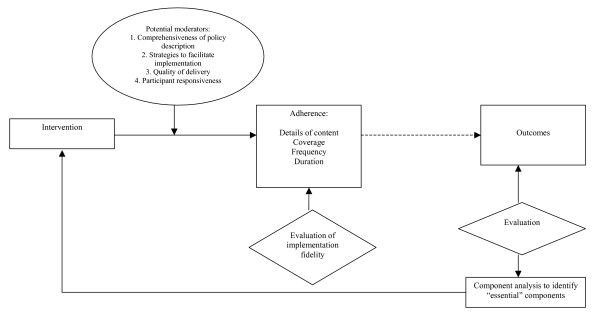
- The framework identifies adherence as the bottom-line measure of fidelity, with subcategories of content, frequency, duration, and coverage (dose).
- The authors argue that fidelity may be moderated by four factors: intervention complexity, facilitation strategies, quality of delivery, and participant responsiveness.
- The paper notes that most implementation-fidelity studies focus only on adherence, while few measure quality of delivery or participant responsiveness; it also says such research rarely reports high implementation fidelity and often falls short of the ideal.
## Methods
- The paper reports a critical review of existing conceptualisations of implementation fidelity and relevant empirical studies, reviews, and theoretical pieces.
- The literature search used the databases Applied Social Sciences Index and Abstracts, CINAHL, International Bibliography of the Social Sciences, MEDLINE, and the Social Science Citation Index, plus scanned references and conference abstracts/presentations.
- The review focused principally on research published from 2002 to 2007.
## Limitations
- The authors explicitly state that the framework is theoretical and requires testing by empirical research.
- They also state that no study has yet measured the moderating effect of facilitation strategies on implementation fidelity, and that the role of quality of delivery as a moderator has not been explored in the literature to date.
- Evident from the text: the paper is a critical review rather than a primary empirical study, so it does not provide new data testing the framework.
Model-written summary. Check it against the paper before relying on it.
Integrity signals
Registry
Cites
Statistics
Figures
Verification
Claims the paper makes
3 Valid · 2 Not valid · 19 Not checked · 32 Own results and interpretations
Every source the paper cites for this claim was checked and supports it.
In the paper
“a study of guidelines intended for General Practitioners (GPs) found that detailed and clear recommendations were almost twice as likely to be followed as vague and non-specific recommendations [23].”
§ A conceptual framework for implementation fidelity > Background > A conceptual framework: elements and relationships
What the sources say
- Supportedcites [23] Grol R Dalhuijsen J Thomas S Veld C Rutten G Mokkink H Attributes of clinical guidelines that influence use of guidelines in general practice: observational study Brit Med J 1998 317 858 861 9748183 PMC31096 source
Table 1 reports that general practitioners followed vague, non-specific recommendations in 36% of decisions, versus 67% for recommendations that were not vague or non-specific—about 1.9 times as often. It also reports 67% compliance for recommendations described concretely and precisely, supporting the claim's characterization as detailed and clear. Page numbers were not available in our copy. (LLM, conf=0.94)
plainstates an association- Asserted: passes — The authors put it forward as true.
- Checkable: passes — It can be checked against evidence.
- Load-bearing: passes — The paper’s conclusions depend on it.
- Based: passes — The paper gives a reason why it holds.
- Supported
None of the sources cited for this claim have been checked yet.
In the paper
“It has been demonstrated that the fidelity with which an intervention is implemented affects how well it succeeds [1-5].”
§ A conceptual framework for implementation fidelity > Background
What the sources say
- Not checked — no full text of the sourcecites [1] Dusenbury L Brannigan R Falco M Hansen W A review of research on fidelity of implementation: Implications for drug abuse prevention in school settings Health Educ Res 2003 18 237 256 12729182 10.1093/her/18.2.237 source
- Not checked — no full text of the sourcecites [2] Dane A Schneider B Program integrity in primary and early secondary prevention: Are implementation effects out of control Clin Psychol Rev 1998 18 23 45 9455622 10.1016/S0272-7358(97)00043-3 source
- Not checked — no full text of the sourcecites [3] Elliot D Mihalic S Issues in disseminating and replicating effective prevention programs Prev Sci 2004 5 47 53 15058912 10.1023/B:PREV.0000013981.28071.52 source
- Not matchedcites [4] Mihalic S The importance of implementation fidelity Emotional & Behavioral Disorders in Youth 2004 4 83 86 and 99–105.
Its entry has no title and year that we can search by.
- Not checked yetcites [5] Mihalic S The importance of implementation fidelity Blueprints Violence Prevention Initiative 2002 Boulder, Colorado
states a cause- Asserted: passes — The authors put it forward as true.
- Checkable: passes — It can be checked against evidence.
- Load-bearing: passes — The paper’s conclusions depend on it.
- Based: passes — The paper gives a reason why it holds.
None of the sources cited for this claim have been checked yet.
In the paper
“Implementation fidelity acts as a potential moderator of the relationship between interventions and their intended outcomes.”
§ A conceptual framework for implementation fidelity > Background
What the sources say
- Not checked — no full text of the sourcecites [1] Dusenbury L Brannigan R Falco M Hansen W A review of research on fidelity of implementation: Implications for drug abuse prevention in school settings Health Educ Res 2003 18 237 256 12729182 10.1093/her/18.2.237 source
- Not checked — no full text of the sourcecites [2] Dane A Schneider B Program integrity in primary and early secondary prevention: Are implementation effects out of control Clin Psychol Rev 1998 18 23 45 9455622 10.1016/S0272-7358(97)00043-3 source
- Not checked — no full text of the sourcecites [3] Elliot D Mihalic S Issues in disseminating and replicating effective prevention programs Prev Sci 2004 5 47 53 15058912 10.1023/B:PREV.0000013981.28071.52 source
- Not matchedcites [4] Mihalic S The importance of implementation fidelity Emotional & Behavioral Disorders in Youth 2004 4 83 86 and 99–105.
Its entry has no title and year that we can search by.
- Not checked yetcites [5] Mihalic S The importance of implementation fidelity Blueprints Violence Prevention Initiative 2002 Boulder, Colorado
hedgedstates a possible cause- Asserted: passes — The authors put it forward as true.
- Checkable: passes — It can be checked against evidence.
- Load-bearing: passes — The paper’s conclusions depend on it.
- Based: passes — The paper gives a reason why it holds.
In the paper
“Unless such an evaluation is made, it cannot be determined whether a lack of impact is due to poor implementation or inadequacies inherent in the programme itself, a so-called Type III error [11]”
§ A conceptual framework for implementation fidelity > Background
What the sources say
- Not checked — no full text of the sourcecites [11] Dobson L Cook T Avoiding Type III error in program evaluation: results from a field experiment Evaluation and Program Planning 1980 3 269 276 10.1016/0149-7189(80)90042-7 source
plainstates a cause- Asserted: passes — The authors put it forward as true.
- Checkable: passes — It can be checked against evidence.
- Load-bearing: passes — The paper’s conclusions depend on it.
- Based: passes — The paper gives a reason why it holds.
None of the sources cited for this claim have been checked yet.
In the paper
“two studies examining programmes to help people with mental health issues obtain employment found that employment outcomes among their study groups were weakest for those in poorly implemented programmes [6,7].”
§ A conceptual framework for implementation fidelity > Background
What the sources say
- Not checked — no full text of the sourcecites [6] McGrew J Griss M Concurrent and predictive validity of two scales to assess the fidelity of implementation of supported employment Psychiatr Rehab J 2005 29 41 47 10.2975/29.2005.41.47 16075696 source
- Not checked yetcites [7] Resnick B Neale M Rosenheck R Impact of public support payments, intensive psychiatric community care, and program fidelity on employment outcomes for people with severe mental illness J Nerv Ment Dis 2003 191 139 144 12637839 10.1097/00005053-200303000-00001 source
plainstates an association- Asserted: passes — The authors put it forward as true.
- Checkable: passes — It can be checked against evidence.
- Load-bearing: passes — The paper’s conclusions depend on it.
- Based: passes — The paper gives a reason why it holds.
22 more claims
Create a free account to see all 56 claims and to verify the 10 references still open.
- Probably not a substantial claim. 21
- It may state two separate claims as one. 8
Claims other papers make about this one
Each is checked against this paper’s own text: does it say what the citing paper says it does?
The source backs part of the claim, not all of it — or backs it for a different population, condition or comparison.
In the citing paper
“They are key indicators of whether a program is appropriate/acceptable for the intended audience and context, whether there are enough resources to support delivery, and whether it is being used (Carroll et al., 2007).”
From Intervention Programs Targeting the Mental Health, Professional Burnout, and/or Wellbeing of School Teachers: Systematic Review and Meta-Analyses (2023) · cites this paper as Carroll et al., 2007
Experimental — accuracy not yet measuredThe source backs part of the claim, not all of it — or backs it for a different population, condition or comparison.
In the citing paper
“They acknowledged that adaptations are likely to occur in real-world implementation, but the question on how to address this issue while measuring fidelity remained unanswered.”
From A modified theoretical framework to assess implementation fidelity of adaptive public health interventions (2015) · cites this paper as [15]
Experimental — accuracy not yet measuredThe cited source says what the claim attributes to it.
In the citing paper
“Fidelity and adherence are important in the translation of research to practice when implementing programs in the real-world.”
From Intervention Programs Targeting the Mental Health, Professional Burnout, and/or Wellbeing of School Teachers: Systematic Review and Meta-Analyses (2023) · cites this paper as Carroll et al., 2007
The cited source says what the claim attributes to it.
In the citing paper
“Evidence from a review of eHealth innovations [12] indicates that centralised diffusion systems such as those considered here were more effective in disseminating authoritative evidence and preserving the ‘fidelity’ [20] of interventions, but less successful in terms of adopter engagement, partly because of strict limits on the extent to which implementation could be modified to address the”
From Beyond pilotitis: taking digital health interventions to the national level in China and Uganda (2017) · cites this paper as [20]
The cited source says what the claim attributes to it.
In the citing paper
“The modified Carroll et al.’s framework we propose may permit a comprehensive assessment of the implementation fidelity-adaptation balance required when implementing adaptive interventions, but more empirical research is needed to validate it.”
From A modified theoretical framework to assess implementation fidelity of adaptive public health interventions (2015) · cites this paper as [15]
5 more claims about this paper
Create a free account to see every claim other papers make about this one.
Citations
Cites
Bellg, A. J., Treatment Fidelity Workgroup of the NIH Behavior Change Consortium, Borrelli, B., Resnick, B., Hecht, J., Minicucci, D. S., Ory, M., Ogedegbe, G., Orwig, D., Ernst, D., et al. (2004) · Health Psychology · doi:10.1037/0278-6133.23.5.443 · Cited by 2,620
Dusenbury, L. (2003) · Health Education Research · doi:10.1093/her/18.2.237 · Cited by 1,671
Dane, A. V., & Schneider, B. H. (1998) · Clinical Psychology Review · doi:10.1016/s0272-7358(97)00043-3 · Cited by 1,557
Reeves, M. (1993) · Cited by 903
Grol, R., Dalhuijsen, J., Thomas, S., Veld, C. I. ‘., Rutten, G., & Mokkink, H. (1998) · BMJ · doi:10.1136/bmj.317.7162.858 · Cited by 877 · cited 1×
“For example, a study of guidelines intended for General Practitioners (GPs) found that detailed and clear recommendations were almost twice as likely to be followed as vague and non-specific recommendations [23].”
Issues in Disseminating and Replicating Effective Prevention Programs
Elliott, D. S., & Mihalic, S. (2004) · Prevention Science · doi:10.1023/b:prev.0000013981.28071.52 · Cited by 794 · cited 6×
“Such strategies included the provision of manuals, guidelines, training, monitoring and feedback, capacity building, and incentives [ 3 ,6,8,17].”
InfluentialProcess evaluation on quality improvement interventions
Hulscher, M. E. J. L. (2003) · Quality and Safety in Health Care · doi:10.1136/qhc.12.1.40 · Cited by 348
Drug therapy in the elderly: what doctors believe and patients actually do
Barat, I., Andreasen, F., & Damsgaard, E. M. S. (2001) · British Journal of Clinical Pharmacology · doi:10.1046/j.0306-5251.2001.01401.x · Cited by 334 · cited 3×
“For example, it has been found that implementation fidelity of prescribed drug interventions for elderly people in the community can be low because these patients deliberately fail to comply with their prescribed regimens [ 31-33 ].”
InfluentialForgatch, M. S., Patterson, G. R., & DeGarmo, D. S. (2005) · Behavior Therapy · doi:10.1016/s0005-7894(05)80049-8 · Cited by 320
The fidelity‐adaptation debate: Implications for the implementation of public sector social programs
Blakely, C. H., Mayer, J. P., Gottschalk, R. G., Schmitt, N., Davidson, W. S., Roitman, D. B., & Emshoff, J. G. (1987) · American Journal of Community Psychology · doi:10.1007/bf00922697 · Cited by 297 · cited 2×
“Indeed, the proadaptation perspective implies that successful interventions are those that adapt to local needs [22].”
Research works printed but not linked: 3
- Medical Research Council A framework for the development and evaluation of RCTs for complex interventions to improve health 2000 London: Medical Research Council
- Rogers EM Diffusion of Innovation 2003 Fifth New York, NY: Free Press
- Herzog S Wright P Addressing the fidelity of personal and social responsibility model implementation Res Q Exerc Sport 2005 A 76
Cited by
Items 501–600 of 2,543
Advancing Implementation Science Measurement
Lewis, C. C., & Dorsey, C. N. (2020) · Springer eBooks · doi:10.1007/978-3-030-03874-8_9 · Cited by 27
Shangani, S., Bhaskar, N., Richmond, N., Operario, D., & van den Berg, J. J. (2020) · AIDS · doi:10.1097/qad.0000000000002713 · Cited by 26
Hoe, C., Kennedy, R. D., Spires, M., Tamplin, S., & Cohen, J. E. (2019) · BMJ Global Health · doi:10.1136/bmjgh-2019-002078 · Cited by 23
Enhancing the Effectiveness of Diabetes Self-Management Education: The Diabetes Literacy Project
den Broucke, S. V., van der Zanden, G., Chang, P. W., Doyle, G., Levin, D., Pelikan, J. M., Schillinger, D., Schwarz, P. E. H., Sørensen, K., Yardley, L., et al. (2014) · Hormone and Metabolic Research · doi:10.1055/s-0034-1389952 · Cited by 32
Paton, F., Chambers, D., Wilson, P. M., Eastwood, A. J., Craig, D., Fox, D., Jayne, D. G., & McGinnes, E. (2014) · Health Services and Delivery Research · doi:10.3310/hsdr02210 · Cited by 23
Hall, W. J., & Dawes, H. C. (2019) · Education Sciences · doi:10.3390/educsci9020112 · Cited by 37
CHAMP: A cluster randomized-control trial to prevent obesity in child care centers
Armstrong, B., Trude, A. C. B., Johnson, C., Castelo, R. J., Zemanick, A., Haber-Sage, S., Arbaiza, R., & Black, M. M. (2019) · Contemporary Clinical Trials · doi:10.1016/j.cct.2019.105849 · Cited by 23
Lebina, L., Alaba, O. A., Ringane, A., Hlongwane, K. E., Pule, P., Oni, T., & Kawonga, M. (2019) · BMC Health Services Research · doi:10.1186/s12913-019-4785-7 · Cited by 24
Chipukuma, H. M., Halwiindi, H., Zulu, J. M., Azizi, S. C., & Jacobs, C. N. (2020) · BMC Health Services Research · doi:10.1186/s12913-020-05458-1 · Cited by 30
Billingy, N. E., Tromp, V. N. M. F., Veldhuijzen, E., Belderbos, J. S. A., Aaronson, N. K., Feldman, E., Hoek, R. J. A., Bogaard, H. J., Onwuteaka-Philipsen, B. D., van de Poll-Franse, L. V., et al. (2021) · BMJ Open · doi:10.1136/bmjopen-2021-052494 · Cited by 27
Rantala, E., Pentikäinen, S. P., Tilles‐Tirkkonen, T., Kanerva, M., Hansen, P. G., Kolehmainen, M., Männikkö, R., Lindström, J., Pihlajamäki, J., Poutanen, K. S., et al. (2021) · Nutrients · doi:10.3390/nu13103592 · Cited by 29
Tukay, S. M., Pasape, L., Tani, K., & Manzi, F. (2021) · International Journal of Women s Health · doi:10.2147/ijwh.s333900 · Cited by 24
Zhao, J., Guan, Y., & McBride, C. M. (2022) · Patient Education and Counseling · doi:10.1016/j.pec.2022.03.009 · Cited by 27
Self‐Brown, S., Valente, J. R., Wild, R. C., Whitaker, D. J., Galanter, R., Dorsey, S., & Stanley, J. (2012) · Journal of Child and Family Studies · doi:10.1007/s10826-012-9566-4 · Cited by 24
Aarestrup, A. K., Jørgensen, T. S., Due, P., & Krølner, R. F. (2014) · Evaluation and Program Planning · doi:10.1016/j.evalprogplan.2014.05.004 · Cited by 26
An Evidence-Based Approach to Professional Development in Head Start Classrooms
Trivette, C. M., Raab, M., & Dunst, C. J. (2012) · NHSA Dialog · doi:10.1080/15240754.2011.636489 · Cited by 26
Embedding Care Management in the Medical Home: A Case Study
Daaleman, T. P., Hay, S. S., Prentice, A. N., & Gwynne, M. D. (2014) · Journal of Primary Care & Community Health · doi:10.1177/2150131913519128 · Cited by 25
Sobriety Treatment and Recovery Teams: Implementation Fidelity and Related Outcomes
Huebner, R. A., Posze, L., Willauer, T., & Hall, M. T. (2015) · Substance Use & Misuse · doi:10.3109/10826084.2015.1013131 · Cited by 52
Hamoda, R. E., Gander, J. C., McPherson, L. J., Arriola, K. J., Cobb, L., Pastan, S. O., Plantinga, L., Browne, T. A., Hartmann, E. L., Mulloy, L., et al. (2018) · BMC Nephrology · doi:10.1186/s12882-017-0807-z · Cited by 24
Implementation fidelity of a clinical medication review intervention: process evaluation
Willeboordse, F., Schellevis, F., Meulendijk, M. C., Hugtenburg, J. G., & Elders, P. J. M. (2018) · International Journal of Clinical Pharmacy · doi:10.1007/s11096-018-0615-y · Cited by 24
Firestone, M., Syrette, J., Jourdain, T., Recollet, V., & Smylie, J. K. (2019) · Canadian Journal of Public Health · doi:10.17269/s41997-019-00192-6 · Cited by 29
Average Effect Sizes in Developer-Commissioned and Independent Evaluations
Wolf, B., Morrison, J., Neitzel, A. J., Slavin, R. E., & Risman, K. (2020) · Journal of Research on Educational Effectiveness · doi:10.1080/19345747.2020.1726537 · Cited by 34
Promising pathways from school restorative practices to educational equity
Varón, J. A. G., Rucinski, C. L., & Higgins‐D'Alessandro, A. (2020) · Journal of Moral Education · doi:10.1080/03057240.2020.1793742 · Cited by 38
Ng, P. E. M., Nicholas, S. O., Wee, S. L., Yau, T. Y., Chan, A., Chng, I., Yap, L. K. P., & Ng, T. P. (2021) · Scientific Reports · doi:10.1038/s41598-021-83408-5 · Cited by 24
Aarestrup, A. K., Jørgensen, T. S., Jørgensen, S. E., Hoelscher, D. M., Due, P., & Krølner, R. (2015) · BMC Public Health · doi:10.1186/s12889-015-1399-9 · Cited by 23
Seda, V., Moles, R. J., Carter, S. R., & Schneider, C. R. (2022) · Research in Social and Administrative Pharmacy · doi:10.1016/j.sapharm.2022.03.019 · Cited by 22
Ryan, A., Prieto, E., Miller, A. A., & Gore, J. M. (2024) · Educational Research Review · doi:10.1016/j.edurev.2024.100620 · Cited by 50
Worksite Walkthrough Intervention: Data-driven Prevention of Workplace Violence on Hospital Units
Hamblin, L. E., Essenmacher, L., LUBORSKY, M. R., Russell, J., Janisse, J. J., Upfal, M. J., & Arnetz, J. E. (2017) · Journal of Occupational and Environmental Medicine · doi:10.1097/jom.0000000000001081 · Cited by 31
Fidelity Assessment of a Social Work–Led Intervention Among Patients With Firearm Injuries
Lyons, V. H., Benson, L. R., Griffin, E., Floyd, A. S., Kiche, S. W., Haggerty, K. P., Whiteside, L., Conover, S., Herman, D. B., Rivara, F. P., et al. (2020) · Research on Social Work Practice · doi:10.1177/1049731520912002 · Cited by 22
Lebina, L., Kawonga, M., Oni, T., Kim, H., & Alaba, O. A. (2020) · PLoS ONE · doi:10.1371/journal.pone.0235429 · Cited by 22
Vidić, Ž., & Cherup, N. P. (2021) · International Journal of Sport and Exercise Psychology · doi:10.1080/1612197x.2021.1891120 · Cited by 29
Orton, E., Lafond, N., Skelton, D. A., Coupland, C. A. C., Gladman, J. R. F., Iliffe, S., Logan, P., Masud, T., Timblin, C., Timmons, S., et al. (2021) · Public Health · doi:10.1016/j.puhe.2021.05.038 · Cited by 25
van Es, C. M., Sleijpen, M., Velu, M. E., Boelen, P. A., van Loon, R. E., Veldman, M., Kusmallah, N., Ekster, P. J. C., & Mooren, T. T. M. (2021) · Child and Adolescent Psychiatry and Mental Health · doi:10.1186/s13034-021-00404-3 · Cited by 28
Zhang, Y., Chen, S., Wu, H., & Guo, C. (2021) · Mindfulness · doi:10.1007/s12671-021-01775-6 · Cited by 32
Cioffi, C. C., Hibbard, P. F., Hagaman, A. M., Tillson, M. D., & Vest, N. A. (2023) · Implementation Research and Practice · doi:10.1177/26334895231180635 · Cited by 31
Youth Program Quality Survey: Youth Assessment of Program Quality
Silliman, B. D., & Schumm, W. R. (2013) · Marriage & Family Review · doi:10.1080/01494929.2013.803010 · Cited by 32
Adherence to Tobacco Dependence Treatment Among HIV-Infected Smokers
Browning, K. K., Wewers, M. E., Ferketich, A. K., Diaz, P., Koletar, S. L., & Reynolds, N. R. (2015) · AIDS and Behavior · doi:10.1007/s10461-015-1059-1 · Cited by 23
Randomized and nonrandomized studies: Complementary or competing?
Pandis, N., Tu, Y., Fleming, P. S., & Polychronopoulou, A. (2014) · American Journal of Orthodontics and Dentofacial Orthopedics · doi:10.1016/j.ajodo.2014.08.002 · Cited by 27
Research Intervention Fidelity: Tips to Improve Internal Validity of Your Intervention Studies
Siedlecki, S. L. (2017) · Clinical Nurse Specialist · doi:10.1097/nur.0000000000000342 · Cited by 24
ReSpAct group, Hoekstra, F., Offenbeek, V. M., Dekker, R., Hettinga, F. J., Hoekstra, T., van der Woude, L. H. V., & van der Schans, C. P. (2017) · Implementation Science · doi:10.1186/s13012-017-0667-8 · Cited by 24
Text Messages Sent to Household Tuberculosis Contacts in Kampala, Uganda: Process Evaluation
Meyer, A. J., Babirye, D., Armstrong-Hough, M. J., Mark, D., Ayakaka, I., Katamba, A., Haberer, J. E., & Davis, J. L. (2018) · JMIR mhealth and uhealth · doi:10.2196/10239 · Cited by 23
Matvienko‐Sikar, K., Toomey, E. C., Delaney, L., Flannery, C., McHugh, S., McSharry, J., Byrne, M., Queally, M., Heary, C., & Kearney, P. M. (2019) · Health Psychology Review · doi:10.1080/17437199.2019.1605838 · Cited by 27
Dogar, O. F., Boehnke, J. R., Lorencatto, F., Sheldon, T., & Siddiqi, K. (2019) · Addiction · doi:10.1111/add.14804 · Cited by 18
Sedlar, G. R., Bruns, E. J., Walker, S. C., Kerns, S. E. U., & Negrete, A. (2015) · Administration and Policy in Mental Health and Mental Health Services Research · doi:10.1007/s10488-015-0663-8 · Cited by 26
A Process Evaluation of an Efficacious Family-Based Intervention to Promote Healthy Eating
Schmied, E. A., Parada, H., Horton, L. A., Ibarra, L., & Ayala, G. X. (2015) · Health Education & Behavior · doi:10.1177/1090198115577375 · Cited by 28
Translating knowledge to practice: optimizing the use of guidelines
Gagliardi, A. R. (2012) · Epidemiology and Psychiatric Sciences · doi:10.1017/s2045796012000212 · Cited by 26
How―and Why―Middle School Intensive Reading Teachers Make Adaptations to a Scripted Curriculum
Chapman, L. A., & Elbaum, B. E. (2021) · Teacher Education and Special Education The Journal of the Teacher Education Division of the Council for Exceptional Children · doi:10.1177/0888406421992377 · Cited by 34
Lee, A., Gage, N. A., McLeskey, J., & Huggins‐Manley, A. C. (2021) · The Elementary School Journal · doi:10.1086/712625 · Cited by 32
Reinke, W. M., Herman, K. C., Thompson, A. M., Copeland, C., McCall, C. S., Holmes, S. R., & Owens, S. (2021) · School Psychology Review · doi:10.1080/2372966x.2020.1870869 · Cited by 25
Kirk, J. W., Nilsen, P., Andersen, O., Stefánsdóttir, N. T., Grønfeldt, B., Brødsgaard, R., Pedersen, B. S., Bandholm, T., Tjørnhøj-Thomsen, T., & Pedersen, M. M. (2021) · BMC Health Services Research · doi:10.1186/s12913-021-07142-4 · Cited by 21
Port, A. L., Séye, M., Heckert, J., Peterman, A., Tchamwa, A. N., Dione, M., Fall, A. S., & Hidrobo, M. (2022) · BMC Public Health · doi:10.1186/s12889-022-13570-6 · Cited by 34
Ahumada‐Canale, A., Jeet, V., Bilgrami, A., Seil, E., Gu, Y., & Cutler, H. (2023) · Social Science & Medicine · doi:10.1016/j.socscimed.2023.115790 · Cited by 26
Scherrer, J. F., Widner, G., Shroff, M., Matthieu, M. M., Balan, S., van den Berk‐Clark, C., & Price, R. K. (2014) · Military Medicine · doi:10.7205/milmed-d-14-00094 · Cited by 22
The “Critical” Elements of Illness Management and Recovery: Comparing Methodological Approaches
McGuire, A. B., Luther, L., White, D. A., White, L. M., McGrew, J. H., & Salyers, M. P. (2014) · Administration and Policy in Mental Health and Mental Health Services Research · doi:10.1007/s10488-014-0614-9 · Cited by 20
Supporting improvement in a quality collaborative
Howe, C., Randall, K., Chalkley, S. R., & Bell, D. (2013) · British Journal of Healthcare Management · doi:10.12968/bjhc.2013.19.9.434 · Cited by 24
CLOUGH, A. R., Fitts, M. S., Robertson, J. A., et al. (2014) · BMC Public Health · doi:10.1186/1471-2458-14-15 · Cited by 21
Álvarez, M., Padilla, S., & Máiquez, M.-L. (2016) · Psychosocial Intervention · doi:10.1016/j.psi.2016.03.006 · Cited by 30
Recommendations for surgical safety checklist use in Canadian children’s hospitals
Skarsgard, E. D. (2016) · Canadian Journal of Surgery · doi:10.1503/cjs.016715 · Cited by 21
Potential in-class strategies to increase children’s vegetable consumption
Sharp, G., Pettigrew, S., Wright, S., Pratt, I., Blane, S., & Biagioni, N. (2017) · Public Health Nutrition · doi:10.1017/s136898001700012x · Cited by 27
An empirical study of multidimensional fidelity of COMPASS consultation.
Wong, V. W., Ruble, L. A., McGrew, J. H., & Yu, Y. (2018) · School Psychology Quarterly · doi:10.1037/spq0000217 · Cited by 30
La Intervención Social como Objeto de Estudio: Discursos, prácticas, problematizaciones y propuestas
Camacho, M. A. M., & Valencia, N. M. (2018) · Athenea Digital Revista de pensamiento e investigación social · doi:10.5565/rev/athenea.2055 · Cited by 48
Implementing Supported Employment. Lessons from the Making IPS Work Project
Hutchinson, J., Gilbert, D., Rachel, P., & Boardman, J. (2018) · International Journal of Environmental Research and Public Health · doi:10.3390/ijerph15071545 · Cited by 24
Palmer, K. S., Brown, A. D., Evans, J. M., Marani, H., Russell, K. K., Martin, D., & Ivers, N. M. (2018) · Health Research Policy and Systems · doi:10.1186/s12961-018-0353-6 · Cited by 29
Burke, K. M., Shogren, K. A., Raley, S. K., Wehmeyer, M. L., Antosh, A. A., & LaPlante, T. (2019) · Education and Training in Autism and Developmental Disabilities · doi:10.1177/215416471905400103 · Cited by 35
van der Laan, D. M., Langendoen‐Gort, M., Nijpels, G., Boons, C. C. L. M., Elders, P. J. M., & Hugtenburg, J. G. (2019) · International Journal of Clinical Pharmacy · doi:10.1007/s11096-019-00845-z · Cited by 24
Saarijärvi, M., Wallin, L., & Bratt, E. (2020) · European Journal of Cardiovascular Nursing · doi:10.1177/1474515120906561 · Cited by 21
Njuguna, I. N., Beima‐Sofie, K., Mburu, C. W., Mugo, C., Neary, J., Itindi, J., Onyango, A., Richardson, B. A., Means, A. R., Sharma, M., et al. (2020) · BMJ Open · doi:10.1136/bmjopen-2020-039972 · Cited by 25
Kepper, M. M., Walsh‐Bailey, C., Brownson, R. C., Kwan, B. M., Morrato, E. H., Garbutt, J. M., Fuentes, L. D. L., Glasgow, R. E., Lopetegui, M. A., & Foraker, R. E. (2021) · Frontiers in Digital Health · doi:10.3389/fdgth.2021.648777 · Cited by 28
Passing the torch: evaluating exportability of a violence intervention program
Smith, R. N., Evans, A. E., Adams, C. M., Cocanour, C. S., & Dicker, R. A. (2013) · The American Journal of Surgery · doi:10.1016/j.amjsurg.2012.11.025 · Cited by 22
Gerde, H. K., Duke, N. K., Moses, A. M., Spybrook, J. K., & Shedd, M. K. (2013) · Early Education and Development · doi:10.1080/10409289.2013.788424 · Cited by 24
Stevens, Z., Carpenter, H., Gawler, S. J., Belcher, C., Haworth, D., Kendrick, D., Morris, R. W., Masud, T., Skelton, D. A., Iliffe, S., et al. (2013) · Trials · doi:10.1186/1745-6215-14-192 · Cited by 22
The Prevention and Reactivation Care Program: intervention fidelity matters
de Vos, A., Bakker, T. J. E. M., de Vreede, P. L., van Wijngaarden, J. D. H., Steyerberg, E. W., Mackenbach, J. P., & Nieboer, A. P. (2013) · BMC Health Services Research · doi:10.1186/1472-6963-13-29 · Cited by 26
Tong, F., Tang, S., Irby, B. J., Lara‐Alecio, R., & Guerrero, C. L. (2019) · International Journal of Educational Research · doi:10.1016/j.ijer.2019.101514 · Cited by 35
School-based obesity prevention interventions in Latin America: A systematic review
Chavez, R. C., & Nam, E. W. (2020) · Revista de Saúde Pública · doi:10.11606/s1518-8787.2020054002038 · Cited by 20
Martinez-Calderon, J., Flores-Cortes, M., Morales-Asencio, J. M., & Luque-Suarez, A. (2021) · Pain Medicine · doi:10.1093/pm/pnaa331 · Cited by 21
Down, M. J. A., Picknoll, D., Hoyne, G. F., Piggott, B., & Bulsara, C. (2024) · Journal of Outdoor and Environmental Education · doi:10.1007/s42322-023-00151-3 · Cited by 36
Slattery, E. J., Butler, D., Marshall, K., Barrett, M. J., Hyland, N., O'Leary, M. R., & McAvinue, L. P. (2024) · Learning and Instruction · doi:10.1016/j.learninstruc.2024.102003 · Cited by 37
Connecting Children to Recreational Activities: Results of a Cluster Randomized Trial
McNeil, D. A., Wilson, B. N., Siever, J. E., Ronca, M., & Mah, J. K. (2009) · American Journal of Health Promotion · doi:10.4278/ajhp.071010107 · Cited by 20
Jäger, C., Freund, T., Steinhäuser, J., Aakhus, E., Flottorp, S. A., Godycki-Ćwirko, M., van Lieshout, J., Krause, J., Szécsényi, J., & Wensing, M. (2014) · Trials · doi:10.1186/1745-6215-15-87 · Cited by 21
Irvine, L. A., Crombie, I. K., Cunningham, K. B., Williams, B., Sniehotta, F. F., Norrie, J. D., Melson, A. J., Jones, C., Rice, P. M., Slane, P. W., et al. (2017) · Alcohol and Alcoholism · doi:10.1093/alcalc/agx067 · Cited by 23
Introduction to Implementation Science for Research on Learning Disabilities
Smolkowski, K., Crawford, L., Seeley, J. R., & Rochelle, J. L. (2019) · Learning Disability Quarterly · doi:10.1177/0731948719851512 · Cited by 26
Bonnesen, C. T., Jensen, M. P., Madsen, K. R., Toftager, M., Rosing, J. A., & Krølner, R. F. (2020) · Health Education Research · doi:10.1093/her/cyaa003 · Cited by 26
Lebina, L., Oni, T., Alaba, O. A., & Kawonga, M. (2020) · BMC Health Services Research · doi:10.1186/s12913-020-05455-4 · Cited by 20
Ibe, C. A., Alvarez, C., Carson, K. A., Marsteller, J. A., Crews, D. C., Dietz, K. B., Greer, R. C., Bone, L., & Cooper, L. A. (2021) · Ethnicity & Disease · doi:10.18865/ed.31.1.47 · Cited by 21
Choi, H., Jung, Y., & Kim, H. (2021) · Implementation Science · doi:10.1186/s13012-021-01113-3 · Cited by 27
Carnemolla, P., Debono, D. S., Hourihan, F., Hor, S.-Y., Robertson, H., & Travaglia, J. (2021) · Health & Place · doi:10.1016/j.healthplace.2021.102624 · Cited by 24
Mehjabeen, S., Matin, M., Gupta, R. D., Sutradhar, I., Mazumder, Y., Kim, M., Sharmin, S., Islam, J., & Sarker, M. (2021) · Implementation Science Communications · doi:10.1186/s43058-021-00215-9 · Cited by 20
Kalolo, A., Kapologwe, N., Samky, H., & Kibusi, S. M. (2021) · The International Journal of Health Planning and Management · doi:10.1002/hpm.3402 · Cited by 22
Saarijärvi, M., Wallin, L., Moons, P., Gyllensten, H., & Bratt, E. (2022) · BMC Health Services Research · doi:10.1186/s12913-022-07549-7 · Cited by 23
Swindle, T., Rutledge, J. M., Martin, J., & Curran, G. M. (2022) · Implementation Science Communications · doi:10.1186/s43058-022-00307-0 · Cited by 29
Ang, W. H. D., Chew, H. S. J., Ong, Y. H. N., Zheng, Z. J., Shorey, S., & Lau, Y. (2022) · International Journal of Environmental Research and Public Health · doi:10.3390/ijerph191912899 · Cited by 24
Glass, J. E., Dorsey, C. N., Beatty, T. C., Bobb, J. F., Wong, E. S., Palazzo, L. G., King, D., Mogk, J. M., Stefanik-Guizlo, K., Idu, A., et al. (2023) · Implementation Science · doi:10.1186/s13012-022-01258-9 · Cited by 20
Alfian, S. D., Insani, W. N., Puspitasari, I. M., Wawruch, M., & Abdulah, R. (2023) · Telemedicine Journal and e-Health · doi:10.1089/tmj.2022.0406 · Cited by 28
Lee, Y., & Chue, S. (2011) · International Journal of Science Education · doi:10.1080/09500693.2011.609189 · Cited by 30
Rezze, B. D., Law, M., Eva, K. W., Pollock, N., & Gorter, J. W. (2013) · Disability and Rehabilitation · doi:10.3109/09638288.2013.775358 · Cited by 20
Measuring program- and individual-level fidelity in a home visiting program for adolescent parents
Goldberg, J., Bumgarner, E., & Jacobs, F. H. (2016) · Evaluation and Program Planning · doi:10.1016/j.evalprogplan.2015.12.007 · Cited by 22
Mahoney, J., Gobel, V. L., Shea, T. A., Janczewski, J., Cech, S., & Clemson, L. M. (2016) · Frontiers in Public Health · doi:10.3389/fpubh.2016.00251 · Cited by 26
Saunders, J. M., Robbins, M. W., & Ober, A. J. (2017) · Criminology & Public Policy · doi:10.1111/1745-9133.12316 · Cited by 24
Role enactment of facilitation in primary care – a qualitative study
Due, T. D., Thorsen, T., Waldorff, F. B., & Kousgaard, M. B. (2017) · BMC Health Services Research · doi:10.1186/s12913-017-2537-0 · Cited by 21
Schiefer, J., Golle, J., Tibus, M., Trautwein, U., & Oschatz, K. (2017) · Contemporary Educational Psychology · doi:10.1016/j.cedpsych.2017.09.011 · Cited by 27
Metadata
- Authors
- Carroll, C., Patterson, M., Wood, S., Booth, A., Rick, J., & Balain, S.
- Affiliations
- University of Sheffield (GB)
- Corresponding author
- Carroll, Christopher
- Venue
- Implementation Science
- Published
- 2007-11-30
- Volume
- 2
- Issue
- 1
- Pages
- 40-40
- ISSN
- 1748-5908 (ISSN-L)
- PMC
- PMC2213686
- OpenAlex
- W2167997731
- Cited by
- 2,559
- References
- 41
- Citations by year
- 2026: 224 · 2025: 237 · 2024: 245 · 2023: 232 · 2022: 212 · 2021: 284 · 2020: 249 · 2019: 169 · 2018: 105 · 2017: 121 · 2016: 96 · 2015: 104 · 2014: 100 · 2013: 72 · 2012: 43
- FWCI
- 23.60
- Type
- journal article
- Language
- en
- Open access
- gold
- doi.org
- Licence
- Locations
- Implementation Science (publishedVersion, cc-by)
- PubMed Central (publishedVersion, cc-by)
- PubMed (publishedVersion)
- White Rose Research Online (University of Leeds, The University of Sheffield, University of York) (acceptedVersion)
- DOAJ (DOAJ: Directory of Open Access Journals) (submittedVersion)
- Leicester Research Archive (University of Leicester) (submittedVersion)
- Funders
- Fondazione Italiana per la ricerca sulle Malattie del Pancreas
- Topics
- Health Sciences › Health Professions › General Health Professions › Health Policy Implementation Science
- Social Sciences › Public Administration › Evaluation and Performance Assessment
- Social Sciences › Sociology and Political Science › Delphi Technique in Research
- Keywords
- implementation fidelity, conceptual framework, intervention delivery, fidelity assessment, research credibility, intervention effectiveness, implementation process
About these checks
Registry, retraction, Cites and statistics results are computed, not judged, with one exception: a printed reference that no index lists is read once by a model before it counts as a citation error. Claims are extracted by a model and kept only when their quote appears verbatim in the text; each cited source is then checked, with a model’s help, for whether it says what the claim relies on. Those verdicts can be wrong — read the claim’s quote and the cited source before relying on one.
The claim verdicts this report counts are experimental: their accuracy is not yet measured.
A language model drew the claims from the paper on 2026-10-10, under version 3 of the claim definition (model deepseek-v4.1-flash, prompt extract-v3).
A second model labelled each claim on 2026-10-10 (model jev-1.13-20260917, definition revision gold-guideline-v0.2).
Cited sources are checked with a language model’s help (gpt-6-sol).
Statistics and arithmetic are recomputed, not judged.
Confidence bands are shown only for fields calibrated on our annotated test set. None is calibrated yet, so no band is shown.
What counts as a claim ›How we measure confidence ›How we check this ›
Are you an author, or do you see a problem with this page? Request a review
Data sources
Bibliographic data: Semantic Scholar, OpenAlex, Crossref.
Contains information from the Semantic Scholar Academic Graph Datasets, made available under the ODC Attribution License (ODC-BY 1.0).
Semantic Scholar’s data is described in: Kinney, R., et al. (2023). The Semantic Scholar Open Data Platform. arXiv:2301.10140.
