

Factors influencing the adoption of an innovation: An examination of the uptake of the Canadian Heart Health Kit (HHK)
Open accessThe DOI matches its Crossref record; 27 of the 27 references it cites were found in a registry or an index.
Abstract
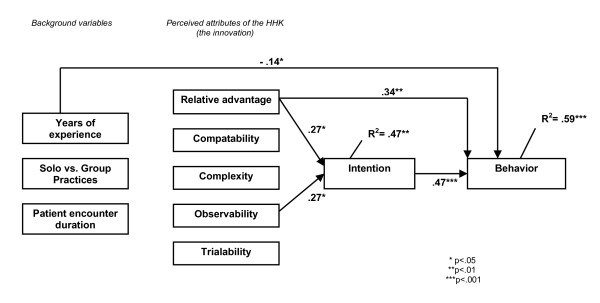
BACKGROUND: There is an emerging knowledge base on the effectiveness of strategies to close the knowledge-practice gap. However, less is known about how attributes of an innovation and other contextual and situational factors facilitate and impede an innovation's adoption. The Healthy Heart Kit (HHK) is a risk management and patient education resource for the prevention of cardiovascular disease (CVD) and promotion of cardiovascular health. Although previous studies have demonstrated the HHK's content validity and practical utility, no published study has examined physicians' uptake of the HHK and factors that shape its adoption. OBJECTIVES: Conceptually informed by Rogers' Diffusion of Innovation theory, and Theory of Planned Behaviour, this study had two objectives: (1) to determine if specific attributes of the HHK as well as contextual and situational factors are associated with physicians' intention and actual usage of the HHK kit; and (2), to determine if any contextual and situational factors are associated with individual or environmental barriers that prevent the uptake of the HHK among those physicians who do not plan to use the kit. METHODS: A sample of 153 physicians who responded to an invitation letter sent to all family physicians in the province of Alberta, Canada were recruited for the study. Participating physicians were sent a HHK, and two months later a study questionnaire assessed primary factors on the physicians' clinical practice, attributes of the HHK (relative advantage, compatibility, complexity, trialability, observability), confidence and control using the HHK, barriers to use, and individual attributes. All measures were used in path analysis, employing a causal model based on Rogers' Diffusion of Innovations Theory and Theory of Planned Behaviour. RESULTS: 115 physicians (follow up rate of 75%) completed the questionnaire. Use of the HHK was associated with intention to use the HHK, relative advantage, and years of experience. Relative advantage and the observability of the HHK benefits were also significantly associated with physicians' intention to use the HHK. Physicians working in solo medical practices reported experiencing more individual and environmental barriers to using the HHK. CONCLUSION: The results of this study suggest that future information innovations must demonstrate an advantage over current resources and the research evidence supporting the innovation must be clearly visible. Findings also suggest that the innovation adoption process has a social element, and collegial interactions and discussions may facilitate that process. These results could be valuable for knowledge translation researchers and health promotion developers in future innovation adoption planning.
Overview
The claims and statistics of this paper haven’t been checked yet.
Free: it reads the open-access text and checks the first 5 claims that cite a source we can check. Create a free account to check every claim.
Integrity signals
Registry
Cites
Statistics
Figures
Verification
Claims the paper makes
The claims and statistics of this paper haven’t been checked yet.
Free: it reads the open-access text and checks the first 5 claims that cite a source we can check. Create a free account to check every claim.
Claims other papers make about this one
Each is checked against this paper’s own text: does it say what the citing paper says it does?
The cited source says what the claim attributes to it.
In the citing paper
“Many of these measures assessed constructs outlined in Roger’s diffusion of innovations theory [18] such as relative advantage, compatibility, complexity, trialability, and observability [26].”
Self-check
Percentages, sums and reported differences re-computed from the paper’s own numbers.
The self-check needs the paper’s full text.
Citations
Cites
The theory of planned behavior
Ajzen, I. (1991) · Organizational Behavior and Human Decision Processes · doi:10.1016/0749-5978(91)90020-t · Cited by 90,587
Rogers, E. M., Singhal, A., & Quinlan, M. M. (2019) · An Integrated Approach to Communication Theory and Research · doi:10.4324/9780203710753-35 · Cited by 37,322
Diffusion of Innovations in Service Organizations: Systematic Review and Recommendations
GREENHALGH, T., ROBERT, G., MACFARLANE, F., BATE, P., & KYRIAKIDOU, O. (2004) · The Milbank Quarterly · doi:10.1111/j.0887-378x.2004.00325.x · Cited by 7,448 · cited 4×
“Current research evidence indicates that if a potential user sees no relative advantage in using the innovation, it will not be adopted [6].”
InfluentialThe diffusion of innovations: Some examples of finnish civil servant's professional tours in Europe
Hietala, M. (1983) · Scandinavian Journal of History · doi:10.1080/03468758308579015 · Cited by 6,162
The Theory of Planned Behaviour
Conner, M. T., & McMillan, B. (2004) · Research Explorer (The University of Manchester) · Cited by 4,463
(2001) · PubMed · Cited by 1,709
Canadian journal of public health
(1949) · Tubercle · doi:10.1016/s0041-3879(49)80069-9 · Cited by 1,537
Systematic Review: The Relationship between Clinical Experience and Quality of Health Care
Choudhry, N. K., Fletcher, R. H., & Soumerai, S. B. (2005) · Annals of Internal Medicine · doi:10.7326/0003-4819-142-4-200502150-00008 · Cited by 1,468 · cited 1×
“One study [20] that systematically reviewed data from several studies linked the physician's age or years since graduation with inferior knowledge of the latest cancer-screening techniques, and poorer diagnosis and treatment of other chronic diseases.”
Interventions to change health behaviours: evidence-based or evidence-inspired?
Michie, S., & Abraham, C. (2004) · Psychology & Health · doi:10.1080/0887044031000141199 · Cited by 784 · cited 1×
“Furthermore, existing social-cognitive theories can help guide investigations in this field of study, especially considering that, in general, theory-based interventions are more efficacious than atheoretical approaches for behaviour change [11].”
Changing Provider Behavior: An Overview of Systematic Reviews of Interventions
Grimshaw, J. M., Shirran, L., Thomas, R., Mowatt, G., Fraser, C., Bero, L., Grilli, R., Harvey, E., Oxman, A., & O’Brien, M. A. (2001) · Medical Care · doi:10.1097/00005650-200108002-00002 · Cited by 778 · cited 1×
“Intermediaries such as opinion leaders, change agents, and knowledge brokers are considered to play an important role in convincing others to adopt an innovation or use research in their practice [18,19].”
Research works printed but not linked: 2
- Rogers EM Diffusion of Innovations 1995 4 New York: Free Press
- Birdsell J Thornley R Landry R Estabrooks C Mayan M The utilization of health research results in Alberta 2005 Edmonton, AB: Alberta Heritage Foundation for Medical Research
Cited by
Items 101–200 of 240
Primary Care Pathway for Childhood Asthma: Protocol for a Randomized Cluster-Controlled Trial
Cave, A., Sharpe, H. M., Anselmo, M. A., Befus, A. D., Currie, G. R., Davey, C., Drummond, N., Graham, J., Green, L. A., Grimshaw, J., et al. (2016) · JMIR Research Protocols · doi:10.2196/resprot.5261 · Cited by 11
“We will purposefully select 6 practices randomized to the pathway and education intervention based on size of the practice and heterogeneity of professionals in the practice [56], and evaluate them using multidisciplinary focus groups after the intervention.”
MethodSelf-citationSearching for social equity among public administration mission statements
Dooley, T. P. (2019) · Teaching Public Administration · doi:10.1177/0144739419867121 · Cited by 11
“The more compatible the innovation, the greater the likelihood of adoption (Scott et al., 2008).”
BackgroundLindholm, L. H., Koivukangas, A., Lassila, A., & Kampman, O. (2019) · Nordic Journal of Psychiatry · doi:10.1080/08039488.2019.1582698 · Cited by 11
Huybrechts, I., Declercq, A., Verté, E., Boeckxstaens, P., Raeymaeckers, P., & Anthierens, S. (2023) · Social Science & Medicine · doi:10.1016/j.socscimed.2023.116048 · Cited by 11
The emotional responses of older adults to new technology
Kim, K. O. (2012) · Illinois Digital Environment for Access to Learning and Scholarship (University of Illinois at Urbana-Champaign) · Cited by 24
Daood, R. M., Oppong, E. O., & Wang, J. (2024) · Open Journal of Business and Management · doi:10.4236/ojbm.2024.124142 · Cited by 9
“Because new innovations require investing time, energy and resources, innovations that can be tried before being fully implemented are more readily adopted (Scott et al., 2008).”
Kegler, M. C., Rana, S., Vandenberg, A. E., Hastings, S. N., Hwang, U., Eucker, S. A., & Vaughan, C. P. (2022) · Frontiers in Health Services · doi:10.3389/frhs.2022.1053489 · Cited by 9
Chatbot for Public Relations and Customer Service in Indonesia: A Diffusion Innovation Study
Nasikhah, N., Wijaya, G., & Rahayu, T. P. (2022) · Jurnal Sosioteknologi · doi:10.5614/sostek.itbj.2022.21.3.5 · Cited by 12
“If the innovation is considered to provide more benefits, then individuals will tend to adopt the innovation (Scott et al., 2008).”
BackgroundPanagoulias, D. P., Virvou, M. K., & Tsihrintzis, G. A. (2023) · International Conference on Information, Intelligence, Systems & Applications (IISA) · doi:10.1109/iisa59645.2023.10345846 · Cited by 9
“In [19], the factors were investigated which associated with the doctors’ intention to use the Canadian Heart Health Kit.”
Evaluation of health care providers’ use of the ‘Exercise and Depression Toolkit’: a case study
Glowacki, K., Zumrawi, D., Michalak, E. E., & Faulkner, G. (2021) · BMC Psychiatry · doi:10.1186/s12888-021-03248-5 · Cited by 9
“This includes the importance of adopters viewing the resource as having an advantage over other resources, and that the evidence-base for the resource is clear [12].”
BackgroundDewinta, M. C. N., Penggalih, M. H. S. T., & Purwaningrum, D. N. (2022) · Nutrition and Health · doi:10.1177/02601060221102681 · Cited by 9
A Cross-Sectional Audit of Sorghum in Selected Cereal Food Products in Australian Supermarkets
Ducksbury, C., & Stefoska‐Needham, A. (2022) · Nutrients · doi:10.3390/nu14091821 · Cited by 11
“According to Rodger’s diffusion of innovation (DOI) theory [53], the uptake of ideas is a gradual process, and there are five factors that affect the adoption of new innovations: relative advantage (to previous innovations), compatibility, complexity (ease of use), trialability, and observability [53,54].”
BackgroundMobile Banking Intention: Nexus Between Innovation, Tech Adoption, and Gamification
Çera, G., & Khan, K. A. (2024) · Journal of East-West Business · doi:10.1080/10669868.2024.2347165 · Cited by 11
“Studies show that if innovation is more compatible, it will likely be adopted (Scott et al. 2008).”
Measuring and predicting teachers’ commitment to implementing evidence-based programs
Cramer, T., Cappella, E., Morris, P., & Ganimian, A. (2023) · Early Childhood Research Quarterly · doi:10.1016/j.ecresq.2023.04.009 · Cited by 8
Pynnönen, S. (2020) · Dissertationes Forestales · doi:10.14214/df.289 · Cited by 11
“The process begins with gaining knowledge about the innovation, where the socio-economic characteristics, personality and the ways the adopter uses communication channels play an important role (Rogers 2003, p. 170; Scott et al. 2008).”
BackgroundGutiérrez, T., & Cabalín, V. H. (2018) · BMC Medical Informatics and Decision Making · doi:10.1186/s12911-018-0590-1 · Cited by 10
Berger, A., Rennie, S., Aijaz, J., Johnson, L., Antillón‐Klussmann, F., Roberts, M. C., Chitsike, I., Kambugu, J., Saha, V., Bhakta, N. H., et al. (2023) · Cancer · doi:10.1002/cncr.35065 · Cited by 7
“19 (Figure 1A,C”
Staiano, A. E., Button, A. M., Baker, A. E., Beyl, R. A., Conn, A., Lima, A., Lindros, J., Newton, R. L., Stein, R. I., Welch, R. R., et al. (2024) · Contemporary Clinical Trials · doi:10.1016/j.cct.2024.107459 · Cited by 7
for the MAG-CP Collaborative Group, Teela, K. C., Silva, D. A. D., Chapman, K., Synnes, A. R., Sawchuck, D., Basso, M., Liston, R. M., von Dadelszen, P., & Magee, L. A. (2015) · BMC Pregnancy and Childbirth · doi:10.1186/s12884-015-0785-8 · Cited by 11
“A clear clinical improvement over current behaviour [41] and simplicity versus complexity of the proposed change [37, 41–43] help bring about success.”
BackgroundAre There Speed Limits in Doctor of Physical Therapy Education? Future Research Directions
Davis, D. S. (2025) · Physical Therapy · doi:10.1093/ptj/pzaf079 · Cited by 7
Kamaludin, J. W. (2021) · Türk bilgisayar ve matematik eğitimi dergisi · doi:10.17762/turcomat.v12i6.5777 · Cited by 8
“The easier it is seen to the results of an innovation, the more likely the innovation is adopted by a person or group of people (Scott et al., 2008; Toole et al., 2012; Miranda et al., 2016;Alan et al., 2017).”
BackgroundAnalysis of a Teleworking Technology Adoption Case: An Agent-Based Model
Arbelaez-Velasquez, C. A., Ramírez, D. P. G., & Quintero, S. (2022) · Sustainability · doi:10.3390/su14169930 · Cited by 8
Laird, S. D., George, J., Sanford, S. M., & Coon, S. (2010) · PubMed · Cited by 7
Using the Diffusion of Innovations to Develop Healthy Cooking Demonstrations at a Farmers’ Market
Castellanos, D. K. C., Christaldi, J., & Borer, K. (2014) · Journal of Hunger & Environmental Nutrition · doi:10.1080/19320248.2014.908448 · Cited by 7
“present study.(13) The questionnaire included statements regarding the 5 subscales, each relating to the DOI attribute incorporated into the cooking demonstrations and recipes.”
BackgroundInternet-Based Dementia Resources: Physician Attitudes and Practices
Galvin, J. E., Meuser, T. M., Boise, L., & Connell, C. M. (2010) · Journal of Applied Gerontology · doi:10.1177/0733464810363894 · Cited by 8
Implementation Science Across Lifestyle Medicine Interventions
Adsul, P., Perez, L. G., Oh, A., & Chambers, D. (2020) · Springer eBooks · doi:10.1007/978-3-030-48088-2_4 · Cited by 7
McFayden, C. B., Johnston, L. M., MacPherson, L., Sloane, M., Hope, E. S., Crowley, M. A., Jong, M. C. D., Simpson, H., Stockdale, C., Simpson, B. N., et al. (2024) · The Forestry Chronicle · doi:10.5558/tfc2024-017 · Cited by 6
Bonito, J. A., Ruppel, E. K., Saul, J. E., & Leischow, S. J. (2012) · Health Communication · doi:10.1080/10410236.2012.673245 · Cited by 6
“Furthermore, researchers examining factors that compel Canadian physicians to use new methods to educate patients regarding cardiovascular disease found that discussion of those methods with fellow physicians was important to adoption ( Scott, Kessler, Karunamuni, Bize, & Rodgers, 2008 ).”
BackgroundKhouiyi, A. H., Guillemette, F., & St-Pierre, M.-J. (2022) · Enjeux et société Approches transdisciplinaires · doi:10.7202/1092844ar · Cited by 7
“Cette méthodologie générale nous a permis une avancée dans l’approfondissement scientifique des stratégies qui réduisent le fossé entre les connaissances issues de la recherche et la pratique professionnelle (Scott et al., 2008).”
BackgroundAtinga, R. A., Akosen, G., & Bawontuo, V. (2021) · Hospital Practice · doi:10.1080/21548331.2021.1942878 · Cited by 6
“[29] were used to assess compatibility.”
Kule, A. M., Wilson, M., Ampeire, K. H., & Turiabe, V. (2021) · Interdisciplinary Journal of Rural and Community Studies · doi:10.51986/ijrcs-2021.vol3.02.04 · Cited by 5
Goliath, C. (2009) · OhioLink ETD Center (Ohio Library and Information Network) · Cited by 5
Characteristics of Successful Innovations
Grol, R. P. T. M., & Wensing, M. (2020) · Wiley eBooks · doi:10.1002/9781119488620.ch5 · Cited by 5
Zoysa, M. D. (2022) · Open Journal of Forestry · doi:10.4236/ojf.2022.121004 · Cited by 5
Enns, B., Sui, Y., Guerra‐Alejos, B. C., Humphrey, L., Piske, M., Zang, X., Doblecki‐Lewis, S., Feaster, D. J., Frye, V. A., Geng, E., et al. (2024) · Journal of the International AIDS Society · doi:10.1002/jia2.26265 · Cited by 5
Talsma, A., McLaughlin, M., Bathish, M. A., Sirihorachai, R., & Kuttner, R. (2014) · Western Journal of Nursing Research · doi:10.1177/0193945914537121 · Cited by 7
When do physicians perceive the success of a new care model differently?
Richter, S., Demirer, I., Nocon, M., Pfaff, H., & Karbach, U. (2021) · BMC Health Services Research · doi:10.1186/s12913-021-07061-4 · Cited by 5
Determinants of User’s Intention to Adopt Digital Banking Services in Malaysia
Azmi, N., Zahari, N. H. M., Yunus, Z. M., & Kamar-BODIAN, W. N. I. W. A. (2021) · International Journal of Advanced Research in Economics and Finance · doi:10.55057/ijaref.2021.3.4.3 · Cited by 5
“…an innovation may be tested or experimented for some time before a commitment to adopt is made on a limited time basis i.e., allowed to experiment with it, would feel comfortable with it and thus be more likely to adopt it (Roger, 1983; Roger, 2003; Scott et al., 2008; Agarwal & Prasad, 1999).”
BackgroundAssessing True Shallot Seed (TSS) performance and farmers’ perceptions of its innovation attributes
Adiyoga, W. (2023) · IOP Conference Series Earth and Environmental Science · doi:10.1088/1755-1315/1230/1/012191 · Cited by 5
“Relative advantage or perceived total benefits of innovation has been indicated as a decisive factor determining adoption [26, 27].”
BackgroundResultBisimirwe, C., Maombi, S., Nabuki, S., Mubelelwa, L., Llosa, A. E., & Palacios, L. (2026) · npj Women s Health · doi:10.1038/s44294-026-00136-9 · Cited by 4
Wang, Z., Hu, H., & Liu, T. (2023) · Engineering Computations · doi:10.1108/ec-07-2023-0369 · Cited by 4
Evidence-Based Policy in the New Organizational Paradigm Part 2
Long, L. E., & Brewer, T. L. (2011) · Journal of Pediatric Nursing · doi:10.1016/j.pedn.2011.05.007 · Cited by 4
Implementing an early-life nutrition intervention through primary healthcare: staff perspectives
Osorio, N. G., Vik, F. N., Helle, C., Hillesund, E. R., Øverby, N. C., Helland, S. H., Love, P., Barker, M. E., Daele, W. V., Abel, M. H., et al. (2024) · BMC Health Services Research · doi:10.1186/s12913-024-11582-z · Cited by 5
“This is unfortunate, as studies have shown that observability - the degree to which results of an intervention are visible to the recipient - is one of the most influential attributes for innovation uptake [47].”
BackgroundAsawo, L. O., Aseey, A. A., & Chandi, J. R. (2021) · Agricultural Sciences · doi:10.4236/as.2021.127047 · Cited by 4
Read, S., Morgan, J., Gillespie, D., Nollett, C. L., Weiss, M., Allen, D. A., Anderson, P., & Waterman, H. A. (2021) · PLoS ONE · doi:10.1371/journal.pone.0255564 · Cited by 6
“A recent review outlined their commonality in explaining unsuccessful interventions or, at least, perceived barriers to success across a range of settings [28].”
BackgroundEvaluating Technology-Mediated Collaborative Workflows for Telehealth
Bondy, C., Chen, L., Grover, P., Hanson, V., Li, R., & Shi, P. (2021) · IEEE Journal of Biomedical and Health Informatics · doi:10.1109/jbhi.2021.3119458 · Cited by 4
“Further research is needed to understand the dynamics of helping users internalize the advantages of the technology-mediated workflow; this is a crucial aspect of technology adoption in telehealth, [35], [36].”
BackgroundFan, C. L. J., Kwang, G. B., Ling, V. C. W., Peng, T. W., & Goh, B. Q. (2022) · Journal of Medical Internet Research · doi:10.2196/23266 · Cited by 4
Frimpong, B. N., Osei, M. K., Mochiah, M. B., Asante, B. O., & Gyau, J. (2022) · Agricultural and Food Science Journal of Ghana · doi:10.4314/afsjg.v14i1.8 · Cited by 4
Hayes, K. J., Dadich, A., Fitzgerald, A., Sloan, T. R., Eljiz, K., & Kobilski, S. (2010) · Cited by 4
Bowman, C., Luck, J., Gale, R. C., Smith, N., York, L. S., & Asch, S. M. (2015) · Quality Management in Health Care · doi:10.1097/qmh.0000000000000063 · Cited by 4
Building the Clinical Bridge to Support Nursing Effectiveness Science
Potempa, K. M., Daly, J., & Titler, M. G. (2012) · Nursing Research and Practice · doi:10.1155/2012/194147 · Cited by 5
He, W., Wu, J., Chen, C. H., Finley, A., Wang, P., Huang, H., Ng, C., Chui, T., Zhang, J., & Hon, C. (2025) · Journal of Thoracic Disease · doi:10.21037/jtd-24-1313 · Cited by 5
Socioeconomic Drivers of Adoption and Use Intensity of Improved Teff Seed in Northwest Ethiopia
Wosene, G., Pang, Y., Cao, J., Aynalem, M., & Jadoon, A. U. (2025) · Food Science & Nutrition · doi:10.1002/fsn3.71030 · Cited by 3
“The farmer then evaluates the technology against the existing ones while considering other factors such as the costs of the technology, trial ability and relative advantage (Scott et al. 2008).”
Adopting a technological innovation to improve patient care cooperation
Garidi, S., & Karâa, M. (2025) · Supply Chain Forum an International Journal · doi:10.1080/16258312.2024.2446011 · Cited by 3
Musa, N. C., & Kadir, B. (2025) · International Journal of Academic Research in Business and Social Sciences · doi:10.6007/ijarbss/v15-i2/24682 · Cited by 3
“…insufficient studies on the influence of DOI Theory on the WTP premium for food packaging with sustainable labeling amongst working adults in Malaysia, particularly representing an emerging market, which warrants this study (Hosseinikhah Choshaly, 2019; Scott et al., 2008; Menzli et al., 2022).”
Williams, P. P., Prinsloo, M., Peden, M. M., Neethling, I., Mhlongo, S., Maqungo, S., Parry, C. D. H., & Matzopoulos, R. (2024) · JMIR Research Protocols · doi:10.2196/52949 · Cited by 3
“These areas of discussion will ensure appropriate information are collected that will inform national stakeholders on the benefits for the adoption of the recommended alcohol diagnostic screening tools for larger implementation [28].”
Kakomwe, Y., Mashapa, M. M., & Tichaawa, T. M. (2025) · Studia Periegetica · doi:10.58683/sp.2080 · Cited by 2
“As Scott et al. (2008) note, technology that aligns with the expectations and backgrounds of potential users is more likely to gain acceptance.”
Evidence-Based Practice in Practice : Exploring Conditions for Using Research in Physiotherapy
Dannapfel, P. (2015) · Linköping University medical dissertations · doi:10.3384/diss.diva-122172 · Cited by 2
Bringing Evidence into Practice in Hand Surgery
Waljee, J. F., & Chung, K. C. (2020) · Hand Clinics · doi:10.1016/j.hcl.2020.01.014 · Cited by 2
Saad, M. Z. M., Ibrahim, M., & Othman, Z. (2023) · AZKA International Journal of Zakat & Social Finance · doi:10.51377/azjaf.vol4no1.146 · Cited by 5
Rustandi, Y., Wulandari, R., & Savitri, M. (2023) · Anuário do Instituto de Geociências · doi:10.11137/1982-3908_2023_46_55775 · Cited by 2
Astiti, K. A., & Effendy, L. (2025) · JURNAL ILMIAH GLOBAL EDUCATION · doi:10.55681/jige.v6i2.3718 · Cited by 2
Exploring Barriers and Facilitators to Implementation of Acute Care Physical Therapy in Obstetrics
Swartz, J. L., Segraves, J., Segraves, R., & Tuttle, L. J. (2025) · Journal of Women s & Pelvic Health Physical Therapy · doi:10.1097/jwh.0000000000000347 · Cited by 2
Hamid, N. F., Wahab, E., & Abdullah, N. H. (2013) · GATR Global Journal of Business Social Sciences Review · doi:10.35609/gjbssr.2013.1.2(8 · Cited by 2
Salimonu, I. R., Osman, W. R. B. S., & Shittu, A. J. K. (2014) · Universiti Utara Malaysia Institutional Repository (Universiti Utara Malaysia) · Cited by 2
Juzwishin, D., Mueen, M., Cruz, A. M., Ruptash, T., Barnard, S., Sebastianski, M., Esmail, R., & Liu, L. (2017) · Innovation and Entrepreneurship in Health · doi:10.2147/ieh.s124773 · Cited by 3
“24,25,26 Implementation is also catalyzed by innovations that are simple, straightforward and demonstrate reduced risk.”
Nursing Students' Knowledge and Attitudes Toward Infant Sleep Safety
Burgess, A., Bell, T. D., Cirelli, J., Clymer, B. J., & Goodstein, M. H. (2017) · Teaching and learning in nursing · doi:10.1016/j.teln.2017.05.007 · Cited by 3
A Framework for Evaluating Technology-Mediated Collaborative Workflow
Bondy, C. (2021) · RIT Scholar Works (Rochester Institute of Technology) · Cited by 2
Williams, P. P., Prinsloo, M., Peden, M. M., Neethling, I., Mhlongo, S., Maqungo, S., Parry, C. D. H., & Matzopoulos, R. (2022) · medRxiv · doi:10.1101/2022.12.19.22283649 · Cited by 2
“These areas of discussion will ensure appropriate information is collected that will inform national 295 stakeholders on the benefits for adoption of the recommended alcohol diagnostic screening tools for 296 larger implementation [28].”
BackgroundSabahi, S. M. A., Pinto, A. D., & Jayapal, S. K. (2024) · International journal of Nutrition Pharmacology Neurological Diseases · doi:10.4103/ijnpnd.ijnpnd_17_24 · Cited by 1
Tschida, J. E., Peeran, I., & Drahota, A. (2025) · BMJ Open · doi:10.1136/bmjopen-2024-095564 · Cited by 1
Awareness, Acceptability, and Adoption of Prenatal Syphilis Screening Guidelines
Griner, S. B., Neelamegam, M., Johnson, K. C. M., Kinard, A., Farris, A. N., Brosnan, A., & Nelsen, M. (2025) · Journal of Women s Health · doi:10.1177/15409996251382057 · Cited by 1
Accountants’ information technology reskilling: Antecedents and the moderating role of gender
Pothisarn, T., & Thongmak, M. (2025) · Knowledge Management & E-Learning An International Journal · doi:10.34105/j.kmel.2026.18.005 · Cited by 1
Fontanella, C. A., Hughes, J. L., Brock, G. N., Ruch, D. A., Kemper, A. R., Bunger, A. C., Walker, D. M., McAlearney, A. S., Maa, T., Miller, M., et al. (2025) · Contemporary Clinical Trials · doi:10.1016/j.cct.2025.108208 · Cited by 1
Ali, N., Law, B. H. Y., Thomas, A. R., Levy, P. T., Gupta, R., Elshenawy, S., Reed, D., Pavlek, L. R., Shepherd, J., Gowda, S. H., et al. (2026) · Journal of Perinatology · doi:10.1038/s41372-026-02734-6 · Cited by 1
Gorbanev, I., Agudelo-Londoño, S., Cortes, A., & Yepes, F. J. (2015) · Revista Facultad Nacional de Salud Pública · doi:10.17533/udea.rfnsp.v33n3a09 · Cited by 1
Villafana, A. C. (2019) · ProQuest LLC eBooks · doi:10.7916/d8-mt77-pv02 · Cited by 1
“As per Shapiro et al. (2018), in their study’s administration of the Vaccine Knowledge Scale, “vaccines” was changed to “vaccine” to make the measure consistently in the singular.”
Ahmed, A. A., & Usman, Z. (2023) · Gusau Journal of Accounting and Finance · doi:10.57233/gujaf.v4i1.199 · Cited by 1
Tomiuk, D., Zuccaro, C., Öncel, A. G., Plaisent, M., Benslimane, Y., & Bernard, P. M. (2024) · Advances in library and information science (ALIS) book series · doi:10.4018/979-8-3693-1573-6.ch006 · Cited by 1
COVID-19 pandemic ‘e-experiences’ as accelerators of digital society
Piotrowska, A. I., Szalacha-Jarmużek, J., Huterska, A. A., & Ciechan-Kujawa, M. (2024) · Ekonomista · doi:10.52335/ekon/190561 · Cited by 1
“The fact that collegial interaction and discussion can facilitate the process of diffusion of innovations had previously been highlighted in the case of, e.g., healthcare innovation (Scott et al., 2008).”
BackgroundDIGITAL MARKETING OF INSURANCE IN NIGERIA: CHALLENGES AND ISSUES
Chilekezi, O. (2025) · International Journal of Entrepreneurship and Forensic Management Research · doi:10.70382/nijefmr.v8i7.002 · Cited by 1
McKillop, A. (2010) · UTS ePRESS (University of Technology Sydney) · Cited by 1
Eljiz, K., Hayes, K. J., Dadich, A., Fitzgerald, A., Sloan, T. R., & Kobilski, S. (2010) · eCite Digital Repository (University of Tasmania) · Cited by 1
Aladro, C. P. (2020) · Arrow@dit (Dublin Institute of Technology) · Cited by 1
Exploring implementation of quality improvement initiatives in healthcare: a qualitative case study
Mackelson, C. A. (2010) · UVic’s Research and Learning Repository (University of Victoria)
The Diffusion of Health Innovations from Developing to Developed Countries
Dadwal, V. (2012) · uO Research (University of Ottawa)
Bradley, D. K. F. (2015) · Open Access at Essex (University of Essex)
Sanni, S. A. (2014) · International Journal of Innovation Management and Technology · doi:10.7763/ijimt.2014.v5.478
Veranderingsbereidheid. Een onderzoek bij stichting Jeugdformaat
Vermeulen, J. W. M. (2009) · Utrecht University Repository (Utrecht University)
Moore, G., Fitzpatrick, T., Lim-Carter, I., Haynes, A. S., Flego, A., & Snelgrove, B. (2016) · Technology Innovation Management Review · doi:10.22215/timreview/1016 · Cited by 2
“The complex mix of factors that influence individual capacity to engage with knowledge translation have been acknowledged (Dobbins et al., 2001; Scott et al., 2008) and are reflected in some knowledge translation frameworks (e.”
BackgroundBolinger, M. C. (2012) · The Research Repository @ WVU (West Virginia University) · doi:10.33915/etd.3627
Weaver, N. L., Buskirk, T. D., Jupka, K. A., & Williams, J. (2018) · Translational Behavioral Medicine · doi:10.1093/tbm/iby038
“Lastly, features of the program, or innovation, are also related to program adoption [12, 13], including relative advantage over other programs, and the level of investment required to adopt and maintain the intervention.”
BackgroundNguthuku, S. N., Kibera, F., & Musyoka, R. (2018) · Journals & Books Hosting (International Knowledge Sharing Platform)
Chitiyo, J., & May, M. E. (2018) · Journal of the American Academy of Special Education Professionals · doi:10.64546/jaasep.353 · Cited by 1
Taghinejad, H. (2020) · Indian Journal of Forensic Medicine & Toxicology · doi:10.37506/ijfmt.v14i4.12033
Musa, H., Rahim, N. A., Ahmad, B. H., & Aziz, M. Z. A. A. (2016) · GATR Global Journal of Business Social Sciences Review · doi:10.35609/gjbssr.2016.4.2(6
Innovation in a Knowledge-Based Economy: Knowledge Transfer in the Health Sector
Dittrich, W. H. (2021) · FOM-Edition · doi:10.1007/978-3-658-33484-0_14
Metadata
- Authors
- Scott, S. D., Plotnikoff, R. C., Karunamuni, N., Bize, R., & Rodgers, W.
- Affiliations
- University of Alberta (CA)
- University of Lausanne (CH)
- Corresponding author
- Scott, Shannon D
- Venue
- Implementation Science
- Published
- 2008-10-02
- Volume
- 3
- Issue
- 1
- Pages
- 41-41
- ISSN
- 1748-5908 (ISSN-L)
- PMC
- PMC2567341
- OpenAlex
- W2082260995
- Cited by
- 217
- References
- 25
- Citations by year
- 2026: 9 · 2025: 17 · 2024: 25 · 2023: 20 · 2022: 21 · 2021: 27 · 2020: 14 · 2019: 9 · 2018: 7 · 2017: 9 · 2016: 8 · 2015: 11 · 2014: 5 · 2013: 8 · 2012: 12
- FWCI
- 9.67
- Type
- journal article
- Language
- en
- Open access
- gold
- doi.org
- Licence
- Locations
- Implementation Science (publishedVersion, cc-by)
- PubMed Central (publishedVersion, cc-by)
- PubMed (publishedVersion)
- SERVAL (Université de Lausanne) (publishedVersion, other-oa)
- IRIS (submittedVersion)
- DOAJ (DOAJ: Directory of Open Access Journals) (submittedVersion)
- Funders
- National Science Foundation
- Canadian Child Health Clinician Scientist Program
- University of Alberta
- Schweizerischer Nationalfonds zur Förderung der Wissenschaftlichen Forschung
- Fondation pour la Recherche Médicale
- Canadian Institutes of Health Research
- Topics
- Health Sciences › Health Professions › General Health Professions › Health Policy Implementation Science
- Health Sciences › Medicine › Public Health, Environmental and Occupational Health › Clinical practice guidelines implementation
- Health Sciences › Health Professions › General Health Professions › Health Sciences Research and Education
- Keywords
- innovation adoption, cardiovascular disease prevention, patient education, general practitioners, diffusion of innovation theory, theory of planned behavior, relative advantage, observability, barriers to use, knowledge-practice gap, knowledge translation, health promotion resources
About these checks
Registry, retraction, Cites and statistics results are computed, not judged, with one exception: a printed reference that no index lists is read once by a model before it counts as a citation error. Claims are extracted by a model and kept only when their quote appears verbatim in the text; each cited source is then checked, with a model’s help, for whether it says what the claim relies on. Those verdicts can be wrong — read the claim’s quote and the cited source before relying on one.
Statistics and arithmetic are recomputed, not judged.
Confidence bands are shown only for fields calibrated on our annotated test set. None is calibrated yet, so no band is shown.
What counts as a claim ›How we measure confidence ›How we check this ›
Are you an author, or do you see a problem with this page? Request a review
Data sources
Bibliographic data: Semantic Scholar, OpenAlex, Crossref.
Contains information from the Semantic Scholar Academic Graph Datasets, made available under the ODC Attribution License (ODC-BY 1.0).
Semantic Scholar’s data is described in: Kinney, R., et al. (2023). The Semantic Scholar Open Data Platform. arXiv:2301.10140.
