

Factors influencing the adoption of an innovation: An examination of the uptake of the Canadian Heart Health Kit (HHK)
Open accessThe DOI matches its Crossref record; 27 of the 27 references it cites were found in a registry or an index.
Abstract
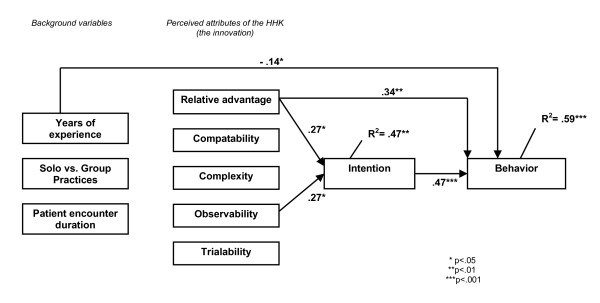
BACKGROUND: There is an emerging knowledge base on the effectiveness of strategies to close the knowledge-practice gap. However, less is known about how attributes of an innovation and other contextual and situational factors facilitate and impede an innovation's adoption. The Healthy Heart Kit (HHK) is a risk management and patient education resource for the prevention of cardiovascular disease (CVD) and promotion of cardiovascular health. Although previous studies have demonstrated the HHK's content validity and practical utility, no published study has examined physicians' uptake of the HHK and factors that shape its adoption. OBJECTIVES: Conceptually informed by Rogers' Diffusion of Innovation theory, and Theory of Planned Behaviour, this study had two objectives: (1) to determine if specific attributes of the HHK as well as contextual and situational factors are associated with physicians' intention and actual usage of the HHK kit; and (2), to determine if any contextual and situational factors are associated with individual or environmental barriers that prevent the uptake of the HHK among those physicians who do not plan to use the kit. METHODS: A sample of 153 physicians who responded to an invitation letter sent to all family physicians in the province of Alberta, Canada were recruited for the study. Participating physicians were sent a HHK, and two months later a study questionnaire assessed primary factors on the physicians' clinical practice, attributes of the HHK (relative advantage, compatibility, complexity, trialability, observability), confidence and control using the HHK, barriers to use, and individual attributes. All measures were used in path analysis, employing a causal model based on Rogers' Diffusion of Innovations Theory and Theory of Planned Behaviour. RESULTS: 115 physicians (follow up rate of 75%) completed the questionnaire. Use of the HHK was associated with intention to use the HHK, relative advantage, and years of experience. Relative advantage and the observability of the HHK benefits were also significantly associated with physicians' intention to use the HHK. Physicians working in solo medical practices reported experiencing more individual and environmental barriers to using the HHK. CONCLUSION: The results of this study suggest that future information innovations must demonstrate an advantage over current resources and the research evidence supporting the innovation must be clearly visible. Findings also suggest that the innovation adoption process has a social element, and collegial interactions and discussions may facilitate that process. These results could be valuable for knowledge translation researchers and health promotion developers in future innovation adoption planning.
Overview
The claims and statistics of this paper haven’t been checked yet.
Free: it reads the open-access text and checks the first 5 claims that cite a source we can check. Create a free account to check every claim.
Integrity signals
Registry
Cites
Statistics
Figures
Verification
Claims the paper makes
The claims and statistics of this paper haven’t been checked yet.
Free: it reads the open-access text and checks the first 5 claims that cite a source we can check. Create a free account to check every claim.
Claims other papers make about this one
Each is checked against this paper’s own text: does it say what the citing paper says it does?
The cited source says what the claim attributes to it.
In the citing paper
“Many of these measures assessed constructs outlined in Roger’s diffusion of innovations theory [18] such as relative advantage, compatibility, complexity, trialability, and observability [26].”
Self-check
Percentages, sums and reported differences re-computed from the paper’s own numbers.
The self-check needs the paper’s full text.
Citations
Cites
The theory of planned behavior
Ajzen, I. (1991) · Organizational Behavior and Human Decision Processes · doi:10.1016/0749-5978(91)90020-t · Cited by 90,587
Rogers, E. M., Singhal, A., & Quinlan, M. M. (2019) · An Integrated Approach to Communication Theory and Research · doi:10.4324/9780203710753-35 · Cited by 37,322
Diffusion of Innovations in Service Organizations: Systematic Review and Recommendations
GREENHALGH, T., ROBERT, G., MACFARLANE, F., BATE, P., & KYRIAKIDOU, O. (2004) · The Milbank Quarterly · doi:10.1111/j.0887-378x.2004.00325.x · Cited by 7,448 · cited 4×
“Current research evidence indicates that if a potential user sees no relative advantage in using the innovation, it will not be adopted [6].”
InfluentialThe diffusion of innovations: Some examples of finnish civil servant's professional tours in Europe
Hietala, M. (1983) · Scandinavian Journal of History · doi:10.1080/03468758308579015 · Cited by 6,162
The Theory of Planned Behaviour
Conner, M. T., & McMillan, B. (2004) · Research Explorer (The University of Manchester) · Cited by 4,463
(2001) · PubMed · Cited by 1,709
Canadian journal of public health
(1949) · Tubercle · doi:10.1016/s0041-3879(49)80069-9 · Cited by 1,537
Systematic Review: The Relationship between Clinical Experience and Quality of Health Care
Choudhry, N. K., Fletcher, R. H., & Soumerai, S. B. (2005) · Annals of Internal Medicine · doi:10.7326/0003-4819-142-4-200502150-00008 · Cited by 1,468 · cited 1×
“One study [20] that systematically reviewed data from several studies linked the physician's age or years since graduation with inferior knowledge of the latest cancer-screening techniques, and poorer diagnosis and treatment of other chronic diseases.”
Interventions to change health behaviours: evidence-based or evidence-inspired?
Michie, S., & Abraham, C. (2004) · Psychology & Health · doi:10.1080/0887044031000141199 · Cited by 784 · cited 1×
“Furthermore, existing social-cognitive theories can help guide investigations in this field of study, especially considering that, in general, theory-based interventions are more efficacious than atheoretical approaches for behaviour change [11].”
Changing Provider Behavior: An Overview of Systematic Reviews of Interventions
Grimshaw, J. M., Shirran, L., Thomas, R., Mowatt, G., Fraser, C., Bero, L., Grilli, R., Harvey, E., Oxman, A., & O’Brien, M. A. (2001) · Medical Care · doi:10.1097/00005650-200108002-00002 · Cited by 778 · cited 1×
“Intermediaries such as opinion leaders, change agents, and knowledge brokers are considered to play an important role in convincing others to adopt an innovation or use research in their practice [18,19].”
Research works printed but not linked: 2
- Rogers EM Diffusion of Innovations 1995 4 New York: Free Press
- Birdsell J Thornley R Landry R Estabrooks C Mayan M The utilization of health research results in Alberta 2005 Edmonton, AB: Alberta Heritage Foundation for Medical Research
Cited by
Items 201–240 of 240
Transforming patient outcomes through effective nursing clinical handover
Hada, A. (2022) · Queensland University of Technology · doi:10.5204/thesis.eprints.228671 · Cited by 1
Bondy, C., Chen, L., Grover, P., & Shi, P. (2022) · doi:10.31038/jppr.2022513 · Cited by 1
“…associated with the subtle migration of non-adopters to adopters and realize that the primary motivator is a relative advantage that triggers attitude towards use and behavioral intent to use, which feeds perceived usefulness of the technology-mediated solution for new telehealth users [73-75].”
BackgroundGimeno, M. L. M. (2021) · Buleria (Universidad de León) · doi:10.18002/10612/13350 · Cited by 1
Katz, T., & Grimaldi, D. (2022) · The international archives of the photogrammetry, remote sensing and spatial information sciences/International archives of the photogrammetry, remote sensing and spatial information sciences · doi:10.5194/isprs-archives-xlviii-4-w5-2022-61-2022
Women in Health Services: Implementation Science 2021
Moullin, J. C., Aufegger, L., & Finch, T. L. (2023) · Frontiers research topics · doi:10.3389/978-2-8325-2337-7
Bourne, S., Kothari, A. R., Wathen, C. N., & Polzer, J. (2023) · Environmental Health Review · doi:10.5864/d2023-001
Phương, B. H. L. T. T. (2024) · Tạp chí Khoa học Trường Đại học Mở Hà Nội · doi:10.59266/houjs.2023.335
Perceptions of the use of IsiZulu Termbank Technology at University of KwaZulu-Natal.
Hadebe, N. (2023) · ResearchSpace (University of KwaZulu-Natal) · doi:10.29086/10413/22991
O’Reilly, L. M., Schwartz, K., Brown, S. A., Dir, A. L., Gillenwater, L. A., Adams, Z. W., Zapolski, T. C. B., Hulvershorn, L. A., & Aalsma, M. C. (2024) · Substance Abuse Treatment Prevention and Policy · doi:10.1186/s13011-024-00614-w
Bannor, R., & Asare, A. K. (2024) · Psychology and Health · doi:10.1080/08870446.2024.2413361
“Innovation is relatively easy to adopt when it is less complex and user-friendly (Scott et al., 2008) as observed in this case where participants indicate that extensions are already created at the four corners of LLINs for easy installation.”
MTURK: Utility in Gerontological Behavioral Health Research
Pudur, R., & Mpofu, E. (2024) · Springer eBooks · doi:10.1007/978-981-92-1288-0_135
Thumma, S. R., & Patel, D. B. (2025) · Elsevier eBooks · doi:10.1016/b978-0-323-91790-2.00013-7
Introducing a Computerized Care‐Pathways System for Older Adults in Home‐Care Settings
Dubuc, N., N’Bouké, A., Corbin, C., & Delli-Colli, N. (2025) · Health & Social Care in the Community · doi:10.1155/hsc/5535495
Ezaddoustdar, J., Tristani, L., McEvenue, T., & Bassett-Gunter, R. L. (2025) · Adapted Physical Activity Quarterly · doi:10.1123/apaq.2025-0024
O’Reilly, L. M., Schwartz, K., Brown, S. A., Dir, A. L., Gillenwater, L. A., Adams, Z. W., Zapolski, T. C. B., Hulvershorn, L. A., & Aalsma, M. C. (2024) · Figshare · doi:10.6084/m9.figshare.26082647
Additional file 2 of When do physicians perceive the success of a new care model differently?
Richter, S., Demirer, I., Nocon, M., Pfaff, H., & Karbach, U. (2021) · Figshare · doi:10.6084/m9.figshare.16755925
Rivera, E. P., Arrivillaga, M. R., Juarez, J. G., Urioste-Stone, S. M. D., Berganza, E., & Pennington, P. M. (2023) · Figshare · doi:10.6084/m9.figshare.24172155
Osorio, N. G., Vik, F. N., Helle, C., Hillesund, E. R., Øverby, N. C., Helland, S. H., Love, P., Barker, M. E., Daele, W. V., Abel, M. H., et al. (2024) · Figshare · doi:10.6084/m9.figshare.27078843
Osorio, N. G., Vik, F. N., Helle, C., Hillesund, E. R., Øverby, N. C., Helland, S. H., Love, P., Barker, M. E., Daele, W. V., Abel, M. H., et al. (2024) · Figshare · doi:10.6084/m9.figshare.27078846
Glowacki, K., Zumrawi, D., Michalak, E. E., & Faulkner, G. (2021) · Figshare · doi:10.6084/m9.figshare.14561492
Additional file 1 of When do physicians perceive the success of a new care model differently?
Richter, S., Demirer, I., Nocon, M., Pfaff, H., & Karbach, U. (2021) · Figshare · doi:10.6084/m9.figshare.16755922
Woodward, E. N., Singh, R. S., Ndebele‐Ngwenya, P., Melgar Castillo, A., Dickson, K. S., & Kirchner, J. E. (2021) · Figshare · doi:10.6084/m9.figshare.14738859
Agroforestry Adoption in Ethiopia: Innovation Systems and Farm Level Analysis
Aysheshim, D. A. (2023) · Qucosa (Saxon State and University Library Dresden) · Cited by 2
Enhancing Telehealth Use To Reduce No-Shows in a Rural Arizona Outpatient Clinic
Chacon, K., & Chacon, K. (2025) · UA Campus Repository (The University of Arizona)
Prenatal Chlamydia Screening Guidelines: Awareness, Adoption, and Acceptability
Griner, S. B., Neelamegam, M., Kinard, A., Johnson, K. C. M., Lemuz, B. T., & Brosnan, A. (2025) · Infectious Diseases in Clinical Practice · doi:10.1097/ipc.0000000000001533
Silva, A. A. F. D. [. (2019) · LA Referencia (Red Federada de Repositorios Institucionales de Publicaciones Científicas)
From Prototype to Practice: A Mixed-Methods Study of a 3D Printing Pilot in Healthcare
Petrie, S., Hassani, M., Kerr, D., Spurway, A. J., Hamilton, M., & Koto, P. (2026) · Hospitals · doi:10.3390/hospitals3010002
“As seen in other research, relating an innovation to workflows through education has been associated with improved uptake [24].”
Medical AI: The Process of Adoption
Schuller, F. C., Ribas, I. F., & Ahmed, G. (2026) · Open Journal of Business and Management · doi:10.4236/ojbm.2026.142058
Santos, A. J., Roxo, L., Sousa, H., Espina, C., Islam, R., Vladu, L., Pîrvan, M., Feliu, A., D´Souza, E., Bouaoun, L., et al. (2026) · Archives of Public Health · doi:10.1186/s13690-026-01947-7
Fontoura, L., Nascimento, D. L. D. M., Neto, J., & Tortorella, G. L. (2026) · International Journal of Production Research · doi:10.1080/00207543.2026.2675461
“Conversely, lower-ranked technologies were perceived as presenting higher organisational and technical barriers, reflecting the DoI constructs of trialability and complexity (Scott et al. 2008; K. Zhu et al. 2006).”
Wongnaa, C. A., Agoalikum, P., & Adom, D. (2026) · Heliyon · doi:10.1016/j.heliyon.2026.e45342
Adair, R., Cole, A. B., & Seitz, H. H. (2026) · Journal of Health Communication · doi:10.1080/10810730.2026.2722678
Tschida, J. E., Moore, L., Powell, A. C., Willar, K. S., Kalatturu, J., Kingstrom, A., Peeran, I., & Drahota, A. (2026) · Autism · doi:10.1177/13623613261484649
“%) that they would use an intervention or method (Pickard et al., 2019; Scott et al., 2008).”
Njoka, K. M. (2026) · SU+ Digital Repository (Strathmore University)
Prompatanapak, A., Thomas, A., Khumboon, R., Chuansanit, N., Kuakpetoon, D., Upaicheewa, S., & Lopetcharat, K. (2026) · BU Academic Review
Belanja Online Bukan Sekedar Harga: Faktor Penentu Minat Beli di Tokopedia
Azura, F. B., & Setyaning, A. N. A. (2025) · Selekta Manajemen: Jurnal Mahasiswa Bisnis & Manajemen · Cited by 2
Pacer, J. (2025) · Journal of Modern Management SHINAWATRA UNIVERSITY
Saragosa, M., Ramsden, R., Shing, P., Fujita, H., Yoo, V., & Li, A. S. (2026) · International Journal of Environmental Research and Public Health · doi:10.3390/ijerph23101323
Swearing as a performance aid: promising evidence, premature promotion
Washmuth, N. B., Jiannine, L., & Ballmann, C. G. (2026) · Frontiers in Sports and Active Living · doi:10.3389/fspor.2026.1930904
Epidemiology of antimicrobial resistance in the Australia dairy cattle industry
Tree, M. (n.d.) · Murdoch University Research Portal
Metadata
- Authors
- Scott, S. D., Plotnikoff, R. C., Karunamuni, N., Bize, R., & Rodgers, W.
- Affiliations
- University of Alberta (CA)
- University of Lausanne (CH)
- Corresponding author
- Scott, Shannon D
- Venue
- Implementation Science
- Published
- 2008-10-02
- Volume
- 3
- Issue
- 1
- Pages
- 41-41
- ISSN
- 1748-5908 (ISSN-L)
- PMC
- PMC2567341
- OpenAlex
- W2082260995
- Cited by
- 217
- References
- 25
- Citations by year
- 2026: 9 · 2025: 17 · 2024: 25 · 2023: 20 · 2022: 21 · 2021: 27 · 2020: 14 · 2019: 9 · 2018: 7 · 2017: 9 · 2016: 8 · 2015: 11 · 2014: 5 · 2013: 8 · 2012: 12
- FWCI
- 9.67
- Type
- journal article
- Language
- en
- Open access
- gold
- doi.org
- Licence
- Locations
- Implementation Science (publishedVersion, cc-by)
- PubMed Central (publishedVersion, cc-by)
- PubMed (publishedVersion)
- SERVAL (Université de Lausanne) (publishedVersion, other-oa)
- IRIS (submittedVersion)
- DOAJ (DOAJ: Directory of Open Access Journals) (submittedVersion)
- Funders
- National Science Foundation
- Canadian Child Health Clinician Scientist Program
- University of Alberta
- Schweizerischer Nationalfonds zur Förderung der Wissenschaftlichen Forschung
- Fondation pour la Recherche Médicale
- Canadian Institutes of Health Research
- Topics
- Health Sciences › Health Professions › General Health Professions › Health Policy Implementation Science
- Health Sciences › Medicine › Public Health, Environmental and Occupational Health › Clinical practice guidelines implementation
- Health Sciences › Health Professions › General Health Professions › Health Sciences Research and Education
- Keywords
- innovation adoption, cardiovascular disease prevention, patient education, general practitioners, diffusion of innovation theory, theory of planned behavior, relative advantage, observability, barriers to use, knowledge-practice gap, knowledge translation, health promotion resources
About these checks
Registry, retraction, Cites and statistics results are computed, not judged, with one exception: a printed reference that no index lists is read once by a model before it counts as a citation error. Claims are extracted by a model and kept only when their quote appears verbatim in the text; each cited source is then checked, with a model’s help, for whether it says what the claim relies on. Those verdicts can be wrong — read the claim’s quote and the cited source before relying on one.
Statistics and arithmetic are recomputed, not judged.
Confidence bands are shown only for fields calibrated on our annotated test set. None is calibrated yet, so no band is shown.
What counts as a claim ›How we measure confidence ›How we check this ›
Are you an author, or do you see a problem with this page? Request a review
Data sources
Bibliographic data: Semantic Scholar, OpenAlex, Crossref.
Contains information from the Semantic Scholar Academic Graph Datasets, made available under the ODC Attribution License (ODC-BY 1.0).
Semantic Scholar’s data is described in: Kinney, R., et al. (2023). The Semantic Scholar Open Data Platform. arXiv:2301.10140.
