

The DOI matches its Crossref record; 38 of the 40 references it cites were found in a registry or an index.
A realistic evaluation: the case of protocol-based care
Open accessAbstract
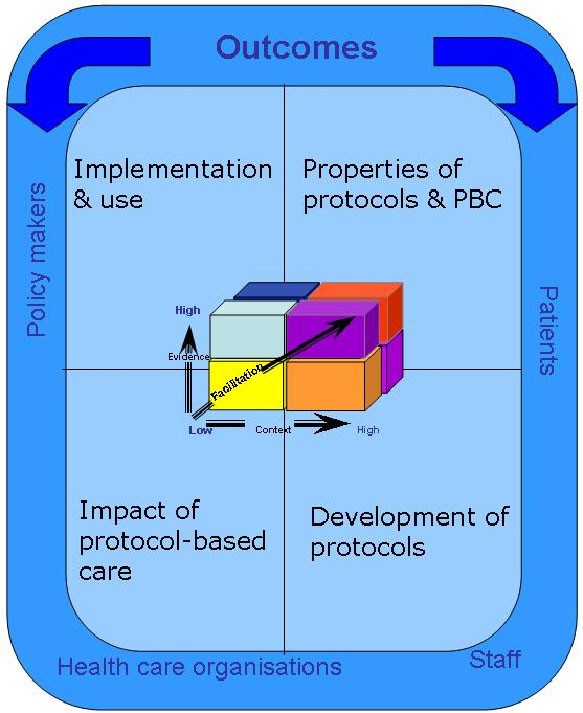
BACKGROUND: 'Protocol based care' was envisioned by policy makers as a mechanism for delivering on the service improvement agenda in England. Realistic evaluation is an increasingly popular approach, but few published examples exist, particularly in implementation research. To fill this gap, within this paper we describe the application of a realistic evaluation approach to the study of protocol-based care, whilst sharing findings of relevance about standardising care through the use of protocols, guidelines, and pathways. METHODS: Situated between positivism and relativism, realistic evaluation is concerned with the identification of underlying causal mechanisms, how they work, and under what conditions. Fundamentally it focuses attention on finding out what works, for whom, how, and in what circumstances. RESULTS: In this research, we were interested in understanding the relationships between the type and nature of particular approaches to protocol-based care (mechanisms), within different clinical settings (context), and what impacts this resulted in (outcomes). An evidence review using the principles of realist synthesis resulted in a number of propositions, i.e., context, mechanism, and outcome threads (CMOs). These propositions were then 'tested' through multiple case studies, using multiple methods including non-participant observation, interviews, and document analysis through an iterative analysis process. The initial propositions (conjectured CMOs) only partially corresponded to the findings that emerged during analysis. From the iterative analysis process of scrutinising mechanisms, context, and outcomes we were able to draw out some theoretically generalisable features about what works, for whom, how, and what circumstances in relation to the use of standardised care approaches (refined CMOs). CONCLUSIONS: As one of the first studies to apply realistic evaluation in implementation research, it was a good fit, particularly given the growing emphasis on understanding how context influences evidence-based practice. The strengths and limitations of the approach are considered, including how to operationalise it and some of the challenges. This approach provided a useful interpretive framework with which to make sense of the multiple factors that were simultaneously at play and being observed through various data sources, and for developing explanatory theory about using standardised care approaches in practice.
Overview
The claims and statistics of this paper haven’t been checked yet.
Run the check — free, no account needed. It reads the open-access text and checks the sources it cites.
Integrity signals
Registry
Cites
Statistics
Figures
Verification
Claims the paper makes
The claims and statistics of this paper haven’t been checked yet.
Run the check — free, no account needed. It reads the open-access text and checks the sources it cites.
Claims other papers make about this one
Each is checked against this paper’s own text: does it say what the citing paper says it does?
In the citing paper
“Rather than identifying simple cause-and-effect relationships, RE is concerned with finding out about what mechanisms work, in what conditions, why, to produce which outcomes and for whom.124”
From ReseArch with Patient and Public invOlvement: a RealisT evaluation – the RAPPORT study (2015) · cites this paper as [124]
Self-check
Percentages, sums and reported differences re-computed from the paper’s own numbers.
The self-check needs the paper’s full text.
Citations
Cites
(1984) · Cited by 81,983
Hartley, J. (2004) · Essential Guide to Qualitative Methods in Organizational Research · doi:10.4135/9781446280119.n26 · Cited by 15,461
(1993) · Cited by 7,856
Diffusion of Innovations in Service Organizations: Systematic Review and Recommendations
GREENHALGH, T., ROBERT, G., MACFARLANE, F., BATE, P., & KYRIAKIDOU, O. (2004) · The Milbank Quarterly · doi:10.1111/j.0887-378x.2004.00325.x · Cited by 7,448
Realist review - a new method of systematic review designed for complex policy interventions
Pawson, R., Greenhalgh, T., Harvey, G., & Walshe, K. (2005) · Journal of Health Services Research & Policy · doi:10.1258/1355819054308530 · Cited by 3,190
Pawson, R. (2006) · doi:10.4135/9781849209120 · Cited by 1,791
The new NHS: modern dependable
Warwick, C. (1998) · British Journal of Midwifery · doi:10.12968/bjom.1998.6.4.265 · Cited by 1,228
Getting evidence into practice: the meaning of `context'
McCormack, B., Kitson, A., Harvey, G., Rycroft‐Malone, J., Titchen, A., & Seers, K. (2002) · Journal of Advanced Nursing · doi:10.1046/j.1365-2648.2002.02150.x · Cited by 765
Ingredients for change: revisiting a conceptual framework
Rycroft-Malone, J. (2002) · Quality and Safety in Health Care · doi:10.1136/qhc.11.2.174 · Cited by 701
An exploration of the factors that influence the implementation of evidence into practice
Rycroft‐Malone, J., Harvey, G., Seers, K., Kitson, A., McCormack, B., & Titchen, A. (2004) · Journal of Clinical Nursing · doi:10.1111/j.1365-2702.2004.01007.x · Cited by 623
Research works printed but not linked: 1
- Pawson R, Tilley N: Realistic evaluation. 1997, London: Sage
Cited by
Sorted by citations
Marchal, B., van Belle, S., van Olmen, J., Hoerée, T., & Kegels, G. (2012) · Evaluation · doi:10.1177/1356389012442444 · Cited by 476
Gilmore, B., McAuliffe, E., Power, J., & Vallières, F. (2019) · International Journal of Qualitative Methods · doi:10.1177/1609406919859754 · Cited by 296
ReseArch with Patient and Public invOlvement: a RealisT evaluation – the RAPPORT study
Wilson, P., Mathie, E., Keenan, J., McNeilly, E., Goodman, C., Howe, A., Poland, F., Staniszewska, S., Kendall, S., Munday, D., et al. (2015) · Health Services and Delivery Research · doi:10.3310/hsdr03380 · Cited by 297
Lacouture, A., Breton, É., Guichard, A., & Ridde, V. (2015) · Implementation Science · doi:10.1186/s13012-015-0345-7 · Cited by 295
Using realist evaluation to open the black box of knowledge translation: a state-of-the-art review
Salter, K. L., & Kothari, A. R. (2014) · Implementation Science · doi:10.1186/s13012-014-0115-y · Cited by 308
Metadata
- Authors
- Rycroft-Malone, J., Fontenla, M., Bick, D., & Seers, K.
- Affiliations
- University of Warwick (GB)
- King's College London (GB)
- Venue
- Implementation Science
- Published
- 2010-05-26
- Volume
- 5
- Issue
- 1
- Pages
- 38-38
- ISSN
- 1748-5908 (ISSN-L)
- PMC
- PMC2889857
- OpenAlex
- W2032357725
- Cited by
- 173
- References
- 40
- Citations by year
- 2026: 1 · 2025: 2 · 2024: 8 · 2023: 6 · 2022: 9 · 2021: 18 · 2020: 11 · 2019: 15 · 2018: 17 · 2017: 13 · 2016: 10 · 2015: 18 · 2014: 17 · 2013: 8 · 2012: 10
- FWCI
- 15.95
- Type
- journal article
- Language
- en
- Open access
- gold
- doi.org
- Licence
- Locations
- Implementation Science (publishedVersion, cc-by)
- PubMed Central (publishedVersion, cc-by)
- PubMed (publishedVersion)
- Warwick Research Archive Portal (University of Warwick) (acceptedVersion)
- DOAJ (DOAJ: Directory of Open Access Journals) (submittedVersion)
- Lancaster EPrints (Lancaster University) (submittedVersion)
- Research Portal (King's College London) (submittedVersion)
- Funders
- National Institute for Health and Care Research
- Service Delivery and Organisation Programme
- Topics
- Health Sciences › Health Professions › General Health Professions › Health Policy Implementation Science
- Social Sciences › Public Administration › Evaluation and Performance Assessment
- Health Sciences › Medicine › Public Health, Environmental and Occupational Health › Clinical practice guidelines implementation
- Keywords
- protocol-based care, realist evaluation, realist synthesis, standardization of care, clinical guidelines, care pathways, implementation research, context-mechanism-outcome, evidence-based practice, health service improvement, causal mechanisms
About these checks
Registry, retraction, Cites and statistics results are computed, not judged, with one exception: a printed reference that no index lists is read once by a model before it counts as a citation error. Claims are extracted by a model and kept only when their quote appears verbatim in the text; each cited source is then checked, with a model’s help, for whether it says what the claim relies on. Those verdicts can be wrong — read the claim’s quote and the cited source before relying on one.
Statistics and arithmetic are recomputed, not judged.
Confidence bands are shown only for fields calibrated on our annotated test set. None is calibrated yet, so no band is shown.
What counts as a claim ›How we measure confidence ›How we check this ›
Are you an author, or do you see a problem with this page? Request a review
