

Employing external facilitation to implement cognitive behavioral therapy in VA clinics: a pilot study
Open accessThe DOI matches its Crossref record; 40 of the 40 references it cites were found in a registry or an index.
Abstract
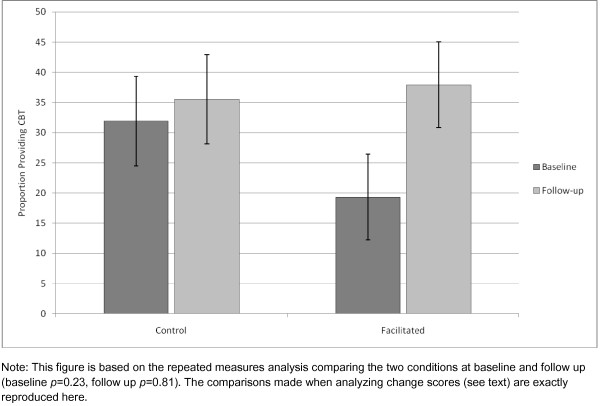
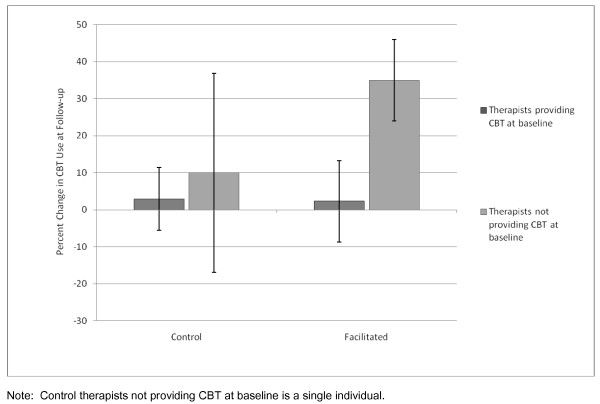
BACKGROUND: Although for more than a decade healthcare systems have attempted to provide evidence-based mental health treatments, the availability and use of psychotherapies remains low. A significant need exists to identify simple but effective implementation strategies to adopt complex practices within complex systems of care. Emerging evidence suggests that facilitation may be an effective integrative implementation strategy for adoption of complex practices. The current pilot examined the use of external facilitation for adoption of cognitive behavioral therapy (CBT) in 20 Department of Veteran Affairs (VA) clinics. METHODS: The 20 clinics were paired on facility characteristics, and 23 clinicians from these were trained in CBT. A clinic in each pair was randomly selected to receive external facilitation. Quantitative methods were used to examine the extent of CBT implementation in 10 clinics that received external facilitation compared with 10 clinics that did not, and to better understand the relationship between individual providers' characteristics and attitudes and their CBT use. Costs of external facilitation were assessed by tracking the time spent by the facilitator and therapists in activities related to implementing CBT. Qualitative methods were used to explore contextual and other factors thought to influence implementation. RESULTS: Examination of change scores showed that facilitated therapists averaged an increase of 19% [95% CI: (2, 36)] in self-reported CBT use from baseline, while control therapists averaged a 4% [95% CI: (-14, 21)] increase. Therapists in the facilitated condition who were not providing CBT at baseline showed the greatest increase (35%) compared to a control therapist who was not providing CBT at baseline (10%) or to therapists in either condition who were providing CBT at baseline (average 3%). Increased CBT use was unrelated to prior CBT training. Barriers to CBT implementation were therapists' lack of control over their clinic schedule and poor communication with clinical leaders. CONCLUSIONS: These findings suggest that facilitation may help clinicians make complex practice changes such as implementing an evidence-based psychotherapy. Furthermore, the substantial increase in CBT usage among the facilitation group was achieved at a modest cost.
Overview
The claims and statistics of this paper haven’t been checked yet.
Free: it reads the open-access text and checks the first 5 claims that cite a source we can check. Create a free account to check every claim.
Integrity signals
Registry
Cites
Statistics
Figures
Verification
Claims the paper makes
The claims and statistics of this paper haven’t been checked yet.
Free: it reads the open-access text and checks the first 5 claims that cite a source we can check. Create a free account to check every claim.
Self-check
Percentages, sums and reported differences re-computed from the paper’s own numbers.
The self-check needs the paper’s full text.
Citations
Cites
Diffusion of Innovations in Service Organizations: Systematic Review and Recommendations
GREENHALGH, T., ROBERT, G., MACFARLANE, F., BATE, P., & KYRIAKIDOU, O. (2004) · The Milbank Quarterly · doi:10.1111/j.0887-378x.2004.00325.x · Cited by 7,448
The cochrane database of systematic reviews
Geddes, J. (1996) · Journal of Psychosomatic Research · doi:10.1016/s0022-3999(96)90063-x · Cited by 5,989
(2005) · Cited by 3,748
Wang, P. S., Lane, M., Olfson, M., Pincus, H. A., Wells, K. B., & Kessler, R. C. (2005) · Archives of General Psychiatry · doi:10.1001/archpsyc.62.6.629 · Cited by 2,695 · cited 1×
“, only 41% of individuals who were diagnosed with a MH disorder received any MH services in a 12-month period [20].”
BackgroundBero, L. A., Grilli, R., Grimshaw, J. M., Harvey, E., Oxman, A. D., & Thomson, M. A. (1998) · BMJ · doi:10.1136/bmj.317.7156.465 · Cited by 2,396
Welcome to Implementation Science
Eccles, M. P., & Mittman, B. S. (2006) · Implementation Science · doi:10.1186/1748-5908-1-1 · Cited by 2,254
Enabling the implementation of evidence based practice: a conceptual framework.
Kitson, A., Harvey, G., & McCormack, B. (1998) · Quality in Health Care · doi:10.1136/qshc.7.3.149 · Cited by 1,985
Forsetlund, L., Bjørndal, A., Rashidian, A., Jamtvedt, G., O'Brien, M. A., Wolf, F. M., Davis, D., Odgaard-Jensen, J., & Oxman, A. D. (2009) · Cochrane Database of Systematic Reviews · doi:10.1002/14651858.cd003030.pub2 · Cited by 1,849
The Cochrane Database of Systematic Reviews
Handoll, H. H., Howe, T. E., & Madhok, R. (2002) · Physiotherapy · doi:10.1016/s0031-9406(05)60709-2 · Cited by 1,497
Kitson, A. L., Rycroft-Malone, J., Harvey, G., McCormack, B., Seers, K., & Titchen, A. (2008) · Implementation Science · doi:10.1186/1748-5908-3-1 · Cited by 1,314
Research works printed but not linked: 1
- Cully JA Teten AT A Therapist's Guide to Brief Cognitive Behavioral Therapy 2008 Houston, TX: South Central Mental Illness Research, Education, and Clinical Center
Cited by
Implementation strategies: recommendations for specifying and reporting
Proctor, E. K., Powell, B. J., & McMillen, J. C. (2013) · Implementation Science · doi:10.1186/1748-5908-8-139 · Cited by 2,585
“Thus, details about the dose or intensity of implementation strategies such as the amount of time spent with an external facilitator [39], the time and intensity of training [80], or the frequency of audit and feedback [81] should be designated a priori and reported.”
BackgroundChaudoir, S. R., Dugan, A. G., & Barr, C. H. (2013) · Implementation Science · doi:10.1186/1748-5908-8-22 · Cited by 800
“Therapist Characteristics and Barriers to Implementation [174] X X O: clinic type, location, organizational support [174] None Mental Health/ Substance Abuse PR: Perceived skills and ability, counseling discipline, level of education, workload, motivation”
InfluentialMichie, S., Wood, C. E., Johnston, M., Abraham, C., Francis, J. J., & Hardeman, W. (2015) · Health Technology Assessment · doi:10.3310/hta19990 · Cited by 680
Systematic Review and Meta-Analysis of Practice Facilitation Within Primary Care Settings
Baskerville, N. B., Liddy, C., & Hogg, W. (2012) · The Annals of Family Medicine · doi:10.1370/afm.1312 · Cited by 571
A multidisciplinary European guideline for tinnitus: diagnostics, assessment, and treatment
Cima, R. F. F., Mazurek, B., Haider, H., Kikidis, D., Lapira, A., Noreña, A., & Hoare, D. J. (2019) · HNO · doi:10.1007/s00106-019-0633-7 · Cited by 442
A systematic review of empirical studies examining mechanisms of implementation in health
Lewis, C. C., Boyd, M. R., Walsh-Bailey, C., Lyon, A. R., Beidas, R., Mittman, B., Aarons, G. A., Weiner, B. J., & Chambers, D. A. (2020) · Implementation Science · doi:10.1186/s13012-020-00983-3 · Cited by 363
“2010 [56] Veterans Affairs Clinics (k = 21); mental health providers (n = 23) Cognitive Behavioral Therapy Y mixed method, quasiexperimental, longitudinal (2 assessment points, 6 months), randomized”
BackgroundMethodInfluentialA Systematic Review of Strategies for Implementing Empirically Supported Mental Health Interventions
Powell, B. J., Proctor, E. K., & Glass, J. E. (2014) · Research on Social Work Practice · doi:10.1177/1049731513505778 · Cited by 268
“Four of the studies used theory to inform the selection of the implementation strategies (Atkins et al., 2008; Forsner et al., 2010; Kauth et al., 2010; Lochman et al., 2009).”
BackgroundMethodKarlin, B. E., & Cross, G. (2014) · American Psychologist · doi:10.1037/a0033888 · Cited by 283
Tracking implementation strategies: a description of a practical approach and early findings
Bunger, A. C., Powell, B. J., Robertson, H. A., MacDowell, H., Birken, S. A., & Shea, C. (2017) · Health Research Policy and Systems · doi:10.1186/s12961-017-0175-y · Cited by 208
Edmunds, J. M., Beidas, R. S., & Kendall, P. C. (2013) · Clinical Psychology: Science and Practice · doi:10.1111/cpsp.12031 · Cited by 208
“…2007), and ongoing support strategies, such as audit and feedback (Jamtvedt, Young, Kristoffersen, O’Brien, & Oxman, 2006), consultation (e.g., Herschell, Kolko, Baumman, & Davis, 2010), facilitation (Kauth et al., 2010), and peer support networks (Institute for Healthcare Improvement, 2003).”
BackgroundInfluentialWriting implementation research grant proposals: ten key ingredients
Proctor, E. K., Powell, B. J., Baumann, A. A., Hamilton, A. M., & Santens, R. L. (2012) · Implementation Science · doi:10.1186/1748-5908-7-96 · Cited by 169
“[105], which demonstrated that an external facilitation strategy intended to increase the use of cognitive behavioral therapy within Veteran Affairs clinics was a promising and low-cost strategy; such pilot data would likely bolster reviewers’ confidence that the strategy is feasible, scalable, and ultimately, sustain…”
BackgroundWilliams, N. J. (2016) · Administration and Policy in Mental Health and Mental Health Services Research · doi:10.1007/s10488-015-0693-2 · Cited by 164
Bergström, A., Ehrenberg, A., Eldh, A. C., Graham, I. D., Gustafsson, K., Harvey, G., Hunter, S. C., Kitson, A. A., Rycroft‐Malone, J., & Wallin, L. (2020) · Implementation Science · doi:10.1186/s13012-020-01003-0 · Cited by 192
Fishman, J., Yang, C. F., & Mandell, D. S. (2021) · Implementation Science · doi:10.1186/s13012-021-01153-9 · Cited by 181
Implementation Support Skills: Findings From a Systematic Integrative Review
Albers, B., Metz, A. J. R., Burke, K., Bührmann, L., Bartley, L., Driessen, P., & Varsi, C. (2020) · Research on Social Work Practice · doi:10.1177/1049731520967419 · Cited by 106
“…and problems faced as part of the change efforts, typically related to learning a new practice (Dusenbury et al., 2010; Eiraldi et al., 2018; Kauth et al., 2010; Nadeem, Gleacher, Pimentel, et al., 2013) and/or enabling its implementation within a particular local context (Rosella et al.,…”
BackgroundBidassie, B., Williams, L. S., Woodward-Hagg, H., Matthias, M. S., & Damush, T. M. (2015) · Implementation Science · doi:10.1186/s13012-015-0252-y · Cited by 93
“[8] that an important barrier to implementation was team members’ poor communication with clinical leaders, and therefore, communication and team cohesiveness were factors targeted by our external facilitators.”
BackgroundCully, J. A., Armento, M. E. A., Mott, J., Nadorff, M. R., Naik, A. D., Stanley, M. A., Sorocco, K. H., Kunik, M. E., Petersen, N. J., & Kauth, M. R. (2012) · Implementation Science · doi:10.1186/1748-5908-7-64 · Cited by 72
“Comparative effectiveness trials suggest a general equivalence between CBT and other therapeutic modalities [44], with CBT being particularly well-suited for implementation within primary care settings, given its skill-based approach and ability to function with a restricted time and session framework [45,46].”
BackgroundMethodInfluentialSelf-citationPredicting implementation from organizational readiness for change: A study protocol
Helfrich, C. D., Blevins, D., Smith, J. L., Kelly, P. A., Hogan, T. P., Hagedorn, H., Dubbert, P. M., & Sales, A. E. (2011) · Implementation Science · doi:10.1186/1748-5908-6-76 · Cited by 66
“These partner projects are described in detail in Additional File 2[41-71].”
BackgroundSelf-citationLindsay, J. A., Kauth, M. R., Hudson, S., Martin, L. A., Ramsey, D. J., Daily, L., & Rader, J. (2015) · Telemedicine and e-Health · doi:10.1089/tmj.2014.0114 · Cited by 66
“An external facilitator uses a combination of strategies based on individual needs of a local setting to enable change within a complex system.(28)”
MethodResultSelf-citationMoussa, L., García‐Cárdenas, V., & Benrimoj, S. I. (2019) · Journal of Change Management · doi:10.1080/14697017.2019.1602552 · Cited by 76
“Seven studies reported facilitators using the Plan-Do-Study-Act (PDSA) cycle (Dickinson et al., 2015; Eriksson et al., 2013; Gustafson et al., 2013; Kauth et al., 2010; Margolis et al., 2004; Mold, Aspy, & Nagykaldi, 2008; Rycroft-Malone et al., 2012).”
BackgroundMethodMignogna, J., Martin, L. A., Harik, J., Hundt, N. E., Kauth, M., Naik, A. D., Sorocco, K., Benzer, J., & Cully, J. (2018) · Implementation Science · doi:10.1186/s13012-018-0768-z · Cited by 47
Self-citationBetween and within-site variation in qualitative implementation research
Benzer, J. K., Beehler, S., Cramer, I. E., Mohr, D. C., Charns, M. P., & Burgess, J. F. (2013) · Implementation Science · doi:10.1186/1748-5908-8-4 · Cited by 45
“Many multisite implementation studies do not include qualitative methods [22-26], and those few that do tend to sample broadly across sites (and narrowly within a site) in order to understand between-site variation [27-29].”
BackgroundBührmann, L., Driessen, P., Metz, A. J. R., Burke, K., Bartley, L., Varsi, C., & Albers, B. (2022) · PLoS ONE · doi:10.1371/journal.pone.0267533 · Cited by 68
“…of strengths and successes present in the implementation context [97, 100, 102, 110], providing constructive, motivating feedback and support [83, 87, 94, 106], validating and encouraging the work of implementers [108, 119, 123] and providing “the energy and direction to stay on track” (p. 422)…”
Baumann, A. A., Domenech Rodríguez, M. M., Amador, N. G., Forgatch, M. S., & Parra-Cardona, J. R. (2014) · Clinical Psychology: Science and Practice · doi:10.1111/cpsp.12059 · Cited by 44
“The implementation process is usually led by a team of researchers, with the help of the facilitator, who is the person who knows the organization and the setting where the intervention is being implemented, and works to facilitate the process of incorporating the EBT in the new setting (Kauth et al., 2010).”
BackgroundImplementing brief cognitive behavioral therapy in primary care: A pilot study
Mignogna, J., Hundt, N. E., Kauth, M. R., Kunik, M. E., Sorocco, K. H., Naik, A. D., Stanley, M. A., York, K. M., & Cully, J. A. (2014) · Translational Behavioral Medicine · doi:10.1007/s13142-013-0248-6 · Cited by 39
“While prior research suggests confirmation of clinician self-evaluated competency is necessary [12, 13], these initial competencies may have improved the “uptake” of the implementation strategy.”
BackgroundResultSelf-citationGoldsmith, E. S., Koffel, E., Ackland, P. E., Hill, J., Landsteiner, A., Miller, W., Stroebel, B., Ullman, K., Wilt, T. J., & Duan-Porter, W. (2023) · Journal of General Internal Medicine · doi:10.1007/s11606-023-08140-4 · Cited by 38
Garner, B. R., Gotham, H. J., Chaple, M., Martino, S., Ford, J. H., Roosa, M. R., Speck, K. J., Vandersloot, D., Bradshaw, M., Ball, E. L., et al. (2020) · Implementation Research and Practice · doi:10.1177/2633489520948073 · Cited by 40
“…that identified facilitation as a promising strategy (Baskerville et al., 2012; Cully et al., 2012; Gustafson et al., 2013; Harvey et al., 2002; Kauth et al., 2010; Kitson et al., 2008; Liddy et al., 2011; Owen et al., 2013; Parchman et al., 2013; Seers et al., 2012; Stetler et al., 2006), we…”
Stirman, S. W., Gutierrez‐Colina, A. M., Toder, K., Esposito, G., Barg, F. K., Castro, F., Beck, A. T., & Crits-Christoph, P. F. (2012) · Administration and Policy in Mental Health and Mental Health Services Research · doi:10.1007/s10488-012-0418-8 · Cited by 43
“Facilitative strategies to address such barriers during CT training programs have been shown to be more effective than training alone (Kauth et al. 2010).”
BackgroundKauth, M. R., Sullivan, G., Cully, J., & Blevins, D. (2011) · Psychological Services · doi:10.1037/a0022250 · Cited by 32
Self-citationSmith, S. N., Almirall, D., Choi, S. Y., Koschmann, E., Rusch, A., Bilek, E. L., Lane, A., Abelson, J. L., Eisenberg, D., Himle, J. A., et al. (2022) · Implementation Science · doi:10.1186/s13012-022-01211-w · Cited by 38
“, that completed training) reporting CBT delivery at least once (relative to CBT adoption rates of 35–40% elsewhere [90]).”
BackgroundA Bibliography of Randomized Controlled Experiments in Social Work (1949–2013): Solvitur Ambulando
Thyer, B. A. (2015) · Research on Social Work Practice · doi:10.1177/1049731515599174 · Cited by 37
The Mechanisms of Implementation Support - Findings from a Systematic Integrative Review
Albers, B., Metz, A. J. R., Burke, K., Bührmann, L., Bartley, L., Driessen, P., & Varsi, C. (2021) · Research on Social Work Practice · doi:10.1177/10497315211042375 · Cited by 41
“This included organizational behaviors such as organizing schedules or workloads in ways that allowed staff to attend ISP-run support sessions (Bidassie et al., 2015; Dogherty, Harrison, Graham, Vandyk, & Keeping-Burke, 2013; Gerrish et al., 2012; Graaf et al., 2017; Holtrop et al., 2008; Kauth et al., 2010; Kinley et…”
BackgroundGarner, B. R., Zehner, M. E., Roosa, M. R., Martino, S., Gotham, H. J., Ball, E. L., Stilen, P., Speck, K. J., Vandersloot, D., Rieckmann, T. R., et al. (2017) · Addiction Science & Clinical Practice · doi:10.1186/s13722-017-0096-7 · Cited by 28
Carter, P. M., Cunningham, R. M., Eisman, A. B., Resnicow, K., Roche, J., Cole, J. T., Goldstick, J. E., Kilbourne, A. M., & Walton, M. A. (2021) · Journal of Emergency Medicine · doi:10.1016/j.jemermed.2021.09.003 · Cited by 26
Stirman, S. W., Gutner, C. A., Gamarra, J., Suvak, M. K., Vogt, D., Johnson, C., Wachen, J. S., Dondanville, K. A., Yarvis, J. S., Mintz, J., et al. (2021) · Behavior Therapy · doi:10.1016/j.beth.2020.08.005 · Cited by 24
“Moreover, because therapists often perceive a self-report of their fidelity to treatment as adding to an already high paperwork burden, they may over- or underreport their use of prescribed treatment elements or not complete the reports as directed (Kauth et al., 2010).”
BackgroundStirman, S. W., Marques, L. M., Creed, T. A., Gutner, C. A., DeRubeis, R. J., Barnett, P. G., Kuhn, E. R., Suvak, M. K., Owen, J. E., Vogt, D. S., et al. (2018) · Implementation Science · doi:10.1186/s13012-018-0756-3 · Cited by 23
“Both our preliminary work and published literature [27] indicate that clinicians (1) perceive adherence checklists as adding to an already high paperwork burden, (2) may not complete them as directed, and (3) may over- or underreport use of prescribed treatment elements.”
BackgroundRole enactment of facilitation in primary care – a qualitative study
Due, T. D., Thorsen, T., Waldorff, F. B., & Kousgaard, M. B. (2017) · BMC Health Services Research · doi:10.1186/s12913-017-2537-0 · Cited by 21
Implementation Science is Imperative to the Optimization of Obstetric Care
Hamm, R. F., Iriye, B. K., & Srinivas, S. K. (2020) · American Journal of Perinatology · doi:10.1055/s-0040-1721728 · Cited by 21
Study protocol: ICONS: Identifying continence options after stroke: A randomised trial
The ICONS Project Team and the ICONS Patient, P. A. C. I. G., Thomas, L. H., Watkins, C. L., French, B., Sutton, C., Forshaw, D., Cheater, F., Roe, B. H., Leathley, M. J., Burton, C. R., et al. (2011) · Trials · doi:10.1186/1745-6215-12-131 · Cited by 21
Beehler, G. P., Funderburk, J. S., King, P. R., Wade, M. J., & Possemato, K. (2015) · Translational Behavioral Medicine · doi:10.1007/s13142-015-0325-0 · Cited by 21
“Additionally, our finding is consistent with other efforts in VHA to improve the implementation of cognitive behavioral therapy in primary care thereby increasing the availability of evidence-based mental health treatments [31–33].”
ResultSarfan, L. D., Agnew, E. R., Diaz, M., Dong, L., Fisher, K., Spencer, J. M., Howlett, S. A., Hache, R. E., Callaway, C. A., Kilbourne, A. M., et al. (2023) · Trials · doi:10.1186/s13063-023-07148-9 · Cited by 22
“In the present research, facilitation was selected as the core implementation strategy used to implement TranS-C in the CMHCs, based on promising evidence [53–55].”
MethodDissemination and Implementation Research
Proctor, E. K. (2014) · Oxford University Press eBooks · doi:10.1093/acrefore/9780199975839.013.900 · Cited by 16
Cucciare, M. A., Curran, G. M., Craske, M. G., Abraham, T. H., McCarthur, M. B., Marchant‐Miros, K., Lindsay, J. A., Kauth, M. R., Landes, S. J., & Sullivan, G. (2015) · Implementation Science · doi:10.1186/s13012-016-0432-4 · Cited by 15
“Thereafter, the facilitator will meet by phone with each therapist at least once a month for 3 months and be available on an “as-needed” basis for an additional 3-month period [21].”
BackgroundMethodInfluentialSelf-citationBarac, R., Kimber, M., Johnson, S. N., & Barwick, M. A. (2018) · Journal of Evidence-Informed Social Work · doi:10.1080/23761407.2018.1480988 · Cited by 16
“…to the growing work which suggests the need to build an infrastructure to support learning and practice change, with consultation included as an essential part of it (Barwick et al., submitted; Durlak & DuPre, 2008; Kauth et al., 2010; Lyon, Stirman, Kerns, & Bruns, 2011; McHugh & Barlow, 2010).”
BackgroundMethodImplementation of an evidence-based biobehavioral treatment for cancer patients
Ryba, M. M., Brothers, B. M., & Andersen, B. L. (2017) · Translational Behavioral Medicine · doi:10.1007/s13142-016-0459-8 · Cited by 14
“Much of the organizational EBT literature chronicles negative aspects that hinder implementation [54, 58].”
BackgroundSmelson, D. A., Yakovchenko, V., Byrne, T. H., McCullough, M. B., Smith, J. L., Bruzios, K. E., & Gabrielian, S. E. (2022) · PLoS ONE · doi:10.1371/journal.pone.0265396 · Cited by 13
“Recent literature on facilitation indicates that it has a mixed legacy in implementation work; in some other studies facilitation is not as effective as the literature suggests in terms of format (active versus passive implementation strategies) and dose, however, for MISSION-Vet facilitation was a relatively producti…”
Stirman, S. W., Miller, C. J., Toder, K., Calloway, A. L., Beck, A. T., Evans, A. C., & Crits-Christoph, P. F. (2012) · Depression Research and Treatment · doi:10.1155/2012/391084 · Cited by 15
“Given the critical role of training in EBT implementation, more information on factors associated with the success and challenges of training programs is needed.”
BackgroundGarner, B. R., Hunter, S. B., Slaughter, M. E., Han, B., & Godley, S. H. (2017) · Drug and Alcohol Dependence · doi:10.1016/j.drugalcdep.2017.08.011 · Cited by 12
“1; Garner et al., 2012; Kauth et al., 2010; Parchman et al., 2013; Stetler et al., 2006).”
Hudon, C., Bisson, M., Chouinard, M., Delahunty‐Pike, A., Lambert, M., Howse, D., Schwarz, C. M., Dumont‐Samson, O., Aubrey‐Bassler, K., Burge, F., et al. (2023) · BMC Health Services Research · doi:10.1186/s12913-023-09379-7 · Cited by 16
Cima, R. F. F. (2017) · Springer eBooks · doi:10.1007/978-3-319-58397-6_8 · Cited by 17
Influences of peer facilitation in general practice – a qualitative study
Due, T. D., Kousgaard, M. B., Waldorff, F. B., & Thorsen, T. (2018) · BMC Family Practice · doi:10.1186/s12875-018-0762-1 · Cited by 11
Callaway, C. A., Sarfan, L. D., Agnew, E. R., Dong, L., Spencer, J. M., Hache, R. E., Diaz, M., Howlett, S. A., Fisher, K., Hilmoe, H. E., et al. (2023) · Trials · doi:10.1186/s13063-023-07523-6 · Cited by 12
Lambdin, B. H., Bluthenthal, R. N., Garner, B. R., Wenger, L. D., Browne, E. N., Morris, T., Ongais, L., Megerian, C. E., & Kral, A. H. (2024) · Implementation Science · doi:10.1186/s13012-024-01354-y · Cited by 10
Harvey, A. G., Agnew, E. R., Hache, R. E., Spencer, J. M., Diaz, M., Patino, E. O., Milner, A., Dong, L., Kilbourne, A. M., Buysse, D. J., et al. (2025) · Implementation Science · doi:10.1186/s13012-025-01440-9 · Cited by 13
“These findings add to the growing support for the Sleep Health Framework (e.g., [10, 89, 90]), REP (e.g., [91–94]), the i-PARIHS framework [8] and the use of external facilitation as an implementation strategy (e.g., [28, 50, 51]).”
Organizational Change – Technology Transfer Processes: A Review of the Literature
Taxman, F. S., & Belenko, S. R. (2011) · Springer eBooks · doi:10.1007/978-1-4614-0412-5_4 · Cited by 10
Kauth, M. R., Adler, G., McCandless, S. J., & Leopolous, W. S. (2016) · The Journal of Mental Health Training Education and Practice · doi:10.1108/jmhtep-01-2016-0001 · Cited by 8
Self-citationDonepezil for cancer-related cognitive impairment: systematic review and meta-analysis
Fornalik, M., Moska, S., Gimła, M., Yabluchanskiy, A., & Pinto, C. B. (2025) · Clinical and Experimental Medicine · doi:10.1007/s10238-025-01708-w · Cited by 9
“However, non-pharmacological interventions also have limitations, such as the need for trained personnel to super-vise cognitive training or its implementation, the long duration required for noticeable effects or considerable time commitment from the patient and often their caregivers [17, 18].”
Pérez-Escamilla, B., Benrimoj, S. I., Martínez‐Martínez, F., Gastelurrutia, M. Á., Doval, R. V., Musial-Gabrys, K., & García‐Cárdenas, V. (2020) · Research in Social and Administrative Pharmacy · doi:10.1016/j.sapharm.2020.12.007 · Cited by 9
Training Community Mental Health Agencies in Cognitive Therapy for Schizophrenia.
Riggs, S. E., Stirman, S. W., & Beck, A. T. (2012) · PubMed · Cited by 6
Cucciare, M. A., Marchant‐Miros, K., Lindsay, J. A., Craske, M. G., Ecker, A. H., Day, S. C., Hogan, J., Henn, J., LeBeau, R. T., Rabalais, A., et al. (2019) · The Journal of Rural Health · doi:10.1111/jrh.12398 · Cited by 5
Kjøge, A., Turtumøygard, T., Berge, T., & Ogden, T. (2015) · The Cognitive Behaviour Therapist · doi:10.1017/s1754470x15000471 · Cited by 6
“In another study, 23 therapists received coaching after training in CBT in order to help them identify and solve problems that occurred when they started using CBT in their clinical practice (Kauth et al. 2010).”
BackgroundMethodResultHarvey, A. G., Agnew, E. R., Hache, R. E., Callaway, C. A., Patino, E. O., Milner, A., Spencer, J. M., Diaz, M., Dong, L., Kilbourne, A. M., et al. (2025) · Implementation Science · doi:10.1186/s13012-025-01467-y · Cited by 7
“Facilitation was chosen as the implementation strategy to support TTT due to its strong evidence base (e.g., [37–39]).”
Lau, E. Y., Small, S. S., Butcher, K., Cragg, A., Loh, G. W., Shalansky, S., & Hohl, C. M. (2023) · Frontiers in Health Services · doi:10.3389/frhs.2023.1106586 · Cited by 5
“Consistent with previous research, we found that external facilitation was effective in increasing the uptake of ActionADE, but effects varied by sites (28, 29, 32).”
BackgroundResultSarfan, L. D., Agnew, E. R., Diaz, M., Cogan, A. B., Spencer, J. M., Hache, R. E., Stirman, S. W., Lewis, C. C., Kilbourne, A. M., & Harvey, A. G. (2024) · Trials · doi:10.1186/s13063-023-07900-1 · Cited by 5
“Two knowledge items, modeled on Kauth et al. [40], are rated on a scale from 0 (not at all) to 7 (extremely), where higher scores indicate more knowledge.”
BackgroundMethodDuan, K. I., Helfrich, C. D., Rao, S. V., Neely, E. L., Sulc, C. A., Naranjo, D. E., & Wong, E. S. (2021) · Implementation Science Communications · doi:10.1186/s43058-021-00219-5 · Cited by 3
A thematic analysis of broker consultation in a TF-CBT community based learning collaborative
Patel, Z. S., Casline, E. P., & Jensen‐Doss, A. (2022) · Journal of Child & Adolescent Trauma · doi:10.1007/s40653-022-00472-3 · Cited by 5
“Thus, consultation may create an infrastructure to support community change after implementation efforts have ended (Durlak & DuPre, 2008; Kauth et al., 2010; Lyon et al., 2014), but consultants also need to remain mindful of the system-level constraints that may be a barrier to referral, like the…”
BackgroundConceptual Model: Evidence Based Interagency Implementation Model
Taxman, F. S., & Belenko, S. R. (2011) · Springer eBooks · doi:10.1007/978-1-4614-0412-5_9 · Cited by 3
A Comparison of Scalable Routine Clinical Materials and Observer Ratings to Assess CBT Fidelity
Calloway, A. L., Creed, T. A., Gumport, N., Gutner, C. A., Marques, L. M., Hernandez, S., Song, J., Johnson, C. M., Youn, S. J., Elhusseini, S. A., et al. (2024) · Behaviour Research and Therapy · doi:10.1016/j.brat.2024.104655 · Cited by 2
Egeland, K. M. (2018) · NVA (Nasjonalt vitenarkiv) · Cited by 3
Garner, B. R., Tueller, S., Bradshaw, M., Speck, K. J., Satre, D. D., Rash, C. J., Donohoe, T., Mungo, J., Philbrick, S. M., Ruwala, R., et al. (2024) · Research Square · doi:10.21203/rs.3.rs-4614222/v1 · Cited by 2
“Consistent with other research that has used motivational interviewing as an implementation strategy [46, 47], ISF uses key principles of motivational interviewing (i.e., engaging, focusing, evoking, planning) as a guide.”
MethodGarner, B. R., Tueller, S., Bradshaw, M., Speck, K. J., Satre, D. D., Rash, C. J., Donohoe, T., Mungo, J., Philbrick, S. M., Ruwala, R., et al. (2023) · Research Square · doi:10.21203/rs.3.rs-3685134/v1 · Cited by 1
Helsepersonell si praktisering av kognitiv åtferdsterapi
Juklestad, S. I. (2011)
Pachankis, J. E., Chiaramonte, D. M., Baldwin, H. T., Prachniak, C., Levine, D. S., Van, S., Hobbs, R. J., Ankrum, H., Wilkins, L. J., Harvey, T. D., et al. (2025) · BMC Health Services Research · doi:10.1186/s12913-025-13136-3 · Cited by 1
Muse, K., Walklet, E., Anderson, K., & Rees-Davies, L. N. (2025) · The Cognitive Behaviour Therapist · doi:10.1017/s1754470x25100160 · Cited by 1
“The use of implementation facilitators to conduct bespoke needs assessments and implement individualised strategies to support change efforts may, therefore, be a cost-effective and pragmatic method of enhancing EB-CBT practices (Kauth et al ., 2010).”
InfluentialSarfan, L. D., Ge, L., Agnew, E. R., Diaz, M., Fisher, K., Howlett, S. A., Hache, R. E., Spencer, J., & Harvey, A. G. (2025) · Research Square · doi:10.21203/rs.3.rs-6107938/v1 · Cited by 1
Kacmarek, C. N., Vivino, A. A., Smith, H. C., & Kreyenbuhl, J. A. (2025) · BMC Psychiatry · doi:10.1186/s12888-025-07248-7
“…is mixed: the amount of time spent in implementation activities was associated with improved delivery of medications for alcohol use disorder in substance use and primary care clinics [81], but was not associated with therapist delivery of cognitive behavioral therapy in primary care clinics [90].”
Garner, B. R., Tueller, S., Bradshaw, M., Speck, K. J., Satre, D. D., Rash, C. J., Donohoe, T., Mungo, J., Philbrick, S. M., Ruwala, R., et al. (2025) · Implementation Research and Practice · doi:10.1177/26334895251389475 · Cited by 1
“Consistent with other research that has used motivational interviewing as an implementation strategy (Hettema et al., 2014; Kauth et al., 2010), ISF uses key principles of motivational interviewing (i.e., engaging, focusing, evoking, planning) as a guide.”
Larocque, J. (2013) · Papyrus : Institutional Repository (Université de Montréal)
Lewis, C. C., Boyd, M. R., Walsh‐Bailey, C., Lyon, A. R., Beidas, R., Mittman, B., Aarons, G. A., Weiner, B. J., & Chambers, D. (2020) · Figshare · doi:10.6084/m9.figshare.12144159
Lewis, C. C., Boyd, M. R., Walsh‐Bailey, C., Lyon, A. R., Beidas, R., Mittman, B., Aarons, G. A., Weiner, B. J., & Chambers, D. (2020) · Figshare · doi:10.6084/m9.figshare.12144168
Duan, K. I., Helfrich, C. D., Rao, S. V., Neely, E. L., Sulc, C. A., Naranjo, D., & Wong, E. S. (2021) · Figshare · doi:10.6084/m9.figshare.16893157
Smith, S. N., Almirall, D., Choi, S. Y., Koschmann, E., Rusch, A., Bilek, E. L., Lane, A., Abelson, J. L., Eisenberg, D., Himle, J. A., et al. (2022) · Figshare · doi:10.6084/m9.figshare.20279450
Hudon, C., Bisson, M., Chouinard, M., Delahunty‐Pike, A., Lambert, M., Howse, D., Schwarz, C., Dumont‐Samson, O., Aubrey-Bassler, K., Burge, F., et al. (2023) · Figshare · doi:10.6084/m9.figshare.22662482
Lewis, C. C., Boyd, M. R., Walsh‐Bailey, C., Lyon, A. R., Beidas, R., Mittman, B., Aarons, G. A., Weiner, B. J., & Chambers, D. (2020) · Figshare · doi:10.6084/m9.figshare.12144174
Sarfan, L. D., Agnew, E. R., Diaz, M., Cogan, A. B., Spencer, J. M., Hache, R. E., Stirman, S. W., Lewis, C. C., Kilbourne, A. M., & Harvey, A. G. (2024) · Figshare · doi:10.6084/m9.figshare.25001682
Lambdin, B. H., Bluthenthal, R. N., Garner, B. R., Wenger, L. D., Browne, E. N., Morris, T., Ongais, L., Megerian, C. E., & Kral, A. H. (2024) · Figshare · doi:10.6084/m9.figshare.25309948
Duan, K. I., Helfrich, C. D., Rao, S. V., Neely, E. L., Sulc, C. A., Naranjo, D., & Wong, E. S. (2021) · Figshare · doi:10.6084/m9.figshare.16893154
Sarfan, L. D., Agnew, E. R., Diaz, M., Dong, L., Fisher, K., Spencer, J. M., Howlett, S. A., Hache, R. E., Callaway, C. A., Kilbourne, A. M., et al. (2024) · Figshare · doi:10.6084/m9.figshare.26575673
Rose, A. L., Jack, H. E., Aaron, L., Jacobs, Y., Ciya, N., Ndamase, S., Johnson, K., Regenauer, K. S., Kagee, A., Kohrt, B. A., et al. (2026) · SSM - Mental Health · doi:10.1016/j.ssmmh.2026.100655
Affirmative Cognitive Behavioral Therapy: Theoretical and Empirical Foundations
Craig, S. L. (2026) · Oxford University Press eBooks · doi:10.1093/9780197778654.003.0001
Craig, S. L. (2026) · Oxford University Press eBooks · doi:10.1093/9780197778654.002.0006
Austin, A., Yang, W., & Craig, S. L. (2026) · Oxford University Press eBooks · doi:10.1093/9780197778654.003.0004
Troubleshooting Common Clinical Challenges
Craig, S. L. (2026) · Oxford University Press eBooks · doi:10.1093/9780197778654.003.0005
Muroff, J. R. (2026) · Oxford University Press eBooks · doi:10.1093/9780197778654.002.0005
Core Affirmative CBT Content and Clinical Strategies
Pascoe, R. V., Hui, J., & Craig, S. L. (2026) · Oxford University Press eBooks · doi:10.1093/9780197778654.003.0003
Craig, S. L. (2026) · Oxford University Press eBooks · doi:10.1093/9780197778654.002.0007
Affirmative CBT: A Brief Review of the Evidence with Sexual and Gender Diverse Populations
Craig, S. L. (2026) · Oxford University Press eBooks · doi:10.1093/9780197778654.003.0002
Metadata
- Authors
- Kauth, M. R., Sullivan, G., Blevins, D., Cully, J. A., Landes, R. D., Said, Q., & Teasdale, T. A.
- Affiliations
- Michael E. DeBakey VA Medical Center (US)
- United States Department of Veterans Affairs (US)
- Central Arkansas Veterans Healthcare System (US)
- Corresponding author
- Kauth, Michael R
- Venue
- Implementation Science
- Published
- 2010-10-13
- Volume
- 5
- Issue
- 1
- Pages
- 75-75
- ISSN
- 1748-5908 (ISSN-L)
- PMC
- PMC2964555
- OpenAlex
- W2132636203
- Cited by
- 98
- References
- 39
- Citations by year
- 2026: 10 · 2025: 8 · 2024: 7 · 2023: 7 · 2022: 5 · 2021: 6 · 2020: 10 · 2019: 3 · 2018: 5 · 2017: 6 · 2016: 1 · 2015: 8 · 2014: 2 · 2013: 8 · 2012: 6
- FWCI
- 11.39
- Type
- journal article
- Language
- en
- Open access
- gold
- doi.org
- Licence
- Locations
- Implementation Science (publishedVersion, cc-by)
- PubMed Central (publishedVersion, cc-by)
- PubMed (publishedVersion)
- DOAJ (DOAJ: Directory of Open Access Journals) (submittedVersion)
- Funders
- Quality Enhancement Research Initiative
- Topics
- Health Sciences › Health Professions › General Health Professions › Health Policy Implementation Science
- Social Sciences › Psychology › Clinical Psychology › Psychotherapy Techniques and Applications
- Social Sciences › Psychology › Clinical Psychology › Psychiatric care and mental health services
- Keywords
- external facilitation, cognitive behavioral therapy, veterans' mental health services, implementation costs
About these checks
Registry, retraction, Cites and statistics results are computed, not judged, with one exception: a printed reference that no index lists is read once by a model before it counts as a citation error. Claims are extracted by a model and kept only when their quote appears verbatim in the text; each cited source is then checked, with a model’s help, for whether it says what the claim relies on. Those verdicts can be wrong — read the claim’s quote and the cited source before relying on one.
Statistics and arithmetic are recomputed, not judged.
Confidence bands are shown only for fields calibrated on our annotated test set. None is calibrated yet, so no band is shown.
What counts as a claim ›How we measure confidence ›How we check this ›
Are you an author, or do you see a problem with this page? Request a review
Data sources
Bibliographic data: Semantic Scholar, OpenAlex, Crossref.
Contains information from the Semantic Scholar Academic Graph Datasets, made available under the ODC Attribution License (ODC-BY 1.0).
Semantic Scholar’s data is described in: Kinney, R., et al. (2023). The Semantic Scholar Open Data Platform. arXiv:2301.10140.
