

Validation of the theoretical domains framework for use in behaviour change and implementation research
Open accessThe DOI matches its Crossref record; 59 of the 61 references it cites were found in a registry or an index; 12 of the 35 sources its claims cite were checked for support.
Abstract
BACKGROUND: An integrative theoretical framework, developed for cross-disciplinary implementation and other behaviour change research, has been applied across a wide range of clinical situations. This study tests the validity of this framework. METHODS: Validity was investigated by behavioural experts sorting 112 unique theoretical constructs using closed and open sort tasks. The extent of replication was tested by Discriminant Content Validation and Fuzzy Cluster Analysis. RESULTS: There was good support for a refinement of the framework comprising 14 domains of theoretical constructs (average silhouette value 0.29): 'Knowledge', 'Skills', 'Social/Professional Role and Identity', 'Beliefs about Capabilities', 'Optimism', 'Beliefs about Consequences', 'Reinforcement', 'Intentions', 'Goals', 'Memory, Attention and Decision Processes', 'Environmental Context and Resources', 'Social Influences', 'Emotions', and 'Behavioural Regulation'. CONCLUSIONS: The refined Theoretical Domains Framework has a strengthened empirical base and provides a method for theoretically assessing implementation problems, as well as professional and other health-related behaviours as a basis for intervention development.
Overview
CoChat Summary
TL;DR
This validation study used open and closed card-sort tasks with behaviour-change experts to test the Theoretical Domains Framework, yielding a refined 14-domain, 84-construct framework. It supports the TDF’s structure while dropping “Nature of the Behaviours” and splitting or adding domains such as Optimism, Reinforcement, Intentions, and Goals.
Key findings
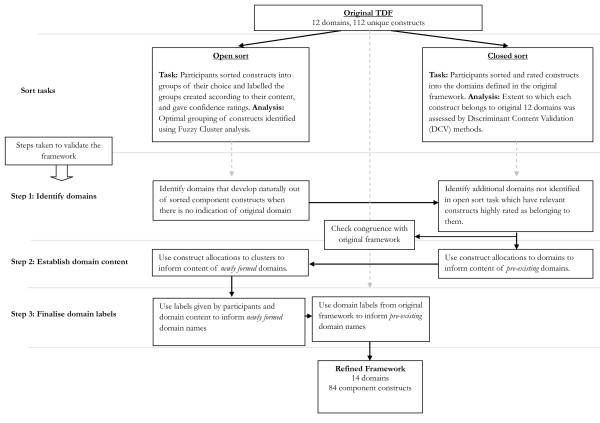
- The refined framework contains 14 domains and 84 component constructs: Knowledge, Skills, Social/Professional Role and Identity, Beliefs about Capabilities, Optimism, Beliefs about Consequences, Reinforcement, Intentions, Goals, Memory/Attention and Decision Processes, Environmental Context and Resources, Social Influences, Emotions, and Behavioural Regulation.
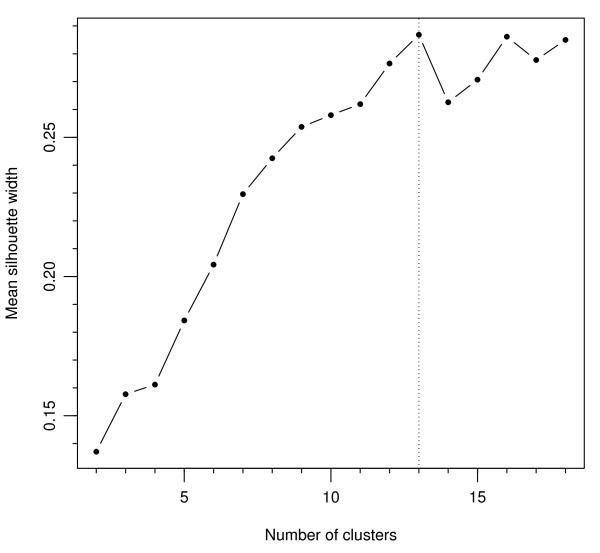
- The open sort produced a 13-cluster solution with the highest overall average silhouette value of 0.29; after removing low-silhouette constructs, 10 clusters had average silhouette values greater than 0.25, with an average of 0.47 across those 10 domains.
- Of the original 112 unique constructs, 34 were removed, leaving 84; “Nature of the Behaviours” was dropped because it was not represented by a single open-sort cluster and had only one construct assigned in the closed sort.
- Closed-sort congruence was >69% for Emotion, Skills, Motivation and Goals, Social/Professional Role and Identity, Beliefs about Capabilities, and Memory/Attention and Decision Processes, with fair ICCs (0.31–0.40); lower congruence was found for Knowledge, Environmental Context and Resources, and Social Influences (27%–50%), and for Behavioural Regulation, Nature of the Behaviours, and Beliefs about Consequences (<27%).
Methods
- Cross-sectional validation design. Eligible participants had a good understanding of behaviour change theory and were unaware of the original framework; 37 completed the tasks (18 closed sort, 19 open sort), mean age 36.54 years, 27 women and 10 men, mostly from the UK.
- Participants sorted 112 unique theoretical constructs after 12 duplicates were removed. The open sort asked participants to create and label their own groups (up to 24); the closed sort asked them to assign constructs to the original 12 labelled domains and rate confidence from 1 to 10.
- Analysis used Fuzzy Cluster Analysis with silhouette values for the open sort, Mantel correlations and Kendall’s W for sorting concordance, Discriminant Content Validation with one-sample t-tests against zero and Hochberg correction, and intraclass correlation coefficients for closed-sort agreement.
Limitations
- The paper states that two domains showed weak clustering: “Environmental Context and Resources” and “Behavioural Regulation.” It also states that the refined framework is limited to constructs identified in the original framework and does not cover all theories of behaviour change.
- Evident from the text: the sample was small and self-selected (37 completers; 18 closed, 19 open), mostly UK-based, and open-sort concordance was low (W = 0.22, p = 0.01). Several clusters had low silhouette values (<0.25) before construct removal, and “Knowledge” had no open-sort cluster, being retained based on closed-sort confidence ratings.
Model-written summary. Check it against the paper before relying on it.
Integrity signals
Registry
Cites
Statistics
Figures
Verification
Claims the paper makes
8 Valid · 2 Not valid · 7 Not checked · 74 Own results and interpretations
The cited sources support only part of this claim — read each source’s verdict below.
In the paper
“In a review of 235 guideline development and implementation studies, only 22.5% were judged to have used theories of behaviour change”
§ Validation of the theoretical domains framework for use in behaviour change and implementation research > Background
What the sources say
- Partly supportedcites [10] Davies P Walker AE Grimshaw J A systematic review of the use of theory in the design and implementation strategies and interpretation of the results of rigorous evaluations Implement Sci 2010 5 1 6 10.1186/1748-5908-5-1 20181130 PMC2832624 sourceExperimental — accuracy not yet measured
The Results report that 53 of 235 studies (22.5%) were judged to have employed theories of behaviour or behaviour change. The Abstract Methods identifies the studies as rigorous evaluations of guideline dissemination and implementation, not guideline development and implementation. (LLM, conf=0.86)
plain- Asserted: passes — The authors put it forward as true.
- Checkable: passes — It can be checked against evidence.
- Load-bearing: passes — The paper’s conclusions depend on it.
- Based: passes — The paper gives a reason why it holds.
- Partly supported
The cited sources support only part of this claim — read each source’s verdict below.
In the paper
“Research using the TDF has identified lack of knowledge as a potential barrier to a number of professional health behaviours, including hand hygiene [17], changing transfusion practice [19], and the adoption of tobacco use cessation counseling in dental practices [21].”
§ Validation of the theoretical domains framework for use in behaviour change and implementation research > Discussion
What the sources say
- Not checked — no full text of the sourcecites [17] Dyson J Lawton R Jackson C Cheater F Does the use of a theoretical approach tell us more about hand hygiene behaviour? The barriers and levers to hand hygiene J Infection Prev 2010 12 17 source
- Partly supportedcites [19] Francis J Tinmouth A Stanworth SJ Using theories of behaviour change to understand transfusion prescribing three clinical contexts in two countries: development work for and implementation trial Implement Sci 2009 4 70 10.1186/1748-5908-4-70 19852832 PMC2777847 sourceExperimental — accuracy not yet measured
The Abstract (Methods) and Methods (Interview study) say the planned TDF-based interviews will examine knowledge as a possible influence on transfusion decisions. The Background (UK and Canadian blood services) says factors hindering change in these clinical contexts had not yet been investigated. This paper therefore does not report that lack of knowledge was identified as a barrier to changing transfusion practice; the other behaviours have separate citations in the citing sentence. (LLM, conf=0.86)
- Partly supportedcites [21] Amemori M Korhonen T Kinnunen T Michie S Murtomaa H Enhancing implementation of tobacco use prevention and cessation counselling guideline among dental providers: a cluster randomised controlled trial Implement Sci 2011 6 13 10.1186/1748-5908-6-13 21320312 PMC3055178 sourceExperimental — accuracy not yet measured
The Background section lists knowledge as a domain in the theoretical-domains framework, and the Methods section says the authors planned to use that framework to assess difficulties with tobacco-cessation counselling in dental practices. But this paper does not report that it identified a lack of knowledge as a barrier; it says the assessment results will be reported elsewhere. This verdict addresses only the dental-practice clause attached to this citation. (LLM, conf=0.83)
hedgedstates an association- Asserted: passes — The authors put it forward as true.
- Checkable: passes — It can be checked against evidence.
- Load-bearing: passes — The paper’s conclusions depend on it.
- Based: passes — The paper gives a reason why it holds.
The cited sources that could be checked couldn’t confirm or dispute this claim.
In the paper
“Furthermore, where the domain has been used, in relation to changing transfusion practice, it was noted that when participants were asked questions relating to the ‘Nature of the Behaviours’ domain they often repeated answers that were previously given in response to questions relating to the ‘Behavioural Regulation’ domain [19]”
§ Validation of the theoretical domains framework for use in behaviour change and implementation research > Discussion
What the sources say
- Could not verifycites [19] Francis J Tinmouth A Stanworth SJ Using theories of behaviour change to understand transfusion prescribing three clinical contexts in two countries: development work for and implementation trial Implement Sci 2009 4 70 10.1186/1748-5908-4-70 19852832 PMC2777847 sourceExperimental — accuracy not yet measured
Split into 2 atoms — 0 confirmed, 0 partially supported, 0 disputed, 0 misattributed, 2 unverifiable. Expand the claim to see per-atom verdicts.
plainstates an association- Asserted: passes — The authors put it forward as true.
- Checkable: passes — It can be checked against evidence.
- Load-bearing: passes — The paper’s conclusions depend on it.
- Based: passes — The paper gives a reason why it holds.
- Could not verify
A result the paper reports from its own data — it cites no other source for it, so there is none to check. The quote shows it is in the paper.
In the paper
“This revealed that the majority of constructs (74/112) were strongly associated with only one cluster (i.e., showed membership values over 80% to one specific cluster, see Additional file 5).”
§ Validation of the theoretical domains framework for use in behaviour change and implementation research > Results > Sample size suitability and open sort pattern concordance
plainstates an association- Asserted: passes — The authors put it forward as true.
- Checkable: passes — It can be checked against evidence.
- Load-bearing: passes — The paper’s conclusions depend on it.
- Based: passes — The paper gives a reason why it holds.
A result the paper reports from its own data — it cites no other source for it, so there is none to check. The quote shows it is in the paper.
In the paper
“However, none of the multiple memberships indicated in the open sort results were replicated in the closed sort task where three different constructs, ‘Professional confidence’, ‘Beliefs’, and ‘Group identity’, were allocated to multiple domains.”
§ Validation of the theoretical domains framework for use in behaviour change and implementation research > Results > Sample size suitability and open sort pattern concordance
plain- Asserted: passes — The authors put it forward as true.
- Checkable: passes — It can be checked against evidence.
- Load-bearing: passes — The paper’s conclusions depend on it.
- Based: passes — The paper gives a reason why it holds.
35 more claims
Create a free account to see all 91 claims and to verify the 1 reference still open.
- Probably not a substantial claim. 29
- It may state two separate claims as one. 31
- The quote only partly states this claim. 2
Claims other papers make about this one
Each is checked against this paper’s own text: does it say what the citing paper says it does?
The source backs part of the claim, not all of it — or backs it for a different population, condition or comparison.
In the citing paper
“Theoretical Domains Framework represents another approach to developing determinant frameworks. It was constructed on the basis of a synthesis of 128 constructs related to behaviour change found in 33 behaviour change theories, including many social cognitive theories [10]. The constructs are sorted into 14 theoretical domains (originally 12 domains), e.g. knowledge, skills, intentions, goals,”
From Making sense of implementation theories, models and frameworks (2015) · cites this paper as [10]
Experimental — accuracy not yet measuredThe source backs part of the claim, not all of it — or backs it for a different population, condition or comparison.
In the citing paper
“Overarching change domains were chosen from the Theoretical Domains Framework (TDF) (68), an integrative framework that provides intervention developers with a possible selection of 14 change domains e.g., behavioral regulation and 84 change mechanisms e.g., self-monitoring from evidence-based behavior change theories.”
From Developing a mechanism-based therapy for acute psychiatric inpatients with psychotic symptoms: an Intervention Mapping approach (2023) · cites this paper as [68]
Experimental — accuracy not yet measuredThe source backs part of the claim, not all of it — or backs it for a different population, condition or comparison.
In the citing paper
“It has been increasingly acknowledged that consideration of patient acceptability using theories of behaviour change are key to effective evaluation, design and implementation of healthcare interventions [23–25] .”
From 'I didn't know what to expect': Exploring patient perspectives to identify targets for change to improve telephone-delivered psychological interventions (2020) · cites this paper as [25]
Experimental — accuracy not yet measuredThe source backs part of the claim, not all of it — or backs it for a different population, condition or comparison.
In the citing paper
“the TDF is a theoretical framework rather than a theory; it does not propose testable relationships between elements but provides a theoretical lens through which to view the cognitive, affective, social and environmental influences on behaviour.”
From A guide to using the Theoretical Domains Framework of behaviour change to investigate implementation problems (2017) · cites this paper as [16]
Experimental — accuracy not yet measuredThe source backs part of the claim, not all of it — or backs it for a different population, condition or comparison.
In the citing paper
“The central tenet of this model is that capability, opportunity and motivation interact to produce behaviour.”
From A guide to using the Theoretical Domains Framework of behaviour change to investigate implementation problems (2017) · cites this paper as [16]
Experimental — accuracy not yet measured
28 more claims about this paper
Create a free account to see every claim other papers make about this one.
Self-check
Percentages, sums and reported differences re-computed from the paper’s own numbers.
Each contradiction between two passages listed here was confirmed by an independent check.
Rated minor: it would not touch a result — a value no result rests on, a p-value that stays on the same side of the significance level, or a conflict that is clerical, resolved elsewhere in the paper, or outside its own findings.
In the paper
“This revealed that the majority of constructs (74/112) were strongly associated with only one cluster (i.e., showed membership values over 80% to one specific cluster, see Additional file 5). A further 32 constructs showed moderately high associations with one cluster (memberships values between 28% to 79%), with the remaining proportion of memberships for these constructs spread over other clusters. Only eight constructs”
§ Validation of the theoretical domains framework for use in behaviour change and implementation research > Results > Sample size suitability and open sort pattern concordance
Reported 112 · recomputed 114
Rated minor: it would not touch a result — a value no result rests on, a p-value that stays on the same side of the significance level, or a conflict that is clerical, resolved elsewhere in the paper, or outside its own findings.
In the paper
§ Validation of the theoretical domains framework for use in behaviour change and implementation research > Discussion
“Second, the ‘Nature of the Behaviours’ domain was dropped in the new framework, because its original component constructs were not assigned to the domain in the closed sort, and there was no cluster representing the ‘Nature of the Behaviours’ in the open sort.”
§ Validation of the theoretical domains framework for use in behaviour change and implementation research > Results > Sample size suitability and open sort pattern concordance
“‘Nature of the Behaviours’ only had one construct (Routine/automatic/habit) included from the original six constructs.”
Rated minor: it would not touch a result — a value no result rests on, a p-value that stays on the same side of the significance level, or a conflict that is clerical, resolved elsewhere in the paper, or outside its own findings.
In the paper
§ Validation of the theoretical domains framework for use in behaviour change and implementation research > Discussion
“Two domains showed weak clustering: ‘Environmental Context and Resources’ and ‘Behavioural Regulation’.”
§ Validation of the theoretical domains framework for use in behaviour change and implementation research > Results > Sample size suitability and open sort pattern concordance
“Three clusters remained with silhouettes below 0.25, ‘Environmental Context and Resources’, ‘Memory, Attention, and Decision Processes’, and ‘Behavioural Regulation’.”
Citations
Cites
The theory of planned behavior
Ajzen, I. (1991) · Organizational Behavior and Human Decision Processes · doi:10.1016/0749-5978(91)90020-t · Cited by 90,587
The Measurement of Observer Agreement for Categorical Data
Landis, J. R., & Koch, G. G. (1977) · Biometrics · doi:10.2307/2529310 · Cited by 81,148 · cited 1×
“61 as good to excellent agreement [44].”
Silhouettes: A graphical aid to the interpretation and validation of cluster analysis
Rousseeuw, P. J. (1987) · Journal of Computational and Applied Mathematics · doi:10.1016/0377-0427(87)90125-7 · Cited by 21,392 · cited 2×
“Silhouette values are calculated for each construct and range from +1, indicating strong association with a cluster and distance from neighboring clusters, through 0, indicating no distinct association with clusters, to −1, indicating that a construct is probably assigned to the wrong cluster and should be considered…”
BackgroundMethodMichie, S., van Stralen, M. M., & West, R. (2011) · Implementation Science · doi:10.1186/1748-5908-6-42 · Cited by 13,697 · cited 4×
“In designing interventions, the TDF fits well with the Behaviour Change Wheel (BCW) [46] referred to above.”
BackgroundMethodInfluentialSelf-citationFinding groups in data: an introduction to cluster analysis
(1991) · Choice Reviews Online · doi:10.5860/choice.28-4558 · Cited by 10,474
Finding Groups in Data: An Introduction to Cluster Analysis
Kaufman, L., & Rousseeuw, P. J. (1990) · Wiley Series in Probability and Statistics · doi:10.1002/9780470316801 · Cited by 7,344
Forming inferences about some intraclass correlation coefficients.
McGraw, K. O., & Wong, S. P. (1996) · Psychological Methods · doi:10.1037/1082-989x.1.1.30 · Cited by 6,903 · cited 1×
“To examine the agreement of these construct x domain ratings and construct assignment across participants, two-way intraclass correlation coefficient (ICC) measures of consistency were used within each domain [43].”
MethodDetermination and Quantification Of Content Validity
LYNN, M. R. (1986) · Nursing Research · doi:10.1097/00006199-198611000-00017 · Cited by 6,775 · cited 1×
“For contentvalidation tasks, such as those proposed in the closed sort task, two to 24 participants have been shown to be sufficient [29-32], with more than five participants reducing the influence of rater outliers [33].”
MethodReliability and Validity Assessment
Carmines, E., & Zeller, R. (1979) · doi:10.4135/9781412985642 · Cited by 5,884 · cited 1×
“For contentvalidation tasks, such as those proposed in the closed sort task, two to 24 participants have been shown to be sufficient [29-32], with more than five participants reducing the influence of rater outliers [33].”
MethodReliability and Validity Assessment
(2011) · The Encyclopedia of Political Science · doi:10.4135/9781608712434.n1341 · Cited by 5,040
Research works printed but not linked: 6
- Clinical Effectiveness Research Agenda Group (CERAG) An Implementation Research Agenda: A report prepared for the High Level Group on Clinical Effectiveness 2008 CERAG, London
- Paul CL A modified approach to a new card sorting methodology J Usability Stud 2008 4 7 30
- Taylor SE Health Psychology (5th Edition) 2003 MacGraw-Hill, Boston
- Oxford English Dictionary Online www.oed.com
- Ogden J Health Psychology: a textbook (2nd Edition) 2000 Open University Press, Buckingham
- Forsyth DR Group Dynamics (5th Edition) 2006 Wadsworth, Cengage Learning
Cited by
Items 4,001–4,100 of 4,858
Hernández-Negrín, H., Catena-Granados, N., Gómez‐Huelgas, R., et al. (2025) · Reumatología Clínica · doi:10.1016/j.reuma.2025.502037
Mooney, M., Weight, C., Biondi, M. J., Grebely, J., Kronfli, N., Barnett, T., Bruneau, J., Dunn, K. P. R., Ngbede, E. D., Etherington, C., et al. (2025) · Implementation Science Communications · doi:10.1186/s43058-025-00837-3 · Cited by 1
Shannon, O. M., Griffiths, A., Matu, J., et al. (2025) · medRxiv · doi:10.64898/2025.12.16.25342370
de Groot, P., Fadaei, S., Luime, J. J., Wagenaar, W., Vis, M., Kok, M. R., Bos, W. H., & Tchetverikov, I. (2025) · EULAR Rheumatology Open · doi:10.1016/j.ero.2025.11.021 · Cited by 1
“A topic guide, underpinned by the graphical framework for clinical decision-making [23] and the theoretical domain framework/COM-B model [24], structured the data collection.”
Co-designing narrative resources for implementation in lower limb amputation rehabilitation
Leggat, F., Wadey, R., Day, M., Winter, S., Sanders, P., & Smith, S. (2025) · Disability and Rehabilitation · doi:10.1080/09638288.2025.2600656
“…familiarised herself with two implementation theories (Consolidated Framework for Implementation Research [35], Theoretical Domains Framework v2 [36]) to increase awareness of barriers and facilitators likely to impact resource implementation and which should be considered during co-design…”
Elser, A., Kopkow, C., & Schäfer, A. G. M. (2026) · BMC Health Services Research · doi:10.1186/s12913-026-14967-4
“Determinate and process frameworks, such as the TDF [23] combined with the BCW [25] or the NASSS Framework [44], are helpful and have been used by others.”
Reale, S., Turner, R. R., Sutton, E., Taylor, S. J., Bourke, L., Morrissey, D., Brown, J., Rosario, D. J., & Steed, L. (2021) · Figshare · doi:10.6084/m9.figshare.14256839
Michas, M., Deuchar, L., Leigh, R., et al. (2020) · Figshare · doi:10.6084/m9.figshare.12845511
Kinchen, G., Cox, S., Kale, D., & Shahab, L. (2022) · Figshare · doi:10.6084/m9.figshare.20408434
Passey, M. E., Longman, J. M., Adams, C., Johnston, J. J., Simms, J., & Rolfe, M. (2020) · Figshare · doi:10.6084/m9.figshare.12134190
Presseau, J., Kasperavicius, D., Rodrigues, I. B., Braimoh, J., Chambers, A., Etherington, C., Giangregorio, L., Gibbs, J. C., Giguere, A. M., Graham, I. D., et al. (2022) · Figshare · doi:10.6084/m9.figshare.20438457
Kastner, M., Makarski, J., Hayden, L., Lai, Y., Chan, J., Treister, V., Harris, K., Munce, S., Holroyd-Leduc, J., Graham, I. D., et al. (2020) · Figshare · doi:10.6084/m9.figshare.12276935
Horppu, R., Väänänen, A., & Kausto, J. (2022) · Figshare · doi:10.6084/m9.figshare.19401852
Rankin, A., Gorman, A., Cole, J. A., Cadogan, C. A., Barry, H. E., Agus, A. M., Logan, D., McDowell, C., Molloy, G. J., Ryan, C. A., et al. (2022) · Figshare · doi:10.6084/m9.figshare.21077883
Schroé, H., Van Dyck, D., Paepe, A. L. D., Poppe, L., Loh, W. W., Verloigne, M., Loeys, T., De Bourdeaudhuij, I., & Crombez, G. (2020) · Figshare · doi:10.6084/m9.figshare.13065505
Horppu, R., Väänänen, A., & Kausto, J. (2022) · Figshare · doi:10.6084/m9.figshare.19401840
Schexnayder, J. K., Longenecker, C. T., Muiruri, C., Bosworth, H. B., Gebhardt, D., Gonzales, S. E., Hanson, J. E., Hileman, C. O., Okeke, N. L., Sico, I. P., et al. (2021) · Figshare · doi:10.6084/m9.figshare.13979419
Hall, A. M., Flodgren, G., Richmond, H. L., Welsh, S. M., Thompson, J., Furlong, B., & Sherriff, A. (2021) · Figshare · doi:10.6084/m9.figshare.15102790
Willmott, T. J., Pang, B., & Rundle-Thiele, S. R. (2021) · Figshare · doi:10.6084/m9.figshare.14702601
Kinchen, G., Cox, S., Kale, D., & Shahab, L. (2022) · Figshare · doi:10.6084/m9.figshare.20408431
Rosário, F., Santos, M. I., Angus, K., Pas, L., Ribeiro, C., & Fitzgerald, N. (2021) · Figshare · doi:10.6084/m9.figshare.13545356
Pellet, J., Weiss, M., Zúñiga, F., & Mabire, C. (2021) · Figshare · doi:10.6084/m9.figshare.14234533
Cumpston, M. S., Webb, S. A., Middleton, P., et al. (2021) · Figshare · doi:10.6084/m9.figshare.14329517
Rosário, F., Santos, M. I., Angus, K., Pas, L., Ribeiro, C., & Fitzgerald, N. (2021) · Figshare · doi:10.6084/m9.figshare.13545353
Lackey, S., Schmidtke, K. A., & Vlaev, I. (2021) · Figshare · doi:10.6084/m9.figshare.14906148
Szewczyk, Z., Reeves, P., Kingsland, M., Doherty, E. L., Elliott, E., Wolfenden, L., Tsang, T. W., Dunlop, A. J., Searles, A., & Wiggers, J. (2022) · Figshare · doi:10.6084/m9.figshare.19126380
Power, B., Kiezebrink, K., Allan, J. L., & Campbell, M. K. (2021) · Figshare · doi:10.6084/m9.figshare.14060139
Munene, A., Lang, E., Ewa, V., Hair, H. J., Cummings, G., McLane, P., Spackman, E., Faris, P., Zuzic, N., Quail, P. B., et al. (2020) · Figshare · doi:10.6084/m9.figshare.13285033
Kentab, B. Y., Barry, H. E., Al-Aqeel, S. A., & Hughes, C. M. (2024) · Figshare · doi:10.6084/m9.figshare.26712938
Oliwa, J. N., Nzinga, J., Masini, E., van Hensbroek, M. B., Jones, C., English, M., & Hoog, A. H. V. (2020) · Figshare · doi:10.6084/m9.figshare.13291009
Gleadhill, C., Alderman, K. B., Davidson, S. R. E., Kamper, S. J., Tutty, A., Robson, E., da Silva, P. V., Donald, B., Dooley, K., Manvell, J., et al. (2022) · Figshare · doi:10.6084/m9.figshare.21592574
Waddell, A., Lennox, A., Spassova, G., & Bragge, P. (2021) · Figshare · doi:10.6084/m9.figshare.15087614
Juckett, L., Bernard, K. P., & Thomas, K. S. (2023) · Figshare · doi:10.6084/m9.figshare.24585921
Wearn, A., Haste, A., Haighton, C., Mallion, V., & Rodrigues, A. M. (2021) · Figshare · doi:10.6084/m9.figshare.14634194
Courvoisier, M., Baddeliyanage, R., Wilhelm, L., Bayliss, L., Straus, S. E., & Fahim, C. (2021) · Figshare · doi:10.6084/m9.figshare.16909915
Turner, R. R., Arden, M. A., Reale, S., Sutton, E., Taylor, S. J., Bourke, L., Greenfield, D., Morrissey, D., Brown, J., Doherty, P., et al. (2021) · Figshare · doi:10.6084/m9.figshare.14314661
Bush, S. H., Skinner, E., Lawlor, P. G., Dhuper, M., Grassau, P. A., Pereira, J. L., MacDonald, A. R., Parsons, H. A., & Kabir, M. (2022) · Figshare · doi:10.6084/m9.figshare.20324727
Michas, M., Deuchar, L., Leigh, R., et al. (2020) · Figshare · doi:10.6084/m9.figshare.12845514
Machingura, F., Busza, J. R., Jamali, G., et al. (2024) · Figshare · doi:10.6084/m9.figshare.26589165
Wenke, R., Roberts, S., Angus, R. L., et al. (2023) · Figshare · doi:10.6084/m9.figshare.22619392
Brygger Venø, L., Pedersen, L. B., Søndergaard, J., Ertmann, R. K., & Jarbøl, D. E. (2022) · Figshare · doi:10.6084/m9.figshare.20380389
Moussa, L., Benrimoj, S. I., Musial, K., Kocbek, S., & García‐Cárdenas, V. (2021) · Figshare · doi:10.6084/m9.figshare.15020564
Dubbeldeman, E. M., Crone, M. R., Kiefte-de Jong, J. C., & van der Kleij, R. (2024) · Figshare · doi:10.6084/m9.figshare.26736882
Flynn, R., Stevens, B., Bains, A., Kennedy, M., & Scott, S. D. (2022) · Figshare · doi:10.6084/m9.figshare.21343163
Taghizadeh, S., Farhangi, M. A., & Zarnaq, R. K. (2021) · Figshare · doi:10.6084/m9.figshare.17162823
Hollis, J., Kocanda, L., Seward, K., Collins, C., Tully, B., Hunter, M., Foureur, M. J., Lawrence, W. T., MacDonald‐Wicks, L. K., & Schumacher, T. L. (2021) · Figshare · doi:10.6084/m9.figshare.16528743
Lovero, K. L., Kemp, C. G., Wagenaar, B. H., Giusto, A. M., Greene, M. C., Powell, B. J., & Proctor, E. K. (2023) · Figshare · doi:10.6084/m9.figshare.24465181
Gleadhill, C., Alderman, K. B., Davidson, S. R. E., Kamper, S. J., Tutty, A., Robson, E., da Silva, P. V., Donald, B., Dooley, K., Manvell, J., et al. (2022) · Figshare · doi:10.6084/m9.figshare.21592577
Schroé, H., Van Dyck, D., Paepe, A. L. D., Poppe, L., Loh, W. W., Verloigne, M., Loeys, T., De Bourdeaudhuij, I., & Crombez, G. (2020) · Figshare · doi:10.6084/m9.figshare.13065511
Hollis, J., Kocanda, L., Seward, K., Collins, C., Tully, B., Hunter, M., Foureur, M. J., Lawrence, W. T., MacDonald‐Wicks, L. K., & Schumacher, T. L. (2021) · Figshare · doi:10.6084/m9.figshare.16528725
Jensen, R. K., Ris, I., Linnebjerg, E., Christensen, H. W., & Myburgh, C. (2022) · Figshare · doi:10.6084/m9.figshare.19327184
Dubbeldeman, E. M., Crone, M. R., Kiefte-de Jong, J. C., & van der Kleij, R. (2024) · Figshare · doi:10.6084/m9.figshare.26074286
Leggett, H., Vinall‐Collier, K. A., Csikar, J. I., Owen, J., Edwebi, S., & Douglas, G. V. A. (2024) · Figshare · doi:10.6084/m9.figshare.25239375
Pellet, J., Weiss, M., Zúñiga, F., & Mabire, C. (2021) · Figshare · doi:10.6084/m9.figshare.14234536
Turner, R. R., Arden, M. A., Reale, S., Sutton, E., Taylor, S. J., Bourke, L., Greenfield, D., Morrissey, D., Brown, J., Doherty, P., et al. (2021) · Figshare · doi:10.6084/m9.figshare.14314658
Kinchen, G., Cox, S., Kale, D., & Shahab, L. (2022) · Figshare · doi:10.6084/m9.figshare.20408437
Borek, A. J., Campbell, A., Dent, E., Moore, M. V., Butler, C. C., Holmes, A. H., Walker, A. S., McLeod, M. C., & Tonkin-Crine, S. K. (2021) · Figshare · doi:10.6084/m9.figshare.16625473
Fehily, C. M. C., Jackson, B. D., Hansen, V., Stettaford, T., Bartlem, K. M., Clancy, R., & Bowman, J. (2023) · Figshare · doi:10.6084/m9.figshare.24792315
Johnston, I., Price, O., McPherson, P., Armitage, C. J., Brooks, H. L., Bee, P., Lovell, K., & Brooks, C. P. (2022) · Figshare · doi:10.6084/m9.figshare.19220896
Sung, B., O’Driscoll, F., Gregory, A., et al. (2024) · Figshare · doi:10.6084/m9.figshare.25734647
Saunders, B., Chudyk, A., Protheroe, J., et al. (2024) · Figshare · doi:10.6084/m9.figshare.26554898
Forbes, G., Akter, S., Miller, S., Galadanci, H., Qureshi, Z., Fawcus, S., Hofmeyr, G. J., Moran, N. F., Singata-Madliki, M., Dankishiya, F., et al. (2023) · Figshare · doi:10.6084/m9.figshare.22616429
Mair, J. L., Castro, Ó., Salamanca-Sanabria, A., Frese, B. F., von Wangenheim, F., Tai, E. S., Kowatsch, T., & Müller‐Riemenschneider, F. (2023) · Figshare · doi:10.6084/m9.figshare.22688898
Houben, F., den Heijer, C. D. J., van Hensbergen, M., Dukers–Muijrers, N. H. T. M., de Bont, E. G. P. M., & Hoebe, C. J. P. A. (2024) · Figshare · doi:10.6084/m9.figshare.26686572
Bele, S., Rabi, S., Zhang, M., et al. (2022) · Figshare · doi:10.6084/m9.figshare.20521550
Klabbers, R. E., Muwonge, T. R., Ajidiru, S., Borthakur, S., Mujugira, A., Sharma, M., Vinck, P., Pham, P. N., Celum, C., Parkes-Ratanshi, R. M., et al. (2023) · Figshare · doi:10.6084/m9.figshare.23722180
Wong, B., Ismail, Z., Watt, J., Holroyd-Leduc, J., & Goodarzi, Z. (2024) · Figshare · doi:10.6084/m9.figshare.25583889
Mistry, S. K., Harris, E., Li, X., & Harris, M. (2024) · Figshare · doi:10.6084/m9.figshare.26588979
Presseau, J., Kasperavicius, D., Rodrigues, I. B., Braimoh, J., Chambers, A., Etherington, C., Giangregorio, L., Gibbs, J. C., Giguere, A. M., Graham, I. D., et al. (2022) · Figshare · doi:10.6084/m9.figshare.20438445
Bush, S. H., Bronicki, K., Dionne, M. A., Lelievre, N., Lawlor, P. G., & Kabir, M. (2024) · Figshare · doi:10.6084/m9.figshare.26635716
Karwański, M., Grzybowska, U., Mierzejewska, E., & Szamotulska, K. (2024) · Figshare · doi:10.6084/m9.figshare.26707059
Yamada, J., Kouri, A., Simard, S. N., Lam Shin Cheung, J., Segovia, S. A., & Gupta, S. (2024) · Figshare · doi:10.6084/m9.figshare.26628463
Curtis, K., Dinh, M. M. Q., Shetty, A., Kourouche, S., Fry, M., Considine, J., Li, L., Lung, T. W.-C., Shaw, T. J., Lam, M. K., et al. (2023) · Figshare · doi:10.6084/m9.figshare.23550242
Barnes, K., Hladkowicz, E., Dorrance, K., Bryson, G. L., Forster, A. J., Gagné, S., Huang, A. R., Lalu, M. M., Lavallée, L. T., Saunders, C., et al. (2024) · Figshare · doi:10.6084/m9.figshare.26594633
Varela-Mato, V., Blake, H., Yarker, J., Godfree, K., Daly, G. B. J., Hassard, J., Meyer, C., Kershaw, C., Marwaha, S., Newman, K., et al. (2024) · Figshare · doi:10.6084/m9.figshare.26614552
Simpson, E. E. A., Davison, J., Doherty, J., Dunwoody, L., McDowell, C., McLaughlin, M., Butter, S., & Giles, M. (2022) · Figshare · doi:10.6084/m9.figshare.19159404
Horppu, R., Väänänen, A., & Kausto, J. (2022) · Figshare · doi:10.6084/m9.figshare.19401843
Haskell, L., Tavender, E. J., Wilson, C. L., Babl, F. E., Oakley, E. A., Sheridan, N., & Dalziel, S. R. (2020) · Figshare · doi:10.6084/m9.figshare.12233810
Turner, R. R., Hart, J., Ashiru-Oredope, D. A. I., Atkins, L., Eades, C. P., Felton, T., Howlett, E., Rice, S., Shallcross, L. J., Lorencatto, F., et al. (2023) · Figshare · doi:10.6084/m9.figshare.23714169
Huisman, H. C. V. D. , Raeven-Eijkenboom, P. H., Magdelijns, F. J. H., Sieben, J. M., de Bie, R. A., & Lenssen, A. F. (2022) · Figshare · doi:10.6084/m9.figshare.19579961
To, D., Hall, A., Bussières, A., French, S. D., Lawrence, R., Pike, A., Patey, A. M., Brake-Patten, D., O’Keefe, L., Elliott, B., et al. (2022) · Figshare · doi:10.6084/m9.figshare.19738640
Cassidy, C. E., Shin, H. D., Ramage, E. R., Conway, A., Mrklas, K., Laur, C. V., Beck, A., Varin, M. D., Steinwender, S., Nguyen, T., et al. (2021) · Figshare · doi:10.6084/m9.figshare.16921649
Wong, B., Ismail, Z., Watt, J., Holroyd-Leduc, J., & Goodarzi, Z. (2024) · Figshare · doi:10.6084/m9.figshare.25584058
Haig, Y., & Feiring, E. (2022) · Figshare · doi:10.6084/m9.figshare.18093036
Fahim, C., Courvoisier, M., Somani, N., Matas, F. D., & Straus, S. E. (2024) · Figshare · doi:10.6084/m9.figshare.26611238
Lai, J., Pilla, B., Stephenson, M., Brettle, A., Zhou, C., Li, W., Li, C., Fu, J., Deng, S., Zhang, Y., et al. (2024) · Figshare · doi:10.6084/m9.figshare.26719215
Dubbeldeman, E. M., van der Kleij, R., Brakema, E. A., & Crone, M. R. (2024) · Figshare · doi:10.6084/m9.figshare.26757088
To, D., De Carvalho, D., Pike, A., Lawrence, R., Etchegary, H., Patey, A. M., Toomey, E., & Hall, A. M. (2024) · Figshare · doi:10.6084/m9.figshare.26565360
Musoke, D., Lubega, G. B., Twesigye, B., Nakachwa, B., Brown, M. O., & Gibson, L. M. (2024) · Figshare · doi:10.6084/m9.figshare.26750270
Barnes, L. A. J., Longman, J. M., Adams, C., Paul, C., Atkins, L., Bonevski, B., Cashmore, A. W., Twyman, L., Bailie, R., Pearce, A., et al. (2024) · Figshare · doi:10.6084/m9.figshare.26552725
Lienhart, G., Elsa, M., Farge, P., Schott, A., Thivichon‐Prince, B., & Chanelière, M. (2024) · Figshare · doi:10.6084/m9.figshare.24355150
Moniz, A., Duarte, S. T., Aguiar, P., Caeiro, C., Pires, D., Fernandes, R. S., Moço, D., Marques, M. M., de Sousa, R. D., Canhão, H. M., et al. (2024) · Figshare · doi:10.6084/m9.figshare.26673339
Reale, S., Turner, R. R., Sutton, E., Taylor, S. J., Bourke, L., Morrissey, D., Brown, J., Rosario, D. J., & Steed, L. (2021) · Figshare · doi:10.6084/m9.figshare.14256842
Pike, A., Patey, A., Lawrence, R., Aubrey-Bassler, K., Grimshaw, J., Mortazhejri, S., Dowling, S. K., Jasaui, Y., & Hall, A. (2022) · Figshare · doi:10.6084/m9.figshare.20003479
Willmott, T. J., Pang, B., & Rundle-Thiele, S. R. (2021) · Figshare · doi:10.6084/m9.figshare.14702592
Rodrigues, A. M., Haste, A., Penn, L., Bell, R., Summerbell, C., White, M., Adamson, A. J., & Sniehotta, F. F. (2020) · Figshare · doi:10.6084/m9.figshare.12135246
Norton, L., Hart, L., Butel, F. E., & Roberts, S. (2020) · Figshare · doi:10.6084/m9.figshare.13199263
Lewis, C. C., Boyd, M. R., Walsh‐Bailey, C., Lyon, A. R., Beidas, R., Mittman, B., Aarons, G. A., Weiner, B. J., & Chambers, D. (2020) · Figshare · doi:10.6084/m9.figshare.12144159
Metadata
- Authors
- Cane, J., O’Connor, D., & Michie, S.
- Affiliations
- University of Kent (GB)
- Monash University (AU)
- University College London (GB)
- Corresponding author
- Michie, Susan
- Venue
- Implementation Science
- Published
- 2012-04-24
- Volume
- 7
- Issue
- 1
- Pages
- 37-37
- ISSN
- 1748-5908 (ISSN-L)
- PMC
- PMC3483008
- OpenAlex
- W2077109464
- Semantic Scholar
- 6d95ed679dcdd72dec679184e21654702ce8f33d
- Cited by
- 4,888
- References
- 61
- Citations by year
- 2026: 531 · 2025: 566 · 2024: 568 · 2023: 504 · 2022: 575 · 2021: 597 · 2020: 496 · 2019: 294 · 2018: 237 · 2017: 167 · 2016: 135 · 2015: 108 · 2014: 62 · 2013: 39 · 2012: 6
- FWCI
- 122.09
- Type
- journal article
- Language
- en
- Open access
- gold
- doi.org
- Licence
- cc-by
- creativecommons.org/licenses/by/2.0/ (tdm)
- creativecommons.org/licenses/by/2.0/ (vor)
- Locations
- Implementation Science (publishedVersion, cc-by)
- Europe PMC (PubMed Central) (publishedVersion, cc-by)
- PubMed Central (publishedVersion, cc-by)
- PubMed (publishedVersion)
- Create (Canterbury Christ Church University) (acceptedVersion)
- Kent Academic Repository (University of Kent) (acceptedVersion)
- DOAJ (DOAJ: Directory of Open Access Journals) (submittedVersion)
- UCL Discovery (University College London) (submittedVersion)
- Funders
- University College London
- University of Aberdeen
- Medical Research Council
- National Health and Medical Research Council
- Topics
- Health Sciences › Health Professions › General Health Professions › Health Policy Implementation Science
- Social Sciences › Psychology › Applied Psychology › Behavioral Health and Interventions
- Health Sciences › Nursing › Research and Theory › Health Education and Validation
- Keywords
- Theoretical Domains Framework, behaviour change interventions, implementation research, theoretical constructs, construct validity, fuzzy clustering, health professionals' practices, intervention development, behavioral regulation, social influence
- MeSH terms
- Adult, Behavior Therapy, Cross-Sectional Studies, Female, Humans, Male, Middle Aged, Reproducibility of Results, Behavior Control, Young Adult
About these checks
Registry, retraction, Cites and statistics results are computed, not judged, with one exception: a printed reference that no index lists is read once by a model before it counts as a citation error. Claims are extracted by a model and kept only when their quote appears verbatim in the text; each cited source is then checked, with a model’s help, for whether it says what the claim relies on. Those verdicts can be wrong — read the claim’s quote and the cited source before relying on one.
The claim verdicts this report counts are experimental: their accuracy is not yet measured.
A language model drew the claims from the paper on 2026-10-10, under version 3 of the claim definition (model deepseek-v4.1-flash, prompt extract-v3).
A second model labelled each claim on 2026-10-10 (model jev-1.13-20260917, definition revision gold-guideline-v0.2).
Cited sources are checked with a language model’s help (gpt-6-sol).
Statistics and arithmetic are recomputed, not judged.
Confidence bands are shown only for fields calibrated on our annotated test set. None is calibrated yet, so no band is shown.
What counts as a claim ›How we measure confidence ›How we check this ›
Are you an author, or do you see a problem with this page? Request a review
Data sources
Bibliographic data: Semantic Scholar, OpenAlex, Crossref.
Contains information from the Semantic Scholar Academic Graph Datasets, made available under the ODC Attribution License (ODC-BY 1.0).
Semantic Scholar’s data is described in: Kinney, R., et al. (2023). The Semantic Scholar Open Data Platform. arXiv:2301.10140.
