

The DOI matches its Crossref record; 16 of the 16 references it cites were found in a registry or an index.
Making change last: applying the NHS institute for innovation and improvement sustainability model to healthcare improvement
Open accessAbstract
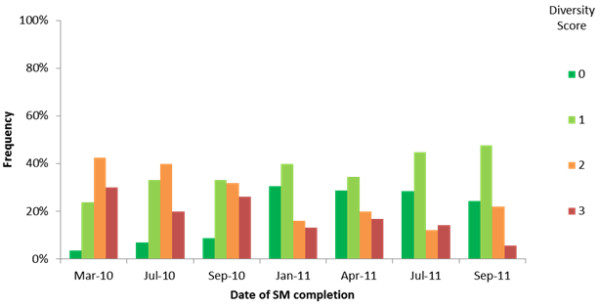
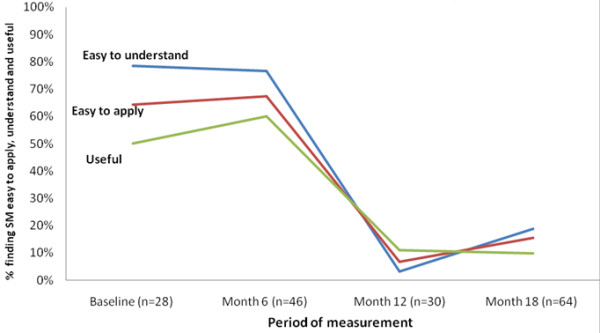
The implementation of evidence-based treatments to deliver high-quality care is essential to meet the healthcare demands of aging populations. However, the sustainable application of recommended practice is difficult to achieve and variable outcomes well recognised. The NHS Institute for Innovation and Improvement Sustainability Model (SM) was designed to help healthcare teams recognise determinants of sustainability and take action to embed new practice in routine care. This article describes a formative evaluation of the application of the SM by the National Institute for Health Research Collaboration for Leadership in Applied Health Research and Care for Northwest London (CLAHRC NWL). Data from project teams' responses to the SM and formal reviews was used to assess acceptability of the SM and the extent to which it prompted teams to take action. Projects were classified as 'engaged,' 'partially engaged' and 'non-engaged.' Quarterly survey feedback data was used to explore reasons for variation in engagement. Score patterns were compared against formal review data and a 'diversity of opinion' measure was derived to assess response variance over time. Of the 19 teams, six were categorized as 'engaged,' six 'partially engaged,' and seven as 'non-engaged.' Twelve teams found the model acceptable to some extent. Diversity of opinion reduced over time. A minority of teams used the SM consistently to take action to promote sustainability but for the majority SM use was sporadic. Feedback from some team members indicates difficulty in understanding and applying the model and negative views regarding its usefulness. The SM is an important attempt to enable teams to systematically consider determinants of sustainability, provide timely data to assess progress, and prompt action to create conditions for sustained practice. Tools such as these need to be tested in healthcare settings to assess strengths and weaknesses and findings disseminated to aid development. This study indicates the SM provides a potentially useful approach to measuring teams' views on the likelihood of sustainability and prompting action. Securing engagement of teams with the SM was challenging and redesign of elements may need to be considered. Capacity building and facilitation appears necessary for teams to effectively deploy the SM.
Overview
The claims and statistics of this paper haven’t been checked yet.
Run the check — free, no account needed. It reads the open-access text and checks the sources it cites.
Integrity signals
Registry
Cites
Statistics
Figures
Verification
Claims the paper makes
The claims and statistics of this paper haven’t been checked yet.
Run the check — free, no account needed. It reads the open-access text and checks the sources it cites.
Claims other papers make about this one
Each is checked against this paper’s own text: does it say what the citing paper says it does?
The cited source says what the claim attributes to it.
In the citing paper
“The fifth most-cited article is entitled “Making change last: applying the NHS institute for innovation and improvement sustainability model to healthcare improvement” [87], and was published in Implementation Science in 2013 by a UK research team.”
From Towards Green and Sustainable Healthcare: A Literature Review and Research Agenda for Green Leadership in the Healthcare Sector (2023) · cites this paper as [87]
In the citing paper
“Effectively engaging staff, and in our case, clients, establishes a sense of empowerment that they are a part of the change process, enhances staff motivation to participate in the change process, and leads to more actionable steps by staff to promote sustainment of the change [40,44-48].”
From Successful Organizational Strategies to Sustain Use of A-CHESS: A Mobile Intervention for Individuals With Alcohol Use Disorders (2015) · cites this paper as [45]
Self-check
Percentages, sums and reported differences re-computed from the paper’s own numbers.
The self-check needs the paper’s full text.
Citations
Cites
Levitt, B., & March, J. G. (1988) · Annual Review of Sociology · doi:10.1146/annurev.so.14.080188.001535 · Cited by 6,669
The Improvement Guide: A Practical Approach to Enhancing Organizational Performance
(1997) · Quality Management Journal · doi:10.1080/10686967.1998.11919154 · Cited by 2,878
Wiltsey Stirman, S., Kimberly, J., Cook, N., Calloway, A., Castro, F., & Charns, M. (2012) · Implementation Science · doi:10.1186/1748-5908-7-17 · Cited by 1,355
Shediac-Rizkallah, M. C., & Bone, L. R. (1998) · Health Education Research · doi:10.1093/her/13.1.87 · Cited by 1,129
An Agenda for Research on the Sustainability of Public Health Programs
Scheirer, M. A., & Dearing, J. W. (2011) · American Journal of Public Health · doi:10.2105/ajph.2011.300193 · Cited by 775
Research methods used in developing and applying quality indicators in primary care
Campbell, S., Braspenning, J., Hutchinson, A., & Marshall, M. (2003) · BMJ · doi:10.1136/bmj.326.7393.816 · Cited by 735
Is Sustainability Possible? A Review and Commentary on Empirical Studies of Program Sustainability
Scheirer, M. A. (2005) · American Journal of Evaluation · doi:10.1177/1098214005278752 · Cited by 710
Making public health programs last: conceptualizing sustainability
Pluye, P., Potvin, L., & Denis, J.-L. (2004) · Evaluation and Program Planning · doi:10.1016/j.evalprogplan.2004.01.001 · Cited by 374
Garside, P. (1998) · PubMed · Cited by 143
Redesigning Work Processes in Health Care: Lessons from the National Health Service
Ham, C., Kipping, R., & McLeod, H. (2003) · Milbank Quarterly · doi:10.1111/1468-0009.t01-3-00062 · Cited by 118
Measuring Sustainability Within the Veterans Administration Mental Health System Redesign Initiative
Ford, J. H., Krahn, D., Wise, M., & Oliver, K. A. (2011) · Quality Management in Health Care · doi:10.1097/qmh.0b013e3182314b20 · Cited by 60
Sustainability of Partnership Projects: A Conceptual Framework and Checklist
Edwards, J. C., Feldman, P. H., Sangl, J., Polakoff, D., Stern, G., & Casey, D. (2007) · The Joint Commission Journal on Quality and Patient Safety · doi:10.1016/s1553-7250(07)33122-x · Cited by 36
Sadof, M. D., Boschert, K. A., Brandt, S., & Motyl, A. P. (2006) · Annals of Allergy Asthma & Immunology · doi:10.1016/s1081-1206(10)60783-1 · Cited by 20
Outcome-Based Quality Improvement in Home Health Care
Shaughnessy, P. W., Crisler, K. S., & Schlenker, R. E. (1998) · Quality Management in Health Care · doi:10.1097/00019514-199807010-00007 · Cited by 15
Program Sustainability Assessment Tool
Luke, D. A., Calhoun, A., Robichaux, C. B., Elliott, M., & Moreland‐Russell, S. (2014) · PsycTESTS Dataset · doi:10.1037/t46509-000 · Cited by 13
Outcome-Based Quality Improvement in Home Health Care
Shaughnessy, P. W., Crisler, K. S., & Schlenker, R. E. (1998) · Quality Management in Health Care · doi:10.1097/00019514-199823000-00007 · Cited by 7
Research works printed but not linked: 2
- Department of Health: Innovation, health and wealth: accelerating adoption and diffusion in the NHS department of health. 2011, Department of Health
- Smith R: Cuts being made to frontline NHS services survey reveals. 2010, London: The Daily Telegraph
Cited by
Sorted by citations
The Sustainability of Evidence-Based Interventions and Practices in Public Health and Health Care
Shelton, R. C., Cooper, B. R., & Stirman, S. W. (2018) · Annual Review of Public Health · doi:10.1146/annurev-publhealth-040617-014731 · Cited by 806
Developing a comprehensive definition of sustainability
Moore, J. E., Mascarenhas, A., Bain, J., & Straus, S. E. (2017) · Implementation Science · doi:10.1186/s13012-017-0637-1 · Cited by 630
Evidence-based intervention sustainability strategies: a systematic review
Hailemariam, M., Bustos, T., Montgomery, B., Barajas, R., Evans, L. B., & Drahota, A. (2019) · Implementation Science · doi:10.1186/s13012-019-0910-6 · Cited by 398
Simple rules for evidence translation in complex systems: A qualitative study
Reed, J. E., Howe, C., Doyle, C., & Bell, D. (2018) · BMC Medicine · doi:10.1186/s12916-018-1076-9 · Cited by 181
Self-citationTricco, A. C., Ashoor, H. M., Cardoso, R., MacDonald, H. R., Cogo, E., Kastner, M., Perrier, L., McKibbon, A., Grimshaw, J., & Straus, S. E. (2015) · Implementation Science · doi:10.1186/s13012-016-0421-7 · Cited by 154
Metadata
- Authors
- Doyle, C., Howe, C., Woodcock, T., Myron, R., Phekoo, K., McNicholas, C., Saffer, J., & Bell, D.
- Affiliations
- Chelsea and Westminster Hospital (GB)
- Corresponding author
- Doyle, Cathal
- Venue
- Implementation Science
- Published
- 2013-10-26
- Volume
- 8
- Issue
- 1
- Pages
- 127-127
- ISSN
- 1748-5908 (ISSN-L)
- PMC
- PMC3827618
- OpenAlex
- W2156517163
- Cited by
- 166
- References
- 15
- Citations by year
- 2026: 8 · 2025: 8 · 2024: 20 · 2023: 17 · 2022: 15 · 2021: 20 · 2020: 13 · 2019: 17 · 2018: 15 · 2017: 9 · 2016: 9 · 2015: 9 · 2014: 5
- FWCI
- 13.89
- Type
- journal article
- Language
- en
- Open access
- gold
- doi.org
- Licence
- Locations
- Implementation Science (publishedVersion, cc-by)
- Europe PMC (PubMed Central) (publishedVersion, cc-by)
- PubMed Central (publishedVersion, cc-by)
- PubMed (publishedVersion)
- UWL Repository (University of West London) (acceptedVersion)
- Spiral (Imperial College London) (submittedVersion, cc-by)
- Funders
- National Institute for Health and Care Research (NIHR-KMF-2012-01-08)
- Topics
- Health Sciences › Health Professions › General Health Professions › Health Policy Implementation Science
- Health Sciences › Medicine › Public Health, Environmental and Occupational Health › Healthcare Quality and Management
- Health Sciences › Health Professions › General Health Professions › Health Sciences Research and Education
- Keywords
- evidence-based practice implementation, team engagement, sustainability drivers, formative assessment, opinion diversity, capacity building, healthcare quality improvement
- MeSH terms
- Diffusion of Innovation, United Kingdom, Hospitals, Public, Patient Care Team, Quality Assurance, Health Care, State Medicine, Program Evaluation, Models, Organizational, Evidence-Based Medicine, Quality Improvement
About these checks
Registry, retraction, Cites and statistics results are computed, not judged, with one exception: a printed reference that no index lists is read once by a model before it counts as a citation error. Claims are extracted by a model and kept only when their quote appears verbatim in the text; each cited source is then checked, with a model’s help, for whether it says what the claim relies on. Those verdicts can be wrong — read the claim’s quote and the cited source before relying on one.
Statistics and arithmetic are recomputed, not judged.
Confidence bands are shown only for fields calibrated on our annotated test set. None is calibrated yet, so no band is shown.
What counts as a claim ›How we measure confidence ›How we check this ›
Are you an author, or do you see a problem with this page? Request a review
