

Public health program capacity for sustainability: a new framework
Open accessThe DOI matches its Crossref record; 40 of the 40 references it cites were found in a registry or an index.
Abstract
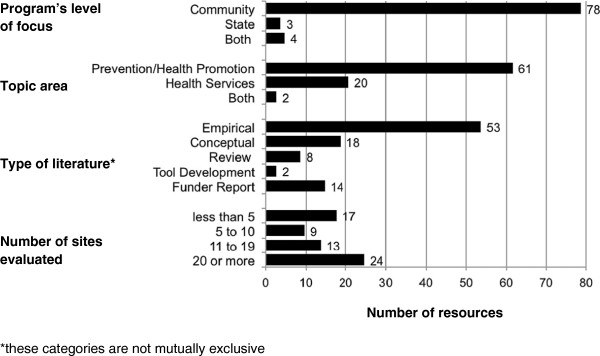
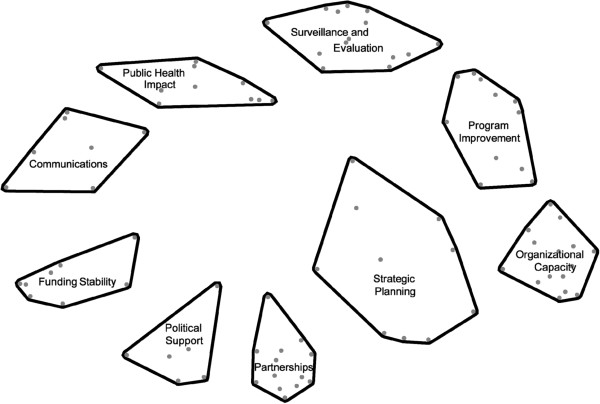
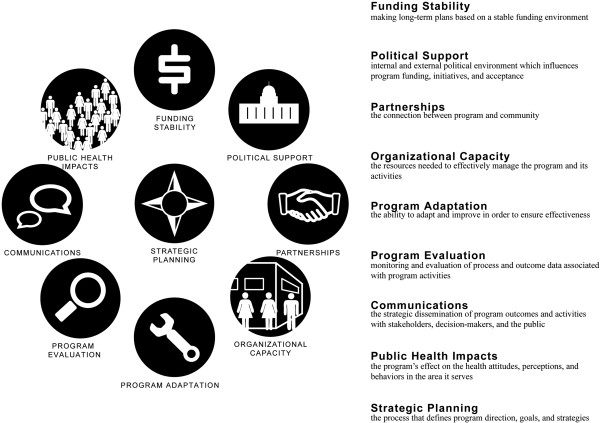
Background: Public health programs can only deliver benefits if they are able to sustain activities over time. There is a broad literature on program sustainability in public health, but it is fragmented and there is a lack of consensus on core constructs. The purpose of this paper is to present a new conceptual framework for program sustainability in public health. Methods: This developmental study uses a comprehensive literature review, input from an expert panel, and the results of concept-mapping to identify the core domains of a conceptual framework for public health program capacity for sustainability. The concept-mapping process included three types of participants (scientists, funders, and practitioners) from several public health areas ( e . g ., tobacco control, heart disease and stroke, physical activity and nutrition, and injury prevention). Results: The literature review identified 85 relevant studies focusing on program sustainability in public health. Most of the papers described empirical studies of prevention-oriented programs aimed at the community level. The concept-mapping process identified nine core domains that affect a program’s capacity for sustainability: Political Support, Funding Stability, Partnerships, Organizational Capacity, Program Evaluation, Program Adaptation, Communications, Public Health Impacts, and Strategic Planning. Concept-mapping participants further identified 93 items across these domains that have strong face validity—89% of the individual items composing the framework had specific support in the sustainability literature. Conclusions: The sustainability framework presented here suggests that a number of selected factors may be related to a program’s ability to sustain its activities and benefits over time. These factors have been discussed in the literature, but this framework synthesizes and combines the factors and suggests how they may be interrelated with one another. The framework presents domains for public health decision makers to consider when developing and implementing prevention and intervention programs. The sustainability framework will be useful for public health decision makers, program managers, program evaluators, and dissemination and implementation researchers.
Overview
The claims and statistics of this paper haven’t been checked yet.
Free: it reads the open-access text and checks the first 5 claims that cite a source we can check. Create a free account to check every claim.
Integrity signals
Registry
Cites
Statistics
Figures
Verification
Claims the paper makes
The claims and statistics of this paper haven’t been checked yet.
Free: it reads the open-access text and checks the first 5 claims that cite a source we can check. Create a free account to check every claim.
Claims other papers make about this one
Each is checked against this paper’s own text: does it say what the citing paper says it does?
The cited source doesn’t support the claim as written.
In the citing paper
“The PSAT was originally created to reflect the concepts represented in each of the eight domains in the program sustainability framework (10).”
From Assessing the sustainability capacity of evidence-based programs in community and health settings (2022) · cites this paper as [10]
Checked by a reasoning model — may be wrong.
Experimental — accuracy not yet measuredThe cited source doesn’t support the claim as written.
In the citing paper
“Both measures had been previously developed with established reliability and validity, and have been widely used across a variety of contexts and settings.”
From Lowering the burden: Shorter versions of the Program Sustainability Assessment Tool (PSAT) and Clinical Sustainability Assessment Tool (CSAT) (2024) · cites this paper as [8]
Checked by a reasoning model — may be wrong.
Experimental — accuracy not yet measuredThe source backs part of the claim, not all of it — or backs it for a different population, condition or comparison.
In the citing paper
“The core domains they identified include environmental support, funding stability, partnerships, organizational capacity, program evaluation, program adaptation, communications, and strategic planning.”
From The Sustainability of Evidence-Based Interventions and Practices in Public Health and Health Care (2018) · cites this paper as [121]
Experimental — accuracy not yet measuredThe source backs part of the claim, not all of it — or backs it for a different population, condition or comparison.
In the citing paper
“Internal organizational supports include champion roles, leadership, resources, policies and procedures, and expert support (ie, coaching).”
From Successful Organizational Strategies to Sustain Use of A-CHESS: A Mobile Intervention for Individuals With Alcohol Use Disorders (2015) · cites this paper as [33]
Experimental — accuracy not yet measuredThe source backs part of the claim, not all of it — or backs it for a different population, condition or comparison.
In the citing paper
“The environment context explores the effects of financial, regulatory, and policy changes.”
From Successful Organizational Strategies to Sustain Use of A-CHESS: A Mobile Intervention for Individuals With Alcohol Use Disorders (2015) · cites this paper as [33]
Experimental — accuracy not yet measured
7 more claims about this paper
Create a free account to see every claim other papers make about this one.
Self-check
Percentages, sums and reported differences re-computed from the paper’s own numbers.
The self-check needs the paper’s full text.
Citations
Cites
Advancing a Conceptual Model of Evidence-Based Practice Implementation in Public Service Sectors
Aarons, G. A., Hurlburt, M., & Horwitz, S. M. (2011) · Administration and Policy in Mental Health and Mental Health Services Research · doi:10.1007/s10488-010-0327-7 · Cited by 3,240 · cited 1×
“However, we have paid much less attention to what happens to programs once they have been implemented [4].”
BackgroundCharbonneau, D. H. (2005) · Europe PMC (PubMed Central) · Cited by 2,041
Proctor, E. K., Landsverk, J., Aarons, G., Chambers, D., Glisson, C., & Mittman, B. (2009) · Administration and Policy in Mental Health and Mental Health Services Research · doi:10.1007/s10488-008-0197-4 · Cited by 1,894 · cited 1×
“The emergence of the new discipline of dissemination and implement ation science has driven a rapid increase in studies of how new scientific discoveries a e tr nslated and developed into programs, policies, and practices [3].”
BackgroundWiltsey Stirman, S., Kimberly, J., Cook, N., Calloway, A., Castro, F., & Charns, M. (2012) · Implementation Science · doi:10.1186/1748-5908-7-17 · Cited by 1,355 · cited 2×
“This framework can help establish a shared unders tanding of sustainability for practitioners, funders, and researchers working in a range of public hea th areas, and is responsive to calls for greater theoretical and definitional str uctu e and clarity [36].”
Concept Mapping for Planning and Evaluation
Kane, M., & Trochim, W. (2007) · Sage eBooks · doi:10.4135/9781412983730 · Cited by 1,179
Task Force on Community Preventive Services
(2005) · The Guide to Community Preventive Services · doi:10.1093/acprof:oso/9780195151091.002.0004 · Cited by 1,159
Shediac-Rizkallah, M. C., & Bone, L. R. (1998) · Health Education Research · doi:10.1093/her/13.1.87 · Cited by 1,129
An Agenda for Research on the Sustainability of Public Health Programs
Scheirer, M. A., & Dearing, J. W. (2011) · American Journal of Public Health · doi:10.2105/ajph.2011.300193 · Cited by 775 · cited 5×
“These are called ‘sustainability outcomes’ by Scheirer and Dearing [5], and reflect the various ways that a program can continue to have its intended effects.”
BackgroundInfluentialIs Sustainability Possible? A Review and Commentary on Empirical Studies of Program Sustainability
Scheirer, M. A. (2005) · American Journal of Evaluation · doi:10.1177/1098214005278752 · Cited by 710 · cited 3×
“While researchers in varied fields have studied sustainability of their specific programs, this knowledge is generally not cumulative [5,18].”
BackgroundFramework for Program Evaluation in Public Health
(1999) · PsycEXTRA Dataset · doi:10.1037/e547822006-001 · Cited by 611
Cited by
Items 501–600 of 653
Baumgardt, J. (2018) · Springer eBooks · doi:10.1007/978-3-658-16901-5_4
Ocampo, M. S. (2018) · ResearchWorks at the University of Washington (University of Washington)
Middle School Model for Single-Sex Teams: Factors Influencing Sustainability
Bristow, K. (2018) · UA Campus Repository (The University of Arizona)
Potthoff, S. (2018) · American Public Health Association eBooks · doi:10.2105/9780875532981ch08
Garcia, A. C., Dias, S., Alves, D. A., Pedro, J. D. A., Cabral, M. H., & Hartz, Z. (2018) · LA Referencia (Red Federada de Repositorios Institucionales de Publicaciones Científicas) · doi:10.25761/anaisihmt.60
Laur, C. V. (2019) · UWSpace (University of Waterloo)
Making Implementation Last: Understanding the Sustainability of an Evidence-based Treatment
Jackson, C. B. (2019) · The Research Repository @ WVU (West Virginia University) · doi:10.33915/etd.3945
Improving Disease Surveillance Programs in Liberia
Ahmed, T. (2019)
Summer, A. (2016) · eScholarship (California Digital Library)
Evaluation of Structural Change in Primary Care
McLaren, A. C. (2020) · Research Online (University of Wollongong)
Empowering Women: Saving Mothers and Enhancing Opportunities
Wampler, B., Sugiyama, N. B., & Touchton, M. M. (2019) · Cambridge University Press eBooks · doi:10.1017/9781108675949.006
Wampler, B., Sugiyama, N. B., & Touchton, M. M. (2019) · Cambridge University Press eBooks · doi:10.1017/9781108675949.002
Improving Health: Saving Lives
Wampler, B., Sugiyama, N. B., & Touchton, M. M. (2019) · Cambridge University Press eBooks · doi:10.1017/9781108675949.005
Political Will, Leadership, and the Importance of Decolonization
Mukherjee, J. S. (2021) · Oxford University Press eBooks · doi:10.1093/oso/9780197607251.003.0013
Educating Society: Promoting Public Education and Learning
Wampler, B., Sugiyama, N. B., & Touchton, M. M. (2019) · Cambridge University Press eBooks · doi:10.1017/9781108675949.007
Conclusion: How Democracy Improves Well-Being
Wampler, B., Sugiyama, N. B., & Touchton, M. M. (2019) · Cambridge University Press eBooks · doi:10.1017/9781108675949.009
Reducing Poverty: Broadening Access to Income
Wampler, B., Sugiyama, N. B., & Touchton, M. M. (2019) · Cambridge University Press eBooks · doi:10.1017/9781108675949.004
Research Design, Methods, and Variables
Wampler, B., Sugiyama, N. B., & Touchton, M. M. (2019) · Cambridge University Press eBooks · doi:10.1017/9781108675949.003
Pathways at Work: Lessons from Brazil’s Poor Northeast
Wampler, B., Sugiyama, N. B., & Touchton, M. M. (2019) · Cambridge University Press eBooks · doi:10.1017/9781108675949.008
Wampler, B., Sugiyama, N. B., & Touchton, M. M. (2019) · Cambridge University Press eBooks · doi:10.1017/9781108675949.011
Wampler, B., Sugiyama, N. B., & Touchton, M. M. (2019) · Cambridge University Press eBooks · doi:10.1017/9781108675949.012
Bäck, A., Stahl, C., Schwarz, U. V. T., Richter, A., & Hasson, H. (2021) · International Journal of Mental Health Systems · doi:10.1186/s13033-021-00471-1
(2019) · The Foundation Review · doi:10.9707/1944-5660.1500
Bryant, M., Burton, W., Collinson, M., Farrin, A. J., Nixon, J., Stevens, J., Roberts, K., Foy, R., Rutter, H., Copsey, B. J., et al. (2021) · Research Square · doi:10.21203/rs.3.rs-188964/v1
Planning and evaluation of public health interventions
Wark, S. (2022) · Cambridge University Press eBooks · doi:10.1017/9781009047784.018
Baldwin, L. (2023) · Queensland University of Technology · doi:10.5204/thesis.eprints.238328
O'BRIEN, A. (2023) · Cronfa (Swansea University) · doi:10.23889/suthesis.63004
Women in Health Services: Implementation Science 2021
Moullin, J. C., Aufegger, L., & Finch, T. L. (2023) · Frontiers research topics · doi:10.3389/978-2-8325-2337-7
Barbaros, M. C., Duduciuc, A. C., & Grădinaru, I.-A. (2023) · Patient Education and Counseling · doi:10.1016/j.pec.2023.107901
Naegeli, R. O. (2023) · Digital Library of Theses and Dissertations (Universidade de São Paulo) · doi:10.11606/d.59.2023.tde-07082023-075710
Shelleng, M. (2023) · Texila international journal of academic research · doi:10.21522/tijar.2014.se.23.01.art004
Rückert, A., Harris, F., Aenishaenslin, C., et al. (2023) · Research Directions One Health · doi:10.1017/one.2023.13.pr3
Rückert, A., Harris, F., Aenishaenslin, C., et al. (2023) · Research Directions One Health · doi:10.1017/one.2023.13.pr6
Lee, S.-Y., Eagleson, R. M., Hearld, L. R., Gibson, M., Hearld, K. R., Hall, A. G., Burkholder, G., McMahon, J., Mahmood, S., Spraberry, C. T., et al. (2026) · BMC Health Services Research · doi:10.1186/s12913-026-14712-x
6. Program and Resource Management
Potthoff, S., Pruitt, Z., & Mishek, J. H. (2024) · American Public Health Association eBooks · doi:10.2105/9780875533551ch06
Public Health Policy and Sustainability
Nare, V. M., Nikam, S. N., & Thakare, D. N. (2024) · Advances in geographical and environmental sciences · doi:10.1007/978-981-97-7993-2_26
Influence Du Style De Management Sur La Pérennité Des Projets De Développement Communautaire.
T., R. (2024) · IOSR Journal of Business and Management · doi:10.9790/487x-2612161625
Benamen, M. N., HSudiyanto, H., Alamudi, M. Y., & Diana, S. (2025) · INTERNATIONAL JOURNAL OF NURSING AND MIDWIFERY SCIENCE (IJNMS) · doi:10.29082/ijnms/2024/vol8/iss3/639
Jock, B., Haroz, E. E., Chamoun, L., Maudrie, T. L., Redmond, L. C., & Gittelsohn, J. (2025) · Current Developments in Nutrition · doi:10.1016/j.cdnut.2025.104569
RetractedElaraby, S., Yahner, M., Sarker, B. K., Nitu, S. N. A., & Lwesha, V. (2025) · doi:10.12688/verixiv.1008.1
The dynamics of school-based health promotion: Optimising implementation by creating contextual fit
Driessen-Willems, M. (2025) · Research Publications (Maastricht University) · doi:10.26481/dis.20250626md
Sharma, K. P., DeGroff, A. S., Beckman, M. G., Sun, J., Sallyann, C. K., & Djenaba, J. A. (2025) · Implementation Science Communications · doi:10.1186/s43058-025-00734-9
Hearld, L. R., Carroll, N. W., Smith, K., Resuehr, H., Parker, S., Jackson, E. A., & Cherrington, A. (2025) · Journal of Ambulatory Care Management · doi:10.1097/jac.0000000000000538
Paudel, R., Uno, H., Cronin, C. M., Dizon, D. S., Hazard-Jenkins, H. W., Bian, J. J., Osarogiagbon, R. U., Wong, S. L., Schrag, D., & Hassett, M. J. (2025) · JCO Oncology Practice · doi:10.1200/op-25-00049
Toward a Framework for Understanding Information Systems Degree Program Sustainability
Tabatabaei, M., Jacobs, N. F., & Case, T. C. (2025) · Journal of Information Systems Education · doi:10.62273/ctio9563
Yan, L., Chen, Z., Goklish, N. A., Mitchell, K., Watchman, C., Stifter, M., O’Keefe, V. M., Barlow, A., Cwik, M. F., Igusa, T., et al. (2025) · Annals of Epidemiology · doi:10.1016/j.annepidem.2025.10.020
Proyecto JACTIVA ¿Te sumas al movimiento?
Bachouri-Muniesa, H., Dieste, S. A., Clemente, J. A. J., Bernalte, E. I., Casterad, J. Z., Solana, A. A., & Martínez, G. B. (2025) · Zaguan (Universidad de Zaragoza) · doi:10.26754/uz.978-84-10169-77-7
Chawan, E., Kadam, K., Mutalikdesai, N., Kasture, S., Gadgil, M., Mukherjee, R., Ambadekar, N. N., Dayma, G., & Patil, R. (2025) · Research Square · doi:10.21203/rs.3.rs-8034894/v1
Ford, J. H., & Gilson, A. (2021) · Figshare · doi:10.6084/m9.figshare.13543937
Ford, J. H., & Gilson, A. (2021) · Figshare · doi:10.6084/m9.figshare.13543931
Bodkin, A., & Hakimi, S. (2020) · Figshare · doi:10.6084/m9.figshare.12519017
Lennox, L., Linwood-Amor, A., Maher, L., & Reed, J. E. (2020) · Figshare · doi:10.6084/m9.figshare.13088038
Malone, S., Prewitt, K., Hackett, R., Lin, J. C., McKay, V., Walsh‐Bailey, C., & Luke, D. A. (2021) · Figshare · doi:10.6084/m9.figshare.15000060
Self-citationNathan, N., Shoesmith, A., Hall, A., Peden, B., Riley-Gibson, E., Pascoe, W., Zucca, A. C., Lane, C., Gardner, C., Princehorn, E. M., et al. (2024) · NOVA (University of Newcastle Australia) · doi:10.25817/f8qp-z566
Czosnek, L., Zopf, E. M., Cormie, P., Rosenbaum, S., Richards, J., & Rankin, N. M. (2022) · Figshare · doi:10.6084/m9.figshare.20502028
Malone, S., Prewitt, K., Hackett, R., Lin, J. C., McKay, V., Walsh‐Bailey, C., & Luke, D. A. (2021) · Figshare · doi:10.6084/m9.figshare.15000063
Self-citationHall, A., Shoesmith, A., Doherty, E. L., McEvoy, B., Mettert, K. D., Lewis, C. C., Wolfenden, L., Yoong, S., Kingsland, M., Shelton, R. C., et al. (2023) · Figshare · doi:10.6084/m9.figshare.22608673
Laur, C. V., Corrado, A. M., Grimshaw, J. M., & Ivers, N. M. (2021) · Figshare · doi:10.6084/m9.figshare.14361317
Moreland‐Russell, S., Combs, T., Gannon, J., Jost, E., Farah Saliba, L., Prewitt, K., Luke, D., & Brownson, R. C. (2024) · Figshare · doi:10.6084/m9.figshare.26676206
Self-citationWolfenden, L., Shoesmith, A., Hall, A., Bauman, A. E., & Nathan, N. (2024) · Figshare · doi:10.6084/m9.figshare.26689166
Shoesmith, A., Nathan, N., Lum, M., Yoong, S., Nolan, E., Wolfenden, L., Shelton, R. C., Cooper, B. R., Lane, C., Grady, A., et al. (2024) · Figshare · doi:10.6084/m9.figshare.26736702
Assessing Health System Readiness for Achieving Sustainability of Effective Programs in Ghana
Bogdewic, S. (2024) · Carolina Digital Repository (University of North Carolina at Chapel Hill) · doi:10.17615/8y7r-e960
Hall, A., Shoesmith, A., Doherty, E. L., McEvoy, B., Mettert, K. D., Lewis, C. C., Wolfenden, L., Yoong, S., Kingsland, M., Shelton, R. C., et al. (2023) · Figshare · doi:10.6084/m9.figshare.22608670
Bodkin, A., & Hakimi, S. (2020) · Figshare · doi:10.6084/m9.figshare.12519029
Hall, A., Shoesmith, A., Doherty, E. L., McEvoy, B., Mettert, K. D., Lewis, C. C., Wolfenden, L., Yoong, S., Kingsland, M., Shelton, R. C., et al. (2023) · Figshare · doi:10.6084/m9.figshare.22608667
Bryant, M., Burton, W., Collinson, M., Farrin, A., Nixon, J., Stevens, J., Roberts, K., Foy, R., Rutter, H., Copsey, B. J., et al. (2021) · Figshare · doi:10.6084/m9.figshare.16943559
Malone, S., Prewitt, K., Hackett, R., Lin, J. C., McKay, V., Walsh‐Bailey, C., & Luke, D. A. (2021) · Figshare · doi:10.6084/m9.figshare.15000066
Self-citationUmeh, C. A., Rockers, P. C., Laing, R. O., Wagh, O., & Wirtz, V. J. (2020) · Figshare · doi:10.6084/m9.figshare.12033078
Allen, P., Jacob, R. R., Parks, R. G., Mazzucca, S., Hu, H., Robinson, M. V., Dobbins, M., Dekker, D. K., Padek, M. M., & Brownson, R. C. (2020) · Figshare · doi:10.6084/m9.figshare.12051312
Lennox, L., Linwood-Amor, A., Maher, L., & Reed, J. E. (2020) · Figshare · doi:10.6084/m9.figshare.13088032
Ford, J. H., & Gilson, A. (2021) · Figshare · doi:10.6084/m9.figshare.13543934
Ford, J. H., & Gilson, A. (2021) · Figshare · doi:10.6084/m9.figshare.13543928
Shoesmith, A., Nathan, N., Lum, M., Yoong, S., Nolan, E., Wolfenden, L., Shelton, R. C., Cooper, B. R., Lane, C., Grady, A., et al. (2024) · Figshare · doi:10.6084/m9.figshare.26736708
Malone, S., Prewitt, K., Hackett, R., Lin, J. C., McKay, V., Walsh‐Bailey, C., & Luke, D. A. (2021) · Figshare · doi:10.6084/m9.figshare.15000057
Self-citationWolfenden, L., Shoesmith, A., Hall, A., Bauman, A. E., & Nathan, N. (2024) · Figshare · doi:10.6084/m9.figshare.26689163
Sivakumar, A., Pan, R. Y., Wang, A., Choi, D., Charif, A. B., Kastner, M., Légaré, F., & Yu, C. H. (2023) · Figshare · doi:10.6084/m9.figshare.23520167
Shoesmith, A., Nathan, N., Lum, M., Yoong, S., Nolan, E., Wolfenden, L., Shelton, R. C., Cooper, B. R., Lane, C., Grady, A., et al. (2024) · Figshare · doi:10.6084/m9.figshare.26736705
Lennox, L., Linwood-Amor, A., Maher, L., & Reed, J. E. (2020) · Figshare · doi:10.6084/m9.figshare.13088035
Bodkin, A., & Hakimi, S. (2020) · Figshare · doi:10.6084/m9.figshare.12519023
Healy, G. N., Goode, A. D., Ulyate, L., Abbott, A., Dunstan, D. W., Eakin, E., Gilson, N. D., Gunning, L., Jetann, J., LaMontagne, A. D., et al. (2024) · Figshare · doi:10.6084/m9.figshare.27140707
Bodkin, A., & Hakimi, S. (2020) · Figshare · doi:10.6084/m9.figshare.12519011
Volpe, I., Brien, R., Grigg, J., Tzanetis, S., Crawford, S., Lyons, T., Lee, N., McKinnon, G., Hughes, C., Eade, A., et al. (2024) · Figshare · doi:10.6084/m9.figshare.26560142
Anselm, R. L. G. (2023) · ScholarWorks (Walden University)
The Pertinence of Risk Management in Behavioral Healthcare Organizations
Darden-Robinson, M. (2021) · ScholarWorks (Walden University)
Could a parent funded, primary school based, child growth programme be sustainable in England?
Vince-Cain, S. (2023) · e-space (Manchester Metropolitan University)
Evaluating generative-AI usage for knowledge transfer ::fine-tuning of LLMs on-premises
Kucharavy, A., & David, D. P. (2024) · ArODES (HES-SO (https://www.hes-so.ch/))
Naar een duurzaam kwaliteitsmanagementsysteem in ziekenhuizen
Claessens, F. (2024) · Lirias
Schmid, S. (2021) · ScholarSpace (University of Hawaii at Manoa)
Harris, K. D. (2020) · K-State Research Exchange (Kansas State University)
Integrating maternal mental health into an early child development program
Singla, D. R. (2015) · eScholarship@McGill (McGill) · doi:10.82308/33877
Factors Predicting Sustainability: A Correlational Study of One Multi-Site Program
King-Jensen, M. (2020) · CUNY Academic Works (City University of New York)
Pascoe, K. M. (2019) · ResearchWorks at the University of Washington (University of Washington)
The theory of planned behavior in the implementation of an evidence-based treatment
Lo, S. B. (2018) · OhioLink ETD Center (Ohio Library and Information Network)
Bernalte, E. I., Zaragoza Casterad, F. J., & Clemente, J. A. J. (2023) · Zaguan (University of Zaragoza Repository)
Disseminating, implementing, scaling, and sustaining proven interventions
Gitlin, L. N., & Czaja, S. J. (2025) · Elsevier eBooks · doi:10.1016/b978-0-443-21664-0.00004-0
Metadata
- Authors
- Schell, S. F., Luke, D. A., Schooley, M. W., Elliott, M. B., Herbers, S. H., Mueller, N. B., & Bunger, A. C.
- Affiliations
- Washington University in St. Louis (US)
- Centers for Disease Control and Prevention (US)
- Saint Louis University (US)
- The Ohio State University (US)
- Corresponding author
- Luke, Douglas A
- Venue
- Implementation Science
- Published
- 2013-02-01
- Volume
- 8
- Issue
- 1
- Pages
- 15-15
- ISSN
- 1748-5908 (ISSN-L)
- PMC
- PMC3599102
- OpenAlex
- W2130480404
- Cited by
- 563
- References
- 39
- Citations by year
- 2026: 38 · 2025: 39 · 2024: 42 · 2023: 61 · 2022: 52 · 2021: 62 · 2020: 63 · 2019: 49 · 2018: 43 · 2017: 29 · 2016: 26 · 2015: 26 · 2014: 26 · 2013: 7
- FWCI
- 51.05
- Type
- journal article
- Language
- en
- Open access
- gold
- doi.org
- Licence
- Locations
- Implementation Science (publishedVersion, cc-by)
- Europe PMC (PubMed Central) (publishedVersion, cc-by)
- PubMed Central (publishedVersion, cc-by)
- PubMed (publishedVersion)
- Digital Commons@Becker (Washington University School of Medicine) (submittedVersion)
- Carolina Digital Repository (University of North Carolina at Chapel Hill) (submittedVersion)
- Carolina Digital Repository (University of North Carolina at Chapel Hill) (submittedVersion, cc-by)
- UNC Libraries
- Funders
- Kaiser Permanente
- Washington University in St. Louis
- Centers for Disease Control and Prevention
- Topics
- Health Sciences › Medicine › Public Health, Environmental and Occupational Health › Public Health Policies and Education
- Health Sciences › Health Professions › General Health Professions › Health Policy Implementation Science
- Health Sciences › Medicine › Public Health, Environmental and Occupational Health › Community Health and Development
- Keywords
- program sustainability, public health programs, program capacity, conceptual framework, political support, funding stability, partnership, organizational capacity, program evaluation, program adaptation, strategic planning, prevention programs, community-based intervention, concept mapping
- MeSH terms
- Chronic Disease, Delivery of Health Care, Diffusion of Innovation, Humans, Public Health, Program Evaluation
About these checks
Registry, retraction, Cites and statistics results are computed, not judged, with one exception: a printed reference that no index lists is read once by a model before it counts as a citation error. Claims are extracted by a model and kept only when their quote appears verbatim in the text; each cited source is then checked, with a model’s help, for whether it says what the claim relies on. Those verdicts can be wrong — read the claim’s quote and the cited source before relying on one.
Statistics and arithmetic are recomputed, not judged.
Confidence bands are shown only for fields calibrated on our annotated test set. None is calibrated yet, so no band is shown.
What counts as a claim ›How we measure confidence ›How we check this ›
Are you an author, or do you see a problem with this page? Request a review
Data sources
Bibliographic data: Semantic Scholar, OpenAlex, Crossref.
Contains information from the Semantic Scholar Academic Graph Datasets, made available under the ODC Attribution License (ODC-BY 1.0).
Semantic Scholar’s data is described in: Kinney, R., et al. (2023). The Semantic Scholar Open Data Platform. arXiv:2301.10140.
