

Public health program capacity for sustainability: a new framework
Open accessThe DOI matches its Crossref record; 40 of the 40 references it cites were found in a registry or an index.
Abstract
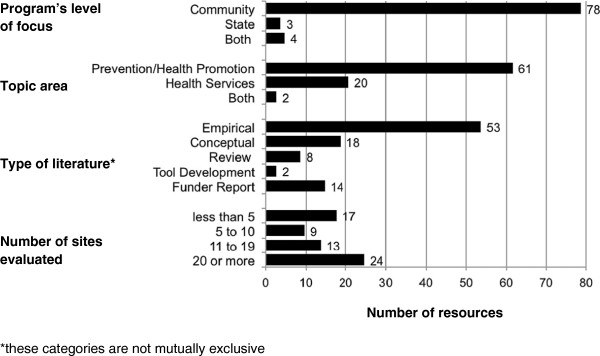
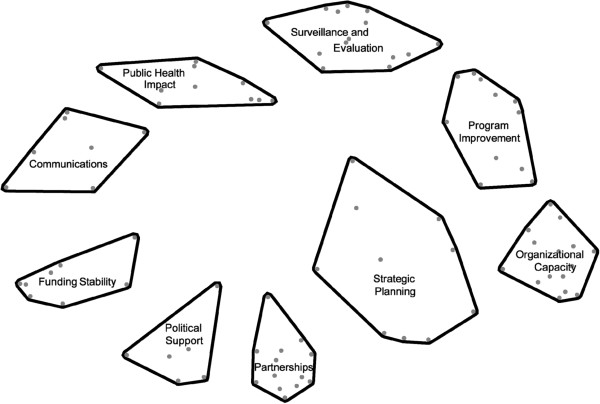
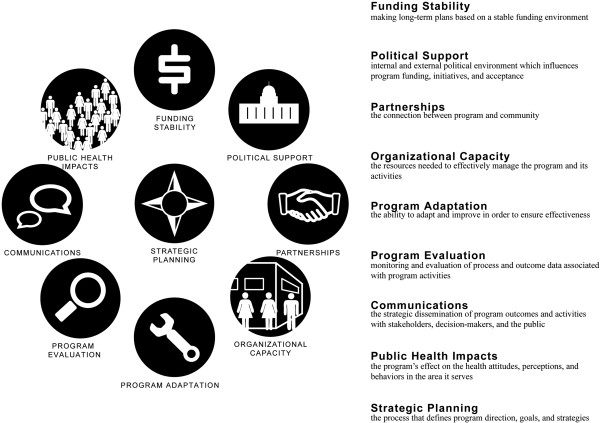
Background: Public health programs can only deliver benefits if they are able to sustain activities over time. There is a broad literature on program sustainability in public health, but it is fragmented and there is a lack of consensus on core constructs. The purpose of this paper is to present a new conceptual framework for program sustainability in public health. Methods: This developmental study uses a comprehensive literature review, input from an expert panel, and the results of concept-mapping to identify the core domains of a conceptual framework for public health program capacity for sustainability. The concept-mapping process included three types of participants (scientists, funders, and practitioners) from several public health areas ( e . g ., tobacco control, heart disease and stroke, physical activity and nutrition, and injury prevention). Results: The literature review identified 85 relevant studies focusing on program sustainability in public health. Most of the papers described empirical studies of prevention-oriented programs aimed at the community level. The concept-mapping process identified nine core domains that affect a program’s capacity for sustainability: Political Support, Funding Stability, Partnerships, Organizational Capacity, Program Evaluation, Program Adaptation, Communications, Public Health Impacts, and Strategic Planning. Concept-mapping participants further identified 93 items across these domains that have strong face validity—89% of the individual items composing the framework had specific support in the sustainability literature. Conclusions: The sustainability framework presented here suggests that a number of selected factors may be related to a program’s ability to sustain its activities and benefits over time. These factors have been discussed in the literature, but this framework synthesizes and combines the factors and suggests how they may be interrelated with one another. The framework presents domains for public health decision makers to consider when developing and implementing prevention and intervention programs. The sustainability framework will be useful for public health decision makers, program managers, program evaluators, and dissemination and implementation researchers.
Overview
The claims and statistics of this paper haven’t been checked yet.
Free: it reads the open-access text and checks the first 5 claims that cite a source we can check. Create a free account to check every claim.
Integrity signals
Registry
Cites
Statistics
Figures
Verification
Claims the paper makes
The claims and statistics of this paper haven’t been checked yet.
Free: it reads the open-access text and checks the first 5 claims that cite a source we can check. Create a free account to check every claim.
Claims other papers make about this one
Each is checked against this paper’s own text: does it say what the citing paper says it does?
The cited source doesn’t support the claim as written.
In the citing paper
“The PSAT was originally created to reflect the concepts represented in each of the eight domains in the program sustainability framework (10).”
From Assessing the sustainability capacity of evidence-based programs in community and health settings (2022) · cites this paper as [10]
Checked by a reasoning model — may be wrong.
Experimental — accuracy not yet measuredThe cited source doesn’t support the claim as written.
In the citing paper
“Both measures had been previously developed with established reliability and validity, and have been widely used across a variety of contexts and settings.”
From Lowering the burden: Shorter versions of the Program Sustainability Assessment Tool (PSAT) and Clinical Sustainability Assessment Tool (CSAT) (2024) · cites this paper as [8]
Checked by a reasoning model — may be wrong.
Experimental — accuracy not yet measuredThe source backs part of the claim, not all of it — or backs it for a different population, condition or comparison.
In the citing paper
“The core domains they identified include environmental support, funding stability, partnerships, organizational capacity, program evaluation, program adaptation, communications, and strategic planning.”
From The Sustainability of Evidence-Based Interventions and Practices in Public Health and Health Care (2018) · cites this paper as [121]
Experimental — accuracy not yet measuredThe source backs part of the claim, not all of it — or backs it for a different population, condition or comparison.
In the citing paper
“Internal organizational supports include champion roles, leadership, resources, policies and procedures, and expert support (ie, coaching).”
From Successful Organizational Strategies to Sustain Use of A-CHESS: A Mobile Intervention for Individuals With Alcohol Use Disorders (2015) · cites this paper as [33]
Experimental — accuracy not yet measuredThe source backs part of the claim, not all of it — or backs it for a different population, condition or comparison.
In the citing paper
“The environment context explores the effects of financial, regulatory, and policy changes.”
From Successful Organizational Strategies to Sustain Use of A-CHESS: A Mobile Intervention for Individuals With Alcohol Use Disorders (2015) · cites this paper as [33]
Experimental — accuracy not yet measured
7 more claims about this paper
Create a free account to see every claim other papers make about this one.
Self-check
Percentages, sums and reported differences re-computed from the paper’s own numbers.
The self-check needs the paper’s full text.
Citations
Cites
Advancing a Conceptual Model of Evidence-Based Practice Implementation in Public Service Sectors
Aarons, G. A., Hurlburt, M., & Horwitz, S. M. (2011) · Administration and Policy in Mental Health and Mental Health Services Research · doi:10.1007/s10488-010-0327-7 · Cited by 3,240 · cited 1×
“However, we have paid much less attention to what happens to programs once they have been implemented [4].”
BackgroundCharbonneau, D. H. (2005) · Europe PMC (PubMed Central) · Cited by 2,041
Proctor, E. K., Landsverk, J., Aarons, G., Chambers, D., Glisson, C., & Mittman, B. (2009) · Administration and Policy in Mental Health and Mental Health Services Research · doi:10.1007/s10488-008-0197-4 · Cited by 1,894 · cited 1×
“The emergence of the new discipline of dissemination and implement ation science has driven a rapid increase in studies of how new scientific discoveries a e tr nslated and developed into programs, policies, and practices [3].”
BackgroundWiltsey Stirman, S., Kimberly, J., Cook, N., Calloway, A., Castro, F., & Charns, M. (2012) · Implementation Science · doi:10.1186/1748-5908-7-17 · Cited by 1,355 · cited 2×
“This framework can help establish a shared unders tanding of sustainability for practitioners, funders, and researchers working in a range of public hea th areas, and is responsive to calls for greater theoretical and definitional str uctu e and clarity [36].”
Concept Mapping for Planning and Evaluation
Kane, M., & Trochim, W. (2007) · Sage eBooks · doi:10.4135/9781412983730 · Cited by 1,179
Task Force on Community Preventive Services
(2005) · The Guide to Community Preventive Services · doi:10.1093/acprof:oso/9780195151091.002.0004 · Cited by 1,159
Shediac-Rizkallah, M. C., & Bone, L. R. (1998) · Health Education Research · doi:10.1093/her/13.1.87 · Cited by 1,129
An Agenda for Research on the Sustainability of Public Health Programs
Scheirer, M. A., & Dearing, J. W. (2011) · American Journal of Public Health · doi:10.2105/ajph.2011.300193 · Cited by 775 · cited 5×
“These are called ‘sustainability outcomes’ by Scheirer and Dearing [5], and reflect the various ways that a program can continue to have its intended effects.”
BackgroundInfluentialIs Sustainability Possible? A Review and Commentary on Empirical Studies of Program Sustainability
Scheirer, M. A. (2005) · American Journal of Evaluation · doi:10.1177/1098214005278752 · Cited by 710 · cited 3×
“While researchers in varied fields have studied sustainability of their specific programs, this knowledge is generally not cumulative [5,18].”
BackgroundFramework for Program Evaluation in Public Health
(1999) · PsycEXTRA Dataset · doi:10.1037/e547822006-001 · Cited by 611
Cited by
Items 601–653 of 653
Best practices of Public Health research equity: examples from Brazil and Portugal
Lapão, L., & Arcêncio, R. A. (2017) · Portuguese National Funding Agency for Science, Research and Technology (RCAAP Project by FCT)
Luna, A. J. A., Garcia, R., Almazol, A. E., Gutierrez, K., & Beltran, F. N. (2026) · Journal of Environmental Science and Management · doi:10.47125/jesam/2026_1/06
Moreland‐Russell, S., Gannon, J., Prewitt, K., & Saliba, L. F. (2026) · Evaluation and Program Planning · doi:10.1016/j.evalprogplan.2026.102761
Built to last: the role of network resilience in sustaining project-based networks
Scott, A. (2025) · Cross Connect (Southern Cross University) · doi:10.25918/thesis.545
Rutter, C., Fischer, F. S., Li, J., Kerr, B., Monroe, G., Denney, A., Su, M., Bustamante, G. C., Marquardt, M. D., Tsai, A., et al. (2026) · Global Surgical Education - Journal of the Association for Surgical Education · doi:10.1007/s44186-026-00487-6
Halk Sağlığı Usul ve Üslubu Beşinci Kitap - Tanzim
Turaman, C. (2026) · Akademisyen Kitabevi eBooks · doi:10.37609/akya.4065
Sustainability in the context of One Health: definitions, concepts and a framework for analysis
Dar, O. A. (2026) · LSHTM Research Online (London School of Hygiene and Tropical Medicine) · doi:10.17037/pubs.04678939
Lovegrove, C., Bannigan, K., Marsden, J. F., & Sturkenboom, I. H. W. M. (2026) · BMJ Open · doi:10.1136/bmjopen-2025-107930
Innovate, Implement and… Sustain?
Austin, T. (2025) · TSpace (University of Toronto)
Strifler, L. (2024) · TSpace (University of Toronto)
Bhuiya, A. R. (2021) · TSpace (University of Toronto)
Haldane, V. E. (2023) · TSpace (University of Toronto)
Turner, S., & Fernandez, D. P. (2026) · Health Research Policy and Systems · doi:10.1186/s12961-026-01455-8
Draper, C. L., & Younginer, N. (2026) · Journal of Nutrition Education and Behavior · doi:10.1016/j.jneb.2026.02.003
Etude de l'impact d'un programme de Récupération Amélioré en Transplantation Hépatique
Brustia, R. (2021) · theses.fr (ABES) · doi:10.70675/fe399d4cz3676z4c09zae15z0693225e260c
Wong, E. L., Wang, D. Y., Yeung, N. C.-Y., Mo, P. K.-H., Nilsen, P., Wong, C. W. Y., Wong, S. Y. S., & Yeoh, E.-K. (2026) · Implementation Science Communications · doi:10.1186/s43058-026-00920-3
Evaluation des interventions de santé publique
Ridde, V. (2024) · HAL
Gillies, C., Baay, C., Liu, J., & Patterson, S. (2026) · Health Promotion International · doi:10.1093/heapro/daag055
Safaria, T., & Dewi, I. G. A. A. N. (2026) · Geopsychiatry · doi:10.1016/j.geopsy.2026.100089
Wilkinson‐Lee, A. M., Hunter, D. R., Stalker, K. C., Stemple, N., Marsiglia, F. F., & Brown, M.-E. (2026) · Frontiers in Public Health · doi:10.3389/fpubh.2026.1747834
Lee, K., Hall, A., Bauman, A. E., Wolfenden, L., Crane, M. A., & Nathan, N. (2026) · Implementation Science Communications · doi:10.1186/s43058-026-00961-8
Choudhury, S., Ilozumba, O., Shrestha, D., Sartori, J., Griffiths, F. E., & Lilford, R. J. (2026) · NIHR Open Research · doi:10.3310/nihropenres.14265.1
Sirivisitkul, S., Kawmongkon, S., Singsamran, P., & Choojit, Y. (2026) · Asia Social Issues · doi:10.48048/asi.2026.287467
Kambhampaty, A., Mullins, K., Bouchard-Burns, J., Mapp, T., Santella, A. J., Powell, J., & Lee, M. (2026) · Research Square · doi:10.21203/rs.3.rs-9611490/v1
Broeck, N. V., Schoenmakers, B., Boeckxstaens, P., VRIENDT, P. D., VELDE, D. V. D., & Anthierens, S. (2026) · Implementation Science Communications · doi:10.1186/s43058-026-01003-z
Mazimpaka, C., Hamer, D. H., Ruberanziza, E., Lane, K., Nshimiyimana, L., Mbonigaba, J. B., Mbituyumuremyi, A., Thea, D. M., & Wirtz, V. J. (2026) · PLoS neglected tropical diseases · doi:10.1371/journal.pntd.0014455
Leme, C. R. P., Edmundo, K. M. B., & da Cruz, M. Q. (2026) · Revista Brasileira de Avaliação · doi:10.4322/rbaval.202600042025
Iyamu, I. O., Haag, D., Pedersen, H., Bondyra, M., Bartlett, S., Worthington, C., Grace, D., & Gilbert, M. (2026) · Research Square · doi:10.21203/rs.3.rs-9621352/v1
Riccio-Ackerman, F., Meah, T., Humure, C., Kamara, A., Kaili, P., Kargbo, N., Planells, C., Buderus, N. M., Kebbie, I., Dotz, D., et al. (2026) · Research Square · doi:10.21203/rs.3.rs-10194598/v1
Driving universal access to sexual and reproductive care:a project management perspective
Hajikazemi, S., & Grover-Minto, J. (2026) · The UWS Academic Portal (University of the West of Scotland)
Crane, M. E., Dopp, A. R., Lyon, A. R., Kim, B., Mohr, D. C., Aldridge, W. A., Kemp, J. J., & Elwy, A. R. (2026) · Implementation Science Communications · doi:10.1186/s43058-026-01050-6
Harkko, J. (2026) · International Journal of Public Health · doi:10.3389/ijph.2026.1609505
Correa-Méndez, M., Chambers, D., & Neta, G. I. (2026) · Implementation Science Communications · doi:10.1186/s43058-026-01039-1
Lawa, K. I. (2026) · Asian Journal of Education and Social Studies · doi:10.9734/ajess/2026/v52i83276
Albrecht, N. (2026) · URN:NBN Resolver for Germany & Switzerland (German National Library) · doi:10.17879/58878726590
What comes next? The Sustainability of Donor Funded HIV/AIDS Programmes Post Funding Cycle
Lephuthing, T. (2025) · University of the Witwatersrand, Johannesburg Institutional Repository on DSpace (University of the Witwatersrand, Johannesburg)
Babatunde, A. O., Gbaja-Biamila, T. A., Tang, W., Day, S., Nkengasong, S., Nwaozuru, U., Rosenberg, N. E., Babatunde, Y. O., Frances, O., Conserve, D. F., et al. (2026) · medRxiv · doi:10.64898/2026.09.03.26360266
Fini, N. A., Cahill, P., Beh, B. A., Suttie, L., Gallant, D., Martel, A., Mateo-Babiano, I. B., Marck, C. H., Hayward, K. S., & Ramage, E. R. (2026) · medRxiv · doi:10.64898/2026.09.17.26362966
Rowe, A. K., Roma, E., Ahuja, N. J., Pope, A. E., Zamboni, K., Yerramilli, P., Rowe, S., Gilani, Z., Kandasami, S., Ryman, T. K., et al. (2026) · Journal of Global Health · doi:10.7189/jogh.16.03027
Billow, H. Y. (2025) · SU+ Digital Repository (Strathmore University)
Peiró, R., Garcia-Sierra, M., Moreno, F. J. P., Abril, G. L., de la Cruz, P. G.-C., Rodríguez‐Acuña, R., Jiménez-Pernett, J., Castillo, A. L., Irigoyen, E. C., Juan, T. P., et al. (2026) · Revista Española de Salud Pública · doi:10.67113/resp.v100i1.1711
Barnard, M. (2021) · Nelson Mandela University Research Repository
Harn, K. (2026) · UND Scholarly Commons (University of North Dakota)
McConkey, R., & Murray, F. (2026) · OLYMPIKA MAGAZINE - Journal for the dissemination of scientific sports research
Kholis, F. N., Ratnaningsih, D. S., Suko, J. P., Wahab, Z., Anggoro, J., & Salianto, G. (2026) · Acta Innovations · doi:10.62441/actainnovations.vi.2253
Pan, S., & Zhang, Y. (2026) · Prevention Science · doi:10.1007/s11121-026-02001-2
Indrajaya, J. A. (2026) · International Journal of Managemen Analytics (IJMA) · doi:10.59890/ijma.v4i3.26
Prevention Program Sustainability and Associated Determinants: A Literature Review, Version 1.0
Walker, A., Steele, S., Allen, M., & Arreola, N. J. (2023) · DigitalCommons@UNO
Tamaddon, M., & Özdemir, S. (2026) · Journal of Pediatric Nursing · doi:10.1016/j.pedn.2026.10.024
Sustainability of Lean healthcare in South Africa: A practitioner's perspective
Wagner, R. (2025) · Boloka Institutional Repository (North-west University)
Love, P., Laws, R., Taki, S., West, M., Hesketh, K. D., & Campbell, K. J. (2022) · doi:10.3389/frhs.2022.1031628.s002
Bacon, C., Malone, S., Prewitt, K., Hackett, R., Hastings, M., Dexter, S., & Luke, D. A. (2022) · doi:10.3389/frhs.2022.1004167.s001
Self-citationClaessens, F., Jans, A., Seys, D., Clerbout, K., Ridder, D. J. M. K. D., der Auwera, C. V., Wilder, A. V., Vlayen, J., & Vanhaecht, K. (2026) · International Journal of Health Care Quality Assurance · doi:10.1108/ijhcqa-08-2025-0114
Metadata
- Authors
- Schell, S. F., Luke, D. A., Schooley, M. W., Elliott, M. B., Herbers, S. H., Mueller, N. B., & Bunger, A. C.
- Affiliations
- Washington University in St. Louis (US)
- Centers for Disease Control and Prevention (US)
- Saint Louis University (US)
- The Ohio State University (US)
- Corresponding author
- Luke, Douglas A
- Venue
- Implementation Science
- Published
- 2013-02-01
- Volume
- 8
- Issue
- 1
- Pages
- 15-15
- ISSN
- 1748-5908 (ISSN-L)
- PMC
- PMC3599102
- OpenAlex
- W2130480404
- Cited by
- 563
- References
- 39
- Citations by year
- 2026: 38 · 2025: 39 · 2024: 42 · 2023: 61 · 2022: 52 · 2021: 62 · 2020: 63 · 2019: 49 · 2018: 43 · 2017: 29 · 2016: 26 · 2015: 26 · 2014: 26 · 2013: 7
- FWCI
- 51.05
- Type
- journal article
- Language
- en
- Open access
- gold
- doi.org
- Licence
- Locations
- Implementation Science (publishedVersion, cc-by)
- Europe PMC (PubMed Central) (publishedVersion, cc-by)
- PubMed Central (publishedVersion, cc-by)
- PubMed (publishedVersion)
- Digital Commons@Becker (Washington University School of Medicine) (submittedVersion)
- Carolina Digital Repository (University of North Carolina at Chapel Hill) (submittedVersion)
- Carolina Digital Repository (University of North Carolina at Chapel Hill) (submittedVersion, cc-by)
- UNC Libraries
- Funders
- Kaiser Permanente
- Washington University in St. Louis
- Centers for Disease Control and Prevention
- Topics
- Health Sciences › Medicine › Public Health, Environmental and Occupational Health › Public Health Policies and Education
- Health Sciences › Health Professions › General Health Professions › Health Policy Implementation Science
- Health Sciences › Medicine › Public Health, Environmental and Occupational Health › Community Health and Development
- Keywords
- program sustainability, public health programs, program capacity, conceptual framework, political support, funding stability, partnership, organizational capacity, program evaluation, program adaptation, strategic planning, prevention programs, community-based intervention, concept mapping
- MeSH terms
- Chronic Disease, Delivery of Health Care, Diffusion of Innovation, Humans, Public Health, Program Evaluation
About these checks
Registry, retraction, Cites and statistics results are computed, not judged, with one exception: a printed reference that no index lists is read once by a model before it counts as a citation error. Claims are extracted by a model and kept only when their quote appears verbatim in the text; each cited source is then checked, with a model’s help, for whether it says what the claim relies on. Those verdicts can be wrong — read the claim’s quote and the cited source before relying on one.
Statistics and arithmetic are recomputed, not judged.
Confidence bands are shown only for fields calibrated on our annotated test set. None is calibrated yet, so no band is shown.
What counts as a claim ›How we measure confidence ›How we check this ›
Are you an author, or do you see a problem with this page? Request a review
Data sources
Bibliographic data: Semantic Scholar, OpenAlex, Crossref.
Contains information from the Semantic Scholar Academic Graph Datasets, made available under the ODC Attribution License (ODC-BY 1.0).
Semantic Scholar’s data is described in: Kinney, R., et al. (2023). The Semantic Scholar Open Data Platform. arXiv:2301.10140.
