

Public health program capacity for sustainability: a new framework
Open accessThe DOI matches its Crossref record; 40 of the 40 references it cites were found in a registry or an index.
Abstract
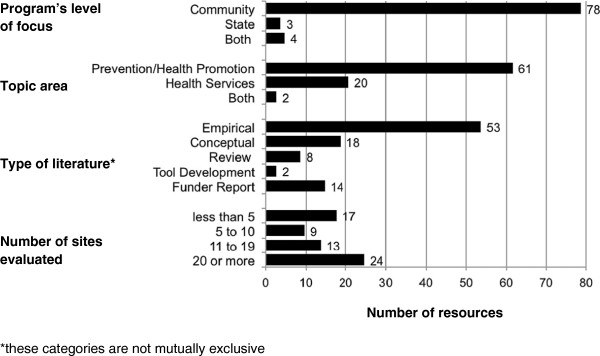
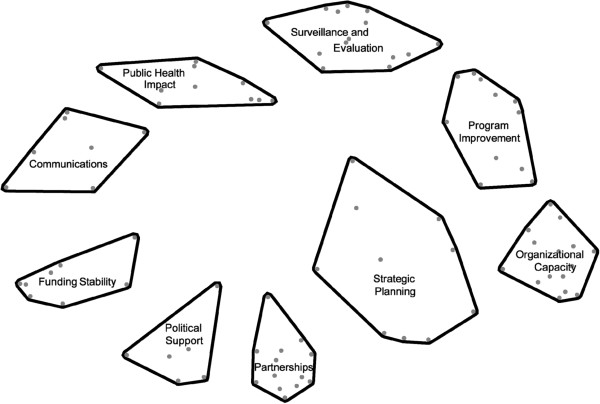
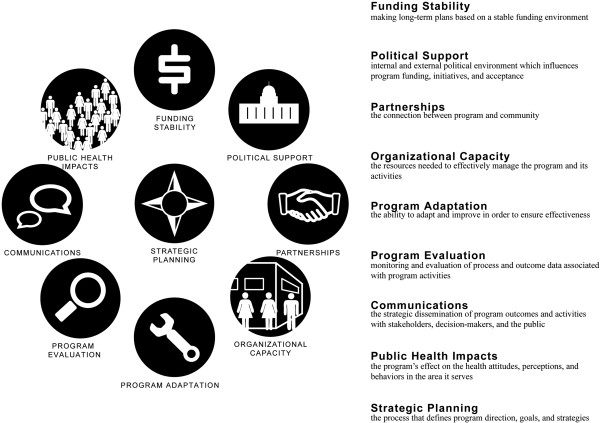
Background: Public health programs can only deliver benefits if they are able to sustain activities over time. There is a broad literature on program sustainability in public health, but it is fragmented and there is a lack of consensus on core constructs. The purpose of this paper is to present a new conceptual framework for program sustainability in public health. Methods: This developmental study uses a comprehensive literature review, input from an expert panel, and the results of concept-mapping to identify the core domains of a conceptual framework for public health program capacity for sustainability. The concept-mapping process included three types of participants (scientists, funders, and practitioners) from several public health areas ( e . g ., tobacco control, heart disease and stroke, physical activity and nutrition, and injury prevention). Results: The literature review identified 85 relevant studies focusing on program sustainability in public health. Most of the papers described empirical studies of prevention-oriented programs aimed at the community level. The concept-mapping process identified nine core domains that affect a program’s capacity for sustainability: Political Support, Funding Stability, Partnerships, Organizational Capacity, Program Evaluation, Program Adaptation, Communications, Public Health Impacts, and Strategic Planning. Concept-mapping participants further identified 93 items across these domains that have strong face validity—89% of the individual items composing the framework had specific support in the sustainability literature. Conclusions: The sustainability framework presented here suggests that a number of selected factors may be related to a program’s ability to sustain its activities and benefits over time. These factors have been discussed in the literature, but this framework synthesizes and combines the factors and suggests how they may be interrelated with one another. The framework presents domains for public health decision makers to consider when developing and implementing prevention and intervention programs. The sustainability framework will be useful for public health decision makers, program managers, program evaluators, and dissemination and implementation researchers.
Overview
The claims and statistics of this paper haven’t been checked yet.
Free: it reads the open-access text and checks the first 5 claims that cite a source we can check. Create a free account to check every claim.
Integrity signals
Registry
Cites
Statistics
Figures
Verification
Claims the paper makes
The claims and statistics of this paper haven’t been checked yet.
Free: it reads the open-access text and checks the first 5 claims that cite a source we can check. Create a free account to check every claim.
Claims other papers make about this one
Each is checked against this paper’s own text: does it say what the citing paper says it does?
The cited source doesn’t support the claim as written.
In the citing paper
“The PSAT was originally created to reflect the concepts represented in each of the eight domains in the program sustainability framework (10).”
From Assessing the sustainability capacity of evidence-based programs in community and health settings (2022) · cites this paper as [10]
Checked by a reasoning model — may be wrong.
Experimental — accuracy not yet measuredThe cited source doesn’t support the claim as written.
In the citing paper
“Both measures had been previously developed with established reliability and validity, and have been widely used across a variety of contexts and settings.”
From Lowering the burden: Shorter versions of the Program Sustainability Assessment Tool (PSAT) and Clinical Sustainability Assessment Tool (CSAT) (2024) · cites this paper as [8]
Checked by a reasoning model — may be wrong.
Experimental — accuracy not yet measuredThe source backs part of the claim, not all of it — or backs it for a different population, condition or comparison.
In the citing paper
“The core domains they identified include environmental support, funding stability, partnerships, organizational capacity, program evaluation, program adaptation, communications, and strategic planning.”
From The Sustainability of Evidence-Based Interventions and Practices in Public Health and Health Care (2018) · cites this paper as [121]
Experimental — accuracy not yet measuredThe source backs part of the claim, not all of it — or backs it for a different population, condition or comparison.
In the citing paper
“Internal organizational supports include champion roles, leadership, resources, policies and procedures, and expert support (ie, coaching).”
From Successful Organizational Strategies to Sustain Use of A-CHESS: A Mobile Intervention for Individuals With Alcohol Use Disorders (2015) · cites this paper as [33]
Experimental — accuracy not yet measuredThe source backs part of the claim, not all of it — or backs it for a different population, condition or comparison.
In the citing paper
“The environment context explores the effects of financial, regulatory, and policy changes.”
From Successful Organizational Strategies to Sustain Use of A-CHESS: A Mobile Intervention for Individuals With Alcohol Use Disorders (2015) · cites this paper as [33]
Experimental — accuracy not yet measured
7 more claims about this paper
Create a free account to see every claim other papers make about this one.
Self-check
Percentages, sums and reported differences re-computed from the paper’s own numbers.
The self-check needs the paper’s full text.
Citations
Cites
Advancing a Conceptual Model of Evidence-Based Practice Implementation in Public Service Sectors
Aarons, G. A., Hurlburt, M., & Horwitz, S. M. (2011) · Administration and Policy in Mental Health and Mental Health Services Research · doi:10.1007/s10488-010-0327-7 · Cited by 3,240 · cited 1×
“However, we have paid much less attention to what happens to programs once they have been implemented [4].”
BackgroundCharbonneau, D. H. (2005) · Europe PMC (PubMed Central) · Cited by 2,041
Proctor, E. K., Landsverk, J., Aarons, G., Chambers, D., Glisson, C., & Mittman, B. (2009) · Administration and Policy in Mental Health and Mental Health Services Research · doi:10.1007/s10488-008-0197-4 · Cited by 1,894 · cited 1×
“The emergence of the new discipline of dissemination and implement ation science has driven a rapid increase in studies of how new scientific discoveries a e tr nslated and developed into programs, policies, and practices [3].”
BackgroundWiltsey Stirman, S., Kimberly, J., Cook, N., Calloway, A., Castro, F., & Charns, M. (2012) · Implementation Science · doi:10.1186/1748-5908-7-17 · Cited by 1,355 · cited 2×
“This framework can help establish a shared unders tanding of sustainability for practitioners, funders, and researchers working in a range of public hea th areas, and is responsive to calls for greater theoretical and definitional str uctu e and clarity [36].”
Concept Mapping for Planning and Evaluation
Kane, M., & Trochim, W. (2007) · Sage eBooks · doi:10.4135/9781412983730 · Cited by 1,179
Task Force on Community Preventive Services
(2005) · The Guide to Community Preventive Services · doi:10.1093/acprof:oso/9780195151091.002.0004 · Cited by 1,159
Shediac-Rizkallah, M. C., & Bone, L. R. (1998) · Health Education Research · doi:10.1093/her/13.1.87 · Cited by 1,129
An Agenda for Research on the Sustainability of Public Health Programs
Scheirer, M. A., & Dearing, J. W. (2011) · American Journal of Public Health · doi:10.2105/ajph.2011.300193 · Cited by 775 · cited 5×
“These are called ‘sustainability outcomes’ by Scheirer and Dearing [5], and reflect the various ways that a program can continue to have its intended effects.”
BackgroundInfluentialIs Sustainability Possible? A Review and Commentary on Empirical Studies of Program Sustainability
Scheirer, M. A. (2005) · American Journal of Evaluation · doi:10.1177/1098214005278752 · Cited by 710 · cited 3×
“While researchers in varied fields have studied sustainability of their specific programs, this knowledge is generally not cumulative [5,18].”
BackgroundFramework for Program Evaluation in Public Health
(1999) · PsycEXTRA Dataset · doi:10.1037/e547822006-001 · Cited by 611
Cited by
The Sustainability of Evidence-Based Interventions and Practices in Public Health and Health Care
Shelton, R. C., Cooper, B. R., & Stirman, S. W. (2018) · Annual Review of Public Health · doi:10.1146/annurev-publhealth-040617-014731 · Cited by 806
Developing a comprehensive definition of sustainability
Moore, J. E., Mascarenhas, A., Bain, J., & Straus, S. E. (2017) · Implementation Science · doi:10.1186/s13012-017-0637-1 · Cited by 630
Best Practices for Comprehensive Tobacco Control Programs
Control, D. (2014) · Cited by 620
Best practices for comprehensive tobacco control programs, 2014
King, B. A., Pechacek, T. F., & Mariolis, P. (2014) · Cited by 452
The sustainability of public health interventions in schools: a systematic review
Herlitz, L., MacIntyre, H., Osborn, T., & Bonell, C. (2020) · Implementation Science · doi:10.1186/s13012-019-0961-8 · Cited by 434
Proctor, E., Luke, D., Calhoun, A., McMillen, C., Brownson, R., McCrary, S., & Padek, M. (2015) · Implementation Science · doi:10.1186/s13012-015-0274-5 · Cited by 429
“The literature includes published frameworks for implementing sustainability interventions [18], measurement frameworks for sustainability [19], and foundational agendas for research on sustainability [20, 21].”
BackgroundSelf-citationLennox, L., Maher, L., & Reed, J. (2018) · Implementation Science · doi:10.1186/s13012-017-0707-4 · Cited by 421
“While some approaches chose to look at overall initiative evaluation or performance [32, 36, 44, 51, 52], others chose to specifically assess either the ability of the initiative to function as intended [15, 36, 39] or the ability of the initiative to produce intended benefits [7, 11, 31, 47, 53–60].”
BackgroundEvidence-based intervention sustainability strategies: a systematic review
Hailemariam, M., Bustos, T., Montgomery, B., Barajas, R., Evans, L. B., & Drahota, A. (2019) · Implementation Science · doi:10.1186/s13012-019-0910-6 · Cited by 398
Moullin, J. C., Sabater-Hernández, D., Fernandez-Llimos, F., & Benrimoj, S. I. (2015) · Health Research Policy and Systems · doi:10.1186/s12961-015-0005-z · Cited by 392
“For example, eight frameworks did not explicitly mention stages [13,15,42,44,46,49,50,64,74], and the terminology ranged from ‘orientation, insight, acceptance, change, and maintenance’ [52], to ‘implement, assess, adopt, disseminate, integrate, implement, maintain’ [73] or ‘unfreezing, moving, refreezing’ [72].”
The Program Sustainability Assessment Tool: A New Instrument for Public Health Programs
Luke, D. A., Calhoun, A., Robichaux, C. B., Elliott, M. B., & Moreland-Russell, S. (2014) · Preventing Chronic Disease · doi:10.5888/pcd11.130184 · Cited by 364
“The structure of the PSAT was based on our previous sustainability conceptual framework (4).”
MethodInfluentialSelf-citationImplementation Science in School Mental Health: Key Constructs in a Developing Research Agenda
Owens, J. S., Lyon, A. R., Brandt, N. E., Masia Warner, C., Nadeem, E., Spiel, C., & Wagner, M. (2014) · School Mental Health · doi:10.1007/s12310-013-9115-3 · Cited by 247
Designing for Dissemination and Sustainability to Promote Equitable Impacts on Health
Kwan, B. M., Brownson, R. C., Glasgow, R. E., Morrato, E. H., & Luke, D. A. (2022) · Annual Review of Public Health · doi:10.1146/annurev-publhealth-052220-112457 · Cited by 234
Self-citationCowie, J., Nicoll, A., Dimova, E. D., Campbell, P., & Duncan, E. A. (2020) · BMC Health Services Research · doi:10.1186/s12913-020-05434-9 · Cited by 231
Roland, K. B., Milliken, E. L., Rohan, E. A., DeGroff, A., White, S., Melillo, S., Rorie, W. E., Signes, C.-A. C., & Young, P. A. (2017) · Health Equity · doi:10.1089/heq.2017.0001 · Cited by 213
March, A., Stapley, E., Hayes, D., Town, R., & Deighton, J. (2022) · International Journal of Environmental Research and Public Health · doi:10.3390/ijerph19063587 · Cited by 211
Sustainability of public health interventions: where are the gaps?
Walugembe, D. R., Sibbald, S., Le Ber, M. J., & Kothari, A. (2019) · Health Research Policy and Systems · doi:10.1186/s12961-018-0405-y · Cited by 204
Expert recommendations for implementing change (ERIC): protocol for a mixed methods study
Waltz, T. J., Powell, B. J., Chinman, M. J., Smith, J. L., Matthieu, M. M., Proctor, E. K., Damschroder, L. J., & Kirchner, J. E. (2014) · Implementation Science · doi:10.1186/1748-5908-9-39 · Cited by 202
“For instance, settings are likely to vary substantially with regard to patient characteristics [43,44]; provider-level factors such as attitudes toward EBPPs [45]; organizationallevel characteristics such as culture and climate [46], implementation climate [47], organizational readiness for change [48], leadership [49…”
BackgroundAment, S. M. C., de Groot, J. J. A., Maessen, J. M. C., Dirksen, C. D., van der Weijden, T., & Kleijnen, J. (2015) · BMJ Open · doi:10.1136/bmjopen-2015-008073 · Cited by 177
McKay, V. R., Morshed, A. B., Brownson, R. C., Proctor, E. K., & Prusaczyk, B. (2018) · American Journal of Community Psychology · doi:10.1002/ajcp.12258 · Cited by 169
Tricco, A. C., Ashoor, H. M., Cardoso, R., MacDonald, H., Cogo, E., Kastner, M., Perrier, L., McKibbon, A., Grimshaw, J. M., & Straus, S. E. (2015) · Implementation Science · doi:10.1186/s13012-016-0421-7 · Cited by 139
The sustainability of healthcare innovations: a concept analysis
Fleiszer, A. R., Semenic, S. E., Ritchie, J. A., Richer, M., & Denis, J. (2015) · Journal of Advanced Nursing · doi:10.1111/jan.12633 · Cited by 166
Sustainable by design: a systematic review of factors for health promotion program sustainability
Bodkin, A., & Hakimi, S. (2020) · BMC Public Health · doi:10.1186/s12889-020-09091-9 · Cited by 122
Linking Sustainability Research to Intervention Types
Scheirer, M. A. (2013) · American Journal of Public Health · doi:10.2105/ajph.2012.300976 · Cited by 161
Malone, S., Prewitt, K., Hackett, R., Lin, J. C., McKay, V., Walsh-Bailey, C., & Luke, D. A. (2021) · Implementation Science Communications · doi:10.1186/s43058-021-00181-2 · Cited by 148
Self-citationRainey, L., Elsman, E. B. M., van Nispen, R. M. A., van Leeuwen, L. M., & van Rens, G. H. M. B. (2016) · Quality of Life Research · doi:10.1007/s11136-016-1292-8 · Cited by 143
Birken, S. A., Haines, E. R., Hwang, S., Chambers, D. A., Bunger, A. C., & Nilsen, P. (2020) · Implementation Science · doi:10.1186/s13012-020-01040-9 · Cited by 122
Self-citationIMPRoving Outcomes for children exposed to domestic ViolencE (IMPROVE): an evidence synthesis
Howarth, E., Moore, T. H., Welton, N. J., Lewis, N., Stanley, N., MacMillan, H., Shaw, A., Hester, M., Bryden, P., & Feder, G. (2016) · Public Health Research · doi:10.3310/phr04100 · Cited by 105
Rosas, S. R., & Ridings, J. W. (2016) · Evaluation and Program Planning · doi:10.1016/j.evalprogplan.2016.08.016 · Cited by 121
Sustaining school improvement initiatives: advice from educational leaders
Koh, G. A., Askell‐Williams, H., & Barr, S. (2023) · School Effectiveness and School Improvement · doi:10.1080/09243453.2023.2190130 · Cited by 110
Rütten, A., Frahsa, A., Abel, T., Bergmann, M., de Leeuw, E., Hunter, D., Jansen, M., King, A., & Potvin, L. (2019) · Health Promotion International · doi:10.1093/heapro/dax053 · Cited by 109
Making change last? Exploring the value of sustainability approaches in healthcare: a scoping review
Lennox, L., Linwood-Amor, A., Maher, L., & Reed, J. E. (2020) · Health Research Policy and Systems · doi:10.1186/s12961-020-00601-0 · Cited by 110
Whelan, J., Love, P., Pettman, T. L., Doyle, J., Booth, S., Smith, E., & Waters, E. (2014) · Journal of Public Health · doi:10.1093/pubmed/fdu027 · Cited by 107
Using the Program Sustainability Assessment Tool to Assess and Plan for Sustainability
Calhoun, A., Mainor, A., Moreland-Russell, S., Maier, R. C., Brossart, L., & Luke, D. A. (2014) · Preventing Chronic Disease · doi:10.5888/pcd11.130185 · Cited by 100
Self-citationFramework for Selecting Best Practices in Public Health: A Systematic Literature Review
Ng, E., & de Colombani, P. (2015) · Journal of Public Health Research · doi:10.4081/jphr.2015.577 · Cited by 100
Model for the evaluation of implementation programs and professional pharmacy services
Moullin, J. C., Sabater‐Hernández, D., & Benrimoj, S. I. (2015) · Research in Social and Administrative Pharmacy · doi:10.1016/j.sapharm.2015.08.003 · Cited by 96
Concept mapping methodology and community-engaged research: A perfect pairing
Vaughn, L. M., Jones, J. R., Booth, E., & Burke, J. G. (2016) · Evaluation and Program Planning · doi:10.1016/j.evalprogplan.2016.08.013 · Cited by 96
Sustainability of an Enhanced Recovery After Surgery Program (ERAS) in Colonic Surgery
Gillissen, F., Ament, S. M. C., Maessen, J. M. C., Dejong, C. H. C., Dirksen, C. D., van der Weijden, T., & MEYENFELDT, M. F. V. (2014) · World Journal of Surgery · doi:10.1007/s00268-014-2744-3 · Cited by 95
Team-Based Care with Pharmacists to Improve Blood Pressure: a Review of Recent Literature
Kennelty, K. A., Polgreen, L. A., & Carter, B. L. (2018) · Current Hypertension Reports · doi:10.1007/s11906-018-0803-0 · Cited by 87
Frerichs, L., Kim, M., Dave, G., Cheney, A. M., Lich, K. H., Jones, J. M., Young, T. L., Cené, C. W., Varma, D. S., Schaal, J. C., et al. (2016) · Health Education & Behavior · doi:10.1177/1090198116648291 · Cited by 88
Lee, K., van Nassau, F., Grunseit, A. C., Conte, K. P., Milat, A., Wolfenden, L., & Bauman, A. E. (2020) · Health Research Policy and Systems · doi:10.1186/s12961-020-00636-3 · Cited by 85
Hall, A., Shoesmith, A., Doherty, E., McEvoy, B., Mettert, K., Lewis, C. C., Wolfenden, L., Yoong, S., Kingsland, M., Shelton, R. C., et al. (2022) · Implementation Science · doi:10.1186/s13012-022-01252-1 · Cited by 81
Sustaining obesity prevention in communities: a systematic narrative synthesis review
Whelan, J., Love, P., Millar, L., Allender, S. E., & Bell, C. (2018) · Obesity Reviews · doi:10.1111/obr.12675 · Cited by 80
Dopp, A. R., Narcisse, M.-R., Mundey, P., Silovsky, J. F., Smith, A. B., Mandell, D., Funderburk, B. W., Powell, B. J., Schmidt, S., Edwards, D., et al. (2020) · Implementation Research and Practice · doi:10.1177/2633489520939980 · Cited by 79
“Yet recent research has revealed a need for much greater emphasis on the sustainment of EBPs (Scheirer & Dearing, 2011; Schell et al., 2013; Shelton et al., 2018), where sustainment is defined as continued use of an EBP over a specified period for the continued achievement of program and population…”
BackgroundSelf-citationBeidas, R. S., Adams, D. R., Kratz, H. E., Jackson, K., Berkowitz, S., Zinny, A., Cliggitt, L. P., DeWitt, K. L., Skriner, L., & Evans, A. (2016) · Evaluation and Program Planning · doi:10.1016/j.evalprogplan.2016.07.004 · Cited by 68
Physician–pharmacist collaborative practice and telehealth may transform hypertension management
Omboni, S., Tenti, M., & Coronetti, C. (2018) · Journal of Human Hypertension · doi:10.1038/s41371-018-0147-x · Cited by 76
Ford II, J. H., Alagoz, E., Dinauer, S., Johnson, K. A., Pe-Romashko, K., & Gustafson, D. H. (2015) · Journal of Medical Internet Research · doi:10.2196/jmir.3965 · Cited by 73
Advancing the pragmatic measurement of sustainment: a narrative review of measures
Moullin, J. C., Sklar, M., Green, A., Dickson, K. S., Stadnick, N. A., Reeder, K., & Aarons, G. A. (2020) · Implementation Science Communications · doi:10.1186/s43058-020-00068-8 · Cited by 72
Fischer, M. (2014) · Sustainability · doi:10.3390/su7010294 · Cited by 72
Kim, S. S., Nguyen, P. H., Tran, L. M., Sanghvi, T. G., Mahmud, Z., Haque, M. R., Afsana, K., Frongillo, E. A., Ruel, M. T., & Menon, P. (2018) · Journal of Nutrition · doi:10.1093/jn/nxy147 · Cited by 72
Rasschaert, F., Decroo, T., Remartinez, D., Telfer, B., Lessitala, F., Biot, M., Candrinho, B., & Van Damme, W. (2014) · Journal of the International AIDS Society · doi:10.7448/ias.17.1.18910 · Cited by 61
Palinkas, L. A., Chou, C.-P., Spear, S. E., Mendon, S. J., Villamar, J., & Brown, C. H. (2020) · Implementation Science · doi:10.1186/s13012-020-01030-x · Cited by 70
Understanding mis-implementation in Public Health practice
Brownson, R. C., Allen, P., Jacob, R. R., Harris, J. K., Duggan, K., Hipp, P. R., & Erwin, P. C. (2015) · American Journal of Preventive Medicine · doi:10.1016/j.amepre.2014.11.015 · Cited by 70
Enhancing the sustainability of school improvement initiatives
Askell‐Williams, H., & Koh, G. A. (2020) · School Effectiveness and School Improvement · doi:10.1080/09243453.2020.1767657 · Cited by 68
Mabunda, D., Oliveira, D., Sidat, M., Cavalcanti, M. T., Cumbe, V., Mandlate, F., Wainberg, M. L., Cournos, F., & Mari, J. D. J. (2022) · International Journal of Mental Health Systems · doi:10.1186/s13033-022-00526-x · Cited by 68
Powell, B. J., Patel, S. V., Haley, A. D., Haines, E. R., Knocke, K., Chandler, S., Katz, C. C., Seifert, H. T. P., Ake, G. S., Amaya-Jackson, L. M., et al. (2019) · Administration and Policy in Mental Health and Mental Health Services Research · doi:10.1007/s10488-019-01003-3 · Cited by 68
Chilundo, B., Cliff, J., Mariano, A. R., Rodríguez, D., & George, A. S. (2015) · Health Policy and Planning · doi:10.1093/heapol/czv036 · Cited by 67
Conceptualizing and measuring sustainability of prevention programs, policies, and practices
Palinkas, L. A., Spear, S. E., Mendon, S. J., Villamar, J., Reynolds, C., Green, C. D., Olson, C., Adade, A., & Brown, C. H. (2020) · Translational Behavioral Medicine · doi:10.1093/tbm/ibz170 · Cited by 66
Gotsadze, G., Chikovani, I., Sulaberidze, L., Gotsadze, T., Goguadze, K., & Tavanxhi, N. (2019) · Global Health Science and Practice · doi:10.9745/ghsp-d-18-00425 · Cited by 66
Pascoe, K. M., Petrescu-Prahova, M. G., Steinman, L. E., Bacci, J. L., Mahorter, S. S., Belza, B. L., & Weiner, B. J. (2021) · Implementation Research and Practice · doi:10.1177/26334895211034581 · Cited by 64
Sustained adoption of water, sanitation and hygiene interventions: systematic review
Martin, N. A., Hulland, K. R. S., Dreibelbis, R., Sultana, F., & WINCH, P. J. (2017) · Tropical Medicine & International Health · doi:10.1111/tmi.13011 · Cited by 64
Communicable disease control programmes and health systems: an analytical approach to sustainability
Shigayeva, A., & Coker, R. J. (2015) · Health Policy and Planning · doi:10.1093/heapol/czu005 · Cited by 63
Ilesanmi, O. S., & Afolabi, A. A. (2022) · Cureus · doi:10.7759/cureus.24643 · Cited by 63
Crespo-González, C., Benrimoj, S. I., Scerri, M., & García‐Cárdenas, V. (2020) · Research in Social and Administrative Pharmacy · doi:10.1016/j.sapharm.2020.01.015 · Cited by 62
Currie, A., Demartines, N., Fearon, K. C. H., Kennedy, R. H., Ljungqvist, O. H., & Soop, M. (2019) · Clinics in Colon and Rectal Surgery · doi:10.1055/s-0038-1673357 · Cited by 60
Grunseit, A. C., Richards, J. A., Reece, L. J., Bauman, A. E., & Merom, D. (2020) · Preventive Medicine Reports · doi:10.1016/j.pmedr.2020.101231 · Cited by 60
Jalali, M. S., Rahmandad, H., Bullock, S. L., Lee, S. H., Gittelsohn, J., & Ammerman, A. S. (2018) · Social Science & Medicine · doi:10.1016/j.socscimed.2018.12.021 · Cited by 60
Hunter, S. B., Han, B., Slaughter, M. E., Godley, S. H., & Garner, B. R. (2015) · Implementation Science · doi:10.1186/s13012-015-0364-4 · Cited by 58
“To meet the goals of developing measurement tools related to program sustainability, a team at Washington University recently conducted a literature review, expert panel, and concept mapping to develop the Program Sustainability Assessment Tool [38, 39] which consists of eight subscales: communication (e.”
MethodInfluentialTucker, J. D., Muessig, K. E., Cui, R. R., Bien, C. H., Lo, E., Lee, R., Wang, K., Han, L., Liu, F.-Y., Yang, L., et al. (2014) · BMC Infectious Diseases · doi:10.1186/s12879-014-0601-5 · Cited by 58
Yadav, U. N., Lloyd, J. E., Baral, K. P., Bhatta, N., Mehta, S., & Harris, M. (2021) · Health Research Policy and Systems · doi:10.1186/s12961-020-00664-z · Cited by 58
Hunter, S. B., Han, B., Slaughter, M. E., Godley, S. H., & Garner, B. R. (2017) · Implementation Science · doi:10.1186/s13012-017-0606-8 · Cited by 56
Democracy at Work: Pathways to Well-Being in Brazil
Wampler, B., Sugiyama, N. B., & Touchton, M. M. (2019) · Cambridge University Press eBooks · doi:10.1017/9781108675949 · Cited by 56
Defining sustainability in practice: views from implementing real-world innovations in health care
Urquhart, R., Kendell, C., Cornelissen, E., Madden, L. L., Powell, B. J., Kissmann, G., Richmond, S. A., Willis, C., & Bender, J. L. (2020) · BMC Health Services Research · doi:10.1186/s12913-020-4933-0 · Cited by 41
Ridde, V., Turcotte‐Tremblay, A., Souares, A., Lohmann, J., Zombré, D., Koulidiati, J., Yaogo, M., Hien, H., Hunt, M. R., Zongo, S., et al. (2014) · Implementation Science · doi:10.1186/s13012-014-0149-1 · Cited by 54
Samuels, F., Amaya, A. B., & Balabanova, D. (2017) · Health Policy and Planning · doi:10.1093/heapol/czx037 · Cited by 45
Hearst, M. O., Adelli, R., Hepperlen, R., Biggs, J., DeGracia, D., Ngulube, E., Maluskiku-Mwewa, B., Johnson, D. E., & Rabaey, P. A. (2020) · Disability and Rehabilitation · doi:10.1080/09638288.2020.1829105 · Cited by 52
The IPS Learning Community: A Longitudinal Study of Sustainment, Quality, and Outcome
Bond, G. R., Drake, R. E., Becker, D. R., & Noel, V. A. (2016) · Psychiatric Services · doi:10.1176/appi.ps.201500301 · Cited by 50
Start small, dream big: Experiences of physical activity in public spaces in Colombia
del Castillo, A. D., González, S. A., Ríos, A. P., Páez, D. C., Torres, A. D., Diaz, M. P., Pratt, M., & Sarmiento, O. L. (2016) · Preventive Medicine · doi:10.1016/j.ypmed.2016.08.028 · Cited by 52
Kastner, M., Sayal, R., Oliver, D., Straus, S. E., & Dolovich, L. R. (2017) · BMC Health Services Research · doi:10.1186/s12913-017-2468-9 · Cited by 51
Sarma, H., D’Este, C. A., Ahmed, T., Bossert, T. J., & Banwell, C. L. (2020) · Public Health Nutrition · doi:10.1017/s1368980019004415 · Cited by 50
One Health governance principles for AMR surveillance: a scoping review and conceptual framework
Rückert, A., Harris, F., Aenishaenslin, C., Aguiar, R., LeBlanc, A. B., Carmo, L. P., Labonté, R., Lambraki, I. A., Parmley, E. J., & Wiktorowicz, M. E. (2024) · Research Directions One Health · doi:10.1017/one.2023.13 · Cited by 48
Trinkley, K. E., Ho, P. M., Glasgow, R. E., & Huebschmann, A. G. (2022) · Academic Medicine · doi:10.1097/acm.0000000000004801 · Cited by 48
Hooker, L., Small, R., & Taft, A. (2016) · Journal of Advanced Nursing · doi:10.1111/jan.12851 · Cited by 47
Rutten, L. J. F., Ridgeway, J. L., & Griffin, J. M. (2024) · Mayo Clinic Proceedings · doi:10.1016/j.mayocp.2023.02.005 · Cited by 47
Singh, N., Scott, K., George, A. S., LeFevre, A. E., & Ved, R. R. (2021) · BMJ Global Health · doi:10.1136/bmjgh-2021-005041 · Cited by 47
Local sustainability and scaling up for user fee exemptions: medical NGOs vis-à-vis health systems
de Sardan, J. O., Diarra, A., Koné, F. Y., Yaogo, M., & Zerbo, R. (2015) · BMC Health Services Research · doi:10.1186/1472-6963-15-s3-s5 · Cited by 46
The next phase in professional services research: From implementation to sustainability
Crespo-Gonzalez, C., Garcia-Cardenas, V., & Benrimoj, S. I. (2017) · Research in Social and Administrative Pharmacy · doi:10.1016/j.sapharm.2017.05.020 · Cited by 45
Haughton, J., Takemoto, M. L., Schneider, J., Hooker, S. P., Rabin, B. A., Brownson, R. C., & Arredondo, E. M. (2020) · Implementation Science Communications · doi:10.1186/s43058-020-00043-3 · Cited by 45
Braithwaite, J., Testa, L., Lamprell, G., Herkes, J., Ludlow, K., McPherson, E., Campbell, M., & Holt, J. (2017) · BMJ Open · doi:10.1136/bmjopen-2017-018568 · Cited by 44
Leeman, J., Myers, A., Ribisl, K. M., & Ammerman, A. S. (2014) · International Journal of Behavioral Medicine · doi:10.1007/s12529-014-9427-1 · Cited by 43
Flämig, K., Decroo, T., van den Borne, B. H. P., & van de Pas, R. (2019) · Journal of the International AIDS Society · doi:10.1002/jia2.25235 · Cited by 43
Otto, S. J. G., Haworth-Brockman, M. J., Miazga-Rodriguez, M., Wierzbowski, A. K., & Saxinger, L. M. (2022) · Canadian Journal of Public Health · doi:10.17269/s41997-021-00600-w · Cited by 43
Barriers and Facilitators to Sustainment of an Evidence-Based Supported Employment Program
Noel, V. A., Bond, G. R., Drake, R. E., Becker, D. R., McHugo, G. J., Swanson, S. J., Luciano, A. E., & Greene, M. A. (2017) · Administration and Policy in Mental Health and Mental Health Services Research · doi:10.1007/s10488-016-0778-6 · Cited by 42
Nelson, G. B., Caplan, R. A., MacLeod, T., Macnaughton, E., Cherner, R., Aubry, T., Méthot, C., Latimer, E. A., Piat, M., Plenert, E., et al. (2017) · American Journal of Community Psychology · doi:10.1002/ajcp.12119 · Cited by 42
Czosnek, L., Zopf, E. M., Cormie, P., Rosenbaum, S., Richards, J. A., & Rankin, N. M. (2022) · Implementation Science Communications · doi:10.1186/s43058-022-00337-8 · Cited by 42
Cai, X., Xiang, H., & Akbari, F. (2025) · Socio-Economic Planning Sciences · doi:10.1016/j.seps.2025.102253 · Cited by 41
de Melo, M. N. T., de Sá, R. M. P. F., & Filho, D. A. D. M. (2016) · Ciência & Saúde Coletiva · doi:10.1590/1413-81232015216.08752016 · Cited by 41
Sustainability of outdoor school ground smoking bans at secondary schools: a mixed-method study
Rozema, A. D., Mathijssen, J. J. P., Jansen, M. W. J., & van Oers, H. (2017) · European Journal of Public Health · doi:10.1093/eurpub/ckx099 · Cited by 41
Brien, R., Volpe, I., Grigg, J., Lyons, T., Hughes, C., McKinnon, G., Tzanetis, S., Crawford, S., Eade, A., Lee, N., et al. (2023) · Harm Reduction Journal · doi:10.1186/s12954-023-00761-6 · Cited by 41
Assessing capacity for sustainability of effective programs and policies in local health departments
Tabak, R. G., Duggan, K., Smith, C., Aisaka, K., Moreland-Russell, S., & Brownson, R. C. (2016) · Journal of Public Health Management and Practice · doi:10.1097/phh.0000000000000254 · Cited by 40
Advancing college food security: priority research gaps
Landry, M. J., Heying, E. K., Qamar, Z., Hagedorn, R. L., Savoie‐Roskos, M. R., Cuite, C. L., Zigmont, V. A., OoNorasak, K., & Chen, S. (2023) · Nutrition Research Reviews · doi:10.1017/s0954422423000094 · Cited by 40
Metadata
- Authors
- Schell, S. F., Luke, D. A., Schooley, M. W., Elliott, M. B., Herbers, S. H., Mueller, N. B., & Bunger, A. C.
- Affiliations
- Washington University in St. Louis (US)
- Centers for Disease Control and Prevention (US)
- Saint Louis University (US)
- The Ohio State University (US)
- Corresponding author
- Luke, Douglas A
- Venue
- Implementation Science
- Published
- 2013-02-01
- Volume
- 8
- Issue
- 1
- Pages
- 15-15
- ISSN
- 1748-5908 (ISSN-L)
- PMC
- PMC3599102
- OpenAlex
- W2130480404
- Cited by
- 563
- References
- 39
- Citations by year
- 2026: 38 · 2025: 39 · 2024: 42 · 2023: 61 · 2022: 52 · 2021: 62 · 2020: 63 · 2019: 49 · 2018: 43 · 2017: 29 · 2016: 26 · 2015: 26 · 2014: 26 · 2013: 7
- FWCI
- 51.05
- Type
- journal article
- Language
- en
- Open access
- gold
- doi.org
- Licence
- Locations
- Implementation Science (publishedVersion, cc-by)
- Europe PMC (PubMed Central) (publishedVersion, cc-by)
- PubMed Central (publishedVersion, cc-by)
- PubMed (publishedVersion)
- Digital Commons@Becker (Washington University School of Medicine) (submittedVersion)
- Carolina Digital Repository (University of North Carolina at Chapel Hill) (submittedVersion)
- Carolina Digital Repository (University of North Carolina at Chapel Hill) (submittedVersion, cc-by)
- UNC Libraries
- Funders
- Kaiser Permanente
- Washington University in St. Louis
- Centers for Disease Control and Prevention
- Topics
- Health Sciences › Medicine › Public Health, Environmental and Occupational Health › Public Health Policies and Education
- Health Sciences › Health Professions › General Health Professions › Health Policy Implementation Science
- Health Sciences › Medicine › Public Health, Environmental and Occupational Health › Community Health and Development
- Keywords
- program sustainability, public health programs, program capacity, conceptual framework, political support, funding stability, partnership, organizational capacity, program evaluation, program adaptation, strategic planning, prevention programs, community-based intervention, concept mapping
- MeSH terms
- Chronic Disease, Delivery of Health Care, Diffusion of Innovation, Humans, Public Health, Program Evaluation
About these checks
Registry, retraction, Cites and statistics results are computed, not judged, with one exception: a printed reference that no index lists is read once by a model before it counts as a citation error. Claims are extracted by a model and kept only when their quote appears verbatim in the text; each cited source is then checked, with a model’s help, for whether it says what the claim relies on. Those verdicts can be wrong — read the claim’s quote and the cited source before relying on one.
Statistics and arithmetic are recomputed, not judged.
Confidence bands are shown only for fields calibrated on our annotated test set. None is calibrated yet, so no band is shown.
What counts as a claim ›How we measure confidence ›How we check this ›
Are you an author, or do you see a problem with this page? Request a review
Data sources
Bibliographic data: Semantic Scholar, OpenAlex, Crossref.
Contains information from the Semantic Scholar Academic Graph Datasets, made available under the ODC Attribution License (ODC-BY 1.0).
Semantic Scholar’s data is described in: Kinney, R., et al. (2023). The Semantic Scholar Open Data Platform. arXiv:2301.10140.
