

Effects of Kombucha on oxidative stress induced nephrotoxicity in rats
Open accessThe DOI matches its Crossref record; 32 of the 32 references it cites were found in a registry or an index.
Abstract
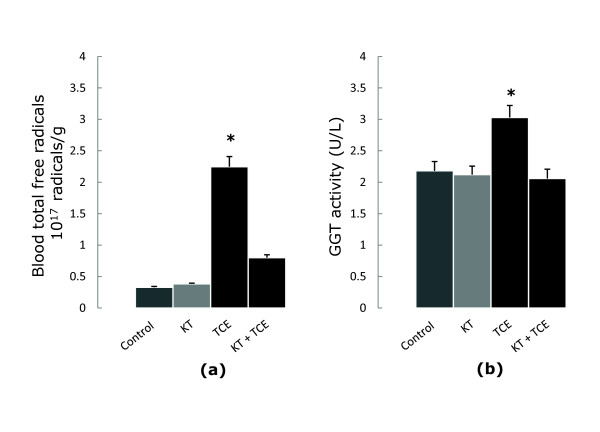
BACKGROUND: Trichloroethylene (TCE) may induce oxidative stress which generates free radicals and alters antioxidants or oxygen-free radical scavenging enzymes. METHODS: Twenty male albino rats were divided into four groups: (1) the control group treated with vehicle, (2) Kombucha (KT)-treated group, (3) TCE-treated group and (4) KT/TCE-treated group. Kidney lipid peroxidation, glutathione content, nitric oxide (NO) and total blood free radical concentrations were evaluated. Serum urea, creatinine level, gamma-glutamyl transferase (GGT) and lactate dehydrogenase (LDH) activities were also measured. RESULTS: TCE administration increased the malondiahyde (MDA) and NO contents in kidney, urea and creatinine concentrations in serum, total free radical level in blood and GGT and LDH activities in serum, whereas it decreased the glutathione (GSH) level in kidney homogenate. KT administration significantly improved lipid peroxidation and oxidative stress induced by TCE. CONCLUSION: The present study indicates that Kombucha may repair damage caused by environmental pollutants such as TCE and may be beneficial to patient suffering from renal impairment.
Overview
The claims and statistics of this paper haven’t been checked yet.
Free: it reads the open-access text and checks the first 5 claims that cite a source we can check. Create a free account to check every claim.
Integrity signals
Registry
Cites
Statistics
Figures
Verification
Claims the paper makes
The claims and statistics of this paper haven’t been checked yet.
Free: it reads the open-access text and checks the first 5 claims that cite a source we can check. Create a free account to check every claim.
Claims other papers make about this one
Each is checked against this paper’s own text: does it say what the citing paper says it does?
The cited source says what the claim attributes to it.
In the citing paper
“Kombucha has been shown to exert effects in animal studies on blood glycaemia [72], oxidative stress [73], diabetes-induced weight loss [74], chemically-induced nephrotoxicity [75], hypercholesterolaemia [72,76] and indomethacin-induced gastric ulceration [77].”
From Fermented foods: definitions and characteristics, impact on the gut microbiota and effects on gastrointestinal health and disease (2019) · cites this paper as [75]
Self-check
Percentages, sums and reported differences re-computed from the paper’s own numbers.
The self-check needs the paper’s full text.
Citations
Cites
DETERMINATION OF SERUM PROTEINS BY MEANS OF THE BIURET REACTION
Gornall, A. G., Bardawill, C. J., & David, M. M. (1949) · Journal of Biological Chemistry · doi:10.1016/s0021-9258(18)57021-6 · Cited by 16,158
Improved method for the determination of blood glutathione.
Beutler, E., Duron, O., & KELLY, B. M. (1963) · PubMed · Cited by 7,025
Halliwell, B., & Whiteman, M. (2004) · British Journal of Pharmacology · doi:10.1038/sj.bjp.0705776 · Cited by 2,238 · cited 1×
“Accumulation of such damage may cause cell death [12].”
BackgroundOxygen, oxidative stress, hypoxia, and heart failure
Giordano, F. J. (2005) · Journal of Clinical Investigation · doi:10.1172/jci200524408 · Cited by 1,496 · cited 1×
“Containing unpaired electron, free radicals are highly reactive and cause damage to part of cells by inducing DNA strand breaks, purine oxidation and protein DNA cross linking and cell membrane damage [11].”
BackgroundA Kinetic Photometric Method for Serum γ-Glutamyl Transpeptidase
Szasz, G. (1969) · Clinical Chemistry · doi:10.1093/clinchem/15.2.124 · Cited by 1,205 · cited 1×
“GGT activity was evaluated according to the method by Szasz [23].”
MethodREGULATION OF GENE EXPRESSION BY REACTIVE OXYGEN
Dalton, T. P., Shertzer, H. G., & Puga, A. (1999) · Annual Review of Pharmacology and Toxicology · doi:10.1146/annurev.pharmtox.39.1.67 · Cited by 1,118 · cited 1×
“TCE induced oxidative stress [9] which is considered an imbalance between the production of oxidizing molecular species (free radicals) and the presence of cellular antioxidants [10].”
BackgroundYoshioka, T., Kawada, K., Shimada, T., & Mori, M. (1979) · American Journal of Obstetrics and Gynecology · doi:10.1016/0002-9378(79)90708-7 · Cited by 1,052 · cited 1×
“Kombucha is a potent antioxidant demonstrated to reduce the damage induced by oxidative stress [16,27,3436].”
BackgroundGlucuronidation of Drugs and Other Compounds
Dutton, G. J. (2019) · Chapman & Hall/CRC eBooks · doi:10.1201/9780429264177 · Cited by 794
Tea, Kombucha, and health: a review
Dufresne, C., & Farnworth, E. (2000) · Food Research International · doi:10.1016/s0963-9969(00)00067-3 · Cited by 484 · cited 1×
“Research indicated that Kombucha improved resistance against cancer, prevented cardiovascular diseases, promoted digestion, stimulated immunity and reduced inflammation [ 2 ].”
BackgroundBiological Applications of Electron Spin Resonance
Wertz, J. E., & Bolton, J. R. (1986) · Electron Spin Resonance · doi:10.1007/978-94-009-4075-8_14 · Cited by 342
Research works printed but not linked: 2
- [20]Gohn A ESR and Elementary Practical Applications 1986 New York: John Wiley
- [26]Gomal AC Bardawill CJ David MM Colorimetric method for total protein determination J Biol Chemi 1949 177 751 18110453
Cited by
Jayabalan, R., Malbaša, R. V., Lončar, E. S., Vitas, J. S., & Sathishkumar, M. (2014) · Comprehensive Reviews in Food Science and Food Safety · doi:10.1111/1541-4337.12073 · Cited by 939
Dimidi, E., Cox, S., Rossi, M., & Whelan, K. (2019) · Nutrients · doi:10.3390/nu11081806 · Cited by 801
Gaggìa, F., Baffoni, L., Galiano, M., Nielsen, D. S., Jakobsen, R. R., Castro-Mejía, J. L., Bosi, S., Truzzi, F., Musumeci, F., Dinelli, G., et al. (2018) · Nutrients · doi:10.3390/nu11010001 · Cited by 541
Hypoglycemic and antilipidemic properties of kombucha tea in alloxan-induced diabetic rats
Aloulou, A., Hamden, K., Elloumi, D., Ali, M. B., Hargafi, K., Jaouadi, B., Ayadi, F., Elfeki, A., & Ammar, E. (2012) · BMC Complementary and Alternative Medicine · doi:10.1186/1472-6882-12-63 · Cited by 201
“showed that, owing to its antioxidant potential, KT can ameliorate trichloroethyleneinduced kidney damage by preventing lipid peroxidation and ROS species formation [16].”
BackgroundSoares, M. G., de Lima, M., & Schmidt, V. C. R. (2021) · Trends in Food Science & Technology · doi:10.1016/j.tifs.2021.02.017 · Cited by 133
Vīna, I., Semjonovs, P., Linde, R., & Deniņa, I. (2014) · Journal of Medicinal Food · doi:10.1089/jmf.2013.0031 · Cited by 92
“KT effects on oxidative stress induced nephrotoxicity this has been studied in rats.(27) Trichloroethylene (TCE) has been Table 1.”
Kombucha: A Promising Functional Beverage Prepared From Tea
Chakravorty, S., Bhattacharya, S., Bhattacharya, D., Sarkar, S., & Gachhui, R. (2019) · Elsevier eBooks · doi:10.1016/b978-0-12-815270-6.00010-4 · Cited by 110
“KT also exhibited nephroprotective effect against thrichloroethylene-induced oxidative stress in rats (Gharib, 2009).”
BackgroundLavefve, L., Marasini, D. N., & Carbonero, F. G. (2018) · Advances in food and nutrition research · doi:10.1016/bs.afnr.2018.09.001 · Cited by 95
Costa, M. A. D. C., Vilela, D. L. D. S., Fraiz, G. M., Lopes, I. L., Coelho, A. Í. M., Castro, L. C. V., & Martin, J. G. P. (2021) · Critical Reviews in Food Science and Nutrition · doi:10.1080/10408398.2021.1995321 · Cited by 88
Bellassoued, K., Ghrab, F., Ayadi, F. M., van Pelt, J. F., Elfeki, A., & Ammar, E. (2015) · Pharmaceutical Biology · doi:10.3109/13880209.2014.1001408 · Cited by 79
Kozyrovska, N., Reva, O. N., Goginyan, V. B., & Vera, J.-P. P. D. (2012) · Biopolymers and Cell · doi:10.7124/bc.000034 · Cited by 80
“Recent well-documented research works on the KT administration have exhibited antimicrobial and antiproliferative activity [13, 15]; improvement after lipid peroxidation and oxidative stress [16] and cytotoxicity [17] induced by environmental pollutants; antiobesity, hypocholesterolaemic and antioxidant effects [18];…”
BackgroundKombucha Tea: A Promising Fermented Functional Beverage
Sinir, G. Ö., Tamer, C. E., & Suna, S. (2019) · Elsevier eBooks · doi:10.1016/b978-0-12-815271-3.00010-5 · Cited by 59
Kombucha: An Old Tradition into a New Concept of a Beneficial, Health-Promoting Beverage
Andrade, D. K. A., Wang, B., Lima, E. M. F., Shebeko, S. K., Ermakov, A. M., Николаевна, Х. В., Иванова, И., Rocha, R. S., Vaz‐Velho, M., Mutukumira, A. N., et al. (2025) · Foods · doi:10.3390/foods14091547 · Cited by 65
“In another study [51], kombucha reduced trichloroethylene-induced kidney damage in rats.”
Additional advances related to the health benefits associated with kombucha consumption
Esatbeyoglu, T., Aydin, S. S., Subaşı, B. G., Erskine, E., Gök, R., Ibrahim, S. A., Yılmaz, B., Özoğul, F., & Çapanoğlu, E. (2023) · Critical Reviews in Food Science and Nutrition · doi:10.1080/10408398.2022.2163373 · Cited by 42
“The results revealed that urea, creatinine, nitric oxide (NO) concentration and lactate dehydrogenase (LDH) activity decreased by administering kombucha tea 24 hours after the last TCE treat-ment (Gharib 2009).”
BackgroundMethodInfluentialHaghmorad, D., Yazdanpanah, E., Sadighi‐Moghaddam, B., Yousefi, B., Sahafi, P., Ghorbani, N., Rashidy‐Pour, A., & Kokhaei, P. (2020) · Acta Neurologica Belgica · doi:10.1007/s13760-020-01475-3 · Cited by 31
“demonstrated that kombucha administration significantly improved trichloroethylene-induced kidney damage by inhibition NO contents and also improved lipid peroxidation and oxidative stress induced nephrotoxicity in rat [42].”
BackgroundAbshenas, J., Derakhshanfar, A., Ferdosi, M., & Hasanzadeh, S. (2011) · Comparative Clinical Pathology · doi:10.1007/s00580-011-1273-9 · Cited by 31
“…xylinoides, Bacterium gluconicum, Saccharomyces ludwigii, Saccharomyces apiculatus varieties, Schizosaccaromyces pombe, Acetobacter ketogenum, Torula varieties, Pichia fermantans, and other yeasts reported to have potential health effects (Gharib 2009; Belloso-Morales and Hernández-Sánchez 2003).”
BackgroundMethodInfluentialKombucha (Bio-Tea): An Elixir for Life?
Chandrakala Shenoy, K., Lobo, R. O., & Dias, F. O. (2019) · Elsevier eBooks · doi:10.1016/b978-0-12-816842-4.00016-2 · Cited by 33
Marzban, F., Azizi, G., Afraei, S., Sedaghat, R., Seyedzadeh, M. H., Razavi, A., & Mirshafiey, A. (2015) · Food and Agricultural Immunology · doi:10.1080/09540105.2015.1036353 · Cited by 29
“Moreover, the efficacy and antioxidant activity of kombucha tea have been demonstrated against oxidative stress-induced nephrotoxicity and hepatotoxicity, as well as in diabetic rats and gastric ulceration in mice (Banerjee et al., 2010; Bhattacharya, Gachhui, & Sil, 2011, 2013; Gharib, 2009).”
BackgroundResultWITHDRAWN: Probiotic potential of Kombucha
Şengün, İ. Y., & Peker, A. K. (2020) · Journal of Functional Foods · doi:10.1016/j.jff.2020.104284 · Cited by 27
RetractedShariatzadeh, S. M. A., Miri, S. A., & Cheraghi, E. (2021) · Andrologia · doi:10.1111/and.13982 · Cited by 11
“Kombucha is a potent antioxidant with the ability to reduce the damage induced by oxidative stress-induced damage (Gharib, 2009).”
BackgroundRajamanikandan, S., Sindhu, T., Durgapriya, D., Sophia, D., Ragavendran, P., & Gopalakrishnan, V. K. (2012) · Asian Pacific Journal of Tropical Medicine · doi:10.1016/s1995-7645(12)60161-8 · Cited by 10
Ameliorative effect of vitamin E on trichloroethylene-induced nephrotoxicity in rats
Heydari, M., Ahmadizadeh, M., & Angali, K. A. (2016) · Journal of Nephropathology · doi:10.15171/jnp.2017.29 · Cited by 9
“The kidney is the main site for the excretion of waste products and therefore is exposed to all xenobiotics entered the body and is the target organ for TCE toxicity(1,4).”
BackgroundZubaidah, E., Susanti, I., Sujuti, H., Martati, E., Rahayu, A. P., Srianta, I., & Tewfik, I. (2023) · Food Bioscience · doi:10.1016/j.fbio.2023.103043 · Cited by 14
The Compositional and Functional Properties of Kombucha: A Literature Review
Kim, J. Y., Shin, H., Kim, H. L., Park, H., Kim, P. K., Park, S. I., & Kim, S. H. (2020) · Food Engineering Progress · doi:10.13050/foodengprog.2020.24.1.1 · Cited by 9
DETERMINAÇÃO COMPOSICIONAL DE AMOSTRAS DE KOMBUCHAS ACRESCIDAS DE POLPAS DE FRUTAS
Moraes, L. S., Bender, S., & Kottwitz, L. B. M. (2020) · FAG JOURNAL OF HEALTH (FJH) · doi:10.35984/fjh.v2i2.213 · Cited by 5
Radio-protective response on the environmental pollutant induced oxidative stress
Gharib, O. A., Ellatif, U. A. A., Abdellah, N. M., & Mohammad, M. A. (2012) · Advances in Bioscience and Biotechnology · doi:10.4236/abb.2012.327122 · Cited by 5
“, Khan and their colleagues and Gharib that TCE significantly increased urea and creatinine in rats [15,43,44].”
BackgroundSelf-citationBioactivity and Cytotoxicity of Kombucha Fermented with Extracts from Green Tea and Citrus Peel
Shin, S., Ko, H. M., Kim, C.-I., & Park, S. (2016) · Journal of the Korean Society of Food Science and Nutrition · doi:10.3746/jkfn.2016.45.12.1838 · Cited by 4
PENGARUH PEMBERIAN “KOMBUCHA” TEH ROSELLA TERHADAP PROFIL DARAH MENCIT (Mus musculus L)
Hidayanti, M. D., Astuti, S., & Kustyawati, M. E. (2015) · Jurnal Agritech · doi:10.22146/agritech.9432 · Cited by 5
Ghiasi, R., Abbasi, M. M., Khordadmehr, M., Imani, S., & Hosseinzadeh, F. (2023) · Neurochemical Research · doi:10.1007/s11064-023-03980-2 · Cited by 4
Abbasi, M. M., Vaezi, F. E., & Hosseinzadeh, F. (2024) · Nutrire · doi:10.1186/s41110-024-00283-6 · Cited by 4
“Moreover, kombucha tea mitigated the oxidative stress and apoptosis caused by tertiary butyl hydroperoxide in the liver [20, 34].”
Jonathan, A. L., Widyadharma, I. P. E., & Artini, I. G. A. (2023) · International Journal of Research and Review · doi:10.52403/ijrr.20230564 · Cited by 1
Abbasi, M. M., Vaezi, F. E., & Hosseinzadeh, F. (2022) · Research Square · doi:10.21203/rs.3.rs-1482869/v1 · Cited by 1
Trichloroethylene-Induced Oxidative Stress and Autoimmunity
Khan, M. F., & Wang, G. (2014) · Molecular and integrative toxicology · doi:10.1007/978-1-4471-6311-4_4
Arani, M. Y., Hemati, B., & Zarei, A. (2014)
Noreini, S. N. (2020) · Biomedical Journal of Scientific & Technical Research · doi:10.26717/bjstr.2020.29.004840
https://www.actascientific.com/ASNH/pdf/ASNH-06-1093.pdf
Simões, G. D., do Amaral, C. C., Ferrúa, C. P., Aldrighi, A. L., de Souza, K. B., Corrêa, G. P., Giorgi, R., & Nedel, F. (2022) · Acta Scientifci Nutritional Health · doi:10.31080/asnh.2022.06.1093
Costa, M. A. D. C., Fraiz, G. M., Cardoso, R. R., da Silva, A. A., Duarte, V. D. S., Cruz, C. E. S. G., Rodrigues, E. G., Shaikh, M. W., Keshavarzian, A., Hamaker, B. R., et al. (2026) · Food & Function · doi:10.1039/d5fo02226f · Cited by 2
Korkmaz, D., & Mutlu, A. G. (2026) · Nutrition and Health · doi:10.1177/02601060261485647
Metadata
- Authors
- Gharib, O.
- Affiliations
- Egyptian Atomic Energy Authority (EG)
- Corresponding author
- Gharib, Ola
- Venue
- Chinese Medicine
- Published
- 2009
- Volume
- 4
- Issue
- 1
- Pages
- 23
- ISSN
- 1749-8546 (ISSN-L)
- PMC
- PMC2788564
- OpenAlex
- W2126840265
- Cited by
- 38
- References
- 32
- Citations by year
- 2026: 2 · 2025: 1 · 2024: 1 · 2023: 4 · 2022: 2 · 2021: 3 · 2020: 5 · 2019: 4 · 2018: 2 · 2016: 2 · 2015: 3 · 2014: 3 · 2013: 1 · 2012: 4
- FWCI
- 1.08
- Type
- journal article
- Language
- en
- Open access
- gold
- doi.org
- Licence
- cc-by
- Locations
- Chinese Medicine (publishedVersion, cc-by)
- Europe PMC (PubMed Central) (publishedVersion, cc-by)
- PubMed Central (publishedVersion, cc-by)
- PubMed (publishedVersion)
- DOAJ (DOAJ: Directory of Open Access Journals) (submittedVersion)
- Greater South Information System
- Topics
- Health Sciences › Medicine › Biochemistry (medical) › Antioxidant Activity and Oxidative Stress
- Life Sciences › Pharmacology, Toxicology and Pharmaceutics › Toxicology › Chemotherapy-induced organ toxicity mitigation
- Physical Sciences › Environmental Science › Health, Toxicology and Mutagenesis › Heavy Metal Exposure and Toxicity
- Keywords
- kombucha, trichloroethylene, nephrotoxicity, oxidative stress, lipid peroxidation, glutathione, nitric oxide, free radicals, kidney injury, renal biomarkers, antioxidant activity, environmental pollutants
About these checks
Registry, retraction, Cites and statistics results are computed, not judged, with one exception: a printed reference that no index lists is read once by a model before it counts as a citation error. Claims are extracted by a model and kept only when their quote appears verbatim in the text; each cited source is then checked, with a model’s help, for whether it says what the claim relies on. Those verdicts can be wrong — read the claim’s quote and the cited source before relying on one.
Statistics and arithmetic are recomputed, not judged.
Confidence bands are shown only for fields calibrated on our annotated test set. None is calibrated yet, so no band is shown.
What counts as a claim ›How we measure confidence ›How we check this ›
Are you an author, or do you see a problem with this page? Request a review
Data sources
Bibliographic data: Semantic Scholar, OpenAlex, Crossref.
Contains information from the Semantic Scholar Academic Graph Datasets, made available under the ODC Attribution License (ODC-BY 1.0).
Semantic Scholar’s data is described in: Kinney, R., et al. (2023). The Semantic Scholar Open Data Platform. arXiv:2301.10140.
