

The DOI matches its Crossref record; 49 of the 49 references it cites were found in a registry or an index.
Validation of a French version of the Freiburg Mindfulness Inventory - short version: relationships between mindfulness and stress in an adult population
Open accessAbstract
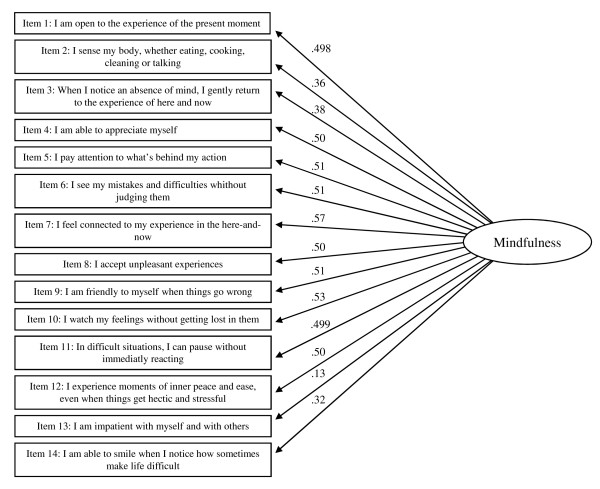
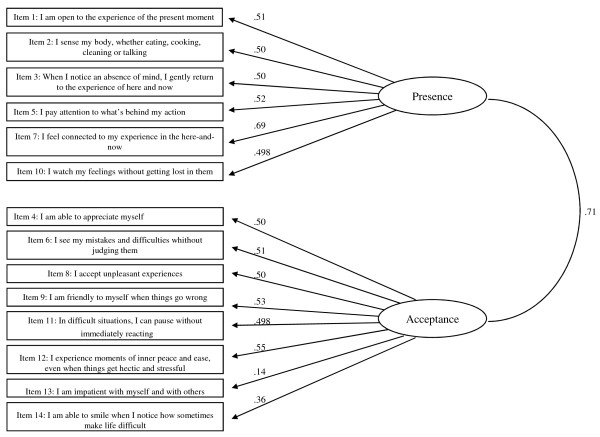
BACKGROUND: Whereas interest in incorporating mindfulness into interventions in medicine is growing, data on the relationships of mindfulness to stress and coping in management is still scarce. This report first presents a French validation of the Freiburg Mindfulness Inventory-short form (FMI) in a middle-aged working population. Secondly, it investigates the relationship between psychological adjustment and mindfulness. METHODS: Five hundred and six non-clinical middle-aged working individuals rated themselves on the self-report French version FMI and completed measures of psychological constructs potentially related to mindfulness levels. RESULTS: Results were comparable to results of the original short version. Internal consistency of the scale based on the one-factor solution was .74, and test-retest reliability was good. The one-dimensional solution as the alternative to the two-factor structure solution yielded suboptimal fit indices. Correlations also indicated that individuals scoring high on mindfulness are prone to stress tolerance, positive affects and higher self-efficacy. Furthermore, subjects with no reports of stressful events were higher on mindfulness. CONCLUSION: These data showed that mindfulness can be measured validly and reliably with the proposed French version of the FMI. The data also highlighted the relationship between mindfulness and stress in an adult population. Mindfulness appears to reduce negative appraisals of challenging or threatening events.
Overview
The claims and statistics of this paper haven’t been checked yet.
Run the check — free, no account needed. It reads the open-access text and checks the sources it cites.
Integrity signals
Registry
Cites
Statistics
Figures
Verification
Claims the paper makes
The claims and statistics of this paper haven’t been checked yet.
Run the check — free, no account needed. It reads the open-access text and checks the sources it cites.
Claims other papers make about this one
Each is checked against this paper’s own text: does it say what the citing paper says it does?
The cited source says what the claim attributes to it.
In the citing paper
“the 14-item, self-administered Freiburg Mindfulness Inventory short form (FMI short form) assessed mindfulness [25] developed for people without any background knowledge in mindfulness [25]. French validation showed good psychometric qualities [43].”
From Acceptance Mindfulness-Trait as a Protective Factor for Post-Natal Depression: A Preliminary Research (2022) · cites this paper as [43]
Self-check
Percentages, sums and reported differences re-computed from the paper’s own numbers.
The self-check needs the paper’s full text.
Citations
Cites
Hu, L., & Bentler, P. M. (1999) · Structural Equation Modeling A Multidisciplinary Journal · doi:10.1080/10705519909540118 · Cited by 108,788
Tabachnick, B. G., & Fidell, L. S. (1983) · Cited by 79,882
Self-efficacy: The exercise of control
Bandura, A., Freeman, W. H., & Lightsey, R. (1999) · Journal of Cognitive Psychotherapy · doi:10.1891/0889-8391.13.2.158 · Cited by 46,835 · cited 3×
“The beneficial effects of self-efficacy include coping with trauma [34] and performance [34].”
A Global Measure of Perceived Stress
Cohen, S., Kamarck, T., & Mermelstein, R. (1983) · Journal of Health and Social Behavior · doi:10.2307/2136404 · Cited by 32,807
Development and validation of brief measures of positive and negative affect: The PANAS scales.
Watson, D., Clark, L. A., & Tellegen, A. (1988) · Journal of Personality and Social Psychology · doi:10.1037/0022-3514.54.6.1063 · Cited by 32,433
The benefits of being present: Mindfulness and its role in psychological well-being
Brown, K. W., & Ryan, R. M. (2003) · Journal of Personality and Social Psychology · doi:10.1037/0022-3514.84.4.822 · Cited by 13,448
Construct validity in psychological tests.
Cronbach, L. J., & Meehl, P. E. (1955) · Psychological Bulletin · doi:10.1037/h0040957 · Cited by 11,195
Using Self-Report Assessment Methods to Explore Facets of Mindfulness
Baer, R. A., Smith, G. T., Hopkins, J., Krietemeyer, J., & Toney, L. (2006) · Assessment · doi:10.1177/1073191105283504 · Cited by 7,511 · cited 9×
“Baer et al. (2006) have specified which facets of mindfulness were responsible for these correlates [20].”
BackgroundMethodInfluential(2008) · Medical Entomology and Zoology · Cited by 7,477
Mindfulness: A proposed operational definition.
Bishop, S. R., Lau, M., Shapiro, S., Carlson, L., Anderson, N. D., Carmody, J., Segal, Z. V., Abbey, S., Speca, M., Velting, D., et al. (2004) · Clinical Psychology: Science and Practice · doi:10.1093/clipsy.bph077 · Cited by 7,234
(1993) · Cited by 7,136
Cognitive-Behavioral Treatment of Borderline Personality Disorder
Cary, G. L. (1994) · American Journal of Psychotherapy · doi:10.1176/appi.psychotherapy.1994.48.1.155 · Cited by 6,299
Bagby, R. M., Parker, J. D. A., & Taylor, G. J. (1994) · Journal of Psychosomatic Research · doi:10.1016/0022-3999(94)90005-1 · Cited by 5,293
Mindfulness-based stress reduction and health benefits
Grossman, P., Niemann, L., Schmidt, S., & Walach, H. (2004) · Journal of Psychosomatic Research · doi:10.1016/s0022-3999(03)00573-7 · Cited by 3,958
(2001) · Cited by 3,666
Baer, R. A., Smith, G. T., Lykins, E., Button, D., Krietemeyer, J., Sauer, S., Walsh, E., Duggan, D., & Williams, J. M. G. (2008) · Assessment · doi:10.1177/1073191107313003 · Cited by 2,930
Alterations in brain and immune function produced by mindfulness meditation
Davidson, R. J., Kabat-Zinn, J., Schumacher, J., Rosenkranz, M., Muller, D., Santorelli, S. F., Urbanowski, F., Harrington, A., Bonus, K., & Sheridan, J. F. (2003) · Psychosomatic Medicine · doi:10.1097/01.psy.0000077505.67574.e3 · Cited by 2,925 · cited 2×
“Indeed, mindfulness training is related to positive psychological and physiological outcomes [6,7].”
BackgroundThe twenty-item Toronto Alexithymia scale—II. Convergent, discriminant, and concurrent validity
Bagby, R. M., Taylor, G. J., & Parker, J. D. A. (1994) · Journal of Psychosomatic Research · doi:10.1016/0022-3999(94)90006-x · Cited by 2,431
Assessment of Mindfulness by Self-Report: The Kentucky Inventory of Mindfulness Skills
Baer, R. A., Smith, G. T., & Allen, K. B. (2004) · Assessment · doi:10.1177/1073191104268029 · Cited by 2,298
Measuring mindfulness—The Freiburg Mindfulness Inventory (FMI)
Walach, H., Buchheld, N., Buttenmüller, V., Kleinknecht, N., & Schmidt, S. (2006) · Personality and Individual Differences · doi:10.1016/j.paid.2005.11.025 · Cited by 1,475 · cited 4×
“…as observed by Walach et al. (2006), the exploratory factorial structure showed that the translated items are not readily separable suggesting that the French translation of the FMI explores mindfulness as “a general construct that has some inter-related facets” (Walach et al., 2006; p. 1548; 7).”
BackgroundMethodInfluentialThe Toronto Mindfulness Scale: Development and validation
Lau, M. A., Bishop, S. R., Segal, Z. V., Buis, T., Anderson, N. D., Carlson, L., Shapiro, S., Carmody, J., Abbey, S., & Devins, G. (2006) · Journal of Clinical Psychology · doi:10.1002/jclp.20326 · Cited by 1,456
Mindfulness-Based Cognitive Therapy for Depression: A New Approach to Preventing Relapse
Hodo, D. W. (2002) · American Journal of Psychiatry · doi:10.1176/appi.ajp.159.7.1257 · Cited by 1,405
Mindfulness-based stress reduction and health benefits: A meta-analysis
Grossman, P., Niemann, L., Schmidt, S., & Walach, H. (2003) · Focus on Alternative and Complementary Therapies · doi:10.1111/j.2042-7166.2003.tb04008.x · Cited by 1,394
The appraisal of body-cathexis: body-cathexis and the self.
Secord, P. F., & Jourard, S. M. (1953) · Journal of Consulting Psychology · doi:10.1037/h0060689 · Cited by 1,061
Standards for Internet-Based Experimenting
Reips, U. (2002) · Experimental Psychology (formerly Zeitschrift für Experimentelle Psychologie) · doi:10.1026/1618-3169.49.4.243 · Cited by 878
Weinstein, N., Brown, K. W., & Ryan, R. M. (2009) · Journal of Research in Personality · doi:10.1016/j.jrp.2008.12.008 · Cited by 874 · cited 3×
“Thus, mindfulness appears to reduce negative appraisals of challenging or threatening events [ 16 ].”
BackgroundInfluential(2014) · Choice Reviews Online · doi:10.5860/choice.51-3535 · Cited by 763
Hayes, A. M., & Feldman, G. (2004) · Clinical Psychology: Science and Practice · doi:10.1093/clipsy.bph080 · Cited by 759
Acceptance and Commitment Therapy
Strosahl, K. D. (2002) · Elsevier eBooks · doi:10.1016/b0-12-343010-0/00001-5 · Cited by 647
On measuring mindfulness in psychosomatic and psychological research
Grossman, P. (2008) · Journal of Psychosomatic Research · doi:10.1016/j.jpsychores.2008.02.001 · Cited by 514
Fliege, H., Rose, M., Arck, P., Walter, O. B., Kocalevent, R.-D., Weber, C., & Klapp, B. F. (2005) · Psychosomatic Medicine · doi:10.1097/01.psy.0000151491.80178.78 · Cited by 496
Levitt, J. T., Brown, T. A., Orsillo, S. M., & Barlow, D. H. (2004) · Behavior Therapy · doi:10.1016/s0005-7894(04)80018-2 · Cited by 479
Well–being and affective style: neural substrates and biobehavioural correlates
Davidson, R. J. (2004) · Philosophical Transactions of the Royal Society of London. Series B: Biological Sciences · doi:10.1098/rstb.2004.1510 · Cited by 446 · cited 1×
“A high level of mindfulness increases willingness to tolerate uncomfortable emotions and sensations [8-11] and emotional acceptance [12,13,4].”
BackgroundMindfulness skills and interpersonal behaviour
Dekeyser, M., Raes, F., Leijssen, M., Leysen, S., & Dewulf, D. (2008) · Personality and Individual Differences · doi:10.1016/j.paid.2007.11.018 · Cited by 404
The effects of acceptance versus control contexts on avoidance of panic-related symptoms
Eifert, G. H., & Heffner, M. (2003) · Journal of Behavior Therapy and Experimental Psychiatry · doi:10.1016/j.jbtep.2003.11.001 · Cited by 375 · cited 1×
“A high level of mindfulness increases willingness to tolerate uncomfortable emotions and sensations [8-11] and emotional acceptance [12,13,4].”
BackgroundSanders, K. M. (2010) · FOCUS The Journal of Lifelong Learning in Psychiatry · doi:10.1176/foc.8.1.foc19 · Cited by 368
Development and Validation of the Situational Self-Awareness Scale
Govern, J. M., & Marsch, L. A. (2001) · Consciousness and Cognition · doi:10.1006/ccog.2001.0506 · Cited by 354
Cognitive-behavioral therapy for bulimia nervosa: Time course and mechanisms of change.
Wilson, G. T., Fairburn, C. G., Agras, W. S., Walsh, B. T., & KRAEMER, H. C. (2002) · Journal of Consulting and Clinical Psychology · doi:10.1037/0022-006x.70.2.267 · Cited by 317
Facets of mindfulness – Results of an online study investigating the Freiburg mindfulness inventory
Kohls, N., Sauer, S., & Walach, H. (2009) · Personality and Individual Differences · doi:10.1016/j.paid.2008.10.009 · Cited by 276
Bergdahl, J., & Bergdahl, M. (2002) · Stress and Health · doi:10.1002/smi.946 · Cited by 258
Task, Domain, and General Efficacy: A Reexamination of the Self-Efficacy Scale
Woodruff, S. L., & Cashman, J. F. (1993) · Psychological Reports · doi:10.2466/pr0.1993.72.2.423 · Cited by 223
Hayes, A. M. (2004) · Clinical Psychology Science and Practice · doi:10.1093/clipsy/bph080 · Cited by 152
Intentional systemic mindfulness: an integrative model for self-regulation and health.
Shapiro, S. L., & SCHWARTZ, G. E. R. (2000) · PubMed · doi:10.1054/ambm.1999.0118 · Cited by 135
Acceptance and Commitment Therapy
Hayes, S. C. (2023) · PsycTHERAPY Dataset · doi:10.1037/v00839-001 · Cited by 80
Orsillo, S. M., Roemer, L., Block‐Lerner, J., & Tull, M. T. (2004) · Cited by 55
* Well-being and affective style: neural substrates and biobehavioural correlates
Davidson, R. J. (2005) · Oxford University Press eBooks · doi:10.1093/acprof:oso/9780198567523.003.0005 · Cited by 38
Typological and factor analysis of the perceived stress measure by using the PSS scale
Cerclé, A., Gadéa, C., Hartmann, A., & Lourel, M. (2008) · European Review of Applied Psychology · doi:10.1016/j.erap.2008.09.006 · Cited by 32
Positive and negative mood in the elderly: the ZENITH study
McConville, C. F., Simpson, E. E. A., Rae, G., Polito, A., Andriollo-Sanchez, M., Meunier, N., Stewart-Knox, B. J., O’Connor, J. M., Roussel, A. M., Cuzzolaro, M., et al. (2005) · European Journal of Clinical Nutrition · doi:10.1038/sj.ejcn.1602293 · Cited by 18
Introducing a short form version of the Scale for Interpersonal Behaviour (s-SIB) for use in Italy.
Arrindell, W. A., Sanavio, E., & Sica, C. (2002) · University of Groningen research database (University of Groningen / Centre for Information Technology) · Cited by 16
Cited by
Sorted by citations
Michel, A., Bosch, C., & Rexroth, M. (2014) · Journal of Occupational and Organizational Psychology · doi:10.1111/joop.12072 · Cited by 305
Trousselard, M., Steiler, D., Dutheil, F., Claverie, D., Canini, F., Fenouillet, F., Naughton, G., Stewart-Brown, S., & Franck, N. (2016) · Psychiatry Research · doi:10.1016/j.psychres.2016.08.050 · Cited by 152
Self-citationJoyce, S., Shand, F., Lal, T. J., Mott, B., Bryant, R. A., & Harvey, S. B. (2019) · Journal of Medical Internet Research · doi:10.2196/12894 · Cited by 101
Baer, R., Gu, J., Cavanagh, K., & Strauss, C. (2019) · Psychological Assessment · doi:10.1037/pas0000744 · Cited by 66
“Mixed findings have been reported for the FMI, with an unspecified coefficient of .67 in a Chinese sample (Chen & Zhou, 2014) and ICC .80 in a French sample (Trousselard et al., 2010).”
BackgroundMindfulness and Empathy: Differential Effects of Explicit and Implicit Buddhist Teachings
Bayot, M., Vermeulen, N., Kever, A., & Mikolajczak, M. (2020) · Mindfulness · doi:10.1007/s12671-018-0966-4 · Cited by 49
Metadata
- Authors
- Trousselard, M., Steiler, D., Raphel, C., Cian, C., Duymedjian, R., Claverie, D., & Canini, F.
- Affiliations
- Service de Santé des Armées (FR)
- Grenoble Ecole de Management (FR)
- Corresponding author
- Trousselard, Marion
- Venue
- BioPsychoSocial Medicine
- Published
- 2010
- Volume
- 4
- Issue
- 1
- Pages
- 8
- ISSN
- 1751-0759 (ISSN-L)
- PMC
- PMC2927476
- OpenAlex
- W2116475876
- Cited by
- 103
- References
- 49
- Citations by year
- 2026: 2 · 2025: 11 · 2024: 5 · 2023: 11 · 2022: 13 · 2021: 13 · 2020: 5 · 2019: 9 · 2018: 8 · 2017: 9 · 2016: 5 · 2015: 3 · 2014: 4 · 2013: 3 · 2012: 1
- FWCI
- 1.76
- Type
- journal article
- Language
- en
- Open access
- gold
- doi.org
- Licence
- cc-by
- Locations
- BioPsychoSocial Medicine (publishedVersion, cc-by)
- PubMed Central (publishedVersion, cc-by)
- PubMed (publishedVersion)
- HAL (submittedVersion, other-oa)
- DOAJ (DOAJ: Directory of Open Access Journals) (submittedVersion)
- Topics
- Social Sciences › Psychology › Clinical Psychology › Mindfulness and Compassion Interventions
- Social Sciences › Health › Religion, Spirituality, and Psychology
- Social Sciences › Decision Sciences › Management Science and Operations Research › Psychometric Methodologies and Testing
- Keywords
- mindfulness, Freiburg Mindfulness Inventory, French translation, psychometric validation, stress, stress tolerance, psychological adjustment, self-efficacy, positive affect, middle-aged adults, working population
About these checks
Registry, retraction, Cites and statistics results are computed, not judged, with one exception: a printed reference that no index lists is read once by a model before it counts as a citation error. Claims are extracted by a model and kept only when their quote appears verbatim in the text; each cited source is then checked, with a model’s help, for whether it says what the claim relies on. Those verdicts can be wrong — read the claim’s quote and the cited source before relying on one.
Statistics and arithmetic are recomputed, not judged.
Confidence bands are shown only for fields calibrated on our annotated test set. None is calibrated yet, so no band is shown.
What counts as a claim ›How we measure confidence ›How we check this ›
Are you an author, or do you see a problem with this page? Request a review
