

Family planning in conflict: results of cross-sectional baseline surveys in three African countries.
Open accessThe DOI matches its Crossref record; 14 of the 16 references it cites were found in a registry or an index.
Abstract
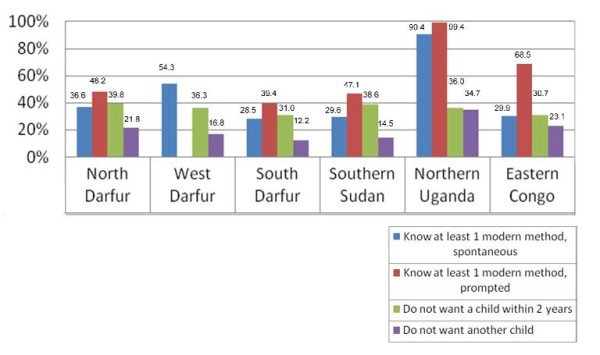
BACKGROUND: Despite the serious consequences of conflict for reproductive health, populations affected by conflict and its aftermath face tremendous barriers to accessing reproductive health services, due to insecurity, inadequate numbers of trained personnel and lack of supplies. Family planning is often particularly neglected. METHODS: In six conflict-affected areas in Sudan, northern Uganda and the Democratic Republic of Congo, household surveys of married or in-union women of reproductive age were conducted to determine baseline measures of family planning knowledge, attitudes and behaviors regarding contraception. Health facility assessments were carried out to assess baseline measures of family planning services availability. Data were double-entered into CSPro 3.2 and exported to SAS 9.2, which was used to calculate descriptive statistics. The studies' purposes were to guide program activities and to serve as a baseline against which program accomplishments could be measured. RESULTS: Knowledge of modern contraceptive methods was low relative to other sub-Saharan African countries, and use of modern methods was under 4% in four sites; in two sites with prior family planning services it was 12% and 16.2%. From 30% to 40% of women reported they did not want a child within two years, however, and an additional 12% to 35% wanted no additional children, suggesting a clear need for family planning services. The health facilities assessment showed that at most only one-third of the facilities mandated to provide family planning had the necessary staff, equipment and supplies to do so adequately; in some areas, none of the facilities were prepared to offer such services. CONCLUSIONS: Family planning services are desired by women living in crisis situations when offered in a manner appropriate to their needs, yet services are rarely adequate to meet these needs. Refugee and internally displaced women must be included in national and donors' plans to improve family planning in Africa.
Overview
The claims and statistics of this paper haven’t been checked yet.
Free: it reads the open-access text and checks the first 5 claims that cite a source we can check. Create a free account to check every claim.
Integrity signals
Registry
Cites
Statistics
Figures
Verification
Claims the paper makes
The claims and statistics of this paper haven’t been checked yet.
Free: it reads the open-access text and checks the first 5 claims that cite a source we can check. Create a free account to check every claim.
Claims other papers make about this one
Each is checked against this paper’s own text: does it say what the citing paper says it does?
The check wasn’t confident either way, so it gives no verdict — never disputed.
In the citing paper
“Protective community support mechanisms, which make adolescent parenthood socially viable in some agricultural societies, are also often lost in migration or mass population movements 10– 12.”
From Trends and birth outcomes in adolescent refugees and migrants on the Thailand-Myanmar border, 1986-2016: an observational study (2018) · cites this paper as [11]
Experimental — accuracy not yet measured
Self-check
Percentages, sums and reported differences re-computed from the paper’s own numbers.
The self-check needs the paper’s full text.
Citations
Cites
Church, J. A. (2001) · Journal of Government Information · doi:10.1016/s1352-0237(01)00307-0 · Cited by 9,153
Human Development Report 2009. Overcoming Barriers: Human Mobility and DevelopmentPreprint
Klugman, J. (2009) · SSRN Electronic Journal · Cited by 804
International family planning perspectives.
(2005) · doi:10.29171/acku_serial_hq763_i624_2005_n3 · Cited by 472
Family Planning. A global handbook for providers
Radhakrishnan, S. (2008) · Journal of Obstetrics and Gynaecology · doi:10.1080/01443610802242957 · Cited by 379
Reproductive Health of War-Affected Populations: What Do We Know?
McGinn, T. (2000) · International Family Planning Perspectives · doi:10.2307/2648255 · Cited by 182
Self-citationContraceptive trends in developing countries
Khan, S. M., Mishra, V., Arnold, F., & Abderrahim, N. (2007) · Cited by 90
Tracking Official Development Assistance for Reproductive Health in Conflict-Affected Countries
Patel, P., Roberts, B., Guy, S., Lee-Jones, L., & Conteh, L. (2009) · PLoS Medicine · doi:10.1371/journal.pmed.1000090 · Cited by 77
Self-citationMaternal and Child Health: Global Challenges, Programs, and Policies
Ehiri, J. E. (2009) · Springer eBooks · doi:10.1007/b106524 · Cited by 65
Programmatic Responses to Refugees' Reproductive Health Needs
Krause, S. K., Jones, R. K., & Purdin, S. J. (2000) · International Family Planning Perspectives · doi:10.2307/2648256 · Cited by 49
Fragile, Threatened, and Still Urgently Needed: Family Planning Programs in Sub‐Saharan Africa
Jacobstein, R., Bakamjian, L., Pile, J. M., & Wickstrom, J. (2009) · Studies in Family Planning · doi:10.1111/j.1728-4465.2009.00197.x · Cited by 32
Research works printed but not linked: 16
- Cohen S The reproductive health needs of refugees and displaced people: an opening for renewed US leadership Guttmacher Policy Review 2009 12 3 15 19
- Wulf D Refugee women and reproductive health care: reassessing priorities 1994 New York: Women's Commission for Refugee Women and Children
- United Nations International conference on population and development, Programme of action 1994 New York
- Inter-agency Working Group on Reproductive Health in Crises Inter-agency Field Manual on Reproductive Health in Humanitarian Settings: 2010 Revision for Field Review 2010 New York http://www.iawg.net/resources/field_manual.html 26203479
- Women's Commission for Refugee Women and Children/Reproductive Health Response in Conflict Consortium Field-Friendly Guide to Integrate Emergency Obstetric Care in Humanitarian Programs 2005 New York
- Women's Commission for Refugee Women and Children Reproductive Health Response in Conflict Consortium HIV Prevention and Control: A Short Course for Humanitarian Workers 2004 New York
- Proceedings of RHRC Consortium Conference 2000: Findings on Reproductive Health of Refugees and Displaced Populations, 2000: December 5-6, 2000; Washington, DC http://www.rhrc.org/resources/general_reports/con00/proc2000.pdf
- Proceedings of RHRC Consortium Conference 2003: Reproductive health from disaster to development: October 7-8, 2003; Brussels http://www.rhrc.org/resources/general_reports/con03/confprocdingsNEW.pdf
- Proceedings of The Reproductive Access, Information, and Services in Emergencies (RAISE) Initiative and RHRC Consortium Reproductive Health in Emergencies Conference 2008: June 18-20, 2008; Kampala New York/London; 2008 http://raiseinitiative.org/conf2008/raise_proceedings.pdf
- Proceedings of The Inter-Agency Working Group (IAWG) on Reproductive Health in Crises Annual Meeting 2010: May 24-26; Santo Domingo New York; 2010 http://www.iawg.net/2010/presentations.html
- Spiedel J Sinding S Gillespie D Maguire E Neuse M Making the Case for US Family Planning Assistance 2009 Washington D.C.: Woodrow Wilson Center International Center for Scholars http://www.prb.org/pdf09/makingthecase.pdf
- McGinn T Casey SE Purdin SJ Marsh M Reproductive health for conflict-affected people: policies, research and programmes Humanitarian Practice Network Paper No 45 2004 London
- United Nations High Commissioner for Refugees (UNHCR) Division of Programme Support and Management 2009 global trends: refugees, asylum-seekers, returnees, internally displaced and stateless persons 2010 Geneva
- Uganda Bureau of Statistics (UBOS) Macro International Inc. Uganda Demographic and Health Survey 2006 2007 Calverton, MD
- Uganda Ministry of Finance Planning and Economic Development The Background to the Budget: 2010/11 Fiscal Year 2010 Kampala
- Toth C Improving lives through CARE's sexual and reproductive health programs-Meeting needs for reproductive health services in post-conflict environments: CARE's family planning project in the Democratic Republic of the Congo 2007 Atlanta, GA: CARE [CARE International: Voices from the Village-Case Study No. 1]21749562
Cited by
The effects of armed conflict on the health of women and children
Bendavid, E., Boerma, T., Akseer, N., Langer, A., Malembaka, E. B., Okiro, E. A., Wise, P. H., Heft-Neal, S., Black, R. E., Bhutta, Z. A., et al. (2021) · The Lancet · doi:10.1016/s0140-6736(21)00131-8 · Cited by 466
Ivanova, O., Rai, M., & Kemigisha, E. (2018) · International Journal of Environmental Research and Public Health · doi:10.3390/ijerph15081583 · Cited by 219
“One of the very few studies on this subject by McGinn et al. demonstrated that knowledge and use of modern contraceptive methods was low among married or in-union women of reproductive age in six reproductive health program locations (North Darfur, West Darfur, South Darfur, Southern Sudan, Northern Uganda and Eastern…”
BackgroundAckerson, K., & Zielinski, R. (2017) · Midwifery · doi:10.1016/j.midw.2017.07.021 · Cited by 136
An assessment of antenatal care among Syrian refugees in Lebanon
Benage, M., Greenough, P. G., Vinck, P., Omeira, N., & Pham, P. (2015) · Conflict and Health · doi:10.1186/s13031-015-0035-8 · Cited by 116
Casey, S. E., Gallagher, M. C., Kakesa, J., Kalyanpur, A., Muselemu, J.-B., Rafanoharana, R. V., & Spilotros, N. (2020) · PLoS Medicine · doi:10.1371/journal.pmed.1003086 · Cited by 112
Self-citationCherri, Z., Cuesta, J. G., Rodriguez-Llanes, J. M., & Guha‐Sapir, D. (2017) · International Journal of Environmental Research and Public Health · doi:10.3390/ijerph14080836 · Cited by 111
Modern contraceptive use among women in Uganda: An analysis of trend and patterns (1995-2011)
Andi, J. R., Wamala, R., Ocaya, B., & Kabagenyi, A. (2014) · African Population Studies · doi:10.11564/28-0-553 · Cited by 83
Namasivayam, A., González, P. I. A., Delgado, R. C., & Chi, P. C. (2017) · PLoS Currents · doi:10.1371/currents.dis.557b987d6519d8c7c96f2006ed3c271a · Cited by 82
Family planning in refugee settings: findings and actions from a multi-country study
Tanabe, M., Myers, A., Bhandari, P., Cornier, N., Doraiswamy, S., & Krause, S. (2017) · Conflict and Health · doi:10.1186/s13031-017-0112-2 · Cited by 78
A scoping review of the health of Conflict-Induced internally displaced women in Africa
Amodu, O. C., Richter, M. S., & Salami, B. O. (2020) · International Journal of Environmental Research and Public Health · doi:10.3390/ijerph17041280 · Cited by 71
“(2011) [44] To document and disseminate data on family planning knowledge, attitudes, and practices among displaced women Population-based household surveys and health facility assessments Sudan, Uganda, and the DRC • Use of modern contraceptive methods among women was under 4% in four program areas: West and South Da…”
BackgroundMethodInfluentialFactors Influencing Contraceptives Use among Women in the Juba City of South Sudan
Obwoya, J. G., Wulifan, J. K., & Kalolo, A. (2018) · International Journal of Population Research · doi:10.1155/2018/6381842 · Cited by 65
Exposure to Armed Conflict and Fertility in Sub-Saharan Africa
Thiede, B. C., Hancock, M., Kodouda, A., & Piazza, J. A. (2020) · Demography · doi:10.1007/s13524-020-00923-2 · Cited by 64
Delivery of sexual and reproductive health interventions in conflict settings: a systematic review
Munyuzangabo, M., Khalifa, D. S., Gaffey, M. F., Kamali, M., Siddiqui, F. J., Meteke, S., Shah, S., Jain, R., Als, D., Radhakrishnan, A., et al. (2020) · BMJ Global Health · doi:10.1136/bmjgh-2019-002206 · Cited by 59
Michielsen, K., Larrson, E. C., Kågesten, A., Erausquin, J. T., Griffin, S., de Velde, S. M. V., & Tucker, J. D. (2020) · Sexually Transmitted Infections · doi:10.1136/sextrans-2020-054664 · Cited by 59
Conflict and Health: seven years of advancing science in humanitarian crises
Ratnayake, R., Degomme, O., Roberts, B., & Spiegel, P. B. (2014) · Conflict and Health · doi:10.1186/1752-1505-8-7 · Cited by 57
The effect of war on infant mortality in the Democratic Republic of Congo
Lindskog, E. E. (2016) · BMC Public Health · doi:10.1186/s12889-016-3685-6 · Cited by 57
Casey, S. E., McNab, S. E., Tanton, C., Odong, J., Testa, A. C., & Lee-Jones, L. (2013) · Global Public Health · doi:10.1080/17441692.2012.758302 · Cited by 56
Self-citationKabakian‐Khasholian, T., Mourtada, R., Bashour, H. N., Kak, F. E., & Zurayk, H. (2017) · Reproductive Health Matters · doi:10.1080/09688080.2017.1378532 · Cited by 56
Factors in use of family planning services by Syrian women in a refugee camp in Jordan
West, L., Isotta-Day, H., Ba-Break, M. M., & Morgan, R. (2016) · Journal of Family Planning and Reproductive Health Care · doi:10.1136/jfprhc-2014-101026 · Cited by 53
Conflict and Contraception in Colombia
Svallfors, S., & Billingsley, S. (2019) · Studies in Family Planning · doi:10.1111/sifp.12087 · Cited by 53
Elmusharaf, K., Byrne, E., AbuAgla, A., AbdelRahim, A., Manandhar, M., Sondorp, E., & O’Donovan, D. (2017) · BMC Pregnancy and Childbirth · doi:10.1186/s12884-017-1463-9 · Cited by 48
Falb, K., Annan, J., Kpebo, D. O., & Gupta, J. (2014) · African Journal of Reproductive Health · Cited by 48
Seyife, A., Fisseha, G., Yebyo, H. G., Gidey, G., & Gerensea, H. (2019) · PLoS ONE · doi:10.1371/journal.pone.0212262 · Cited by 46
Fahme, S. A., Sieverding, M., & Abdulrahim, S. (2021) · Reproductive Health · doi:10.1186/s12978-021-01170-3 · Cited by 45
Primary healthcare delivery models in African conflict-affected settings: a systematic review
Omam, L.-A., Jarman, E., O’Laughlin, K. N., & Parkes-Ratanshi, R. M. (2023) · Conflict and Health · doi:10.1186/s13031-023-00533-w · Cited by 44
Chukwumalu, K., Gallagher, M. C., Baunach, S., & Cannon, A. (2017) · Reproductive Health Matters · doi:10.1080/09688080.2017.1402670 · Cited by 44
Tunçalp, Ö., Fall, I. S., Phillips, S. J., Williams, I., Sacko, M., Touré, O., Thomas, L. J., & Say, L. (2015) · Conflict and Health · doi:10.1186/s13031-015-0051-8 · Cited by 42
Gebrecherkos, K., Gebremariam, B., Worku, A. G., Syum, H., Kahsay, G., & Abay, M. (2018) · BMC Research Notes · doi:10.1186/s13104-018-3956-7 · Cited by 41
Armed Conflict and the Timing of Childbearing in Azerbaijan
Torrisi, O. (2020) · Population and Development Review · doi:10.1111/padr.12359 · Cited by 39
Kidman, R. C., Palermo, T., & Bertrand, J. T. (2015) · Social Science & Medicine · doi:10.1016/j.socscimed.2015.03.034 · Cited by 38
Palmer, J. J., & Storeng, K. T. (2016) · Social Science & Medicine · doi:10.1016/j.socscimed.2016.09.011 · Cited by 38
Curry, D. W., Rattan, J., Nzau, J. J., & Giri, K. (2015) · Global Health: Science and Practice · doi:10.9745/ghsp-d-14-00164 · Cited by 34
“Moreover, recent research in the humanitarian context, while not extensive, shows it is feasible to increase access to and use of a wide range of family planning methods including highly effective long-acting reversible contraceptives (LARCs).(8,9)”
BackgroundCasey, S. E., & Tshipamba, M. (2017) · Conflict and Health · doi:10.1186/s13031-017-0104-2 · Cited by 34
Self-citationMorris, C. N., Lopes, K., Gallagher, M. C., Ashraf, S., & Ibrahim, S. (2019) · Sexual and Reproductive Health Matters · doi:10.1080/26410397.2019.1610279 · Cited by 34
Reproductive health during conflict
Black, B. O., Bouanchaud, P., Bignall, J. K., Simpson, E., & Gupta, M. (2014) · The Obstetrician & Gynaecologist · doi:10.1111/tog.12114 · Cited by 32
Pasquier, E., Owolabi, O., Fetters, T., Ngbalé, R. N., Gbanzi, M. C. A., Williams, T., Chen, H., Fotheringham, C., Lagrou, D., Schulte‐Hillen, C., et al. (2023) · BMC Pregnancy and Childbirth · doi:10.1186/s12884-023-05427-6 · Cited by 29
A Qualitative Exploration of Somali Refugee Women’s Experiences with Family Planning in the U.S.
Zhang, Y., McCoy, E. E., Scego, R., Phillips, W. R., & Godfrey, E. M. (2019) · Journal of Immigrant and Minority Health · doi:10.1007/s10903-019-00887-5 · Cited by 28
Mocelin, H. J. S., de Jezus, S. V., Negri, L. D. S. A., Borges, B. J. P., da Silva, A. I., & Maciel, E. L. N. (2023) · Revista Panamericana de Salud Pública · doi:10.26633/rpsp.2023.3 · Cited by 25
Student support for reproductive health education in middle schools: findings from Lebanon
Mouhanna, F., DeJong, J., Afifi, R., Asmar, K. E., Nazha, B., & Zurayk, H. (2017) · Sex Education · doi:10.1080/14681811.2017.1280011 · Cited by 24
Svallfors, S. (2021) · Population Studies · doi:10.1080/00324728.2021.1953118 · Cited by 24
Scott, J. A., Averbach, S., Modest, A. M., Hacker, M. R., Cornish, S., Spencer, D., Murphy, M., & Parmar, P. K. (2013) · Conflict and Health · doi:10.1186/1752-1505-7-24 · Cited by 24
Gallagher, M. C., Morris, C. N., Fatima, A., Daniel, R., Shire, A. H., & Malilo, B. (2021) · Frontiers in Global Women s Health · doi:10.3389/fgwh.2021.613338 · Cited by 23
Casey, S. E., Isa, G. P., Mazambi, E. I., Giuffrida, M. M., Kulkarni, M. J., & Perera, S. M. (2021) · Global Public Health · doi:10.1080/17441692.2021.1959939 · Cited by 23
Self-citationPatel, P., Dahab, M., Tanabe, M., Murphy, A., Ettema, L., Guy, S., & Roberts, B. (2016) · BJOG An International Journal of Obstetrics & Gynaecology · doi:10.1111/1471-0528.13851 · Cited by 22
Kisindja, R. M., Kimona, C., Etoy, M., Dorme, F., & Benfield, N. C. (2017) · International Journal of Gynecology & Obstetrics · doi:10.1002/ijgo.12220 · Cited by 20
Violent instability and modern contraception: Evidence from Mali
Torrisi, O. (2024) · World Development · doi:10.1016/j.worlddev.2024.106538 · Cited by 19
Interrelationships of Forced Migration, Fertility and Reproductive Health
Agadjanian, V. (2017) · Springer eBooks · doi:10.1007/978-3-319-67147-5_6 · Cited by 19
Ahmed, W. A. M., Shokai, S. B., Abduelkhair, I. H., & Boshra, A. Y. (2015) · AIMS Public Health · doi:10.3934/publichealth.2015.4.655 · Cited by 19
Omishakin, M. Y. J. (2015) · Cited by 18
Parker, A. L., Parker, D. M., Zan, B. N., Min, A. M., Gilder, M. E., Ringringulu, M., Win, E., Wiladphaingern, J., Charunwatthana, P., Nosten, F., et al. (2018) · Wellcome Open Research · doi:10.12688/wellcomeopenres.14613.1 · Cited by 17
Impact of the COVID-19 pandemic on sexual and reproductive health among women with induced abortion
Tu, P., Li, J., Jiang, X., Pei, K., & Gu, Y. (2021) · Scientific Reports · doi:10.1038/s41598-021-95868-w · Cited by 16
Casey, S. E., Gallagher, M. C., Dumas, E. F., Kakesa, J., Katsongo, J. M., & Muselemu, J.-B. (2019) · PLoS ONE · doi:10.1371/journal.pone.0219990 · Cited by 16
Self-citationAnalysis of mobile clinic deployments in conflict zones
González, R. S., Cherkesly, M., Crainic, T. G., & Rancourt, M. (2024) · Journal of Humanitarian Logistics and Supply Chain Management · doi:10.1108/jhlscm-07-2022-0080 · Cited by 13
Assessment of the evidence of links between gender equality, peacebuilding and statebuilding
Domingo, P. B., Holmes, R. S., Menocal, A. R., Jones, N., & Wood, J. M. (2013) · Cited by 11
Displacement and Disease: HIV Risks and Healthcare Gaps Among Refugee Populations
Ullah, A. A. (2025) · Venereology · doi:10.3390/venereology4020007 · Cited by 11
Gebrekidan, H. G., Alemayehu, M., & Debelew, G. T. (2024) · PLoS ONE · doi:10.1371/journal.pone.0303803 · Cited by 11
Adam, I. F. (2016) · International Journal of Gynecology & Obstetrics · doi:10.1016/j.ijgo.2015.09.023 · Cited by 9
Schaub, M., Adeyanju, G. C., Abulfathi, A. A., Bello, M. M., Kasserra, L., Kwaku, A. A., Jalo, M. I., Mahmud, A., Schrage, P., Jalo, R. I., et al. (2025) · BMJ Global Health · doi:10.1136/bmjgh-2025-019494 · Cited by 9
Asgary, R. G., & Price, J. T. (2018) · Disaster Medicine and Public Health Preparedness · doi:10.1017/dmp.2017.146 · Cited by 8
Kristiansen, D., Boyle, E. H., & Svec, J. (2023) · Reproductive Health · doi:10.1186/s12978-023-01708-7 · Cited by 7
Gitonga, E., & Gage, A. J. (2024) · Frontiers in Global Women s Health · doi:10.3389/fgwh.2024.1328612 · Cited by 7
Mugisho, G. (2025) · Advances in Life Course Research · doi:10.1016/j.alcr.2025.100692 · Cited by 6
Covid-19’s Effects on Contraceptive Services Across the Humanitarian–Development Nexus
Jacobi, L., & Rich, S. (2022) · IDS Bulletin · doi:10.19088/1968-2022.120 · Cited by 5
Gender equality in Peacebuilding and Statebuilding
Domingo, P., & Holmes, R. L. (2013) · Cited by 5
Massavon, W., Wilunda, C., Nannini, M., Agaro, C., Amandi, S., Orech, J. B., Vivo, E. D., Lochoro, P., & Putoto, G. (2019) · BMJ Open · doi:10.1136/bmjopen-2018-026851 · Cited by 5
Family Planning for Refugees in Camps in Tanzania
Millington, K. A. (2019) · Figshare · Cited by 5
Elmusharaf, K. (2015) · Arrow@dit (Dublin Institute of Technology) · doi:10.13025/15937 · Cited by 5
Palattiyil, G., Limon, M. T. I., Mowla, S. M. N., Kadery, R. M., Mitra, D. K., Rahman, H., Muztahid, P., Sidhva, D., & Nair, H. (2025) · Social Sciences · doi:10.3390/socsci14090532 · Cited by 4
Rich, S., Jacobi, L., Talbi, N., Wolfington, A., & McDonald, K. (2024) · Global Health Science and Practice · doi:10.9745/ghsp-d-24-00124 · Cited by 4
Aham-Chiabuotu, C. B. (2019) · Otago University Research Archive (University of Otago) · Cited by 4
Tikouk, J., Boubkr, A. A., & Chentoufi, M. A. (2023) · Journal of Public Health in Africa · doi:10.4081/jphia.2023.2263 · Cited by 4
Gele, A. A., Shrestha, M., Khalif, F., & Qureshi, S. (2021) · Research Square · doi:10.21203/rs.3.rs-551043/v1 · Cited by 3
Humanitarianism and Covid-19: Structural Dilemmas, Fault Lines, and New Perspectives
Allouche, J., & Lintelo, D. T. (2022) · IDS Bulletin · doi:10.19088/1968-2022.111 · Cited by 3
Chynoweth, S. K. (2015) · UNSWorks (University of New South Wales, Sydney, Australia) · doi:10.26190/unsworks/17393 · Cited by 3
Arnott, G. (2014) · uO Research (University of Ottawa) · doi:10.20381/ruor-3829 · Cited by 2
Schaub, M., Abreu, L., Adeyanju, G. C., Abulfathi, A. A., Bello, M. M., Kasserra, L., Kwaku, A. A., Jalo, M. I., Mahmud, A., Schrage, P., et al. (2026) · Social Science & Medicine · doi:10.1016/j.socscimed.2026.119114 · Cited by 2
Fonseka, R. W., McDougal, L., Raj, A., Reed, E., Lundgren, R., Urada, L. A., & Silverman, J. G. (2022) · Advances in Global Health · doi:10.1525/agh.2022.1539582 · Cited by 2
ISLAM DAN HAK KESIHATAN REPRODUKTIF WANITA BERKAHWIN: SATU SOROTAN LITERATUR
Ahad, N., & Abdullah, R. (2018) · JOURNAL OF SHARIAH LAW RESEARCH · doi:10.22452/jslr.vol3no1.3 · Cited by 2
Armed Conflict and Pregnancy Termination: Evidence from Burkina Faso
Luetke, M. C., Grace, K. L., Yu, J., & Gunther, M. (2024) · Spatial Demography · doi:10.1007/s40980-024-00129-9 · Cited by 2
Contraceptive access in displacement settings: a quantitative study of Syrians displaced to Türkiye
Voir, R. L. (2025) · Sexual and Reproductive Health Matters · doi:10.1080/26410397.2025.2607838 · Cited by 2
Adaki, A. Y., & Wajim, J. (2025) · International Journal of Emerging Multidisciplinaries Social Science · doi:10.54938/ijemdss.2025.04.1.348 · Cited by 2
Kaya, K., ASLAN, S., ÖZESEN, T. A., & Gülmen, M. K. (2021) · Harran Üniversitesi Tıp Fakültesi Dergisi · doi:10.35440/hutfd.982364 · Cited by 2
47847926 Sexual and Reproductive Health and Family Planning in Armed Conflict and Violence
Torrisi, O., Leone, T., & Voir, R. L. (2025) · De Gruyter eBooks · doi:10.1515/9783111250144-027 · Cited by 1
Evidence for the implementation of contraceptive services in humanitarian settings
Casey, S. E. (2016) · Columbia Academic Commons (Columbia University) · doi:10.7916/d8k937mh · Cited by 1
Self-citationWoytowich, D. J., & Xie, B. (2021) · Research Square · doi:10.21203/rs.3.rs-814775/v1 · Cited by 1
Sieverding, M., Lteif, M. R., Fahme, S. A., & Kabakian‐Khasholian, T. (2025) · Conflict and Health · doi:10.1186/s13031-025-00732-7 · Cited by 1
Nattabi, B. (2012) · UWA Profiles and Research Repository (University of Western Australia) · Cited by 1
Socio-economic drivers and effects of contraceptive usage on breast cancer among women in Nigeria.
Akinola, G. W., Mbonigaba, J., & Akande, J. O. (2022) · African Journal of Reproductive Health · doi:10.29063/ajrh2022/v26i11.4 · Cited by 1
Abledu, Y., & Mike, J. H. (2024) · Journal of Climate Action Research and Policy · doi:10.1142/s2972312424500024
Tomczyk, B., Morof, D. F., & Potts, M. (2018) · Cambridge University Press eBooks · doi:10.1017/9781107477261.015
Is being a refugee affect prenatal bonding scores of Syrian women in Turkey?
Köpük, Ş. Y., NACİ, N., & Çekmez, Y. (2022) · Mustafa Kemal Üniversitesi Tıp Dergisi · doi:10.17944/mkutfd.980838
Culture, Gender and Health in the Humanitarian Context
Levy, E. (2018) · JOJ Nursing & Health Care · doi:10.19080/jojnhc.2018.06.555681
Woytowich, D. J., & Xie, B. (2021) · Research Square · doi:10.21203/rs.3.rs-814775/v2
Woytowich, D. J., & Xie, B. (2021) · Research Square · doi:10.21203/rs.3.rs-841640/v1
Women’s Mental Health, Reproductive Health, and Agency in Humanitarian Crises.
Bell, S. A. (2014) · Deep Blue (University of Michigan)
Wien, D. ̈. (2013) · LSHTM Research Online (London School of Hygiene and Tropical Medicine) · doi:10.17037/pubs.00768504
Questionário I-SHARE Brasil: adaptação do português de Portugal para o português do Brasil
Patrão, A. L., dos Reis, A. P., Tavares, I. M., Aquino, E. M. L., Menezes, G., & Nobre, P. J. (2023) · O Mundo da Saúde · doi:10.15343/0104-7809.202347e15082023p
I-SHARE Brazil questionnaire: adaptation from Portuguese to Brazilian Portuguese
Patrão, A. L., dos Reis, A. P., Tavares, I. M., Aquino, E. M. L., Menezes, G., & Nobre, P. J. (2023) · O Mundo da Saúde · doi:10.15343/0104-7809.202347e15082023i
Meshak, C. (2023) · IAA Journal of Applied Sciences · doi:10.59298/iaajas/2023/1.1.1000
39722 Intergenerational Consequences of Armed Conflict
Hubble, T. R., Osrin, D., Wells, J. C. K., & Devakumar, D. (2025) · De Gruyter eBooks · doi:10.1515/9783111250144-023
Metadata
- Authors
- McGinn, T., Austin, J., Anfinson, K., Amsalu, R., Casey, S. E., Fadulalmula, S. I., Langston, A., Lee-Jones, L., Meyers, J., Mubiru, F. K., Schlecht, J., Sharer, M., & Yetter, M.
- Affiliations
- Columbia University (US)
- Save the Children (US)
- International Rescue Committee (US)
- Marie Stopes International (GB)
- Corresponding author
- McGinn, Therese
- Venue
- Conflict and Health
- Published
- 2011-07-13
- Volume
- 5
- Issue
- 1
- Pages
- 11-11
- ISSN
- 1752-1505 (ISSN-L)
- PMC
- PMC3162885
- OpenAlex
- W2125363818
- Cited by
- 92
- References
- 16
- Citations by year
- 2026: 4 · 2025: 10 · 2024: 7 · 2023: 8 · 2022: 4 · 2021: 7 · 2020: 6 · 2019: 6 · 2018: 8 · 2017: 11 · 2016: 6 · 2015: 6 · 2014: 5 · 2013: 4
- FWCI
- 2.83
- Type
- journal article
- Language
- en
- Open access
- gold
- doi.org
- Licence
- cc-by
- creativecommons.org/licenses/by/2.0 (tdm)
- Locations
- Conflict and Health (publishedVersion, cc-by)
- Europe PMC (PubMed Central) (publishedVersion, cc-by)
- PubMed Central (publishedVersion, cc-by)
- PubMed (publishedVersion)
- DOAJ (DOAJ: Directory of Open Access Journals) (submittedVersion)
- Columbia Academic Commons (Columbia University)
- Topics
- Health Sciences › Medicine › Public Health, Environmental and Occupational Health › Reproductive Health and Contraception
- Health Sciences › Health Professions › General Health Professions › Health and Conflict Studies
- Health Sciences › Medicine › Pediatrics, Perinatology and Child Health › Global Maternal and Child Health
- Keywords
- family planning, conflict-affected populations, reproductive health services, contraceptive use, contraceptive knowledge, refugee women, internally displaced women, Sudan, Northern Uganda, Democratic Republic of the Congo
About these checks
Registry, retraction, Cites and statistics results are computed, not judged, with one exception: a printed reference that no index lists is read once by a model before it counts as a citation error. Claims are extracted by a model and kept only when their quote appears verbatim in the text; each cited source is then checked, with a model’s help, for whether it says what the claim relies on. Those verdicts can be wrong — read the claim’s quote and the cited source before relying on one.
Statistics and arithmetic are recomputed, not judged.
Confidence bands are shown only for fields calibrated on our annotated test set. None is calibrated yet, so no band is shown.
What counts as a claim ›How we measure confidence ›How we check this ›
Are you an author, or do you see a problem with this page? Request a review
Data sources
Bibliographic data: Semantic Scholar, OpenAlex, Crossref.
Contains information from the Semantic Scholar Academic Graph Datasets, made available under the ODC Attribution License (ODC-BY 1.0).
Semantic Scholar’s data is described in: Kinney, R., et al. (2023). The Semantic Scholar Open Data Platform. arXiv:2301.10140.
