

Family planning in conflict: results of cross-sectional baseline surveys in three African countries.
Open accessThe DOI matches its Crossref record; 14 of the 16 references it cites were found in a registry or an index.
Abstract
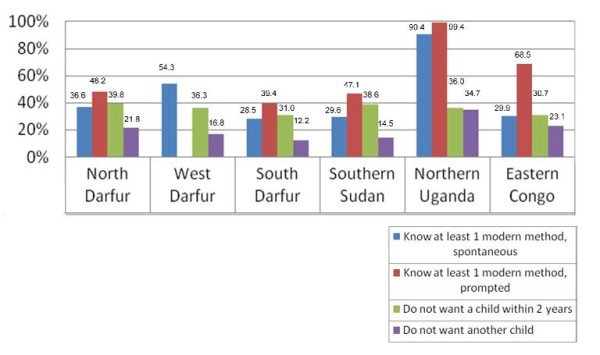
BACKGROUND: Despite the serious consequences of conflict for reproductive health, populations affected by conflict and its aftermath face tremendous barriers to accessing reproductive health services, due to insecurity, inadequate numbers of trained personnel and lack of supplies. Family planning is often particularly neglected. METHODS: In six conflict-affected areas in Sudan, northern Uganda and the Democratic Republic of Congo, household surveys of married or in-union women of reproductive age were conducted to determine baseline measures of family planning knowledge, attitudes and behaviors regarding contraception. Health facility assessments were carried out to assess baseline measures of family planning services availability. Data were double-entered into CSPro 3.2 and exported to SAS 9.2, which was used to calculate descriptive statistics. The studies' purposes were to guide program activities and to serve as a baseline against which program accomplishments could be measured. RESULTS: Knowledge of modern contraceptive methods was low relative to other sub-Saharan African countries, and use of modern methods was under 4% in four sites; in two sites with prior family planning services it was 12% and 16.2%. From 30% to 40% of women reported they did not want a child within two years, however, and an additional 12% to 35% wanted no additional children, suggesting a clear need for family planning services. The health facilities assessment showed that at most only one-third of the facilities mandated to provide family planning had the necessary staff, equipment and supplies to do so adequately; in some areas, none of the facilities were prepared to offer such services. CONCLUSIONS: Family planning services are desired by women living in crisis situations when offered in a manner appropriate to their needs, yet services are rarely adequate to meet these needs. Refugee and internally displaced women must be included in national and donors' plans to improve family planning in Africa.
Overview
The claims and statistics of this paper haven’t been checked yet.
Free: it reads the open-access text and checks the first 5 claims that cite a source we can check. Create a free account to check every claim.
Integrity signals
Registry
Cites
Statistics
Figures
Verification
Claims the paper makes
The claims and statistics of this paper haven’t been checked yet.
Free: it reads the open-access text and checks the first 5 claims that cite a source we can check. Create a free account to check every claim.
Claims other papers make about this one
Each is checked against this paper’s own text: does it say what the citing paper says it does?
The check wasn’t confident either way, so it gives no verdict — never disputed.
In the citing paper
“Protective community support mechanisms, which make adolescent parenthood socially viable in some agricultural societies, are also often lost in migration or mass population movements 10– 12.”
From Trends and birth outcomes in adolescent refugees and migrants on the Thailand-Myanmar border, 1986-2016: an observational study (2018) · cites this paper as [11]
Experimental — accuracy not yet measured
Self-check
Percentages, sums and reported differences re-computed from the paper’s own numbers.
The self-check needs the paper’s full text.
Citations
Cites
Church, J. A. (2001) · Journal of Government Information · doi:10.1016/s1352-0237(01)00307-0 · Cited by 9,153
Human Development Report 2009. Overcoming Barriers: Human Mobility and DevelopmentPreprint
Klugman, J. (2009) · SSRN Electronic Journal · Cited by 804
International family planning perspectives.
(2005) · doi:10.29171/acku_serial_hq763_i624_2005_n3 · Cited by 472
Family Planning. A global handbook for providers
Radhakrishnan, S. (2008) · Journal of Obstetrics and Gynaecology · doi:10.1080/01443610802242957 · Cited by 379
Reproductive Health of War-Affected Populations: What Do We Know?
McGinn, T. (2000) · International Family Planning Perspectives · doi:10.2307/2648255 · Cited by 182
Self-citationContraceptive trends in developing countries
Khan, S. M., Mishra, V., Arnold, F., & Abderrahim, N. (2007) · Cited by 90
Tracking Official Development Assistance for Reproductive Health in Conflict-Affected Countries
Patel, P., Roberts, B., Guy, S., Lee-Jones, L., & Conteh, L. (2009) · PLoS Medicine · doi:10.1371/journal.pmed.1000090 · Cited by 77
Self-citationMaternal and Child Health: Global Challenges, Programs, and Policies
Ehiri, J. E. (2009) · Springer eBooks · doi:10.1007/b106524 · Cited by 65
Programmatic Responses to Refugees' Reproductive Health Needs
Krause, S. K., Jones, R. K., & Purdin, S. J. (2000) · International Family Planning Perspectives · doi:10.2307/2648256 · Cited by 49
Fragile, Threatened, and Still Urgently Needed: Family Planning Programs in Sub‐Saharan Africa
Jacobstein, R., Bakamjian, L., Pile, J. M., & Wickstrom, J. (2009) · Studies in Family Planning · doi:10.1111/j.1728-4465.2009.00197.x · Cited by 32
Girard, F., & Waldman, W. (2000) · International Family Planning Perspectives · doi:10.2307/2648254 · Cited by 32
Turning Point: A Special Report on the Refugee Reproductive Health Field
Schreck, L. (2000) · International Family Planning Perspectives · doi:10.2307/2648253 · Cited by 30
Reproductive freedom for refugees
Black, M., FORSTER, G. E., & Mezey, G. (1993) · The Lancet · doi:10.1016/0140-6736(93)91193-p · Cited by 9
Impact of Wars and Conflict on Maternal and Child Health
d’Harcourt, E., & Purdin, S. (2009) · Springer eBooks · doi:10.1007/b106524_7 · Cited by 7
Research works printed but not linked: 16
- Cohen S The reproductive health needs of refugees and displaced people: an opening for renewed US leadership Guttmacher Policy Review 2009 12 3 15 19
- Wulf D Refugee women and reproductive health care: reassessing priorities 1994 New York: Women's Commission for Refugee Women and Children
- United Nations International conference on population and development, Programme of action 1994 New York
- Inter-agency Working Group on Reproductive Health in Crises Inter-agency Field Manual on Reproductive Health in Humanitarian Settings: 2010 Revision for Field Review 2010 New York http://www.iawg.net/resources/field_manual.html 26203479
- Women's Commission for Refugee Women and Children/Reproductive Health Response in Conflict Consortium Field-Friendly Guide to Integrate Emergency Obstetric Care in Humanitarian Programs 2005 New York
- Women's Commission for Refugee Women and Children Reproductive Health Response in Conflict Consortium HIV Prevention and Control: A Short Course for Humanitarian Workers 2004 New York
- Proceedings of RHRC Consortium Conference 2000: Findings on Reproductive Health of Refugees and Displaced Populations, 2000: December 5-6, 2000; Washington, DC http://www.rhrc.org/resources/general_reports/con00/proc2000.pdf
- Proceedings of RHRC Consortium Conference 2003: Reproductive health from disaster to development: October 7-8, 2003; Brussels http://www.rhrc.org/resources/general_reports/con03/confprocdingsNEW.pdf
- Proceedings of The Reproductive Access, Information, and Services in Emergencies (RAISE) Initiative and RHRC Consortium Reproductive Health in Emergencies Conference 2008: June 18-20, 2008; Kampala New York/London; 2008 http://raiseinitiative.org/conf2008/raise_proceedings.pdf
- Proceedings of The Inter-Agency Working Group (IAWG) on Reproductive Health in Crises Annual Meeting 2010: May 24-26; Santo Domingo New York; 2010 http://www.iawg.net/2010/presentations.html
- Spiedel J Sinding S Gillespie D Maguire E Neuse M Making the Case for US Family Planning Assistance 2009 Washington D.C.: Woodrow Wilson Center International Center for Scholars http://www.prb.org/pdf09/makingthecase.pdf
- McGinn T Casey SE Purdin SJ Marsh M Reproductive health for conflict-affected people: policies, research and programmes Humanitarian Practice Network Paper No 45 2004 London
- United Nations High Commissioner for Refugees (UNHCR) Division of Programme Support and Management 2009 global trends: refugees, asylum-seekers, returnees, internally displaced and stateless persons 2010 Geneva
- Uganda Bureau of Statistics (UBOS) Macro International Inc. Uganda Demographic and Health Survey 2006 2007 Calverton, MD
- Uganda Ministry of Finance Planning and Economic Development The Background to the Budget: 2010/11 Fiscal Year 2010 Kampala
- Toth C Improving lives through CARE's sexual and reproductive health programs-Meeting needs for reproductive health services in post-conflict environments: CARE's family planning project in the Democratic Republic of the Congo 2007 Atlanta, GA: CARE [CARE International: Voices from the Village-Case Study No. 1]21749562
Cited by
The effects of armed conflict on the health of women and children
Bendavid, E., Boerma, T., Akseer, N., Langer, A., Malembaka, E. B., Okiro, E. A., Wise, P. H., Heft-Neal, S., Black, R. E., Bhutta, Z. A., et al. (2021) · The Lancet · doi:10.1016/s0140-6736(21)00131-8 · Cited by 466
Ivanova, O., Rai, M., & Kemigisha, E. (2018) · International Journal of Environmental Research and Public Health · doi:10.3390/ijerph15081583 · Cited by 219
“One of the very few studies on this subject by McGinn et al. demonstrated that knowledge and use of modern contraceptive methods was low among married or in-union women of reproductive age in six reproductive health program locations (North Darfur, West Darfur, South Darfur, Southern Sudan, Northern Uganda and Eastern…”
BackgroundAckerson, K., & Zielinski, R. (2017) · Midwifery · doi:10.1016/j.midw.2017.07.021 · Cited by 136
An assessment of antenatal care among Syrian refugees in Lebanon
Benage, M., Greenough, P. G., Vinck, P., Omeira, N., & Pham, P. (2015) · Conflict and Health · doi:10.1186/s13031-015-0035-8 · Cited by 116
Casey, S. E., Gallagher, M. C., Kakesa, J., Kalyanpur, A., Muselemu, J.-B., Rafanoharana, R. V., & Spilotros, N. (2020) · PLoS Medicine · doi:10.1371/journal.pmed.1003086 · Cited by 112
Self-citation
Metadata
- Authors
- McGinn, T., Austin, J., Anfinson, K., Amsalu, R., Casey, S. E., Fadulalmula, S. I., Langston, A., Lee-Jones, L., Meyers, J., Mubiru, F. K., Schlecht, J., Sharer, M., & Yetter, M.
- Affiliations
- Columbia University (US)
- Save the Children (US)
- International Rescue Committee (US)
- Marie Stopes International (GB)
- Corresponding author
- McGinn, Therese
- Venue
- Conflict and Health
- Published
- 2011-07-13
- Volume
- 5
- Issue
- 1
- Pages
- 11-11
- ISSN
- 1752-1505 (ISSN-L)
- PMC
- PMC3162885
- OpenAlex
- W2125363818
- Cited by
- 92
- References
- 16
- Citations by year
- 2026: 4 · 2025: 10 · 2024: 7 · 2023: 8 · 2022: 4 · 2021: 7 · 2020: 6 · 2019: 6 · 2018: 8 · 2017: 11 · 2016: 6 · 2015: 6 · 2014: 5 · 2013: 4
- FWCI
- 2.83
- Type
- journal article
- Language
- en
- Open access
- gold
- doi.org
- Licence
- cc-by
- creativecommons.org/licenses/by/2.0 (tdm)
- Locations
- Conflict and Health (publishedVersion, cc-by)
- Europe PMC (PubMed Central) (publishedVersion, cc-by)
- PubMed Central (publishedVersion, cc-by)
- PubMed (publishedVersion)
- DOAJ (DOAJ: Directory of Open Access Journals) (submittedVersion)
- Columbia Academic Commons (Columbia University)
- Topics
- Health Sciences › Medicine › Public Health, Environmental and Occupational Health › Reproductive Health and Contraception
- Health Sciences › Health Professions › General Health Professions › Health and Conflict Studies
- Health Sciences › Medicine › Pediatrics, Perinatology and Child Health › Global Maternal and Child Health
- Keywords
- family planning, conflict-affected populations, reproductive health services, contraceptive use, contraceptive knowledge, refugee women, internally displaced women, Sudan, Northern Uganda, Democratic Republic of the Congo
About these checks
Registry, retraction, Cites and statistics results are computed, not judged, with one exception: a printed reference that no index lists is read once by a model before it counts as a citation error. Claims are extracted by a model and kept only when their quote appears verbatim in the text; each cited source is then checked, with a model’s help, for whether it says what the claim relies on. Those verdicts can be wrong — read the claim’s quote and the cited source before relying on one.
Statistics and arithmetic are recomputed, not judged.
Confidence bands are shown only for fields calibrated on our annotated test set. None is calibrated yet, so no band is shown.
What counts as a claim ›How we measure confidence ›How we check this ›
Are you an author, or do you see a problem with this page? Request a review
Data sources
Bibliographic data: Semantic Scholar, OpenAlex, Crossref.
Contains information from the Semantic Scholar Academic Graph Datasets, made available under the ODC Attribution License (ODC-BY 1.0).
Semantic Scholar’s data is described in: Kinney, R., et al. (2023). The Semantic Scholar Open Data Platform. arXiv:2301.10140.
