

The DOI matches its Crossref record; 75 of the 75 references it cites were found in a registry or an index.
A systematic review of resilience and mental health outcomes of conflict-driven adult forced migrants
Open accessAbstract
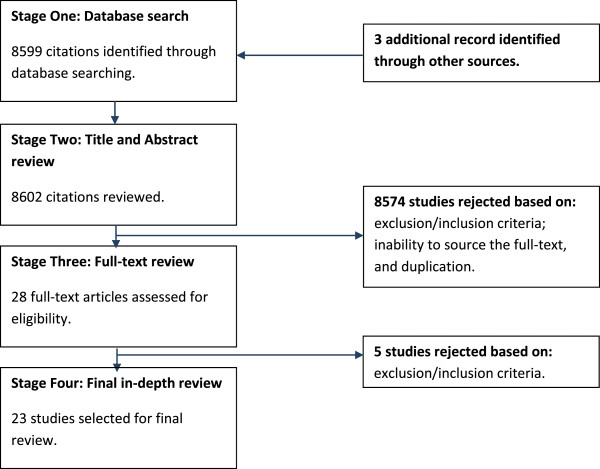
BACKGROUND: The rising global burden of forced migration due to armed conflict is increasingly recognised as an important issue in global health. Forced migrants are at a greater risk of developing mental disorders. However, resilience, defined as the ability of a person to successfully adapt to or recover from stressful and traumatic experiences, has been highlighted as a key potential protective factor. This study aimed to review systematically the global literature on the impact of resilience on the mental health of adult conflict-driven forced migrants. METHODOLOGY: Both quantitative and qualitative studies that reported resilience and mental health outcomes among forcibly displaced persons (aged 18+) by way of exploring associations, links, pathways and causative mechanisms were included. Fourteen bibliographic databases and seven humanitarian study databases/websites were searched and a four stage screening process was followed. RESULTS: Twenty three studies were included in the final review. Ten qualitative studies identified highlighted family and community cohesion, family and community support, individual personal qualities, collective identity, supportive primary relationships and religion. Thirteen quantitative studies were identified, but only two attempted to link resilience with mental disorders, and three used a specific resilience measure. Over-reliance on cross-sectional designs was noted. Resilience was generally shown to be associated with better mental health in displaced populations, but the evidence on this and underlying mechanisms was limited. DISCUSSION: The review highlights the need for more epidemiological and qualitative evidence on resilience in forcibly displaced persons as a potential avenue for intervention development, particularly in resource-poor settings.
Overview
The claims and statistics of this paper haven’t been checked yet.
Run the check — free, no account needed. It reads the open-access text and checks the sources it cites.
Integrity signals
Registry
Cites
Statistics
Figures
Verification
Claims the paper makes
The claims and statistics of this paper haven’t been checked yet.
Run the check — free, no account needed. It reads the open-access text and checks the sources it cites.
Claims other papers make about this one
Each is checked against this paper’s own text: does it say what the citing paper says it does?
The source backs part of the claim, not all of it — or backs it for a different population, condition or comparison.
In the citing paper
“Although successful adaptation to adverse circumstances occurs for most people (e.g. through employing positive coping strategies to target stressors or their psychological consequences), others may develop mental health disorders and pre-existing mental illness may go untreated [4, 5].”
From Mental health and psychosocial support for South Sudanese refugees in northern Uganda: a needs and resource assessment (2016) · cites this paper as [5]
Experimental — accuracy not yet measuredThe source backs part of the claim, not all of it — or backs it for a different population, condition or comparison.
In the citing paper
“Similar to other research on migrants and resilience, family and community support, maintenance of language, religion and culture as well learning new languages and ways of doing, fueled resilience”
From Refugees, asylum-seekers and undocumented migrants and the experience of parenthood: a synthesis of the qualitative literature (2017) · cites this paper as [169]
Experimental — accuracy not yet measured
Self-check
Percentages, sums and reported differences re-computed from the paper’s own numbers.
The self-check needs the paper’s full text.
Citations
Cites
Preferred Reporting Items for Systematic Reviews and Meta-Analyses: the PRISMA statement
Moher, D., Liberati, A., Tetzlaff, J., Altman, D. G., & for the PRISMA Group (2009) · BMJ · doi:10.1136/bmj.b2535 · Cited by 83,823
Preferred reporting items for systematic reviews and meta-analyses: the PRISMA Statement.
(2009) · PubMed Central · Cited by 44,859
Preferred reporting items for systematic reviews and meta-analyses: The PRISMA statement
Moher, D., Liberati, A., Tetzlaff, J., Altman, D. G., & the PRISMA Group* (2009) · Annals of Internal Medicine · doi:10.7326/0003-4819-151-4-200908180-00135 · Cited by 37,554
Preferred Reporting Items for Systematic Reviews and Meta-Analyses: The PRISMA Statement
Moher, D., Liberati, A., Tetzlaff, J., & Altman, D. G. (2009) · Journal of Clinical Epidemiology · doi:10.1016/j.jclinepi.2009.06.005 · Cited by 19,575
Development of a new resilience scale: The Connor-Davidson Resilience Scale (CD-RISC)
Connor, K. M., & Davidson, J. R. T. (2003) · Depression and Anxiety · doi:10.1002/da.10113 · Cited by 11,793
Community Resilience as a Metaphor, Theory, Set of Capacities, and Strategy for Disaster Readiness
Norris, F. H., Stevens, S. P., Pfefferbaum, B., Wyche, K. F., & Pfefferbaum, R. L. (2008) · American Journal of Community Psychology · doi:10.1007/s10464-007-9156-6 · Cited by 5,476
Social and ecological resilience: are they related?
Adger, W. N. (2000) · Progress in Human Geography · doi:10.1191/030913200701540465 · Cited by 4,844
Steel, Z., Chey, T., Silove, D., Marnane, C., Bryant, R. A., & van Ommeren, M. (2009) · JAMA · doi:10.1001/jama.2009.1132 · Cited by 2,246
Ungar, M. T. (2006) · The British Journal of Social Work · doi:10.1093/bjsw/bcl343 · Cited by 2,206
A methodological review of resilience measurement scales
Windle, G., Bennett, K. M., & Noyes, J. (2011) · Health and Quality of Life Outcomes · doi:10.1186/1477-7525-9-8 · Cited by 2,079
Research works printed but not linked: 4
- UNHCR: Facts and Figures about Refugees. 2011, http://www.unhcr.org.uk/about-us/key-facts-and-figures.html .
- Internal Displacement Monitoring Centre (IDMC): Global Conflict Displacement at 18 year High. 2013, Geneva: IDMC
- Rolfe RE, Social cohesion and community resilience: A Multidisciplinary Review of Literature for Rural Health Research. 2006, Halifax: Department of International Development Studies Faculty of Graduate Studies and Research Saint Mary’s University
- Blanchet K, Roberts B: Evidence Review on Research for Health in Humanitarian Crises. 2013, http://www.elrha.org/r2hc/evidence-review .
Cited by
Sorted by citations
The Social Determinants of Refugee Mental Health in the Post-Migration Context: A Critical Review
Hynie, M. (2018) · The Canadian Journal of Psychiatry · doi:10.1177/0706743717746666 · Cited by 659
The mental health of civilians displaced by armed conflict: an ecological model of refugee distress
Miller, K. E., & Rasmussen, A. (2017) · Epidemiology and Psychiatric Sciences · doi:10.1017/s2045796016000172 · Cited by 653
Lawrance, E. L., Thompson, R., Newberry Le Vay, J., Page, L., & Jennings, N. (2022) · International Review of Psychiatry · doi:10.1080/09540261.2022.2128725 · Cited by 500
Henkelmann, J.-R., de Best, S., Deckers, C., Jensen, K., Shahab, M. K., Elzinga, B. M., & Molendijk, M. L. (2020) · BJPsych Open · doi:10.1192/bjo.2020.54 · Cited by 391
Epidemiology of Substance Use among Forced Migrants: A Global Systematic Review
Horyniak, D., Melo, J. S., Farrell, R. M., Ojeda, V. D., & Strathdee, S. A. (2016) · PLoS ONE · doi:10.1371/journal.pone.0159134 · Cited by 288
Metadata
- Authors
- Siriwardhana, C., Ali, S. S., Roberts, B., & Stewart, R.
- Affiliations
- King's College London (GB)
- London School of Hygiene & Tropical Medicine (GB)
- Corresponding author
- Siriwardhana, Chesmal
- Venue
- Conflict and Health
- Published
- 2014-08-20
- Volume
- 8
- Issue
- 1
- Pages
- 13-13
- ISSN
- 1752-1505 (ISSN-L)
- PMC
- PMC4149800
- OpenAlex
- W2145950737
- Cited by
- 299
- References
- 75
- Citations by year
- 2026: 25 · 2025: 36 · 2024: 37 · 2023: 35 · 2022: 43 · 2021: 36 · 2020: 25 · 2019: 19 · 2018: 11 · 2017: 12 · 2016: 14 · 2015: 6
- FWCI
- 1.61
- Type
- journal article
- Language
- en
- Open access
- gold
- doi.org
- Licence
- cc-by
- Locations
- Conflict and Health (publishedVersion, cc-by)
- Europe PMC (PubMed Central) (publishedVersion, cc-by)
- PubMed Central (publishedVersion, cc-by)
- PubMed (publishedVersion)
- LSHTM Research Online (London School of Hygiene and Tropical Medicine) (acceptedVersion)
- Research Portal (King's College London) (submittedVersion, cc-by)
- Funders
- South London and Maudsley NHS Foundation Trust
- National Institute for Health and Care Research
- King's College London
- Topics
- Social Sciences › Psychology › Clinical Psychology › Migration, Health and Trauma
- Social Sciences › Psychology › Clinical Psychology › Resilience and Mental Health
- Health Sciences › Medicine › Public Health, Environmental and Occupational Health › Maternal Mental Health During Pregnancy and Postpartum
- Keywords
- resilience, mental health, forced migration, armed conflict, displaced persons, protective factors, social support, collective identity, mental illness, humanitarian settings
About these checks
Registry, retraction, Cites and statistics results are computed, not judged, with one exception: a printed reference that no index lists is read once by a model before it counts as a citation error. Claims are extracted by a model and kept only when their quote appears verbatim in the text; each cited source is then checked, with a model’s help, for whether it says what the claim relies on. Those verdicts can be wrong — read the claim’s quote and the cited source before relying on one.
Statistics and arithmetic are recomputed, not judged.
Confidence bands are shown only for fields calibrated on our annotated test set. None is calibrated yet, so no band is shown.
What counts as a claim ›How we measure confidence ›How we check this ›
Are you an author, or do you see a problem with this page? Request a review
