

The DOI matches its Crossref record; 174 of the 178 references it cites were found in a registry or an index.
Zymomonas mobilis: a novel platform for future biorefineries
Open accessAbstract
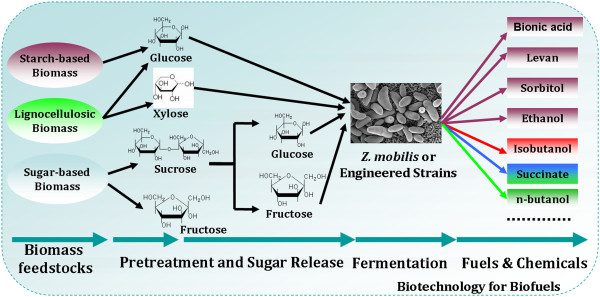
Biosynthesis of liquid fuels and biomass-based building block chemicals from microorganisms have been regarded as a competitive alternative route to traditional. Zymomonas mobilis possesses a number of desirable characteristics for its special Entner-Doudoroff pathway, which makes it an ideal platform for both metabolic engineering and commercial-scale production of desirable bio-products as the same as Escherichia coli and Saccharomyces cerevisiae based on consideration of future biomass biorefinery. Z. mobilis has been studied extensively on both fundamental and applied level, which will provide a basis for industrial biotechnology in the future. Furthermore, metabolic engineering of Z. mobilis for enhancing bio-ethanol production from biomass resources has been significantly promoted by different methods (i.e. mutagenesis, adaptive laboratory evolution, specific gene knock-out, and metabolic engineering). In addition, the feasibility of representative metabolites, i.e. sorbitol, bionic acid, levan, succinic acid, isobutanol, and isobutanol produced by Z. mobilis and the strategies for strain improvements are also discussed or highlighted in this paper. Moreover, this review will present some guidelines for future developments in the bio-based chemical production using Z. mobilis as a novel industrial platform for future biofineries.
Overview
The claims and statistics of this paper haven’t been checked yet.
Run the check — free, no account needed. It reads the open-access text and checks the sources it cites.
Integrity signals
Registry
Cites
Statistics
Figures
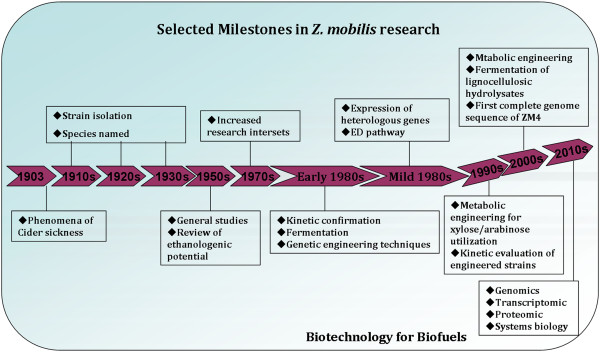
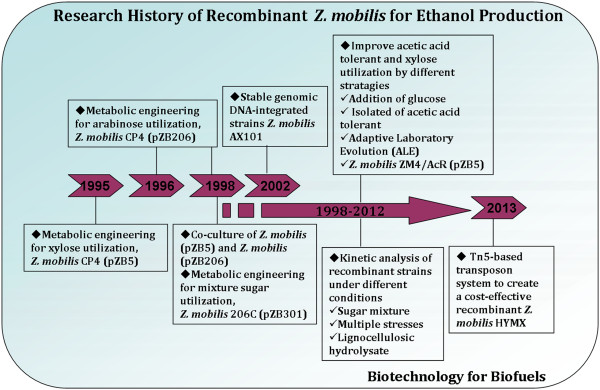
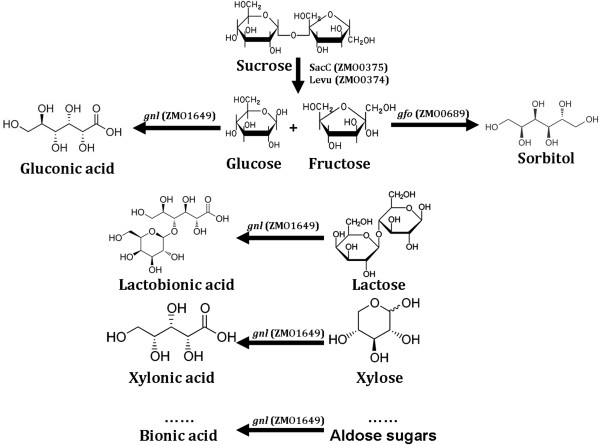
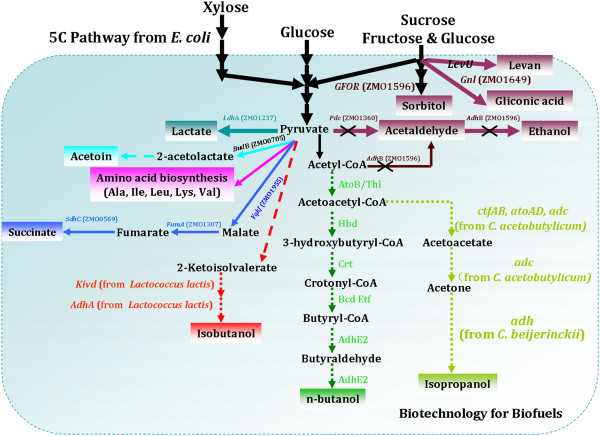
Verification
Claims the paper makes
The claims and statistics of this paper haven’t been checked yet.
Run the check — free, no account needed. It reads the open-access text and checks the sources it cites.
Claims other papers make about this one
Each is checked against this paper’s own text: does it say what the citing paper says it does?
The source backs part of the claim, not all of it — or backs it for a different population, condition or comparison.
In the citing paper
“It naturally converts up to 96% of glucose into ethanol and can be engineered to produce other valuable bioproducts, such as isobutanol and isoprenoids (5–11).”
From Physiological and metabolic responses of Zymomonas mobilis to lignocellulosic hydrolysate (2025) · cites this paper as [5]
Experimental — accuracy not yet measuredThe cited source says what the claim attributes to it.
In the citing paper
“It naturally converts up to 96% of glucose into ethanol and can be engineered to produce other valuable bioproducts, such as isobutanol and isoprenoids (5–11).”
From Physiological and metabolic responses of Zymomonas mobilis to lignocellulosic hydrolysate (2025) · cites this paper as [5]
Self-check
Percentages, sums and reported differences re-computed from the paper’s own numbers.
The self-check needs the paper’s full text.
Citations
Cites
Multiplex Genome Engineering Using CRISPR/Cas Systems
Cong, L., Ran, F. A., Cox, D., Lin, S., Barretto, R., Habib, N., Hsu, P. D., Wu, X., Jiang, W., Marraffini, L. A., et al. (2013) · Science · doi:10.1126/science.1231143 · Cited by 15,339
Werpy, T. A., & Petersen, G. R. (2004) · doi:10.2172/15008859 · Cited by 3,224
Non-fermentative pathways for synthesis of branched-chain higher alcohols as biofuels
Atsumi, S., Hanai, T., & Liao, J. C. (2008) · Nature · doi:10.1038/nature06450 · Cited by 1,945
Ethanol fermentation from biomass resources: current state and prospects
Lin, Y., & Tanaka, S. (2005) · Applied Microbiology and Biotechnology · doi:10.1007/s00253-005-0229-x · Cited by 1,622
Recent trends in global production and utilization of bio-ethanol fuel
Balat, M., & Balat, H. (2009) · Applied Energy · doi:10.1016/j.apenergy.2009.03.015 · Cited by 1,599
Programming cells by multiplex genome engineering and accelerated evolution
Wang, H. H., Isaacs, F. J., Carr, P. A., Sun, Z. Z., Xu, G., Forest, C. R., & Church, G. M. (2009) · Nature · doi:10.1038/nature08187 · Cited by 1,529
Consolidated bioprocessing of cellulosic biomass: an update
Lynd, L. R., van Zyl, W. H., McBride, J. E., & Laser, M. S. (2005) · Current Opinion in Biotechnology · doi:10.1016/j.copbio.2005.08.009 · Cited by 1,451
Pimentel, D. M. D. S., & Patzek, T. W. (2005) · Natural Resources Research · doi:10.1007/s11053-005-4679-8 · Cited by 1,399
Microbial engineering for the production of advanced biofuels
Peralta‐Yahya, P., Zhang, F., del Cardayré, S. B., & Keasling, J. D. (2012) · Nature · doi:10.1038/nature11478 · Cited by 1,100
Genome Engineering With Zinc-Finger Nucleases
Carroll, D. (2011) · Genetics · doi:10.1534/genetics.111.131433 · Cited by 1,076
Cited by
Sorted by citations
Application of nanoparticles in biofuels: An overview
Sekoai, P. T., Ouma, C. N. M., du Preez, S. P., Modisha, P. M., Engelbrecht, N., Bessarabov, D., & Ghimire, A. (2018) · Fuel · doi:10.1016/j.fuel.2018.10.030 · Cited by 393
Salehi Jouzani, G., & Taherzadeh, M. J. (2015) · Biofuel Research Journal · doi:10.18331/brj2015.2.1.4 · Cited by 224
Zymomonas mobilis as a model system for production of biofuels and biochemicals
Yang, S., Fei, Q., Zhang, Y., Contreras, L. M., Utturkar, S. M., Brown, S. D., Himmel, M. E., & Zhang, M. (2016) · Microbial Biotechnology · doi:10.1111/1751-7915.12408 · Cited by 204
Lignocellulosic ethanol: Technology design and its impact on process efficiency
Paulová, L., Patáková, P., Branská, B., Rychtera, M., & Melzoch, K. (2014) · Biotechnology Advances · doi:10.1016/j.biotechadv.2014.12.002 · Cited by 195
Yang, S., Mohagheghi, A., Franden, M. A., Chou, Y., Chen, X., Dowe, N., Himmel, M. E., & Zhang, M. (2016) · Biotechnology for Biofuels · doi:10.1186/s13068-016-0606-y · Cited by 168
Metadata
- Authors
- He, M., Wu, B., Qin, H., Ruan, Z., Tan, F., Wang, J., Shui, Z., Dai, L., Zhu, Q., Pan, K., Tang, X., Wang, W., & Hu, Q.
- Affiliations
- Biogas Institute of Ministry of Agriculture (CN)
- Institute of Agricultural Resources and Regional Planning (CN)
- Venue
- Biotechnology for Biofuels
- Published
- 2014
- Volume
- 7
- Issue
- 1
- Pages
- 101
- ISSN
- 1754-6834 (ISSN-L)
- PMC
- PMC4094786
- OpenAlex
- W2172228379
- Cited by
- 203
- References
- 178
- Citations by year
- 2026: 4 · 2025: 8 · 2024: 12 · 2023: 23 · 2022: 16 · 2021: 35 · 2020: 18 · 2019: 17 · 2018: 20 · 2017: 16 · 2016: 19 · 2015: 12 · 2014: 3
- FWCI
- 1.57
- Type
- journal article
- Language
- en
- Open access
- gold
- doi.org
- Licence
- cc-by
- Locations
- Biotechnology for Biofuels (publishedVersion, cc-by)
- PubMed Central (publishedVersion, cc-by)
- PubMed (publishedVersion)
- Funders
- Shandong University
- National Natural Science Foundation of China (201403019, 31000028)
- Chinese Academy of Agricultural Sciences (201403019)
- Tarim University
- Special Fund for Agro-scientific Research in the Public Interest (201403019)
- Topics
- Life Sciences › Biochemistry, Genetics and Molecular Biology › Molecular Biology › Microbial Metabolic Engineering and Bioproduction
- Physical Sciences › Engineering › Biomedical Engineering › Biofuel production and bioconversion
- Life Sciences › Biochemistry, Genetics and Molecular Biology › Biotechnology › Biochemical and biochemical processes
- Keywords
- Zymomonas mobilis, Entner-Doudoroff pathway, metabolic engineering, bioethanol production, bio-based chemicals, sorbitol, levan, succinic acid, isobutanol, adaptive laboratory evolution, gene knockout, industrial biotechnology
About these checks
Registry, retraction, Cites and statistics results are computed, not judged, with one exception: a printed reference that no index lists is read once by a model before it counts as a citation error. Claims are extracted by a model and kept only when their quote appears verbatim in the text; each cited source is then checked, with a model’s help, for whether it says what the claim relies on. Those verdicts can be wrong — read the claim’s quote and the cited source before relying on one.
Statistics and arithmetic are recomputed, not judged.
Confidence bands are shown only for fields calibrated on our annotated test set. None is calibrated yet, so no band is shown.
What counts as a claim ›How we measure confidence ›How we check this ›
Are you an author, or do you see a problem with this page? Request a review
