

The DOI matches its Crossref record; 54 of the 55 references it cites were found in a registry or an index.
Feeding patterns of molestus and pipiens forms of Culex pipiens (Diptera: Culicidae) in a region of high hybridization
Open accessAbstract
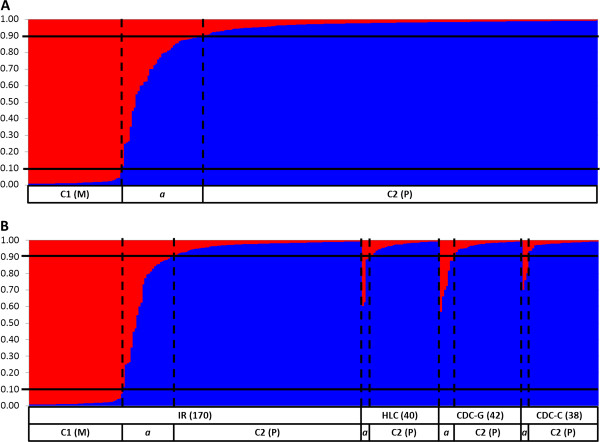
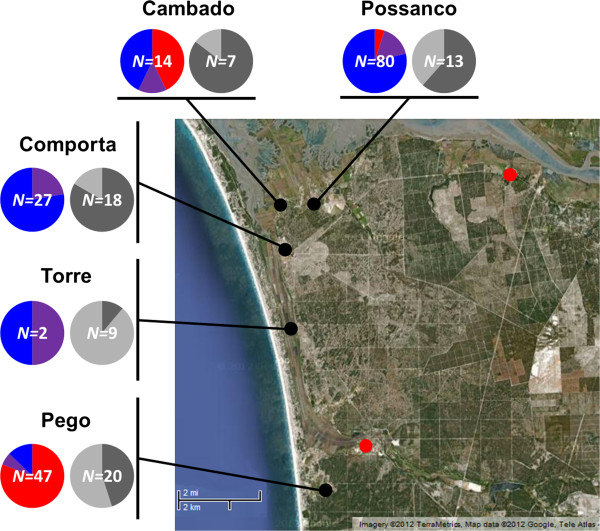
BACKGROUND: Two biological forms of the mosquito Culex pipiens s.s., denoted pipiens and molestus, display behavioural differences that may affect their role as vectors of arboviruses. In this study, the feeding patterns of molestus and pipiens forms were investigated in Comporta (Portugal), where high levels of inter-form admixture have been recorded. METHODS: Indoor and outdoor mosquito collections were performed in the summer of 2010. Collected Cx. pipiens s.l. females were molecularly identified to species and form by PCR and genotyped for six microsatellites. The source of the blood meal in post-fed females was determined by ELISA and mitochondrial DNA sequencing. RESULTS: The distribution of the forms differed according to the collection method. The molestus form was present only in indoor collections, whereas pipiens and admixed individuals were sampled both indoors and outdoors. In both forms, over 90% of blood meals were made on avian hosts. These included blood meals taken from Passeriformes (Passer domesticus and Turdus merula) by females caught resting inside domestic shelters. CONCLUSION: Genetic structure and blood meal analyses suggest the presence of a bird biting molestus population in the study area. Both forms were found to rest indoors, mainly in avian shelters, but at least a proportion of females of the pipiens form may bite outdoors in sylvan habitats and then search for anthropogenic resting sites to complete their gonotrophic cycle. This behaviour may potentiate the accidental transmission of arboviruses to humans in the region.
Overview
The claims and statistics of this paper haven’t been checked yet.
Run the check — free, no account needed. It reads the open-access text and checks the sources it cites.
Integrity signals
Registry
Cites
Statistics
Figures
Verification
Claims the paper makes
The claims and statistics of this paper haven’t been checked yet.
Run the check — free, no account needed. It reads the open-access text and checks the sources it cites.
Claims other papers make about this one
Each is checked against this paper’s own text: does it say what the citing paper says it does?
In the citing paper
“The detection of filarioid worms with a possible avian origin in Cx. pipiens, mainly of the pipiens form and hybrids is consistent with its ornithophilic habits ( Gomes et al., 2013)”
From Culex pipiens as a potential vector for transmission of Dirofilaria immitis and other unclassified Filarioidea in Southwest Spain (2016) · cites this paper as Gomes et al., 2013
In the citing paper
“Despite its usefulness, genetic analysis of mosquito populations solely based on such a strategy is not devoid of analytical limitations, which could be overcome via combination with microsatellite analyses in future studies ( Gomes et al., 2013).”
From Culex pipiens as a potential vector for transmission of Dirofilaria immitis and other unclassified Filarioidea in Southwest Spain (2016) · cites this paper as Gomes et al., 2013
Self-check
Percentages, sums and reported differences re-computed from the paper’s own numbers.
The self-check needs the paper’s full text.
Citations
Cites
Hall, T. A. (1999) · Nucleic Acids Symposium Series · doi:10.14601/phytopathol_mediterr-14998u1.29 · Cited by 38,156
Inference of Population Structure Using Multilocus Genotype Data
Pritchard, J. K., Stephens, M., & Donnelly, P. (2000) · Genetics · doi:10.1093/genetics/155.2.945 · Cited by 33,871
Detecting the number of clusters of individuals using the software structure: a simulation study
Evanno, G., Regnaut, S., & Goudet, J. (2005) · Molecular Ecology · doi:10.1111/j.1365-294x.2005.02553.x · Cited by 21,540
A Simple Sequentially Rejective Multiple Test Procedure
(1979) · Scandinavian Journal of Statistics · doi:10.2307/4615733 · Cited by 21,526
Molecular Evolutionary Genetics
Nei, M. (1987) · Columbia University Press eBooks · doi:10.7312/nei-92038 · Cited by 16,583
Arlequin (version 3.0): An integrated software package for population genetics data analysis
Excoffier, L., Laval, G., & Schneider, S. (2005) · Evolutionary Bioinformatics · doi:10.1177/117693430500100003 · Cited by 14,265
Updated world map of the Köppen-Geiger climate classification
(2007) · doi:10.5194/hess-11-1633-2007 · Cited by 13,640
micro ‐ checker : software for identifying and correcting genotyping errors in microsatellite data
VAN OOSTERHOUT, C., HUTCHINSON, W. F., WILLS, D. P. M., & SHIPLEY, P. (2004) · Molecular Ecology Notes · doi:10.1111/j.1471-8286.2004.00684.x · Cited by 10,327
FSTAT (Version 1.2): A Computer Program to Calculate F-Statistics
Goudet, J. (1995) · Journal of Heredity · doi:10.1093/oxfordjournals.jhered.a111627 · Cited by 7,639
Jakobsson, M., & Rosenberg, N. A. (2007) · Bioinformatics · doi:10.1093/bioinformatics/btm233 · Cited by 6,309
Research works printed but not linked: 6
- Ribeiro H, Ramos HC: Identification keys of the mosquitoes (Diptera: Culicidae) of Continental Portugal, Acores and Madeira. Eur Mosq Bull. 1999, 3: 1-11.
- Simões MJ, Próspero MI, Henrique R: Optimização da técnica ELISA “two sites” utilizada na identificação de refeições sanguíneas de mosquitos. Rev Port Doenc Infec. 1995, 18: 225-229.
- World Health Organization: Manual on Practical Entomology in Malaria. Part II: Methods and Techniques Geneva. 1975, Geneva, 191-
- Ribeiro H, Pires CA, Ramos HC, Capela RA: Research on the mosquitoes of Portugal (Diptera, Culicicae). VIII- On the occurrence of Culex (Culex) molestus Forskål, 1775. J Soc Cienc Med Lisb. 1983, 147: 185-188.
- Sousa CA:Malaria vectorial capacity and competence ofAnopheles atroparvusVan Thiel, 1927 (Diptera, Culicidae): Implications for the potential re-emergence of malaria in Portugal.PhD thesis. 2008, Universidade Nova de Lisboa, Instituto de Higiene e Medicina Tropical,
- Formosinho P, Santos-Silva MM, Santos A, Melo P, Encarnação V, Santos N, Nunes T, Agrícola R, Portas M: O vírus West Nile em Portugal – estudos de vigilância epidemiológica. Rev Port. Cienc Vet. 2006, 101: 61-68.
Cited by
Sorted by citations
Items 101–103 of 103
Application d'outils innovants de génomique et protéomique à l'entomologie médicale
Laroche, M. (2018) · theses.fr (ABES) · doi:10.70675/5f7fcf86z1ea9z4bf5z9415z030fd9ba5901
Cebrián-Camisón, S., Rivera‐Colón, A. G., Small, S. T., Figuerola, J., Kern, A. D., Ralph, P. L., Bombarely, A., & Ruiz‐López, M. J. (2026) · bioRxiv (Cold Spring Harbor Laboratory) · doi:10.64898/2026.05.10.722846 · Cited by 1
Cerecedo-Iglesias, C., Pardo-Araujo, M., Palmer, J. R. B., Montarsi, F., Barzon, L., Papa, A., Tsioka, K., Gewehr, S., Sikkema, R. S., Schrama, M. J. J., et al. (2026) · Ecological Informatics · doi:10.1016/j.ecoinf.2026.104083
Metadata
- Authors
- Gomes, B., Sousa, C. A., Vicente, J. L., Pinho, L., Calderón, I., Arez, E., Almeida, A. P., Donnelly, M. J., & Pinto, J.
- Affiliations
- Universidade Nova de Lisboa (PT)
- Liverpool School of Tropical Medicine (GB)
- Corresponding author
- Pinto, João
- Venue
- Parasites & Vectors
- Published
- 2013-04-11
- Volume
- 6
- Issue
- 1
- Pages
- 93-93
- ISSN
- 1756-3305 (ISSN-L)
- PMC
- PMC3637809
- OpenAlex
- W2146195042
- Cited by
- 103
- References
- 55
- Citations by year
- 2026: 7 · 2025: 5 · 2024: 9 · 2023: 8 · 2022: 7 · 2021: 11 · 2020: 10 · 2019: 7 · 2018: 8 · 2017: 10 · 2016: 10 · 2015: 8 · 2014: 3
- FWCI
- 7.14
- Type
- journal article
- Language
- en
- Open access
- gold
- doi.org
- Licence
- cc-by
- Locations
- Parasites & Vectors (publishedVersion, cc-by)
- Europe PMC (PubMed Central) (publishedVersion, cc-by)
- PubMed Central (publishedVersion, cc-by)
- PubMed (publishedVersion)
- LSTM Online Archive (Liverpool School of Tropical Medicine) (acceptedVersion)
- Portuguese National Funding Agency for Science, Research and Technology (RCAAP Project by FCT) (submittedVersion, other-oa)
- Funders
- Fundação para a Ciência e a Tecnologia (SFRH/BD/36410/2007, POCI/BIA-BDE/57650/2004)
- Topics
- Health Sciences › Medicine › Public Health, Environmental and Occupational Health › Mosquito-borne diseases and control
- Life Sciences › Agricultural and Biological Sciences › Ecology, Evolution, Behavior and Systematics › Diptera species taxonomy and behavior
- Health Sciences › Medicine › Public Health, Environmental and Occupational Health › Malaria Research and Control
- Keywords
- Culex pipiens, blood meal sources, avian hosts, Passer domesticus, Turdus merula, indoor biting, hybridization, arbovirus vectors
- MeSH terms
- Animals, Birds, Blood Cells, Culex, Feeding Behavior, Female, Genotype, Insect Vectors, Portugal, Polymerase Chain Reaction, Microsatellite Repeats
About these checks
Registry, retraction, Cites and statistics results are computed, not judged, with one exception: a printed reference that no index lists is read once by a model before it counts as a citation error. Claims are extracted by a model and kept only when their quote appears verbatim in the text; each cited source is then checked, with a model’s help, for whether it says what the claim relies on. Those verdicts can be wrong — read the claim’s quote and the cited source before relying on one.
Statistics and arithmetic are recomputed, not judged.
Confidence bands are shown only for fields calibrated on our annotated test set. None is calibrated yet, so no band is shown.
What counts as a claim ›How we measure confidence ›How we check this ›
Are you an author, or do you see a problem with this page? Request a review
