

Test-retest reliability of the ‘Reading the Mind in the Eyes’ test: a one-year follow-up study
Open accessThe DOI matches its Crossref record; 44 of the 44 references it cites were found in a registry or an index.
Abstract
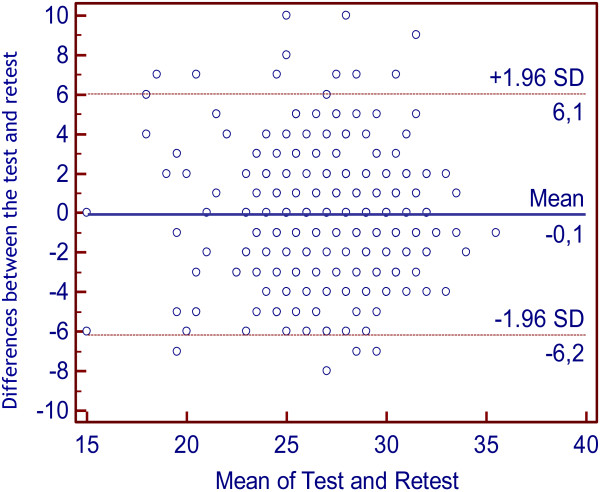
Background: The ‘Reading the Mind in the Eyes’ (Eyes) test is an advanced test of theory of mind. It is widely used to assess individual differences in social cognition and emotion recognition across different groups and cultures. The present study examined distributions of responses and scores on a Spanish version of the test in a non-clinical Spanish adult population, and assessed test-retest reliability over a 1-year interval. Methods: A total of 358 undergraduates of both sexes, age 18 to 65 years, completed the Spanish version of the test twice over an interval of 1 year. The Bland-Altman method was used to calculate test-retest reliability. Results: Distributions of responses and scores were optimal. Test-retest reliability for total score on the Eyes test was .63 (P <.01), based on the intraclass correlation coefficient. Test-retest reliability using the Bland-Altman method was fairly good. Conclusions: This is the first study providing evidence that the Eyes test is reliable and stable over a 1-year period, in a non-clinical sample of adults.
Overview
The claims and statistics of this paper haven’t been checked yet.
Free: it reads the open-access text and checks the first 5 claims that cite a source we can check. Create a free account to check every claim.
Integrity signals
Registry
Cites
Statistics
Figures
Verification
Claims the paper makes
The claims and statistics of this paper haven’t been checked yet.
Free: it reads the open-access text and checks the first 5 claims that cite a source we can check. Create a free account to check every claim.
Claims other papers make about this one
Each is checked against this paper’s own text: does it say what the citing paper says it does?
The source backs part of the claim, not all of it — or backs it for a different population, condition or comparison.
In the citing paper
“It has been adapted to Spanish population with a good test-retest reliability (ICC = 0.76) [52].”
From Mindfulness-based social cognition training (SocialMIND) versus psychoeducational multicomponent intervention for people with a first episode of psychosis: A study protocol for a randomised controlled trial (2019) · cites this paper as [52]
Experimental — accuracy not yet measuredThe source backs part of the claim, not all of it — or backs it for a different population, condition or comparison.
In the citing paper
“The test has good internal consistency and test-retest reliability [60, 61].”
From A 'choice', an 'addiction', a way 'out of the lost': Exploring self-injury in autistic people without intellectual disability (2019) · cites this paper as [61]
Experimental — accuracy not yet measured
Self-check
Percentages, sums and reported differences re-computed from the paper’s own numbers.
The self-check needs the paper’s full text.
Citations
Cites
STATISTICAL METHODS FOR ASSESSING AGREEMENT BETWEEN TWO METHODS OF CLINICAL MEASUREMENT
Martin Bland, J., & Altman, D. (1986) · The Lancet · doi:10.1016/s0140-6736(86)90837-8 · Cited by 47,965
(1965) · The Lancet · doi:10.1016/s0140-6736(65)91037-8 · Cited by 16,856
Baron‐Cohen, S., Wheelwright, S., Hill, J., Raste, Y., & Plumb, I. (2001) · Journal of Child Psychology and Psychiatry · doi:10.1111/1469-7610.00715 · Cited by 4,555 · cited 6×
“Measures The revised Eyes test [1] was used to generate a Spanish version of the Eyes test.”
BackgroundMethodInfluentialSelf-citationBaron‐Cohen, S., Wheelwright, S. J., Hill, J., Raste, Y., & Plumb, I. (2001) · PubMed · Cited by 4,313
Self-citationMindblindness: An Essay on Autism and Theory of Mind
(1995) · Choice Reviews Online · doi:10.5860/choice.33-2412 · Cited by 3,670 · cited 1×
“Social cognitive studies examine how people process information in the social environment, particularly perceiving, interpreting, and responding to the mental states (intentions, feelings, perception, and beliefs), dispositions, and behaviors of others [2-5].”
BackgroundFrith, C., & Frith, U. (2005) · Current Biology · doi:10.1016/j.cub.2005.08.041 · Cited by 3,481
Mindblindness: An Essay on Autism and Theory of Mind
Baron-Cohen, S. (1995) · doi:10.7551/mitpress/4635.001.0001 · Cited by 3,428
Self-citationBaron‐Cohen, S., Jolliffe, T., Mortimore, C., & Robertson, M. (1997) · Journal of Child Psychology and Psychiatry · doi:10.1111/j.1469-7610.1997.tb01599.x · Cited by 1,970 · cited 3×
“developed the ‘Reading the Mind in the Eyes’ test, an advanced test of theory of mind [23].”
BackgroundInfluentialSelf-citationSocial Cognition: From Brains to Culture
Fiske, S. T., & Taylor, S. E. (2013) · SAGE Publications Ltd eBooks · doi:10.4135/9781529681451 · Cited by 1,741
Social Cognition: Making Sense of People
Howard, J. A., & Kunda, Z. (2000) · Contemporary Sociology · doi:10.2307/2654104 · Cited by 1,072
Cited by
Items 101–200 of 209
Social perception in children with fetal alcohol spectrum disorder
Stevens, S. A., Clairman, H., Nash, K., & ROVET, J. F. (2016) · Child Neuropsychology · doi:10.1080/09297049.2016.1246657 · Cited by 14
Having siblings is associated with better mentalizing abilities in adults
Lo, R. F., & Mar, R. A. (2022) · Cognitive Development · doi:10.1016/j.cogdev.2022.101193 · Cited by 13
Burke, T., Gleeson, C., Holleran, L., Mothersill, D., Holland, J. F., Costello, L., Kane, R., McKernan, D. P., Morris, D. W., Kelly, J. P., et al. (2022) · Brain Sciences · doi:10.3390/brainsci12091208 · Cited by 12
“The RMET has been found to be reliable and stable over time [68], with a Cronbach’s alpha of 0.”
MethodStaden, J. G. V., & Callaghan, C. W. (2021) · Psychological Research · doi:10.1007/s00426-021-01539-w · Cited by 12
Inzunza, M., Stenlund, T., & Wikström, C. (2019) · Policing An International Journal · doi:10.1108/pijpsm-09-2018-0129 · Cited by 15
Kouklari, E.-C., Tagkouli, E., Tsermentseli, S. K., Ntre, V., Pehlivanidis, A., & Papanikolaou, Κ. (2023) · Journal of Pediatric Neuropsychology · doi:10.1007/s40817-023-00148-2 · Cited by 12
Franca, M., Bolognini, N., & Brysbaert, M. (2023) · Cognitive Research Principles and Implications · doi:10.1186/s41235-023-00521-x · Cited by 14
“Fernández-Abascal et al. (2013) reported a 1-year test–retest reliability of 0.63 for the Spanish version.”
BackgroundInfluentialMediavilla, R., Muñoz‐Sanjosé, A., Vega, B. R., Lahera, G., Palao, Á., Bayón, C., Vidal-Villegas, M.-P., Chadwick, P., & Bravo‐Ortiz, M. F. (2021) · Psychiatric Rehabilitation Journal · doi:10.1037/prj0000466 · Cited by 11
Arroyave, T. Z., Valencia, J. B. Z., & Arias, J. M. C. (2022) · Interdisciplinaria Revista de Psicología y Ciencias Afines · doi:10.16888/interd.2022.39.2.12 · Cited by 10
Social Cognition and Mild Cognitive Impairment in Mid-Stage Parkinson’s Disease
Fernández-Fernández, R., Lahera, G., Fernández‐Rodríguez, B., Guida, P., Trompeta, C., Mata‐Marín, D., & Gasca‐Salas, C. (2024) · Behavioral Sciences · doi:10.3390/bs14020101 · Cited by 11
“Affective ToM was assessed with the revised version of the Reading the Mind in The Eyes Test (RMET) [48–50] that consists of 36 photographs of the eye region of male and female subjects.”
MethodSocial cognition in first-episode schizophrenia/schizoaffective disorder patients
Fortuny, J. J., Navarra‐Ventura, G., Fernández‐Gonzalo, S., Pousa, E., Crosas, J. M., Palao, D. J., & Jódar, M. (2020) · Revista de Psiquiatría y Salud Mental · doi:10.1016/j.rpsm.2020.04.006 · Cited by 11
Chakrabarty, M., Dasgupta, G., Acharya, R., Chatterjee, S. S., Guha, P., Belmonte, M. K., & Bhattacharya, K. (2021) · Indian Journal of Psychiatry · doi:10.4103/psychiatry.indianjpsychiatry_967_20 · Cited by 10
“[30] The Bengali RMET-R was found to be correlated with other social cognition tests per our expectations.”
Emotion recognition and baseline cortisol levels relationship in early Alzheimer disease
Ferrer, I., Ferré‐González, L., García‐Lluch, G., Peña‐Bautista, C., Álvarez-Sánchez, L., Baquero, M., & Cháfer‐Pericás, C. (2023) · Biological Psychology · doi:10.1016/j.biopsycho.2023.108511 · Cited by 10
Kourtesis, P., Kouklari, E.-C., Ρούσσος, Π., Mantas, V., Papanikolaou, Κ., Skaloumbakas, C., & Pehlivanidis, A. (2023) · PsyArXiv (OSF Preprints) · doi:10.31234/osf.io/ykjub · Cited by 14
Peñuelas‐Calvo, I., Sareen, A., Porras‐Segovia, A., Cegla-Schvartzman, F., & Fernández‐Berrocal, P. (2021) · Frontiers in Psychiatry · doi:10.3389/fpsyt.2021.642799 · Cited by 9
Self-citationValidation of the Cognitive-Emotional Perspective Taking test in patients with neurodegeneration
Zegarra-Valdivia, J. A., Shany‐Ur, T., Rijpma, M. G., Callahan, P. M., Poorzand, P., Grossman, S. N., McEachen, B. A., Kramer, J. H., Miller, B. L., & Rankin, K. P. (2025) · Journal of Alzheimer s Disease · doi:10.1177/13872877251317683 · Cited by 8
La medida de la capacidad reflexiva: instrumentos disponibles en castellano y tareas pendientes
Pascual, M. S., León-Quismondo, L., de Arenosa, A. G. L., Hesse, J. M., & Liria, A. F. (2015) · Revista de la Asociación Española de Neuropsiquiatría · doi:10.4321/s0211-57352015000300004 · Cited by 13
Vass, E., Simon, V., Fekete, Z., Kis, B., & Simon, L. (2021) · Frontiers in Psychology · doi:10.3389/fpsyg.2021.642590 · Cited by 9
Brewe, A. M., Antezana, L., Carlton, C. N., Gračanin, D., Richey, J. A., Kim, I., & White, S. W. (2024) · Journal of Autism and Developmental Disorders · doi:10.1007/s10803-024-06436-w · Cited by 7
“It has demon - strated acceptable internal consistency (a = 0.73) and good convergent validity with other emotion perception tasks (Fernández-Abascal et al., 2013; Kittel et al., 2022).”
InfluentialKouklari, E.-C., Tsermentseli, S. K., & Pavlidou, A. (2024) · Applied Neuropsychology Child · doi:10.1080/21622965.2024.2375659 · Cited by 8
Understanding the relationship between general intelligence and socio-cognitive abilities in humans
Fernández‐Berrocal, P., Cabello, R., & Gutiérrez‐Cobo, M. J. (2017) · Behavioral and Brain Sciences · doi:10.1017/s0140525x1600162x · Cited by 7
Self-citationRamos, J. M., Rodríguez, A., Sánchez, A., & Mena, A. C. (2018) · Clínica y Salud · doi:10.5093/clysa2018a8 · Cited by 12
Vatandoust, L., & Hasanzadeh, R. (2018) · Iranian Rehabilitation Journal · doi:10.32598/irj.16.2.121 · Cited by 7
Sánchez-Reales, S., Caballero-Peláez, C., Prado-Abril, J., Inchausti, F., Lado-Codesido, M., García-Caballero, A. A., & Lahera, G. (2019) · Research in Autism · doi:10.1016/j.rasd.2019.101421 · Cited by 9
Theory of Mind in Adults with Traumatic Brain Injury
Fazaeli, S. M., Yazdi, S. A. A., Sharifi, S., Rad, D. S., & Ehsaei, M. R. (2018) · Trauma Monthly · doi:10.5812/traumamon.22022 · Cited by 9
“lated to children (22) and adults (23, 24).”
BackgroundDoes Having a Sibling Affect Autistic People's Empathy?
Rum, Y., Golan, O., Allison, C. L., Smith, P. L., White, S. R., & Baron‐Cohen, S. (2023) · Journal of Autism and Developmental Disorders · doi:10.1007/s10803-023-06153-w · Cited by 7
“The RMET has been evaluated in hundreds of studies and has been found to have good reliability (Fernández-Abascal et al., 2013; Greenberg et al., 2023; Lombardo et al., 2007; Vellante et al., 2013).”
MethodSelf-citationPoor sleep quality may trigger cognitive deficits after recovery from COVID-19
Carnes, A., Piñol‐Ripoll, G., Ariza, M., Cano, N., Segura, B., Junqué, C., Béjar, J., Barruè, C., Garolera, M., & Nautilus Project Collaborative Group (2024) · Frontiers in Psychology · doi:10.3389/fpsyg.2024.1382875 · Cited by 6
Espinós, U., Fernández-Abascal, E. G., Bruna, M. M. O., & Lahera, G. (2021) · PLoS ONE · doi:10.1371/journal.pone.0246908 · Cited by 6
“The Spanish version of the test RMET [61].”
MethodSelf-citationVass, E., Simon, V., Csukly, G., Kis, B., Zsigmond, R., Hermán, L., & Simon, L. (2023) · Acta Psychologica · doi:10.1016/j.actpsy.2023.103842 · Cited by 7
Relationship between neuroimaging and emotion recognition in mild cognitive impairment patients
Gandia‐Ferrero, M. T., Adrián‐Ventura, J., Cháfer‐Pericás, C., Álvarez‐Sánchez, L., Ferrer, I., Martínez‐Sanchis, B., Torres-Espallardo, I., Baquero‐Toledo, M., & Martí‐Bonmatí, L. (2024) · Behavioural Brain Research · doi:10.1016/j.bbr.2023.114844 · Cited by 8
Croatian Adaptation of the Revised Reading the Mind in the Eyes Test (RMET)
Topić, M. K., & Kovačević, M. P. (2019) · Psihologijske teme · doi:10.31820/pt.28.2.8 · Cited by 6
“…French (Prevost et al., 2014), Italian (Vellante et al., 2013), German (Pflatz et al., 2013), Portuguese (Sanvicente-Vieira et al., 2014), Spanish (Fernandez-Abascal et al., 2013), Turkish (Girli, 2014; Yildirim et al., 2011), Japanese (Kunihira, Senju, Dairoku, Wakabayashi, & Hasegawa, 2006),…”
Trompeta, C., Gasca‐Salas, C., Pineda‐Pardo, J. A., Guida, P., Cohn, M., Mata‐Marín, D., Monje, M. H. G., López‐Aguirre, M., Obeso, I., & Sánchez‐Ferro, Á. (2023) · Behavioural Brain Research · doi:10.1016/j.bbr.2023.114654 · Cited by 6
Panzano, M. G., Borao, L., Herrera‐Mercadal, P., Campos, D., del Hoyo, Y. L., Morillo, H., & García‐Campayo, J. (2019) · Revista de Psicopatología y Psicología Clínica · doi:10.5944/rppc.24170 · Cited by 8
Improving Empathy of Occupational Therapy Students Through Reading Literary Narratives
Kelly, C. (2022) · Journal of Occupational Therapy Education · doi:10.26681/jote.2022.060404 · Cited by 7
Mediavilla, R., Muñoz-Sanjose, A., Rodriguez-Vega, B., Bayon, C., Palao, A., Lahera, G., Sanchez-Castro, P., Roman, E., Cebolla, S., de Diego, A., et al. (2019) · BMC Psychiatry · doi:10.1186/s12888-019-2206-4 · Cited by 5
Beyond beauty: Does visual art facilitate social cognitive skills?
Ozbay, Y., Oosterwijk, S., & Stamkou, E. (2024) · PLoS ONE · doi:10.1371/journal.pone.0308392 · Cited by 3
Rossetto, F., Isernia, S., Smecca, G., Rovaris, M., & Baglio, F. (2024) · The Clinical Neuropsychologist · doi:10.1080/13854046.2024.2446026 · Cited by 6
“For example, the Reading the Mind in the eyes test (RMeT; Baron-Cohen et al., 2001; Fernández-Abascal et al., 2013; Oliveira et al., 2023; Vellante et al., 2013) is commonly used to evaluate the affective component of ToM, while the False Belief task (Baron-Cohen, 1989; Perner et al., 1987), and…”
Multilingualism and mentalizing abilities in adults
Chung-Fat-Yim, A., Lo, R. F., & Mar, R. A. (2022) · Bilingualism Language and Cognition · doi:10.1017/s1366728922000669 · Cited by 5
Inzunza, M., Brown, G., Stenlund, T., & Wikström, C. (2022) · Frontiers in Psychology · doi:10.3389/fpsyg.2022.907610 · Cited by 7
“Not reporting the alpha reliability has been the common procedure with tests designed to assess emotion recognition due to the complexity involved in those tasks when correlating different items (Fernández-Abascal et al., 2013).”
MethodEl Desarrollo de la Estabilidad Emocional en Patología Dual: una Propuesta de Intervención Breve
García-Pardo, A. (2018) · Clínica y Salud · doi:10.5093/clysa2018a19 · Cited by 5
Varga, E., Herold, R., Tényi, T., Endre, S., Fekete, J., & Bugya, T. (2019) · Frontiers in Psychiatry · doi:10.3389/fpsyt.2019.00912 · Cited by 5
“(37) they found acceptable psychometric properties in schizophrenia (test-retest reliability: r = 0.”
Background“Reading the Mind in the Eyes” Is Associated with Top-Down Visual Attention
Malaei, F., Sohrabi, A., & Jahanitabesh, A. (2020) · Activitas Nervosa Superior · doi:10.1007/s41470-020-00075-z · Cited by 5
Clark, C. B., Armstrong, J., Ballout, M. H., & Ewy, R. (2020) · Criminal Behaviour and Mental Health · doi:10.1002/cbm.2164 · Cited by 4
Stix, K., Dalkner, N., Bengesser, S., Birner, A., Fellendorf, F. T., Häussl, A., Lenger, M., Maget, A., Painold, A., Platzer, M., et al. (2024) · Psychiatry Research · doi:10.1016/j.psychres.2024.116039 · Cited by 5
“The RMET is also considered reliable and stable in non-clinical samples (Fern ´ andez-Abascal et al., 2013).”
MethodFrom mind to mind: Understanding the role of mothers in children’s theory of mind
Koç, N., Tahiroğlu, D., & Uzundağ, B. A. (2024) · Journal of Applied Developmental Psychology · doi:10.1016/j.appdev.2024.101719 · Cited by 4
The impact of breast cancer on social cognition in female Colombian patients
Palacio, N., Romero, D. N., Bernal, A. M., González-Rodríguez, D., Solarte-Bothe, D., García, M. D. P., Murillo, R., Santamaría‐García, H. A., & Báez, S. (2022) · BMC Psychology · doi:10.1186/s40359-022-01005-1 · Cited by 5
“63 [57, 58], it has good test–retest reliability [59], and it has been adapted to Spanish [60].”
MethodTsermentseli, S. K., Pavlidou, A., & Kouklari, E.-C. (2025) · Brain Sciences · doi:10.3390/brainsci16010042 · Cited by 3
Dahò, M., & Monzani, D. (2026) · Current Psychology · doi:10.1007/s12144-025-08959-6 · Cited by 5
“Findings showed that participants in the VR-ToMIS group exhibited significant improvements in ToM tasks compared to the control group, as assessed by the Cartoon Test (Baron-Cohen et al., 2001 ), Faux Pas Test (Fernández-Modamio et al., 2018 ), and the Baron-Cohen Minds in the Eyes Test (Fernández-Abascal et al., 2013…”
Zegarra-Valdivia, J. A., Vilca, B. N. C., Doval, S., Baron‐Cohen, S., & Tirapu, J. (2022) · Revista Ecuatoriana de Neurologia · doi:10.46997/revecuatneurol31100066 · Cited by 7
Self-citationEddy, C. M. (2023) · Frontiers in Psychiatry · doi:10.3389/fpsyt.2023.1129252 · Cited by 3
“The RMET has good test-retest stability as shown over 1 year in a non-clinical sample (50).”
MethodPérez-Cámara, N., Teva, I., Pérez-García, M., Burneo-Garcés, C., & Hidalgo-Ruzzante, N. A. (2024) · Psychology of Violence · doi:10.1037/vio0000539 · Cited by 3
Patterns of individual differences in reduction: Implications for listener-oriented theories
Turnbull, R. (2015) · Newcastle University ePrints (Newcastle Univesity) · doi:10.25405/ncl.34446204 · Cited by 5
Short-term impact of alcohol detoxification on facial emotions recognition
Frileux, S., Dubertret, C., & Strat, Y. L. (2020) · L Encéphale · doi:10.1016/j.encep.2020.04.019 · Cited by 3
Što ustvari ispituje Test očiju? Neke metodološke teškoće ispitivanja teorije uma Testom očiju
Dom za djecu “Maestral”, S., Barać, B., Vulić‐Prtorić, A., & Odjel za psihologiju, S. U. Z. (2016) · Klinička psihologija · doi:10.21465/2016-kp-2-0002 · Cited by 4
Toloza-Muñoz, J., González-Mendoza, J., Castillo, R. D., & Morales-Bader, D. (2020) · bioRxiv (Cold Spring Harbor Laboratory) · doi:10.1101/2020.03.25.007575 · Cited by 4
“29 In some studies, the RMET seems to be reliable in its temporal stability [10, 15–17].”
BackgroundAssessing the Reading the Mind in the Eyes Test with Spanish Adolescents
Martínez, A., Romero, A. G., Malas, O., & Blanch, À. (2025) · Psychology International · doi:10.3390/psycholint7020041 · Cited by 2
“The adaptation to the Spanish language might have influenced the participants’ responses, particularly regarding the ten items representing complex mental states.”
InfluentialMoncaleano, C., & Rodríguez, D. A. L. (2024) · Psykhe (Santiago) · doi:10.7764/psykhe.2020.38787 · Cited by 2
Sawant, Y., Das, K., & Susmitha, M. (2024) · Advances in medical technologies and clinical practice book series · doi:10.4018/979-8-3693-1265-0.ch013 · Cited by 2
Butler, L. (2016) · UEL Research Repository (University of East London) · doi:10.15123/pub.5407 · Cited by 2
Trait irritability in adults is unrelated to face emotion identification
Deveney, C. M., Chavez, G., & Mejia, L. (2021) · Personality and Individual Differences · doi:10.1016/j.paid.2021.111290 · Cited by 2
Romero‐Martínez, Á., Sarrate‐Costa, C., Lila, M., & Moya‐Albiol, L. (2025) · Child Abuse & Neglect · doi:10.1016/j.chiabu.2025.107760 · Cited by 1
Male brain type women and female brain type men: Atypical cognitive styles and their correlates
Ojala, S. (2016) · Helda - University of Helsinki Institutional Repository · Cited by 1
Social Cognition in Parkinson's Disease after Focused Ultrasound Subthalamotomy: A Controlled Study
Guida, P., Martínez‐Fernández, R., Máñez-Miró, J. U., del Álamo, M., Foffani, G., Fernández‐Rodríguez, B., Monje, M. H. G., Obeso, I., Obeso, J. A., & Gasca‐Salas, C. (2024) · Movement Disorders · doi:10.1002/mds.29945 · Cited by 3
“53 The maximum possible score is 36, one point for each correct answer.”
Kakuszi, B., Bitter, I., & Czobor, P. (2025) · BMC Psychology · doi:10.1186/s40359-025-02457-x · Cited by 1
“RMET’s test-retest reliability has been demonstrated based on a one-year longitudinal study [38].”
The embodied mind: A journey through the “soma” to reach the “psyche”.
Cucchi, A. (2017) · City Research Online (City University London) · doi:10.13140/rg.2.2.22187.03364 · Cited by 1
Assessing the Cultural Effects of Neoliberalism on Empathy
Racho, M. M. (2017) · Scholarship & Creative Works - Digital UNC a service of University Libraries (University of Northern Colorado) · Cited by 3
Sukhapure, M. (2019) · Otago University Research Archive (University of Otago) · Cited by 7
Fathering: Increasing their Visibility In Research and as Influencers of Child Development
Dyson, A. (2019) · TSpace (University of Toronto) · Cited by 4
Begum, A. (2015) · UEL Research Repository (University of East London) · doi:10.15123/pub.4528
Fischer, A. L. (2015) · Summit (Simon Fraser University)
Wisdom of the crowd mechanisms
Walker, J. D. (2016) · D-Scholarship@Pitt (University of Pittsburgh)
Posttraumatic Stress and Emotion Recognition
Woody, R. (2015) · Journal of the Arkansas Academy of Science
Yang, C. (2018) · Nottingham ePrints (University of Nottingham)
Age-Related Differences in Executive, Social and Creative Cognition in Neurologically Healthy Adults
Duff, H., Lyvers, M., & Bahr, M. (2019) · IAFOR Journal of Psychology & the Behavioral Sciences · doi:10.22492/ijpbs.5.1.06
Morse, A. R. (2019) · ANU Open Research (Australian National University) · doi:10.25911/5f58afa619d23 · Cited by 1
Kist, J. D., Bethlehem, R. A. I., Stonier, B., Sluijters, O. J. J., Crockford, S. K., de Jonge, E., Freyberg, J., Baron‐Cohen, S., & Parsons, O. (2020) · bioRxiv (Cold Spring Harbor Laboratory) · doi:10.1101/2020.09.11.292706
Self-citationEarly life adversities and social cognition in schizophrenia
Rokita, K. (2020) · Arrow@dit (Dublin Institute of Technology) · doi:10.13025/17136
Teeters, L., McKimmy, C., Shedro, M., Ashar, Y. K., Álvarez, A., Price, E., & Dimidjian, S. (2021) · DergiPark (Istanbul University)
Fischer, S., Norton, P. J., Spaulding, W. D., & Courtney, J. A. (2020) · Elsevier eBooks · doi:10.1016/b978-0-12-817752-5.00005-6
O papel moderador do sexo na relação entre acurácia da percepção de emoções e sintomas depressivos
Pinto, A. L. D. C. B., & da Silva-Filho, J. H. (2022) · Interação em Psicologia · doi:10.5380/riep.v26i1.75794
Self-Understanding and Other-Understanding in Personality Pathology
Lind, M., Folmo, E. J., & Kaufman, E. A. (2024) · Frontiers research topics · doi:10.3389/978-2-8325-4401-3
Coping with Life Stress, volume II
Libin, A. V., Libin, E. V., Penk, W. E., & Shara, N. (2024) · Frontiers research topics · doi:10.3389/978-2-8325-4462-4
Stein, J. (2024) · SSRN Electronic Journal · doi:10.2139/ssrn.4863454
Mete, E., & Sarı, Z. (2024) · Türk fizyoterapi ve rehabilitasyon dergisi · doi:10.21653/tjpr.1401868
Buron, L., Perreault, S., Sultan, S., Bonanno, M., Coltin, H., Laverdière, C., Rondeau, É., & Desjardins, L. (2024) · Current Oncology · doi:10.3390/curroncol31080339
“The RMET is a well-established performance-based measure, with adequate test–retest reliability [33] that we used as a proximal measure for affect recognition with partial facial expression availability.”
MethodThe 36-Item Yoni Task: Normative Data for the Clinical Assessment of Theory of Mind
Isernia, S., Rossetto, F., Marchetti, A., & Baglio, F. (2024) · Journal of Clinical Medicine · doi:10.3390/jcm13216334
Social Cognition in Suicidal Behavior in Psychosis: A Systematic Review
Herrero, M. C., Sastre-Buades, A., & Barrigón, M. L. (2025) · Behavioral Sciences · doi:10.3390/bs15060759
Winters, D. E., & Sakai, J. T. (2025) · Personality and Mental Health · doi:10.1002/pmh.70037
Martín-Fernández, J., Estebaranz, N. C., Félez, E., Rosário, P. J. S. L. F., Pulido, F. R., Navarro-Peris, N., Martínez, F., Cervio, A., & Martín-Monzón, I. (2025) · Acta Neurochirurgica · doi:10.1007/s00701-025-06661-x
“In this study, the e-Motions test, the Spanish RMET [17], the Spanish Ekman-60F test [45], and the Movie for the Assessment of Social Cognition (MASC) [20]”
de-la-Higuera-Gonzalez, P., Gálvez-Merlín, A., Marcos-Diaz, B., Calvo, A., Carrasco-Díaz, Á., Ayad‐Ahmed, W., Mola-Cardenes, P., de la Torre‐Luque, A., Ruiz-Guerrero, F., Polo, F., et al. (2025) · Progress in Neuro-Psychopharmacology and Biological Psychiatry · doi:10.1016/j.pnpbp.2025.111556
Sari, N. P., Jansen, P. W., Blanken, L. M. E., Ruigrok, A. N. V., Prinzie, P., Tiemeier, H. W., Baron‐Cohen, S., van IJzendoorn, M. H., & White, T. (2022) · Figshare · doi:10.6084/m9.figshare.20076789
Self-citationAdditional file 1 of The impact of breast cancer on social cognition in female Colombian patients
Palacio, N., Romero, D. N., Bernal, A. M., González-Rodríguez, D., Solarte-Bothe, D., del Pilar García, M., Murillo, R., Santamaría-García, H., & Báez, S. (2024) · Figshare · doi:10.6084/m9.figshare.26553785
Kallitsounaki, A. (2022) · Kent Academic Repository (University of Kent) · doi:10.22024/unikent/01.02.94951
Robinson, J. (2023) · Massey Research Online (Massey University)
Amaoui, S. (2023) · Institutional Repository of the University of Granada (University of Granada)
Towards personalized medicine in psychosis: the roles of social cognition and metacognition
Ferrer-Quintero, M. (2022) · Tesis Doctorals en Xarxa (Consorci de Serveis Universitaris de Catalunya)
Motnje socialne kognicije pri amiotrofični lateralni sklerozi
Kadenšek, S. (2024) · University of Maribor digital library (University of Maribor)
Stressors in Epilepsy: Impact on Cognition, Quality of Life, and Social Function
Catalán‐Aguilar, J. (2024) · Repository of Digital Objects for Teaching Research and Culture (University of Valencia)
Does personality and self-esteem influence theory of mind considering age and gender?
Tsai, Y. L. (2025) · NORMA
Exploring the influence of team characteristics on the quality of scenarios in disaster management
Curnin, S., Brooks, B., Capizzi-Walsh, C., Akhtar, S. A., & Brooks, O. (2026) · International Journal of Disaster Risk Reduction · doi:10.1016/j.ijdrr.2026.106079 · Cited by 1
Metadata
- Authors
- Fernández-Abascal, E. G., Cabello, R., Fernández-Berrocal, P., & Baron-Cohen, S.
- Affiliations
- Universidad Nacional de Educación a Distancia (ES)
- Universidad de Huelva (ES)
- Venue
- Molecular Autism
- Published
- 2013-09-11
- Volume
- 4
- Issue
- 1
- Pages
- 33-33
- ISSN
- 2040-2392 (ISSN-L)
- PMC
- PMC3848772
- OpenAlex
- W2115827003
- Cited by
- 187
- References
- 44
- Citations by year
- 2026: 6 · 2025: 9 · 2024: 19 · 2023: 15 · 2022: 21 · 2021: 18 · 2020: 16 · 2019: 25 · 2018: 15 · 2017: 16 · 2016: 13 · 2015: 11 · 2014: 3
- FWCI
- 18.61
- Type
- journal article
- Language
- en
- Open access
- gold
- doi.org
- Licence
- cc-by
- Locations
- Molecular Autism (publishedVersion, cc-by)
- Europe PMC (PubMed Central) (publishedVersion, cc-by)
- PubMed Central (publishedVersion, cc-by)
- PubMed (publishedVersion)
- Repositorio Institucional de la Universidad de Huelva (Universidad de Huelva) (submittedVersion)
- Hispana (submittedVersion, cc-by-nc-nd)
- Repositorio Institucional de la Universidad de Huelva (Universidad de Huelva) (submittedVersion, cc-by-nc-nd)
- Funders
- Wellcome Trust
- National Institute for Health and Care Research
- Medical Research Council
- Topics
- Social Sciences › Psychology › Developmental and Educational Psychology › Child and Animal Learning Development
- Life Sciences › Neuroscience › Cognitive Neuroscience › Autism Spectrum Disorder Research
- Life Sciences › Neuroscience › Cognitive Neuroscience › Face Recognition and Perception
- Keywords
- Reading the Mind in the Eyes Test, theory of mind, test-retest reliability, social cognition, emotion recognition, Spanish translation, non-clinical adults, Bland-Altman analysis, intraclass correlation coefficient
About these checks
Registry, retraction, Cites and statistics results are computed, not judged, with one exception: a printed reference that no index lists is read once by a model before it counts as a citation error. Claims are extracted by a model and kept only when their quote appears verbatim in the text; each cited source is then checked, with a model’s help, for whether it says what the claim relies on. Those verdicts can be wrong — read the claim’s quote and the cited source before relying on one.
Statistics and arithmetic are recomputed, not judged.
Confidence bands are shown only for fields calibrated on our annotated test set. None is calibrated yet, so no band is shown.
What counts as a claim ›How we measure confidence ›How we check this ›
Are you an author, or do you see a problem with this page? Request a review
Data sources
Bibliographic data: Semantic Scholar, OpenAlex, Crossref.
Contains information from the Semantic Scholar Academic Graph Datasets, made available under the ODC Attribution License (ODC-BY 1.0).
Semantic Scholar’s data is described in: Kinney, R., et al. (2023). The Semantic Scholar Open Data Platform. arXiv:2301.10140.
