

Prevalence of autism in mainland China, Hong Kong and Taiwan: a systematic review and meta-analysis
Open accessThe DOI matches its Crossref record; 64 of the 65 references it cites were found in a registry or an index.
Abstract
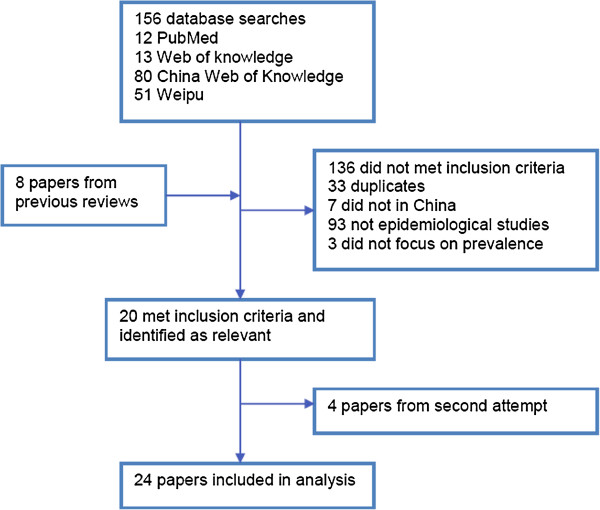
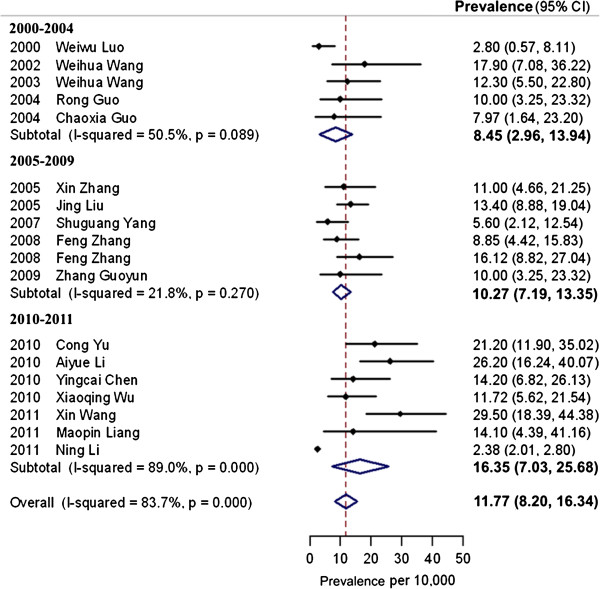
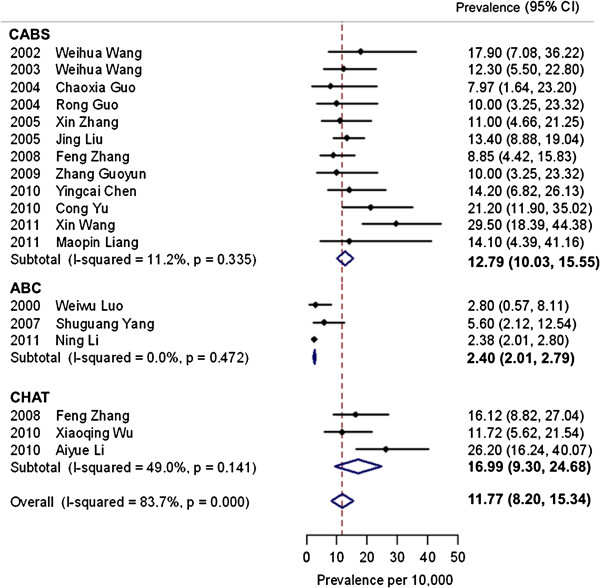
BACKGROUND: The prevalence of autism spectrum conditions (ASC) is 1% in developed countries, but little data are available from mainland China, Hong Kong and Taiwan. This study synthesizes evidence relating to the prevalence of ASC in these areas and assesses the effects of research methodology on prevalence estimates. METHODS: Systematic literature searches were conducted in PubMed, Web of Knowledge, China Web of Knowledge and Weipu databases, as well as relevant papers published from 1987 to 2011, reporting prevalence estimates of ASC or childhood autism in mainland China, Hong Kong and Taiwan. Summary estimates of prevalence were calculated with a random effects model. The effects of research methodology on the prevalence estimates were assessed using a meta-regression model. RESULTS: There were 25 studies eligible for review, 18 of which were suitable for inclusion in a meta-analysis. Pooled prevalence of childhood autism was 11.8 per 10,000 individuals (95% confidence interval (CI): 8.2, 15.3) in mainland China. Pooled prevalence of ASC was 26.6 per 10,000 (95% CI: 18.5, 34.6) in three areas. Substantial heterogeneity was identified between studies (I2>75%). The prevalence estimate of childhood autism was most strongly associated with the choice of screening instrument. After adjustment for age group, the odds ratio for prevalence estimates when using the Autism Behavior Checklist (ABC) as the screening instrument compared with those using the Clancy Autism Behavior Scale (CABS) was 0.29 (95% CI: 0.12, 0.69), and 1.79 (95% CI: 0.70, 4.55; P= 0.20) when using the Checklist for Autism in Toddlers (CHAT) compared to the CABS. CONCLUSIONS: The available studies investigating the prevalence of ASC in China, Hong Kong and Taiwan have focused mainly on childhood autism rather than the whole spectrum. The prevalence estimates are lower than estimates from developed countries. Studies using more recently developed screening instruments reported higher prevalence than older ones. However, available studies have methodological weaknesses and therefore these results lack comparability with those from developed countries. Our findings indicate a potential under-diagnosis and under-detection of ASC in mainland China, Hong Kong and Taiwan, and a need to adopt more advanced methods for research of ASC in these areas.
Overview
The claims and statistics of this paper haven’t been checked yet.
Free: it reads the open-access text and checks the first 5 claims that cite a source we can check. Create a free account to check every claim.
Integrity signals
Registry
Cites
Statistics
Figures
Verification
Claims the paper makes
The claims and statistics of this paper haven’t been checked yet.
Free: it reads the open-access text and checks the first 5 claims that cite a source we can check. Create a free account to check every claim.
Claims other papers make about this one
Each is checked against this paper’s own text: does it say what the citing paper says it does?
The source backs part of the claim, not all of it — or backs it for a different population, condition or comparison.
In the citing paper
“There are many factors contributing to the geographical variation in prevalence, including varying exposure to risk factors, cultural variation in behavioural norms, validity and choice of screening and diagnostic tools, participants' responses to survey questions, or even their choice to participate.30, 31”
From The global epidemiology and health burden of the autism spectrum: findings from the Global Burden of Disease Study 2021. (2025) · cites this paper as [30]
Experimental — accuracy not yet measured
Self-check
Percentages, sums and reported differences re-computed from the paper’s own numbers.
The self-check needs the paper’s full text.
Citations
Cites
Measuring inconsistency in meta-analyses
Higgins, J. P. T., Thompson, S. G., Deeks, J. J., & Altman, D. G. (2003) · BMJ · doi:10.1136/bmj.327.7414.557 · Cited by 63,139 · cited 1×
“The extent of heterogeneity was estimated by calculating I(2) (values of 25%, 50% and 75%, representing low, medium and high heterogeneity, respectively) [35].”
MethodCochrane Handbook for Systematic Reviews of Interventions: Cochrane Book Series
(2008) · doi:10.1002/9780470712184 · Cited by 25,048 · cited 1×
“Only the studies that conducted both screening and diagnostic assessment for childhood autism were examined using meta-regression, since the recommended minimum number of studies for inclusion in a meta-regression analysis is ten [66].”
MethodLord, C., Rutter, M., & Le Couteur, A. (1994) · Journal of Autism and Developmental Disorders · doi:10.1007/bf02172145 · Cited by 9,065 · cited 3×
“Abbreviations ADI-R: Autism Diagnostic Interview-Revised; ADOS: Autism Diagnostic Observation Schedule; AQ: Autism Spectrum Quotient; ASDASQ: Autism Spectrum Disorder in Adults Screening Questionnaire; CARS: Childhood Autism Rating Scale; CAST: Childhood Autism Spectrum Test; CCMD: Chinese Classification of Mental Dis…”
MethodCochrane Handbook for Systematic Reviews of Interventions Version 5.0.1. The Cochrane Collaboration
Higgins, J. P. T., Green, S. R., & Higgins, J. P. T. (2008) · Cited by 7,259
Clinical Epidemiology: A Basic Science for Clinical Medicine.
(1991) · Annals of Internal Medicine · doi:10.7326/0003-4819-114-9-825_9 · Cited by 3,476
Toward objective classification of childhood autism: Childhood Autism Rating Scale (CARS)
Schopler, E., Reichler, R. J., DeVellis, R. F., & Daly, K. (1980) · Journal of Autism and Developmental Disorders · doi:10.1007/bf02408436 · Cited by 2,432 · cited 8×
“Perry A, Condillac RA, Freeman NL, Dunn-Geier J, Belair J: Multi-site study of the childhood autism rating scale (CARS) in five clinical groups of young children.”
MethodInfluentialLord, C., Rutter, M., Goode, S., Heemsbergen, J., Jordan, H., Mawhood, L., & Schopler, E. (1989) · Journal of Autism and Developmental Disorders · doi:10.1007/bf02211841 · Cited by 2,030
Epidemiology of Pervasive Developmental Disorders
Fombonne, E. (2009) · Pediatric Research · doi:10.1203/pdr.0b013e31819e7203 · Cited by 1,971 · cited 2×
“In addition, the bibliographies of previous reviews were examined to identify published prevalence studies [1,22,34].”
Background
Research works printed but not linked: 8
- Dai S Jia M Tao K-t Help autistic children get away from loneliness 2008 Beijing: Chinese Women Press
- Chinese Society of Psychiatry Chinese Classification of Mental Disorders, 2nd edition, revised (CCMD-2-R) 1993 Shandong: Shandong Publishing House of Science and Technology
- Chinese Society of Psychiatry Chinese Classification of Mental Disorders, 3rd edition (CCMD-3) 2001 Shandong: Shandong Publishing House of Science and Technology
- Li A Zhang X Lv C Zhu Y Li Y Liu Y Analysis of behavioural characteristics of children with autism aged 1.5-3 years old Child Mental Health Journal 2010 24 215 218
- American Psychiatric Association (APA) Diagnostic and Statistical Manual of Mental Disorders, 3rd edition,revised (DSM-III-R) 1987 Washington DC: APA
- American Psychiatric Association (APA) Diagnostic and Statistical Manual of Mental Disorders, 4th edition (DSM-IV) 1994 Washington DC: APA
- Higgins JPT, Green S Cochrane Handbook for Systematic Reviews of Interventions 2011 Oxford: The Cochrane Collaboration
- Sun X Allison C Matthews F Zhang Z Auyeung B Baron-Cohen S Brayne C An exploration of the underdiagnosis of autism in mainland China using screening and diagnostic instruments 2012 Cambridge: Submitted for publication
Cited by
Items 201–201 of 201
Yu, Y., & Mercieca, D. P. (2026) · London Review of Education · doi:10.14324/lre.24.1.19
Metadata
- Authors
- Sun, X., Allison, C., Matthews, F. E., Sharp, S. J., Auyeung, B., Baron-Cohen, S., & Brayne, C.
- Affiliations
- University of Cambridge (GB)
- MRC Biostatistics Unit (GB)
- Addenbrooke's Hospital (GB)
- Corresponding author
- Sun, Xiang
- Venue
- Molecular Autism
- Published
- 2013
- Volume
- 4
- Issue
- 1
- Pages
- 7
- ISSN
- 2040-2392 (ISSN-L)
- PMC
- PMC3643868
- OpenAlex
- W2149989587
- Cited by
- 200
- References
- 65
- Citations by year
- 2026: 11 · 2025: 12 · 2024: 15 · 2023: 15 · 2022: 10 · 2021: 19 · 2020: 25 · 2019: 17 · 2018: 19 · 2017: 22 · 2016: 6 · 2015: 20 · 2014: 9
- FWCI
- 0.99
- Type
- journal article
- Language
- en
- Open access
- gold
- doi.org
- Licence
- cc-by
- Locations
- Molecular Autism (publishedVersion, cc-by)
- Europe PMC (PubMed Central) (publishedVersion, cc-by)
- PubMed Central (publishedVersion, cc-by)
- PubMed (publishedVersion)
- Apollo (University of Cambridge) (submittedVersion, cc-by)
- Repository@Hull (Worktribe) (University of Hull) (submittedVersion, cc-by)
- Funders
- Wellcome Trust
- Waterloo Foundation
- Peking University First Hospital
- National Institute for Health and Care Research (NF-SI-0611-10084)
- Cambridge Commonwealth Trust
- Peking University
- Medical Research Council
- Topics
- Life Sciences › Neuroscience › Cognitive Neuroscience › Autism Spectrum Disorder Research
- Health Sciences › Medicine › Psychiatry and Mental health › Child Nutrition and Feeding Issues
- Social Sciences › Psychology › Clinical Psychology › Family and Disability Support Research
- Keywords
- autism spectrum disorder, autism prevalence, childhood autism, screening tool, Autism Behavior Checklist, underdiagnosis, mainland China, Hong Kong, Taiwan
About these checks
Registry, retraction, Cites and statistics results are computed, not judged, with one exception: a printed reference that no index lists is read once by a model before it counts as a citation error. Claims are extracted by a model and kept only when their quote appears verbatim in the text; each cited source is then checked, with a model’s help, for whether it says what the claim relies on. Those verdicts can be wrong — read the claim’s quote and the cited source before relying on one.
Statistics and arithmetic are recomputed, not judged.
Confidence bands are shown only for fields calibrated on our annotated test set. None is calibrated yet, so no band is shown.
What counts as a claim ›How we measure confidence ›How we check this ›
Are you an author, or do you see a problem with this page? Request a review
Data sources
Bibliographic data: Semantic Scholar, OpenAlex, Crossref.
Contains information from the Semantic Scholar Academic Graph Datasets, made available under the ODC Attribution License (ODC-BY 1.0).
Semantic Scholar’s data is described in: Kinney, R., et al. (2023). The Semantic Scholar Open Data Platform. arXiv:2301.10140.
