

The phylogenetic position of ctenophores and the origin(s) of nervous systems
Open accessThe DOI matches its Crossref record; 70 of the 70 references it cites were found in a registry or an index.
Abstract
Ctenophores have traditionally been treated as eumetazoans, but some recent whole genome studies have revived the idea that they are, rather, the sister group to all other metazoans. This deep branching position implies either that nervous systems have evolved twice, in Ctenophora and in Eumetazoa, or that an ancestral metazoan nervous system has been lost in sponges and placozoans. We caution, however, that phylogenetic-tree construction artifacts may have placed ctenophores too deep in the metazoan tree. We discuss nervous system origins under these alternative phylogenies and in light of comparative data of ctenophore and eumetazoan nervous systems. We argue that characters like neuropeptide signaling, ciliary photoreceptors, gap junctions and presynaptic molecules are consistent with a shared ancestry of nervous systems. However, if ctenophores are the sister group to all other metazoans, this ancestral nervous system was likely very simple. Further studies are needed to resolve the deep phylogeny of metazoans and to have a better understanding of the early steps of nervous system evolution.
Overview
The claims and statistics of this paper haven’t been checked yet.
Free: it reads the open-access text and checks the first 5 claims that cite a source we can check. Create a free account to check every claim.
Integrity signals
Registry
Cites
Statistics
Figures
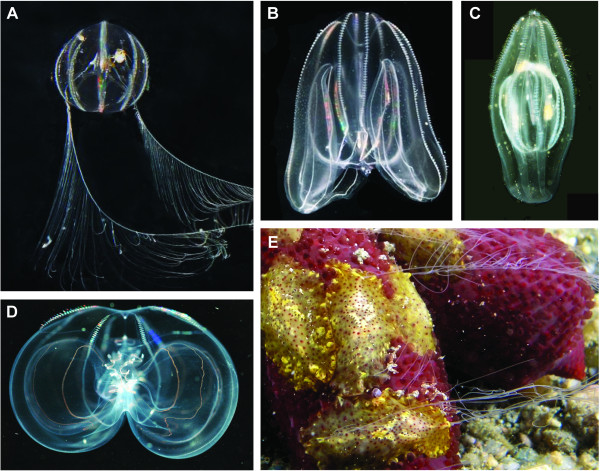
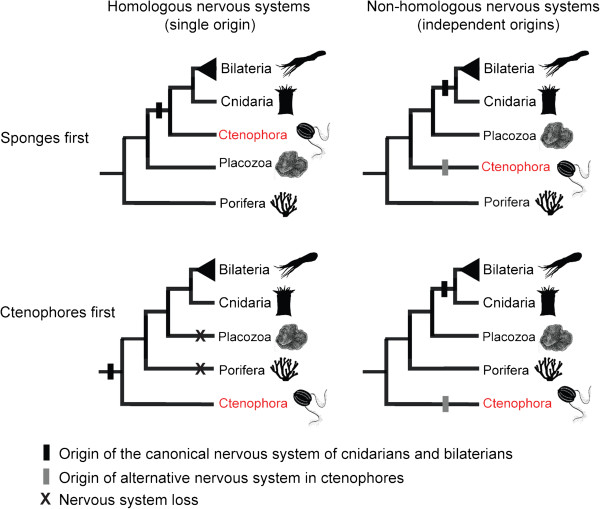
Verification
Claims the paper makes
The claims and statistics of this paper haven’t been checked yet.
Free: it reads the open-access text and checks the first 5 claims that cite a source we can check. Create a free account to check every claim.
Claims other papers make about this one
Each is checked against this paper’s own text: does it say what the citing paper says it does?
The cited source says what the claim attributes to it.
In the citing paper
“However, in the ctenophore-sister scenario supported here by deeply conserved syntenies, there are two possible alternatives explaining the evolution of neurons: either complex neural systems arose more than once3,59,62 but were elaborated differently in ctenophores, cnidarians and bilaterians3,4,59, or neuronal cell types were present in the metazoan ancestor but were lost in the sponge lineage4,”
From Ancient gene linkages support ctenophores as sister to other animals (2023) · cites this paper as [3]
The cited source says what the claim attributes to it.
In the citing paper
“Perhaps the most intriguing suite of metazoan characters pertain to neuromuscular systems, which are present in varying complexity in ctenophores, bilaterians, and cnidarians but are absent in sponges3,6,59.”
From Ancient gene linkages support ctenophores as sister to other animals (2023) · cites this paper as [3]
The cited source says what the claim attributes to it.
In the citing paper
“These relationships can be expected to be important to hypotheses about early neural evolution [98,100-103].”
From An option space for early neural evolution (2015) · cites this paper as [98]
The cited source says what the claim attributes to it.
In the citing paper
“Considerable uncertainty remains about the phylogenetic relationships between sponges, ctenophores, placozoa and other nonbilaterian animals [96-99].”
From An option space for early neural evolution (2015) · cites this paper as [98]
The cited source says what the claim attributes to it.
In the citing paper
“This long period of rudimentary nervous system development likely involved the deployment of genes now associated with the nervous system in proto-nervous system tissues, similar to Trichoplax today [13,53,58].”
From Early metazoan life: divergence, environment and ecology (2015) · cites this paper as [13]
1 more claim about this paper
Create a free account to see every claim other papers make about this one.
Self-check
Percentages, sums and reported differences re-computed from the paper’s own numbers.
The self-check needs the paper’s full text.
Citations
Cites
Broad phylogenomic sampling improves resolution of the animal tree of life
Dunn, C. W., Hejnol, A., Matus, D. Q., Pang, K., Browne, W. E., Smith, S. A., Seaver, E., Rouse, G. W., Obst, M., Edgecombe, G. D., et al. (2008) · Nature · doi:10.1038/nature06614 · Cited by 1,921 · cited 2×
“While several phylogenomic analyses [6,7,11,12] support the position of ctenophores as the sister lineage to all other animals, other works considered this branching contentious in light of methodological issues.”
BackgroundResultEvidence for a clade of nematodes, arthropods and other moulting animals
Aguinaldo, A. M. A., Turbeville, J. M., Linford, L. S., Rivera, M. C., Garey, J. R., Raff, R. A., & Lake, J. A. (1997) · Nature · doi:10.1038/387489a0 · Cited by 1,609 · cited 1×
“There is also little hope that wider ctenophore taxon sampling will break this long branch, as was the case for nematodes or acoels [23-25], since the range of ctenophores sampled in the two genome studies already captures the known diversity of the group.”
BackgroundResolving difficult phylogenetic questions: Why more sequences are not enough
Philippe, H., Brinkmann, H., Lavrov, D. V., Littlewood, D. T. J., Manuel, M., Wörheide, G., & Baurain, D. (2011) · PLoS Biology · doi:10.1371/journal.pbio.1000602 · Cited by 1,129 · cited 2×
“Some of these methodological issues have previously been highlighted as potentially affecting the placement of ctenophores [13-16,20], and each of these issues needs to be tackled with different strategies.”
BackgroundThe Amphimedon queenslandica genome and the evolution of animal complexity
Srivastava, M., Simakov, O., Chapman, J., Fahey, B., Gauthier, M. E. A., Mitros, T., Richards, G. S., Conaco, C., Dacre, M., Hellsten, U., et al. (2010) · Nature · doi:10.1038/nature09201 · Cited by 1,049 · cited 1×
“It is to be noted, however, that the presence of neurotransmitter pathways and ‘neuronal’ genes does not necessarily indicate the presence of a nervous system, since both sponges and placozoans contain several such genes, including enzymes in the pathways for making serotonin, dopamine (sponges [35,36]) or noradrenali…”
BackgroundAnimal evolution: interrelationships of the living phyla
(2012) · Choice Reviews Online · doi:10.5860/choice.50-1469 · Cited by 1,039
The Trichoplax genome and the nature of placozoans
Srivastava, M., Begovic, E., Chapman, J., Putnam, N. H., Hellsten, U., Kawashima, T., Kuo, A., Mitros, T., Salamov, A., Carpenter, M. L., et al. (2008) · Nature · doi:10.1038/nature07191 · Cited by 889
Assessing the root of bilaterian animals with scalable phylogenomic methods
Hejnol, A., Obst, M., Stamatakis, A., Ott, M., Rouse, G. W., Edgecombe, G. D., Martinez, P., Baguñà, J., Bailly, X., Jondelius, U., et al. (2009) · Proceedings of the Royal Society B: Biological Sciences · doi:10.1098/rspb.2009.0896 · Cited by 747 · cited 3×
“While several phylogenomic analyses [6,7,11,12] support the position of ctenophores as the sister lineage to all other animals, other works considered this branching contentious in light of methodological issues.”
BackgroundResultEarly origins and evolution of microRNAs and Piwi-interacting RNAs in animals
Grimson, A., Srivastava, M., Fahey, B., Woodcroft, B. J., Chiang, H. R., King, N., Degnan, B. M., Rokhsar, D. S., & Bartel, D. P. (2008) · Nature · doi:10.1038/nature07415 · Cited by 734
The ctenophore genome and the evolutionary origins of neural systems
Moroz, L. L., Kocot, K. M., Citarella, M. R., Dosung, S., Norekian, T. P., Povolotskaya, I. S., Grigorenko, A. P., Dailey, C., Berezikov, E., Buckley, K. M., et al. (2014) · Nature · doi:10.1038/nature13400 · Cited by 716
Phylogenomics Revives Traditional Views on Deep Animal Relationships
Philippe, H., Derelle, R., Lopez, P., Pick, K., Borchiellini, C., Boury-Esnault, N., Vacelet, J., Renard, E., Houliston, E., Quéinnec, E., et al. (2009) · Current Biology · doi:10.1016/j.cub.2009.02.052 · Cited by 695 · cited 3×
“The placement of ctenophores as a sister to all other metazoans was supported by earlier phylogenetic studies [8-12], while other work indicated sponges as the sister lineage to all other metazoans [13-16].”
BackgroundResult
Cited by
Items 101–191 of 191
Müller, W. E. G., Schröder, H. C., & Wang, X. (2017) · Marine Drugs · doi:10.3390/md15060172 · Cited by 21
Schäfer, N., Kaya, Y., Rebl, H., Stüeken, M., Rebl, A., Nguinkal, J. A., Franz, G. P., Brunner, R. M., Goldammer, T., Grunow, B., et al. (2021) · Fish Physiology and Biochemistry · doi:10.1007/s10695-021-00929-6 · Cited by 18
Brückner, A., Barnett, A. A., Bhat, P., Antoshechkin, I. A., & Kitchen, S. A. (2022) · Acarologia · doi:10.24349/pjye-gkeo · Cited by 14
Evolution of Metazoan Life Cycles and the Origin of Pelagic Larvae
Malakhov, V. V., Bogomolova, E., Kuzmina, T. V., & Temereva, E. N. (2019) · Russian Journal of Developmental Biology · doi:10.1134/s1062360419060043 · Cited by 19
What Makes an Animal? The Molecular Quest for the Origin of the Animal Kingdom
Paps, J. (2018) · Integrative and Comparative Biology · doi:10.1093/icb/icy036 · Cited by 20
Self-citationDevelopmental origins of the crocodylian skull table and platyrostral face
Morris, Z. S., Vliet, K. A., Abzhanov, A., & Pierce, S. E. (2021) · The Anatomical Record · doi:10.1002/ar.24802 · Cited by 17
Improving Orthologous Signal and Model Fit in Datasets Addressing the Root of the Animal Phylogeny
McCarthy, C. G. P., Mulhair, P. O., Siu-Ting, K., Creevey, C. J., & O’Connell, M. J. (2023) · Molecular Biology and Evolution · doi:10.1093/molbev/msac276 · Cited by 20
Magarlamov, T. Y., Dyachuk, V. A., & Chеrnyshev, A. V. (2020) · Frontiers in Zoology · doi:10.1186/s12983-019-0347-4 · Cited by 14
The IS630/Tc1/mariner transposons in three ctenophore genomes
Puzakov, M. V., Puzakova, L. V., Cheresiz, S. V., & Sang, Y. (2021) · Molecular Phylogenetics and Evolution · doi:10.1016/j.ympev.2021.107231 · Cited by 14
The premetazoan ancestry of the synaptic toolkit and appearance of first neurons
Colgren, J. J., & Burkhardt, P. (2022) · Essays in Biochemistry · doi:10.1042/ebc20220042 · Cited by 19
Zhao, T., Specht, C. D., Dong, Z., Ye, Y., Liu, H., & Liao, J. (2020) · Plant Growth Regulation · doi:10.1007/s10725-020-00575-7 · Cited by 17
A Look Back Over 20 Years of Evo-Devo Studies on Sponges: A Challenged View of Urmetazoa
Schenkelaars, Q., Vernale, A., Fierro‐Constaín, L., Borchiellini, C., & Renard, E. (2019) · Springer eBooks · doi:10.1007/978-3-030-30363-1_7 · Cited by 16
Tian, X., Yu, Q., Liu, H., & Liao, J. (2016) · Frontiers in Plant Science · doi:10.3389/fpls.2016.01194 · Cited by 17
Tian, X., Zou, P., Miao, M., Ning, Z., & Liao, J. (2017) · Molecular Genetics and Genomics · doi:10.1007/s00438-017-1392-3 · Cited by 15
Bodily Complexity: Integrated Multicellular Organizations for Contraction-Based Motility
Arnellos, A., & Keijzer, F. (2019) · Frontiers in Physiology · doi:10.3389/fphys.2019.01268 · Cited by 17
Zhang, J., Liu, B., Song, Y., Chen, Y., Fu, J., Liu, J., Ma, T., Xi, Z., & Liu, H. (2021) · BMC Genomic Data · doi:10.1186/s12863-021-00972-5 · Cited by 14
Assembling animals: trees, genomes, cells, and contrast to plants
Paps, J., Rossi, M. E., Bowles, A. M. C., & Álvarez‐Presas, M. (2023) · Frontiers in Ecology and Evolution · doi:10.3389/fevo.2023.1185566 · Cited by 13
Self-citationOno, H., Koop, D., & Holland, L. Z. (2018) · Development · doi:10.1242/dev.162586 · Cited by 11
Teso, V., & Penchaszadeh, P. E. (2018) · Polar Biology · doi:10.1007/s00300-018-2412-4 · Cited by 11
Non-directional Photoreceptors in the Pluteus of Strongylocentrotus purpuratus
Valero‐Gracia, A., Petrone, L., Oliveri, P., Nilsson, D., & Arnone, M. I. (2016) · Frontiers in Ecology and Evolution · doi:10.3389/fevo.2016.00127 · Cited by 14
Differentiation of the Oral–Aboral Axis and Body Parts during Life Cycle Transitions in Scyphozoa
Сухопутова, А. В., Kraus, Y. A., Kirillova, A., & Markov, A. V. (2019) · Biology Bulletin Reviews · doi:10.1134/s2079086419050086 · Cited by 11
McIlroy, D., Pasinetti, G., Pérez-Pinedo, D., McKean, C., Dufour, S. C., Matthews, J. J., Menon, L. R., Nicholls, R., & Taylor, R. S. (2024) · Life · doi:10.3390/life14091096 · Cited by 12
The performance of outgroup-free rooting under evolutionary radiations
Lamarca, A. P., Mello, B., & Schrago, C. G. (2022) · Molecular Phylogenetics and Evolution · doi:10.1016/j.ympev.2022.107434 · Cited by 8
Evolutionary origin of the nervous system from Ctenophora prospective
Sachkova, M. Y. (2024) · Evolution & Development · doi:10.1111/ede.12472 · Cited by 11
Developmental divergence in gene regulation among rapidly radiating cichlid speciesPreprint
Duenser, A., Singh, P., Ahi, E. P., Durdević, M., Schäffer, S., Gallaun, J., Gessl, W., D, O. S. C., & Sturmbauer, C. (2024) · bioRxiv (Cold Spring Harbor Laboratory) · doi:10.1101/2024.01.24.577063 · Cited by 9
Renewed perspectives on the sedentary-pelagic last common bilaterian ancestor
Martynov, A. V., & Korshunova, T. (2022) · Bijdragen tot de Dierkunde · doi:10.1163/18759866-bja10034 · Cited by 7
Amplatz, K., Zieger, E., Abed‐Navandi, D., Weissenbacher, A., & Wanninger, A. (2024) · Frontiers in Neuroscience · doi:10.3389/fnins.2023.1324980 · Cited by 9
BHX Inhibits the Wnt Signaling Pathway by Suppressing β-catenin Transcription in the Nucleus
Ding, F., Wang, M., Du, Y., Du, S., Zhu, Z., & Yan, Z. (2016) · Scientific Reports · doi:10.1038/srep38331 · Cited by 9
MicroRNA Applications in Marine Biology
Bonin, C. A., van Wijnen, A. J., & Lewallen, E. A. (2019) · Current Molecular Biology Reports · doi:10.1007/s40610-019-00124-w · Cited by 9
Genetic mechanisms controlling anterior expansion of the central nervous system
Salmani, B. Y., & Thor, S. (2020) · Current topics in developmental biology/Current Topics in Developmental Biology · doi:10.1016/bs.ctdb.2019.11.005 · Cited by 9
Structure of the yolk syncytial layer in the larvae of whitefishes: A histological study
Kondakova, E., Vi, E., & Bogdanova, V. A. (2017) · Russian Journal of Developmental Biology · doi:10.1134/s1062360417030055 · Cited by 8
Colgren, J. J., & Burkhardt, P. (2025) · Nature reviews. Neuroscience · doi:10.1038/s41583-025-00983-6 · Cited by 8
Breaking the neural code of a cnidarian: Learning principles of neuroscience from the “vulgar” Hydra
Yuste, R. (2024) · Current Opinion in Neurobiology · doi:10.1016/j.conb.2024.102869 · Cited by 14
Cherry, A. L., Wheeler, M. J., Mathisova, K., & Miceli, M. D. (2024) · Frontiers in Neuroinformatics · doi:10.3389/fninf.2024.1294939 · Cited by 7
Fast speciations and slow genes: uncovering the root of living canids
Lamarca, A. P., & Schrago, C. G. (2019) · Biological Journal of the Linnean Society · doi:10.1093/biolinnean/blz181 · Cited by 8
Back Through Time: How Cnidarians and Basal Metazoans Shed Light on Ancient Nervous Systems
Watanabe, H. (2017) · Diversity and commonality in animals · doi:10.1007/978-4-431-56469-0_3 · Cited by 9
Molecular, phylogenetic and developmental analyses of Sall proteins in bilaterians
Lorente-Sorolla, J. M., Truchado-García, M., Perry, K. J., Henry, J. J., & Grande, C. (2018) · EvoDevo · doi:10.1186/s13227-018-0096-z · Cited by 8
Simplest Model of Nervous System. I. FormalismPreprint
Sinitskiy, A. V. (2023) · bioRxiv (Cold Spring Harbor Laboratory) · doi:10.1101/2023.11.23.568481 · Cited by 6
Botha, T. L., Sherratt, E., Droser, M. L., Gehlîng, J. G., & García‐Bellido, D. C. (2023) · Papers in Palaeontology · doi:10.1002/spp2.1530 · Cited by 6
Herranz, M., Park, T., Domênico, M. D., Leander, B. S., Sørensen, M. V., & Worsaae, K. (2021) · Frontiers in Zoology · doi:10.1186/s12983-021-00438-5 · Cited by 7
Invertebrate Genomics Provide Insights Into the Origin of Synaptic Transmission
Abrams, T. W., & Sossin, W. S. (2018) · Oxford University Press eBooks · doi:10.1093/oxfordhb/9780190456757.013.4 · Cited by 7
Courtney, A., Merces, G., & Pickering, M. (2020) · bioRxiv (Cold Spring Harbor Laboratory) · doi:10.1101/2020.05.25.114744 · Cited by 15
Wong, K. S., & Arenas‐Mena, C. (2016) · Evolution & Development · doi:10.1111/ede.12196 · Cited by 5
Model Systems for Exploring the Evolutionary Origins of the Nervous System
Whitmer, K. M. H. (2018) · Results and problems in cell differentiation · doi:10.1007/978-3-319-92486-1_10 · Cited by 5
Beyond synapses: cytoplasmic connections in brain function and evolution
Rakotobé, M., & Zurzolo, C. (2025) · Biological reviews/Biological reviews of the Cambridge Philosophical Society · doi:10.1111/brv.70034 · Cited by 4
A Pre-Bilaterian Origin of Phototransduction Genes and Photoreceptor CellsPreprint
Aleotti, A., Giorgini, F., & Feuda, R. (2025) · bioRxiv (Cold Spring Harbor Laboratory) · doi:10.1101/2025.02.09.637293 · Cited by 5
Post-embryonic tail development through molting of the freshwater shrimp Neocaridina denticulata
Adachi, H., Moritoki, N., Shindo, T., & Arakawa, K. (2025) · iScience · doi:10.1016/j.isci.2025.111885 · Cited by 5
Evolution of neuroglia: From worm to man
Pękowska, A., Verkhratsky, A., & Falcone, C. (2025) · Handbook of clinical neurology · doi:10.1016/b978-0-443-19104-6.00004-8 · Cited by 6
The yolk syncytial layer of loach,Misgurnus fossilis(Teleostei) during early development
Kondakova, E., Neklyudova, I. V., & Vi, E. (2017) · Zygote · doi:10.1017/s0967199417000314 · Cited by 3
Sachslehner, A. P., Zieger, E., Calcino, A., & Wanninger, A. (2021) · Scientific Reports · doi:10.1038/s41598-021-96711-y · Cited by 3
Kimbara, R., Kohtsuka, H., & Miura, T. (2023) · Biological Bulletin · doi:10.1086/726772 · Cited by 3
Evolution of the gene regulatory network of body axis by enhancer hijacking in amphioxus
Shi, C., Chen, S., Liu, H., Li, S., Wang, Y., Pan, R., Wu, X., Li, X., Li, J., 邢超凡, et al. (2023) · eLife · doi:10.7554/elife.89615 · Cited by 3
Functional characterization of optic photoreception in Lymnaea stagnalis
Harracksingh, A. N., Bandura, J., Morizumi, T., Monnier, P. P., Henderson, J. T., & Feng, Z. (2024) · PLoS ONE · doi:10.1371/journal.pone.0313407 · Cited by 6
Huang, J., Kwan, R. S.-Y., Tsai, Z. T., Lin, T., & Tsai, H. (2018) · Frontiers in Genetics · doi:10.3389/fgene.2018.00571 · Cited by 3
Introduction: Young Approaches to Animal Evolution
Martín-Durán, J. M., & Vellutini, B. C. (2019) · Fascinating life sciences · doi:10.1007/978-3-030-18202-1_1 · Cited by 2
Zhao, T., Piñeyro‐Nelson, A., Yu, Q., Pan, X., Hu, X., Liu, H., & Liao, J. (2021) · Journal of Plant Biology · doi:10.1007/s12374-021-09312-7 · Cited by 4
Schmidt‐Rhaesa, A., Harzsch, S., & Purschke, G. (2015) · Oxford University Press eBooks · doi:10.1093/acprof:oso/9780199682201.003.0001 · Cited by 2
Neuropeptides at the origin of neurons
Sachkova, M. Y. (2022) · Nature Ecology & Evolution · doi:10.1038/s41559-022-01828-6 · Cited by 2
Mayer, M. L., & Jegla, T. J. (2018) · eLife · doi:10.7554/elife.43815 · Cited by 2
Orús-Alcalde, A., Børve, A., & Hejnol, A. (2022) · bioRxiv (Cold Spring Harbor Laboratory) · doi:10.1101/2022.04.26.489627 · Cited by 2
Non-visual photoreceptive brain specification in sea urchin larvae
Yaguchi, J., Tsuyuzaki, K., Sawada, I., Horiuchi, A., Sakamoto, N., Yamamoto, T., Yamashita, T., & Yaguchi, S. (2025) · Nature Communications · doi:10.1038/s41467-025-65628-9 · Cited by 2
Brent, A. E., Chan, R., Sirkay, V., Morton, B. R., & Mansfield, J. H. (2026) · Developmental Biology · doi:10.1016/j.ydbio.2026.02.008 · Cited by 1
Tracing the Evolutionary Origin of the Gut–Brain Axis
Bosch, T. C. G. (2018) · Springer eBooks · doi:10.1007/978-3-319-95954-2_4 · Cited by 1
Comparative Genomics of Convergent Evolution
Martinez, C. L. F. (2019) · Springer proceedings in complexity · doi:10.1007/978-3-030-00075-2_12 · Cited by 2
Meeting report of Ctenopalooza: the first international meeting of ctenophorologists
Ryan, J. F., Schnitzler, C. E., & Tamm, S. L. (2016) · EvoDevo · doi:10.1186/s13227-016-0057-3 · Cited by 1
leidyi Is a New Group of DD41D Transposons in Mnemiopsis leidyi Genome
Puzakov, M. V., & Puzakova, L. V. (2019) · Russian Journal of Genetics · doi:10.1134/s1022795419070123 · Cited by 1
FEATURES OF THE INSECTS NEUROPEPTIDES BIOSYNTHESIS - Review
Ilyasov, R. A., Han, G. Y., Song, J. H., Lim, S. H., & Kwon, H. W. (2018) · ÈKOBIOTEH · doi:10.31163/2618-964x-2018-1-1-52-61
Hahn, N. (2019) · eDiss (Georg-August-Universität Göttingen) · doi:10.53846/goediss-7774
From skin to brain: modelling a whole-body coordination scenario of nervous system origin
de Wiljes, O. (2020) · University of Groningen research database (University of Groningen / Centre for Information Technology) · doi:10.33612/diss.123420732 · Cited by 1
Spezielle Zoologie Teil A: „Protista“ und Metazoa
Schumann, I., & Schaffer, S. (2020) · Springer eBooks · doi:10.1007/978-3-662-61671-0_4
Reframing fundamental concepts of insect societies for bio-ontologiesPreprint
Silva, T. S. R. (2021) · bioRxiv (Cold Spring Harbor Laboratory) · doi:10.1101/2021.05.18.444717
Extended Evolutionary Synthesis, Epigenetics and the Contingency of Evolution
Hemminger, H. (2021) · New approaches to the scientific study of religion · doi:10.1007/978-3-030-70408-7_6
(2021) · Elsevier eBooks · doi:10.1016/b978-0-12-822655-1.16001-5
Zardoya, R., Mauro, D. S., & Irisarri, I. (2018) · Faculty Opinions – Post-Publication Peer Review of the Biomedical Literature · doi:10.3410/f.733502210.793549205
Nag, S., & Bhat, A. S. (2022) · Heliyon · doi:10.1016/j.heliyon.2022.e09882
A single amino acid change drives left- right asymmetry in BilateriaPreprint
Truchado-García, M., Perry, K. J., Cavodeassi, F., Kenny, N. J., Henry, J. J., & Grande, C. (2022) · bioRxiv (Cold Spring Harbor Laboratory) · doi:10.1101/2022.10.06.511172
Puzakov, M. V., Puzakova, L. V., & Ulupova, Y. N. (2022) · Molecular Genetics Microbiology and Virology (Russian) · doi:10.17116/molgen20224004130
Puzakov, M. V., Puzakova, L. V., & Ulupova, Y. N. (2022) · Molecular Genetics Microbiology and Virology · doi:10.3103/s089141682204005x
Embryogenesis in myrmicine ants combines features of short and long germ-band modes of developmentPreprint
Fang, C., Rajakumar, A., Kenny, A., Mueller, U. G., Abouheif, E., & Stein, D. (2023) · bioRxiv (Cold Spring Harbor Laboratory) · doi:10.1101/2023.09.19.557849
Wiese, J., Richards, E. J., Kowalko, J. E., & McGaugh, S. E. (2024) · bioRxiv (Cold Spring Harbor Laboratory) · doi:10.1101/2024.03.29.587360
Hsiao, J., Deng, L. C., Moroz, L. L., Chalasani, S. H., & Edsinger, E. (2024) · Methods in molecular biology · doi:10.1007/978-1-0716-3642-8_19
Vasilenko, E. O., & Sinitskiy, A. V. (2024) · bioRxiv (Cold Spring Harbor Laboratory) · doi:10.1101/2024.08.30.610546
Ctenophore neural systems: Independent origin(s) and “alien neurons”
Moroz, L. L. (2025) · Elsevier eBooks · doi:10.1016/b978-0-443-27380-3.00044-0 · Cited by 2
Dong, G., Mitchell, D. G., & Moss, A. G. (2026) · iScience · doi:10.1016/j.isci.2026.115508
Franco, A. D. (2019) · theses.fr (ABES) · doi:10.70675/9c8d2b6cz53cfz4351za1cbz83d9c20217f1 · Cited by 1
Nervous system evolution : insights from the sea urchin
Formery, L. (2019) · theses.fr (ABES) · doi:10.70675/146c0b8aza71az47ecza2c7zc12baf0f5794
Extensive opsin gene expansion and non-cerebral origin of the minimalist eye in a model tardigradePreprint
Dutta, S., Gross, V., Hering, L., Klein, M., Flenner, S., Greving, I., Longo, E., & Mayer, G. (2026) · bioRxiv (Cold Spring Harbor Laboratory) · doi:10.64898/2026.04.15.718617 · Cited by 1
Molecular Mechanisms Driving Larval Green Color Adaptation in Swallowtail Butterfly, Papilio memnon
Liu, L., Komata, S., Wu, K., Itoh, T., Kojima, T., & Fujiwara, H. (2026) · Genome Biology and Evolution · doi:10.1093/gbe/evag253
Metadata
- Authors
- Jákely, G., Paps, J., & Nielsen, C.
- Affiliations
- University of Oxford (GB)
- University of Copenhagen (DK)
- Corresponding author
- Nielsen, Claus
- Venue
- EvoDevo
- Published
- 2015
- Volume
- 6
- Issue
- 1
- Pages
- 1
- ISSN
- 2041-9139 (ISSN-L)
- PMC
- PMC4406211
- OpenAlex
- W2139360357
- Semantic Scholar
- f9fb21b081d16b3beb678b13362b307b2661d846
- Cited by
- 189
- References
- 70
- Citations by year
- 2026: 4 · 2025: 7 · 2024: 10 · 2023: 9 · 2022: 14 · 2021: 16 · 2020: 15 · 2019: 20 · 2018: 24 · 2017: 26 · 2016: 27 · 2015: 17
- FWCI
- 3.95
- Type
- journal article
- Language
- en
- Open access
- gold
- doi.org
- Licence
- cc-by
- Locations
- EvoDevo (publishedVersion, cc-by)
- PubMed Central (publishedVersion, cc-by)
- PubMed (publishedVersion)
- Research at the University of Copenhagen (University of Copenhagen) (publishedVersion, other-oa)
- Bristol Research (University of Bristol) (publishedVersion)
- Open Access at Essex (University of Essex) (acceptedVersion)
- Figshare (submittedVersion, cc-by)
- Open Research Exeter (University of Exeter) (submittedVersion, cc-by)
- Funders
- Brown University
- University of Alberta
- University College London
- European Commission (2007–2013, FP7 2007-2013, 260821, FP7/2007)
- FP7 Ideas: European Research Council (260821)
- Topics
- Life Sciences › Agricultural and Biological Sciences › Animal Science and Zoology › Marine Invertebrate Physiology and Ecology
- Life Sciences › Biochemistry, Genetics and Molecular Biology › Molecular Biology › Developmental Biology and Gene Regulation
- Life Sciences › Biochemistry, Genetics and Molecular Biology › Molecular Biology › Planarian Biology and Electrostimulation
- Keywords
- ctenophores, nervous system evolution, metazoan phylogeny, placozoans, neuropeptide signaling, ciliary photoreceptors, gap junctions
About these checks
Registry, retraction, Cites and statistics results are computed, not judged, with one exception: a printed reference that no index lists is read once by a model before it counts as a citation error. Claims are extracted by a model and kept only when their quote appears verbatim in the text; each cited source is then checked, with a model’s help, for whether it says what the claim relies on. Those verdicts can be wrong — read the claim’s quote and the cited source before relying on one.
Statistics and arithmetic are recomputed, not judged.
Confidence bands are shown only for fields calibrated on our annotated test set. None is calibrated yet, so no band is shown.
What counts as a claim ›How we measure confidence ›How we check this ›
Are you an author, or do you see a problem with this page? Request a review
Data sources
Bibliographic data: Semantic Scholar, OpenAlex, Crossref.
Contains information from the Semantic Scholar Academic Graph Datasets, made available under the ODC Attribution License (ODC-BY 1.0).
Semantic Scholar’s data is described in: Kinney, R., et al. (2023). The Semantic Scholar Open Data Platform. arXiv:2301.10140.
