

The phylogenetic position of ctenophores and the origin(s) of nervous systems
Open accessThe DOI matches its Crossref record; 70 of the 70 references it cites were found in a registry or an index.
Abstract
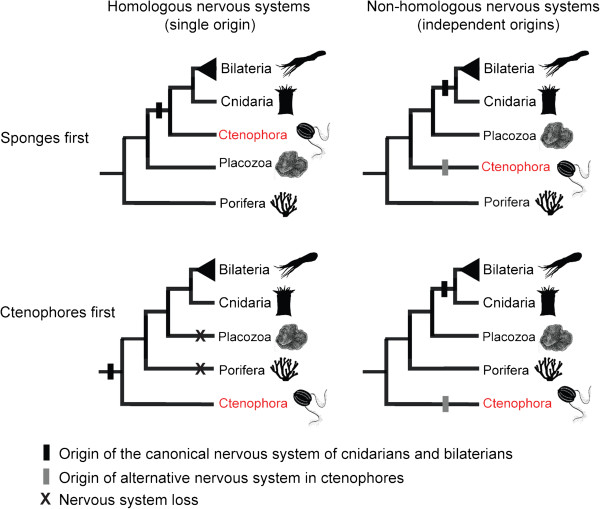
Ctenophores have traditionally been treated as eumetazoans, but some recent whole genome studies have revived the idea that they are, rather, the sister group to all other metazoans. This deep branching position implies either that nervous systems have evolved twice, in Ctenophora and in Eumetazoa, or that an ancestral metazoan nervous system has been lost in sponges and placozoans. We caution, however, that phylogenetic-tree construction artifacts may have placed ctenophores too deep in the metazoan tree. We discuss nervous system origins under these alternative phylogenies and in light of comparative data of ctenophore and eumetazoan nervous systems. We argue that characters like neuropeptide signaling, ciliary photoreceptors, gap junctions and presynaptic molecules are consistent with a shared ancestry of nervous systems. However, if ctenophores are the sister group to all other metazoans, this ancestral nervous system was likely very simple. Further studies are needed to resolve the deep phylogeny of metazoans and to have a better understanding of the early steps of nervous system evolution.
Overview
The claims and statistics of this paper haven’t been checked yet.
Free: it reads the open-access text and checks the first 5 claims that cite a source we can check. Create a free account to check every claim.
Integrity signals
Registry
Cites
Statistics
Figures
Verification
Claims the paper makes
The claims and statistics of this paper haven’t been checked yet.
Free: it reads the open-access text and checks the first 5 claims that cite a source we can check. Create a free account to check every claim.
Claims other papers make about this one
Each is checked against this paper’s own text: does it say what the citing paper says it does?
The cited source says what the claim attributes to it.
In the citing paper
“However, in the ctenophore-sister scenario supported here by deeply conserved syntenies, there are two possible alternatives explaining the evolution of neurons: either complex neural systems arose more than once3,59,62 but were elaborated differently in ctenophores, cnidarians and bilaterians3,4,59, or neuronal cell types were present in the metazoan ancestor but were lost in the sponge lineage4,”
From Ancient gene linkages support ctenophores as sister to other animals (2023) · cites this paper as [3]
The cited source says what the claim attributes to it.
In the citing paper
“Perhaps the most intriguing suite of metazoan characters pertain to neuromuscular systems, which are present in varying complexity in ctenophores, bilaterians, and cnidarians but are absent in sponges3,6,59.”
From Ancient gene linkages support ctenophores as sister to other animals (2023) · cites this paper as [3]
The cited source says what the claim attributes to it.
In the citing paper
“These relationships can be expected to be important to hypotheses about early neural evolution [98,100-103].”
From An option space for early neural evolution (2015) · cites this paper as [98]
The cited source says what the claim attributes to it.
In the citing paper
“Considerable uncertainty remains about the phylogenetic relationships between sponges, ctenophores, placozoa and other nonbilaterian animals [96-99].”
From An option space for early neural evolution (2015) · cites this paper as [98]
The cited source says what the claim attributes to it.
In the citing paper
“This long period of rudimentary nervous system development likely involved the deployment of genes now associated with the nervous system in proto-nervous system tissues, similar to Trichoplax today [13,53,58].”
From Early metazoan life: divergence, environment and ecology (2015) · cites this paper as [13]
1 more claim about this paper
Create a free account to see every claim other papers make about this one.
Self-check
Percentages, sums and reported differences re-computed from the paper’s own numbers.
The self-check needs the paper’s full text.
Citations
Cites
Broad phylogenomic sampling improves resolution of the animal tree of life
Dunn, C. W., Hejnol, A., Matus, D. Q., Pang, K., Browne, W. E., Smith, S. A., Seaver, E., Rouse, G. W., Obst, M., Edgecombe, G. D., et al. (2008) · Nature · doi:10.1038/nature06614 · Cited by 1,921 · cited 2×
“While several phylogenomic analyses [6,7,11,12] support the position of ctenophores as the sister lineage to all other animals, other works considered this branching contentious in light of methodological issues.”
BackgroundResultEvidence for a clade of nematodes, arthropods and other moulting animals
Aguinaldo, A. M. A., Turbeville, J. M., Linford, L. S., Rivera, M. C., Garey, J. R., Raff, R. A., & Lake, J. A. (1997) · Nature · doi:10.1038/387489a0 · Cited by 1,609 · cited 1×
“There is also little hope that wider ctenophore taxon sampling will break this long branch, as was the case for nematodes or acoels [23-25], since the range of ctenophores sampled in the two genome studies already captures the known diversity of the group.”
BackgroundResolving difficult phylogenetic questions: Why more sequences are not enough
Philippe, H., Brinkmann, H., Lavrov, D. V., Littlewood, D. T. J., Manuel, M., Wörheide, G., & Baurain, D. (2011) · PLoS Biology · doi:10.1371/journal.pbio.1000602 · Cited by 1,129 · cited 2×
“Some of these methodological issues have previously been highlighted as potentially affecting the placement of ctenophores [13-16,20], and each of these issues needs to be tackled with different strategies.”
BackgroundThe Amphimedon queenslandica genome and the evolution of animal complexity
Srivastava, M., Simakov, O., Chapman, J., Fahey, B., Gauthier, M. E. A., Mitros, T., Richards, G. S., Conaco, C., Dacre, M., Hellsten, U., et al. (2010) · Nature · doi:10.1038/nature09201 · Cited by 1,049 · cited 1×
“It is to be noted, however, that the presence of neurotransmitter pathways and ‘neuronal’ genes does not necessarily indicate the presence of a nervous system, since both sponges and placozoans contain several such genes, including enzymes in the pathways for making serotonin, dopamine (sponges [35,36]) or noradrenali…”
BackgroundAnimal evolution: interrelationships of the living phyla
(2012) · Choice Reviews Online · doi:10.5860/choice.50-1469 · Cited by 1,039
The Trichoplax genome and the nature of placozoans
Srivastava, M., Begovic, E., Chapman, J., Putnam, N. H., Hellsten, U., Kawashima, T., Kuo, A., Mitros, T., Salamov, A., Carpenter, M. L., et al. (2008) · Nature · doi:10.1038/nature07191 · Cited by 889
Assessing the root of bilaterian animals with scalable phylogenomic methods
Hejnol, A., Obst, M., Stamatakis, A., Ott, M., Rouse, G. W., Edgecombe, G. D., Martinez, P., Baguñà, J., Bailly, X., Jondelius, U., et al. (2009) · Proceedings of the Royal Society B: Biological Sciences · doi:10.1098/rspb.2009.0896 · Cited by 747 · cited 3×
“While several phylogenomic analyses [6,7,11,12] support the position of ctenophores as the sister lineage to all other animals, other works considered this branching contentious in light of methodological issues.”
BackgroundResultEarly origins and evolution of microRNAs and Piwi-interacting RNAs in animals
Grimson, A., Srivastava, M., Fahey, B., Woodcroft, B. J., Chiang, H. R., King, N., Degnan, B. M., Rokhsar, D. S., & Bartel, D. P. (2008) · Nature · doi:10.1038/nature07415 · Cited by 734
The ctenophore genome and the evolutionary origins of neural systems
Moroz, L. L., Kocot, K. M., Citarella, M. R., Dosung, S., Norekian, T. P., Povolotskaya, I. S., Grigorenko, A. P., Dailey, C., Berezikov, E., Buckley, K. M., et al. (2014) · Nature · doi:10.1038/nature13400 · Cited by 716
Phylogenomics Revives Traditional Views on Deep Animal Relationships
Philippe, H., Derelle, R., Lopez, P., Pick, K., Borchiellini, C., Boury-Esnault, N., Vacelet, J., Renard, E., Houliston, E., Quéinnec, E., et al. (2009) · Current Biology · doi:10.1016/j.cub.2009.02.052 · Cited by 695 · cited 3×
“The placement of ctenophores as a sister to all other metazoans was supported by earlier phylogenetic studies [8-12], while other work indicated sponges as the sister lineage to all other metazoans [13-16].”
BackgroundResult
Cited by
Simion, P., Philippe, H., Baurain, D., Jager, M., Richter, D. J., Di Franco, A., Roure, B., Satoh, N., Quéinnec, É., Ereskovsky, A., et al. (2017) · Current Biology · doi:10.1016/j.cub.2017.02.031 · Cited by 518
Ancient gene linkages support ctenophores as sister to other animals
Schultz, D. T., Haddock, S. H. D., Bredeson, J. V., Green, R. E., Simakov, O., & Rokhsar, D. S. (2023) · Nature · doi:10.1038/s41586-023-05936-6 · Cited by 362
Genomic data do not support comb jellies as the sister group to all other animals
Pisani, D., Pett, W., Dohrmann, M., Feuda, R., Rota-Stabelli, O., Philippe, H., Lartillot, N., & Wörheide, G. (2015) · Proceedings of the National Academy of Sciences · doi:10.1073/pnas.1518127112 · Cited by 319
Improved Modeling of Compositional Heterogeneity Supports Sponges as Sister to All Other Animals
Feuda, R., Dohrmann, M., Pett, W., Philippe, H., Rota-Stabelli, O., Lartillot, N., Wörheide, G., & Pisani, D. (2017) · Current Biology · doi:10.1016/j.cub.2017.11.008 · Cited by 291
Ctenophore relationships and their placement as the sister group to all other animals
Whelan, N. V., Kocot, K. M., Moroz, T. P., Mukherjee, K., Williams, P., Paulay, G., Moroz, L. L., & Halanych, K. M. (2017) · Nature Ecology & Evolution · doi:10.1038/s41559-017-0331-3 · Cited by 263
Early metazoan cell type diversity and the evolution of multicellular gene regulation
Sebé-Pedrós, A., Chomsky, E., Pang, K., Lara-Astiaso, D., Gaiti, F., Mukamel, Z., Amit, I., Hejnol, A., Degnan, B. M., & Tanay, A. (2018) · Nature Ecology & Evolution · doi:10.1038/s41559-018-0575-6 · Cited by 292
Neuropeptides as Regulators of Behavior in Insects
Schoofs, L., De Loof, A., & Van Hiel, M. B. (2017) · Annual Review of Entomology · doi:10.1146/annurev-ento-031616-035500 · Cited by 269
Evolution of neuropeptide signalling systems
Elphick, M. R., Mirabeau, O., & Larhammar, D. (2018) · Journal of Experimental Biology · doi:10.1242/jeb.151092 · Cited by 264
Russell, J. J., Theriot, J. A., Sood, P., Marshall, W. F., Landweber, L. F., Fritz-Laylin, L., Polka, J. K., Oliferenko, S., Gerbich, T., Gladfelter, A., et al. (2017) · BMC Biology · doi:10.1186/s12915-017-0391-5 · Cited by 230
Phylogenomic Insights into Animal Evolution
Telford, M. J., Budd, G. E., & Philippe, H. (2015) · Current Biology · doi:10.1016/j.cub.2015.07.060 · Cited by 213
The hidden biology of sponges and ctenophores
Dunn, C. W., Leys, S. P., & Haddock, S. H. D. (2015) · Trends in Ecology & Evolution · doi:10.1016/j.tree.2015.03.003 · Cited by 212
Collagen IV and basement membrane at the evolutionary dawn of metazoan tissues
Fidler, A. L., Darris, C. E., Chetyrkin, S. V., Pedchenko, V. K., Boudko, S. P., Brown, K. L., Gray Jerome, W., Hudson, J. K., Rokas, A., & Hudson, B. G. (2017) · eLife · doi:10.7554/elife.24176 · Cited by 192
Coordinated beating of algal flagella is mediated by basal coupling
Wan, K. Y., & Goldstein, R. E. (2016) · Proceedings of the National Academy of Sciences · doi:10.1073/pnas.1518527113 · Cited by 183
Independent origins of neurons and synapses: insights from ctenophores
Moroz, L. L., & Kohn, A. B. (2016) · Philosophical Transactions of the Royal Society B: Biological Sciences · doi:10.1098/rstb.2015.0041 · Cited by 171
An option space for early neural evolution
Jékely, G., Keijzer, F., & Godfrey-Smith, P. (2015) · Philosophical Transactions of the Royal Society B: Biological Sciences · doi:10.1098/rstb.2015.0181 · Cited by 171
Self-citationEarly metazoan life: divergence, environment and ecology
Erwin, D. H. (2015) · Philosophical Transactions of the Royal Society B: Biological Sciences · doi:10.1098/rstb.2015.0036 · Cited by 154
Embracing Uncertainty in Reconstructing Early Animal Evolution
King, N., & Rokas, A. (2017) · Current Biology · doi:10.1016/j.cub.2017.08.054 · Cited by 146
Back to the Basics: Cnidarians Start to Fire
Bosch, T. C. G., Klimovich, A., Domazet-Lošo, T., Gründer, S., Holstein, T. W., Jékely, G., Miller, D. J., Murillo-Rincon, A. P., Rentzsch, F., Richards, G. S., et al. (2017) · Trends in Neurosciences · doi:10.1016/j.tins.2016.11.005 · Cited by 144
“But, in addition to the controversial phylogenetic position of Ctenophora [14,15], a paucity of data and limited amenability to technical approaches currently make these animals difficult candidates for comparative studies of neurobiology.”
BackgroundInfluentialSelf-citationCavalier-Smith, T. (2017) · Philosophical Transactions of the Royal Society B: Biological Sciences · doi:10.1098/rstb.2015.0476 · Cited by 142
Reconstruction of the ancestral metazoan genome reveals an increase in genomic novelty
Paps, J., & Holland, P. W. H. (2018) · Nature Communications · doi:10.1038/s41467-018-04136-5 · Cited by 137
Self-citationNeural versus alternative integrative systems: molecular insights into origins of neurotransmitters
Moroz, L. L., Romanova, D. Y., & Kohn, A. B. (2021) · Philosophical Transactions of the Royal Society B · doi:10.1098/rstb.2019.0762 · Cited by 130
Early sponge evolution: A review and phylogenetic framework
Botting, J. P., & Muir, L. A. (2018) · Palaeoworld · doi:10.1016/j.palwor.2017.07.001 · Cited by 125
Widespread patterns of gene loss in the evolution of the animal kingdom
Guijarro-Clarke, C., Holland, P. W. H., & Paps, J. (2020) · Nature Ecology & Evolution · doi:10.1038/s41559-020-1129-2 · Cited by 133
Self-citationHigh Cell Diversity and Complex Peptidergic Signaling Underlie Placozoan Behavior
Varoqueaux, F., Williams, E. A., Grandemange, S., Truscello, L., Kamm, K., Schierwater, B., Jékely, G., & Fasshauer, D. (2018) · Current Biology · doi:10.1016/j.cub.2018.08.067 · Cited by 132
Self-citationOrigin and evolution of the panarthropod head – A palaeobiological and developmental perspective
Ortega‐Hernández, J., Janßen, R., & Budd, G. E. (2016) · Arthropod Structure & Development · doi:10.1016/j.asd.2016.10.011 · Cited by 120
Evolution and development of scyphozoan jellyfish
Helm, R. R. (2018) · Biological reviews/Biological reviews of the Cambridge Philosophical Society · doi:10.1111/brv.12393 · Cited by 115
Coordinated Feeding Behavior in Trichoplax, an Animal without Synapses
Smith, C. L., Pivovarova, N., & Reese, T. S. (2015) · PLOS ONE · doi:10.1371/journal.pone.0136098 · Cited by 98
Evolution of eumetazoan nervous systems: insights from cnidarians
Kelava, I., Rentzsch, F., & Technau, U. (2015) · Philosophical Transactions of the Royal Society B: Biological Sciences · doi:10.1098/rstb.2015.0065 · Cited by 84
Co-expression of xenopsin and rhabdomeric opsin in photoreceptors bearing microvilli and cilia
Vöcking, O., Kourtesis, I., Tumu, S. C., & Hausen, H. (2017) · eLife · doi:10.7554/elife.23435 · Cited by 88
Polymorphic adaptations in metazoans to establish and maintain photosymbioses
Clavijo, J. M., Donath, A., Serôdio, J., & Christa, G. (2018) · Biological reviews/Biological reviews of the Cambridge Philosophical Society · doi:10.1111/brv.12430 · Cited by 84
Senatore, A., Raiss, H., & Le, P. (2016) · Frontiers in Physiology · doi:10.3389/fphys.2016.00481 · Cited by 82
Where is my mind? How sponges and placozoans may have lost neural cell types
Ryan, J. F., & Chiodin, M. (2015) · Philosophical Transactions of the Royal Society B: Biological Sciences · doi:10.1098/rstb.2015.0059 · Cited by 73
A developmental perspective on the evolution of the nervous system
Martín-Durán, J. M., & Hejnol, A. (2019) · Developmental Biology · doi:10.1016/j.ydbio.2019.10.003 · Cited by 77
Evolution of the bilaterian mouth and anus
Nielsen, C., Brunet, T., & Arendt, D. (2018) · Nature Ecology & Evolution · doi:10.1038/s41559-018-0641-0 · Cited by 70
Self-citationTelford, M. J., Moroz, L. L., & Halanych, K. M. (2016) · Nature · doi:10.1038/529286a · Cited by 65
‘Biogeneric’ developmental processes: drivers of major transitions in animal evolution
Newman, S. A. (2016) · Philosophical Transactions of the Royal Society B Biological Sciences · doi:10.1098/rstb.2015.0443 · Cited by 75
Nanglu, K., de Carle, D., Cullen, T. M., Anderson, E. B., Arif, S., Castañeda, R. A., Chang, L. M., Iwama, R. E., Fellin, E., Manglicmot, C., et al. (2023) · Ecology and Evolution · doi:10.1002/ece3.10621 · Cited by 90
Phylogenetic origins of biological cognition: convergent patterns in the early evolution of learning
van Duijn, M. (2017) · Interface Focus · doi:10.1098/rsfs.2016.0158 · Cited by 60
Moroz, L. L., & Kohn, A. B. (2015) · Integrative and Comparative Biology · doi:10.1093/icb/icv104 · Cited by 60
Helm, C., Vöcking, O., Kourtesis, I., & Hausen, H. (2016) · BMC Evolutionary Biology · doi:10.1186/s12862-016-0690-4 · Cited by 58
Dorsoventral decoupling of Hox gene expression underpins the diversification of molluscs
Huan, P., Wang, Q., Tan, S., & Liu, B. (2019) · Proceedings of the National Academy of Sciences · doi:10.1073/pnas.1907328117 · Cited by 60
Evolutionary origin of synapses and neurons – Bridging the gap
Burkhardt, P., & Sprecher, S. G. (2017) · BioEssays · doi:10.1002/bies.201700024 · Cited by 67
Francis, W. R., Eitel, M., Vargas, S., Adamski, M., Haddock, S. H. D., Krebs, S., Blum, H., Erpenbeck, D., & Wörheide, G. (2017) · bioRxiv (Cold Spring Harbor Laboratory) · doi:10.1101/120998 · Cited by 56
Adherens Junctions Modulate Diffusion between Epithelial Cells in Trichoplax adhaerens
Smith, C. L., & Reese, T. S. (2016) · The Biological Bulletin · doi:10.1086/691069 · Cited by 50
Getting Nervous: An Evolutionary Overhaul for Communication
Varoqueaux, F., & Fasshauer, D. (2017) · Annual Review of Genetics · doi:10.1146/annurev-genet-120116-024648 · Cited by 50
Evolution of Animal Neural Systems
Liebeskind, B. J., Hofmann, H. A., Hillis, D. M., & Zakon, H. H. (2017) · Annual Review of Ecology, Evolution, and Systematics · doi:10.1146/annurev-ecolsys-110316-023048 · Cited by 49
A Screen for Gene Paralogies Delineating Evolutionary Branching Order of Early Metazoa
Erives, A., & Fritzsch, B. (2020) · G3 Genes|Genomes|Genetics · doi:10.1534/g3.119.400951 · Cited by 49
How and Why to Build a Unified Tree of Life
McTavish, E. J., Drew, B. T., Redelings, B., & Cranston, K. (2017) · BioEssays · doi:10.1002/bies.201700114 · Cited by 53
Ahi, E. P., Walker, B. S., Lassiter, C. S., & Jónsson, Z. O. (2016) · PeerJ · doi:10.7717/peerj.1878 · Cited by 58
Ancient origins of arthropod moulting pathway components
de Oliveira, A. L., Calcino, A., & Wanninger, A. (2019) · eLife · doi:10.7554/elife.46113 · Cited by 52
The animal sensorimotor organization: a challenge for the environmental complexity thesis
Keijzer, F., & Arnellos, A. (2017) · Biology & Philosophy · doi:10.1007/s10539-017-9565-3 · Cited by 45
Whelan, N. V., Kocot, K. M., & Halanych, K. M. (2015) · Integrative and Comparative Biology · doi:10.1093/icb/icv037 · Cited by 43
Sommerlandt, F. M. J., Brockmann, A., Rößler, W., & Spaethe, J. (2018) · Cellular and Molecular Life Sciences · doi:10.1007/s00018-018-2948-z · Cited by 54
Skipper genome sheds light on unique phenotypic traits and phylogeny
Cong, Q., Borek, D., Otwinowski, Z., & Grishin, N. V. (2015) · BMC Genomics · doi:10.1186/s12864-015-1846-0 · Cited by 45
Early evolution of radial glial cells in Bilateria
Helm, C., Karl, A., Beckers, P., Kaul-Strehlow, S., Ulbricht, E., Kourtesis, I., Kuhrt, H., Hausen, H., Bartolomaeus, T., Reichenbach, A., et al. (2017) · Proceedings of the Royal Society B Biological Sciences · doi:10.1098/rspb.2017.0743 · Cited by 42
Neuropeptide signalling systems – An underexplored target for venom drug discovery
Mendel, H. C., Kaas, Q., & Muttenthaler, M. (2020) · Biochemical Pharmacology · doi:10.1016/j.bcp.2020.114129 · Cited by 45
Larval nervous systems: true larval and precocious adult
Nielsen, C. (2015) · Journal of Experimental Biology · doi:10.1242/jeb.109603 · Cited by 41
Self-citationThe Gain and Loss of Cryptochrome/Photolyase Family Members during Evolution
Deppisch, P., Helfrich‐Förster, C., & Senthilan, P. R. (2022) · Genes · doi:10.3390/genes13091613 · Cited by 43
Babonis, L. S., DeBiasse, M. B., Francis, W. R., Christianson, L. M., Moss, A. G., Haddock, S. H. D., Martindale, M. Q., & Ryan, J. F. (2018) · Molecular Biology and Evolution · doi:10.1093/molbev/msy171 · Cited by 37
Salinas-Saavedra, M., Rock, A. Q., & Martindale, M. Q. (2018) · eLife · doi:10.7554/elife.36740 · Cited by 38
The visual pigment xenopsin is widespread in protostome eyes and impacts the view on eye evolution
Döring, C. C., Kumar, S., Tumu, S. C., Kourtesis, I., & Hausen, H. (2020) · eLife · doi:10.7554/elife.55193 · Cited by 43
Single-cell morphometrics reveals ancestral principles of notochord development
Andrews, T. G. R., Pönisch, W., Paluch, E. K., Steventon, B., & Benito‐Gutiérrez, È. (2021) · Development · doi:10.1242/dev.199430 · Cited by 43
six3 acts upstream of foxQ2 in labrum and neural development in the spider Parasteatoda tepidariorum
Schacht, M. I., Schomburg, C., & Bucher, G. (2020) · Development Genes and Evolution · doi:10.1007/s00427-020-00654-9 · Cited by 37
Of Circuits and Brains: The Origin and Diversification of Neural Architectures
Martínez, P., & Sprecher, S. G. (2020) · Frontiers in Ecology and Evolution · doi:10.3389/fevo.2020.00082 · Cited by 44
Function and Distribution of the Wamide Neuropeptide Superfamily in Metazoans
Williams, E. A. (2020) · Frontiers in Endocrinology · doi:10.3389/fendo.2020.00344 · Cited by 43
Parry, L. A., Lerosey‐Aubril, R., Weaver, J. C., & Ortega‐Hernández, J. (2021) · iScience · doi:10.1016/j.isci.2021.102943 · Cited by 39
Yin, J., Zhuang, G., Zhu, Y., Hu, X., Zhao, H., Zhang, R., Guo, H., Fan, X., & Cao, Y. (2017) · Cell Biology International · doi:10.1002/cbin.10780 · Cited by 36
Cilia are required for asymmetric nodal induction in the sea urchin embryo
Tisler, M., Wetzel, F., Mantino, S., Kremnyov, S. V., Thumberger, T., Schweickert, A., Blum, M., & Vick, P. (2016) · BMC Developmental Biology · doi:10.1186/s12861-016-0128-7 · Cited by 37
Carrillo‐Baltodano, A. M., Boyle, M. J., Rice, M. E., & Meyer, N. P. (2019) · Journal of Morphology · doi:10.1002/jmor.21054 · Cited by 33
Histories of molecules: Reconciling the past
O’Malley, M. A. (2015) · Studies in History and Philosophy of Science Part A · doi:10.1016/j.shpsa.2015.09.002 · Cited by 37
Salmani, B. Y., Cobeta, I., Rakar, J., Bauer, S., Curt, J. R., Starkenberg, A., & Thor, S. (2018) · Development · doi:10.1242/dev.160747 · Cited by 33
Koop, D., Cisternas, P., Morris, V. B., Strbenac, D., Yang, J. Y. H., Wray, G. A., & Byrne, M. (2017) · BMC Developmental Biology · doi:10.1186/s12861-017-0145-1 · Cited by 31
Lencer, E. S., Warren, W. C., Harrison, R., & McCune, A. R. (2017) · BMC Genomics · doi:10.1186/s12864-017-3810-7 · Cited by 31
Divergence and ranking of taxa across the kingdoms Animalia, Fungi and Plantae
Samarakoon, M. C. (2016) · Mycosphere · doi:10.5943/mycosphere/7/11/5 · Cited by 35
How our view of animal phylogeny was reshaped by molecular approaches: lessons learned
Halanych, K. M. (2016) · Organisms Diversity & Evolution · doi:10.1007/s13127-016-0264-8 · Cited by 34
Shen, J., Cong, Q., Borek, D., Otwinowski, Z., & Grishin, N. V. (2017) · Current Genomics · doi:10.2174/1389202918666170426113315 · Cited by 41
Ge, J., Liu, C., Tan, J., Bian, L., & Chen, S. (2018) · Development Genes and Evolution · doi:10.1007/s00427-018-0621-z · Cited by 31
The finer points of urban adaptation: intraspecific variation in lizard claw morphology
Falvey, C. H., Avilés‐Rodríguez, K. J., Hagey, T. J., & Winchell, K. M. (2020) · Biological Journal of the Linnean Society · doi:10.1093/biolinnean/blaa123 · Cited by 36
Seudre, O., Martín-Zamora, F. M., Rapisarda, V., Luqman, I., Carrillo‐Baltodano, A. M., & Martín-Durán, J. M. (2022) · Genome Biology and Evolution · doi:10.1093/gbe/evac139 · Cited by 27
Ferrier, D. E. K. (2016) · Briefings in Functional Genomics · doi:10.1093/bfgp/elv056 · Cited by 28
Animal Evolution and the Origins of Experience
Godfrey‐Smith, P. (2016) · Cambridge University Press eBooks · doi:10.1017/9781107295490.004 · Cited by 38
Hahn, N., Büschgens, L., Schwedhelm‐Domeyer, N., Bank-Aubin, S., Geurten, B. R. H., Neugebauer, P., Massih, B., Göpfert, M. C., & Heinrich, R. (2019) · Frontiers in Molecular Neuroscience · doi:10.3389/fnmol.2019.00251 · Cited by 30
Structural and functional consequences of PAX6 mutations in the brain: Implications for aniridia
Grant, M. K., Bobilev, A. M., Branch, A., & Lauderdale, J. D. (2021) · Brain Research · doi:10.1016/j.brainres.2021.147283 · Cited by 29
Fibronectin contributes to notochord intercalation in the invertebrate chordate, Ciona intestinalis
Segade, F., Cota, C. D., Famiglietti, A. L., Cha, A., & Davidson, B. (2016) · EvoDevo · doi:10.1186/s13227-016-0056-4 · Cited by 27
Whole-Body Regeneration in the Lobate Ctenophore Mnemiopsis leidyi
Edgar, A., Mitchell, D. G., & Martindale, M. Q. (2021) · Genes · doi:10.3390/genes12060867 · Cited by 29
Unravelling theLineus ruber/viridisspecies complex (Nemertea, Heteronemertea)
Krämer, D., Schmidt, C., Podsiadłowski, L., Beckers, P., Horn, L., & von Döhren, J. (2016) · Zoologica Scripta · doi:10.1111/zsc.12185 · Cited by 27
Developmental processes in Ediacara macrofossils
Evans, S. D., Droser, M. L., & Erwin, D. H. (2021) · Proceedings of the Royal Society B Biological Sciences · doi:10.1098/rspb.2020.3055 · Cited by 36
Ctenophores: an evolutionary-developmental perspective
Jager, M., & Manuel, M. (2016) · Current Opinion in Genetics & Development · doi:10.1016/j.gde.2016.05.020 · Cited by 27
Reitzel, A. M., Pang, K., & Martindale, M. Q. (2016) · EvoDevo · doi:10.1186/s13227-016-0051-9 · Cited by 28
Kerbl, A., Martín-Durán, J. M., Worsaae, K., & Hejnol, A. (2016) · EvoDevo · doi:10.1186/s13227-016-0058-2 · Cited by 24
Alzugaray, M. E., Bruno, M. C., Sambucaro, M. J. V., & Ronderos, J. R. (2019) · Scientific Reports · doi:10.1038/s41598-019-46712-9 · Cited by 28
Genes with spiralian-specific protein motifs are expressed in spiralian ciliary bands
Wu, L., Hiebert, L. S., Klann, M., Passamaneck, Y. J., Bastin, B. R., Schneider, S., Martindale, M. Q., Seaver, E. C., Maslakova, S. A., & Lambert, J. D. (2020) · Nature Communications · doi:10.1038/s41467-020-17780-7 · Cited by 21
Koutsakis, C., & Kazanis, I. (2016) · Frontiers in Cellular Neuroscience · doi:10.3389/fncel.2016.00035 · Cited by 25
Evolution of glial wrapping: A new hypothesis
Rey, S., Zalc, B., & Klämbt, C. (2020) · Developmental Neurobiology · doi:10.1002/dneu.22739 · Cited by 26
Nervous systems and scenarios for the invertebrate-to-vertebrate transition
Holland, N. D. (2016) · Philosophical Transactions of the Royal Society B Biological Sciences · doi:10.1098/rstb.2015.0047 · Cited by 24
Why can insects not biosynthesize cholesterol?
Haas, E. J., Kim, Y., & STANLEY, D. W. (2022) · Archives of Insect Biochemistry and Physiology · doi:10.1002/arch.21983 · Cited by 22
Wong, E., Mölter, J., Anggono, V., Degnan, S. M., & Degnan, B. M. (2019) · Scientific Reports · doi:10.1038/s41598-019-51282-x · Cited by 23
Glynn, P. W., Coffman, B., Fuller, M. P. C., Moorhead, S. G., Williams, M. K., Primov, K. D., Fortson, T. N., Barrales, R. N., & Glynn, P. J. (2017) · Invertebrate Biology · doi:10.1111/ivb.12189 · Cited by 18
Müller, W. E. G., Schröder, H. C., & Wang, X. (2017) · Marine Drugs · doi:10.3390/md15060172 · Cited by 21
Schäfer, N., Kaya, Y., Rebl, H., Stüeken, M., Rebl, A., Nguinkal, J. A., Franz, G. P., Brunner, R. M., Goldammer, T., Grunow, B., et al. (2021) · Fish Physiology and Biochemistry · doi:10.1007/s10695-021-00929-6 · Cited by 18
Metadata
- Authors
- Jákely, G., Paps, J., & Nielsen, C.
- Affiliations
- University of Oxford (GB)
- University of Copenhagen (DK)
- Corresponding author
- Nielsen, Claus
- Venue
- EvoDevo
- Published
- 2015
- Volume
- 6
- Issue
- 1
- Pages
- 1
- ISSN
- 2041-9139 (ISSN-L)
- PMC
- PMC4406211
- OpenAlex
- W2139360357
- Semantic Scholar
- f9fb21b081d16b3beb678b13362b307b2661d846
- Cited by
- 189
- References
- 70
- Citations by year
- 2026: 4 · 2025: 7 · 2024: 10 · 2023: 9 · 2022: 14 · 2021: 16 · 2020: 15 · 2019: 20 · 2018: 24 · 2017: 26 · 2016: 27 · 2015: 17
- FWCI
- 3.95
- Type
- journal article
- Language
- en
- Open access
- gold
- doi.org
- Licence
- cc-by
- Locations
- EvoDevo (publishedVersion, cc-by)
- PubMed Central (publishedVersion, cc-by)
- PubMed (publishedVersion)
- Research at the University of Copenhagen (University of Copenhagen) (publishedVersion, other-oa)
- Bristol Research (University of Bristol) (publishedVersion)
- Open Access at Essex (University of Essex) (acceptedVersion)
- Figshare (submittedVersion, cc-by)
- Open Research Exeter (University of Exeter) (submittedVersion, cc-by)
- Funders
- Brown University
- University of Alberta
- University College London
- European Commission (2007–2013, FP7 2007-2013, 260821, FP7/2007)
- FP7 Ideas: European Research Council (260821)
- Topics
- Life Sciences › Agricultural and Biological Sciences › Animal Science and Zoology › Marine Invertebrate Physiology and Ecology
- Life Sciences › Biochemistry, Genetics and Molecular Biology › Molecular Biology › Developmental Biology and Gene Regulation
- Life Sciences › Biochemistry, Genetics and Molecular Biology › Molecular Biology › Planarian Biology and Electrostimulation
- Keywords
- ctenophores, nervous system evolution, metazoan phylogeny, placozoans, neuropeptide signaling, ciliary photoreceptors, gap junctions
About these checks
Registry, retraction, Cites and statistics results are computed, not judged, with one exception: a printed reference that no index lists is read once by a model before it counts as a citation error. Claims are extracted by a model and kept only when their quote appears verbatim in the text; each cited source is then checked, with a model’s help, for whether it says what the claim relies on. Those verdicts can be wrong — read the claim’s quote and the cited source before relying on one.
Statistics and arithmetic are recomputed, not judged.
Confidence bands are shown only for fields calibrated on our annotated test set. None is calibrated yet, so no band is shown.
What counts as a claim ›How we measure confidence ›How we check this ›
Are you an author, or do you see a problem with this page? Request a review
Data sources
Bibliographic data: Semantic Scholar, OpenAlex, Crossref.
Contains information from the Semantic Scholar Academic Graph Datasets, made available under the ODC Attribution License (ODC-BY 1.0).
Semantic Scholar’s data is described in: Kinney, R., et al. (2023). The Semantic Scholar Open Data Platform. arXiv:2301.10140.
