

The phylogenetic position of ctenophores and the origin(s) of nervous systems
Open accessThe DOI matches its Crossref record; 70 of the 70 references it cites were found in a registry or an index.
Abstract
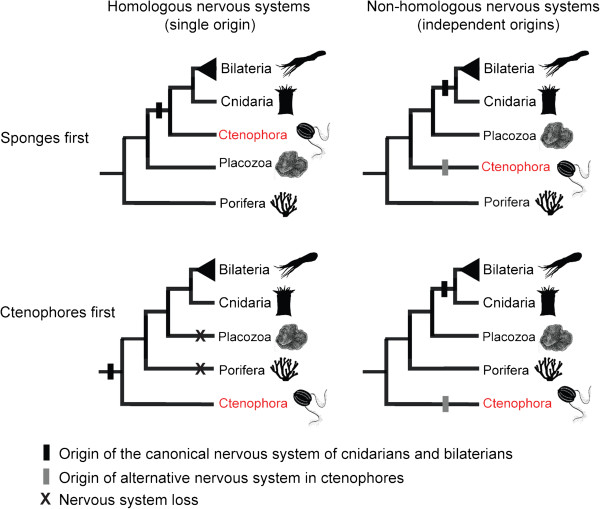
Ctenophores have traditionally been treated as eumetazoans, but some recent whole genome studies have revived the idea that they are, rather, the sister group to all other metazoans. This deep branching position implies either that nervous systems have evolved twice, in Ctenophora and in Eumetazoa, or that an ancestral metazoan nervous system has been lost in sponges and placozoans. We caution, however, that phylogenetic-tree construction artifacts may have placed ctenophores too deep in the metazoan tree. We discuss nervous system origins under these alternative phylogenies and in light of comparative data of ctenophore and eumetazoan nervous systems. We argue that characters like neuropeptide signaling, ciliary photoreceptors, gap junctions and presynaptic molecules are consistent with a shared ancestry of nervous systems. However, if ctenophores are the sister group to all other metazoans, this ancestral nervous system was likely very simple. Further studies are needed to resolve the deep phylogeny of metazoans and to have a better understanding of the early steps of nervous system evolution.
Overview
The claims and statistics of this paper haven’t been checked yet.
Free: it reads the open-access text and checks the first 5 claims that cite a source we can check. Create a free account to check every claim.
Integrity signals
Registry
Cites
Statistics
Figures
Verification
Claims the paper makes
The claims and statistics of this paper haven’t been checked yet.
Free: it reads the open-access text and checks the first 5 claims that cite a source we can check. Create a free account to check every claim.
Claims other papers make about this one
Each is checked against this paper’s own text: does it say what the citing paper says it does?
The cited source says what the claim attributes to it.
In the citing paper
“However, in the ctenophore-sister scenario supported here by deeply conserved syntenies, there are two possible alternatives explaining the evolution of neurons: either complex neural systems arose more than once3,59,62 but were elaborated differently in ctenophores, cnidarians and bilaterians3,4,59, or neuronal cell types were present in the metazoan ancestor but were lost in the sponge lineage4,”
From Ancient gene linkages support ctenophores as sister to other animals (2023) · cites this paper as [3]
The cited source says what the claim attributes to it.
In the citing paper
“Perhaps the most intriguing suite of metazoan characters pertain to neuromuscular systems, which are present in varying complexity in ctenophores, bilaterians, and cnidarians but are absent in sponges3,6,59.”
From Ancient gene linkages support ctenophores as sister to other animals (2023) · cites this paper as [3]
The cited source says what the claim attributes to it.
In the citing paper
“These relationships can be expected to be important to hypotheses about early neural evolution [98,100-103].”
From An option space for early neural evolution (2015) · cites this paper as [98]
The cited source says what the claim attributes to it.
In the citing paper
“Considerable uncertainty remains about the phylogenetic relationships between sponges, ctenophores, placozoa and other nonbilaterian animals [96-99].”
From An option space for early neural evolution (2015) · cites this paper as [98]
The cited source says what the claim attributes to it.
In the citing paper
“This long period of rudimentary nervous system development likely involved the deployment of genes now associated with the nervous system in proto-nervous system tissues, similar to Trichoplax today [13,53,58].”
From Early metazoan life: divergence, environment and ecology (2015) · cites this paper as [13]
1 more claim about this paper
Create a free account to see every claim other papers make about this one.
Self-check
Percentages, sums and reported differences re-computed from the paper’s own numbers.
The self-check needs the paper’s full text.
Citations
Cites
Broad phylogenomic sampling improves resolution of the animal tree of life
Dunn, C. W., Hejnol, A., Matus, D. Q., Pang, K., Browne, W. E., Smith, S. A., Seaver, E., Rouse, G. W., Obst, M., Edgecombe, G. D., et al. (2008) · Nature · doi:10.1038/nature06614 · Cited by 1,921 · cited 2×
“While several phylogenomic analyses [6,7,11,12] support the position of ctenophores as the sister lineage to all other animals, other works considered this branching contentious in light of methodological issues.”
BackgroundResultEvidence for a clade of nematodes, arthropods and other moulting animals
Aguinaldo, A. M. A., Turbeville, J. M., Linford, L. S., Rivera, M. C., Garey, J. R., Raff, R. A., & Lake, J. A. (1997) · Nature · doi:10.1038/387489a0 · Cited by 1,609 · cited 1×
“There is also little hope that wider ctenophore taxon sampling will break this long branch, as was the case for nematodes or acoels [23-25], since the range of ctenophores sampled in the two genome studies already captures the known diversity of the group.”
BackgroundResolving difficult phylogenetic questions: Why more sequences are not enough
Philippe, H., Brinkmann, H., Lavrov, D. V., Littlewood, D. T. J., Manuel, M., Wörheide, G., & Baurain, D. (2011) · PLoS Biology · doi:10.1371/journal.pbio.1000602 · Cited by 1,129 · cited 2×
“Some of these methodological issues have previously been highlighted as potentially affecting the placement of ctenophores [13-16,20], and each of these issues needs to be tackled with different strategies.”
BackgroundThe Amphimedon queenslandica genome and the evolution of animal complexity
Srivastava, M., Simakov, O., Chapman, J., Fahey, B., Gauthier, M. E. A., Mitros, T., Richards, G. S., Conaco, C., Dacre, M., Hellsten, U., et al. (2010) · Nature · doi:10.1038/nature09201 · Cited by 1,049 · cited 1×
“It is to be noted, however, that the presence of neurotransmitter pathways and ‘neuronal’ genes does not necessarily indicate the presence of a nervous system, since both sponges and placozoans contain several such genes, including enzymes in the pathways for making serotonin, dopamine (sponges [35,36]) or noradrenali…”
BackgroundAnimal evolution: interrelationships of the living phyla
(2012) · Choice Reviews Online · doi:10.5860/choice.50-1469 · Cited by 1,039
The Trichoplax genome and the nature of placozoans
Srivastava, M., Begovic, E., Chapman, J., Putnam, N. H., Hellsten, U., Kawashima, T., Kuo, A., Mitros, T., Salamov, A., Carpenter, M. L., et al. (2008) · Nature · doi:10.1038/nature07191 · Cited by 889
Assessing the root of bilaterian animals with scalable phylogenomic methods
Hejnol, A., Obst, M., Stamatakis, A., Ott, M., Rouse, G. W., Edgecombe, G. D., Martinez, P., Baguñà, J., Bailly, X., Jondelius, U., et al. (2009) · Proceedings of the Royal Society B: Biological Sciences · doi:10.1098/rspb.2009.0896 · Cited by 747 · cited 3×
“While several phylogenomic analyses [6,7,11,12] support the position of ctenophores as the sister lineage to all other animals, other works considered this branching contentious in light of methodological issues.”
BackgroundResultEarly origins and evolution of microRNAs and Piwi-interacting RNAs in animals
Grimson, A., Srivastava, M., Fahey, B., Woodcroft, B. J., Chiang, H. R., King, N., Degnan, B. M., Rokhsar, D. S., & Bartel, D. P. (2008) · Nature · doi:10.1038/nature07415 · Cited by 734
The ctenophore genome and the evolutionary origins of neural systems
Moroz, L. L., Kocot, K. M., Citarella, M. R., Dosung, S., Norekian, T. P., Povolotskaya, I. S., Grigorenko, A. P., Dailey, C., Berezikov, E., Buckley, K. M., et al. (2014) · Nature · doi:10.1038/nature13400 · Cited by 716
Phylogenomics Revives Traditional Views on Deep Animal Relationships
Philippe, H., Derelle, R., Lopez, P., Pick, K., Borchiellini, C., Boury-Esnault, N., Vacelet, J., Renard, E., Houliston, E., Quéinnec, E., et al. (2009) · Current Biology · doi:10.1016/j.cub.2009.02.052 · Cited by 695 · cited 3×
“The placement of ctenophores as a sister to all other metazoans was supported by earlier phylogenetic studies [8-12], while other work indicated sponges as the sister lineage to all other metazoans [13-16].”
BackgroundResultRare genomic changes as a tool for phylogenetics
Rokas, A., & Holland, P. W. H. (2000) · Trends in Ecology & Evolution · doi:10.1016/s0169-5347(00)01967-4 · Cited by 689
The Genome of the Ctenophore Mnemiopsis leidyi and Its Implications for Cell Type Evolution
Ryan, J. F., Pang, K., Schnitzler, C. E., Nguyen, A.-D., Moreland, R. T., Simmons, D. K., Koch, B. J., Francis, W. R., Havlak, P., Program, N. C. S., et al. (2013) · Science · doi:10.1126/science.1242592 · Cited by 682
Monophyletic Origins of the Metazoa: an Evolutionary Link with Fungi
Wainright, P. O., Hinkle, G., Sogin, M. L., & Stickel, S. K. (1993) · Science · doi:10.1126/science.8469985 · Cited by 667
Recent Advances in Our Knowledge of the Myxozoa
KENT, M. L., ANDREE, K. B., BARTHOLOMEW, J. L., EL‐MATBOULI, M., DESSER, S. S., DEVLIN, R. H., FEIST, S. W., HEDRICK, R. P., HOFFMANN, R. W., KHATTRA, J., et al. (2001) · Journal of Eukaryotic Microbiology · doi:10.1111/j.1550-7408.2001.tb00173.x · Cited by 627
Ciliary photoreceptors with a vertebrate-type opsin in an invertebrate brain
Arendt, D., Tessmar-Raible, K., Snyman, H., Dorresteijn, A. W., & Wittbrodt, J. (2004) · Science · doi:10.1126/science.1099955 · Cited by 458 · cited 1×
“coupled opsin family [53], members of which are commonly associated with ciliary photoreceptors [54,55].”
Global view of the evolution and diversity of metazoan neuropeptide signaling
Jékely, G. (2013) · Proceedings of the National Academy of Sciences · doi:10.1073/pnas.1221833110 · Cited by 449
Self-citationAcoel Flatworms: Earliest Extant Bilaterian Metazoans, Not Members of Platyhelminthes
Ruiz-Trillo, I., Riutort, M., Littlewood, D. T. J., Herniou, E. A., & Baguñà, J. (1999) · Science · doi:10.1126/science.283.5409.1919 · Cited by 440
Cloning of the amiloride-sensitive FMRFamide peptide-gated sodium channel
Lingueglia, E., Champigny, G., Lazdunski, M., & Barbry, P. (1995) · Nature · doi:10.1038/378730a0 · Cited by 391
Impact of missing data on phylogenies inferred from empirical phylogenomic data sets
Roure, B., Baurain, D., & Philippe, H. (2013) · Molecular Biology and Evolution · doi:10.1093/molbev/mss208 · Cited by 365
Improved phylogenomic taxon sampling noticeably affects nonbilaterian relationships
Pick, K. S., Philippe, H., Schreiber, F., Erpenbeck, D., Jackson, D. J., Wrede, P., Wiens, M., Alie, A., Morgenstern, B., Manuel, M., et al. (2010) · Molecular Biology and Evolution · doi:10.1093/molbev/msq089 · Cited by 334
Mechanism of phototaxis in marine zooplankton
Jékely, G., Colombelli, J., Hausen, H., Guy, K., Stelzer, E., Nédélec, F., & Arendt, D. (2008) · Nature · doi:10.1038/nature07590 · Cited by 298 · cited 1×
“This active behavior is performed more efficiently using neuronal systems in several eumetazoan larvae, yet there is no trace of neuronal connections in the sponge larva [62,63].”
BackgroundSelf-citationGenome-Wide Analyses Reveal a Role for Peptide Hormones in Planarian Germline Development
Collins, J. J., Hou, X., Romanova, E. V., Lambrus, B. G., Miller, C. M., Saberi, A., Sweedler, J. V., & Newmark, P. A. (2010) · PLoS Biology · doi:10.1371/journal.pbio.1000509 · Cited by 289
Simionato, E., Ledent, V., Richards, G., Thomas-Chollier, M., Kerner, P., Coornaert, D., Degnan, B. M., & Vervoort, M. (2007) · BMC Evolutionary Biology · doi:10.1186/1471-2148-7-33 · Cited by 288
Riesgo, A., Farrar, N., Windsor, P. J., Giribet, G., & Leys, S. P. (2014) · Molecular Biology and Evolution · doi:10.1093/molbev/msu057 · Cited by 266 · cited 2×
“identified in both sponges and placozoans [19,36,37], and their numbers have greatly expanded in ctenophores [7].”
BackgroundJékely, G. (2009) · Philosophical Transactions of the Royal Society B Biological Sciences · doi:10.1098/rstb.2009.0072 · Cited by 263 · cited 1×
“This active behavior is performed more efficiently using neuronal systems in several eumetazoan larvae, yet there is no trace of neuronal connections in the sponge larva [62,63].”
BackgroundSelf-citationSchierwater, B., Eitel, M., Jakob, W., Osigus, H.-J., Hadrys, H., Dellaporta, S. L., Kolokotronis, S.-O., & DeSalle, R. (2009) · PLoS Biology · doi:10.1371/journal.pbio.1000020 · Cited by 260
Deep metazoan phylogeny: When different genes tell different stories
Nosenko, T., Schreiber, F., Adamska, M., Adamski, M., Eitel, M., Hammel, J., Maldonado, M., Müller, W. E. G., Nickel, M., Schierwater, B., et al. (2013) · Molecular Phylogenetics and Evolution · doi:10.1016/j.ympev.2013.01.010 · Cited by 254 · cited 3×
“The placement of ctenophores as a sister to all other metazoans was supported by earlier phylogenetic studies [8-12], while other work indicated sponges as the sister lineage to all other metazoans [13-16].”
BackgroundResultSmith, C. L., Varoqueaux, F., Kittelmann, M., Azzam, R. N., Cooper, B., Winters, C. A., Eitel, M., Fasshauer, D., & Reese, T. S. (2014) · Current Biology · doi:10.1016/j.cub.2014.05.046 · Cited by 254 · cited 4×
“Trichoplax has sensory cells [42] and responds to food cues by altering its locomotion pattern [69].”
BackgroundInfluentialMitochondrial genome of Trichoplax adhaerens supports Placozoa as the basal lower metazoan phylum
Dellaporta, S. L., Xu, A., Sagasser, S., Jakob, W., Moreno, M. A., Buss, L. W., & Schierwater, B. (2006) · Proceedings of the National Academy of Sciences · doi:10.1073/pnas.0602076103 · Cited by 252 · cited 1×
“Some previous studies using mitochondrial markers [17,18] pointed to an early split of Trichoplax within a monophyletic Diploblastica clade (Porifera, Placozoa, Ctenophora and Cnidaria).”
Collins, A. G. (1998) · Proceedings of the National Academy of Sciences · doi:10.1073/pnas.95.26.15458 · Cited by 252
Cytological Basis of Photoresponsive Behavior in a Sponge Larva
Leys, S. P., & Degnan, B. M. (2001) · The Biological Bulletin · doi:10.2307/1543611 · Cited by 212 · cited 1×
“The free-swimming ciliated larvae of several sponges perform helical phototaxis, using a specialized ring of pigment-covered lightsensory cells [61].”
BackgroundA novel Go-mediated phototransduction cascade in scallop visual cells
Kojima, D., Terakita, A., Ishikawa, T., Tsukahara, Y., Maeda, A., & Shichida, Y. (1997) · Journal of Biological Chemistry · doi:10.1074/jbc.272.37.22979 · Cited by 198 · cited 1×
“coupled opsin family [53], members of which are commonly associated with ciliary photoreceptors [54,55].”
A placozoan affinity for Dickinsonia and the evolution of late Proterozoic metazoan feeding modes
Sperling, E. A., & Vinther, J. (2010) · Evolution & Development · doi:10.1111/j.1525-142x.2010.00404.x · Cited by 194 · cited 1×
“Trichoplax is also free-living, with active ciliary locomotion and a ventral ciliated surface that functions as a gut with extracellular digestion [68].”
BackgroundA Molecular Phylogenetic Framework for the Phylum Ctenophora Using 18S rRNA Genes
Podar, M., Haddock, S. H. D., Sogin, M. L., & Harbison, G. R. (2001) · Molecular Phylogenetics and Evolution · doi:10.1006/mpev.2001.1036 · Cited by 175 · cited 1×
“The low variability of 18S in ctenophores suggests that their LCA was more modern than those of other animal phyla, perhaps as recent as the Cretaceous-Tertiary (K-T) boundary (66 Mya [22]).”
BackgroundAbouheif, E., Zardoya, R., & Meyer, A. (1998) · Journal of Molecular Evolution · doi:10.1007/pl00006397 · Cited by 167 · cited 1×
“The placement of ctenophores as a sister to all other metazoans was supported by earlier phylogenetic studies [8-12], while other work indicated sponges as the sister lineage to all other metazoans [13-16].”
ResultEvolutionary analyses of gap junction protein families
Abascal, F., & Zardoya, R. (2012) · Biochimica et Biophysica Acta (BBA) - Biomembranes · doi:10.1016/j.bbamem.2012.02.007 · Cited by 162
Impulse conduction in a sponge
Leys, S. P., Mackie, G. O., & Meech, R. W. (1999) · Journal of Experimental Biology · doi:10.1242/jeb.202.9.1139 · Cited by 162
Conserved MIP receptor–ligand pair regulates Platynereis larval settlement
Conzelmann, M., Williams, E. A., Tunaru, S., Randel, N., Shahidi, R., Asadulina, A., Berger, J., Offermanns, S., & Jékely, G. (2013) · Proceedings of the National Academy of Sciences · doi:10.1073/pnas.1220285110 · Cited by 155 · cited 2×
“These gland cells also have a cilium and are putatively sensory, reminiscent of nonsynaptic sensory-neurosecretory cells described in some eumetazoans [43].”
BackgroundSelf-citationStudies on hexactinellid sponges. I. Histology of Rhabdocalyptus dawsoni (Lambe, 1873)
Mackie, G. O., & Singla, C. L. (1983) · Philosophical Transactions of the Royal Society of London. B, Biological Sciences · doi:10.1098/rstb.1983.0028 · Cited by 140
Paps, J., Baguñà, J., & Riutort, M. (2009) · Proceedings of the Royal Society B: Biological Sciences · doi:10.1098/rspb.2008.1574 · Cited by 137
Self-citationSchnitzler, C. E., Pang, K., Powers, M. L., Reitzel, A. M., Ryan, J. F., Simmons, D., Tada, T., Park, M., Gupta, J., Brooks, S. Y., et al. (2012) · BMC Biology · doi:10.1186/1741-7007-10-107 · Cited by 132 · cited 2×
“sponges and placozoans, but like all other groups of metazoans, ctenophores contain opsins [52].”
BackgroundCilia and the life of ctenophores
Tamm, S. L. (2014) · Invertebrate Biology · doi:10.1111/ivb.12042 · Cited by 129
Ludeman, D. A., Farrar, N., Riesgo, A., Paps, J., & Leys, S. P. (2014) · BMC Evolutionary Biology · doi:10.1186/1471-2148-14-3 · Cited by 129
Self-citationGehring, W. J. (2014) · WIREs Developmental Biology · doi:10.1002/wdev.96 · Cited by 127
Richards, G. S., & Rentzsch, F. (2014) · Development · doi:10.1242/dev.112029 · Cited by 110 · cited 1×
“For example, it would be interesting to test using knockout or knockdown approaches whether the neuronally expressed SoxB gene also has an essential role in nervous system development in ctenophores, as recently shown for the cnidarian Nematostella vectensis [57].”
BackgroundJager, M., Chiori, R., Alié, A., Dayraud, C., Quéinnec, E., & Manuel, M. (2011) · Journal of Experimental Zoology Part B: Molecular and Developmental Evolution · doi:10.1002/jez.b.21386 · Cited by 107 · cited 2×
“ctenophore nervous system is organized into an epithelial and a mesogleal nerve net and two parallel nerve cords in the tentacles [1].”
BackgroundElliott, G. R. D., & Leys, S. P. (2010) · Journal of Experimental Biology · doi:10.1242/jeb.039859 · Cited by 106
A peptide-gated ion channel from the freshwater polyp Hydra
Golubovic, A., Kuhn, A., Williamson, M., Kalbacher, H., Holstein, T. W., Grimmelikhuijzen, C. J. P., & Gründer, S. (2007) · Journal of Biological Chemistry · doi:10.1074/jbc.m706849200 · Cited by 101 · cited 1×
“[7] as ASICs, a name reserved for a chordatespecific subfamily of DEG/ENaC channels), a family of ion channels ancestrally gated by neuropeptides [44].”
Bioinformatic prediction of Trichoplax adhaerens regulatory peptides
Nikitin, M. (2015) · General and Comparative Endocrinology · doi:10.1016/j.ygcen.2014.03.049 · Cited by 93
Substantial Loss of Conserved and Gain of Novel MicroRNA Families in Flatworms
Fromm, B., Worren, M. M., Hahn, C., Hovig, E., & Bachmann, L. (2013) · Molecular Biology and Evolution · doi:10.1093/molbev/mst155 · Cited by 92
Evolution: Ctenophore Genomes and the Origin of Neurons
Marlow, H., & Arendt, D. (2014) · Current Biology · doi:10.1016/j.cub.2014.06.057 · Cited by 71 · cited 2×
“The ctenophore genome studies have revealed the presence of specific components of the pre-synapse, notably including five proteins that form the core of active zones in eumetazoan synapses, including the Rab3-RIM-Munc13 complex, ELKS and liprin-alpha proteins [47].”
BackgroundThe Comb Jelly Opsins and the Origins of Animal Phototransduction
Feuda, R., Rota-Stabelli, O., Oakley, T. H., & Pisani, D. (2014) · Genome Biology and Evolution · doi:10.1093/gbe/evu154 · Cited by 70 · cited 1×
“coupled opsin family [53], members of which are commonly associated with ciliary photoreceptors [54,55].”
BackgroundA critical appraisal of the use of microRNA data in phylogenetics
Thomson, R. C., Plachetzki, D. C., Mahler, D. L., & Moore, B. R. (2014) · Proceedings of the National Academy of Sciences · doi:10.1073/pnas.1407207111 · Cited by 65
Lehmann, C., Lechner, H., Löer, B., Knieps, M., Herrmann, S., Famulok, M., Bauer, R., & Hoch, M. (2006) · Molecular Biology of the Cell · doi:10.1091/mbc.e05-11-1059 · Cited by 63
Molecular characterization of the apical organ of the anthozoan Nematostella vectensis
Sinigaglia, C., Busengdal, H., Lerner, A., Oliveri, P., & Rentzsch, F. (2015) · Developmental Biology · doi:10.1016/j.ydbio.2014.11.019 · Cited by 62
Mackie, G. O., Lawn, I. D., & De Ceccatty, M. P. (1983) · Philosophical Transactions of the Royal Society of London. B, Biological Sciences · doi:10.1098/rstb.1983.0029 · Cited by 60
Innexin gap junctions in nerve cells coordinate spontaneous contractile behavior in Hydra polyps
Takaku, Y., Hwang, J. S., Wolf, A., Böttger, A., Shimizu, H., David, C. N., & Gojobori, T. (2014) · Scientific Reports · doi:10.1038/srep03573 · Cited by 59
Ghost Loci Imply Hox and ParaHox Existence in the Last Common Ancestor of Animals
Ramos, O. M., Barker, D., & Ferrier, D. E. K. (2012) · Current Biology · doi:10.1016/j.cub.2012.08.023 · Cited by 59
Maxwell, E. K., Ryan, J. F., Schnitzler, C. E., Browne, W. E., & Baxevanis, A. D. (2012) · BMC Genomics · doi:10.1186/1471-2164-13-714 · Cited by 59
Three homologous subunits form a high affinity peptide-gated ion channel in Hydra
Dürrnagel, S., Kuhn, A., Tsiairis, C. D., Williamson, M., Kalbacher, H., Grimmelikhuijzen, C. J. P., Holstein, T. W., & Gründer, S. (2010) · Journal of Biological Chemistry · doi:10.1074/jbc.m109.059998 · Cited by 58 · cited 1×
“cnidarians and some bilaterians [44-46].”
Did the ctenophore nervous system evolve independently?
Ryan, J. F. (2014) · Zoology · doi:10.1016/j.zool.2014.06.001 · Cited by 55 · cited 1×
“What do these similarities tell us about the origin of nervous systems? Overall, the detailed molecular and cellular similarities are compatible with the single origin of the ctenophore and eumetazoan nervous systems [47,56].”
BackgroundPresumed photoreceptive cilia in a ctenophore
Horridge, G. A. (1964) · Journal of Cell Science · doi:10.1242/jcs.s3-105.71.311 · Cited by 54
Dynamic patterns in the locomotion and feeding behaviors by the placozoan Trichoplax adhaerence
Ueda, T., Koya, S., & Maruyama, Y. K. (1999) · Biosystems · doi:10.1016/s0303-2647(99)00066-0 · Cited by 54
Neurociliary synapses in Pleurobrachia (Ctenophora)
Horridge, G. A., & Mackay, B. (1964) · Journal of Cell Science · doi:10.1242/jcs.s3-105.70.163 · Cited by 54
Høeg, J. T. (1987) · Zoomorphology · doi:10.1007/bf00312176 · Cited by 44
Giant Axons and Escape Swimming in Euplokamis dunlapae (Ctenophora: Cydippida)
Mackie, G. O., Mills, C. E., & Singla, C. L. (1992) · The Biological Bulletin · doi:10.2307/1542118 · Cited by 40
Animal Evolution: Looking for the First Nervous System
Jørgensen, E. M. (2014) · Current Biology · doi:10.1016/j.cub.2014.06.036 · Cited by 34
Anctil, M. (1985) · Journal of Experimental Biology · doi:10.1242/jeb.119.1.225 · Cited by 22
Ovsepian, S. V., & Vesselkin, N. P. (2014) · Reviews in the Neurosciences · doi:10.1515/revneuro-2014-0037 · Cited by 21
E value cutoff and eukaryotic genome content phylogenetics
Rosenfeld, J., & DeSalle, R. (2012) · Molecular Phylogenetics and Evolution · doi:10.1016/j.ympev.2012.01.003 · Cited by 16
Cited by
Simion, P., Philippe, H., Baurain, D., Jager, M., Richter, D. J., Di Franco, A., Roure, B., Satoh, N., Quéinnec, É., Ereskovsky, A., et al. (2017) · Current Biology · doi:10.1016/j.cub.2017.02.031 · Cited by 518
Ancient gene linkages support ctenophores as sister to other animals
Schultz, D. T., Haddock, S. H. D., Bredeson, J. V., Green, R. E., Simakov, O., & Rokhsar, D. S. (2023) · Nature · doi:10.1038/s41586-023-05936-6 · Cited by 362
Genomic data do not support comb jellies as the sister group to all other animals
Pisani, D., Pett, W., Dohrmann, M., Feuda, R., Rota-Stabelli, O., Philippe, H., Lartillot, N., & Wörheide, G. (2015) · Proceedings of the National Academy of Sciences · doi:10.1073/pnas.1518127112 · Cited by 319
Improved Modeling of Compositional Heterogeneity Supports Sponges as Sister to All Other Animals
Feuda, R., Dohrmann, M., Pett, W., Philippe, H., Rota-Stabelli, O., Lartillot, N., Wörheide, G., & Pisani, D. (2017) · Current Biology · doi:10.1016/j.cub.2017.11.008 · Cited by 291
Ctenophore relationships and their placement as the sister group to all other animals
Whelan, N. V., Kocot, K. M., Moroz, T. P., Mukherjee, K., Williams, P., Paulay, G., Moroz, L. L., & Halanych, K. M. (2017) · Nature Ecology & Evolution · doi:10.1038/s41559-017-0331-3 · Cited by 263
Metadata
- Authors
- Jákely, G., Paps, J., & Nielsen, C.
- Affiliations
- University of Oxford (GB)
- University of Copenhagen (DK)
- Corresponding author
- Nielsen, Claus
- Venue
- EvoDevo
- Published
- 2015
- Volume
- 6
- Issue
- 1
- Pages
- 1
- ISSN
- 2041-9139 (ISSN-L)
- PMC
- PMC4406211
- OpenAlex
- W2139360357
- Semantic Scholar
- f9fb21b081d16b3beb678b13362b307b2661d846
- Cited by
- 189
- References
- 70
- Citations by year
- 2026: 4 · 2025: 7 · 2024: 10 · 2023: 9 · 2022: 14 · 2021: 16 · 2020: 15 · 2019: 20 · 2018: 24 · 2017: 26 · 2016: 27 · 2015: 17
- FWCI
- 3.95
- Type
- journal article
- Language
- en
- Open access
- gold
- doi.org
- Licence
- cc-by
- Locations
- EvoDevo (publishedVersion, cc-by)
- PubMed Central (publishedVersion, cc-by)
- PubMed (publishedVersion)
- Research at the University of Copenhagen (University of Copenhagen) (publishedVersion, other-oa)
- Bristol Research (University of Bristol) (publishedVersion)
- Open Access at Essex (University of Essex) (acceptedVersion)
- Figshare (submittedVersion, cc-by)
- Open Research Exeter (University of Exeter) (submittedVersion, cc-by)
- Funders
- Brown University
- University of Alberta
- University College London
- European Commission (2007–2013, FP7 2007-2013, 260821, FP7/2007)
- FP7 Ideas: European Research Council (260821)
- Topics
- Life Sciences › Agricultural and Biological Sciences › Animal Science and Zoology › Marine Invertebrate Physiology and Ecology
- Life Sciences › Biochemistry, Genetics and Molecular Biology › Molecular Biology › Developmental Biology and Gene Regulation
- Life Sciences › Biochemistry, Genetics and Molecular Biology › Molecular Biology › Planarian Biology and Electrostimulation
- Keywords
- ctenophores, nervous system evolution, metazoan phylogeny, placozoans, neuropeptide signaling, ciliary photoreceptors, gap junctions
About these checks
Registry, retraction, Cites and statistics results are computed, not judged, with one exception: a printed reference that no index lists is read once by a model before it counts as a citation error. Claims are extracted by a model and kept only when their quote appears verbatim in the text; each cited source is then checked, with a model’s help, for whether it says what the claim relies on. Those verdicts can be wrong — read the claim’s quote and the cited source before relying on one.
Statistics and arithmetic are recomputed, not judged.
Confidence bands are shown only for fields calibrated on our annotated test set. None is calibrated yet, so no band is shown.
What counts as a claim ›How we measure confidence ›How we check this ›
Are you an author, or do you see a problem with this page? Request a review
Data sources
Bibliographic data: Semantic Scholar, OpenAlex, Crossref.
Contains information from the Semantic Scholar Academic Graph Datasets, made available under the ODC Attribution License (ODC-BY 1.0).
Semantic Scholar’s data is described in: Kinney, R., et al. (2023). The Semantic Scholar Open Data Platform. arXiv:2301.10140.
