

Frontostriatal functional connectivity in major depressive disorder
Open accessThe DOI matches its Crossref record; 55 of the 55 references it cites were found in a registry or an index.
Abstract
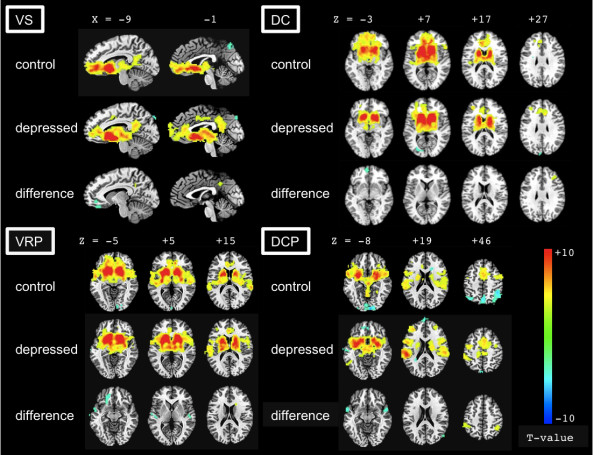
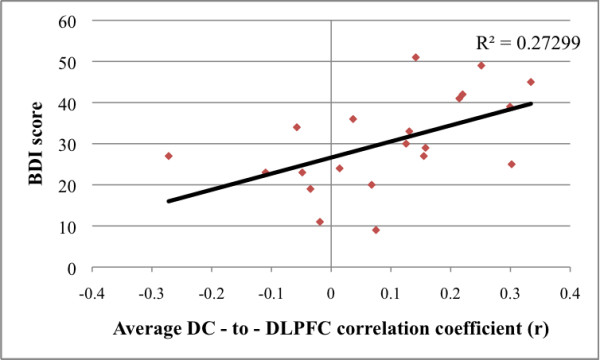
BACKGROUND: Abnormalities of the striatum and frontal cortex have been reported consistently in studies of neural structure and function in major depressive disorder (MDD). Despite speculation that compromised connectivity between these regions may underlie symptoms of MDD, little work has investigated the integrity of frontostriatal circuits in this disorder. METHODS: Functional magnetic resonance images were acquired from 21 currently depressed and 19 never-disordered women during wakeful rest. Using four predefined striatal regions-of-interest, seed-to-whole brain correlations were computed and compared between groups. RESULTS: Compared to controls, depressed participants exhibited attenuated functional connectivity between the ventral striatum and both ventromedial prefrontal cortex and subgenual anterior cingulate cortex. Depressed participants also exhibited stronger connectivity between the dorsal caudate and dorsal prefrontal cortex, which was positively correlated with severity of the disorder. CONCLUSIONS: Depressed individuals are characterized by aberrant connectivity in frontostriatal circuits that are posited to support affective and cognitive processing. Further research is required to examine more explicitly the link between patterns of disrupted connectivity and specific symptoms of depression, and the extent to which these patterns precede the onset of depression and normalize with recovery from depressive illness.
Overview
The claims and statistics of this paper haven’t been checked yet.
Free: it reads the open-access text and checks the first 5 claims that cite a source we can check. Create a free account to check every claim.
Integrity signals
Registry
Cites
Statistics
Figures
Verification
Claims the paper makes
The claims and statistics of this paper haven’t been checked yet.
Free: it reads the open-access text and checks the first 5 claims that cite a source we can check. Create a free account to check every claim.
Claims other papers make about this one
Each is checked against this paper’s own text: does it say what the citing paper says it does?
The source backs part of the claim, not all of it — or backs it for a different population, condition or comparison.
In the citing paper
“Depressed patients show an attenuated activation of the VTA-NAc pathway or the NAc itself when compared to normal patients in fMRI analyses (Epstein et al. 2006; Furman et al. 2011; Pizzagalli et al. 2009; Smoski et al. 2009).”
From Neurotrophic factors and neuroplasticity pathways in the pathophysiology and treatment of depression (2018) · cites this paper as Furman et al. 2011
Experimental — accuracy not yet measuredThe source backs part of the claim, not all of it — or backs it for a different population, condition or comparison.
In the citing paper
“Furthermore, depression severity was positively correlated with functional connectivity between frontolimbic regions (18,19).”
From Relation Between Structural and Functional Connectivity in Major Depressive Disorder (2013) · cites this paper as [18]
Experimental — accuracy not yet measuredThe source backs part of the claim, not all of it — or backs it for a different population, condition or comparison.
In the citing paper
“In line with these results both task-based and resting state studies reported abnormal functional connectivity within the frontolimbic network (4,6,17,18,55-57).”
From Relation Between Structural and Functional Connectivity in Major Depressive Disorder (2013) · cites this paper as [18]
Experimental — accuracy not yet measuredThe source backs part of the claim, not all of it — or backs it for a different population, condition or comparison.
In the citing paper
“The dlPFC primarily projects to the dorsolateral caudate to serve cognitive control and executive functioning (Furman et al., 2011), while the thalamic MDN supports cortico-striatal-cortical information transfer and modulates cortical activity through extensive connections with the PFC and midbrain dopaminergic regions (Mitchell, 2015).”
From Cortico-striatal-thalamic loop circuits of the salience network: A central pathway in psychiatric disease and treatment (2016) · cites this paper as Furman et al., 2011
Experimental — accuracy not yet measuredThe source backs part of the claim, not all of it — or backs it for a different population, condition or comparison.
In the citing paper
“For example, sgACC connectivity with limbic, thalamic, and striatal regions has been strongly implicated in the maladaptive emotion regulation underlying depression (Davey et al, 2012; Furman et al, 2011; Giacobbe et al, 2009; Lui et al, 2011)”
From Resting-state cortico-thalamic-striatal connectivity predicts response to dorsomedial prefrontal rTMS in major depressive disorder (2014) · cites this paper as Furman et al, 2011
Experimental — accuracy not yet measured
5 more claims about this paper
Create a free account to see every claim other papers make about this one.
Self-check
Percentages, sums and reported differences re-computed from the paper’s own numbers.
The self-check needs the paper’s full text.
Citations
Cites
A default mode of brain function
Raichle, M. E., MacLeod, A. M., Snyder, A. Z., Powers, W. J., Gusnard, D. A., & Shulman, G. L. (2001) · Proceedings of the National Academy of Sciences · doi:10.1073/pnas.98.2.676 · Cited by 12,190 · cited 5×
“The DMN, composed of medial frontal, lateral and medial parietal, as well as temporal lobe regions, has been implicated broadly in self-referential processing [49].”
InfluentialParallel organization of functionally segregated circuits linking basal ganglia and cortex
Alexander, G. E., DeLong, M. R., & Strick, P. L. (1986) · Annual Review of Neuroscience · doi:10.1146/annurev.ne.09.030186.002041 · Cited by 8,527 · cited 3×
“In general, these divisions along the ventral-dorsal axis of the striatum are posited to be relatively segregated, thereby differentially supporting affective, cognitive, and motor processing [8].”
The reward circuit: linking primate anatomy and human imaging
Haber, S. N., & Knutson, B. (2010) · Neuropsychopharmacology · doi:10.1038/npp.2009.129 · Cited by 3,718 · cited 1×
“Patterns of connectivity in both control and depressed participants were consistent with the results of previous studies [14]; importantly, however, striking differences between the depressed and non-depressed participants were detected in networks that have been implicated in affective and motivational processing [28…”
Nolen-Hoeksema, S., & Morrow, J. (1991) · Journal of Personality and Social Psychology · doi:10.1037/0022-3514.61.1.115 · Cited by 3,276
Gusnard, D. A., Akbudak, E., Shulman, G. L., & Raichle, M. E. (2001) · Proceedings of the National Academy of Sciences · doi:10.1073/pnas.071043098 · Cited by 2,997 · cited 2×
“Activity across the various nodes of this network is reduced during periods of non-self-referential processing, such as those that occur during the performance of demanding cognitive tasks [48,49].”
Toward discovery science of human brain function
Biswal, B. B., Mennes, M., Zuo, X.-N., Gohel, S., Kelly, C., Smith, S. M., Beckmann, C. F., Adelstein, J. S., Buckner, R. L., Colcombe, S., et al. (2010) · Proceedings of the National Academy of Sciences · doi:10.1073/pnas.0911855107 · Cited by 2,970 · cited 1×
“Previous investigators have demonstrated the feasibility of pooling data with varying acquisition parameters from multiple studies [23].”
Subgenual prefrontal cortex abnormalities in mood disorders
Drevets, W. C., Price, J. L., Simpson, J. R., Todd, R. D., Reich, T., Vannier, M., & Raichle, M. E. (1997) · Nature · doi:10.1038/386824a0 · Cited by 2,693 · cited 1×
“Functional [29], metabolic [34], and volumetric [34,35] anomalies involving the sACC are often reported in studies of MDD.”
THE BASAL GANGLIA: FOCUSED SELECTION AND INHIBITION OF COMPETING MOTOR PROGRAMS
MINK, J. W. (1996) · Progress in Neurobiology · doi:10.1016/s0301-0082(96)00042-1 · Cited by 2,486 · cited 1×
“Whereas the PFC is generally thought to serve central control or goal representation functions, investigators have argued that CSPT circuitry aids in the filtering and focusing of cortical input, selecting among potential cognitive and behavioral representations [5,6].”
Cognition and Depression: Current Status and Future Directions
Gotlib, I. H., & Joormann, J. (2010) · Annual Review of Clinical Psychology · doi:10.1146/annurev.clinpsy.121208.131305 · Cited by 2,420 · cited 1×
“Individuals diagnosed with MDD also often exhibit psychomotor retardation and deficits in executive function, typically reflected by difficulties concentrating, making decisions, and terminating the processing of negative material [2].”
Self-citationGender differences in depression: Critical review
Piccinelli, M., & Wilkinson, G. (2000) · British Journal of Psychiatry · doi:10.1192/bjp.177.6.486 · Cited by 2,376
Research works printed but not linked: 2
- 20. Beck AT, Steer RA, Brown GK: Manual for the Beck Depression Inventory-II San Antonio, TX: Psychological Corporation; 1996.
- 38. Furman et al. Biology of Mood & Anxiety Disorders 2011, 1:11 http://www.biolmoodanxietydisord.com/content/1/1/11
Cited by
Items 201–236 of 236
Cortical–Subcortical Interactions in the Pathophysiology of Depression
Lee, K. S., & Lee, S. (2017) · Springer eBooks · doi:10.1007/978-981-10-6580-4_13
Alexander, L. (2019) · Apollo (University of Cambridge) · doi:10.17863/cam.35720
Aberrant resting-state functional networks in depression
Xu, X., Ying, F., Lei, K., Luo, Y., & Li, Z. (2019) · Scientia Sinica Vitae · doi:10.1360/n052018-00251
Mood, immunity and brain connectivity in patients with chronic hepatitis c
Oriolo, G. (2019) · Dipòsit Digital de la Universitat de Barcelona (Universitat de Barcelona)
Functional and Structural Neuroplasticity in Depression
Alders, G. L. (2019) · MacSphere (McMaster University) · doi:10.71548/18202
Glukose vermittelte Modulation der Aktivierung Salienz kodierender Gehirnregionen
Stauß, P. S. (2020) · OPen Access Repositorium der Universität Ulm (OPARU) (Ulm University) · doi:10.18725/oparu-33341
Current Connections: Brain patterns in Electroconvulsive Therapy
Mulders, P. C. R. (2020) · Radboud Repository (Radboud University)
Wang, X., & Raizada, R. D. S. (2018) · UR Research (University of Rochester)
Godot is not coming: when we will let innovations enter psychiatry?Preprint
Čukić, M. (2021) · arXiv (Cornell University) · doi:10.48550/arxiv.2110.12873
“Furman et al (2011) reported the aberrated frontostriatal functional connectivity in major depressive disorder (MDD) [51] , and Horn (2010) reported the correlation between functional connectivity of pregenual anterior cingulate cortex (pgACC) and severity of anhedonia in MDD [52] .”
BackgroundBarakat, M., Shamseddeen, W. A., Hanna, E., Dirani, L. A., Brent, D. A., Porta, G., & Maalouf, F. T. (2024) · Middle East Current Psychiatry · doi:10.1186/s43045-024-00413-w
“…showed reduced activation in the right dorsolateral and anterior cingulate gyrus when performing relevant tasks compared to healthy controls [21] and reduced connectivity between the prefrontal cortex and neural circuits that respond to positive and negative emotional information [18, 48].”
BackgroundGál, B. I. (2025) · SZTE Repository of Dissertations (University of Szeged) · doi:10.14232/phd.12299
Neuroimaging in Psychiatry 2023: Mood Disorders
(2025) · Frontiers research topics · doi:10.3389/978-2-8325-6998-6
Li, J., Sun, S., Yu, L., Chen, J., Wu, J. Y., Xie, R., Huang, Y., Ping, L., & You, Z. (2025) · Asian Journal of Psychiatry · doi:10.1016/j.ajp.2025.104785
Cognitive Modeling of high-level cognition through Discrete State Dynamic processes
D'Alessandro, M. (2021) · Iris (University of Trento) · doi:10.15168/11572_290039
Role of adenosine receptors in suicide
Xavier, A. C. G. D. A. (2014) · Portuguese National Funding Agency for Science, Research and Technology (RCAAP Project by FCT)
�슦�슱利� �솚�옄�쓽 諛섎났�쟻 寃쎈몢媛� �옄湲곗옄洹�(rTMS)�쓽 移섎즺 �슚怨쇱� 湲곕뒫�쟻 �뇤 �뿰寃곗꽦�쓽 蹂��솕�쓽 �뿰愿��꽦
源��옱誘� (2013) · YUHSpace (Yonsei University Medical Library)
Mapping neural function in DCC mutation carriers
Vosberg, D. E. (2019) · eScholarship@McGill (McGill) · doi:10.82308/18707
Strack, J., Merz, E. C., Thomas, M., Seger, C. A., & Lucas‐Thompson, R. G. (2023) · Digital Collections of Colorado (Colorado State University) · doi:10.25675/3.02749
Objektivizacija ocene obraznih izrazov pri parkinsonovi bolezni in depresiji
Matić, T. (2026) · Repository of the University of Ljubljana (University of Ljubljana)
Gu, Y., Wang, Y.-X., Xia, W.-J., & Wang, J. (2026) · World Journal of Psychiatry · doi:10.5498/wjp.v16.i3.114153
Deco, G., & Kringelbach, M. L. (2026) · Oxford University Press eBooks · doi:10.1093/oso/9780198991250.003.0008
Epigenetic regulation of BDNF-TRKB signaling in the pathophysiology and treatment of mood disorders
Boulle, F. (2013) · theses.fr (ABES) · doi:10.70675/7796cc83z9f91z48c6zadb1zb6a90897b5d5
“Depressed patients show an attenuated activation of the VTA-NAc pathway or the NAc itself when compared to normal patients using fMRI analysis (Epstein et al., 2006; Furman et al., 2011; Pizzagalli et al., 2009; Smoski et al., 2009).”
ResultShaikh, U. J. (2026) · RWTH Publications (RWTH Aachen) · doi:10.18154/rwth-2026-02859
Wang, X., Wang, P., Niu, M., Yangyang, C., Almulla, A. F., Chen, C., Li, J., Zhang, Y., & Maes, M. H. J. (2026) · Journal of Affective Disorders · doi:10.1016/j.jad.2026.121840
Chen, S., Cao, Y., Li, J., Kong, L., He, J., Yuan, F., & Zhu, X. (2026) · Progress in Neuro-Psychopharmacology and Biological Psychiatry · doi:10.1016/j.pnpbp.2026.111822
de Havenon, A., Wong, K., Mananah, M., Anderson, C. D., Fenick, A. M., Arnsten, A. F. T., Fesharaki‐Zadeh, A., McPartland, J. C., Adams, M. L., & Sheth, K. N. (2026) · Annals of Clinical and Translational Neurology · doi:10.1002/acn3.70464
Bae, J., & Im, H. (2026) · Neurobiology of Disease · doi:10.1016/j.nbd.2026.107581
Yin, Y., Zhou, Y., Ren, L., Xie, C., Zhang, H., Zhang, H., Kong, Y., & Yuan, Y. (2026) · Journal of Affective Disorders · doi:10.1016/j.jad.2026.122344
Wen, X., Han, B., Zhang, J., Gao, Y., Fengge, Y., Dou, F., Hao, Z., Li, H., & Hou, G. (2026) · Journal of Affective Disorders · doi:10.1016/j.jad.2026.122383
Qi, Z., Chen, P., Chen, G., Luo, Z., Zhang, S., Jiang, L., Tang, G., Huang, L., Tao, Q., & Wang, Y. (2026) · PLOS Digital Health · doi:10.1371/journal.pdig.0001665
“Furman [23] linked cytokine-induced mood alterations to connectivity between the nucleus accumbens and ACC.”
Qin, H., Hong, G., Ma, D., Wang, Z., Zhao, L., Li, W., & Xu, X. (2026) · CNS Neuroscience & Therapeutics · doi:10.1002/cns.71158
“L) form fronto- striatal-thalamic circuits involved in reward processing and action selection, where abnormal morphology and connectivity have been reported in depressed patients [37, 38].”
Functional connectivity during smooth pursuit eye movements in major depressive disorder
Piwkowski, P., Duschek, S., Dohrenbusch, R., Trautner, P., Philipsen, A., & Ettinger, U. (2026) · Psychiatry Research · doi:10.1016/j.psychres.2026.117534
Miyamoto, J., & Yoshiura, T. (2026) · Neurology and Clinical Neuroscience · doi:10.1002/ncn3.70175
Jackson, T. B., & Bernard, J. A. (2022) · doi:10.3389/fnbeh.2022.953303.s001
Lian, J., Luo, Y., Zheng, M., Zhang, J., Liang, J., Wen, J., & Guo, X. (2022) · doi:10.3389/fnins.2021.736426.s002
Metadata
- Authors
- Furman, D. J., Hamilton, J. P., & Gotlib, I. H.
- Affiliations
- Stanford University (US)
- Corresponding author
- Furman, Daniella J
- Venue
- Biology of Mood & Anxiety Disorders
- Published
- 2011-12
- Volume
- 1
- Issue
- 1
- Pages
- 11-11
- ISSN
- 2045-5380 (ISSN-L)
- PMC
- PMC3384258
- OpenAlex
- W2108891761
- Cited by
- 208
- References
- 55
- Citations by year
- 2026: 12 · 2025: 15 · 2024: 18 · 2023: 14 · 2022: 16 · 2021: 17 · 2020: 14 · 2019: 15 · 2018: 20 · 2017: 12 · 2016: 13 · 2015: 16 · 2014: 12 · 2013: 14
- FWCI
- 4.22
- Type
- journal article
- Language
- en
- Open access
- hybrid
- doi.org
- Licence
- cc-by
- creativecommons.org/licenses/by/2.0 (tdm)
- Locations
- Biology of Mood & Anxiety Disorders (publishedVersion, cc-by)
- Europe PMC (PubMed Central) (publishedVersion, cc-by)
- PubMed Central (publishedVersion, cc-by)
- PubMed (publishedVersion)
- Funders
- National Institute of Mental Health (MH59259, Grant MH59259)
- Topics
- Life Sciences › Neuroscience › Cognitive Neuroscience › Functional Brain Connectivity Studies
- Life Sciences › Neuroscience › Cognitive Neuroscience › Neural and Behavioral Psychology Studies
- Health Sciences › Medicine › Pharmacology (medical) › Treatment of Major Depression
- Keywords
- major depressive disorder, frontostriatal circuits, functional connectivity, ventral striatum, ventromedial prefrontal cortex, subgenual anterior cingulate cortex, dorsal caudate, dorsal prefrontal cortex, depression severity, women
About these checks
Registry, retraction, Cites and statistics results are computed, not judged, with one exception: a printed reference that no index lists is read once by a model before it counts as a citation error. Claims are extracted by a model and kept only when their quote appears verbatim in the text; each cited source is then checked, with a model’s help, for whether it says what the claim relies on. Those verdicts can be wrong — read the claim’s quote and the cited source before relying on one.
Statistics and arithmetic are recomputed, not judged.
Confidence bands are shown only for fields calibrated on our annotated test set. None is calibrated yet, so no band is shown.
What counts as a claim ›How we measure confidence ›How we check this ›
Are you an author, or do you see a problem with this page? Request a review
Data sources
Bibliographic data: Semantic Scholar, OpenAlex, Crossref.
Contains information from the Semantic Scholar Academic Graph Datasets, made available under the ODC Attribution License (ODC-BY 1.0).
Semantic Scholar’s data is described in: Kinney, R., et al. (2023). The Semantic Scholar Open Data Platform. arXiv:2301.10140.
