

The DOI matches its Crossref record; 140 of the 140 references it cites were found in a registry or an index.
Mapping anhedonia onto reinforcement learning: a behavioural meta-analysis
Open accessAbstract
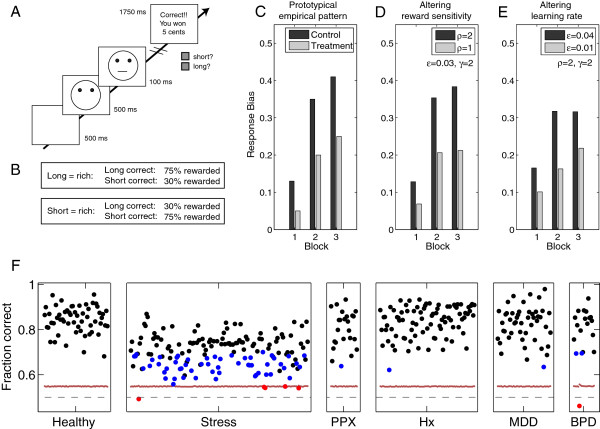
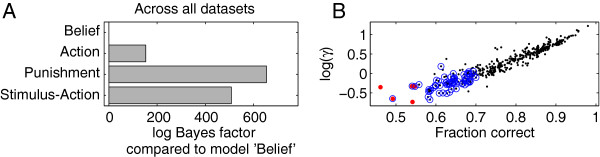
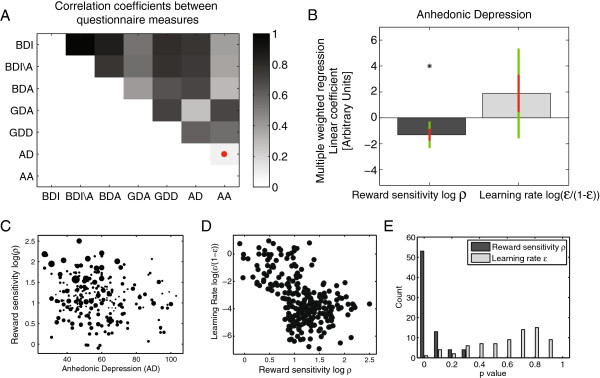
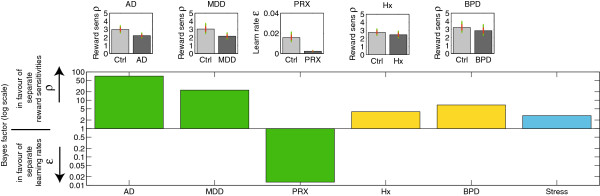
BACKGROUND: Depression is characterised partly by blunted reactions to reward. However, tasks probing this deficiency have not distinguished insensitivity to reward from insensitivity to the prediction errors for reward that determine learning and are putatively reported by the phasic activity of dopamine neurons. We attempted to disentangle these factors with respect to anhedonia in the context of stress, Major Depressive Disorder (MDD), Bipolar Disorder (BPD) and a dopaminergic challenge. METHODS: Six behavioural datasets involving 392 experimental sessions were subjected to a model-based, Bayesian meta-analysis. Participants across all six studies performed a probabilistic reward task that used an asymmetric reinforcement schedule to assess reward learning. Healthy controls were tested under baseline conditions, stress or after receiving the dopamine D2 agonist pramipexole. In addition, participants with current or past MDD or BPD were evaluated. Reinforcement learning models isolated the contributions of variation in reward sensitivity and learning rate. RESULTS: MDD and anhedonia reduced reward sensitivity more than they affected the learning rate, while a low dose of the dopamine D2 agonist pramipexole showed the opposite pattern. Stress led to a pattern consistent with a mixed effect on reward sensitivity and learning rate. CONCLUSION: Reward-related learning reflected at least two partially separable contributions. The first related to phasic prediction error signalling, and was preferentially modulated by a low dose of the dopamine agonist pramipexole. The second related directly to reward sensitivity, and was preferentially reduced in MDD and anhedonia. Stress altered both components. Collectively, these findings highlight the contribution of model-based reinforcement learning meta-analysis for dissecting anhedonic behavior.
Overview
The claims and statistics of this paper haven’t been checked yet.
Run the check — free, no account needed. It reads the open-access text and checks the sources it cites.
Integrity signals
Registry
Cites
Statistics
Figures
Verification
Claims the paper makes
The claims and statistics of this paper haven’t been checked yet.
Run the check — free, no account needed. It reads the open-access text and checks the sources it cites.
Claims other papers make about this one
Each is checked against this paper’s own text: does it say what the citing paper says it does?
In the citing paper
“Their study was consistent with evidence that reward sensitivity and not learning rates are reduced in anhedonic depression (Huys et al., 2013; Chen et al., 2015).”
From The orbitofrontal cortex: reward, emotion and depression (2020) · cites this paper as Huys et al., 2013
Self-check
Percentages, sums and reported differences re-computed from the paper’s own numbers.
The self-check needs the paper’s full text.
Citations
Cites
Diagnostic and Statistical Manual of Mental Disorders
Williams, J. B. W., & First, M. B. (2013) · Oxford University Press eBooks · doi:10.1093/acrefore/9780199975839.013.104 · Cited by 109,845
Maximum Likelihood from Incomplete Data Via the EM Algorithm
Dempster, A. P., Laird, N. M., & Rubin, D. B. (1977) · Journal of the Royal Statistical Society Series B: Statistical Methodology · doi:10.1111/j.2517-6161.1977.tb01600.x · Cited by 50,444
Hamilton, M. (1960) · Journal of Neurology, Neurosurgery & Psychiatry · doi:10.1136/jnnp.23.1.56 · Cited by 32,817
Gelman, A., Carlin, J. B., Stern, H. S., & Rubin, D. B. (2003) · doi:10.1201/9780429258480 · Cited by 27,276
Reinforcement Learning: An Introduction
Sutton, R. S., & Barto, A. G. (1998) · IEEE Transactions on Neural Networks · doi:10.1109/tnn.1998.712192 · Cited by 27,225
Reinforcement Learning: An Introduction
Sutton, R. S., & Barto, A. (2005) · IEEE Transactions on Neural Networks · doi:10.1109/tnn.2004.842673 · Cited by 25,268
Advances in neural information processing systems 7
Cios, K. J., & Shields, M. E. (1997) · Neurocomputing · doi:10.1016/s0925-2312(97)90018-7 · Cited by 22,093
Kass, R. E., & Raftery, A. E. (1995) · Journal of the American Statistical Association · doi:10.1080/01621459.1995.10476572 · Cited by 12,558
(1966) · Medical Entomology and Zoology · Cited by 10,293
A Rating Scale for Mania: Reliability, Validity and Sensitivity
Young, R. C., Biggs, J. T., Ziegler, V. E., & Meyer, D. A. (1978) · British Journal of Psychiatry · doi:10.1192/bjp.133.5.429 · Cited by 8,744
Research works printed but not linked: 3
- Beck A, Steer R, Brown G: Manual for the Beck Depression Inventory-II. 1996, San Antonio: Psychological Corporation
- Daw N: Decision Making, Affect, and Learning: Attention and Performance XXIII. Edited by: Delgado MR, Phelps EA, Robbins TW. 2009, OUP
- Dutra S, Brooks N, Lempert K, Guardado A, Goetz E, Pizzagalli D: Reward responsiveness in a remitted depressed sample: Effects of gender and trait negative affect. 23rd Annual Meeting of the Society for Research in Psychopathology. 2009, Minneapolis:
Cited by
Sorted by citations
Computational psychiatry as a bridge from neuroscience to clinical applications
Huys, Q. J. M., Maia, T. V., & Frank, M. J. (2016) · Nature Neuroscience · doi:10.1038/nn.4238 · Cited by 1,002
Self-citationNeuroscience of apathy and anhedonia: a transdiagnostic approach
Husain, M., & Roiser, J. P. (2018) · Nature reviews. Neuroscience · doi:10.1038/s41583-018-0029-9 · Cited by 682
Reward Processing in Depression: A Conceptual and Meta-Analytic Review Across fMRI and EEG Studies
Keren, H., O’Callaghan, G., Vidal-Ribas, P., Buzzell, G. A., Brotman, M. A., Leibenluft, E., Pan, P. M., Meffert, L., Kaiser, A., Wolke, S., et al. (2018) · American Journal of Psychiatry · doi:10.1176/appi.ajp.2018.17101124 · Cited by 521
The orbitofrontal cortex: reward, emotion and depression
Rolls, E. T., Cheng, W., & Feng, J. (2020) · Brain Communications · doi:10.1093/braincomms/fcaa196 · Cited by 474
The neurobiology of interoception in health and disease
Quadt, L., Critchley, H., & Garfinkel, S. N. (2018) · Annals of the New York Academy of Sciences · doi:10.1111/nyas.13915 · Cited by 488
Metadata
- Authors
- Huys, Q. J., Pizzagalli, D. A., Bogdan, R., & Dayan, P.
- Affiliations
- Gatsby Computational Neuroscience Unit (GB)
- Harvard University (US)
- Duke University (US)
- Corresponding author
- Huys, Quentin JM
- Venue
- Biology of Mood & Anxiety Disorders
- Published
- 2013-06-19
- Volume
- 3
- Issue
- 1
- Pages
- 12-12
- ISSN
- 2045-5380 (ISSN-L)
- PMC
- PMC3701611
- OpenAlex
- W2157813419
- Cited by
- 480
- References
- 139
- Citations by year
- 2026: 27 · 2025: 42 · 2024: 35 · 2023: 54 · 2022: 50 · 2021: 57 · 2020: 78 · 2019: 20 · 2018: 35 · 2017: 38 · 2016: 14 · 2015: 19 · 2014: 9 · 2013: 2
- FWCI
- 7.20
- Type
- journal article
- Language
- en
- Open access
- hybrid
- doi.org
- Licence
- Locations
- Biology of Mood & Anxiety Disorders (publishedVersion, cc-by)
- Europe PMC (PubMed Central) (publishedVersion, cc-by)
- PubMed Central (publishedVersion, cc-by)
- PubMed (publishedVersion)
- Zurich Open Repository and Archive (University of Zurich) (acceptedVersion, other-oa)
- Digital Access to Scholarship at Harvard (DASH) (Harvard University) (submittedVersion, cc-by)
- UCL Discovery (University College London) (submittedVersion)
- MPG.PuRe (Max Planck Society) (submittedVersion)
- Repository for Publications and Research Data (ETH Zurich) (submittedVersion, cc-by)
- Zurich Open Repository and Archive (University of Zurich) (submittedVersion, cc-by)
- ETH Zürich Research Collection
- Zurich Open Repository and Archive (University of Zurich)
- Funders
- AstraZeneca
- Gatsby Charitable Foundation
- Deutsche Forschungsgemeinschaft
- Servier
- National Institute of Mental Health (R01MH101521, R01MH095809, MH095809, R01MH068376, R21MH078979, MH068376)
- National Center for Complementary and Integrative Health (R21AT002974)
- Topics
- Life Sciences › Neuroscience › Cellular and Molecular Neuroscience › Neurotransmitter Receptor Influence on Behavior
- Life Sciences › Neuroscience › Cognitive Neuroscience › Neural and Behavioral Psychology Studies
- Social Sciences › Psychology › Experimental and Cognitive Psychology › Anxiety, Depression, Psychometrics, Treatment, Cognitive Processes
- Keywords
- anhedonia, reinforcement learning, reward sensitivity, prediction error, dopamine, pramipexole, major depressive disorder, bipolar disorder, stress, learning rate, probabilistic reward task, model-based reinforcement learning
About these checks
Registry, retraction, Cites and statistics results are computed, not judged, with one exception: a printed reference that no index lists is read once by a model before it counts as a citation error. Claims are extracted by a model and kept only when their quote appears verbatim in the text; each cited source is then checked, with a model’s help, for whether it says what the claim relies on. Those verdicts can be wrong — read the claim’s quote and the cited source before relying on one.
Statistics and arithmetic are recomputed, not judged.
Confidence bands are shown only for fields calibrated on our annotated test set. None is calibrated yet, so no band is shown.
What counts as a claim ›How we measure confidence ›How we check this ›
Are you an author, or do you see a problem with this page? Request a review
