

Conflicts of interest and critiques of the use of systematic reviews in policymaking: an analysis of opinion articles
Open accessThe DOI matches its Crossref record; 51 of the 51 references it cites were found in a registry or an index.
Abstract
BACKGROUND: Strong opinions for or against the use of systematic reviews to inform policymaking have been published in the medical literature. The purpose of this paper was to examine whether funding sources and author financial conflicts of interest were associated with whether an opinion article was supportive or critical of the use of systematic reviews for policymaking. We examined the nature of the arguments within each article, the types of disclosures present, and whether these articles are being cited in the academic literature. METHODS: We searched for articles that expressed opinions about the use of systematic reviews for policymaking. We included articles that presented opinions about the use of systematic reviews for policymaking and categorized each article as supportive or critical of such use. We extracted all arguments regarding the use of systematic reviews from each article and inductively coded each as internal or external validity argument, categorized disclosed funding sources, conflicts of interest, and article types, and systematically searched for undisclosed financial ties. We counted the number of times each article has been cited in the "Web of Science." We report descriptive statistics. RESULTS: Articles that were critical of the use of systematic reviews (n=25) for policymaking had disclosed or undisclosed industry ties 2.3 times more often than articles that were supportive of the use (n=34). We found that editorials, comments, letters, and perspectives lacked published disclosures nearly twice as often (60% v. 33%) as other types of articles. We also found that editorials, comments, letters, and perspectives were less frequently cited in the academic literature than other article types (median number of citations=5 v. 19). CONCLUSIONS: It is important to consider whether an article has industry ties when evaluating the strength of the argument for or against the use of systematic reviews for policymaking. We found that journal conflict of interest disclosures are often inadequate, particularly for editorials, comments, letters, and perspectives and that these articles are being cited as evidence in the academic literature. Our results further suggest the need for more consistent and complete disclosure for all article types.
Overview
The claims and statistics of this paper haven’t been checked yet.
Free: it reads the open-access text and checks the first 5 claims that cite a source we can check. Create a free account to check every claim.
Integrity signals
Registry
Cites
Statistics
Figures
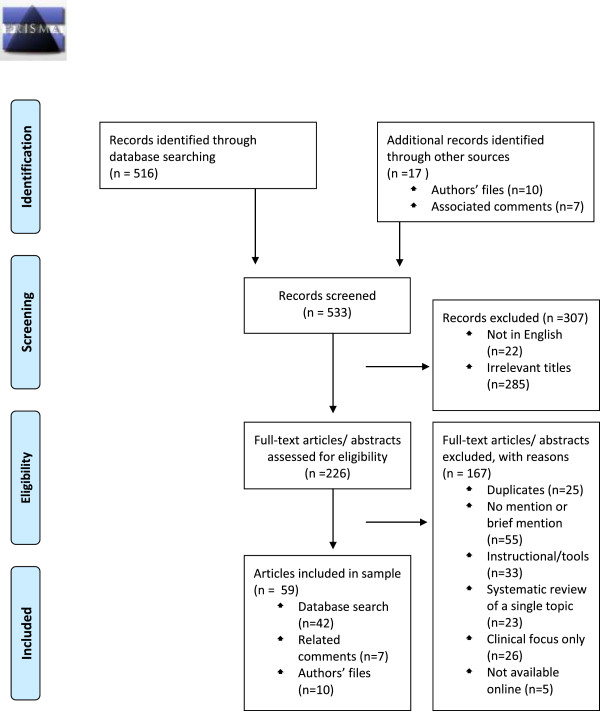
Verification
Claims the paper makes
The claims and statistics of this paper haven’t been checked yet.
Free: it reads the open-access text and checks the first 5 claims that cite a source we can check. Create a free account to check every claim.
Claims other papers make about this one
Each is checked against this paper’s own text: does it say what the citing paper says it does?
The source backs part of the claim, not all of it — or backs it for a different population, condition or comparison.
In the citing paper
“This lack of disclosure is consistent with the lack of transparency and compliance with conflict of interest disclosure policies reported in several fields [48, 55–58].”
From Relationship between research outcomes and risk of bias, study sponsorship, and author financial conflicts of interest in reviews of the effects of artificially sweetened beverages on weight outcomes: a systematic review of reviews (2016) · cites this paper as [48]
Experimental — accuracy not yet measuredIn the citing paper
“We used a modification of a previous method to identify undisclosed financial conflicts of interest of authors [48].”
Self-check
Percentages, sums and reported differences re-computed from the paper’s own numbers.
The self-check needs the paper’s full text.
Citations
Cites
Methods for the thematic synthesis of qualitative research in systematic reviews
Thomas, J., & Harden, A. (2008) · BMC Medical Research Methodology · doi:10.1186/1471-2288-8-45 · Cited by 9,312
Weber, R. (1990) · doi:10.4135/9781412983488 · Cited by 7,750
Cochrane Handbook for Systematic Reviews of Interventions Version 5.0.1. The Cochrane Collaboration
Higgins, J. P. T., Green, S. R., & Higgins, J. P. T. (2008) · Cited by 7,247
Methods for the synthesis of qualitative research: a critical review
Barnett-Page, E., & Thomas, J. (2009) · BMC Medical Research Methodology · doi:10.1186/1471-2288-9-59 · Cited by 2,042
Industry sponsorship and research outcome
Lundh, A., Lexchin, J., Mintzes, B., Schroll, J. B., & Bero, L. (2017) · Cochrane Database of Systematic Reviews · doi:10.1002/14651858.mr000033.pub3 · Cited by 1,697
Self-citationEvidence-Based Public Health: A Fundamental Concept for Public Health Practice
Brownson, R. C., Fielding, J. E., & Maylahn, C. M. (2009) · Annual Review of Public Health · doi:10.1146/annurev.publhealth.031308.100134 · Cited by 1,124 · cited 1×
“The authors of these articles generally argued that well-conducted systematic reviews were the highest level of evidence available [30,31] and effectively summarized large bodies of evidence, resulting in strong external validity [32].”
BackgroundBoutron, I. (2010) · JAMA · doi:10.1001/jama.2010.651 · Cited by 842 · cited 1×
“Our results are consistent with previous studies that showed a positive relationship between industry ties and favorable conclusions in research articles, even when the results of the study do not support the conclusions drawn [13,14,45,48].”
ResultIndustry sponsorship and research outcome
Lundh, A., Sismondo, S., Lexchin, J., Busuioc, O. A., & Bero, L. (2012) · Cochrane Database of Systematic Reviews · doi:10.1002/14651858.mr000033.pub2 · Cited by 605 · cited 2×
“Primary studies or reviews funded by the pharmaceutical or tobacco industries are more likely to having findings or conclusions that favor the sponsor’s product than those funded by non-industry sources [12-14].”
BackgroundSelf-citationA brief history of research synthesis
Chalmers, I., Hedges, L. V., & Cooper, H. (2002) · Evaluation & the Health Professions · doi:10.1177/0163278702025001003 · Cited by 552 · cited 1×
“Systematic reviews synthesize the results of primary qualitative and quantitative research, using strategies to reduce bias [6,7].”
BackgroundGREENHALGH, T., POTTS, H. W. W., WONG, G., BARK, P., & SWINGLEHURST, D. (2009) · The Milbank Quarterly · doi:10.1111/j.1468-0009.2009.00578.x · Cited by 541 · cited 1×
“Systematic reviews of qualitative research summarize and narratively synthesize results using a range of methods [8-10].”
Background
Research works printed but not linked: 2
- Sweet M Moynihan R Fund MM Improving Population Health: The Uses of Systematic Reviews 2007 New York: Milbank Memorial Fund
- Pringle P Eysenck took pounds 800,000 tobacco funds. The Independent 1996 London: Independent Print Limited
Cited by
Li, J., Pega, F., Ujita, Y., Brisson, C., Clays, E., Descatha, A., Ferrario, M. M., Godderis, L., Iavicoli, S., Landsbergis, P. A., et al. (2020) · Environment International · doi:10.1016/j.envint.2020.105739 · Cited by 183
Mandrioli, D., Kearns, C. E., & Bero, L. A. (2016) · PLOS ONE · doi:10.1371/journal.pone.0162198 · Cited by 160
“We used a modification of a previous method to identify undisclosed financial conflicts of interest of authors [48].”
MethodSelf-citationHulshof, C. T. J., Pega, F., Neupane, S., van der Molen, H. F., Colosio, C., Daams, J. G., Descatha, A., Prakash, K. C., Kuijer, P., Mandić‐Rajčević, S., et al. (2020) · Environment International · doi:10.1016/j.envint.2020.106157 · Cited by 210
“A modification of a previous method was used to identify and assess undisclosed financial interests (Forsyth et al., 2014).”
MethodDescatha, A., Sembajwe, G. N., Pega, F., Ujita, Y., Baer, M., Boccuni, F., Tecco, C. D., Duret, C., Evanoff, B., Gagliardi, D., et al. (2020) · Environment International · doi:10.1016/j.envint.2020.105746 · Cited by 172
Rugulies, R., Sørensen, K., Tecco, C. D., Bonafede, M., Rondinone, B. M., Ahn, S., Ando, E., Ayuso‐Mateos, J. L., Cabello, M., Descatha, A., et al. (2021) · Environment International · doi:10.1016/j.envint.2021.106629 · Cited by 154
Metadata
- Authors
- Forsyth, S. R., Odierna, D. H., Krauth, D., & Bero, L. A.
- Affiliations
- University of California, San Francisco (US)
- Corresponding author
- Bero, Lisa A
- Venue
- Systematic Reviews
- Published
- 2014-11-18
- Volume
- 3
- Issue
- 1
- Pages
- 122-122
- ISSN
- 2046-4053 (ISSN-L)
- PMC
- PMC4241194
- OpenAlex
- W2120736871
- Cited by
- 50
- References
- 51
- Citations by year
- 2026: 1 · 2024: 2 · 2023: 1 · 2022: 2 · 2021: 8 · 2020: 10 · 2019: 8 · 2018: 11 · 2017: 1 · 2016: 6
- FWCI
- 0.42
- Type
- journal article
- Language
- en
- Open access
- gold
- doi.org
- Licence
- Locations
- Systematic Reviews (publishedVersion, cc-by)
- Europe PMC (PubMed Central) (publishedVersion, cc-by)
- PubMed Central (publishedVersion, cc-by)
- PubMed (publishedVersion)
- eScholarship (California Digital Library) (submittedVersion)
- Funders
- Tobacco-Related Disease Research Program
- Flight Attendant Medical Research Institute
- University of California, San Francisco
- Topics
- Health Sciences › Nursing › Issues, ethics and legal aspects › Pharmaceutical industry and healthcare
- Social Sciences › Decision Sciences › Statistics, Probability and Uncertainty › Meta-analysis and systematic reviews
- Health Sciences › Medicine › Public Health, Environmental and Occupational Health › Global Public Health Policies and Epidemiology
- Keywords
- conflicts of interest, evidence-informed policy, financial disclosure, funding sources, industry ties, citation patterns, disclosure adequacy, internal and external validity
- MeSH terms
- Peer Review, Policy Making, Conflict of Interest
About these checks
Registry, retraction, Cites and statistics results are computed, not judged, with one exception: a printed reference that no index lists is read once by a model before it counts as a citation error. Claims are extracted by a model and kept only when their quote appears verbatim in the text; each cited source is then checked, with a model’s help, for whether it says what the claim relies on. Those verdicts can be wrong — read the claim’s quote and the cited source before relying on one.
Statistics and arithmetic are recomputed, not judged.
Confidence bands are shown only for fields calibrated on our annotated test set. None is calibrated yet, so no band is shown.
What counts as a claim ›How we measure confidence ›How we check this ›
Are you an author, or do you see a problem with this page? Request a review
How to cite
Cite CoChat for the checks on this page, and the paper for its own findings.
- This page
- CoChat. (2026). Citation check: Conflicts of interest and critiques of the use of systematic reviews in policymaking: an analysis of opinion articles. https://app.cochat.ai/papers/10.1186/2046-4053-3-122
- The paper
- Forsyth, S. R., Odierna, D. H., Krauth, D., & Bero, L. A. (2014). Conflicts of interest and critiques of the use of systematic reviews in policymaking: an analysis of opinion articles. Systematic Reviews. https://doi.org/10.1186/2046-4053-3-122
Data sources
Bibliographic data: Semantic Scholar, OpenAlex, Crossref.
Contains information from the Semantic Scholar Academic Graph Datasets, made available under the ODC Attribution License (ODC-BY 1.0).
Semantic Scholar’s data is described in: Kinney, R., et al. (2023). The Semantic Scholar Open Data Platform. arXiv:2301.10140.
