

User-centered design and the development of patient decision aids: protocol for a systematic review
Open accessThe DOI matches its Crossref record; 41 of the 42 references it cites were found in a registry or an index.
Abstract
BACKGROUND: Providing patient-centered care requires that patients partner in their personal health-care decisions to the full extent desired. Patient decision aids facilitate processes of shared decision-making between patients and their clinicians by presenting relevant scientific information in balanced, understandable ways, helping clarify patients' goals, and guiding decision-making processes. Although international standards stipulate that patients and clinicians should be involved in decision aid development, little is known about how such involvement currently occurs, let alone best practices. This systematic review consisting of three interlinked subreviews seeks to describe current practices of user involvement in the development of patient decision aids, compare these to practices of user-centered design, and identify promising strategies. METHODS/DESIGN: A research team that includes patient and clinician representatives, decision aid developers, and systematic review method experts will guide this review according to the Cochrane Handbook and PRISMA reporting guidelines. A medical librarian will hand search key references and use a peer-reviewed search strategy to search MEDLINE, EMBASE, PubMed, Web of Science, the Cochrane Library, the ACM library, IEEE Xplore, and Google Scholar. We will identify articles across all languages and years describing the development or evaluation of a patient decision aid, or the application of user-centered design or human-centered design to tools intended for patient use. Two independent reviewers will assess article eligibility and extract data into a matrix using a structured pilot-tested form based on a conceptual framework of user-centered design. We will synthesize evidence to describe how research teams have included users in their development process and compare these practices to user-centered design methods. If data permit, we will develop a measure of the user-centeredness of development processes and identify practices that are likely to be optimal. DISCUSSION: This systematic review will provide evidence of current practices to inform approaches for involving patients and other stakeholders in the development of patient decision aids. We anticipate that the results will help move towards the establishment of best practices for the development of patient-centered tools and, in turn, help improve the experiences of people who face difficult health decisions. SYSTEMATIC REVIEW REGISTRATION: PROSPERO CRD42014013241.
Overview
The claims and statistics of this paper haven’t been checked yet.
Free: it reads the open-access text and checks the first 5 claims that cite a source we can check. Create a free account to check every claim.
Integrity signals
Registry
Cites
Statistics
Figures
Verification
Claims the paper makes
The claims and statistics of this paper haven’t been checked yet.
Free: it reads the open-access text and checks the first 5 claims that cite a source we can check. Create a free account to check every claim.
Claims other papers make about this one
Each is checked against this paper’s own text: does it say what the citing paper says it does?
The source backs part of the claim, not all of it — or backs it for a different population, condition or comparison.
In the citing paper
“User-centered design is an approach that involves end-users in designing applications, and has been shown to increase the usability of applications [13, 14].”
From Development of a decision guide to support the elderly in decision making about location of care: an iterative, user-centered design (2016) · cites this paper as [14]
Experimental — accuracy not yet measuredThe cited source says what the claim attributes to it.
In the citing paper
“Regarding DA development, there is little evidence about effective methods to involve patients [14, 36].”
From Development of a decision guide to support the elderly in decision making about location of care: an iterative, user-centered design (2016) · cites this paper as [14]
The cited source says what the claim attributes to it.
In the citing paper
“Although DA development is often presented as a linear process [19], the separate development phases are better described as an ongoing cyclical process [14, 32].”
From Development of a decision guide to support the elderly in decision making about location of care: an iterative, user-centered design (2016) · cites this paper as [14]
Self-check
Percentages, sums and reported differences re-computed from the paper’s own numbers.
The self-check needs the paper’s full text.
Citations
Cites
Decision aids for people facing health treatment or screening decisions
Stacey, D., Légaré, F., Lewis, K., Barry, M. J., Bennett, C. L., Eden, K. B., Holmes-Rovner, M., Llewellyn-Thomas, H., Lyddiatt, A., Thomson, R., et al. (2017) · Cochrane Database of Systematic Reviews · doi:10.1002/14651858.cd001431.pub5 · Cited by 6,685
Self-citationNorman, D. (2016) · Vahlen eBooks · doi:10.15358/9783800648108 · Cited by 6,374
Shared decision making — The pinnacle of patient-centered care
Barry, M. J., & Edgman-Levitan, S. (2012) · New England Journal of Medicine · doi:10.1056/nejmp1109283 · Cited by 3,433 · cited 1×
“…from a health-care professional in the process of shared decision-making [8] and provide a means for clinicians and patients to collaboratively incorporate their expertise, insights, and views in order to make evidence-based health decisions that are aligned with patients ’ preferences [9,10].”
BackgroundDesigning for usability: key principles and what designers think
Gould, J. D., & Lewis, C. (1985) · Communications of the ACM · doi:10.1145/3166.3170 · Cited by 2,066 · cited 1×
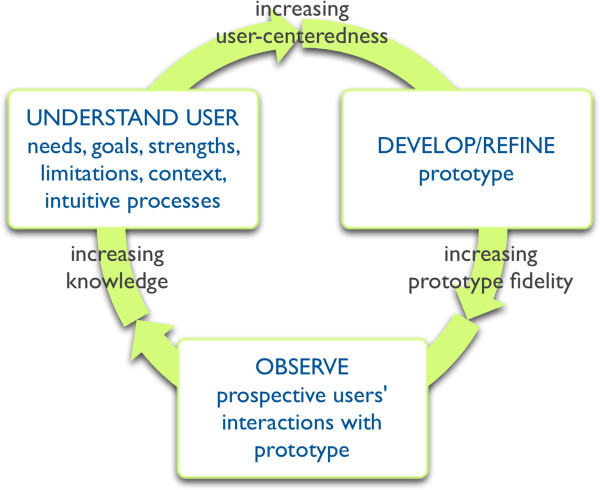
“Figure 1 shows a visual depiction of user-centered design, distilled from seminal work in the field of Human Factors [18,20,22,31-33].”
MethodElwyn, G. (2006) · BMJ · doi:10.1136/bmj.38926.629329.ae · Cited by 1,824 · cited 1×
“However, due to the lack of a robust evidence base from which to draw conclusions about best practices, practical guidance is minimal and vague [11-14].”
BackgroundAn integrative model of shared decision making in medical encounters
Makoul, G., & Clayman, M. L. (2006) · Patient Education and Counseling · doi:10.1016/j.pec.2005.06.010 · Cited by 1,621 · cited 1×
“…intended to be used by patients to complement information and counseling from a health-care professional in the process of shared decision-making [8] and provide a means for clinicians and patients to collaboratively incorporate their expertise, insights, and views in order to make…”
BackgroundTalking about tactile experiences
Obrist, M., Seah, S. A., & Subramanian, S. (2013) · Proceedings of the SIGCHI Conference on Human Factors in Computing Systems · doi:10.1145/2470654.2466220 · Cited by 1,613
Brett, J., Staniszewska, S., Mockford, C., Herron‐Marx, S., Hughes, J., Tysall, C., & Suleman, R. (2014) · Health Expectations · doi:10.1111/j.1369-7625.2012.00795.x · Cited by 1,598 · cited 1×
“Patient partnership in research teams is increasingly encouraged or required by funding organizations [3-6].”
Background(1987) · Andalas University Repository (Andalas University) · Cited by 1,584
Decision aids for people facing health treatment or screening decisions
Stacey, D., Légaré, F., Col, N. F., Bennett, C. L., Barry, M. J., Eden, K. B., Holmes-Rovner, M., Llewellyn-Thomas, H., Lyddiatt, A., Thomson, R., et al. (2014) · Cochrane Database of Systematic Reviews · doi:10.1002/14651858.cd001431.pub4 · Cited by 1,471 · cited 7×
“Patient decision aids are structured tools, often booklets or websites, that aim to provide unbiased, evidence-based information and guidance to patients making health decisions [7].”
BackgroundMethodInfluentialSelf-citation
Research works printed but not linked: 4
- 3. Topic of conversation. Den Haag. Netherlands: Dutch organization for health and innovation in healthcare; 2010. p. 1-17.
- 13. Coulter A, Kryworuchko J, Mullen PD, Ng CJ, Stillwell D, van der Weijden T. Chapter A: using a systematic development process. In: Volk RJ, Llewellyn-Thomas HA, editors. 2012 update of the international patient decision Aid standards (IPDAS) Collaboration's background document. 2012. p. 1-16. Available at: http://ipdas.ohri.ca/IPDAS-Chapter-A.pdf.
- 22. Iso DIS. 9241-210:2010: ergonomics of human-system interaction-part 210: human-centred design for interactive systems (formerly known as 13407). Switzerland: International Standards Organization; 2010.
- 28. Garrett JJ. Elements of user experience. 2nd ed. New Riders: Berkeley, CA; 2011.
Cited by
Items 101–200 of 210
Rouleau, G., Reis, C., Ivers, N. M., & Desveaux, L. (2023) · JMIR Human Factors · doi:10.2196/38736 · Cited by 9
“…understand users based on the elements relevant to the A&F cycle (what do we need to know about users that is more important to A&F); and (3) user-centered design principles, including empathy with the end users’ goals and an understanding of their context, to operationalize those elements [12,15].”
BackgroundSelf-citationSaigal, C. S., Lambrechts, S. I., Srinivasan, V., & Dahan, E. (2016) · Patient · doi:10.1007/s40271-016-0203-y · Cited by 9
“In the healthcare literature, domain experts have noted that there is ‘‘little empirical evidence available about methods for putting patients at the center of the process (of decision aid design)’’ [16].”
BackgroundEnd-user views of an electronic encounter decision aid linked to routine depression screening
Dannenberg, M. D., Bienvenida, J. C. M., BRUCE, M. L., Nguyen, T., Hinn, M., Matthews, J., Bartels, S. J., Elwyn, G. J., & Barr, P. J. (2018) · Patient Education and Counseling · doi:10.1016/j.pec.2018.10.002 · Cited by 11
Coulter, R. W. S., Mitchell, S. R., Prangley, K., Smallwood, S., Bonanno, L., Foster, E. N., Wilson, A., Miller, E. P., & Chugani, C. D. (2021) · JMIR Research Protocols · doi:10.2196/26554 · Cited by 10
“To overcome these barriers, human-centered design uses structured activities that are time-limited, engaging, and accessible to laypersons, including youth [16-27].”
BackgroundMethodInfluentialHilty, D. M., & Mucić, D. (2015) · Springer eBooks · doi:10.1007/978-3-319-20852-7_1 · Cited by 11
“International standards stipulate that patients and clinicians should be involved in decision aid development [ 64 ].”
BackgroundThompson, W., Farrell, B. J., Welch, V. A., Tugwell, P., & Bjerre, L. M. (2016) · Canadian Pharmacists Journal / Revue des Pharmaciens du Canada · doi:10.1177/1715163516679425 · Cited by 8
Lee, Y. J., Brazile, T. L., Galbiati, F., Hamm, M., Bryce, C. L., Jain, S. K., Kraschnewski, J. L., & McTigue, K. M. (2020) · Journal of Clinical and Translational Science · doi:10.1017/cts.2020.530 · Cited by 8
“Researchers have emphasized the need to include potential stakeholders and communities who can potentially benefit from decision aids throughout the process of decision aid design [17].”
Educational interventions using a primer and motivational interviewing: randomized clinical trial
de Sabino, L. M. M., Ferreira, Á. M. V., Mendes, E. R. D. R., Joventino, E. S., da Penha, J. C., Lima, K. F., do Nascimento, L. A., Lima, F. E. T., Dodt, R. C. M., de Almeida, P. C., et al. (2021) · European Journal of Public Health · doi:10.1093/eurpub/ckab021 · Cited by 7
Crowley, P., Kildedal, R., Vindelev, S. O., Jacobsen, S. S., Larsen, J. R., Johansson, P. J., Aadahl, M., Straker, L. M., Stamatakis, E., Holtermann, A., et al. (2023) · JMIR Formative Research · doi:10.2196/48209 · Cited by 7
“System development was guided by the User-Centered Design framework [12] where design decisions are largely based on the participant’s needs and specifications [12].”
MethodInformation Priorities for Deciding on Treatment of Pelvic Organ Prolapse
Gerjevic, K. A., Erekson, E. A., Strohbehn, K., Jacobs, K. A., Hanissian, P. D., & Aarts, J. W. M. (2018) · Urogynecology · doi:10.1097/spv.0000000000000572 · Cited by 7
User involvement in the development of patient decision aids: A systematic reviewPreprint
Vaisson, G., Provencher, T., Dugas, M., Trottier, M.-È., Dansokho, S. C., Colquhoun, H. L., Fagerlin, A., Giguere, A. M. C., Hakim, H., Haslett, L., et al. (2019) · OSF Preprints (OSF Preprints) · doi:10.31219/osf.io/qyfkp · Cited by 9
Self-citationGrowing Importance of Patient Engagement in Healthcare
Ramdurai, B. (2020) · International Journal of Nursing and Health Science · doi:10.14445/24547484/ijnhs-v6i3p101 · Cited by 6
Görtz, M., Wendeborn, A., Müller, M., & Hohenfellner, M. (2023) · Healthcare · doi:10.3390/healthcare11050682 · Cited by 6
“Because of its ease of use and broad acceptance, mHealth is considered to be a valuable tool in the implementation of patient-centered care, which has become a central goal of healthcare systems and international standards [7].”
Gunn, C. M., Maschke, A., Paasche‐Orlow, M. K., Housten, A. J., Kressin, N. R., Schonberg, M. A., & Battaglia, T. A. (2021) · MDM Policy & Practice · doi:10.1177/23814683211033249 · Cited by 8
“(Expert 6).”
Deliv, C., Putnam, E., Devane, D., Healy, P., Hall, A. M., Rosenbaum, S., & Toomey, E. C. (2023) · Digital Health · doi:10.1177/20552076231170696 · Cited by 6
Michaux, K. D., Metcalfe, R., Burns, P., Conklin, A., Hoens, A. M., Smith, D., Struik, L., Safari, A., Sin, D. D., Sadatsafavi, M., et al. (2023) · Diagnostic and Prognostic Research · doi:10.1186/s41512-023-00140-6 · Cited by 7
Li, C., Matthews, A. K., Gao, X., & Cheung, K. (2023) · Journal of the National Medical Association · doi:10.1016/j.jnma.2023.01.009 · Cited by 7
Wilkinson, T. A., Jenkins, K., Hawryluk, B. A., Moore, C. M., Wiehe, S. E., & Kottke, M. (2022) · Journal of Pediatric and Adolescent Gynecology · doi:10.1016/j.jpag.2022.08.009 · Cited by 5
“35-39 Our findings suggest that AYA’s are enthusiastic about the concepts underlying dual protection and would like to hear and see more about its benefits from reliable sources.”
Disease prevention: what's really important?
Matheson, G. O., Witteman, H. O., & Mochar, T. G. (2015) · British Journal of Sports Medicine · doi:10.1136/bjsports-2014-094261 · Cited by 5
Self-citationRochon, E. A., Sy, M. S., Phillips, M., Anderson, E. W., Plys, E., Ritchie, C. S., & Vranceanu, A. (2023) · JMIR Research Protocols · doi:10.2196/52799 · Cited by 4
“Consistent with guidelines for the development of technology-enhanced interventions, we supplement the NIH model with principles of user-centered design as outlined in the process model for user-centered design [34], see Figure 1.”
MethodInfluentialSchonberg, M. A., Stout, N. K., Stein, S. J., Corey, M. T., Jushchyshyn, J. A., Shah, R., Wolfson, E. A., Mandelblatt, J. S., Montori, V. M., Richman, I. B., et al. (2025) · Journal of the American Geriatrics Society · doi:10.1111/jgs.19466 · Cited by 4
Self-citationRochon, E. A., Thacker, A., Phillips, M., Ritchie, C. S., Vranceanu, A., & Plys, E. (2025) · JMIR Aging · doi:10.2196/66212 · Cited by 6
“This study followed a multiphasic conceptual model of user-centered design rooted in human factors research, as outlined by Witteman et al [38]; refer to Figure 1.”
InfluentialA Human-Centered Algorithmic Management Framework: A Literature Review
Jiang, Y., Fan, S., Zhu, Y., Wang, L., Ye, K., Zhou, J., Zhang, L., Wang, Z., Liu, W., & Rau, P. P. (2024) · Lecture notes in computer science · doi:10.1007/978-3-031-76827-9_4 · Cited by 4
Wysocki, T., James, L., Milkes, A. I., Taylor, A., Pierce, J. S., Brinkman, W. B., Carakushansky, M., ROSS, J. L., & Hirschfeld, F. (2018) · MDM Policy & Practice · doi:10.1177/2381468318769857 · Cited by 6
Sandholdt, C. T., Jønsson, A. B. R., Reventlow, S. D., Bach‐Holm, D., Kessel, L., Kolko, M., Jacobsen, M. H., Mathiesen, O. H., & Waldorff, F. B. (2023) · BMJ Open · doi:10.1136/bmjopen-2022-069974 · Cited by 5
“An essential element in human-centred design processes is to create understanding and empathy for the end-user 48 49 —in our case people living with visual impairment and their relatives.”
BackgroundPeng, L., Xu, L.-Y., Wang, S., Huang, W., Liu, Q.-Q., Huang, N.-T., Wu, P., & Tang, J. (2023) · JPRAS Open · doi:10.1016/j.jpra.2023.06.012 · Cited by 4
Time for Quality Measures to Get Personal
Mafi, J. N., Rothberg, M. B., Sepucha, K., & Barry, M. J. (2016) · The Joint Commission Journal on Quality and Patient Safety · doi:10.1016/s1553-7250(16)42016-7 · Cited by 3
Briffault, X., & Morgiève, M. (2018) · Droit Santé et Société · doi:10.3917/dsso.043.0035 · Cited by 7
DIAGNOSING MEDICAL TRANSLATION AND FRAMING CURRENT CHALLENGES
Rusu, M. R., & Vîlceanu, T. (2022) · The International Conference "Synergies in Communication" · doi:10.24818/sic/2021/02.03 · Cited by 3
Fallon, C., Lemire, M., Dumont, D., Parent, É., Figueroa, E., Cummings, I., Brousseau, J., Marquis, M., Paquet, N., Plante, S., et al. (2022) · MDM Policy & Practice · doi:10.1177/23814683221094477 · Cited by 3
Self-citationGuidelines for Disc Golf Applications and Design Principles for SportsHCI: A Human-Centered Approach
Moilanen, M., Iivari, N., Arhippainen, L., & Lanamäki, A. (2024) · International Conference on Mobile and Ubiquitous Multimedia (MUM) · doi:10.1145/3701571.3701584 · Cited by 3
Khan, M. S., Almas, A., Samad, Z. Z., Zimmerman, K. O., & Ali, T. S. (2025) · Journal of Health Population and Nutrition · doi:10.1186/s41043-025-01097-6 · Cited by 4
“Through a user-centered development process [63, 82] involving students, teachers, parents, and administrators, eSHEPP was specifically designed to align with the local educational context.”
Human-Centered Design Components in Spiral Model to Improve Mobility of Older Adults
Khakurel, J., Porras, J., Melkas, H., & Garzo, A. (2018) · EAI/Springer Innovations in Communication and Computing · doi:10.1007/978-3-319-93491-4_5 · Cited by 3
Azmi, L. F., & Ahmad, N. (2021) · Lecture notes on data engineering and communications technologies · doi:10.1007/978-3-030-70713-2_24 · Cited by 3
Development of a Patient Decision Aid to Help People Living with Inflammatory Bowel Disease
Tamizifar, B., Ehsani, M., Farzi, S., Adibi, P., Taleghani, F., Farzi, S., Shahriari, M., & Moladoost, A. (2022) · Middle East Journal of Digestive Diseases · doi:10.34172/mejdd.2022.256 · Cited by 2
Rauwerda, N. L., Pot, I., Braamse, A. M. J., van Straten, A., Nieuwkerk, P. T., Boss, M., Rikkert, M., & Knoop, H. (2025) · Journal of Sleep Research · doi:10.1111/jsr.70115 · Cited by 2
“Furthermore, although we attempted to describe the treatment methods in the TPP questionnaire as objectively as possible using guidelines of Witteman et al. (2015), the treatments do have distinctly different features.”
Kim, B.-S., Heo, I.-S., Sahithi, K. K., & Kim, S. (2025) · Acta Psychologica · doi:10.1016/j.actpsy.2025.105622 · Cited by 2
Decision aids for the care of patients with multimorbidity: a systematic review
Chen, Y., He, R., Chen, Z., Bai, Y., & Yang, C. (2025) · BMC Family Practice · doi:10.1186/s12875-025-03082-8 · Cited by 2
“…checklist [42], the EBCD Australia Toolkit [43], the Ottawa Decision Support Framework [44], the interpro-fessional shared decision-making conceptual model [45], the user-centred design [46], the dynamic model of SDM with frail older patients [35] and the Multi-Criteria Decision Analysis [47].”
The waiting room of uncertainty: digital patient support for potentially bad news—a scoping review
Kellermann, M., Wetterauer, C., Kullak-Ublick, G. A., & Cheetham, M. (2025) · Frontiers in Digital Health · doi:10.3389/fdgth.2025.1706839 · Cited by 2
“…information about potential clinical outcomes, offering context-specific explanations and clarifications, correcting common misconceptions, facilitating adaptive emotional and behavioural coping strategies, and helping to enhance patient communication during clinical encounters (45–47).”
Estopà, R., & Armayones, M. (2021) · Teknokultura Revista de Cultura Digital y Movimientos Sociales · doi:10.5209/tekn.73595 · Cited by 2
“Se partió de las ideas propuestas de Witteman et al. (2015) sobre la base del Marco de Diseño Centrado en el Usuario.”
BackgroundJosephy, T., Loeffler, D. R., Pam, M., & Godfrey, E. M. (2021) · Journal of the American Medical Informatics Association · doi:10.1093/jamia/ocab224 · Cited by 2
Examination of Interventions’ Acceptance
(2021) · Wiley eBooks · doi:10.1002/9781119610113.ch11 · Cited by 2
Zelig, R. S., Rothpletz‐Puglia, P., Hoskin, E. R., Singer, S. R., Jones, V. M., Byham-Gray, L. D., & Touger-Decker, R. E. (2023) · Gerodontology · doi:10.1111/ger.12697 · Cited by 2
Thatmann, D., Raschke, P., & Küpper, A. (2016) · IEEE Annual International Computer Software and Applications Conference (COMPSAC) · doi:10.1109/compsac.2016.1 · Cited by 3
“[11] introduced a general protocol for a systematic review.”
BackgroundUser-Driven Development for UK M-Health Patient Management System
Bahja, M., Hammad, R., & Bahja, M. (2018) · Electronic workshops in computing · doi:10.14236/ewic/hci2018.18 · Cited by 3
“It was identified that, despite the international standards specifying the active involvement of users (patients & physicians) in developing patient centred health applications, there are not many research works that have identified with such practices [37].”
BackgroundYamada, J., Ballantyne, M., Kron, A., & Sidani, S. (2020) · Canadian Journal of Nursing Research · doi:10.1177/0844562120931661 · Cited by 2
“A description of the intervention is highly recommended (Tarrier et al., 2006; Witteman et al., 2015) to ensure parents have an understanding of the intervention, which is required for its meaningful appraisal.”
BackgroundBuilding a Digital Health Risk Calculator for Older Women with Early-Stage Breast Cancer
Abujarad, F., Wang, S., Ulrich, D., Mougalian, S. S., Killelea, B. K., Fraenkel, L., Gross, C. P., & Evans, S. B. (2021) · Lecture notes in computer science · doi:10.1007/978-3-030-78224-5_27 · Cited by 4
Moody, L., Clarke, S., Compton, M., Hughson-Gill, R., Boardman, F., Clark, C. C. A., Holder, P., Bonham, J. R., & Chudleigh, J. H. (2024) · Journal of Participatory Medicine · doi:10.2196/59686 · Cited by 1
“…a range of disciplines to center the design of innovation (eg, products, software systems, educational resources, service delivery, and so on) around the knowledge and understanding of those that will use it, in order to optimize ease of use, effectiveness, efficiency, and satisfaction [53-55].”
van den Braak, K. P. M., Veldhuizen, J., Wulfse-Huisman, S., Bakker, J., Pel‐Littel, R. E., Buurman, B. M., Zondervan-Zwijnenburg, M. A. J., & Bleijenberg, N. (2026) · CIN Computers Informatics Nursing · doi:10.1097/cin.0000000000001508 · Cited by 1
Liu, C.-W., & Jung, H. (2026) · Health Science Reports · doi:10.1002/hsr2.73091 · Cited by 1
“Tool‐driven participation reflects the utility of structured information delivery in promoting confidence and active involvement [22].”
Moshki, M., Khajavi, A., Sadeghi‐Ghyassi, F., Sadeghi‐Bazargani, H., & Pour-Doulati, S. (2019) · Systematic Reviews · doi:10.1186/s13643-019-1121-6 · Cited by 1
Noël, G., Pasay, D., Campbell-Scherer, D. L., & Saxinger, L. M. (2021) · Visible Language · doi:10.34314/vl.v55i1.4605 · Cited by 1
“Recently, increased collaboration between experts in design and healthcare is emerging (Breslin et al., 2008; Hargraves, 2018; Noël et al., 2019; Roberts et al., 2016; Witteman et al., 2015).”
BackgroundYu, S., Kuo, P., Lin, H.-C., & Yu, H.-T. (2025) · BMC Health Services Research · doi:10.1186/s12913-025-13439-5 · Cited by 1
“Previous research on PtDA can be divided into (1) tool development and design [6, 8], (2) clinical application [20, 21], (3) special considerations [22, 23], and (4) novel format and technology [24].”
User-Centered Design Strategies for Clinical Brain-Computer Interface Assistive Technology Devices
Light, G. (2019) · ScholarWorks (Walden University) · Cited by 1
Speller, B. (2017) · TSpace (University of Toronto) · Cited by 1
Does a Decision Aid Help Patients Learn about Their Treatment Options for Advanced Heart Failure?
Blumenthal‐Barby, J., Kostick, K. M., Bruce, C. R., Volk, R. J., Bruckner, B. A., Loebe, M. M., Estep, J. D., McCurdy, S., & Minard, C. G. (2019) · doi:10.25302/4.2019.cdr.130601769 · Cited by 1
Self-citationPasmans, S. (2019) · Research Publications (Maastricht University) · doi:10.26481/dis.20190606wsp · Cited by 1
mHealth-based Methods for Neuromotor Assessment and Rehabilitation
Corzani, M. (2021) · AMS Dottorato Institutional Doctoral Theses Repository (University of Bologna) · doi:10.48676/unibo/amsdottorato/9640 · Cited by 1
Bagò, R. E. I., & Armayones, M. (2020) · doi:10.21203/rs.2.23480/v1 · Cited by 1
“This methodology – adopting a user-centred design framework – is inspired by proposals made initially by Witteman (14).”
MethodSeverijns, Y. (2024) · Research Publications (Maastricht University) · doi:10.26481/dis.20240404ys · Cited by 1
Belleville, G., Lebel, J., Gagné, S., Bouchard, S., Guay, S., Jackson, P. L., Massoungue, G., Ouellet, M., Tremblay, J., & Witteman, H. O. (2025) · SSRN Electronic Journal · doi:10.2139/ssrn.5351475 · Cited by 1
Self-citationPrinted Educational Materials for Primary Care Physicians
Grudniewicz, A. (2015) · TSpace (University of Toronto) · Cited by 1
Krumsvik, O. A. (2017) · NORA - Norwegian Open Research Archives
User-interface design and evaluation in a mobile application for detecting latent tuberculosis
Farao, J. (2019) · Open University of Cape Town (University of Cape Town) · Cited by 1
Designing a Decision Aid for Patients Considering Bone Marrow Transplant
Fadem, S. J. (2020) · ACM International Conference on Design of Communication (SIGDOC) · doi:10.1145/3380851.3418610
“Though the standards for DA development include a welldocumented design process that includes field-testing with patients and providers [4], there is minimal practical guidance for stakeholder involvement, leading to much variation in the frequency and form of participation [5, 6].”
BackgroundShared decision-making in oncology: challenges and opportunities
Ankolekar, A. (2021) · Research Publications (Maastricht University) · doi:10.26481/dis.20211125aa
Rouleau, G., Thiruganasambandamoorthy, V., Wu, K., Ghaedi, B. B., Nguyen, P. A., & Desveaux, L. (2021) · Research Square · doi:10.21203/rs.3.rs-1107283/v1
mHealth Apps for Older Adults and Persons with Parkinson's Disease
Corzani, M. (2022) · Studies in computational intelligence · doi:10.1007/978-981-16-8488-3_11 · Cited by 1
Parry, M. J. E., Richards, D. P., Wells, D., Najam, A., Hemani, S., & Marlin, S. (2022) · Healthcare Quarterly · doi:10.12927/hcq.2022.26776
Bagò, R. E. I., & Armayones, M. (2020) · doi:10.21203/rs.2.23480/v3
Backman, C., Harley, A., Peyton, L., Kuziemsky, C. E., Mercer, J. G., Monahan, A., Schmidt, S., Singh, H., & Gravelle, D. (2018) · doi:10.2196/preprints.11031
Fallon, C., Lemire, M., Dumont, D., Parent, É., Figueroa, E., Cummings, I., Brousseau, J., Paquet, N., Plante, S., & Witteman, H. O. (2020) · NutriXiv (OSF Preprints) · doi:10.31232/osf.io/btjh5
Self-citationWan, J., Zhang, F., Tan, M., wang, L., Hu, S., & Bian, W. (2022) · Research Square · doi:10.21203/rs.3.rs-1823280/v1
Supporting CKD Patients at Home
Bell, J. (2015) · EMJ Nephrology · doi:10.33590/emjnephrol/10310510
Measurement of Consumer Engagement in HIV Care Quality Improvement
Concannon, T. W., & Timmins, G. T. (2023) · RAND Corporation eBooks · doi:10.7249/rra2744-1
Umaefulam, V. O., Wilson, M. K., Boucher, M. C., Brent, M. H., Dogba, M. J., Drescher, O., Grimshaw, J., Ivers, N. M., Lawrenson, J. G., Lorencatto, F., et al. (2023) · Figshare · doi:10.6084/m9.figshare.22621529
Self-citationA User-Centered Design of a Decision Support Tool for Spare Parts Inventory Control
Hinrichs, M., & Schneegaß, S. (2024) · International Conference on PErvasive Technologies Related to Assistive Environments (PETRA) · doi:10.1145/3652037.3663907
“To design data-driven decision support for maintenance and logistics professionals, we used a user-centered approach [20].”
MethodAlmazam, A. A., Alenezi, S. Z., Emam, A. M., Alqahtani, N. S., Alanazi, M. H., Alghamdi, M. S., Alsharari, S. F., Alsharari, A. S., & Albalawi, A. E. A. (2019) · International Journal of Health Sciences · doi:10.53730/ijhs.v3ns1.15086
Mehmood, S., Naseer, S., & Chen, D. L. (2024) · Proceedings of the National Academy of Sciences · doi:10.1073/pnas.2406034121 · Cited by 1
McCleary, N., Presseau, J., Perkins, I., Mutsaers, B., Kendall, C., Yamada, J., Gillis, K. A., & Green, D. (2025) · BMC Medical Informatics and Decision Making · doi:10.1186/s12911-024-02733-7
Mucić, D., & Hilty, D. M. (2024) · Springer eBooks · doi:10.1007/978-3-031-59936-1_1 · Cited by 1
Guruge, S., & Sidani, S. (2025) · International Health Trends and Perspectives · doi:10.32920/ihtp.v5i3.2553
Haines, E. R., Dopp, A. R., Lyon, A. R., Witteman, H. O., Bender, M., Vaisson, G., Hitch, D., & Birken, S. A. (2021) · Figshare · doi:10.6084/m9.figshare.14490557
Self-citationHaines, E. R., Dopp, A. R., Lyon, A. R., Witteman, H. O., Bender, M., Vaisson, G., Hitch, D., & Birken, S. A. (2021) · Figshare · doi:10.6084/m9.figshare.14490560
Self-citationUmaefulam, V. O., Wilson, M. K., Boucher, M. C., Brent, M. H., Dogba, M. J., Drescher, O., Grimshaw, J. M., Ivers, N. M., Lawrenson, J. G., Lorencatto, F., et al. (2023) · Figshare · doi:10.6084/m9.figshare.22621526
Self-citationHaines, E. R., Dopp, A. R., Lyon, A. R., Witteman, H. O., Bender, M., Vaisson, G., Hitch, D., & Birken, S. A. (2021) · Figshare · doi:10.6084/m9.figshare.14490563
Self-citationMichaux, K. D., Metcalfe, R. K., Burns, P., Conklin, A., Hoens, A. M., Smith, D., Struik, L., Safari, A., Sin, D. D., & Sadatsafavi, M. (2023) · Figshare · doi:10.6084/m9.figshare.22598998
Kremer, I., Jongen, P. J., Evers, S., Hoogervorst, E. L. J., Verhagen, W. I. M., & Hiligsmann, M. (2021) · Figshare · doi:10.6084/m9.figshare.14396706
Kremer, I., Jongen, P. J., Evers, S., Hoogervorst, E. L. J., Verhagen, W. I. M., & Hiligsmann, M. (2021) · Figshare · doi:10.6084/m9.figshare.14396712
Haines, E. R., Dopp, A. R., Lyon, A. R., Witteman, H. O., Bender, M., Vaisson, G., Hitch, D., & Birken, S. A. (2021) · Figshare · doi:10.6084/m9.figshare.14490554
Self-citationKremer, I., Jongen, P. J., Evers, S., Hoogervorst, E. L. J., Verhagen, W. I. M., & Hiligsmann, M. (2021) · Figshare · doi:10.6084/m9.figshare.14396709
Heen, A. F., Per, V., Brandt, L., Achille, F., Guyatt, G. H., Akl, E. A., Treewek, S., & Agoritsas, T. (2021) · Figshare · doi:10.6084/m9.figshare.14880704
Haines, E. R., Dopp, A. R., Lyon, A. R., Witteman, H. O., Bender, M., Vaisson, G., Hitch, D., & Birken, S. A. (2021) · Figshare · doi:10.6084/m9.figshare.14490566
Self-citationUmaefulam, V. O., Wilson, M. K., Boucher, M. C., Brent, M. H., Dogba, M. J., Drescher, O., Grimshaw, J. M., Ivers, N. M., Lawrenson, J. G., Lorencatto, F., et al. (2023) · Figshare · doi:10.6084/m9.figshare.22621523
Self-citationUmaefulam, V. O., Wilson, M. K., Boucher, M. C., Brent, M. H., Dogba, M. J., Drescher, O., Grimshaw, J. M., Ivers, N. M., Lawrenson, J. G., Lorencatto, F., et al. (2023) · Figshare · doi:10.6084/m9.figshare.22621532
Self-citationCol, N. F., Hull, S., Springmann, V., Ngo, L. H., Merritt, E., GOLD, S. D., Sprintz, M., Genova, N., Nesin, N., Tierman, B., et al. (2020) · Figshare · doi:10.6084/m9.figshare.13107699
Umaefulam, V. O., Wilson, M. K., Boucher, M. C., Brent, M. H., Dogba, M. J., Drescher, O., Grimshaw, J. M., Ivers, N. M., Lawrenson, J. G., Lorencatto, F., et al. (2023) · Figshare · doi:10.6084/m9.figshare.22621517
Self-citationCol, N. F., Hull, S., Springmann, V., Ngo, L. H., Merritt, E., GOLD, S. D., Sprintz, M., Genova, N., Nesin, N., Tierman, B., et al. (2020) · Figshare · doi:10.6084/m9.figshare.13107696
Marier-Deschênes, P. (2019) · Corpus Université Laval (Université Laval)
Metadata
- Authors
- Witteman, H. O., Dansokho, S. C., Colquhoun, H., Coulter, A., Dugas, M., Fagerlin, A., Giguere, A. M., Glouberman, S., Haslett, L., Hoffman, A., Ivers, N., Légaré, F., Légaré, J., Levin, C., Lopez, K., Montori, V. M., Provencher, T., Renaud, J.-S., Sparling, K., Stacey, D., Vaisson, G., Volk, R. J., & Witteman, W.
- Affiliations
- Université Laval (CA)
- University of Oxford (GB)
- University of Michigan (US)
- Hôpital du Saint-Sacrement (CA)
- Dartmouth Institute for Health Policy and Clinical Practice (US)
- University of Toronto (CA)
- Centre hospitalier universitaire de Québec (CA)
- Healthwise (US)
- University of Ottawa (CA)
- The University of Texas MD Anderson Cancer Center (US)
- Corresponding author
- Witteman, Holly O
- ORCID
- Venue
- Systematic Reviews
- Published
- 2015-01-26
- Volume
- 4
- Issue
- 1
- Pages
- 11-11
- ISSN
- 2046-4053 (ISSN-L)
- PMC
- PMC4328638
- OpenAlex
- W2117757460
- Semantic Scholar
- dadd30861520033b7f49f7cc9644c21f6d327f7d
- Cited by
- 202
- References
- 42
- Citations by year
- 2026: 9 · 2025: 12 · 2024: 10 · 2023: 22 · 2022: 13 · 2021: 34 · 2020: 22 · 2019: 21 · 2018: 28 · 2017: 13 · 2016: 13 · 2015: 5
- FWCI
- 3.53
- Type
- journal article
- Language
- en
- Open access
- gold
- doi.org
- Licence
- Locations
- Systematic Reviews (publishedVersion, cc-by)
- Europe PMC (PubMed Central) (publishedVersion, cc-by)
- PubMed Central (publishedVersion, cc-by)
- PubMed (publishedVersion)
- TSpace (University of Toronto) (acceptedVersion)
- Funders
- Patient-Centered Outcomes Research Institute (ME-1306-03174)
- University of Ottawa
- University of Toronto
- Canadian Institutes of Health Research
- Department of Family and Community Medicine, University of Toronto
- National Institute on Aging
- Topics
- Health Sciences › Health Professions › General Health Professions › Patient-Provider Communication in Healthcare
- Health Sciences › Health Professions › General Health Professions › Mental Health and Patient Involvement
- Health Sciences › Health Professions › General Health Professions › Health Policy Implementation Science
- Keywords
- patient decision aids, user-centered design, shared decision-making, human-centered design, patient-centered care, stakeholder engagement, best practices, health decision-making
- MeSH terms
- Systematic Reviews as Topic, Decision Making, Decision Support Techniques, Health Services Research, Humans, Patient Education as Topic, Patient Participation, Patient-Centered Care
About these checks
Registry, retraction, Cites and statistics results are computed, not judged, with one exception: a printed reference that no index lists is read once by a model before it counts as a citation error. Claims are extracted by a model and kept only when their quote appears verbatim in the text; each cited source is then checked, with a model’s help, for whether it says what the claim relies on. Those verdicts can be wrong — read the claim’s quote and the cited source before relying on one.
Statistics and arithmetic are recomputed, not judged.
Confidence bands are shown only for fields calibrated on our annotated test set. None is calibrated yet, so no band is shown.
What counts as a claim ›How we measure confidence ›How we check this ›
Are you an author, or do you see a problem with this page? Request a review
Data sources
Bibliographic data: Semantic Scholar, OpenAlex, Crossref.
Contains information from the Semantic Scholar Academic Graph Datasets, made available under the ODC Attribution License (ODC-BY 1.0).
Semantic Scholar’s data is described in: Kinney, R., et al. (2023). The Semantic Scholar Open Data Platform. arXiv:2301.10140.
