

User-centered design and the development of patient decision aids: protocol for a systematic review
Open accessThe DOI matches its Crossref record; 41 of the 42 references it cites were found in a registry or an index.
Abstract
BACKGROUND: Providing patient-centered care requires that patients partner in their personal health-care decisions to the full extent desired. Patient decision aids facilitate processes of shared decision-making between patients and their clinicians by presenting relevant scientific information in balanced, understandable ways, helping clarify patients' goals, and guiding decision-making processes. Although international standards stipulate that patients and clinicians should be involved in decision aid development, little is known about how such involvement currently occurs, let alone best practices. This systematic review consisting of three interlinked subreviews seeks to describe current practices of user involvement in the development of patient decision aids, compare these to practices of user-centered design, and identify promising strategies. METHODS/DESIGN: A research team that includes patient and clinician representatives, decision aid developers, and systematic review method experts will guide this review according to the Cochrane Handbook and PRISMA reporting guidelines. A medical librarian will hand search key references and use a peer-reviewed search strategy to search MEDLINE, EMBASE, PubMed, Web of Science, the Cochrane Library, the ACM library, IEEE Xplore, and Google Scholar. We will identify articles across all languages and years describing the development or evaluation of a patient decision aid, or the application of user-centered design or human-centered design to tools intended for patient use. Two independent reviewers will assess article eligibility and extract data into a matrix using a structured pilot-tested form based on a conceptual framework of user-centered design. We will synthesize evidence to describe how research teams have included users in their development process and compare these practices to user-centered design methods. If data permit, we will develop a measure of the user-centeredness of development processes and identify practices that are likely to be optimal. DISCUSSION: This systematic review will provide evidence of current practices to inform approaches for involving patients and other stakeholders in the development of patient decision aids. We anticipate that the results will help move towards the establishment of best practices for the development of patient-centered tools and, in turn, help improve the experiences of people who face difficult health decisions. SYSTEMATIC REVIEW REGISTRATION: PROSPERO CRD42014013241.
Overview
The claims and statistics of this paper haven’t been checked yet.
Free: it reads the open-access text and checks the first 5 claims that cite a source we can check. Create a free account to check every claim.
Integrity signals
Registry
Cites
Statistics
Figures
Verification
Claims the paper makes
The claims and statistics of this paper haven’t been checked yet.
Free: it reads the open-access text and checks the first 5 claims that cite a source we can check. Create a free account to check every claim.
Claims other papers make about this one
Each is checked against this paper’s own text: does it say what the citing paper says it does?
The source backs part of the claim, not all of it — or backs it for a different population, condition or comparison.
In the citing paper
“User-centered design is an approach that involves end-users in designing applications, and has been shown to increase the usability of applications [13, 14].”
From Development of a decision guide to support the elderly in decision making about location of care: an iterative, user-centered design (2016) · cites this paper as [14]
Experimental — accuracy not yet measuredThe cited source says what the claim attributes to it.
In the citing paper
“Regarding DA development, there is little evidence about effective methods to involve patients [14, 36].”
From Development of a decision guide to support the elderly in decision making about location of care: an iterative, user-centered design (2016) · cites this paper as [14]
The cited source says what the claim attributes to it.
In the citing paper
“Although DA development is often presented as a linear process [19], the separate development phases are better described as an ongoing cyclical process [14, 32].”
From Development of a decision guide to support the elderly in decision making about location of care: an iterative, user-centered design (2016) · cites this paper as [14]
Self-check
Percentages, sums and reported differences re-computed from the paper’s own numbers.
The self-check needs the paper’s full text.
Citations
Cites
Decision aids for people facing health treatment or screening decisions
Stacey, D., Légaré, F., Lewis, K., Barry, M. J., Bennett, C. L., Eden, K. B., Holmes-Rovner, M., Llewellyn-Thomas, H., Lyddiatt, A., Thomson, R., et al. (2017) · Cochrane Database of Systematic Reviews · doi:10.1002/14651858.cd001431.pub5 · Cited by 6,685
Self-citationNorman, D. (2016) · Vahlen eBooks · doi:10.15358/9783800648108 · Cited by 6,374
Shared decision making — The pinnacle of patient-centered care
Barry, M. J., & Edgman-Levitan, S. (2012) · New England Journal of Medicine · doi:10.1056/nejmp1109283 · Cited by 3,433 · cited 1×
“…from a health-care professional in the process of shared decision-making [8] and provide a means for clinicians and patients to collaboratively incorporate their expertise, insights, and views in order to make evidence-based health decisions that are aligned with patients ’ preferences [9,10].”
BackgroundDesigning for usability: key principles and what designers think
Gould, J. D., & Lewis, C. (1985) · Communications of the ACM · doi:10.1145/3166.3170 · Cited by 2,066 · cited 1×
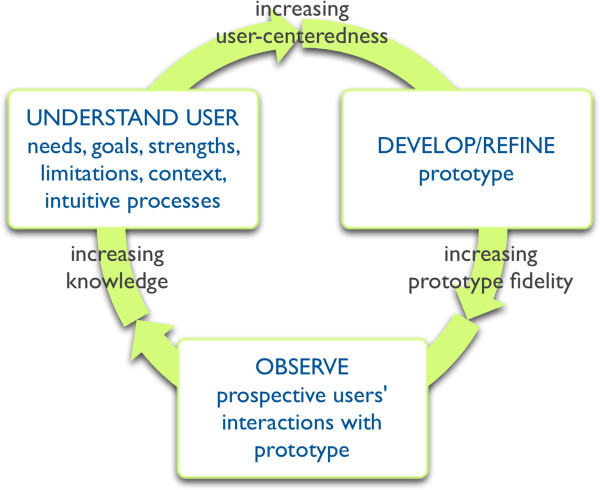
“Figure 1 shows a visual depiction of user-centered design, distilled from seminal work in the field of Human Factors [18,20,22,31-33].”
MethodElwyn, G. (2006) · BMJ · doi:10.1136/bmj.38926.629329.ae · Cited by 1,824 · cited 1×
“However, due to the lack of a robust evidence base from which to draw conclusions about best practices, practical guidance is minimal and vague [11-14].”
BackgroundAn integrative model of shared decision making in medical encounters
Makoul, G., & Clayman, M. L. (2006) · Patient Education and Counseling · doi:10.1016/j.pec.2005.06.010 · Cited by 1,621 · cited 1×
“…intended to be used by patients to complement information and counseling from a health-care professional in the process of shared decision-making [8] and provide a means for clinicians and patients to collaboratively incorporate their expertise, insights, and views in order to make…”
BackgroundTalking about tactile experiences
Obrist, M., Seah, S. A., & Subramanian, S. (2013) · Proceedings of the SIGCHI Conference on Human Factors in Computing Systems · doi:10.1145/2470654.2466220 · Cited by 1,613
Brett, J., Staniszewska, S., Mockford, C., Herron‐Marx, S., Hughes, J., Tysall, C., & Suleman, R. (2014) · Health Expectations · doi:10.1111/j.1369-7625.2012.00795.x · Cited by 1,598 · cited 1×
“Patient partnership in research teams is increasingly encouraged or required by funding organizations [3-6].”
Background(1987) · Andalas University Repository (Andalas University) · Cited by 1,584
Decision aids for people facing health treatment or screening decisions
Stacey, D., Légaré, F., Col, N. F., Bennett, C. L., Barry, M. J., Eden, K. B., Holmes-Rovner, M., Llewellyn-Thomas, H., Lyddiatt, A., Thomson, R., et al. (2014) · Cochrane Database of Systematic Reviews · doi:10.1002/14651858.cd001431.pub4 · Cited by 1,471 · cited 7×
“Patient decision aids are structured tools, often booklets or websites, that aim to provide unbiased, evidence-based information and guidance to patients making health decisions [7].”
BackgroundMethodInfluentialSelf-citation
Research works printed but not linked: 4
- 3. Topic of conversation. Den Haag. Netherlands: Dutch organization for health and innovation in healthcare; 2010. p. 1-17.
- 13. Coulter A, Kryworuchko J, Mullen PD, Ng CJ, Stillwell D, van der Weijden T. Chapter A: using a systematic development process. In: Volk RJ, Llewellyn-Thomas HA, editors. 2012 update of the international patient decision Aid standards (IPDAS) Collaboration's background document. 2012. p. 1-16. Available at: http://ipdas.ohri.ca/IPDAS-Chapter-A.pdf.
- 22. Iso DIS. 9241-210:2010: ergonomics of human-system interaction-part 210: human-centred design for interactive systems (formerly known as 13407). Switzerland: International Standards Organization; 2010.
- 28. Garrett JJ. Elements of user experience. 2nd ed. New Riders: Berkeley, CA; 2011.
Cited by
Items 201–210 of 210
Hickey, K. E., Ivankovic, V., Boushey, R. P., & Apte, S. S. (2025) · Clinics in Colon and Rectal Surgery · doi:10.1055/a-2760-7307
Influence de l'intolérance à l'incertitude sur la prise de décision dans le domaine de la santé
Brun, C. (2023) · theses.fr (ABES) · doi:10.70675/9f3530c6z1d12z46a9zb67ezc5188fa3b55e
Savard, I., Léveillée, A.-K., Dellazizzo, L., Latulippe, K., Plante, P., Mendoza, G. A. A., Roy, J., & Daniel Lemire, A. (2026) · Médiations et médiatisations · doi:10.52358/mm.vi23.504
Mingming, W., Duh, H. B., Zhang, X., Mei, Y., Wang, H., Jiang, H., & Zhou, Z. (2026) · CHI Conference on Human Factors in Computing Systems · doi:10.1145/3772318.3790362
Chen, C., Huang, J., Chen, R., Lv, M., Huang, M., Guo, L., & Lin, Y. (2026) · European Journal of Cancer Care · doi:10.1155/ecc/7668282
Using agile development methodology to develop a decision aid for complex rectal cancer
Williams, A., Woods, F. E. R., O’Neill, C., Hutchings, H. A., Quyn, A., Gilbert, A., Duff, M., Jenkins, J. T., Taylor, C., Griffiths, B., et al. (2026) · European Journal of Surgical Oncology · doi:10.1016/j.ejso.2026.111813
Nalavenkata, S. B., Bergengren, O., Lynch, K., Emard, N., Austria, M. D., Martin, S., Ogbennaya, G., Dualeh, K., Stevanović, K., Patel, M. I., et al. (2026) · BMJ Open · doi:10.1136/bmjopen-2024-095951 · Cited by 1
Self-citationUser-Centered Design as a Harassment Prevention Strategy for Networking Events
(2026) · New Design Ideas · doi:10.62476/ndi102455
Patel, K., Jahanzeb, M., Boccia, R., Olson, N., Nadkarni, R., Naidu, D., Kodali, A., Clinton, N., Lozano, R., Anandpura, N., et al. (2026) · NCODA Oncology and Hematology Meeting Abstracts · doi:10.67209/yngr8908
Shrivastava, S., & Ramkumar, J. (2026) · Lecture notes in mechanical engineering · doi:10.1007/978-981-95-2298-9_43
Metadata
- Authors
- Witteman, H. O., Dansokho, S. C., Colquhoun, H., Coulter, A., Dugas, M., Fagerlin, A., Giguere, A. M., Glouberman, S., Haslett, L., Hoffman, A., Ivers, N., Légaré, F., Légaré, J., Levin, C., Lopez, K., Montori, V. M., Provencher, T., Renaud, J.-S., Sparling, K., Stacey, D., Vaisson, G., Volk, R. J., & Witteman, W.
- Affiliations
- Université Laval (CA)
- University of Oxford (GB)
- University of Michigan (US)
- Hôpital du Saint-Sacrement (CA)
- Dartmouth Institute for Health Policy and Clinical Practice (US)
- University of Toronto (CA)
- Centre hospitalier universitaire de Québec (CA)
- Healthwise (US)
- University of Ottawa (CA)
- The University of Texas MD Anderson Cancer Center (US)
- Corresponding author
- Witteman, Holly O
- ORCID
- Venue
- Systematic Reviews
- Published
- 2015-01-26
- Volume
- 4
- Issue
- 1
- Pages
- 11-11
- ISSN
- 2046-4053 (ISSN-L)
- PMC
- PMC4328638
- OpenAlex
- W2117757460
- Semantic Scholar
- dadd30861520033b7f49f7cc9644c21f6d327f7d
- Cited by
- 202
- References
- 42
- Citations by year
- 2026: 9 · 2025: 12 · 2024: 10 · 2023: 22 · 2022: 13 · 2021: 34 · 2020: 22 · 2019: 21 · 2018: 28 · 2017: 13 · 2016: 13 · 2015: 5
- FWCI
- 3.53
- Type
- journal article
- Language
- en
- Open access
- gold
- doi.org
- Licence
- Locations
- Systematic Reviews (publishedVersion, cc-by)
- Europe PMC (PubMed Central) (publishedVersion, cc-by)
- PubMed Central (publishedVersion, cc-by)
- PubMed (publishedVersion)
- TSpace (University of Toronto) (acceptedVersion)
- Funders
- Patient-Centered Outcomes Research Institute (ME-1306-03174)
- University of Ottawa
- University of Toronto
- Canadian Institutes of Health Research
- Department of Family and Community Medicine, University of Toronto
- National Institute on Aging
- Topics
- Health Sciences › Health Professions › General Health Professions › Patient-Provider Communication in Healthcare
- Health Sciences › Health Professions › General Health Professions › Mental Health and Patient Involvement
- Health Sciences › Health Professions › General Health Professions › Health Policy Implementation Science
- Keywords
- patient decision aids, user-centered design, shared decision-making, human-centered design, patient-centered care, stakeholder engagement, best practices, health decision-making
- MeSH terms
- Systematic Reviews as Topic, Decision Making, Decision Support Techniques, Health Services Research, Humans, Patient Education as Topic, Patient Participation, Patient-Centered Care
About these checks
Registry, retraction, Cites and statistics results are computed, not judged, with one exception: a printed reference that no index lists is read once by a model before it counts as a citation error. Claims are extracted by a model and kept only when their quote appears verbatim in the text; each cited source is then checked, with a model’s help, for whether it says what the claim relies on. Those verdicts can be wrong — read the claim’s quote and the cited source before relying on one.
Statistics and arithmetic are recomputed, not judged.
Confidence bands are shown only for fields calibrated on our annotated test set. None is calibrated yet, so no band is shown.
What counts as a claim ›How we measure confidence ›How we check this ›
Are you an author, or do you see a problem with this page? Request a review
Data sources
Bibliographic data: Semantic Scholar, OpenAlex, Crossref.
Contains information from the Semantic Scholar Academic Graph Datasets, made available under the ODC Attribution License (ODC-BY 1.0).
Semantic Scholar’s data is described in: Kinney, R., et al. (2023). The Semantic Scholar Open Data Platform. arXiv:2301.10140.
