

The DOI matches its Crossref record; 69 of the 69 references it cites were found in a registry or an index.
Balancing glycolytic flux: the role of 6-phosphofructo-2-kinase/fructose 2,6-bisphosphatases in cancer metabolism
Open accessAbstract
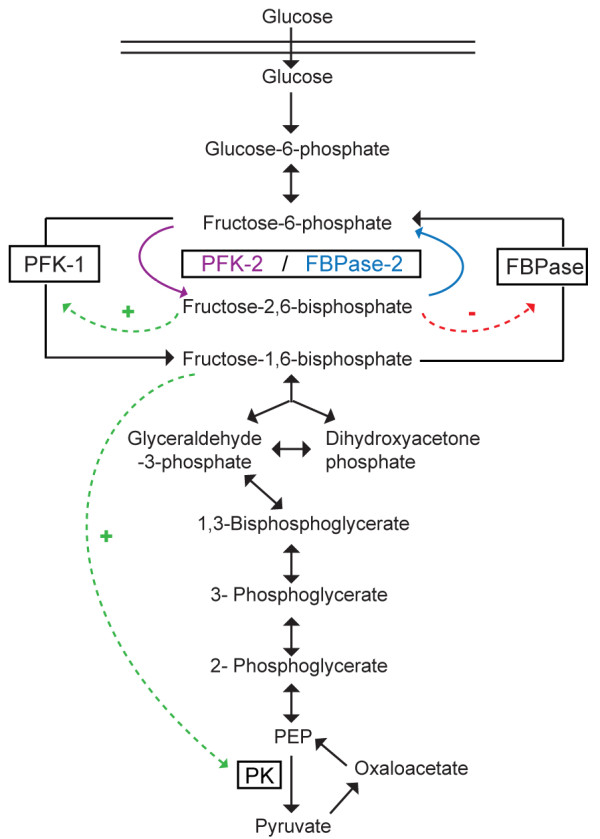
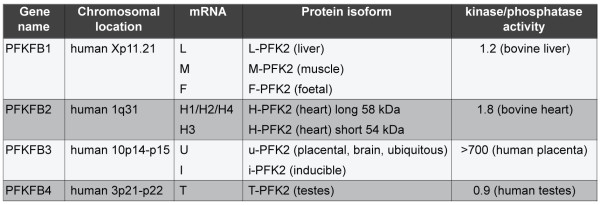
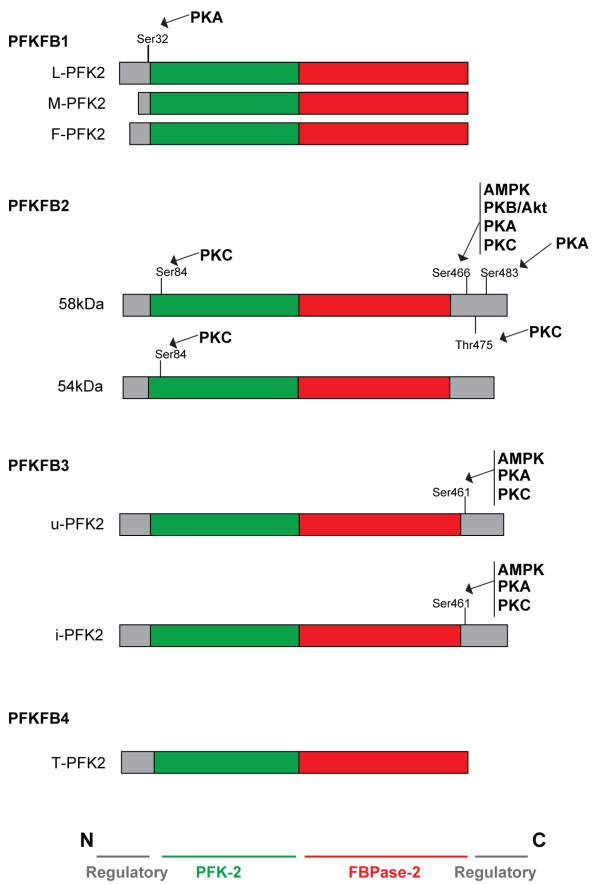
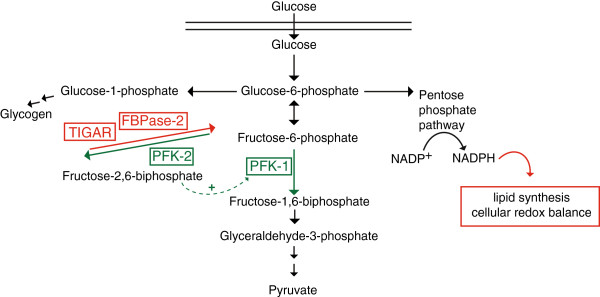
The increased glucose metabolism in cancer cells is required to fulfill their high energetic and biosynthetic demands. Changes in the metabolic activity of cancer cells are caused by the activation of oncogenes or loss of tumor suppressors. They can also be part of the metabolic adaptations to the conditions imposed by the tumor microenvironment, such as the hypoxia response. Among the metabolic enzymes that are modulated by these factors are the 6-phosphofructo-2-kinase/fructose 2,6-bisphosphatases (PFKFBs), a family of bifunctional enzymes that control the levels of fructose 2,6-bisphosphate (Fru-2,6-P2). This metabolite is important for the dynamic regulation of glycolytic flux by allosterically activating the rate-limiting enzyme of glycolysis phosphofructokinase-1 (PFK-1). Therapeutic strategies designed to alter the levels of this metabolite are likely to interfere with the metabolic balance of cancer cells, and could lead to a reduction in cancer cell proliferation, invasiveness and survival. This article will review our current understanding of the role of PFKFB proteins in the control of cancer metabolism and discuss the emerging interest in these enzymes as potential targets for the development of antineoplastic agents.
Overview
The claims and statistics of this paper haven’t been checked yet.
Run the check — free, no account needed. It reads the open-access text and checks the sources it cites.
Integrity signals
Registry
Cites
Statistics
Figures
Verification
Claims the paper makes
The claims and statistics of this paper haven’t been checked yet.
Run the check — free, no account needed. It reads the open-access text and checks the sources it cites.
Claims other papers make about this one
Each is checked against this paper’s own text: does it say what the citing paper says it does?
The source backs part of the claim, not all of it — or backs it for a different population, condition or comparison.
In the citing paper
“The PFK-2/FBPase-2 family comprises several enzyme isoforms, PFKFB1, PFKFB2, PFKFB3 and PFKFB4, all of which are induced by HIF-1 under hypoxic conditions [101].”
From HIF-1-Independent Mechanisms Regulating Metabolic Adaptation in Hypoxic Cancer Cells (2021) · cites this paper as [101]
Experimental — accuracy not yet measured
Self-check
Percentages, sums and reported differences re-computed from the paper’s own numbers.
The self-check needs the paper’s full text.
Citations
Cites
Warburg, O. (1956) · Science · doi:10.1126/science.123.3191.309 · Cited by 13,425
Targeting HIF-1 for cancer therapy
Semenza, G. L. (2003) · Nature Reviews Cancer · doi:10.1038/nrc1187 · Cited by 6,717 · cited 1×
“Adaptation to hypoxic conditions is largely mediated by HIF, a transcription factor that regulates a distinct transcriptional program [40].”
BackgroundThe Biology of Cancer: Metabolic Reprogramming Fuels Cell Growth and Proliferation
DeBerardinis, R. J., Lum, J. J., Hatzivassiliou, G., & Thompson, C. B. (2008) · Cell Metabolism · doi:10.1016/j.cmet.2007.10.002 · Cited by 4,088
TIGAR, a p53-Inducible Regulator of Glycolysis and Apoptosis
Bensaad, K., Tsuruta, A., Selak, M. A., Vidal, M. N. C., Nakano, K., Bartrons, R., Gottlieb, E., & Vousden, K. H. (2006) · Cell · doi:10.1016/j.cell.2006.05.036 · Cited by 2,019
Cancer's Molecular Sweet Tooth and the Warburg Effect
Kim, J., & Dang, C. V. (2006) · Cancer Research · doi:10.1158/0008-5472.can-06-1501 · Cited by 1,233
Oncogenic alterations of metabolism
Dang, C. V., & Semenza, G. L. (1999) · Trends in Biochemical Sciences · doi:10.1016/s0968-0004(98)01344-9 · Cited by 1,106
Deregulation of Glucose Transporter 1 and Glycolytic Gene Expression by c-Myc
Osthus, R. C., Shim, H., Kim, S., Li, Q., Reddy, R., Mukherjee, M., Xu, Y., Wonsey, D. R., Lee, L. A., & Dang, C. V. (2000) · Journal of Biological Chemistry · doi:10.1074/jbc.c000023200 · Cited by 876
Marsin, A.-S., Bertrand, L., Rider, M. H., Deprez, J., Beauloye, C., Vincent, M. F., den Berghe, G. V., Carling, D., & Hue, L. (2000) · Current Biology · doi:10.1016/s0960-9822(00)00742-9 · Cited by 853
p53 regulates biosynthesis through direct inactivation of glucose-6-phosphate dehydrogenase
Jiang, P., Du, W., Wang, X., Mancuso, A., Gao, X., Wu, M., & Yang, X. (2011) · Nature Cell Biology · doi:10.1038/ncb2172 · Cited by 834
Flier, J. S., Mueckler, M., Usher, P., & Lodish, H. F. (1987) · Science · doi:10.1126/science.3103217 · Cited by 783
Cited by
Sorted by citations
Metformin—mode of action and clinical implications for diabetes and cancer
Pernicova, I., & Korbonits, M. (2014) · Nature Reviews Endocrinology · doi:10.1038/nrendo.2013.256 · Cited by 1,393
Reprogramming glucose metabolism in cancer: can it be exploited for cancer therapy?
Hay, N. (2016) · Nature reviews. Cancer · doi:10.1038/nrc.2016.77 · Cited by 1,152
Tumor glycolysis, an essential sweet tooth of tumor cells
Paul, S., Ghosh, S., & Kumar, S. (2022) · Seminars in Cancer Biology · doi:10.1016/j.semcancer.2022.09.007 · Cited by 449
Four Key Steps Control Glycolytic Flux in Mammalian Cells
Tanner, L. B., Goglia, A. G., Wei, M. H., Sehgal, T., Parsons, L. R., Park, J. O., White, E., Toettcher, J. E., & Rabinowitz, J. D. (2018) · Cell Systems · doi:10.1016/j.cels.2018.06.003 · Cited by 383
Endothelial PFKFB3 Plays a Critical Role in Angiogenesis
Xu, Y., An, X., Guo, X., Habtetsion, T. G., Wang, Y., Xu, X., Kandala, S., Li, Q., Li, H., Zhang, C., et al. (2014) · Arteriosclerosis Thrombosis and Vascular Biology · doi:10.1161/atvbaha.113.303041 · Cited by 256
Metadata
- Authors
- Ros, S., & Schulze, A.
- Affiliations
- Cancer Research UK (GB)
- Corresponding author
- Schulze, Almut
- ORCID
- Schulze, Almut
- Venue
- Cancer & Metabolism
- Published
- 2013-02-04
- Volume
- 1
- Issue
- 1
- Pages
- 8-8
- ISSN
- 2049-3002 (ISSN-L)
- PMC
- PMC4178209
- OpenAlex
- W2106223802
- Cited by
- 269
- References
- 69
- Citations by year
- 2026: 9 · 2025: 21 · 2024: 29 · 2023: 32 · 2022: 31 · 2021: 26 · 2020: 15 · 2019: 20 · 2018: 17 · 2017: 17 · 2016: 19 · 2015: 20 · 2014: 11 · 2013: 2
- FWCI
- 6.22
- Type
- journal article
- Language
- en
- Open access
- gold
- doi.org
- Licence
- Locations
- Cancer & Metabolism (publishedVersion, cc-by)
- PubMed Central (publishedVersion, cc-by)
- PubMed (publishedVersion)
- Apollo (University of Cambridge) (submittedVersion, cc-by)
- Apollo (cc-by)
- Funders
- Cancer Research UK
- Topics
- Life Sciences › Biochemistry, Genetics and Molecular Biology › Cancer Research › Cancer, Hypoxia, and Metabolism
- Life Sciences › Biochemistry, Genetics and Molecular Biology › Molecular Biology › Metabolism, Diabetes, and Cancer
- Life Sciences › Biochemistry, Genetics and Molecular Biology › Molecular Biology › Biochemical and Molecular Research
- Keywords
- 6-phosphofructo-2-kinase/fructose-2,6-bisphosphatase, fructose-2,6-bisphosphate, glycolytic flux, tumor microenvironment, hypoxia response, oncogene activation, tumor suppressor loss
About these checks
Registry, retraction, Cites and statistics results are computed, not judged, with one exception: a printed reference that no index lists is read once by a model before it counts as a citation error. Claims are extracted by a model and kept only when their quote appears verbatim in the text; each cited source is then checked, with a model’s help, for whether it says what the claim relies on. Those verdicts can be wrong — read the claim’s quote and the cited source before relying on one.
Statistics and arithmetic are recomputed, not judged.
Confidence bands are shown only for fields calibrated on our annotated test set. None is calibrated yet, so no band is shown.
What counts as a claim ›How we measure confidence ›How we check this ›
Are you an author, or do you see a problem with this page? Request a review
