

The DOI matches its Crossref record; 23 of the 23 references it cites were found in a registry or an index.
AceView: a comprehensive cDNA-supported gene and transcripts annotation
Open accessAbstract
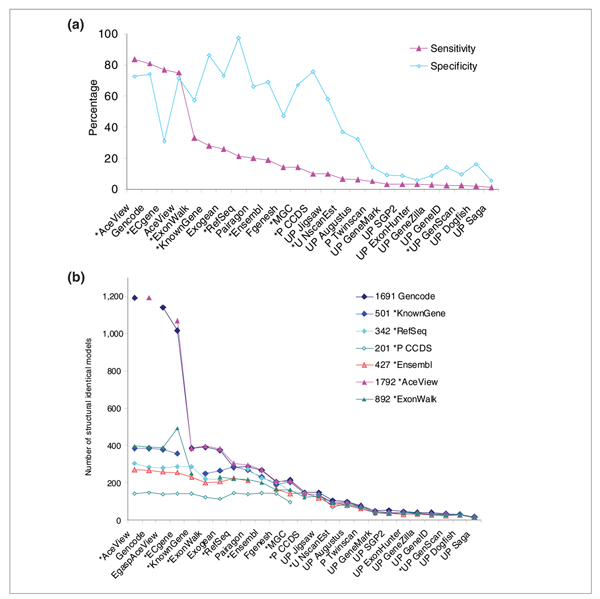
Background: Regions covering one percent of the genome, selected by ENCODE for extensive analysis, were annotated by the HAVANA/Gencode group with high quality transcripts, thus defining a benchmark. The ENCODE Genome Annotation Assessment Project (EGASP) competition aimed at reproducing Gencode and finding new genes. The organizers evaluated the protein predictions in depth. We present a complementary analysis of the mRNAs, including alternative transcript variants. Results: We evaluate 25 gene tracks from the University of California Santa Cruz (UCSC) genome browser. We either distinguish or collapse the alternative splice variants, and compare the genomic coordinates of exons, introns and nucleotides. Whole mRNA models, seen as chains of introns, are sorted to find the best matching pairs, and compared so that each mRNA is used only once. At the mRNA level, AceView is by far the closest to Gencode: the vast majority of transcripts of the two methods, including alternative variants, are identical. At the protein level, however, due to a lack of experimental data, our predictions differ: Gencode annotates proteins in only 41% of the mRNAs whereas AceView does so in virtually all. We describe the driving principles of AceView, and how, by performing hand-supervised automatic annotation, we solve the combinatorial splicing problem and summarize all of GenBank, dbEST and RefSeq into a genome-wide non-redundant but comprehensive cDNA-supported transcriptome. AceView accuracy is now validated by Gencode. Conclusion: Relative to a consensus mRNA catalog constructed from all evidence-based annotations, Gencode and AceView have 81% and 84% sensitivity, and 74% and 73% specificity, respectively. This close agreement validates a richer view of the human transcriptome, with three to five times more transcripts than in UCSC Known Genes (sensitivity 28%), RefSeq (sensitivity 21%) or Ensembl (sensitivity 19%).
Overview
The claims and statistics of this paper haven’t been checked yet.
Free: it reads the open-access text and checks the first 5 claims that cite a source we can check. Create a free account to check every claim.
Integrity signals
Registry
Cites
Statistics
Figures
Verification
Claims the paper makes
The claims and statistics of this paper haven’t been checked yet.
Free: it reads the open-access text and checks the first 5 claims that cite a source we can check. Create a free account to check every claim.
Claims other papers make about this one
Each is checked against this paper’s own text: does it say what the citing paper says it does?
The check wasn’t confident either way, so it gives no verdict — never disputed.
In the citing paper
“We also observed substantial but 12% lower agreement with TopHat2, regardless of whether it was run with or without gene model guided alignment 17 (Supplementary Figure 5a), giving a total of 1,110,550 junctions consistently found by all five analysis variants.”
From A comprehensive assessment of RNA-seq accuracy, reproducibility and information content by the Sequencing Quality Control Consortium (2014) · cites this paper as [17]
Experimental — accuracy not yet measured
Self-check
Percentages, sums and reported differences re-computed from the paper’s own numbers.
The self-check needs the paper’s full text.
Citations
Cites
Finishing the euchromatic sequence of the human genome
International Human Genome Sequencing Consortium (2004) · Nature · doi:10.1038/nature03001 · Cited by 4,971
The ENCODE (ENCyclopedia Of DNA Elements) Project
(2004) · Science · doi:10.1126/science.1105136 · Cited by 2,390 · cited 1×
“project [1], launched by the National Human Genome Research Institute, encourages a concentration of international efforts and expertise on 1% of the human genome, in 44 carefully selected regions taken as representative of the whole genome, in the hope that mature annotation techniques will be developed, validated, a…”
BackgroundThe UCSC Genome Browser Database: update 2006
Hinrichs, A. S. (2006) · Nucleic Acids Research · doi:10.1093/nar/gkj144 · Cited by 1,646 · cited 1×
“The UCSC genome browser [2] provides fast and open access to a highly configurable view of a wealth of sequence-based genome annotations.”
BackgroundFrom Birth to Death: The Complex Lives of Eukaryotic mRNAs
Moore, M. J. (2005) · Science · doi:10.1126/science.1111443 · Cited by 1,010 · cited 4×
“Indeed, activation of mRNA degradation by this pathway requires a pioneering round of translation that, due to the dual role of NMD proteins in activating translation, should be very efficient on transcripts still decorated with exon junction complexes (reviewed in [10,11]).”
BackgroundInfluentialComplete sequencing and characterization of 21,243 full-length human cDNAs
Ota, T., Suzuki, Y., Nishikawa, T., Otsuki, T., Sugiyama, T., Irie, R., Wakamatsu, A., Hayashi, K., Sato, H., Nagai, K., et al. (2004) · Nature Genetics · doi:10.1038/ng1285 · Cited by 925 · cited 1×
“Indeed, we compared the high quality full-length cDNA libraries made by Sugano using the oligo-capping method in either the nematode Caenorhabditis elegans or human (all sequences are in GenBank [7,9]).”
MethodPushing the limits of the scanning mechanism for initiation of translation
Kozak, M. (2002) · Gene · doi:10.1016/s0378-1119(02)01056-9 · Cited by 919 · cited 3×
“But it is difficult to conceive how the ribosomes would be aware of these rules, instead of following the scanning mechanism experimentally established by Kozak [14].”
BackgroundInfluentialMendell, J. T., Sharifi, N. A., Meyers, J. L., Martinez-Murillo, F., & Dietz, H. C. (2004) · Nature Genetics · doi:10.1038/ng1429 · Cited by 876
Kimura, K., Wakamatsu, A., Suzuki, Y., Ota, T., Nishikawa, T., Yamashita, R., Yamamoto, J.-I., Sekine, M., Tsuritani, K., Wakaguri, H., et al. (2006) · Genome Research · doi:10.1101/gr.4039406 · Cited by 506 · cited 1×
“…almost linearly with new cDNA sequences: the addition to GenBank in January 2006 of close to two million 5’ complete capped ESTs by the Japanese FLJ group [26] proportionately increased by 26% the number of alternative variants, and added 7% new spliced genes to the AceView collection [7].”
BackgroundKozak, M. (1989) · Molecular and Cellular Biology · doi:10.1128/mcb.9.11.5073 · Cited by 478 · cited 1×
“But if the mRNA appears to be complete, the CDS starts at the first AUG codon, unless there is, in the correct environment, an in frame NUG or ANG codon [14,17-20] at least 180 bp upstream of the first AUG.”
BackgroundEGASP: the human ENCODE Genome Annotation Assessment Project.
Guigó, R., Flicek, P., Abril, J. F., Reymond, A., Lagarde, J., Denœud, F., Antonarakis, S. E., Ashburner, M., Bajić, V. B., Birney, E., et al. (2006) · Genome biology · doi:10.1186/gb-2006-7-s1-s2 · Cited by 368
Research works printed but not linked: 1
- The AceView genes. [http://www.ncbi.nlm.nih.gov/IEB/Research/Acembly]
Cited by
Zhang, Y., Chen, K., Sloan, S. A., Bennett, M. L., Scholze, A. R., O'Keeffe, S., Phatnani, H. P., Guarnieri, P., Caneda, C., Ruderisch, N., et al. (2014) · The Journal of Neuroscience · doi:10.1523/jneurosci.1860-14.2014 · Cited by 4,875
“…current genome; we detected 26 novel transcripts with expression levels of FPKM 5 that were previously unannotated in UCSC Genome Browser (Meyer et al., 2013), Ensembl (Flicek et al., 2012), Vega (Ashurst et al., 2005), and AceView (Thierry-Mieg and Thierry-Mieg, 2006) databases (data not shown).”
BackgroundGENCODE: The reference human genome annotation for The ENCODE Project
Harrow, J., Frankish, A., Gonzalez, J. M., Tapanari, E., Diekhans, M., Kokocinski, F., Aken, B. L., Barrell, D., Zadissa, A., Searle, S., et al. (2012) · Genome Research · doi:10.1101/gr.135350.111 · Cited by 4,585
“Excluding single exon loci predicted by AceView from this analysis, the number of AceView gene loci is much closer to the number in other gene sets (Fig.”
MethodInfluentialComprehensive Analysis of mRNA Methylation Reveals Enrichment in 3′ UTRs and near Stop Codons
Meyer, K. D., Saletore, Y., Zumbo, P., Elemento, O., Mason, C. E., & Jaffrey, S. R. (2012) · Cell · doi:10.1016/j.cell.2012.05.003 · Cited by 4,223
Using native and syntenically mapped cDNA alignments to improve de novo gene finding
Stanke, M., Diekhans, M., Baertsch, R., & Haussler, D. (2008) · Bioinformatics · doi:10.1093/bioinformatics/btn013 · Cited by 2,605
“Expression-based annotation pipelines that report alternative splicing are ENSEMBL (Curwen et al., 2004), Aceview (Thierry-Mieg and Thierry-Mieg, 2006) and EuGÈNE-M.”
MethodThe Arabidopsis Information Resource (TAIR): improved gene annotation and new tools
Lamesch, P., Berardini, T. Z., Li, D., Swarbreck, D., Wilks, C., Sasidharan, R., Muller, R., Dreher, K., Alexander, D. L., Garcia-Hernandez, M., et al. (2012) · Nucleic Acids Research · doi:10.1093/nar/gkr1090 · Cited by 2,399
“Alternative genome annotation datasets derived from several different software packages, including Gnomon (http://www.ncbi.nlm.nih.gov/projects/genome/guide/ gnomon.shtml), (predictions provided by Tatiana Tatusova and Alexandre Souvorov, NCBI), EuGene (27,32) (gene predictions provided by Sébastien Aubourg, Unité d…”
Method
Metadata
- Authors
- Thierry-Mieg, D., & Thierry-Mieg, J.
- Venue
- Genome Biology
- Published
- 2006-08-07
- Volume
- 7
- Issue
- S1
- Pages
- S12.1-14
- ISSN
- 1465-6906 (ISSN-L)
- 1474-760X
- PMC
- PMC1810549
- OpenAlex
- W2095907724
- Cited by
- 629
- References
- 23
- Citations by year
- 2025: 10 · 2024: 22 · 2023: 21 · 2022: 22 · 2021: 26 · 2020: 23 · 2019: 15 · 2018: 21 · 2017: 45 · 2016: 39 · 2015: 40 · 2014: 58 · 2013: 47 · 2012: 57
- FWCI
- 12.36
- Type
- journal article
- Language
- en
- Open access
- gold
- doi.org
- Licence
- cc-by
- creativecommons.org/licenses/by/2.0/ (tdm)
- creativecommons.org/licenses/by/2.0/ (vor)
- Locations
- Genome biology (publishedVersion, cc-by)
- PubMed Central (publishedVersion, cc-by)
- PubMed (publishedVersion)
- Funders
- National Institutes of Health
- U.S. National Library of Medicine
- Topics
- Life Sciences › Biochemistry, Genetics and Molecular Biology › Molecular Biology › Genomics and Phylogenetic Studies
- Life Sciences › Biochemistry, Genetics and Molecular Biology › Molecular Biology › RNA Research and Splicing
- Life Sciences › Biochemistry, Genetics and Molecular Biology › Molecular Biology › Genomics and Chromatin Dynamics
- Keywords
- genome annotation, transcript annotation, alternative splicing, human transcriptome, ENCODE, GENCODE, UCSC Genome Browser, exon-intron structure
- MeSH terms
- Exons, Genes, Humans, Introns, Models, Genetic, Nucleotides, RNA, Messenger, Software, Sequence Analysis, DNA, Sequence Analysis, RNA, DNA, Complementary, Computational Biology, Sequence Analysis, Protein, Genomics
About these checks
Registry, retraction, Cites and statistics results are computed, not judged, with one exception: a printed reference that no index lists is read once by a model before it counts as a citation error. Claims are extracted by a model and kept only when their quote appears verbatim in the text; each cited source is then checked, with a model’s help, for whether it says what the claim relies on. Those verdicts can be wrong — read the claim’s quote and the cited source before relying on one.
Statistics and arithmetic are recomputed, not judged.
Confidence bands are shown only for fields calibrated on our annotated test set. None is calibrated yet, so no band is shown.
What counts as a claim ›How we measure confidence ›How we check this ›
Are you an author, or do you see a problem with this page? Request a review
How to cite
Cite CoChat for the checks on this page, and the paper for its own findings.
- This page
- CoChat. (2026). Citation check: AceView: a comprehensive cDNA-supported gene and transcripts annotation. https://app.cochat.ai/papers/10.1186/gb-2006-7-s1-s12
- The paper
- Thierry-Mieg, D., & Thierry-Mieg, J. (2006). AceView: a comprehensive cDNA-supported gene and transcripts annotation. Genome Biology. https://doi.org/10.1186/gb-2006-7-s1-s12
Data sources
Bibliographic data: Semantic Scholar, OpenAlex, Crossref.
Contains information from the Semantic Scholar Academic Graph Datasets, made available under the ODC Attribution License (ODC-BY 1.0).
Semantic Scholar’s data is described in: Kinney, R., et al. (2023). The Semantic Scholar Open Data Platform. arXiv:2301.10140.
