

AceView: a comprehensive cDNA-supported gene and transcripts annotation
Open accessThe DOI matches its Crossref record; 23 of the 23 references it cites were found in a registry or an index.
Abstract
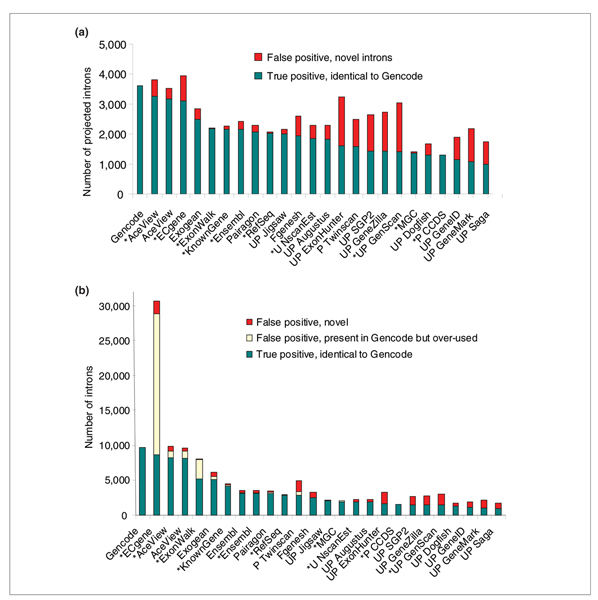
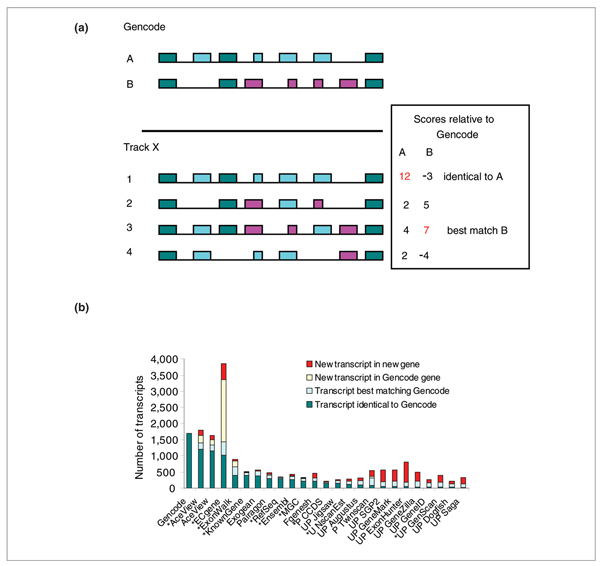
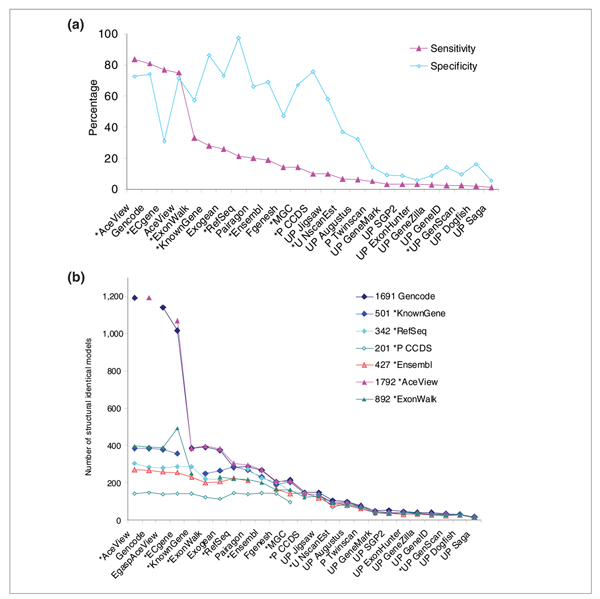
Background: Regions covering one percent of the genome, selected by ENCODE for extensive analysis, were annotated by the HAVANA/Gencode group with high quality transcripts, thus defining a benchmark. The ENCODE Genome Annotation Assessment Project (EGASP) competition aimed at reproducing Gencode and finding new genes. The organizers evaluated the protein predictions in depth. We present a complementary analysis of the mRNAs, including alternative transcript variants. Results: We evaluate 25 gene tracks from the University of California Santa Cruz (UCSC) genome browser. We either distinguish or collapse the alternative splice variants, and compare the genomic coordinates of exons, introns and nucleotides. Whole mRNA models, seen as chains of introns, are sorted to find the best matching pairs, and compared so that each mRNA is used only once. At the mRNA level, AceView is by far the closest to Gencode: the vast majority of transcripts of the two methods, including alternative variants, are identical. At the protein level, however, due to a lack of experimental data, our predictions differ: Gencode annotates proteins in only 41% of the mRNAs whereas AceView does so in virtually all. We describe the driving principles of AceView, and how, by performing hand-supervised automatic annotation, we solve the combinatorial splicing problem and summarize all of GenBank, dbEST and RefSeq into a genome-wide non-redundant but comprehensive cDNA-supported transcriptome. AceView accuracy is now validated by Gencode. Conclusion: Relative to a consensus mRNA catalog constructed from all evidence-based annotations, Gencode and AceView have 81% and 84% sensitivity, and 74% and 73% specificity, respectively. This close agreement validates a richer view of the human transcriptome, with three to five times more transcripts than in UCSC Known Genes (sensitivity 28%), RefSeq (sensitivity 21%) or Ensembl (sensitivity 19%).
Overview
The claims and statistics of this paper haven’t been checked yet.
Free: it reads the open-access text and checks the first 5 claims that cite a source we can check. Create a free account to check every claim.
Integrity signals
Registry
Cites
Statistics
Figures
Verification
Claims the paper makes
The claims and statistics of this paper haven’t been checked yet.
Free: it reads the open-access text and checks the first 5 claims that cite a source we can check. Create a free account to check every claim.
Claims other papers make about this one
Each is checked against this paper’s own text: does it say what the citing paper says it does?
The check wasn’t confident either way, so it gives no verdict — never disputed.
In the citing paper
“We also observed substantial but 12% lower agreement with TopHat2, regardless of whether it was run with or without gene model guided alignment 17 (Supplementary Figure 5a), giving a total of 1,110,550 junctions consistently found by all five analysis variants.”
From A comprehensive assessment of RNA-seq accuracy, reproducibility and information content by the Sequencing Quality Control Consortium (2014) · cites this paper as [17]
Experimental — accuracy not yet measured
Self-check
Percentages, sums and reported differences re-computed from the paper’s own numbers.
The self-check needs the paper’s full text.
Citations
Cites
Finishing the euchromatic sequence of the human genome
International Human Genome Sequencing Consortium (2004) · Nature · doi:10.1038/nature03001 · Cited by 4,971
The ENCODE (ENCyclopedia Of DNA Elements) Project
(2004) · Science · doi:10.1126/science.1105136 · Cited by 2,390 · cited 1×
“project [1], launched by the National Human Genome Research Institute, encourages a concentration of international efforts and expertise on 1% of the human genome, in 44 carefully selected regions taken as representative of the whole genome, in the hope that mature annotation techniques will be developed, validated, a…”
BackgroundThe UCSC Genome Browser Database: update 2006
Hinrichs, A. S. (2006) · Nucleic Acids Research · doi:10.1093/nar/gkj144 · Cited by 1,646 · cited 1×
“The UCSC genome browser [2] provides fast and open access to a highly configurable view of a wealth of sequence-based genome annotations.”
BackgroundFrom Birth to Death: The Complex Lives of Eukaryotic mRNAs
Moore, M. J. (2005) · Science · doi:10.1126/science.1111443 · Cited by 1,010 · cited 4×
“Indeed, activation of mRNA degradation by this pathway requires a pioneering round of translation that, due to the dual role of NMD proteins in activating translation, should be very efficient on transcripts still decorated with exon junction complexes (reviewed in [10,11]).”
BackgroundInfluentialComplete sequencing and characterization of 21,243 full-length human cDNAs
Ota, T., Suzuki, Y., Nishikawa, T., Otsuki, T., Sugiyama, T., Irie, R., Wakamatsu, A., Hayashi, K., Sato, H., Nagai, K., et al. (2004) · Nature Genetics · doi:10.1038/ng1285 · Cited by 925 · cited 1×
“Indeed, we compared the high quality full-length cDNA libraries made by Sugano using the oligo-capping method in either the nematode Caenorhabditis elegans or human (all sequences are in GenBank [7,9]).”
MethodPushing the limits of the scanning mechanism for initiation of translation
Kozak, M. (2002) · Gene · doi:10.1016/s0378-1119(02)01056-9 · Cited by 919 · cited 3×
“But it is difficult to conceive how the ribosomes would be aware of these rules, instead of following the scanning mechanism experimentally established by Kozak [14].”
BackgroundInfluentialMendell, J. T., Sharifi, N. A., Meyers, J. L., Martinez-Murillo, F., & Dietz, H. C. (2004) · Nature Genetics · doi:10.1038/ng1429 · Cited by 876
Kimura, K., Wakamatsu, A., Suzuki, Y., Ota, T., Nishikawa, T., Yamashita, R., Yamamoto, J.-I., Sekine, M., Tsuritani, K., Wakaguri, H., et al. (2006) · Genome Research · doi:10.1101/gr.4039406 · Cited by 506 · cited 1×
“…almost linearly with new cDNA sequences: the addition to GenBank in January 2006 of close to two million 5’ complete capped ESTs by the Japanese FLJ group [26] proportionately increased by 26% the number of alternative variants, and added 7% new spliced genes to the AceView collection [7].”
BackgroundKozak, M. (1989) · Molecular and Cellular Biology · doi:10.1128/mcb.9.11.5073 · Cited by 478 · cited 1×
“But if the mRNA appears to be complete, the CDS starts at the first AUG codon, unless there is, in the correct environment, an in frame NUG or ANG codon [14,17-20] at least 180 bp upstream of the first AUG.”
BackgroundEGASP: the human ENCODE Genome Annotation Assessment Project.
Guigó, R., Flicek, P., Abril, J. F., Reymond, A., Lagarde, J., Denœud, F., Antonarakis, S. E., Ashburner, M., Bajić, V. B., Birney, E., et al. (2006) · Genome biology · doi:10.1186/gb-2006-7-s1-s2 · Cited by 370
Cited by
Zhang, Y., Chen, K., Sloan, S. A., Bennett, M. L., Scholze, A. R., O'Keeffe, S., Phatnani, H. P., Guarnieri, P., Caneda, C., Ruderisch, N., et al. (2014) · The Journal of Neuroscience · doi:10.1523/jneurosci.1860-14.2014 · Cited by 4,875
“…current genome; we detected 26 novel transcripts with expression levels of FPKM 5 that were previously unannotated in UCSC Genome Browser (Meyer et al., 2013), Ensembl (Flicek et al., 2012), Vega (Ashurst et al., 2005), and AceView (Thierry-Mieg and Thierry-Mieg, 2006) databases (data not shown).”
BackgroundGENCODE: The reference human genome annotation for The ENCODE Project
Harrow, J., Frankish, A., Gonzalez, J. M., Tapanari, E., Diekhans, M., Kokocinski, F., Aken, B. L., Barrell, D., Zadissa, A., Searle, S., et al. (2012) · Genome Research · doi:10.1101/gr.135350.111 · Cited by 4,585
“Excluding single exon loci predicted by AceView from this analysis, the number of AceView gene loci is much closer to the number in other gene sets (Fig.”
MethodInfluentialComprehensive Analysis of mRNA Methylation Reveals Enrichment in 3′ UTRs and near Stop Codons
Meyer, K. D., Saletore, Y., Zumbo, P., Elemento, O., Mason, C. E., & Jaffrey, S. R. (2012) · Cell · doi:10.1016/j.cell.2012.05.003 · Cited by 4,223
Using native and syntenically mapped cDNA alignments to improve de novo gene finding
Stanke, M., Diekhans, M., Baertsch, R., & Haussler, D. (2008) · Bioinformatics · doi:10.1093/bioinformatics/btn013 · Cited by 2,605
“Expression-based annotation pipelines that report alternative splicing are ENSEMBL (Curwen et al., 2004), Aceview (Thierry-Mieg and Thierry-Mieg, 2006) and EuGÈNE-M.”
MethodThe Arabidopsis Information Resource (TAIR): improved gene annotation and new tools
Lamesch, P., Berardini, T. Z., Li, D., Swarbreck, D., Wilks, C., Sasidharan, R., Muller, R., Dreher, K., Alexander, D. L., Garcia-Hernandez, M., et al. (2012) · Nucleic Acids Research · doi:10.1093/nar/gkr1090 · Cited by 2,399
“Alternative genome annotation datasets derived from several different software packages, including Gnomon (http://www.ncbi.nlm.nih.gov/projects/genome/guide/ gnomon.shtml), (predictions provided by Tatiana Tatusova and Alexandre Souvorov, NCBI), EuGene (27,32) (gene predictions provided by Sébastien Aubourg, Unité d…”
MethodMAQC Consortium, Shi, L., Shi, L., Reid, L. H., Jones, W. D., Shippy, R., Warrington, J. A., Baker, S. C., Collins, P. J., de Longueville, F., et al. (2006) · Nature Biotechnology · doi:10.1038/nbt1239 · Cited by 2,126
“AceView comparisons were based on the August 2005 database 32 .”
MethodSelf-citationFunction of alternative splicing
Stamm, S., Ben-Ari, S., Rafalska, I., Tang, Y., Zhang, Z., Toiber, D., Thanaraj, T. A., & Soreq, H. (2005) · Gene · doi:10.1016/j.gene.2004.10.022 · Cited by 1,377
“gov/IEB/ Research/Acembly/ (Thierry-Mieg and Thierry-Mieg, 2006)”
Stem cell transcriptome profiling via massive-scale mRNA sequencing
Cloonan, N., Forrest, A. R. R., Kolle, G., Gardiner, B. B. A., Faulkner, G. J., Brown, M. K., Taylor, D. F., Steptoe, A. L., Wani, S., Bethel, G., et al. (2008) · Nature Methods · doi:10.1038/nmeth.1223 · Cited by 1,035
Prensner, J. R., Iyer, M. K., Balbin, O. A., Dhanasekaran, S. M., Cao, Q., Brenner, J. C., Laxman, B., Asangani, I. A., Grasso, C. S., Kominsky, H. D., et al. (2011) · Nature Biotechnology · doi:10.1038/nbt.1914 · Cited by 1,029
“3% when trained using transcripts that overlapped genes in the AceView databas”
MethodSEQC/MAQC-III Consortium (2014) · Nature Biotechnology · doi:10.1038/nbt.2957 · Cited by 983
Self-citationRecommendations for interpreting the loss of function PVS1 ACMG/AMP variant criterion
Abou Tayoun, A. N., Pesaran, T., DiStefano, M. T., Oza, A., Rehm, H. L., Biesecker, L. G., Harrison, S. M., & ClinGen Sequence Variant Interpretation Working Group (ClinGen SVI) (2018) · Human Mutation · doi:10.1002/humu.23626 · Cited by 885
“In addition, splicing patterns can be better understood by navigating existing transcript isoforms for a given gene in databases likeRefSeq, CCDS, Ensembl, and AceView (Casper et al., 2018;Harrison et al., 2017;O'Leary et al., 2016; Thierry-Mieg & Thierry-Mieg, 2006).”
BackgroundFunction of alternative splicing
Kelemen, O., Convertini, P., Zhang, Z., Wen, Y., Shen, M., Falaleeva, M., & Stamm, S. (2013) · Gene · doi:10.1016/j.gene.2012.07.083 · Cited by 743
Focal Gains of VEGFA and Molecular Classification of Hepatocellular Carcinoma
Chiang, D. Y., Villanueva, A., Hoshida, Y., Peix, J., Newell, P., Minguez, B., LeBlanc, A. C., Donovan, D. J., Thung, S. N., Solé, M., et al. (2008) · Cancer Research · doi:10.1158/0008-5472.can-08-0742 · Cited by 719
RNA splicing factors as oncoproteins and tumour suppressors
Dvinge, H., Kim, E., Abdel-Wahab, O., & Bradley, R. K. (2016) · Nature Reviews Cancer · doi:10.1038/nrc.2016.51 · Cited by 687
CD19: a biomarker for B cell development, lymphoma diagnosis and therapy
Wang, K., Wei, G., & Liu, D. (2012) · Experimental Hematology & Oncology · doi:10.1186/2162-3619-1-36 · Cited by 562
“There are more than one mRNA transcripts, though only two transcript isoforms have been isolated in vivo [5-7].”
BackgroundKarimi, M. M., Goyal, P., Maksakova, I. A., Bilenky, M., Leung, D., Tang, J. X., Shinkai, Y., Mager, D. L., Jones, S., Hirst, M., et al. (2011) · Cell Stem Cell · doi:10.1016/j.stem.2011.04.004 · Cited by 535
Wang, C., Gong, B., Bushel, P. R., Thierry-Mieg, J., Thierry-Mieg, D., Xu, J., Fang, H., Hong, H., Shen, J., Su, Z., et al. (2014) · Nature Biotechnology · doi:10.1038/nbt.3001 · Cited by 512
Self-citationShapiro, I. M., Cheng, A. W., Flytzanis, N. C., Balsamo, M., Condeelis, J. S., Oktay, M. H., Burge, C. B., & Gertler, F. B. (2011) · PLoS Genetics · doi:10.1371/journal.pgen.1002218 · Cited by 461
“). Sequenced cDNA fragments (reads) were mapped to the human genome (hg18 version) and to a splice junction database derived from AceView annotation”
MethodMorin, R. D., Bainbridge, M., Fejes, A., Hirst, M., Krzywinski, M., Pugh, T. J., McDonald, H., Varhol, R., Jones, S. J. M., & Marra, M. A. (2008) · BioTechniques · doi:10.2144/000112900 · Cited by 342
“As expected, some of these sites (1927, 20%) corresponded to exons in the UCSC “known genes” while a larger proportion (6722, 70%) also overlapped with an exon from an AceView ESTbased gene model (24).”
ResultA rat RNA-Seq transcriptomic BodyMap across 11 organs and 4 developmental stages
Yu, Y., Fuscoe, J. C., Zhao, C., Guo, C., Jia, M., Qing, T., Bannon, D. I., Lancashire, L., Bao, W., Du, T., et al. (2014) · Nature Communications · doi:10.1038/ncomms4230 · Cited by 395
Self-citationComparison of RNA-seq and microarray-based models for clinical endpoint prediction
Zhang, W., Yu, Y., Hertwig, F., Thierry-Mieg, J., Zhang, W., Thierry-Mieg, D., Wang, J., Furlanello, C., Devanarayan, V., Cheng, J., et al. (2015) · Genome Biology · doi:10.1186/s13059-015-0694-1 · Cited by 393
“8 Mbp of the genome represented exonic regions not annotated in any of the databases RefSeq/EntrezGene [21], AceView [22], or Gencode [23]”
BackgroundMethodSelf-citationExtending the story of very-long-chain fatty acid elongation
Haslam, T. M., & Kunst, L. (2013) · Plant Science · doi:10.1016/j.plantsci.2013.05.008 · Cited by 369
“At4g36830 (HOS3) shows highest expression in reproductive tissues and developing embryos, At3g06470 is most highly expressed in vegetative aerial tissues, At3g06460 shows highest expression in root, and At1g75000 transcript has been detected in siliques and, more broadly, in aerial tissues [72].”
BackgroundKwon, H., Thierry-Mieg, D., Thierry-Mieg, J., Kim, H.-P., Oh, J., Tunyaplin, C., Carotta, S., Donovan, C. E., Goldman, M. L., Tailor, P., et al. (2009) · Immunity · doi:10.1016/j.immuni.2009.10.008 · Cited by 361
“When we integrated in AceView Immunity.”
InfluentialSelf-citationZhu, Z., Guo, Y., Shi, H., Liu, C.-L., Panganiban, R. A., Chung, W., O'Connor, L. J., Himes, B. E., Gazal, S., Hasegawa, K., et al. (2020) · Journal of Allergy and Clinical Immunology · doi:10.1016/j.jaci.2019.09.035 · Cited by 362
Cancer-associated regulation of alternative splicing
Venables, J. P., Klinck, R., Koh, C., Gervais-Bird, J., Bramard, A., Inkel, L., Durand, M., Couture, S., Froehlich, U., Lapointe, E., et al. (2009) · Nature Structural & Molecular Biology · doi:10.1038/nsmb.1608 · Cited by 342
“This represented 520 cassette exons identified in the AceView databas”
BackgroundLong-term IL-33–producing epithelial progenitor cells in chronic obstructive lung disease
Byers, D. E., Alexander-Brett, J., Patel, A. C., Agapov, E., Dang-Vu, G., Jin, X., Wu, K., You, Y., Alevy, Y., Girard, J.-P., et al. (2013) · Journal of Clinical Investigation · doi:10.1172/jci65570 · Cited by 337
“To improve interpretation (86), bead types were annotated using annotations from Illumina (87), ReMOAT (88), AILUN (89), AceView (90), and Ensembl (91).”
Target mRNA abundance dilutes microRNA and siRNA activity
Arvey, A., Larsson, E., Sander, C., Leslie, C. S., & Marks, D. S. (2010) · Molecular Systems Biology · doi:10.1038/msb.2010.24 · Cited by 335
“We examined genes by their AceView 30-UTR annotations (Thierry-Mieg and Thierry-Mieg, 2006) and determined the number of RPN, which we use as a proxy for transcript abundance (Mortazavi et al, 2008).”
BackgroundMethodPiotrowski, A., Xie, J., Liu, Y. F., Poplawski, A. B., Gomes, A. R., Madanecki, P., Fu, C., Crowley, M. R., Crossman, D. K., Armstrong, L., et al. (2014) · Nature Genetics · doi:10.1038/ng.2855 · Cited by 315
A human microprotein that interacts with the mRNA decapping complex
D'Lima, N. G., Ma, J., Winkler, L., Chu, Q., Loh, K. H., Corpuz, E. O., Budnik, B. A., Lykke-Andersen, J., Saghatelian, A., & Slavoff, S. A. (2017) · Nature Chemical Biology · doi:10.1038/nchembio.2249 · Cited by 304
Comparison of Mesenchymal Stem Cell Markers in Multiple Human Adult Stem Cells
Maleki, M., Ghanbarvand, F., Behvarz, M. R., Ejtemaei, M., & Ghadirkhomi, E. (2014) · International Journal of Stem Cells · doi:10.15283/ijsc.2014.7.2.118 · Cited by 284
“The human CD19 antigen which identified as B4 antigen of human B lymphocytes is a transmembrane glycoprotein belonging to immunoglubolin (Ig) superfamily (33, 34) and is a specific biomarker of normal and neoplastic B cells (35).”
BackgroundMessina, A., Reina, S., Guarino, F., & De Pinto, V. (2012) · Biochimica et Biophysica Acta (BBA) - Biomembranes · doi:10.1016/j.bbamem.2011.10.005 · Cited by 271
Kuppusamy, K. T., Jones, D. C., Sperber, H., Madan, A., Fischer, K. A., Rodriguez, M. L., Pabon, L., Zhu, W.-Z., Tulloch, N. L., Yang, X., et al. (2015) · Proceedings of the National Academy of Sciences · doi:10.1073/pnas.1424042112 · Cited by 267
“To increase the chances of detecting changes in splicing dynamics, the AceView gene annotations were used, which more liberally include alternate isoforms (56).”
MethodCancer transcriptome profiling at the juncture of clinical translation
Cieślik, M., & Chinnaiyan, A. M. (2018) · Nature Reviews Genetics · doi:10.1038/nrg.2017.96 · Cited by 269
Long noncoding RNA genes: conservation of sequence and brain expression among diverse amniotes
Chodroff, R. A., Goodstadt, L., Sirey, T. M., Oliver, P. L., Davies, K. E., Green, E. D., Molnár, Z., & Ponting, C. P. (2010) · Genome Biology · doi:10.1186/gb-2010-11-7-r72 · Cited by 253
“Aceview annotations [33] indicate an unspliced (single exon) transcript and single promoter for the AK043754 locus (spanning 1.”
BackgroundLi, X., Mai, J., Virtue, A., Yin, Y., Gong, R., Sha, X., Gutchigian, S., Frisch, A., Hodge, I., Jiang, X., et al. (2012) · PLoS ONE · doi:10.1371/journal.pone.0033628 · Cited by 245
“. We hypothesized that IL-35 and other anti-inflammatory cytokines have several alternative spliced isoforms and promoters. To test this hypothesis, we examined the AceView-NCBI database; the most comprehensive database of alternative promoters and alternatively spliced gene isoforms that is generated from experimenta…”
MethodThe Landscape of C. elegans 3′UTRs
Mangone, M., Manoharan, A. P., Thierry-Mieg, D., Thierry-Mieg, J., Han, T., Mackowiak, S. D., Mis, E., Zegar, C., Gutwein, M. R., Khivansara, V., et al. (2010) · Science · doi:10.1126/science.1191244 · Cited by 250
Self-citationXu, N., Brodin, P., Wei, T., Meisgen, F., Eidsmo, L., Nagy, N., Kemeny, L., Ståhle, M., Sonkoly, E., & Pivarcsi, A. (2011) · Journal of Investigative Dermatology · doi:10.1038/jid.2011.55 · Cited by 231
“Importantly, the mRNA encoding this isoform contains all four miR-125b-binding sites in its 30UTR (Thierry-Mieg and Thierry-Mieg, 2006).”
BackgroundTimofeeva, M. N., Hung, R. J., Rafnar, T., Christiani, D. C., Field, J. K., Bickeböller, H., Risch, A., McKay, J. D., Wang, Y., Dai, J., et al. (2012) · Human Molecular Genetics · doi:10.1093/hmg/dds334 · Cited by 232
“Both BAT3 and MSH5 are expressed in lung tissue and are strong potential candidates for being the functional basis for the association (35,36).”
BackgroundEvolutionarily Dynamic Alternative Splicing of GPR56 Regulates Regional Cerebral Cortical Patterning
Bae, B.-I., Tietjen, I., Atabay, K. D., Evrony, G. D., Johnson, M. B., Asare, E., Wang, P. P., Murayama, A. Y., Im, K., Lisgo, S. N., et al. (2014) · Science · doi:10.1126/science.1244392 · Cited by 229
Critical Evaluation of Imprinted Gene Expression by RNA–Seq: A New Perspective
DeVeale, B., van der Kooy, D., & Babak, T. (2012) · PLoS Genetics · doi:10.1371/journal.pgen.1002600 · Cited by 223
Chelala, C., Khan, A., & Lemoine, N. R. (2009) · Bioinformatics · doi:10.1093/bioinformatics/btn653 · Cited by 200
“…range of possible effects for SNPs through the main gene annotation systems: NCBI RefSeq (Pruitt et al ., 2007), UCSC Known Genes (Hsu et al ., 2006), Ensembl (Hubbard et al ., 2007), the Vertebrate Genome Annotation (VEGA) (Ashurst et al ., 2005) and AceView (Thierry-Mieg and Thierry-Mieg, 2006).”
BackgroundDeBoever, C., Ghia, E. M., Shepard, P. J., Rassenti, L., Barrett, C. L., Jepsen, K., Jamieson, C. H. M., Carson, D., Kipps, T. J., & Frazer, K. A. (2015) · PLOS Computational Biology · doi:10.1371/journal.pcbi.1004105 · Cited by 211
“08— outFilterMultimapNmax 100—outFilterIntronMotifs RemoveNoncanonicalUnannotated— outSJfilterOverhangMin 6 6 6 6) and a splice junction database consisting of junctions from Gencode, UCSC knownGene, AceView, lincRNAs, and H-Inv [19,35–39].”
BackgroundComplex architecture and regulated expression of the Sox2ot locus during vertebrate development
Amaral, P. P., Neyt, C., Wilkins, S. J., Askarian-Amiri, M. E., Sunkin, S. M., Perkins, A. C., & Mattick, J. S. (2009) · RNA · doi:10.1261/rna.1705309 · Cited by 209
IL-13–induced airway mucus production is attenuated by MAPK13 inhibition
Alevy, Y. G., Patel, A. C., Romero, A. G., Patel, D. A., Tucker, J., Roswit, W. T., Miller, C. A., Heier, R. F., Byers, D. E., Brett, T. J., et al. (2012) · Journal of Clinical Investigation · doi:10.1172/jci64896 · Cited by 204
“Beadtypes were annotated to genes using a combination of the manufacturer’s annotation, transcript level annotations obtained from AceView (10), and annotations from the University of Cambridge Computational Biology Group (11) in order to optimize interpretation of the gene expression data(12).”
MethodBendoraite, A., Knouf, E. C., Garg, K. S., Parkin, R. K., Kroh, E. M., O'Briant, K. C., Ventura, A. P., Godwin, A. K., Karlan, B. Y., Drescher, C. W., et al. (2010) · Gynecologic Oncology · doi:10.1016/j.ygyno.2009.08.009 · Cited by 199
“For the miR-200c/141 promoter, the TSS was found using Acembly (AceView) annotation (29).”
MethodVariation in genomic landscape of clear cell renal cell carcinoma across Europe
Scelo, G., Riazalhosseini, Y., Greger, L., Letourneau, L., Gonzàlez-Porta, M., Wozniak, M. B., Bourgey, M., Harnden, P., Egevad, L., Jackson, S. M., et al. (2014) · Nature Communications · doi:10.1038/ncomms6135 · Cited by 193
26G endo-siRNAs regulate spermatogenic and zygotic gene expression in Caenorhabditis elegans
Han, T., Manoharan, A. P., Harkins, T. T., Bouffard, P., Fitzpatrick, C., Chu, D. S., Thierry-Mieg, D., Thierry-Mieg, J., & Kim, J. K. (2009) · Proceedings of the National Academy of Sciences · doi:10.1073/pnas.0906378106 · Cited by 187
Self-citationIdentifying Causal Genes and Dysregulated Pathways in Complex Diseases
Kim, Y.-A., Wuchty, S., & Przytycka, T. M. (2011) · PLoS Computational Biology · doi:10.1371/journal.pcbi.1001095 · Cited by 187
“To assess the significance of our set of causal genes, we determined the overlap with sets of GBM/glioma specific genes. In particular, AceView”
ResultDayem Ullah, A. Z., Lemoine, N. R., & Chelala, C. (2012) · Nucleic Acids Research · doi:10.1093/nar/gks364 · Cited by 185
“Enriched gene/protein consequences In addition to the previously supported five major gene reference systems including NCBI RefSeq, Ensembl, Vega, UCSC and AceView, SNPnexus now enables users to compute functional consequences on H-Invitational (16) and CCDS (17) genes, thus providing the most extensive information on…”
BackgroundIdentification of Alternative Splicing Markers for Breast Cancer
Venables, J. P., Klinck, R., Bramard, A., Inkel, L., Dufresne-Martin, G., Koh, C., Gervais-Bird, J., Lapointe, E., Froehlich, U., Durand, M., et al. (2008) · Cancer Research · doi:10.1158/0008-5472.can-08-1769 · Cited by 189
“of the AceView database (13), and predicted ASEs were identified and catalogued by the LISA.”
MethodHolmes, R. S., Wright, M. W., Laulederkind, S. J. F., Cox, L. A., Hosokawa, M., Imai, T., Ishibashi, S., Lehner, R., Miyazaki, M., Perkins, E. J., et al. (2010) · Mammalian Genome · doi:10.1007/s00335-010-9284-4 · Cited by 180
“Figure 2 shows the comparative structures for human CES reference sequences and transcripts described on the AceView website (http://www.ncbi.nlm.nih.gov/IEB/Research/Acembly/) ( Thierry-Mieg & Thierry-Mieg, 2006).”
InfluentialDetecting and correcting systematic variation in large-scale RNA sequencing data
Li, S., Łabaj, P. P., Zumbo, P., Sykacek, P., Shi, W., Shi, L., Phan, J., Wu, P.-Y., Wang, M., Wang, C., et al. (2014) · Nature Biotechnology · doi:10.1038/nbt.3000 · Cited by 175
Self-citationSharma, S., Malarcher, A. M., Giles, W. H., & Myers, G. L. (2004) · PubMed · Cited by 188
A Genome-Wide Association Study Reveals Variants in ARL15 that Influence Adiponectin Levels
Richards, J. B., Waterworth, D., O'Rahilly, S., Hivert, M.-F., Loos, R. J. F., Perry, J. R. B., Tanaka, T., Timpson, N. J., Semple, R. K., Soranzo, N., et al. (2009) · PLoS Genetics · doi:10.1371/journal.pgen.1000768 · Cited by 169
“ARL15 is widely expressed [20].”
Nacu, S., Yuan, W., Kan, Z., Bhatt, D., Rivers, C. S., Stinson, J., Peters, B. A., Modrusan, Z., Jung, K., Seshagiri, S., et al. (2011) · BMC Medical Genomics · doi:10.1186/1755-8794-4-11 · Cited by 167
“The AceView database [33] is intended to store all observed alternative splicing events in various genomes.”
BackgroundFarkas, M. H., Grant, G. R., White, J. A., Sousa, M. E., Consugar, M. B., & Pierce, E. A. (2013) · BMC Genomics · doi:10.1186/1471-2164-14-486 · Cited by 163
“Eight of these (UCSC, Refseq, CCDS, Vega, Ensembl, Aceview, Gencode, and LincRNAs) are based on empiricallyobserved EST or RNA-Seq data [24,39-45].”
BackgroundDeng, Z., Glousker, G., Molczan, A., Fox, A. J., Lamm, N., Dheekollu, J., Weizman, O.-E., Schertzer, M., Wang, Z., Vladimirova, O., et al. (2013) · Proceedings of the National Academy of Sciences · doi:10.1073/pnas.1300600110 · Cited by 161
Demethylation of the aryl hydrocarbon receptor repressor as a biomarker for nascent smokers
Philibert, R. A., Beach, S. R. H., & Brody, G. H. (2012) · Epigenetics · doi:10.4161/epi.22520 · Cited by 156
“Furthermore, review of the AceView database reveals that the gene has five probable alternative promoters that regulate the production of seven alternatively spliced mRNAs, at least five partially confirmed protein isoforms.(32) Taken together with the current findings, these additional data suggest that differential…”
BackgroundPolymorphisms and Splice Variants Influence the Antiretroviral Activity of Human APOBEC3H
Harari, A., Ooms, M., Mulder, L. C. F., & Simon, V. R. (2008) · Journal of Virology · doi:10.1128/jvi.01665-08 · Cited by 185
Candidate gene association studies: a comprehensive guide to useful in silicotools
Patnala, R., Clements, J. A., & Batra, J. (2013) · BMC Genetics · doi:10.1186/1471-2156-14-39 · Cited by 211
“gov/IEB/Research/Acembly/) [27] provides an extensive annotated evaluation of cDNA supported transcriptome complete with data on mRNA and existing splice variants in the genome.”
BackgroundMethodSensing pressure with ion channels
Nilius, B., & Honoré, É. (2012) · Trends in Neurosciences · doi:10.1016/j.tins.2012.04.002 · Cited by 171
Andreeva, A. V., & Kutuzov, M. A. (2010) · Genes Chromosomes and Cancer · doi:10.1002/gcc.20787 · Cited by 157
“4A) [AceView (Thierry-Mieg and Thierry-Mieg, 2006)].”
BackgroundInfluentialFang, B., Kovačević, Ž., Park, K. C., Kalinowski, D. S., Jansson, P. J., Lane, D. J. R., Sahni, S., & Richardson, D. R. (2013) · Biochimica et Biophysica Acta (BBA) - Reviews on Cancer · doi:10.1016/j.bbcan.2013.11.002 · Cited by 167
Himes, B. E., Jiang, X., Wagner, P., Hu, R., Wang, Q., Klanderman, B. J., Whitaker, R. M., Duan, Q., Lasky-Su, J. A., Nikolos, C., et al. (2014) · PLoS ONE · doi:10.1371/journal.pone.0099625 · Cited by 183
Multiple Alternative Splicing Markers for Ovarian Cancer
Klinck, R., Bramard, A., Inkel, L., Dufresne-Martin, G., Gervais-Bird, J., Madden, R., Paquet, E. R., Koh, C., Venables, J. P., Prinos, P., et al. (2008) · Cancer Research · doi:10.1158/0008-5472.can-07-2580 · Cited by 152
“We based our comprehensive primer design on the AceView database as it has the most comprehensive EST coverage ( 34 ).”
MethodHor, H., Francescatto, L., Bartesaghi, L., Ortega‐Cubero, S., Kousi, M., Lorenzo‐Betancor, O., Jiménez‐Jiménez, F. J., Gironell, A., Clarimón, J., Drechsel, O., et al. (2015) · Human Molecular Genetics · doi:10.1093/hmg/ddv281 · Cited by 154
“Information on the specific tissues inwhich each of these genes is detected was retrieved from AceView (53).”
BackgroundFunnell, T., Tasaki, S., Oloumi, A., Araki, S., Kong, E., Yap, D., Nakayama, Y., Hughes, C. S., Cheng, S., Tozaki, H., et al. (2017) · Nature Communications · doi:10.1038/s41467-016-0008-7 · Cited by 143
Roles of Glycosylation in Notch Signaling
(2010) · Current Topics in Developmental Biology · doi:10.1016/s0070-2153(10)92004-8 · Cited by 136
Sheng, D., Qu, D., Kwok, K. H. H., Ng, S. S., Lim, A. Y. M., Aw, S. S., Lee, C. W. H., Sung, W.-K. K., Tan, E. K., Lufkin, T., et al. (2010) · PLoS Genetics · doi:10.1371/journal.pgen.1000914 · Cited by 152
“and the suggestion that hLRRK2 has several splicing forms (AceView”
BackgroundAtlas of RNA sequencing profiles for normal human tissues
Suntsova, M., Гайфуллин, Н., Allina, D. O., Reshetun, A., Li, X., Менделеева, Л. П., Сурин, В. Л., Sergeeva, A., Spirin, P., Prassolov, V., et al. (2019) · Scientific Data · doi:10.1038/s41597-019-0043-4 · Cited by 160
Introns in UTRs: why we should stop ignoring them
Bicknell, A. A., Cenik, C., Chua, H. N., Roth, F. P., & Moore, M. J. (2012) · BioEssays · doi:10.1002/bies.201200073 · Cited by 133
Zhao, S., & Zhang, B. (2015) · BMC Genomics · doi:10.1186/s12864-015-1308-8 · Cited by 130
“In addition to RefGene, there are several other public human genome annotations, including UCSC Known Genes [22], Ensembl [23], AceView [24], Vega [25], and GENCODE[26].”
BackgroundMcClay, J. L., Adkins, D. E., Åberg, K., Bukszár, J., Khachane, A. N., Keefe, R. S. E., Perkins, D. O., McEvoy, J. P., Stroup, T. S., Vann, R. E., et al. (2011) · Neuropsychopharmacology · doi:10.1038/npp.2010.193 · Cited by 124
“It is expressed at high levels in airway and gastric surface epithelia, but is also expressed in the brain (based on the AceView (Thierry-Mieg et al , 2006) and UniGene (Wheeler et al , 2003) databases).”
InfluentialNicotinamide Phosphoribosyltransferase in Human Diseases
Zhang, L. Q., P. Heruth, D., & Qing Ye, S. (2011) · Journal of Bioanalysis & Biomedicine · doi:10.4172/1948-593x.1000038 · Cited by 126
“According to Aceview [13], a comprehensive cDNA-supported gene and transcripts annotation [http://www.”
MethodRegulation of Class IIa HDAC Activities: It is Not Only Matter of Subcellular Localization
Di Giorgio, E., & Brancolini, C. (2016) · Epigenomics · doi:10.2217/epi.15.106 · Cited by 126
Predictable dynamic program of timing of DNA replication in human cellsPreprint
Desprat, R., Thierry‐Mieg, D., Lailler, N., Lajugie, J., Schildkraut, C. L., Thierry‐Mieg, J., & Bouhassira, E. E. (2009) · Genome Research · doi:10.1101/gr.094060.109 · Cited by 137
“…timing values that we observed is particularly remarkable because the Affymetrix arrays we used do not cover all of the known transcripts (Thierry-Mieg and Thierry-Mieg 2006), do not encompass many of the intergenic transcripts that have recently been detected (Katayama et al. 2005;…”
BackgroundMethodSelf-citationThe human olfactory transcriptome
Olender, T., Keydar, I., Pinto, J. M., Tatarskyy, P., Alkelai, A., Chien, M.-S., Fishilevich, S., Restrepo, D., Matsunami, H., Gilad, Y., et al. (2016) · BMC Genomics · doi:10.1186/s12864-016-2960-3 · Cited by 122
“AceView transcripts [64] which overlap the OR coding regions were downloaded using the UCSC TableBrowser tool of the [85].”
MethodRole of NFAT5 in the Immune System and Pathogenesis of Autoimmune Diseases
Lee, N., Kim, D.-H., & Kim, W. (2019) · Frontiers in Immunology · doi:10.3389/fimmu.2019.00270 · Cited by 142
Human tRNA synthetase catalytic nulls with diverse functions
Lo, W.-S., Gardiner, E., Xu, Z., Lau, C.-F., Wang, F., Zhou, J. J., Mendlein, J. D., Nangle, L. A., Chiang, K. P., Yang, X.-L., et al. (2014) · Science · doi:10.1126/science.1252943 · Cited by 124
Himes, B. E., Jiang, X., Hu, R., Wu, A. C., Lasky-Su, J. A., Klanderman, B. J., Ziniti, J. P., Sylvia, J. S., Lima, J. J., Irvin, C. G., et al. (2012) · PLoS Genetics · doi:10.1371/journal.pgen.1002824 · Cited by 123
“). This gene maps to chromosome 2 at 2q33.1, covering 176.78 kb from 201170592 to 201347368 (NCBI 37, August 2010). According to data gathered via the AceView”
MethodInfluentialVDAC2-specific cellular functions and the underlying structure
Naghdi, S., & Hajnóczky, G. (2016) · Biochimica et Biophysica Acta (BBA) - Molecular Cell Research · doi:10.1016/j.bbamcr.2016.04.020 · Cited by 136
“html [27] and Ensembl 83 database [28], Table 1), but the presence of these variants has not been validated.”
InfluentialDecline of nucleotide excision repair capacity in aging Caenorhabditis elegans
Meyer, J. N., Boyd, W. A., Azzam, G. A., Haugen, A. C., Freedman, J. H., & Houten, B. V. (2007) · Genome biology · doi:10.1186/gb-2007-8-5-r70 · Cited by 129
“Different nuclear targets were chosen to include genes that we expected to be transcribed at negligible, medium, or high levels in glp-1 adults, based initially on available expression data including the Kohara cDNA library [89], the Kohara in situ hybridization database [90], and published gene expression experiments…”
MethodIdentification of Nuclear and Cytoplasmic mRNA Targets for the Shuttling Protein SF2/ASF
Sanford, J. R., Coutinho, P., Hackett, J. A., Wang, X., Ranahan, W., & Caceres, J. F. (2008) · PLoS ONE · doi:10.1371/journal.pone.0003369 · Cited by 116
An emerging role of PARK2 in cancer
Xu, L., Lin, D., Yin, D., & Koeffler, H. P. (2013) · Journal of Molecular Medicine · doi:10.1007/s00109-013-1107-0 · Cited by 120
“Alternative splicing of PARK2 produces multiple tissue-specific variants [15, 25].”
BackgroundA practical guide for the functional annotation of genetic variations using SNPnexus
Dayem Ullah, A. Z., Lemoine, N. R., & Chelala, C. (2013) · Briefings in Bioinformatics · doi:10.1093/bib/bbt004 · Cited by 109
“0 UTR[2];NC[1] AceView 9 3down[6]”
InfluentialFrankish, A., Uszczynska, B., Ritchie, G. R., Gonzalez, J. M., Pervouchine, D., Petryszak, R., Mudge, J. M., Fonseca, N., Brazma, A., Guigo, R., et al. (2015) · BMC Genomics · doi:10.1186/1471-2164-16-s8-s2 · Cited by 106
“We did not include the alternative geneset Aceview [27] in this analysis, as its human gene model annotation does not appear to have been updated since 2007, well before the release of GRCh38.”
Methodδ ENaC: a novel divergent amiloride-inhibitable sodium channel
Ji, H.-L., Zhao, R., Chen, Z.-X., Shetty, S., Idell, S., & Matalon, S. (2012) · American Journal of Physiology-Lung Cellular and Molecular Physiology · doi:10.1152/ajplung.00206.2012 · Cited by 127
Characterization of Conserved and Nonconserved Imprinted Genes in Swine1
Bischoff, S. R., Tsai, S., Hardison, N., Motsinger-Reif, A. A., Freking, B. A., Nonneman, D., Rohrer, G., & Piedrahita, J. A. (2009) · Biology of Reproduction · doi:10.1095/biolreprod.109.078139 · Cited by 107
“For DIRAS3, PLAGL1, SGCE, and SLC38A4, tissue-specific differences were detected.”
BackgroundMethodInfluentialKank proteins: structure, functions and diseases
Kakinuma, N., Zhu, Y., Wang, Y., Roy, B. C., & Kiyama, R. (2009) · Cellular and Molecular Life Sciences · doi:10.1007/s00018-009-0038-y · Cited by 119
“A comprehensive summary of alternative splicing of the KANK1 gene can be found in the AceView database [17],”
Death of a dogma: eukaryotic mRNAs can code for more than one protein
Mouilleron, H., Delcourt, V., & Roucou, X. (2016) · Nucleic Acids Research · doi:10.1093/nar/gkv1218 · Cited by 105
“These rules, which exclude ‘small’ CDSs are part of the annotation guidelines used by virtually all publicly available gene sets, including AceView (36), GENCODE (37), RefSeq (38), Ensembl (39), VEGA (40), CCDS (41) and have exacerbated the single CDS dogma (Figure 1).”
BackgroundRole of DJ-1 in Immune and Inflammatory Diseases
Zhang, L., Wang, J., Wang, J., Yang, B., He, Q., & Weng, Q. (2020) · Frontiers in Immunology · doi:10.3389/fimmu.2020.00994 · Cited by 120
Brown, P. J., Ashe, S., Leich, E., Burek, C., Barrans, S., Fenton, J. A. L., Jack, A., Pulford, K. A. F., Rosenwald, A., & Banham, A. H. (2007) · Blood · doi:10.1182/blood-2007-09-115113 · Cited by 102
The dystrobrevin-binding protein 1 gene: features and networks
Guo, A. Y., Sun, J., Riley, B. P., Thiselton, D. L., Kendler, K. S., & Zhao, Z. (2009) · Molecular Psychiatry · doi:10.1038/mp.2008.88 · Cited by 100
Yamanaka, Y., Faghihi, M. A., Magistri, M., Alvarez-Garcia, O., Lotz, M., & Wahlestedt, C. (2015) · Cell Reports · doi:10.1016/j.celrep.2015.04.011 · Cited by 99
“Similarly, in mouse, these ESTs correspond to an AceView (Thierry-Mieg and Thierry-Mieg, 2006) annotated two-exon antisense RNA of 1387 bp (sloty) that we named Lrp1-AS (Figure 1B).”
BackgroundPleiotrophin: Activity and mechanism
(2020) · Advances in Clinical Chemistry · doi:10.1016/bs.acc.2020.02.003 · Cited by 98
“Thierry-Mieg D and Thierry-Mieg J, AceView: a comprehensive cDNA-supported gene and transcripts annotation.”
BackgroundInfluentialNellore, A., Jaffe, A. E., Fortin, J.-P., Alquicira-Hernández, J., Collado-Torres, L., Wang, S., Phillips III, R. A., Karbhari, N., Hansen, K. D., Langmead, B., et al. (2016) · Genome Biology · doi:10.1186/s13059-016-1118-6 · Cited by 104
OCRL1 Mutations in Dent 2 Patients Suggest a Mechanism for Phenotypic Variability
Shrimpton, A. E., Hoopes, R. R., Knohl, S. J., Hueber, P., Reed, A. J., Christie, P. T., Igarashi, T., Lee, P., Lehman, A., White, C., et al. (2009) · Nephron Physiology · doi:10.1159/000213506 · Cited by 106
Rifas, L., & Weitzmann, M. N. (2009) · Arthritis & Rheumatism · doi:10.1002/art.24877 · Cited by 105
“gov/IEB/Research/Acembly/) (34) revealed that the THNSL2 gene contains 26 different introns, and that 13 different mRNA are transcribed.”
BackgroundCircular RNAs of the nucleophosmin (NPM1) gene in acute myeloid leukemia
Lux, S., Blätte, T. J., Grasedieck, S., Cocciardi, S., ROUHI, A. M., Jongen‐Lavrencic, M., Paschka, P., Krönke, J., Gaidzik, V. I., Döhner, H., et al. (2017) · Haematologica · doi:10.3324/haematol.2017.172866 · Cited by 97
Bertomeu, T., Coulombe-Huntington, J., Chatr-aryamontri, A., Bourdages, K. G., Coyaud, E., Raught, B., Xia, Y., & Tyers, M. (2018) · Molecular and Cellular Biology · doi:10.1128/mcb.00302-17 · Cited by 94
“(A) ORF length distribution of RefSeq genes, hypothetical ORFs from AceView or GenCode covered by the EKO library.”
MethodInfluential
Metadata
- Authors
- Thierry-Mieg, D., & Thierry-Mieg, J.
- Venue
- Genome Biology
- Published
- 2006-08-07
- Volume
- 7
- Issue
- S1
- Pages
- S12.1-14
- ISSN
- 1465-6906 (ISSN-L)
- 1474-760X
- PMC
- PMC1810549
- OpenAlex
- W2095907724
- Semantic Scholar
- 4337ea68f0395c054a12a88f1927f1ad98176606
- Cited by
- 629
- References
- 23
- Citations by year
- 2025: 10 · 2024: 22 · 2023: 21 · 2022: 22 · 2021: 26 · 2020: 23 · 2019: 15 · 2018: 21 · 2017: 45 · 2016: 39 · 2015: 40 · 2014: 58 · 2013: 47 · 2012: 57
- FWCI
- 12.36
- Type
- journal article
- Language
- en
- Open access
- gold
- doi.org
- Licence
- cc-by
- creativecommons.org/licenses/by/2.0/ (tdm)
- creativecommons.org/licenses/by/2.0/ (vor)
- Locations
- Genome biology (publishedVersion, cc-by)
- PubMed Central (publishedVersion, cc-by)
- PubMed (publishedVersion)
- Funders
- National Institutes of Health
- U.S. National Library of Medicine
- Topics
- Life Sciences › Biochemistry, Genetics and Molecular Biology › Molecular Biology › Genomics and Phylogenetic Studies
- Life Sciences › Biochemistry, Genetics and Molecular Biology › Molecular Biology › RNA Research and Splicing
- Life Sciences › Biochemistry, Genetics and Molecular Biology › Molecular Biology › Genomics and Chromatin Dynamics
- Keywords
- genome annotation, transcript annotation, alternative splicing, human transcriptome, ENCODE, GENCODE, UCSC Genome Browser, exon-intron structure
- MeSH terms
- Exons, Genes, Humans, Introns, Models, Genetic, Nucleotides, RNA, Messenger, Software, Sequence Analysis, DNA, Sequence Analysis, RNA, DNA, Complementary, Computational Biology, Sequence Analysis, Protein, Genomics
About these checks
Registry, retraction, Cites and statistics results are computed, not judged, with one exception: a printed reference that no index lists is read once by a model before it counts as a citation error. Claims are extracted by a model and kept only when their quote appears verbatim in the text; each cited source is then checked, with a model’s help, for whether it says what the claim relies on. Those verdicts can be wrong — read the claim’s quote and the cited source before relying on one.
Statistics and arithmetic are recomputed, not judged.
Confidence bands are shown only for fields calibrated on our annotated test set. None is calibrated yet, so no band is shown.
What counts as a claim ›How we measure confidence ›How we check this ›
Are you an author, or do you see a problem with this page? Request a review
Data sources
Bibliographic data: Semantic Scholar, OpenAlex, Crossref.
Contains information from the Semantic Scholar Academic Graph Datasets, made available under the ODC Attribution License (ODC-BY 1.0).
Semantic Scholar’s data is described in: Kinney, R., et al. (2023). The Semantic Scholar Open Data Platform. arXiv:2301.10140.
