

voom: precision weights unlock linear model analysis tools for RNA-seq read counts
Open accessThe DOI matches its Crossref record; 65 of the 67 references it cites were found in a registry or an index; 1 of the 51 sources its claims cite were checked for support.
Abstract
New normal linear modeling strategies are presented for analyzing read counts from RNA-seq experiments. The voom method estimates the mean-variance relationship of the log-counts, generates a precision weight for each observation and enters these into the limma empirical Bayes analysis pipeline. This opens access for RNA-seq analysts to a large body of methodology developed for microarrays. Simulation studies show that voom performs as well or better than count-based RNA-seq methods even when the data are generated according to the assumptions of the earlier methods. Two case studies illustrate the use of linear modeling and gene set testing methods.
Overview
CoChat Summary
TL;DR
voom estimates the mean-variance relationship of log-counts per million and generates observation-level precision weights for limma, allowing normal-based linear model analysis of RNA-seq read counts. Simulations and case studies show voom controls error rates well and often has better power or lower FDR than negative binomial/Poisson methods, especially when library sizes are unequal.
Key findings
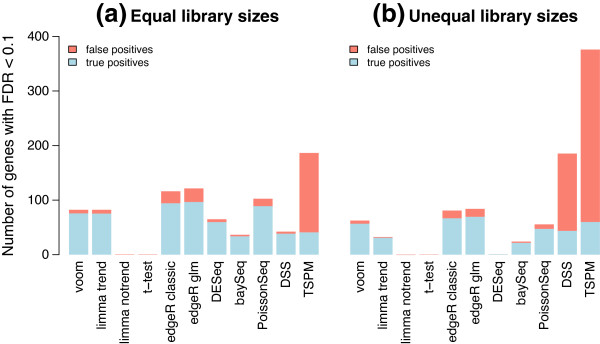
- In simulations with 6 libraries, 10,000 genes, and 100 upregulated plus 100 downregulated genes, voom had the best power among methods that controlled type I and FDR error rates; with unequal library sizes, voom had the best power except for edgeR while maintaining low FDR. edgeR and PoissonSeq were somewhat liberal, while DESeq and DSS became very conservative when library sizes were unequal.
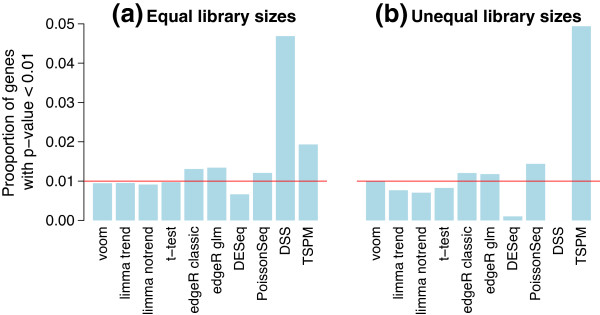
- For type I error at P<0.01, NB/Poisson methods did not control error accurately; voom was close to the nominal rate in both equal and unequal library size scenarios, while limma-trend was similar when sizes were equal but conservative when unequal. In SEQC HBRR technical replicates, voom returned no DE genes at 5% FDR for 6 of 7 possible partitions.
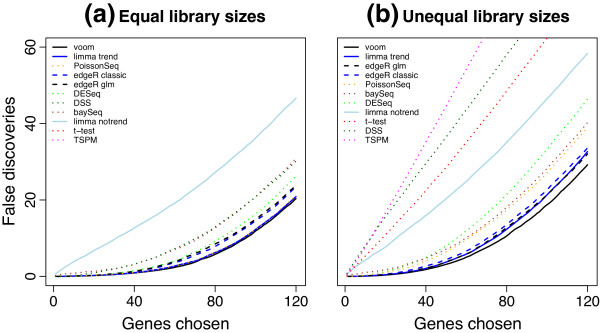
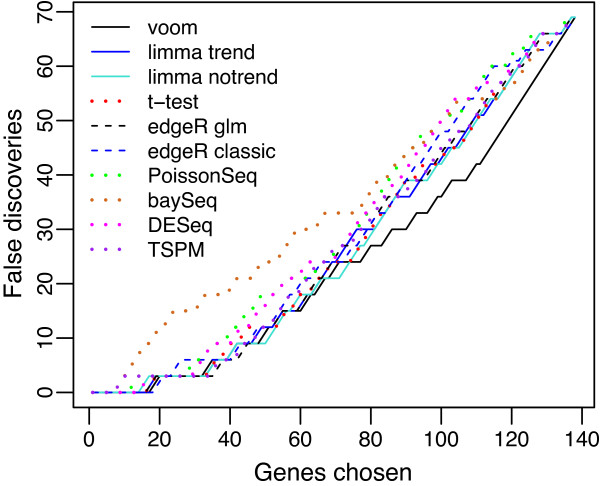
- voom had the lowest FDR at any cutoff in simulations and in SEQC spike-in data; the spike-in analysis used 138 transcripts, half truly DE and half non-DE.
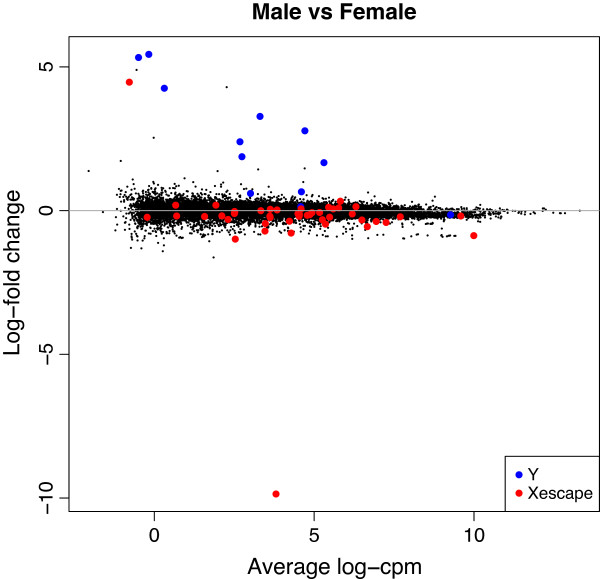
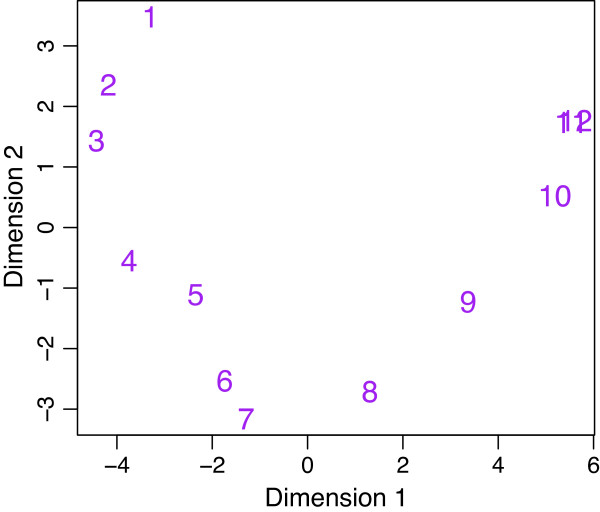
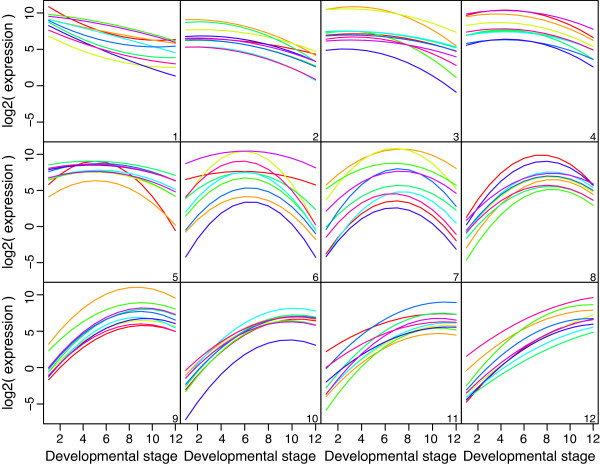
- In the Nigerian lymphoblastoid dataset (29 males, 40 females), voom found 16 genes upregulated in males and 43 upregulated in females at 5% FDR, with XIST the top gene; ROAST and CAMERA confirmed male-specific Y chromosome genes and X-inactivation escape genes. In Drosophila embryonic stages, 8,366 of 14,869 expressed genes showed a significant trend at 5% FDR.
Methods
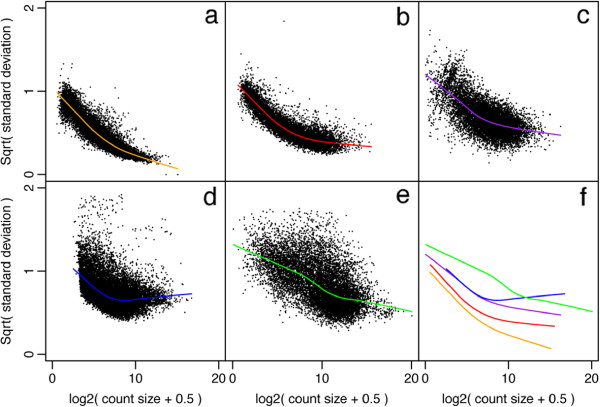
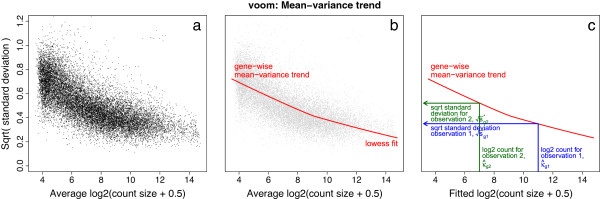
- voom works on log-cpm values: fit gene-wise linear models, estimate residual standard deviations as a function of average log-count using a robust LOWESS trend, interpolate that trend to each observation’s predicted count, and use inverse squared predicted standard deviation as a precision weight in limma’s empirical Bayes pipeline. limma-trend applies the mean-variance trend at the gene level instead.
- Simulations generated NB counts for 6 libraries and 10,000 genes, with baseline cpm distribution matched to real data and dispersion trend ψ^1/2 = 0.2 + λ^-1/2; gene-wise dispersions were drawn from an inverse chi-square with 40 degrees of freedom. Equal library sizes used 11 million reads per library; unequal sizes used 20 million for odd libraries and 2 million for even libraries. Results were averaged over 100 simulations and compared with edgeR, DESeq, baySeq, TSPM, PoissonSeq, and DSS.
- Case studies used SEQC pilot libraries (16 libraries in groups A–D; 4 HBRR libraries; 92 spike-in transcripts expanded to 138), Nigerian lymphoblastoid cell lines from 69 unrelated individuals, Drosophila melanogaster embryonic stages (12 libraries), and C57BL/6J versus DBA/2J mouse striatum data. Gene set testing used ROAST and CAMERA.
Limitations
- Stated: gene-level analysis does not allow different isoforms of the same gene to be differentially expressed in different directions, though voom can be run at exon level. The Drosophila quadratic time trends do not match all intricacies of gene expression over time. Simulations were generated under NB assumptions, and other scenarios may differ. baySeq was excluded from the type I error comparison because it does not return P values.
- Evident: the Drosophila analysis has no replicate libraries, so variances are estimated by assuming smooth expression over time and fitting quadratic trends. Performance comparisons rely on specific simulation settings and default software pipelines, and the case studies illustrate use rather than provide independent experimental validation.
Model-written summary. Check it against the paper before relying on it.
Integrity signals
Registry
Cites
Statistics
Figures
Verification
Claims the paper makes
1 Valid · 4 Not valid · 34 Not checked · 142 Own results and interpretations
The cited sources support only part of this claim — read each source’s verdict below.
In the paper
“voom and limma could be used to analyze any gene-level RNA-seq differential expression experiment, including those with multiple experimental factors [34].”
§ voom: precision weights unlock linear model analysis tools for RNA-seq read counts > Results > Development stages of Drosophila melanogaster
What the sources say
- Partly supportedcites [34] McCarthy DJ Chen Y Smyth GK Differential expression analysis of multifactor RNA-Seq experiments with respect to biological variation Nucleic Acids Res 2012 40 4288 4297 10.1093/nar/gks042 22287627 PMC3378882 sourceExperimental — accuracy not yet measured
Our copy of McCarthy et al. (2012) supports the scope part of the claim: the INTRODUCTION states 'The methodology provides a pipeline for analysing arbitrarily complex RNA-Seq experiments provided that there is some degree of biological replication', the Abstract describes analysis of 'complex experiments involving multiple treatment conditions and blocking variables', and the article's focus is gene-level counts ('For simplicity... counts are summarized at the gene level', RESULTS > Technical and biological variation). However, the capability is attributed to negative-binomial generalized linear models implemented in the edgeR package (DISCUSSION: 'The methods described in this article are implemented in the software package edgeR'), and no passage of our copy mentions voom or limma at all — the closest the paper comes to normal-linear-model analysis of transformed counts is a critique in the INTRODUCTION that transforming counts to approximate normality and analysing as for microarray data 'is however not fully tuned to the characteristics of read count data'. Thus the specific tools named in the citing sentence (voom and limma) are not this paper's methods, while the multifactor/gene-level applicability is. (LLM, conf=0.72)
hedged- Asserted: passes — The authors put it forward as true.
- Checkable: passes — It can be checked against evidence.
- Load-bearing: unclear — It is unclear whether the paper’s conclusions depend on it.
- Based: passes — The paper gives a reason why it holds.
- Rests on an assumption not shown here.
- Partly supported
A result the paper reports from its own data — it cites no other source for it, so there is none to check. The quote shows it is in the paper.
In the paper
“When the library sizes are unequal, DSS and DESeq became extremely conservative.”
§ voom: precision weights unlock linear model analysis tools for RNA-seq read counts > Results > voom and limma-trend control the type I error rate correctly
plainstates a cause- Asserted: passes — The authors put it forward as true.
- Checkable: passes — It can be checked against evidence.
- Load-bearing: unclear — It is unclear whether the paper’s conclusions depend on it.
- Based: passes — The paper gives a reason why it holds.
A result the paper reports from its own data — it cites no other source for it, so there is none to check. The quote shows it is in the paper.
In the paper
“Figures 3 and 4 together show that voom has the best power of those methods that correctly control the type I and FDR error rates.”
§ voom: precision weights unlock linear model analysis tools for RNA-seq read counts > Results > voom has the best power of methods that control the type I error rate
plain- Asserted: passes — The authors put it forward as true.
- Checkable: passes — It can be checked against evidence.
- Load-bearing: passes — The paper’s conclusions depend on it.
- Based: passes — The paper gives a reason why it holds.
- Rests on an assumption not shown here.
A result the paper reports from its own data — it cites no other source for it, so there is none to check. The quote shows it is in the paper.
In the paper
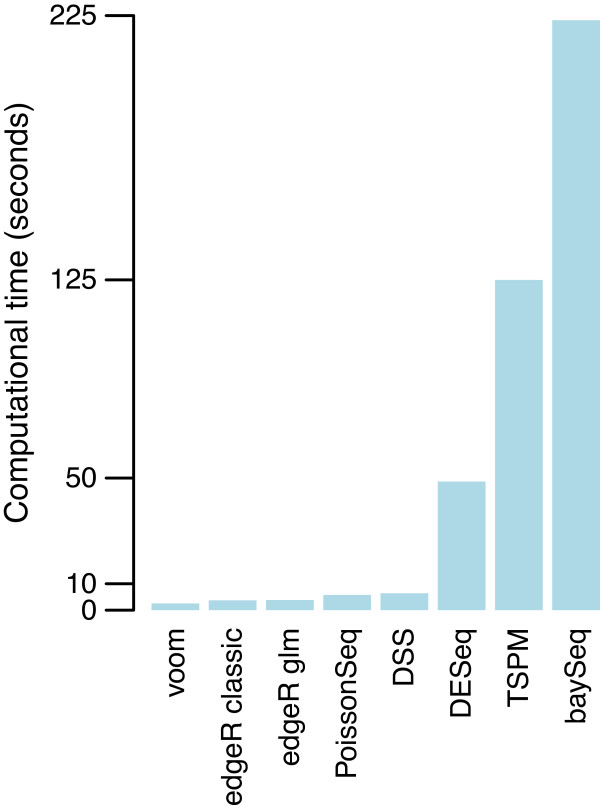
“voom is easily the fastest of the methods compared, with edgeR-classic next fastest (Figure 7).”
§ voom: precision weights unlock linear model analysis tools for RNA-seq read counts > Results > voom and limma-trend are faster than specialist RNA-seq methods
plain- Asserted: passes — The authors put it forward as true.
- Checkable: passes — It can be checked against evidence.
- Load-bearing: unclear — It is unclear whether the paper’s conclusions depend on it.
- Based: passes — The paper gives a reason why it holds.
A result the paper reports from its own data — it cites no other source for it, so there is none to check. The quote shows it is in the paper.
In the paper
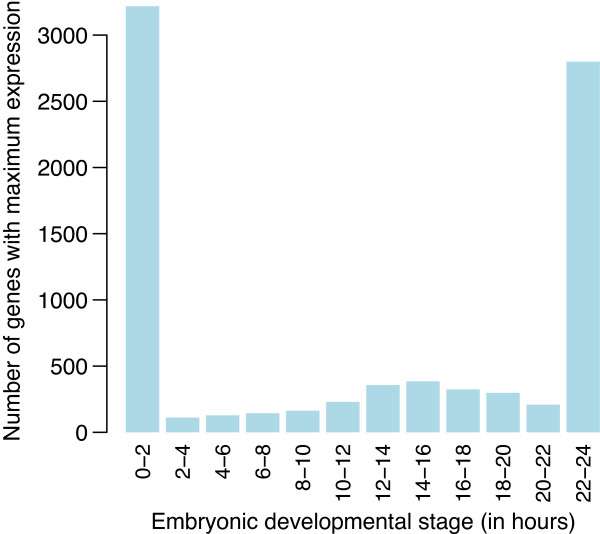
“Genes peaking at the last stage tended to be associated with precursor metabolites and energy, the oxidation-reduction process and with metabolic pathways.”
§ voom: precision weights unlock linear model analysis tools for RNA-seq read counts > Results > Development stages of Drosophila melanogaster
plainstates an association- Asserted: passes — The authors put it forward as true.
- Checkable: passes — It can be checked against evidence.
- Load-bearing: unclear — It is unclear whether the paper’s conclusions depend on it.
- Based: passes — The paper gives a reason why it holds.
79 more claims
Create a free account to see all 181 claims and to verify the 45 references still open.
- It may state two separate claims as one. 48
- Probably not a substantial claim. 68
- The quote only partly states this claim. 2
Claims other papers make about this one
Each is checked against this paper’s own text: does it say what the citing paper says it does?
The source backs part of the claim, not all of it — or backs it for a different population, condition or comparison.
In the citing paper
“First, specific caution is needed with all the methods when the number of replicate samples is very small or for genes that are expressed at very low levels [55, 64, 209].”
From A survey of best practices for RNA-seq data analysis (2016) · cites this paper as [55]
Experimental — accuracy not yet measuredThe cited source says what the claim attributes to it.
In the citing paper
“Methods for transforming normalized counts of RNA-seq reads while learning the variance structure of the data have been shown to perform well in comparison to the discrete distribution approaches described above [55, 56].”
From A survey of best practices for RNA-seq data analysis (2016) · cites this paper as [55]
The cited source says what the claim attributes to it.
In the citing paper
“First, the global variance estimate can now incorporate a mean-variance trend (10,17,18).”
From limma powers differential expression analyses for RNA-sequencing and microarray studies (2015) · cites this paper as [10]
The cited source says what the claim attributes to it.
In the citing paper
“This approach is commonly applied in learning error models for bulk RNA-seq in the context of differential expression analysis [22–25], but to our knowledge has not been previously applied in this context for single-cell normalization.”
From Normalization and variance stabilization of single-cell RNA-seq data using regularized negative binomial regression (2019) · cites this paper as [25]
The check wasn’t confident either way, so it gives no verdict — never disputed.
In the citing paper
“SAMseq performs well in terms of FDR but presents an acceptable sensitivity when the number of replicates is relatively high, at least 10 [20, 55, 209].”
From A survey of best practices for RNA-seq data analysis (2016) · cites this paper as [55]
Experimental — accuracy not yet measured
12 more claims about this paper
Create a free account to see every claim other papers make about this one.
Self-check
Percentages, sums and reported differences re-computed from the paper’s own numbers.
Each contradiction between two passages listed here was confirmed by an independent check.
Rated minor: it would not touch a result — a value no result rests on, a p-value that stays on the same side of the significance level, or a conflict that is clerical, resolved elsewhere in the paper, or outside its own findings.
In the paper
§ voom: precision weights unlock linear model analysis tools for RNA-seq read counts > Materials and methods > Lymphoblastoid cell lines from Nigerian individuals
“Read counts, summarized by Ensembl gene, and transcript annotations were obtained from version 1.0.9 of the tweeDEseqCountData Bioconductor package [43]”
§ voom: precision weights unlock linear model analysis tools for RNA-seq read counts > Materials and methods > Software
“The results presented in this article were obtained using R version 3.0.0 and the software packages limma 3.16.2, edgeR 3.2.3, baySeq 1.14.1, DESeq 1.12.0, DSS 1.4.0, PoissonSeq 1.1.2 and tweeDEseqCountData 1.0.8.”
Citations
Cites
Subramanian, A., Tamayo, P., Mootha, V. K., Mukherjee, S., Ebert, B. L., Gillette, M. A., Paulovich, A., Pomeroy, S. L., Golub, T. R., Lander, E. S., et al. (2005) · Proceedings of the National Academy of Sciences · doi:10.1073/pnas.0506580102 · Cited by 53,625 · cited 1×
“This includes methods for differential expression analysis [1, 2, 3], random effects [4, 5], gene set enrichment [6], gene set testing [7, 8] and so on.”
MethodRobinson, M. D., McCarthy, D. J., & Smyth, G. K. (2010) · Bioinformatics · doi:10.1093/bioinformatics/btp616 · Cited by 41,364 · cited 2×
“Specifically we used the goodTuringProportions function of the edgeR package [12], which implements the Good-Turing algorithm [55], to predict the true proportion of total RNA attributable to each gene.”
BackgroundMethodSelf-citationfeatureCounts: an efficient general purpose program for assigning sequence reads to genomic features
Liao, Y., Smyth, G. K., & Shi, W. (2014) · Bioinformatics · doi:10.1093/bioinformatics/btt656 · Cited by 27,219
Self-citation(2005) · Statistics for Biology and Health · doi:10.1007/0-387-27255-0_9 · Cited by 20,133
McCullagh, P., & Nelder, J. A. (1989) · doi:10.1007/978-1-4899-3242-6 · Cited by 16,836
Differential expression analysis for sequence count data
Anders, S., & Huber, W. (2010) · Genome Biology · doi:10.1186/gb-2010-11-10-r106 · Cited by 15,581
Mapping and quantifying mammalian transcriptomes by RNA-Seq
Mortazavi, A., Williams, B. A., McCue, K., Schaeffer, L., & Wold, B. (2008) · Nature Methods · doi:10.1038/nmeth.1226 · Cited by 13,696
RNA-Seq: a revolutionary tool for transcriptomics
Wang, Z., Gerstein, M., & Snyder, M. (2009) · Nature Reviews Genetics · doi:10.1038/nrg2484 · Cited by 13,174 · cited 1×
“olutionary new technology for expression profiling [10].”
Bioconductor: open software development for computational biology and bioinformatics
Gentleman, R. C., Carey, V. J., Bates, D. M., Bolstad, B., Dettling, M., Dudoit, S., Ellis, B., Gautier, L., Ge, Y., Gentry, J., et al. (2004) · Genome Biology · doi:10.1186/gb-2004-5-10-r80 · Cited by 12,172 · cited 1×
“All of these packages are part of the Bioconductor project [67,68], except for PoissonSeq, which is part of the Comprehensive R Archive Network [69].”
BackgroundSelf-citationSmyth, G. K. (2004) · Statistical Applications in Genetics and Molecular Biology · doi:10.2202/1544-6115.1027 · Cited by 11,829
Self-citation
Research works printed but not linked: 2
- Law CW Chen Y Shi W Smyth GK Supplementary information for ‘Voom: precision weights unlock linear model analysis tools for RNA-seq read counts’ [ http://bioinf.wehi.edu.au/voom] PMC4053721 24485249
- Frazee A Langmead B Leek J ReCount: a multi-experiment resource of analysis-ready RNA-seq gene count datasets [ http://bowtie-bio.sourceforge.net/recount] PMC3229291 22087737
Cited by
Items 6,401–6,500 of 7,059
Kim, S. J., Cecchini, M. J., & Mura, M. (2025) · Bioinformatics · doi:10.1093/bioinformatics/btaf401
Additional file 1 of Transcriptional landscape of the embryonic chicken Müllerian duct
Roly, Z. Y., Godini, R., Estermann, M. A., Major, A. T., Pocock, R., & Smith, C. A. (2020) · Figshare · doi:10.6084/m9.figshare.13047299
Additional file 6 of Transcriptional landscape of the embryonic chicken Müllerian duct
Roly, Z. Y., Godini, R., Estermann, M. A., Major, A. T., Pocock, R., & Smith, C. A. (2020) · Figshare · doi:10.6084/m9.figshare.13047314
Additional file 8 of Transcriptional landscape of the embryonic chicken Müllerian duct
Roly, Z. Y., Godini, R., Estermann, M. A., Major, A. T., Pocock, R., & Smith, C. A. (2020) · Figshare · doi:10.6084/m9.figshare.13047320
Additional file 7 of Transcriptional landscape of the embryonic chicken Müllerian duct
Roly, Z. Y., Godini, R., Estermann, M. A., Major, A. T., Pocock, R., & Smith, C. A. (2020) · Figshare · doi:10.6084/m9.figshare.13047317
Computational Curation of Open Science Data
Grechkin, M. (2018) · ResearchWorks at the University of Washington (University of Washington)
Liu, Z., Wu, C., Uyemura, M. M., Sardella, B., Aronson, E. K., Ke, S., Massicott, E. S., Li, X., Wang, L., Karagkouni, D., et al. (2026) · medRxiv · doi:10.64898/2026.03.09.26347941
Genomic mechanisms underlying the collapse and lack of recovery of Prince William Sound herring
Gill, J. A. (2023) · eScholarship (California Digital Library)
McCoy, A. M., Kemper, A. M., Boyce, M. K., Brown, M. P., & Trumble, T. N. (2020) · Figshare · doi:10.6084/m9.figshare.13311312
McCoy, A. M., Kemper, A. M., Boyce, M. K., Brown, M. P., & Trumble, T. N. (2020) · Figshare · doi:10.6084/m9.figshare.13311303
McCoy, A. M., Kemper, A. M., Boyce, M. K., Brown, M. P., & Trumble, T. N. (2020) · Figshare · doi:10.6084/m9.figshare.13311324
McCoy, A. M., Kemper, A. M., Boyce, M. K., Brown, M. P., & Trumble, T. N. (2020) · Figshare · doi:10.6084/m9.figshare.13311321
Beyond the scale:Exploring novel treatment strategies and health impacts of obesity
Oussaada, S. M. (2024) · UvA-DARE (University of Amsterdam)
Precision modeling of breast cancer in the CRISPR era
Annunziato, S. (2020) · Leiden Repository (Leiden University)
Pheromones in Heliconius butterflies: Chemical ecology, genetics, and behaviour
Darragh, K. (2019) · Apollo (University of Cambridge) · doi:10.17863/cam.48985
Dekkers, K. F. (2025) · Leiden Repository (Leiden University)
A Integrative systems analysis of the immune response to dengue virus
Plaça, D. R. (2024) · Digital Library of Theses and Dissertations (Universidade de São Paulo) · doi:10.11606/t.9.2024.tde-10102024-104755
Linking protistan community shifts along salinity gradients with cellular haloadaptation strategies
Kühner, S. (2019) · Publication Server of Kaiserslautern University of Technology (Kaiserslautern University of Technology)
Infection Dynamics and Host Responses to Two IPNV Isolates in Liver of Atlantic Salmon (Salmo salar)
Quiñones, V. A., Grammes, F., Boyartchuk, V., & Torgersen, J. S. (2025) · Pathogens · doi:10.3390/pathogens14121245
Genetic and Epigenetic Mechanisms Underlying Maternal Transmission of Asthma Risk
Magnaye, K. M. (2020) · Knowledge@UChicago (University of Chicago) · doi:10.6082/ky9k7-96b46
Dharuri, H. (2016) · Leiden Repository (Leiden University)
Bioinformatics: Computational analysis of breast cancer transcripts
Kling Åhlén, E., Rudin, I., Pelligra, K., & Chammas, O. (2023) · KTH Publication Database DiVA (KTH Royal Institute of Technology)
The emergence of zoonotic Streptococcus suis
Gabaldon, J. B. G. B. (2025) · UvA-DARE (University of Amsterdam)
Nikonezhad, B., Shahriarizade, M., Zamani, A., & Mahdevar, M. (2025) · BMC Cancer · doi:10.1186/s12885-025-15522-w
Interrogating the 3D Structure of Primate Genomes
Eres, I. E. (2020) · Knowledge@UChicago (University of Chicago) · doi:10.6082/uchicago.2733
Janda, C. Y., Buhl, J. L., Koelewijn, J., Munter, S. D., Cruz, V. M., Chin, D., Zhang, B., van Hoesel, M., van Herk, N., Paassen, I., et al. (2025) · Research Square · doi:10.21203/rs.3.rs-6111378/v1
Kuanyshev, N. (2017) · BOA (University of Milano-Bicocca)
Zhang, Y., Liu, W., & Qiu, W. (2023) · BMC Bioinformatics · doi:10.1186/s12859-023-05556-x
Functional genomics studies of cancer and cells of origin: from pan-cancer to single-cell
Hu, Z. (2020) · Oxford University Research Archive (ORA) (University of Oxford) · doi:10.5287/ora-5rqzvx9vk
Kong, H., & Sun, Q. (2026) · Research Square · doi:10.21203/rs.3.rs-9331029/v1
Whole gene expression profiles and virulence traits of dermatophytes during infection
Coi, N. D. (2016) · IRIS
Martinez Pacheco, J., Ranocha, P., Kasulin, L., Fusari, C. M., Servi, L., Ferrero, L., Berdion Gabarain, V., Peralta, J. M., Borassi, C., Marzol, E., et al. (2021) · CONICET Digital (CONICET)
Robson, J. K. (2021) · Nottingham ePrints (University of Nottingham)
Detecting differential polyadenylation length
Harrison, P. F. (2014) · F1000Research · doi:10.7490/f1000research.1097121.1
A genomic study of the contribution of DNA methylation to regulatory evolution in primates
Roux, J., Hernando-Herraez, I., Banovich, N. E., García, R., Chavarria, C. I., Mitrano, A., Pritchard, J. K., Marquès‐Bonet, T., & Gilad, Y. (2014) · DIGITAL.CSIC (Spanish National Research Council (CSIC)) · doi:10.7490/f1000research.1096813.1
Thakor, F. (2016) · John Spoor Broome Library Institutional Repository (California State University)
Karlsson, T. (2016) · Uppsala University Publications (Uppsala University)
The molecular fingerprint of human spermatogenesis
Jan, S. Z. (2018) · UvA-DARE (University of Amsterdam)
Burr, A. J. (2017) · OhioLink ETD Center (Ohio Library and Information Network)
Quality Control Metrics for Extraction-Free Targeted RNA-Seq Under a Compositional Framework
LaRoche, D., Billheimer, D. D., Michels, K., & LaFleur, B. (2019) · Springer proceedings in mathematics & statistics · doi:10.1007/978-3-319-67386-8_21
Framework para el análisis de datos ómicos
Fernández, R. S. (2019) · LA Referencia (Red Federada de Repositorios Institucionales de Publicaciones Científicas)
Gene expression and survival analysis of breast cancer sub types defined by immunohistochemistry
Yan, M. (2020) · The Sydney eScholarship Repository (The University of Sydney)
“The Importance of G. Gamow's Ideas for Biology of thе 21st Century”
Савицький, О. В., Фішер, Е. П., Чеботар, С. В., Благодарова, О. М., Cherkas, S. L., Kalashnikov, V. L., Іщенко, О. О., Volkov, R. A., Тинкевич, Ю. О., Герасимчук, І. В., et al. (2019) · Odesa National University Herald Biology · doi:10.18524/2077-1746.2019.2(45).189618
The role of siRNAs in genome stability maintaining in the bread wheat introgression lines
Наваліхіна, А., Аntonyuk, M., & Ternovska, T. (2020) · Faktori eksperimental noi evolucii organizmiv · doi:10.7124/feeo.v26.1251
Feature reduction for machine learning on molecular features: The GeneScorePreprint
Denker, A., Steshina, A., Grooss, T., Ueckert, F., & Nürnberg, S. (2021) · arXiv (Cornell University) · doi:10.48550/arxiv.2101.05546
Outlier Detection for Mixed Model with Application to RNA-Seq Data
Liu, T.-Y. (2018) · Deep Blue (University of Michigan)
Cui, X., Li, C., Wei, C., Tong, G., & Xing, Y. (2019) · Research Square · doi:10.21203/rs.2.15726/v1
Gao, L., Xiong, D., Xu, Q.-Q., Chen, P., Li, Y., Qin, L.-T., Dang, Y., Liu, L., Liao, L.-F., Chen, J., et al. (2021) · SSRN Electronic Journal · doi:10.2139/ssrn.3917047
Ticagrelor responsive platelet genes are associated with platelet function and bleedingPreprint
Myers, R. A., Ortel, T. L., Waldrop, A., Davé, S. S., Ginsburg, G. S., & Voora, D. (2022) · medRxiv · doi:10.1101/2022.03.18.22270280
Lin, Y., Liang, R., Zhang, J., Liu, Z., Liu, Z., Li, Q., Luo, X., Li, Y., & Ye, J. (2020) · Research Square · doi:10.21203/rs.3.rs-15789/v1
Toxicogenomics to assess biological relevance of a putative proliferative response
Hofstra, A. H., Currie, R. A., & Doonan, L. B. (2022) · Toxicology Letters · doi:10.1016/j.toxlet.2022.07.667
Robinson, M. D. (2013) · arXiv (Cornell University) · doi:10.48550/arxiv.1305.6202
(2022) · Natural hazards and earth system sciences · doi:10.5194/nhess-2022-228-rc1
Computational learning of small RNA regulation in pancreatic cancer progression
Madadjim, R., Dogan, H., & Cui, J. (2022) · IEEE International Conference on Bioinformatics and Biomedicine (BIBM) · doi:10.1109/bibm55620.2022.9995706
Teo, Z. L., Versaci, S., Dushyanthen, S., Caramia, F., Savas, P. S., Mintoff, C. P., Zethoven, M., Virassamy, B., Luen, S. J., McArthur, G. A., et al. (2023) · doi:10.1158/0008-5472.22415711
Janjanam, J., Pano, G., Wang, R., Minden‐Birkenmaier, B. A., Breeze‐Jones, H., Baker, E., Garcin, C., Clayton, G., Shirinifard, A., Zaske, A. M., et al. (2023) · doi:10.1158/0008-5472.22428366
Ma, F., Arai, S., Wang, K., Calagua, C., Yuan, A. R., Poluben, L., Gu, Z., Russo, J. W., Einstein, D. J., Ye, H., et al. (2023) · doi:10.1158/0008-5472.22431144
Rampal, R. K., Pinzon-Ortiz, M. C., Somasundara, A. V. H., Durham, B. H., Koche, R. P., Spitzer, B. G., Mowla, S., Krishnan, A., Li, B., An, W., et al. (2023) · doi:10.1158/1078-0432.22479654
Hogg, S. J., Newbold, A., Vervoort, S. J., Cluse, L. A., Martin, B. P., Gregory, G. P., Lefebure, M., Vidacs, E., Tothill, R. W., Bradner, J. E., et al. (2023) · doi:10.1158/1535-7163.22503375
Rashid, A., Al-Obeidat, F. N., Ramakrishnan, K. A., Hafez, W., Hamza, N. A. E., Malik, Z. A., Kadwa, R., Gador, M., Benakatti, G., Malik, R. A., et al. (2024) · Informatics in Medicine Unlocked · doi:10.1016/j.imu.2024.101474
Karlström, A., Gómez-Cortecero, A., Connell, J., Nellist, C. F., Ordidge, M., Dunwell, J. M., & Harrison, R. J. (2024) · Research Square · doi:10.21203/rs.3.rs-4423688/v1
Varga, C., Eichinger, F. H., Nair, V., Naik, A. S., Nasr, S. H., Fogo, A. B., Toskic, D., Kretzler, M., & Comenzo, R. L. (2024) · Kidney International Reports · doi:10.1016/j.ekir.2024.07.002
Zou, M., Qiu, L., Wu, W., Liu, H., Han, X., & Liu, J. (2025) · Genes Chromosomes and Cancer · doi:10.1002/gcc.70030
Watson, T. K., Rosen, A. B. I., Drow, T., Medjo, J. A., MacQuivey, M. A., Ge, Y., Liggitt, D., Grosvenor, D. A., Dill‐McFarland, K. A., Altman, M. C., et al. (2025) · doi:10.2337/figshare.28513934.v1
Kwan, E., Legione, A. R., Hartley, C. A., & Devlin, J. M. (2025) · Virology Journal · doi:10.1186/s12985-025-02722-w
Key inflammatory mediators drive the resolution of acute Lyme disease
Cervantes, J., Chaudhry, S., Barragan, J. A., Akinlusi, I., Zhao, T., Graff, R., & Hong, B.-Y. (2025) · Journal of Investigative Medicine · doi:10.1177/10815589251348934
Koçhan, N., & Sheikhi, A. (2025) · Communications Faculty Of Science University of Ankara Series A1Mathematics and Statistics · doi:10.31801/cfsuasmas.1517305
Gao, G., Woo, Y., Gehring, C., Tester, M. A., & Julkowska, M. (2025) · bioRxiv (Cold Spring Harbor Laboratory) · doi:10.64898/2025.12.01.691713
Kwan, E., Legione, A. R., Hartley, C. A., & Devlin, J. M. (2025) · Virus Research · doi:10.1016/j.virusres.2025.199681
Mannarino, L. (2022) · Open Research Online (The Open University) · doi:10.21954/ou.ro.000140dc
Goswami, C., Chawla, S., Thakral, D., Pant, H., Verma, P., Malik, P. S., ▮, J., Gupta, R., Ahuja, G., & Sengupta, D. (2020) · Figshare · doi:10.6084/m9.figshare.13151829
Vestal, B. E., Moore, C. M., Wynn, E. A., Saba, L. M., Fingerlin, T. E., & Kechris, K. J. (2020) · Figshare · doi:10.6084/m9.figshare.12891336
Goel, A., Ward, D. G., Noyvert, B., Yu, M., Gordon, N. S., Abbotts, B., Colbourne, J. K., Kissane, S., James, N. D., Zeegers, M. P., et al. (2022) · Figshare · doi:10.6084/m9.figshare.19980655
Goel, A., Ward, D. G., Noyvert, B., Yu, M., Gordon, N. S., Abbotts, B., Colbourne, J. K., Kissane, S., James, N. D., Zeegers, M. P., et al. (2022) · Figshare · doi:10.6084/m9.figshare.19980658
Farutin, V., Prod’Homme, T., McConnell, K., Washburn, N., Halvey, P., Etzel, C. J., Guess, J. R., Duffner, J. L., Getchell, K., Meccariello, R., et al. (2019) · Figshare · doi:10.6084/m9.figshare.10033856
ゼンケツメッセンジャーアールエヌエーマイクロアールエヌエートウゴウカイセキニモトヅクハイエンノシンキビョウタイカイメイ
小田, 紗., & オダ, サ. (2023) · Institutional Repositories DataBase (IRDB) · doi:10.18910/92994
A Role for Reactive Electrophile Species in High Light Signalling in Chlamydomonas reinhardtii
Baur (2018) · Digital Library of the University of Innsbruck (University of Innsbruck)
Alonso, U. (2022) · Tesis Doctorals en Xarxa (Consorci de Serveis Universitaris de Catalunya)
Glaser, J. (2020) · Qucosa (Saxon State and University Library Dresden)
Differential gene expression analysis of Nostoc sp. N6 in Peltigera membranacea
Magnússon, G. V. (2023) · Skemman
A multicolor map of NK and T cell diversity: from bulk to single-cell
Melsen, J. E. (2022) · Leiden Repository (Leiden University)
Binary Classification With First Phase Feature Selection forGene Expression Survival Data
Loveless, I. (2019) · OhioLink ETD Center (Ohio Library and Information Network)
Geminiviruses: molecular and genetic characterization of their interaction with the plant.
Romero-Rodríguez, B. (2023) · Repositorio Institucional de la Universidad de Málaga (University of Málaga)
Metadata
- Authors
- Law, C. W., Chen, Y., Shi, W., & Smyth, G. K.
- Affiliations
- The University of Melbourne (AU)
- Corresponding author
- Smyth, Gordon K
- Venue
- Genome Biology
- Published
- 2014-02-03
- Volume
- 15
- Issue
- 2
- Pages
- R29-R29
- ISSN
- 1465-6906 (ISSN-L)
- 1474-760X
- PMC
- PMC4053721
- OpenAlex
- W2137526110
- Semantic Scholar
- f85a6cb90dbe6f064e37b427a129e3976e87a86d
- Cited by
- 6,155
- References
- 67
- Citations by year
- 2026: 472 · 2025: 640 · 2024: 713 · 2023: 671 · 2022: 664 · 2021: 761 · 2020: 586 · 2019: 471 · 2018: 420 · 2017: 307 · 2016: 241 · 2015: 145 · 2014: 52
- FWCI
- 101.89
- Type
- journal article
- Language
- en
- Open access
- gold
- doi.org
- Licence
- cc-by
- creativecommons.org/licenses/by/2.0/ (tdm)
- creativecommons.org/licenses/by/2.0/ (vor)
- Locations
- Genome biology (publishedVersion, cc-by)
- Europe PMC (PubMed Central) (publishedVersion, cc-by)
- PubMed Central (publishedVersion, cc-by)
- PubMed (publishedVersion)
- Minerva Access (University of Melbourne) (submittedVersion, cc-by)
- Topics
- Life Sciences › Biochemistry, Genetics and Molecular Biology › Molecular Biology › Gene expression and cancer classification
- Life Sciences › Biochemistry, Genetics and Molecular Biology › Molecular Biology › Genomics and Phylogenetic Studies
- Life Sciences › Biochemistry, Genetics and Molecular Biology › Molecular Biology › Single-cell and spatial transcriptomics
- Keywords
- RNA-seq read counts, mean-variance relationship, limma, empirical Bayes, linear modeling, differential gene expression
- MeSH terms
- Algorithms, Base Sequence, Bayes Theorem, Computer Simulation, RNA, Linear Models, Sequence Analysis, RNA, Gene Expression Profiling, High-Throughput Nucleotide Sequencing
About these checks
Registry, retraction, Cites and statistics results are computed, not judged, with one exception: a printed reference that no index lists is read once by a model before it counts as a citation error. Claims are extracted by a model and kept only when their quote appears verbatim in the text; each cited source is then checked, with a model’s help, for whether it says what the claim relies on. Those verdicts can be wrong — read the claim’s quote and the cited source before relying on one.
The claim verdicts this report counts are experimental: their accuracy is not yet measured.
A language model drew the claims from the paper on 2026-11-23, under version 3 of the claim definition (model deepseek-v4.1-flash, prompt extract-v3).
A second model labelled each claim on 2026-11-23 (model jev-1.13-20260917, definition revision gold-guideline-v0.2).
Cited sources are checked with a language model’s help (qwen3.8-omni-flash).
Statistics and arithmetic are recomputed, not judged.
Confidence bands are shown only for fields calibrated on our annotated test set. None is calibrated yet, so no band is shown.
What counts as a claim ›How we measure confidence ›How we check this ›
Are you an author, or do you see a problem with this page? Request a review
Data sources
Bibliographic data: Semantic Scholar, OpenAlex, Crossref.
Contains information from the Semantic Scholar Academic Graph Datasets, made available under the ODC Attribution License (ODC-BY 1.0).
Semantic Scholar’s data is described in: Kinney, R., et al. (2023). The Semantic Scholar Open Data Platform. arXiv:2301.10140.
