

The DOI matches its Crossref record; 30 of the 30 references it cites were found in a registry or an index.
Validation of the Generalized Anxiety Disorder-7 (GAD-7) and GAD-2 in patients with migraine
Open accessAbstract
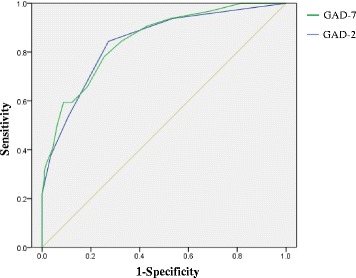
BACKGROUND: Psychiatric problems have been commonly reported in patients with migraine. This study investigated the reliability and validity of the Generalized Anxiety Disorder-7 (GAD-7) and Generalized Anxiety Disorder-2 (GAD-2) in patients with migraine. METHODS: Subjects were recruited from a headache clinic and a neuropsychologist examined their GAD using the Mini International Neuropsychiatric Interview-Plus Version 5.0.0 (MINI). Subjects completed several instruments, including the GAD-7, the Beck Anxiety Inventory (BAI), the Migraine Disability Assessment Scale (MIDAS), the Headache Impact Test-6 (HIT-6), and the Migraine-Specific Quality of Life (MSQoL). RESULTS: Among 146 participants, 32 patients (21.9 %) had GAD as determined by the MINI. Cronbach's α for the GAD-7 and GAD-2 were 0.915 and 0.820, respectively. At a cutoff score of 5, the GAD-7 had a sensitivity of 78.1 %, a specificity of 74.6 %, a positive predictive value (PPV) of 46.3 %, and a negative predictive value (NPV) of 92.4 %. At a cutoff score of 1, the GAD-2 had a sensitivity of 84.4 %, a specificity of 72.8 %, a PPV of 46.6 %, and a NPV of 94.3 %. The scores of the GAD-7 and GAD-2 well correlated with the BAI score, the MIDAS score, the HIT-6 score, and the MSQoL score. CONCLUSIONS: The GAD-7 and GAD-2 are both reliable and valid screening instruments for GAD in patients with migraine.
Overview
The claims and statistics of this paper haven’t been checked yet.
Run the check — free, no account needed. It reads the open-access text and checks the sources it cites.
Integrity signals
Registry
Cites
Statistics
Figures
Verification
Claims the paper makes
The claims and statistics of this paper haven’t been checked yet.
Run the check — free, no account needed. It reads the open-access text and checks the sources it cites.
Claims other papers make about this one
Each is checked against this paper’s own text: does it say what the citing paper says it does?
The cited source says what the claim attributes to it.
In the citing paper
“The GAD-7 has shown strong internal consistency (Cronbach’s α = 0.92) [57] and is validated for chronic pain patients with migraine [58].”
From ACTsmart: Guided Smartphone-Delivered Acceptance and Commitment Therapy for Chronic Pain—A Pilot Trial. (2021) · cites this paper as [58]
Self-check
Percentages, sums and reported differences re-computed from the paper’s own numbers.
The self-check needs the paper’s full text.
Citations
Cites
A Brief Measure for Assessing Generalized Anxiety Disorder: The GAD-7
Spitzer, R. L., Kroenke, K., Williams, J. B. W., & Löwe, B. (2006) · Archives of Internal Medicine · doi:10.1001/archinte.166.10.1092 · Cited by 31,765
(1998) · The Journal of Clinical Psychiatry · Cited by 19,139
(1998) · PubMed · Cited by 10,216
The International Classification of Headache Disorders, 3rd edition (beta version)
Headache Classification Committee of the International Headache Society (IHS) (2013) · Cephalalgia · doi:10.1177/0333102413485658 · Cited by 8,229
The mini international neuropsychiatric interview
Lecrubier, Y., Sheehan, D. V., Hergueta, T., & Weiller, E. (1998) · European Psychiatry · doi:10.1016/s0924-9338(99)80239-9 · Cited by 5,899
Anxiety disorders in primary care: prevalence, impairment, comorbidity, and detection
Kroenke, K., Spitzer, R. L., Williams, J. B. W., Monahan, P. O., & Löwe, B. (2007) · Annals of Internal Medicine · doi:10.7326/0003-4819-146-5-200703060-00004 · Cited by 4,741
The global burden of headache: A documentation of headache prevalence and disability worldwide
Stovner, L., Hagen, K., Jensen, R., Katsarava, Z., Lipton, R., Scher, A., Steiner, T., & Zwart, J.-A. (2007) · Cephalalgia · doi:10.1111/j.1468-2982.2007.01288.x · Cited by 2,444
A six-item short-form survey for measuring headache impact: The HIT-6™
Kosinski, M., Bayliss, M. S., Bjorner, J. B., Ware, J. E., Garber, W. H., Batenhorst, A., Cady, R., Dahlöf, C. G. H., Dowson, A., & Tepper, S. (2003) · Quality of Life Research · doi:10.1023/a:1026119331193 · Cited by 1,376
Garcia-Campayo, J., Zamorano, E., Ruiz, M. A., Pardo, A., Perez-Paramo, M., Lopez-Gomez, V., Freire, O., & Rejas, J. (2010) · Health and Quality of Life Outcomes · doi:10.1186/1477-7525-8-8 · Cited by 673
McWilliams, L. A., Goodwin, R. D., & Cox, B. J. (2004) · Pain · doi:10.1016/j.pain.2004.06.002 · Cited by 562
Research works printed but not linked: 3
- Yook SP, Kim ZS (1997) A clinical study on the Korean version of Beck Anxiety Inventory: comparative study of patient and non-patient. Korean J Clin Psychol 16:185–197
- Lee HS, Chung CS, Song HJ, Park HS (2000) The reliability and validity of the MIDAS (Migraine Disability Assessment) Questionnaire for Korean migraine sufferers. J Korean Neurol Assoc 18:287–291
- Bayliss M, Batenhorst A (2002) The HIT-6™ a user’s guide. Quality Metric Incorporated, Lincoln
Cited by
Sorted by citations
Items 301–342 of 342
Choi, Y., Song, H., Namgung, H.-I., & Lee, N. R. (2025) · Disaster Medicine and Public Health Preparedness · doi:10.1017/dmp.2024.342
“The Patient Health Questionnaire-9 (PHQ-9) developed by Kroenke, Spitzer, and Williams, et al. 25 and validated by Park, Choi, and Choi, et al. 26 was used to determine the level of depression in participants.”
Effectiveness of a Multidisciplinary Headache Management Program: An Open-Label Pilot Study
Souren, R., Winteler, B., Bischoff, N., Fluri, O., Grolimund, J., Scutelnic, A., Streitberger, K., Beckwée, D., & Schankin, C. J. (2025) · Clinical and Translational Neuroscience · doi:10.3390/ctn9020027
Jung, H., Lee, D. H., & Lee, H. J. (2025) · Asian Journal Of Social Psychology · doi:10.1111/ajsp.70037
Kim, B.-H., Kim, J., Kim, J., Cha, J., Jeon, S. W., Oh, K., Shin, D., & Cho, S. (2025) · doi:10.2196/preprints.80412
Lü, J., Chen, X., McAra‐Couper, J., Ye, Y., Huang, K., Zheng, C., Pan, M., & Qiu, P. (2025) · Women and Birth · doi:10.1016/j.wombi.2025.102076
Changes in citizens’ anxiety, depression, and PTSD after the Seoul Halloween crowd crush in 2022
Choi, Y., & Song, H. (2025) · Scientific Reports · doi:10.1038/s41598-025-15634-0
Seo-Hee, C. H. O. I., Kim, Y., & Choe, Y. (2025) · Daehan imsang geon-gang jeungjin hakoeji/Daehan imsang geon'gang jeungjin haghoeji · doi:10.15384/kjhp.2025.00122
“Anxiety was assessed via the 7-item Generalized Anxiety Disorder scale (GAD-7) [17], with scores ranging from 0 to 21, also showing excellent reliability in Korean validation studies (α=0.91) [18].”
InfluentialCorrelates of desire for hastened death in chronic illness: A cross-sectional network analysis
Shim, E., Jeong, D., Jung, S., & Hahm, B. (2025) · Journal of Psychosomatic Research · doi:10.1016/j.jpsychores.2025.112407
Cefaleia e transtornos mentais na prática
Souza, R. M. G., Oliveira, L. N. D. S., da Silva, D. J., de Oliveira, L. B., Grassi, V., & Jurno, M. E. (2025) · Headache Medicine/Revista Headache Medicine · doi:10.48208/headachemed.2025.23
Ha, T. (2025) · The Journal of Korean Academic Society of Nursing Education · doi:10.5977/jkasne.2025.31.4.527
Oh, H., Cha, J., Kim, B.-H., Oh, K.-S., Shin, Y., Jeon, S., Cho, S. J., & Kim, J. (2025) · Journal of Clinical Medicine · doi:10.3390/jcm15010007
Wei, H.-L., Yu, Y., Wang, M.-Y., Zhou, G.-P., Li, J., Zhang, H., & Zhou, Z. (2024) · Figshare · doi:10.6084/m9.figshare.26074072
Poulin, T. G., Krewulak, K. D., Rosgen, B. K., Stelfox, H. T., Fiest, K. M., & Moss, S. J. (2021) · Figshare · doi:10.6084/m9.figshare.16943677
Kim, J.-H., Kim, J., Jang, S.-Y., & Park, E.-C. (2024) · Figshare · doi:10.6084/m9.figshare.26409858
Sex differences in the association between chronotype and anxiety: A nationwide population study
Yum, J., Cho, S., Ha, W., Kim, K. M., Lee, W., & Chu, M. K. (2026) · Journal of Psychiatric Research · doi:10.1016/j.jpsychires.2026.01.012
Lee, G. Y., Latimer, M. C., Kelly, S. M., Verinumbe, T. I., Agee, T., Hutton, H. E., Lesko, C. R., Jones, J., Schwartz, S., Hsu, J., et al. (2026) · HIV Research & Clinical Practice · doi:10.1080/25787489.2026.2616103
Han, D., & Lee, S. (2026) · Journal of Interpersonal Violence · doi:10.1177/08862605251412376
Bae, H., Kim, G., Yim, M., & Hur, J. (2026) · Current Psychology · doi:10.1007/s12144-025-08965-8
“All variables except age were assessed using categorical (Seo & Park, 2015 ), with Cronbach’s α = .92.”
Meyer, A. M., Kim, E., Lee, H. K., Jo, G., Schaub, M. P., & Haug, S. (2026) · JMIR Research Protocols · doi:10.2196/82782
Dai, C., Hu, Y., Huang, M., Liu, X., Tao, Z., Zhang, X., Li, X., Yang, X., 叶梦茜, Fu, F., et al. (2026) · Neuroradiology · doi:10.1007/s00234-026-03906-z
Natural Diagnostic Classes of Headache Disorders: Latent Class Analysis of a Population-Based Study
Lee, W., Heo, S., Yum, J., & Chu, M. K. (2026) · Headache and Pain Research · doi:10.62087/hpr.2026.0004
Wexler, R. S., Balsamo, W., Lendof, V., Shane, D., Fox, M., Heron, R. L., Berg, M., Hansen, T., Vaughn, A. W., Walton, T., et al. (2026) · Research Square · doi:10.21203/rs.3.rs-8682836/v1 · Cited by 1
Bae, H., Yim, M., Kim, G., & Hur, J. (2026) · BMC Psychology · doi:10.1186/s40359-026-04075-7 · Cited by 2
Medication adherence in thoracic transplant candidates
SANBORN, D., Pennington, K. M., Benzo, R. P., Schneekloth, T. D., Erasmus, D. B., Budev, M. M., Chandrashekaran, S., Lease, E. D., Levine, D. J., Zell, C. L., et al. (2026) · Frontiers in Psychology · doi:10.3389/fpsyg.2026.1726871
Chang, S. R., & Grysman, N. (2026) · Springer eBooks · doi:10.1007/978-3-032-15772-0_5
Fani, M., Sharp, N., & Schwedt, T. J. (2026) · Cephalalgia · doi:10.1177/03331024261439257
Lee, E.-Y., Han, G., & Jeong, H. (2026) · BMC Public Health · doi:10.1186/s12889-026-27491-1
“The GAD-7 was translated and validated for the Korean population [19] and comprises seven self-reported items and responses ranging from 0 to 3 points.”
Jo, D., Im, S., Lee, E., & Yang, E. (2026) · Cognitive Behaviour Therapy · doi:10.1080/16506073.2026.2680603
Park, Y., Cha, B., Kim, H. Y., & Kim, S. R. (2026) · Journal of Nursing Research · doi:10.1097/jnr.0000000000000752
“The Korean version of the Generalized Anxiety Disorder-7 was used to assess anxiety in this study (Seo & Park, 2015; Spitzer et al., 2006).”
Luo, Y. X., Qiu, C., & Zhang, Z. N. (2026) · doi:10.2196/preprints.103873
Methodological limitations of anxiety screening tools used in migraine studies -a narrative review
Pham, M. Y. H., Asheer, J., Ali, F. A., Hilker, R. W., Videbech, P., & Schytz, H. W. (2026) · Cephalalgia · doi:10.1177/03331024261453541
“17,25 One reason may be that studies have treated screening tools as a diagnostic measure of anxiety.”
Kwak, J. S., Lee, H., Jo, S., Kwon, J. H., Kwon, S. J., Kim, Y., & Lee, H. (2026) · JMIR mhealth and uhealth · doi:10.2196/88223
“The Korean validated version [35] also demonstrated strong internal consistency (Cronbach α =0.92), and reliability in this sample was high (Cronbach α =0.906).”
InfluentialRenemane, L., Ķīvīte‐Urtāne, A., & Rancāns, E. (2026) · Frontiers in Psychiatry · doi:10.3389/fpsyt.2026.1855491
“The Cronbach ’ s alpha for the GAD-7 is consistent with values reported in international validation studies, supporting the structural integrity of the scale in Latvian primary care (12, 13, 15).”
Leta, F. O., Abera, M., & Agenagnew, L. (2026) · BMJ Open · doi:10.1136/bmjopen-2025-106016
“23 The GAD-7 cut-off value was 7 in a study done in Finland among primary care patients using the MINI as gold standard, 34 and the cut-off value was 7 in a study done in Germany among patients with cancer using the CIDI for Oncology (CIDI-O) as gold standard.”
Khan, A., & Madihie, A. (2026) · Discover Public Health · doi:10.1186/s12982-026-02578-7
Clarifying the Association Between Food Insecurity and Chronic Disease: Why Methods Matter
Arenas, D. J., Beltrán, S., Okoyeh, P., & DeLisser, H. M. (2026) · Current Nutrition Reports · doi:10.1007/s13668-026-00782-0
Song, J., & Choi, W. (2026) · Frontiers in Public Health · doi:10.3389/fpubh.2026.1934776
“The Korean version of the GAD-7 has demonstrated high internal consistency (Cronbach’s α = 0.915) and convergent validity ( r = 0.756) in Korean validation research (25) and has also shown high internal consistency (Cronbach’s α = 0.93) among Korean adolescents (26).”
InfluentialYun, J., Kwon, G., Shim, M., Kim, S., Lee, S.-H., & Park, S. (2026) · Journal of Affective Disorders · doi:10.1016/j.jad.2026.122590
Association of stress-related genetic risk and lifestyle factors with BMI in Korean adults
Lee, G. Y., Lee, J., Kim, J., Chung, K., & Han, S. N. (2026) · Nutrition Research and Practice · doi:10.4162/nrp.2026.20.5.820
“It has been reported that the GAD-7 demonstrated high internal consistency with a Cronbach’s α of 0.92 in Korean validation study [39], and the Cronbach’s α observed in the present study was 0.89.”
InfluentialTrivedi, M., Chirravuri, R., Schwedt, T. J., Ischii, R., Dumkrieger, G. M., Dodick, D., Gottschalk, C. H., Tepper, S. J., Digre, K. B., & Chong, C. D. (2026) · Research Square · doi:10.21203/rs.3.rs-11118845/v1
Боженко, М. І., Bozhenko, N., & Bozhenko, O. B. (2026) · Український медичний часопис · doi:10.32471/umj.1680-3051.281820
Prasad, S., Elaiyappan, R., Hariram, V., Ramalingam, S., & Arul, V. (2026) · Arquivos de Neuro-Psiquiatria · doi:10.1055/s-0046-1829149
“Seo et al. demonstrated convergence with mental-health measures, 36,37 underscoring the value of multi-instrument assessment.”
Metadata
- Authors
- Seo, J.-G., & Park, S.-P.
- Affiliations
- Kyungpook National University (KR)
- Corresponding author
- Park, Sung-Pa
- Venue
- The Journal of Headache and Pain
- Published
- 2015-11-23
- Volume
- 16
- Issue
- 1
- Pages
- 97-97
- ISSN
- 1129-2369 (ISSN-L)
- 1129-2377
- PMC
- PMC4656257
- OpenAlex
- W2173864200
- Cited by
- 341
- References
- 30
- Citations by year
- 2026: 40 · 2025: 36 · 2024: 53 · 2023: 46 · 2022: 36 · 2021: 49 · 2020: 26 · 2019: 25 · 2018: 19 · 2017: 3 · 2016: 8
- FWCI
- 8.11
- Type
- journal article
- Language
- en
- Open access
- gold
- doi.org
- Locations
- The Journal of Headache and Pain (publishedVersion, cc-by)
- PubMed Central (publishedVersion, cc-by)
- PubMed (publishedVersion)
- Topics
- Health Sciences › Medicine › Clinical Neurology › Migraine and Headache Studies
- Social Sciences › Psychology › Experimental and Cognitive Psychology › Anxiety, Depression, Psychometrics, Treatment, Cognitive Processes
- Health Sciences › Nursing › Research and Theory › Health Education and Validation
- Keywords
- Generalized Anxiety Disorder-7, GAD-2, generalized anxiety disorder, migraine, anxiety screening, psychometric validation, reliability statistics, sensitivity and specificity, migraine disability, migraine-related quality of life, headache impact
- MeSH terms
- Adolescent, Adult, Aged, Anxiety Disorders, Cross-Sectional Studies, Female, Humans, Male, Middle Aged, Migraine Disorders, Psychiatric Status Rating Scales, Psychometrics, Sensitivity and Specificity, Reproducibility of Results, Comorbidity, Young Adult
About these checks
Registry, retraction, Cites and statistics results are computed, not judged, with one exception: a printed reference that no index lists is read once by a model before it counts as a citation error. Claims are extracted by a model and kept only when their quote appears verbatim in the text; each cited source is then checked, with a model’s help, for whether it says what the claim relies on. Those verdicts can be wrong — read the claim’s quote and the cited source before relying on one.
Statistics and arithmetic are recomputed, not judged.
Confidence bands are shown only for fields calibrated on our annotated test set. None is calibrated yet, so no band is shown.
What counts as a claim ›How we measure confidence ›How we check this ›
Are you an author, or do you see a problem with this page? Request a review
